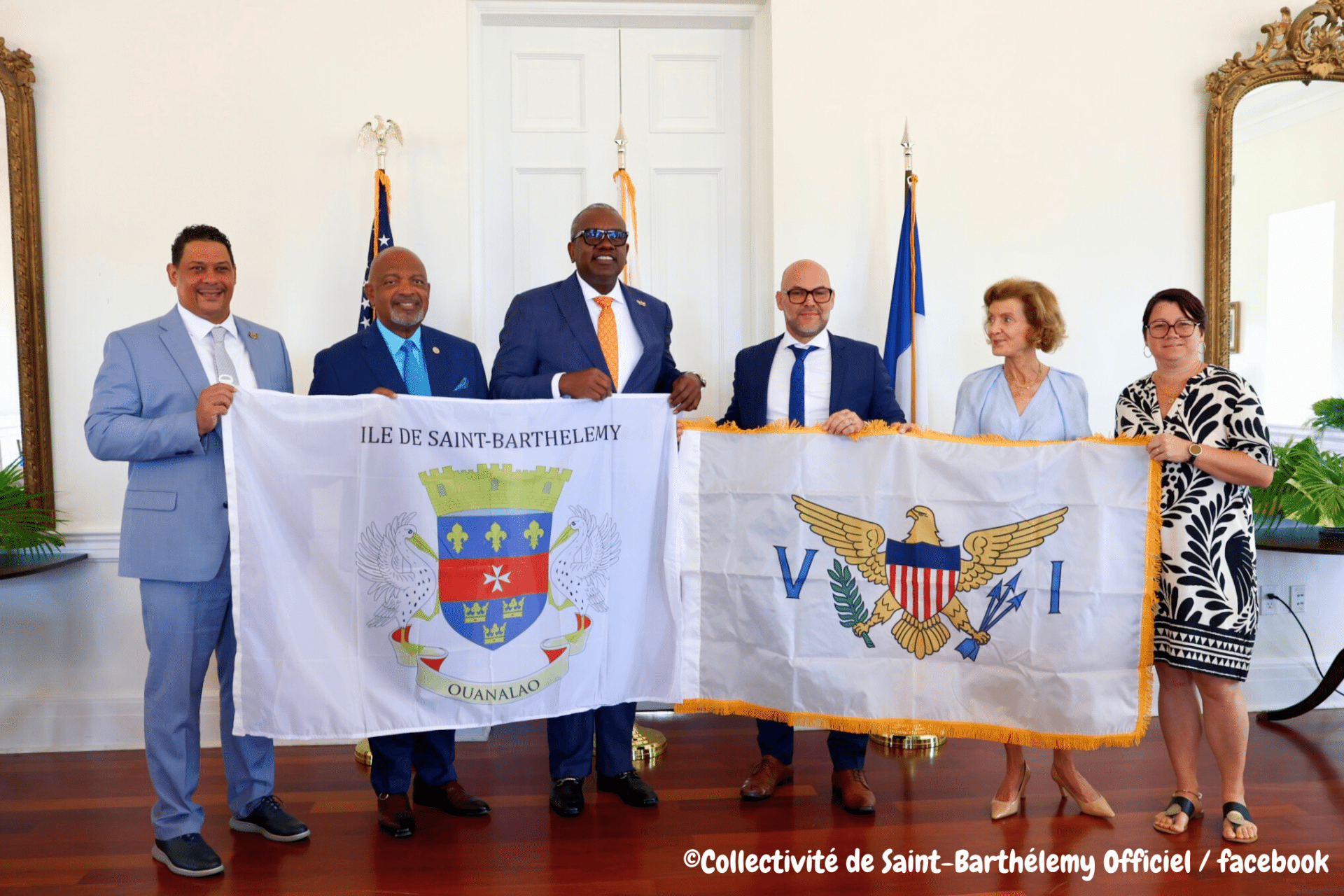
The twinning of Saint-Barth and Saint-Thomas marks a new stage in relations between two neighboring territories whose human, cultural and historical ties have long transcended administrative boundaries. Tuesday, March 10, 2026, Xavier Lédée, President of the Territorial Council of Saint-Barthélemy, and Albert Bryan Jr, Governor of the U.S. Virgin Islands, officially signed the twinning agreement between the two islands. The signing provides a concrete framework for a long-standing regional relationship, and lays the foundations for cooperation that is set to expand in a number of areas, including culture, education, sport and institutional exchanges.
In the Caribbean, where neighboring territories often share common histories, families and economic flows, this type of agreement takes on a special dimension. The twinning arrangement between Saint-Barth and Saint-Thomas illustrates this regional reality: that of close islands that are now choosing to structure their relations more closely in order to build joint projects and strengthen their dialogue.
An official signature supported by committed players
The signing of the twinning agreement between Saint-Barth and Saint-Thomas took place in the presence of a delegation representing the institutional and associative life of Saint-Barthélemy. Around the President Xavier Lédée, several personalities involved in the cultural and associative life of the region were present: Bettina Cointre, president of the culture commission, Cécile Coudreau, president of AJOE, Vianney Blanchard, president of the “Jumelage Saint-Barth et Saint-Thomas” association, and Jean-Yann Bouchau, thead of the culture and communications department.
This composition underlines the ambition of the project. The twinning between Saint-Barth and Saint-Thomas is not limited to a relationship between institutions. It also relies on cultural, associative and educational players who will play an essential role in transforming this agreement into concrete initiatives. The first working meetings should rapidly identify projects capable of giving real visibility to this rapprochement between the two territories.
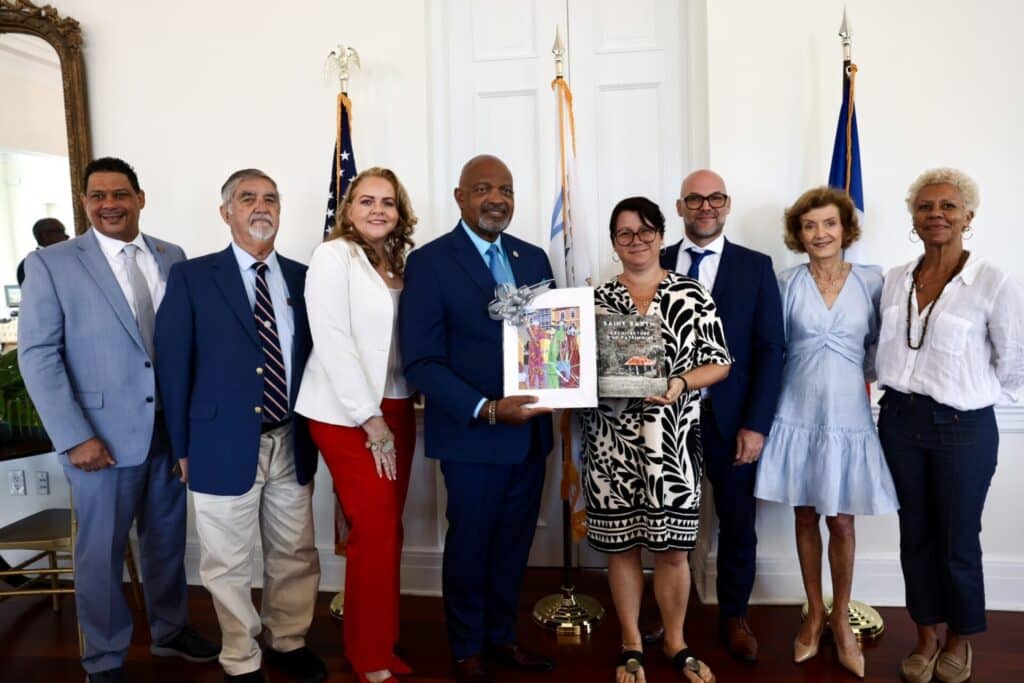
Two neighbouring islands linked by a regional history
The proximity between Saint-Barth and Saint-Thomas is not new. Located just a few dozen kilometers from each other, the two islands have maintained regular human, economic and cultural exchanges over the decades. In the Caribbean, movement between neighboring islands has always shaped daily life. Families, migrations, commercial activities and cultural exchanges have all contributed to the creation of a regional space where administrative borders do not always reflect the reality of human links.
The twinning of Saint-Barth and Saint-Thomas is a logical step in this direction. It formalizes a proximity that is already well established in the region, and opens up the possibility of translating it into structured, sustainable projects.
A project several months in the making
The signing of the agreement in March 2026 is the culmination of a process initiated by the local authorities. As early as 2025, the idea of a twinning arrangement between Saint-Barth and Saint-Thomas had been mooted as a way of strengthening relations between the two territories and developing joint initiatives. Discussions held at the time had already identified several possible areas of cooperation: cultural events, educational exchanges, sporting events and institutional collaboration. The official signature now gives a formal framework to this desire for closer ties, and paves the way for the implementation phase.

Culture, youth and sport: the first areas of cooperation
One of the main aims of the twinning between Saint-Barth and Saint-Thomas is to encourage exchanges between the inhabitants of the two territories.
Cultural initiatives to promote Caribbean heritage
Culture is naturally one of the first areas of cooperation. Exhibitions, artistic encounters, exchanges between associations and heritage initiatives could all help to raise the profile of cultural links between the two islands. In a region marked by linguistic diversity and the legacy of several historical influences, these cultural exchanges also help to enhance local identities while strengthening regional bridges.
Educational exchanges for young people
The jumelage between Saint-Barth and Saint-Thomas also opens up prospects for the younger generation. School or language exchange programs could enable students to learn more about the cultural and social realities of their Caribbean neighbors. In a region where several languages coexist: French, English, Spanish and Creole, these initiatives also represent an opportunity for openness and learning.
Sport as a means of bringing people together
Sport is another important lever for cooperation. Sports meetings between young people, clubs or associations often provide a simple and effective framework for strengthening ties between neighboring territories. These events not only encourage exchanges between residents, but also give concrete visibility to the twinning between Saint-Barth and Saint-Thomas among the general public.
Saint-Thomas and the region's francophone memory
The rapprochement between the two territories is also part of a broader cultural context. St. Thomas has a history marked by the presence of communities from various Caribbean territories, including the neighboring French-speaking islands. This cultural dimension was recently brought to the fore when the authorities of the US Virgin Islands proclaimed a French Heritage Week recognizing the lasting influence of French-speaking communities in the region, particularly those linked to Saint-Barth, Guadeloupe and Saint-Martin.
In this context, the jumelage between Saint-Barth and Saint-Thomas takes on a special resonance. It helps to shed light on a shared history and to strengthen exchanges between territories whose cultural relations go back several generations.
A rapprochement revealing Caribbean dynamics
The twinning between Saint-Barth and Saint-Thomas reflects a wider dynamic in the Caribbean. The region’s territories are increasingly seeking to strengthen their direct cooperation in order to meet common cultural, economic and educational challenges. These partnerships between neighboring islands are helping to build a more connected regional space, where local initiatives can foster exchanges and encourage greater mutual understanding.
From this perspective, the rapprochement between Saint-Barth and Saint-Thomas is a concrete example of how Caribbean territories can transform their historical ties into future projects.

Cooperation set to take shape
The signing of the twinning agreement between Saint-Barth and Saint-Thomas marks the start of a new phase: that of implementing the projects that will bring this agreement to life. Future initiatives will enable us to measure the extent of this cooperation and observe how the two territories choose to develop their exchanges. In a Caribbean where relations between neighboring islands play an essential role in the circulation of cultures, ideas and initiatives, this twinning could become an example of regional cooperation built on already solid human and historical links.
The twinning between Saint-Barth and Saint-Thomas is an official agreement signed on March 10, 2026 between the Collectivité de Saint-Barthélemy and the government of the US Virgin Islands. It aims to strengthen exchanges between the two territories in a number of areas, including culture, education, sport and institutional relations.
This partnership formalizes a long-standing relationship between two neighboring Caribbean islands, enabling the development of joint projects. It also helps strengthen cultural and human links between the region’s French- and English-speaking territories.
The first avenues to be explored include cultural events, school exchanges, sporting events and institutional collaboration, designed to foster relations between residents, associations and institutions in both areas.