As the last weekend of July approaches, Loíza is getting ready to send its masked characters back out onto the streets. Among them, the vejigantes march forward wearing wooden horns and faces carved from coconut shells. Behind their spectacular appearance lies a complex history: that of a Spanish figure that has become, in Puerto Rico, a powerful symbol of Afro-Boricua creativity.
A mask shaped by the region
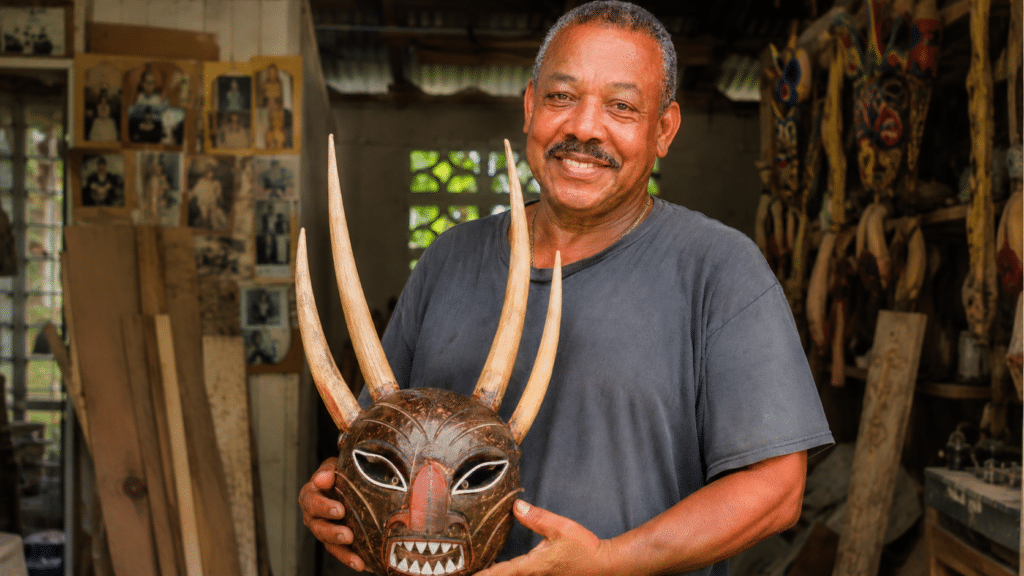
A rounded shell, two eye slits, a toothed mouth, and long horns arranged like a crown. The vejigantes of Loíza are instantly recognizable. The material they’re made of sets them apart from those of Ponce, where the caretas are generally made of papier-mâché. .
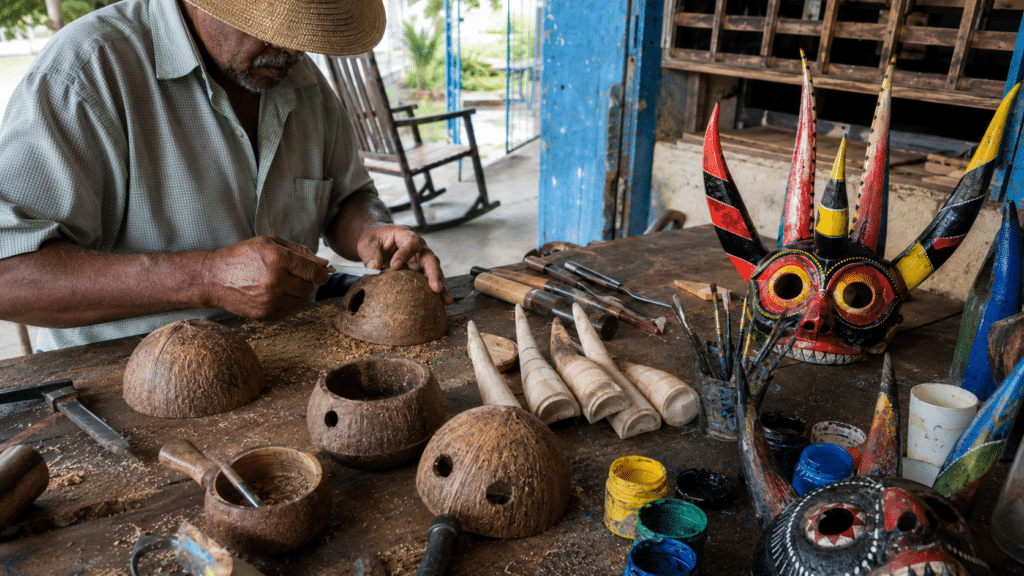
This difference is not merely an aesthetic detail. The coconut ties the mask to the coastal landscape, to the available resources, and to the artisanal craft. The Smithsonian holds several pieces made in Loíza, including a coconut careta attributed to Castor Ayala. The object has become part of a national collection, but it remains the result of knowledge passed down from hand to hand.
A figure from Spain, transformed in Puerto Rico
The vejigante originates from medieval Spanish folklore. Its name is derived from *vejiga*, meaning “bladder,” and *gigante*, meaning “giant.” During celebrations, the character used to carry an inflated animal bladder and hit passersby with it.
Although introduced during the colonial period, this figure has not remained unchanged. In Puerto Rico, the masks, costumes, music, and public performances have incorporated African and Taíno influences. The vejigantes of Loíza bear witness to this transformation. They do not replicate a European model; rather, they express how a community has made a character its own and then given it a local form.
St. James the Apostle: Between Faith and the Streets
The vejigantes of Loíza make their appearance, in particular, during the Fiestas de Santiago Apóstol, celebrated in July. Processions, parades, costumes, food, and music bring the community together around its patron saint. In the streets, the vejigantes rub shoulders with the Spanish caballeros, the viejos, and the locas. This cast brings to life different memories and multiple layers of meaning, particularly the contrast between good and evil. Yet the festival goes far beyond a religious representation. It becomes a space where Loíza asserts its own way of telling its story.

"La bomba" Makes Bodies Speak
La bomba lends celebrations a musical, historical, and collective depth. Originating in the African communities enslaved in Puerto Rico, this music is based on a dialogue between percussion and movement. The lead drummer follows the dancer’s movements, and the dancer responds with his or her body. During the festival, this relationship transforms the street into a space for cultural transmission. Children watch, musicians respond, dancers improvise, and masked figures move among the audience. The vejigantes of Loíza thus only take on their full meaning through this music, these bodies, and this collective participation.

An Afro-Boricuan history without a simplified narrative
To say that the vejigantes are exclusively African would be historically inaccurate. Their origins lie in Spanish folklore. To say, however, that they are solely Spanish would overlook what Loíza has made of them. The Afro-Boricuan heritage embodied by these masks lies in appropriation, transformation, and continuity. It is evident in the materials chosen, in the bomba, in the learned gestures, in the Black presence at the heart of the festival, and in the pride asserted today. Resistance is understood here as the ability to keep a culture visible, transmissible, and alive, rather than as the definitive origin of the character.

When a Mask Becomes a Living Legacy
In 2026, the installation “Hebras y Vejigantes”, which focuses on the masks of Loíza, won the Smithsonian Outwin Audience Choice Award. This recognition raises a question: What becomes of a mask when it leaves the street?
In Loíza, the answer may lie in the movement itself. As long as the caretas are carved, worn, accompanied by drums, and explained to new generations, they will not be mere decorative objects. They will continue to connect various legacies without blurring their distinctions. And every July, their return will serve as a reminder that a community can embrace a tradition, transform it, and make it fully its own.
The vejigantes of Loíza are masked figures who appear during the Fiestas de Santiago Apóstol in Puerto Rico. They wear colorful costumes and horned masks, called masks, usually carved from coconut shells. Their appearance stems from the local adaptation of a figure from Spanish folklore, enriched by the history, craftsmanship, and Afro-Boricua cultural practices of Loíza.
In Loíza, coconut shells have become the signature material for vejigantes masks. Artisans prepare, carve, and paint them, and add wooden horns. This technique distinguishes the vejigantes of Loíza from those of Ponce, where masks are more often made of papier-mâché. The coconut shell thus connects the mask to the local area and to a craft passed down through generations.
The Vejigante has origins rooted in Spanish traditions, but Loíza has given it its own unique cultural expression. The coconut masks, the presence of the bomba, the artisanal traditions, and community participation have gradually linked the character to Afro-Puerto Rican heritage. Today, it represents a living legacy, shaped by various influences and brought to life in the streets during the celebrations of Santiago Apóstol.