Vieques, the island of phosphorescent waters and free-roaming horses

Just a few miles east of Puerto Rico, Vieques juts out like a tongue of land bordered by clear coves, lagoons and ocean-side roads. Here, time slips by smoothly: a conversation on an Esperanza stoop, a horse striding through the village, light lingering on the seaside almond trees. The island doesn’t impose anything, it proposes a rhythm. And it’s a rhythm that the islanders hold dear.

A simple geography, a landscape that breathes

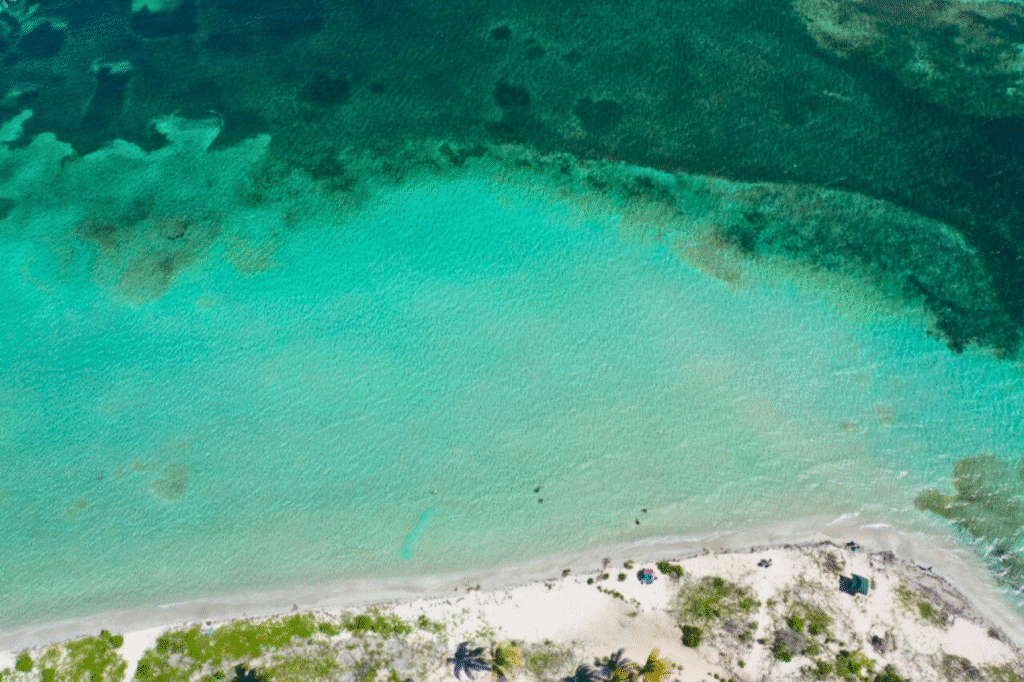
Vieques is easy to read: two small towns – Isabel II to the north, Esperanza to the south – and, between them, an alternation of coves, scrub-covered hills, lagoons and former military roads turned sea trails. The south coast offers a succession of beaches with a distinct character: Sun Bay and its generous arch, Media Luna with its calm waters, Navío hemmed in by rocks, La Chiva and Caracas where the horizon opens up effortlessly. Nothing ostentatious: a line of sand, crystal-clear water and the steady breeze of the trade winds.

Vieques

Mosquito Bay, the night that lights up

When the moon fades and the wind dies down, Mosquito Bay whispers another Vieques truth. In this protected lagoon, micro-organisms light up at the slightest movement. A stroke of the paddle, an arm brushing the water, and thousands of bluish sparks respond. The spectacle needs no superlatives: it’s striking because it surprises, because it demands slowness and attention. Local guides insist on a few simple rules – limit the use of creams, avoid sudden gestures, respect silence – not out of rigidity, but because beauty lies in this tacit agreement between place and visitor.

Vieques

Creole horses, village neighbors

In Vieques, you quickly get used to sharing the road. Creole horses move about in their own way: a band trotting along the beach in the morning, a foal sheltering under an almond tree, a group crossing Esperanza’s main street as the fishermen return. Their presence is not the stuff of postcards; it simply expresses the continuity of rural life, the ancient use of pastures, the proud autonomy of a small island. Glances are exchanged, the pace slows and the daily routine continues.

Vieques

Recent memory, reinvented territory

Vieques wasn’t always as sea-oriented as it is today. For decades, part of the coastline was used for military training. The inhabitants defended access to the beaches, the quality of the water and the possibility of a future that would not be built against nature. From this period remain paths that have been reclaimed by vegetation, batteries won over by salt, and above all a conviction: the value of Vieques is measured by its ability to remain itself. This memory nurtures a public-spiritedness: here, we discuss, we organize, we prefer clarity to haste.

Esperanza: the seaside at human level

The Malecon d’Esperanza rolls out its low-slung houses, its cafés open to the trade winds, its terraces where people linger. The hours take on a different color: in the morning, passers-by greet departing crews; at midday, the shade attracts conversation; in the evening, the bay captures a sky that changes hue at a glance. A few steps are all it takes to go from the murmur of the waves to the voices that answer each other under the verandas. Hospitality often comes in the form of an address, a tip on the state of the sea, or a dish of the day that varies according to the catch.

Vieques
Vieques

Island itineraries: walking, paddling, watching

At La Chiva, the transparency of the water can be read from the shore; at Media Luna, the curve of the bay protects against currents; at Navío, the swell sculpts a more pronounced breath. The paths leading to the beaches pass through woods of mancenilla, grape and cactus: a dry, straightforward landscape punctuated by chiaroscuro. On the lagoons, a kayak glides between the mangroves; on the seagrass beds, turtles graze peacefully. The guides insist on simple gestures: don’t walk on the weed beds, keep your distance from the fauna, leave with your garbage. In short, elegance.

Vieques
Vieques
Vieques

A way of being in the world

What we take away from Vieques is not an inventory of places ticked off a list; it’s a feeling of rightness. A windless evening in Mosquito Bay, an early-morning walk on Sun Bay, a greeting exchanged with a horseman, a meal eaten facing the water – these are all moments when the island seems to be saying “take your time”. We leave with the impression of having relearned a simple gesture – looking – and of having found a place at human level, between sea, light and village voices.

Vieques doesn’t look for effects. She prefers links. And perhaps that’s why it stays in the memory for so long.

Leave a Reply

Your email address will not be published. Required fields are marked *

More articles from RK

St Maarten Carnival 2026
EVENT MANAGEMENT
Tolotra

St Maarten Carnival 2026: 55 years on an island split in two

In Philipsburg, carnival is about much more than costumes and concerts. It shows an island divided between two histories, two administrations and the same popular energy. For its 55th anniversary, St Maarten Carnival 2026 gives Sint Maarten the opportunity to show what the Caribbean does best: transforming a local festival into a marker of identity. A carnival that’s more than just a party St Maarten Carnival 2026 began on April 10 and continues until May 5, with Philipsburg as the focal point. In the streets, locals aren’t just watching a parade go by. They recognize families, neighborhoods, groups, sounds, food stands, faces that have returned for the occasion. Carnival is not just a decoration. It’s part of the way Sint Maarten tells its story. This year’s event carries a special weight. St. Maarten Carnival 2026 marks the 55th edition of the biggest cultural event on the Dutch part of the

Read More »
Viengsay Valdés
DANCE
Tolotra

Cuba – Viengsay Valdés: Alicia Alonso’s heiress

When Alicia Alonso passed away in October 2019, the Ballet National de Cuba, which Alicia Alonso had founded in 1948 and directed for seven decades, was orphaned. Only one person has been entrusted with the responsibility of following in her footsteps: Viengsay Valdés. Now 49, she leads one of the world’s most respected ballet companies. She does so from Havana, a city in crisis, with resources that no comparable institution in Europe or the United States would accept. The challenge is from another time. But Viengsay Valdés holds her ground. Demanding Cuban training Born in Havana in 1976, she began dancing at the age of 9 at the Alejo Carpentier elementary ballet school, before continuing her training at the Cuban National Ballet School, one of the most prestigious in the world, free and open to all Cuban children by audition. It was here that she encountered the world of Alicia

Read More »
Eric Williams
MUSIC
Tolotra

Shenseea and Daddy Yankee bring the Caribbean to FIFA World Cup 2026

Shenseea and Daddy Yankee at FIFA 2026: the announcement goes beyond a simple musical release. With “Echo”, Jamaica and Puerto Rico enter the sound universe of the next World Cup together. Behind this track, a part of the urban Caribbean finds a new place in one of the planet’s most popular events. One FIFA title, two Caribbean voices On April 28, 2026, FIFA announced the release of “Echo”, the third single from the official FIFA World Cup 2026 album. The track brings together Shenseea, a Jamaican artist associated with contemporary dancehall, and Daddy Yankee, a major Puerto Rican reggaeton figure. FIFA points out that the track is one of a series of musical releases designed to accompany the build-up to the tournament. This announcement goes beyond the framework of a collaboration between two well-known artists. It brings two Caribbean territories, Jamaica and Puerto Rico, face to face, united in a

Read More »

conTACT RK

we'd love to have your feedback on your experience so far

Join The List

Join our Richès Karayib community!  Sign up for our newsletter.

Want To Maximize Your Business Presence On Riches Karayib?

Complete the form to start the application