
Belize – Great Blue Hole: 318 metres of mystery in the sea

Great Blue Hole

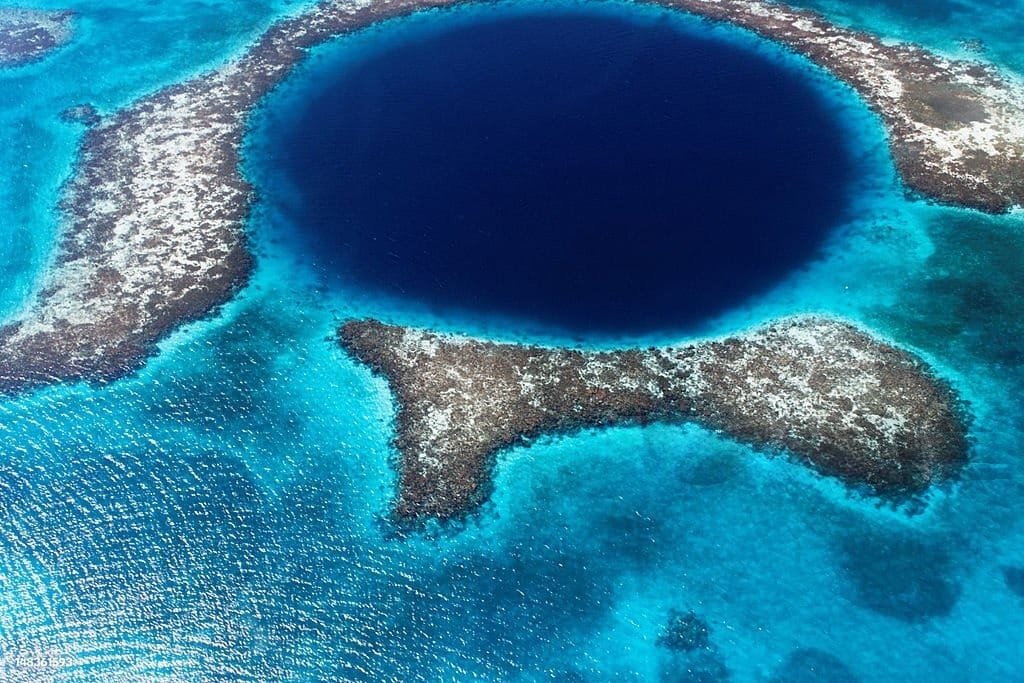
Great Blue Hole: seen from the air, it’s a dark circle in the middle of a turquoise lagoon. An almost perfect shape, set in the sea like an enigma. Off the coast of Belize, near Lighthouse Reef, this marine abyss, some 318 metres in diameter and 124 metres deep, has transformed a geological phenomenon into a global image.

A blue circle in the heart of the reef

From a small plane, the contrast is immediately striking. All around, the clear water hints at the shallows, reefs and nuances of the lagoon. In the center, the blue becomes denser, almost black. The Great Blue Hole is no mere natural curiosity. It’s an ancient limestone cavity, formed at a time when sea levels were much lower, then covered by the waters.

This uniqueness explains its visual power. Few places tell such a clear story of the link between geology, climate, sea and tourism. Here, the landscape is not just beautiful. It tells an ancient story that can be read on the surface.

Great Blue Hole
Great Blue Hole

A site off the coast of Belize

The Great Blue Hole is located near the center of Lighthouse Reef, a remote atoll off the mainland coast of Belize. NASA locates it some 80 kilometers off the Belizean coast, in an area where clear water allows the dark circle to stand out clearly against the reef’s shallow waters.

This site is part of the Belize Barrier Reef Reserve System, designated a UNESCO World Heritage Site in 1996. This vast protected area comprises seven zones, including the Blue Hole Natural Monument. It is one of Belize’s great natural symbols and one of the most recognizable landmarks in the English-speaking Caribbean.

Great Blue Hole
Great Blue Hole

More than just a postcard

The figures are striking: around 318 metres wide, 124 metres deep. But there’s more to it than that. The Great Blue Hole is a reminder that the Caribbean is not just about beaches and hotels. It also has its own natural archives. Beneath the surface, limestone walls, ancient formations and geological layers tell the story of sea-level variations and climate transformations.

This is what makes the site so special. It attracts travelers for its spectacular appearance, but it also interests scientists, environmentalists and institutions charged with protecting the reefs. In a country where the sea is at once a resource, a heritage and an economic engine, this blue circle concentrates many issues.

Belize

A showcase for tourism, but also a responsibility

The Great Blue Hole has become one of Belize‘s strongest images. It features in travel reports, tourism campaigns, aerial photographs and rankings of great marine sites. But this notoriety demands vigilance. The site doesn’t exist on its own. It depends on the health of the Belize Barrier Reef, conservation policies, water quality and the country’s ability to manage tourism development.

Belize has already experienced the tensions typical of coastal territories: pressure on reefs, development, tourist numbers, climate change. In fact, the Belizean reef was removed from the List of World Heritage in Danger in 2018, after conservation measures praised by UNESCO. This reminder is essential: a site admired worldwide can also be fragile.

Great Blue Hole

What Belize is showing the Caribbean

The Great Blue Hole gives the country an immediate signature. It’s instantly recognizable. Yet its strength lies not only in its beauty. It comes from the fact that it forces us to look at the Caribbean Sea differently. Not as a backdrop, but as a living, ancient, vulnerable and strategic territory.

At a time when many Caribbean islands are seeking a better balance between tourism, natural heritage and ecosystem protection, Belize has a powerful example here. The Great Blue attracts the world’s attention. Now the real question is simple: how can we sustainably protect what everyone wants to see?

The Great Blue Hole Belize is located off the coast of Belize, near Lighthouse Reef, in the Caribbean Sea. It is part of the Belize Barrier Reef Reserve System, a UNESCO World Heritage Site.

The Great Blue Hole Belize is famous for its spectacular circular shape, visible from the sky, as well as for its impressive dimensions: around 318 meters in diameter and 124 meters deep. It has become one of Belize’s best-known natural symbols.

Yes, the Great Blue Hole Belize can be visited on organized excursions, notably by boat or aerial flight. The site attracts enthusiasts of diving, marine landscapes and natural heritage, but its frequentation must remain supervised in order to preserve this fragile ecosystem.

Leave a Reply

Your email address will not be published. Required fields are marked *

More articles from RK

Great Blue Hole
COOPERATION
Tolotra

Belize – Great Blue Hole: 318 metres of mystery in the sea

Great Blue Hole: seen from the air, it’s a dark circle in the middle of a turquoise lagoon. An almost perfect shape, set in the sea like an enigma. Off the coast of Belize, near Lighthouse Reef, this marine abyss, some 318 metres in diameter and 124 metres deep, has transformed a geological phenomenon into a global image. A blue circle in the heart of the reef From a small plane, the contrast is immediately striking. All around, the clear water hints at the shallows, reefs and nuances of the lagoon. In the center, the blue becomes denser, almost black. The Great Blue Hole is no mere natural curiosity. It’s an ancient limestone cavity, formed at a time when sea levels were much lower, then covered by the waters. This uniqueness explains its visual power. Few places tell such a clear story of the link between geology, climate, sea and

Read More »
St Maarten Carnival 2026
EVENT MANAGEMENT
Tolotra

St Maarten Carnival 2026: 55 years on an island split in two

In Philipsburg, carnival is about much more than costumes and concerts. It shows an island divided between two histories, two administrations and the same popular energy. For its 55th anniversary, St Maarten Carnival 2026 gives Sint Maarten the opportunity to show what the Caribbean does best: transforming a local festival into a marker of identity. A carnival that’s more than just a party St Maarten Carnival 2026 began on April 10 and continues until May 5, with Philipsburg as the focal point. In the streets, locals aren’t just watching a parade go by. They recognize families, neighborhoods, groups, sounds, food stands, faces that have returned for the occasion. Carnival is not just a decoration. It’s part of the way Sint Maarten tells its story. This year’s event carries a special weight. St. Maarten Carnival 2026 marks the 55th edition of the biggest cultural event on the Dutch part of the

Read More »
Viengsay Valdés
DANCE
Tolotra

Cuba – Viengsay Valdés: Alicia Alonso’s heiress

When Alicia Alonso passed away in October 2019, the Ballet National de Cuba, which Alicia Alonso had founded in 1948 and directed for seven decades, was orphaned. Only one person has been entrusted with the responsibility of following in her footsteps: Viengsay Valdés. Now 49, she leads one of the world’s most respected ballet companies. She does so from Havana, a city in crisis, with resources that no comparable institution in Europe or the United States would accept. The challenge is from another time. But Viengsay Valdés holds her ground. Demanding Cuban training Born in Havana in 1976, she began dancing at the age of 9 at the Alejo Carpentier elementary ballet school, before continuing her training at the Cuban National Ballet School, one of the most prestigious in the world, free and open to all Cuban children by audition. It was here that she encountered the world of Alicia

Read More »

conTACT RK

we'd love to have your feedback on your experience so far

Join The List

Join our Richès Karayib community!  Sign up for our newsletter.

Want To Maximize Your Business Presence On Riches Karayib?

Complete the form to start the application