Climate resilience: an island challenge
The climate resilience of the Caribbean is a concept that goes far beyond simple environmental discussions. For this region of the world, often perceived as a tourist paradise, the reality is far more complex. Despite making a marginal contribution to global greenhouse gas emissions, Caribbean countries are facing devastating climate impacts.
While the Caribbean accounts for only a tiny fraction of global CO₂ emissions, it is on the front line when it comes to the consequences of global warming. These geographical and economic realities make the fight for sustainability in this region both urgent and decisive.
Less than 1% of global emissions, but a disproportionate impact
Less than 1% – that’s the share of global CO₂ emissions attributable to the entire Caribbean, according to estimates by the IMF (0.3%), the OECD (0.23%) and BNP Paribas (economic-research.bnpparibas.com). Other sources, such as CEPAL, indicate that Latin America and the Caribbean as a whole accounts for less than 10%, and according to Richmond Vale Academy, the Caribbean produces even less than 0.1% of the world total. An island paradox: the region is not a major polluter, yet it bears the full brunt of climate change.
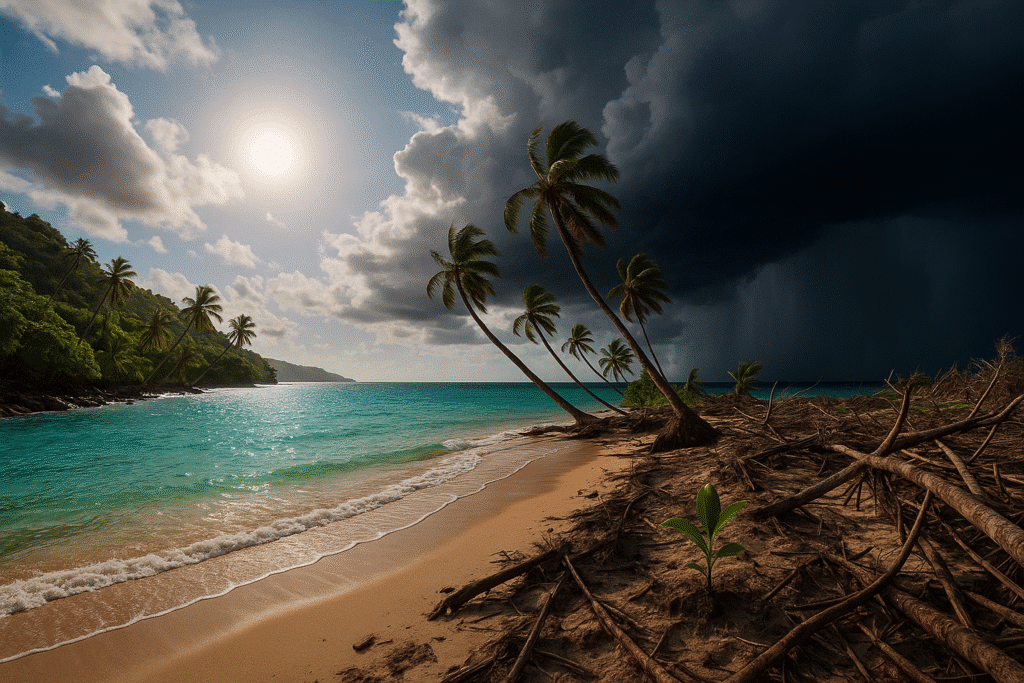
The Caribbean islands are particularly vulnerable to extreme climatic phenomena: increasingly powerful hurricanes, heat waves, prolonged droughts and rising sea levels affecting many islands. These environmental shocks test the limits of climate resilience of island nations.
According to the United Nations Development Programme (UNDP), small developing islands such as those in the Caribbean risk losing up to 10% of their annual GDP due to climate-related natural disasters.
An economic crisis exacerbated by climate change
6 times – the economic impact of climate change on Caribbean economies is estimated to be up to six times greater than the global average (BNP Paribas, IMF, World Bank). Every dollar lost or spent due to climate change weighs six times more than elsewhere – a colossal burden for countries that are often indebted and dependent on agriculture or tourism. It’s an ongoing test of their climate resilience.
A striking example: Hurricane Maria in 2017 caused damage equivalent to 226% of GDP of Dominica, according to the World Bank, PDNA and the ACP-EU NDRR Program (esg.wharton.upenn.edu). In just a few hours, more than two years’ worth of national wealth was wiped out. This shocking figure illustrates the extent to which a single cyclone can topple the economy of a small island state, wiping out years of efforts to strengthen the economy. climate resilience.
Energy transition: efforts, but challenges to overcome
In the face of environmental and economic threats climate resilience also requires an ambitious energy transition. Belize leads the way: 48 % of its electricity already comes from renewable sources, according to the Atlantic Council. This is a regional record. However, the majority of Caribbean countries are struggling to keep pace.
The Alliance of Caribbean States has set a collective target of 48% of electricity generated from renewable energies by 2027. Although endowed with strong solar and wind energy potential, the region is making slow and uneven progress. Accelerating this transition is essential to strengthen the region’s competitiveness. climate resilience in the face of energy dependency and volatile fossil fuel markets.

A decisive step against single-use plastics
When it comes to waste management, more than 14 countries of the Caribbean (more than a third of the region) have banned single-use plastic bags and polystyrene containers since 2019, according to a study published on ResearchGate. Among them: Saint Kitts and Nevis, Barbados and Antigua and Barbuda.
These regulatory actions, which are crucial for the marine ecosystems on which tourism, fishing and coastal protection depend, also help to strengthen climate resilience. climate resilience. However, the region is still faced with growing volumes of plastic waste, much of which comes from outside the region.
The role of young people and local initiatives
The climate resilience in the Caribbean is also rooted in civic action. Younger generations are leading local initiatives for responsible consumption, biodiversity preservation and reforestation. In several islands, ecological start-ups are emerging to support the green transition.
These community movements show that climate resilience depends not only on governments and international donors, but also on local creativity and determination.

Faced with colossal challenges climate resilience of the Caribbean is reflected in a willingness to act, even when resources seem limited. While the region bears only a small share of responsibility for global CO₂ emissions, it bears disproportionate economic and human costs.
Local initiatives, energy transition efforts and the fight against pollution are all encouraging signs. However, the road to a climate resilience is still a long way off. It is crucial that the international community supports the Caribbean’s efforts, recognizing the uniqueness of the challenges it faces.