[JEP 2025] – Martinique: Modernist architectural stroll through the streets of Fort-de-France by Abité

Journées Européennes du Patrimoine

A guided tour to rediscover Fort-de-France

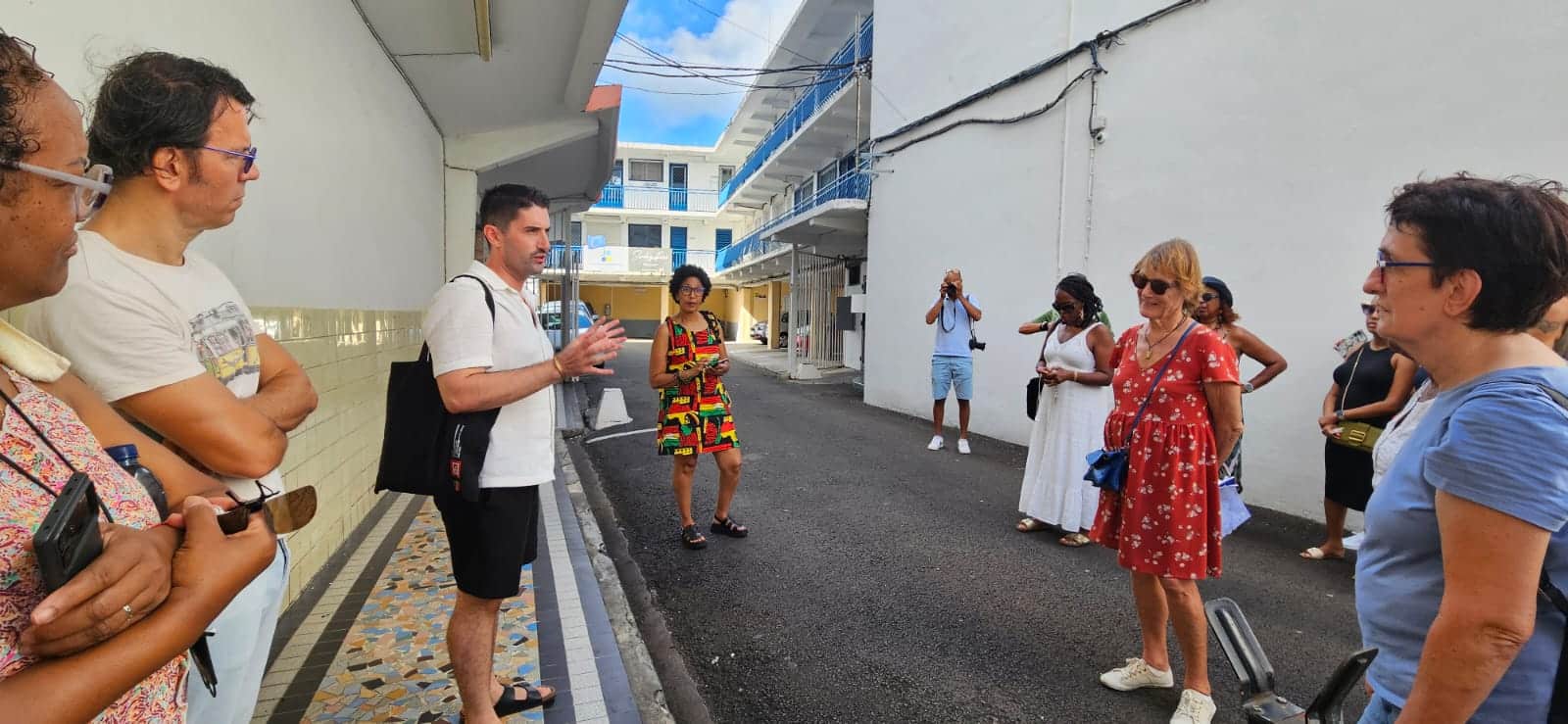
On Saturday, September 20, 2025, as part of the European Heritage Days the association Abitē guided the public into the heart of Fort-de-France for a guided tour of the city’s modernist heritage. For over two hours, participants wandered the streets of Martinique’s capital, discovering buildings emblematic of the modern movement, between architectural innovations, historical accounts and questions about the future of this heritage.

European Heritage Days

Louis Caillat's Antilles building

The European Heritage Days itinerary begins in front of the Antilles building at 42-44 rue Garnier-Pagès. Built in 1955 by architect Louis Caillat for the “Monplaisir group”. This seven-storey complex is one of Martinique’s first modern residential buildings.

Conceived in the tradition of Le Corbusier’s experiments “Le Corbusier” it combines shops, offices and housing. Its two elevators, rare at the time, airy walkways, entrance “verandas” and sunshades bear witness to the adaptation of modernist principles to the tropical climate. Oriented to catch the trade winds, the building offers natural ventilation of the apartments and framed views of the harbor and cathedral. A highlight of these European Heritage Days in the heart of Fort-de-France.

Journées Européennes du Patrimoine

From the BDAF to the Merlande building: early modern daring

As you move through the city, your visit stops in front of the former headquarters of the “Banque de Développement des Antilles Françaises (BDAF)”.. Built in 1931 (Banque de la Martinique, future BDAF), it is often cited as an early example of modernism in Fort-de-France, even though its facades have undergone several alterations.

Journées Européennes du Patrimoine

Further on, the  Merlande building marks a commercial turning point. Built to house the department store “Au Printemps” department store, then renamed “Galeries Lafayette”, it embodies the emergence of an urban modernity focused on consumerism. Its roof terrace, conceived as a usable space, illustrates the innovation of modernism: transforming the roof into a “fifth façade”. It was in this spirit that the European Heritage Days reminded us of the importance of preserving the city’s commercial memory.

Journées Européennes du Patrimoine

Plein Ciel and ventilated facades

 Plein Ciel building on rue Victor-Schœlcher features a different typology: shops on the first floor, integrated parking, offices and housing on the upper floors. Its sunshade protect the west facade, while the side overlooking the Savane is more enclosed. Damaged by the 2007 earthquake, the building was reinforced with a metal structure, modifying its initial appearance.

Journées Européennes du Patrimoine

Nearby, another building catches the eye. Known as the Mansour Chaussures building, its façade is punctuated by concrete reliefs that also serve as natural ventilation. The initials “LC” stand for the developer who financed the building, not for an architect. Claustras and original wooden joinery recall the concern to adapt modernism to local resources, a message that the European Heritage Days have chosen to highlight.

Journées Européennes du Patrimoine

A rare example of Brutalist architecture

Rue Victor-Schœlcher, the tour pauses in front of the “Maison des Combattants”. Erected between 1970 and 1980, this building illustrates the  Brutalist trend with its raw concrete and massive forms. Little represented in Martinique, this style remains a precious testimony to an international architectural era. Its spotlight during the European Heritage Days underlines just how much this discreet heritage deserves to be recognized.

Journées Européennes du Patrimoine

The Church of Christ the King in Bethlehem: faith and modernity

The Church of Christ the King in Bethlehem built in the 1960s by architect Maurice de Lavigne Sainte-Suzanne is a major milestone. Inspired by the work of Oscar Niemeyer and marked by the reforms of the Second Vatican Council, it translates the spirit of liturgical openness into tropical architecture: sunshades and colorful light effects.

Journées Européennes du Patrimoine

Although recent alterations (minieries and closures added in the 1990s) have altered its original purity, the church remains a jewel of Martinican religious modernism. Its presentation on the occasion of the European Heritage Days aroused great emotion among visitors.

Right next door, the “Mutualité” also catches the eye. This building, marked by the influences of art deco and modernism, is an example of a social building emblematic of the 1950s, designed to embody solidarity and progress.

Journées Européennes du Patrimoine

La Rotonde and Hôtel Impératrice: two symbols face to face

Along the Rue de la Liberté, the tour stops in front of “La Rotonde”. Designed by Louis Caillat in 1942, this office building has been completely refurbished to become the headquarters of Crédit Agricole. Under the direction of architect Bernard Leclercq the structure was rebuilt identically and raised. This project is presented as a model: preserving the foundations and adapting rather than demolishing.

Journées Européennes du Patrimoine

A little further on, the “Hôtel Impératrice” built in the 1940s-1950s by the Glaudon family family, exemplifies seaside modernism. Its large terraces overlooking the sea, balconies and natural ventilation recall the golden age of Caribbean touristification. As part of the European Heritage Days, this monument was seen as a symbol of Fort-de-France’s openness to the world.

The sea department and the hotel of the Collectivité Territorial de Martinique in Fort-de-France

The guide emphasized the place of concrete in Caribbean urban planning: a material that has enabled a veritable constructive revolution, but also a major source of CO₂ emissions. This stop served as a reminder of the need, today, to diversify materials, to integrate wood and metal to a greater extent, and to design a city that is more sustainable and respectful of its environment.

Journées Européennes du Patrimoine

The old Post Office: a giant in waiting

Journées Européennes du Patrimoine

Not far away, the old post office since the 2007 earthquake, stands out for its sheer mass. With almost 3,000 m² of floor space, the building is the subject of heated debate. For the association Abitē, the solution is clear: rather than destroying the building and generating tons of waste, it should be rehabilitated in an earthquake-resistant, less costly and more environmentally-friendly way. A message that resonates perfectly with the spirit of the European Heritage Days, which invite us to rethink the future of our heritage.

The tour also included the “Maison des Syndicats”, designed by architect Marcel Salasc and built in 1948. Still in use for its original function, it embodies the continuity of a modernist building that remains vibrant in the heart of the city.

Journées Européennes du Patrimoine

L'Imprimerie Officielle: a bitter farewell

The tour ends in front of the “Imprimerie Officielle” built in 1936 by engineer Donat Honoré. Designed to print government documents, it housed workshops, offices, storage galleries and the director’s house.

Labelled Outstanding Contemporary Architecture, the building is scheduled for demolition in the days following the visit. A traffic circle project is due to take its place. For the Abitē association, the loss is immense: this site could have become a writers’ house, a city museum or a civic space. The final group photo, taken in front of its facade, seals a collective farewell to a major witness to modern heritage, reminding us that every edition of the European Heritage Days is also a moment of vigilance.

Journées Européennes du Patrimoine

Modernist heritage and the city's future

From the Antilles building to the Imprimerie Officielle, this guided tour revealed the richness and fragility of Fort-de-France’s modernist heritage of Fort-de-France. Each stop told the story of an era, and posed a question for today: should we preserve, rehabilitate or demolish?

Through the stories of Louis Caillat, Maurice de Lavigne Sainte-Suzanne or Donat Honoré, the capital of Martinique reveals a little-known face of inventive tropical modernity. More than an architectural tour, the visit posed a question: what future can we give to the architecture that has shaped the city, and that could still nourish it tomorrow?

And that’s what the European Heritage Days are all about: walking, observing, discussing and, above all, sharing.

Leave a Reply

Your email address will not be published. Required fields are marked *

More articles from RK

French
NEWS
Tolotra

396 million people speak French: the 2026 report reveals

The Organisation internationale de la Francophonie has published a figure that reshuffles the deck in the global language debate: 396 million people now speak French. With this total, the French language in the world rises from 5th to 4th position behind English, Mandarin and Spanish, but ahead of standard Arabic. This is more than just an announcement. It marks a fundamental change in the place of French on the international stage, and confirms that the language continues to make headway in strategic areas such as education, economic exchanges, digital technology and cultural mobility. Global progress changes the narrative around French For years, French has often been portrayed as a language of great influence, but weakened in the face of global competition. The OIF’s 2026 report introduces an important corrective. The French language in the world is not only holding its own: it is gaining ground in terms of the number
Read More »
Bonaire
TOURISM
Tolotra

Bonaire, a Caribbean island built around the sea and conservation

In the southern Caribbean, off the coast of Venezuela, Bonaire is a territory in a class of its own. Less publicized than its neighbors Aruba and Curaçao, the island has built its identity around one central principle: the protection of its environment. Here, the sea structures the economy, landscapes and customs, while tourism development has been gradual and controlled. For travelers, Bonaire offers a clear picture: a compact island, visible natural areas, an accessible coastline and an organization geared towards sustainability. An island structured by its marine park Since 1979, Bonaire’s entire coastline has been protected by the Bonaire National Marine Park which completely surrounds the island. This marine area regulates nautical activities and aims to preserve the coral reefs, considered among the best preserved in the Caribbean. One of the island’s special features is the direct accessibility of its marine sites. Diving and underwater observation can be carried out
Read More »
Marcus Garvey
HISTORY & HERITAGE
Tolotra

Jamaica – Marcus Garvey, Jamaican hero of international renown

Marcus Garvey remains one of the most influential figures to emerge from the Caribbean. Born in Jamaica at the end of the 19th century, he transformed a local experience into a political and cultural project of international scope. At a time when black populations faced deeply rooted systems of exclusion, Marcus Garvey proposed a structured vision based on dignity, organization and autonomy. Recognized today as a national hero in Jamaica, he is much more than a historical symbol. His story helps us understand how the Caribbean helped shape major intellectual and political movements on a global scale. His name continues to circulate in contemporary debates on identity, memory and the development of societies born out of colonial history. From Jamaican origins to the formation of a committed conscience He was born on August 17, 1887 in St. Ann’s Bay, Jamaica, into a modest family. Very early on, he developed a
Read More »

conTACT RK

we'd love to have your feedback on your experience so far

Join The List

Join our Richès Karayib community!  Sign up for our newsletter.

Want To Maximize Your Business Presence On Riches Karayib?

Complete the form to start the application