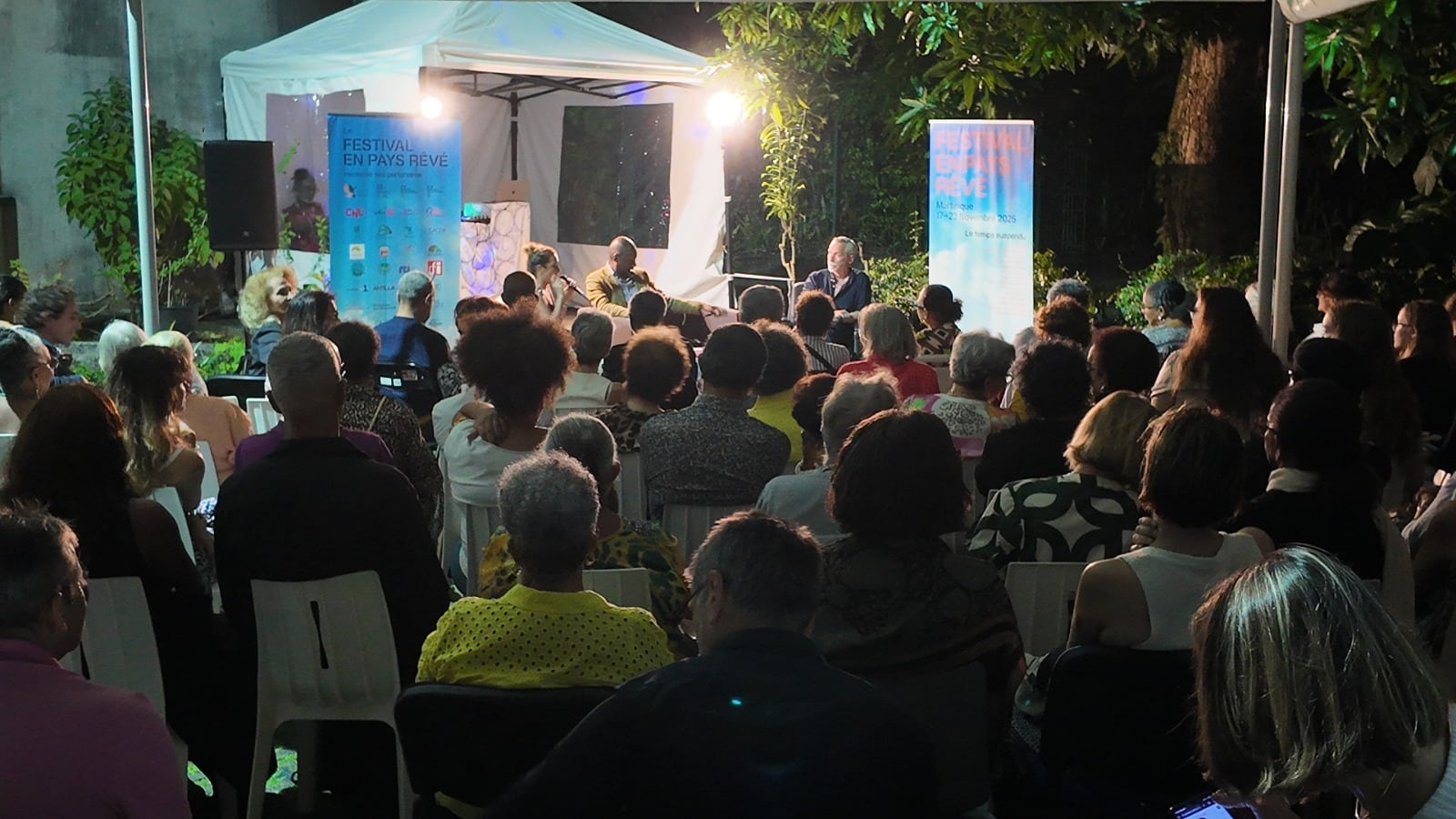
On November 21, 2025, at the Direction des Affaires culturelles de Martinique, the Festival en Pays Rêvé evening dedicated to “Le temps suspendu” offered a moment of great depth.
Driven by the vision of Viktor Lazlo, the festival’s organizer and artistic director, the event brought together Dorcy Rugamba and Olivier Norek, two voices each exploring in their own way how personal stories rub up against collective tragedies.
As part of the Festival en Pays Rêvé, the two authors met an attentive audience who had come to Martinique for a genuine literary encounter.
Dorcy Rugamba: writing so that the absent don't fade away
For Dorcy Rugamba, writing Hewa Rwanda, lettres aux absents was a long-delayed process.
For thirty years, he had been unable to put into words the intimacy of his lost family.
At this evening’s Festival en Pays Rêvé, he explains that, in stories about Rwanda, the victims became figures, while the executioners took up all the space.

For him, writing has become an act of restitution: giving back to his loved ones their voices, their gestures, their dreams, their humanity.
It’s also a way of passing on to your children a story told by a father, and not by cold tales from outside.
His father’s poetry was his anchor. A living memory, which he carries with him, and which accompanied him during this Festival en Pays Rêvé in a moment when words finally reappear with precision.

Olivier Norek: understanding the extreme through someone else's war
Olivier Norek has chosen to write about a distant war: a brutal conflict in the former Yugoslavia.
His novel Les guerriers de l’hiver (Winter Warriors) explores the journey of Simo Häyhä, a young farmer who became a major figure in a country in turmoil.
A guest at the Festival en Pays Rêvé, Olivier Norek stresses that this is not his war, nor his legacy. Yet he felt the need to understand that moment when a man can tip over into violence, or try to preserve some of his humanity.
He describes how entire communities are thrown into a conflict in which the bonds of friendship, love and neighborliness become essential forces.
In this literary encounter in Martinique, he also recounts a striking episode: that of a soldier who gives up shooting when he sees a man holding a letter to his face. A tiny gesture, but profoundly human.
That evening, at the Festival en Pays Rêvé, he reminded us that even in the midst of war, certain internal borders remain.

Surviving hate: the invisible post-war struggle
The exchanges between the two authors reveal that the post-war period is not just a period of reconstruction: it’s an intimate struggle.
Dorcy Rugamba confides that when he heard of his family’s death, his first emotion was anger, a brutal reaction that could have destroyed him.
Theater and writing have enabled her to confront this inner violence, transforming it over time.
Olivier Norek sums up this struggle in one sentence:
“When words disappear, all that’s left are the fists.”
A simple truth, which finds a particular resonance at the Festival en Pays Rêvé: as long as words exist, there’s still a chance to prevent destruction from repeating itself.


A Martinique open to the voices of the world
Thanks to Viktor Lazlo’s sensitivity, the Festival en Pays Rêvé has become a place where the experiences of Dorcy Rugamba and Olivier Norek dialogue with Martinique’s history.
In this literary encounter in Martinique on November 21, the two writers showed that words can become paths of understanding, bridges between memories, and tools to prevent the wounds of the past from closing in silence.
In this suspended time offered by the Festival en Pays Rêvé, everyone was able to measure the power of two stories from elsewhere, and leave with a renewed sense of humanity.
FAQ
The Festival en Pays Rêvé is a literary event organized in Martinique under the artistic direction of Viktor Lazlo. It brings together authors, artists and audiences for meetings, readings, concerts and discussions exploring the memory, creation and voices of the Caribbean and international world.
The theme “Suspended Time” was intended to create a space for reflection on what wars, traumas and family legacies leave in each of us. Through the voices of Dorcy Rugamba and Olivier Norek, the evening invited us to slow down, listen and understand what personal stories reveal about collective histories.
The meeting brought together Dorcy Rugamba, Rwandan author and actor, to present Hewa Rwanda, lettres aux absents, and Olivier Norek, writer and former French policeman, to share his work on Les guerriers de l’hiver. Both spoke about war, memory and reconstruction.