Jazz an ba Tol’: “La Wond’ des Bassistes”, 2nd edition at Jardin de Monique

Jazz an ba Tol’

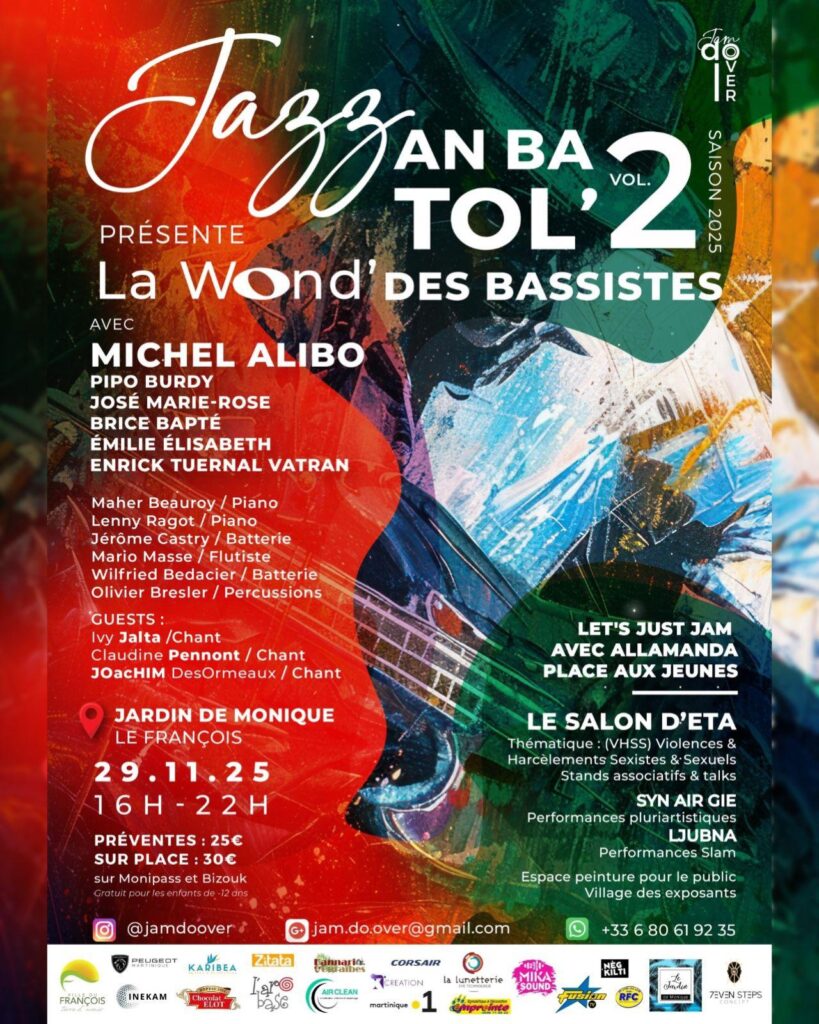
On Saturday, November 29, 2025, Jardin de Monique in Le François played host to the 2ᵉ edition of Jazz an ba Tol’, focusing on “La Wond’ des Bassistes”. The venue was packed throughout the afternoon, with families, young musicians, music scene regulars and residents of the François area coming to see the energy the event brings to the area. The event remained on the same course as the rest of the season: combining music, transmission and commitment to sexual and gender-based violence and harassment (SGBV).

Music, flavors and shared moments

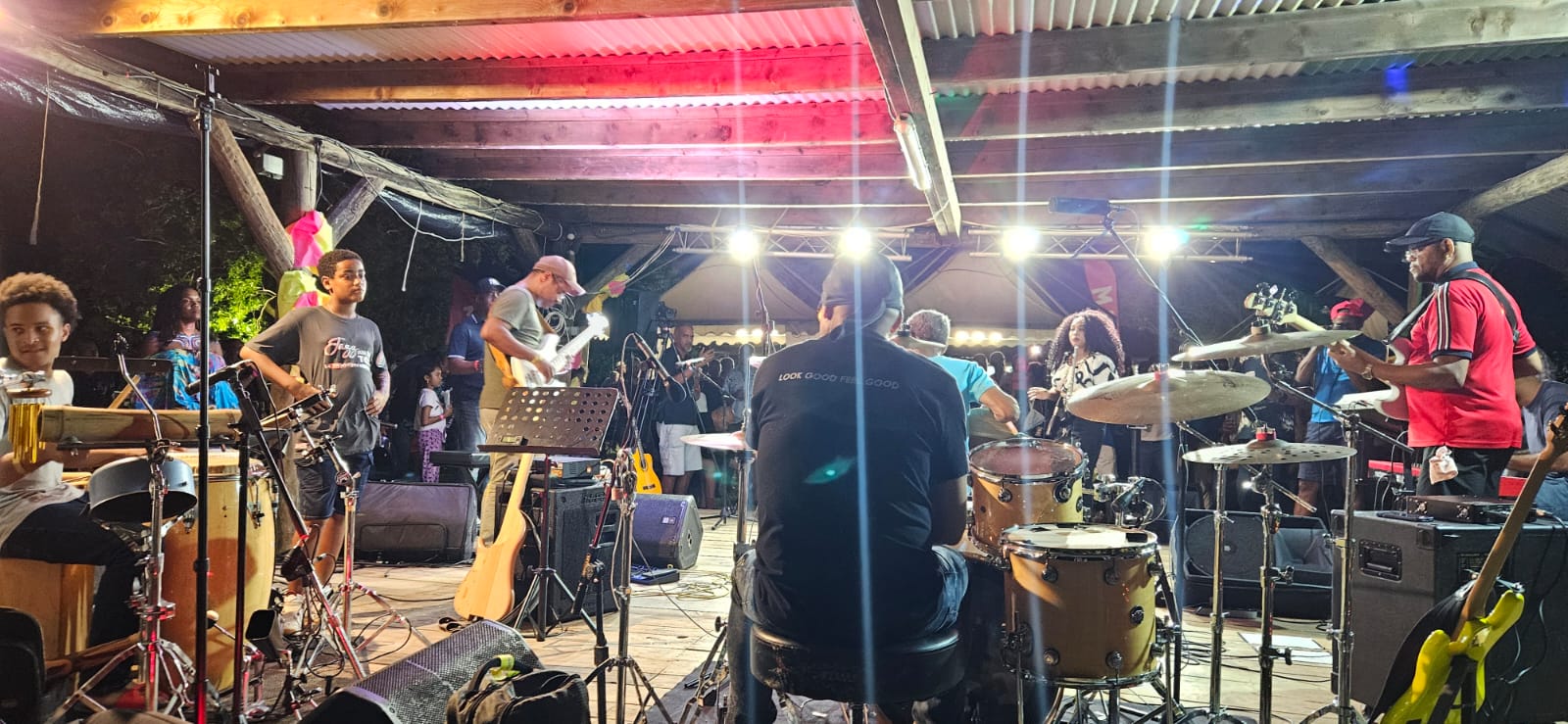
From the outset, the atmosphere blended naturally into the garden setting. As is often the case at Jazz an ba Tol’, people moved between the stage, the dance areas, the live arts stands and the food courts. The music ranged from Afro-Caribbean jazz to improvisations and revisited covers.

Stalls offered crêpes, paninis, pâtés… but it was the fish soup that really stood out. Many people crossed the garden with bowl in hand, explaining that it “tore everything apart”, a culinary detail that also contributed to the singularity of the event.

The event remained multidisciplinary: contemporary dance, collective fresco, body painting, slam performances, exchanges with the associations present. The jam opened the stage to those who wanted to try, share and learn, in keeping with the Jazz an ba Tol’ philosophy.

Jazz an ba Tol’
Jazz an ba Tol’
Jazz an ba Tol’

La Wond' des Bassistes: a tribute to the depth of rhythm

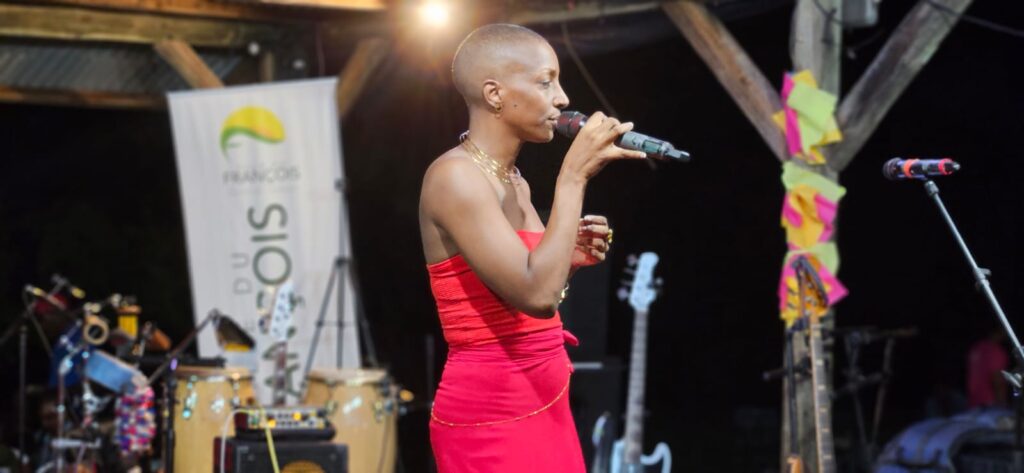
The main stage was home to the featured bassists: Michel Alibo, Pipo Burdy, José Marie-Rose, Brice Bapté, Emilie Elisabeth and Enrick Tuernal Vatran. Alongside them, the resident musicians formed a solid base, and the voices of Ivy Jalta, Claudine Pennont and Joachim DesOrmeaux gave the evening a resonance deeply rooted in Caribbean heritage. The bass was no longer a shadow instrument: it became the heart of a musical narrative carried by the event.

Jazz an ba Tol’
Jazz an ba Tol’
Jazz an ba Tol’

Michel Alibo: a career shaped by the world and focused on transmission

A bassist from Martinique with an international career, Michel Alibo talked about his roots, his travels and his demanding relationship with musical sincerity. He evoked freedom, improvisation and the refusal to play for mere convenience. At Jardin de Monique, his presence reflected a strong desire for transmission, particularly visible during exchanges with the young musicians of Allamanda. In this 2ᵉ edition of Jazz an ba Tol’, his role went beyond simple performance: he built a framework where others could take risks, explore, open up their playing.

Jazz an ba Tol’

Allamanda: five young artists, five points of view

Jazz an ba Tol’

Emilie Elisabeth – a message to women

Emilie, bassist-guitarist with Allamanda and member of La Wond’ des Bassistes, stressed the importance of women finding an artistic practice that helps them to blossom and free themselves from the tensions of everyday life. Her message rang true in the context of this edition, where Jazz an ba Tol’ was working to create spaces of expression and recognition for all generations.

Sarah Sabin – versatility as freedom

At 18, Sarah was alternating between piano and bass. She saw the Jardin de Monique stage as a concrete learning space: testing, finding one’s place, listening to others, confronting a real audience. Her words reflected a generation moving forward with several musical tools at once, perfectly in tune with the open-minded spirit of Jazz an ba Tol’.

Jazz an ba Tol’

Lisa Manikon – an open vision of music

Lisa Manikon, Allamanda’s lead vocalist, emphasized the group’s spirit: a band under construction, refusing to accept musical boundaries.

His vision emphasized research, audacity and the desire to create a space where the five artists can assert their own sound, a spirit very much in tune with what Jazz an ba Tol’ stands for.

Jazz an ba Tol’
Jazz an ba Tol’

Jade Francisque – musical continuity between islands

Jade Francisque, also lead vocalist with Allamanda, emphasized the musical relationship between Martinique and Guadeloupe, citing Soft as a natural reference.

She spoke of a Caribbean dialogue, of the pleasure of playing “the music of our homeland” while bringing a modernity to it.

His perspective was in line with the idea of a wider musical territory, dear to Jazz an ba Tol’.

Oriane Pamphile – asserting the place of young musicians

Oriane Pamphile, percussionist and drummer with Allamanda, saw this stage as an essential springboard.

She explained that the group has only been in existence for a year, and that this performance, only their second, reinforced their desire to move forward: to progress, to show themselves, to fully exist in the Caribbean music scene.

She made one thing clear: young girls are not just singers: they are musicians.


For her, playing on this stage, alongside experienced bassists and committed artists, was a way of asserting the presence of women in instrumental practices that are still all too often invisible.

Jazz an ba Tol’
Jazz an ba Tol’
Jazz an ba Tol’

Salon de Eta and VHSS: when culture opens the floor

The Salon de Eta brought together associations, speakers and the general public to discuss VHSS, with a “talks” area, discussions, workshops and performances. Plastic arts, dance and a collective fresco were used to tackle the subject in a different, less heavy-handed way, in a dynamic of citizen participation. This approach was in line with Jazz an ba Tol”s overall project: to inform, raise awareness and bring people together, while leaving plenty of room for emotion.

https://www.youtube.com/watch?v=yZfSk2utkas
Jazz an ba Tol’
Jazz an ba Tol’
Jazz an ba Tol’

An edition that confirms the project's identity

This 2ᵉ edition showed what makes Jazz an ba Tol’ so strong: putting the spotlight on established musicians like Michel Alibo, offering a place to a new generation of artists, women and men, anchoring the event in a lively venue like Monique’s Garden and tackling a social issue through artistic creation.

On November 29, 2025, the bass told the story of Martinique in a different way: through transmission, dialogue and those moments when a garden becomes, for the space of an evening, musical and human territory.

FAQ

Jazz an ba Tol’ is a cultural event in Martinique that highlights musical creation, artistic transmission and multidisciplinary expression. Each edition showcases local and international artists while tackling a societal theme, such as sexual and gender-based violence and harassment (SGBV) in 2025.

La Wond’ des Bassistes brought together a number of Caribbean bassists, including Michel Alibo, Pipo Burdy, José Marie-Rose, Brice Bapté, Emilie Elisabeth and Enrick Tuernal Vatran. The stage was also buoyed by a solid resident band and the young female musicians of the Allamanda group, who made their mark on this 2ᵉ edition.

In addition to the music, the event features a village of exhibitors, dance performances, body painting, a collective fresco, discussion forums and a Salon de Eta dedicated to raising awareness. Jazz an ba Tol’ combines artistic creation and civic reflection, in a setting open to all.

Leave a Reply

Your email address will not be published. Required fields are marked *

More articles from RK

French
NEWS
Tolotra

396 million people speak French: the 2026 report reveals

The Organisation internationale de la Francophonie has published a figure that reshuffles the deck in the global language debate: 396 million people now speak French. With this total, the French language in the world rises from 5th to 4th position behind English, Mandarin and Spanish, but ahead of standard Arabic. This is more than just an announcement. It marks a fundamental change in the place of French on the international stage, and confirms that the language continues to make headway in strategic areas such as education, economic exchanges, digital technology and cultural mobility. Global progress changes the narrative around French For years, French has often been portrayed as a language of great influence, but weakened in the face of global competition. The OIF’s 2026 report introduces an important corrective. The French language in the world is not only holding its own: it is gaining ground in terms of the number
Read More »
Bonaire
TOURISM
Tolotra

Bonaire, a Caribbean island built around the sea and conservation

In the southern Caribbean, off the coast of Venezuela, Bonaire is a territory in a class of its own. Less publicized than its neighbors Aruba and Curaçao, the island has built its identity around one central principle: the protection of its environment. Here, the sea structures the economy, landscapes and customs, while tourism development has been gradual and controlled. For travelers, Bonaire offers a clear picture: a compact island, visible natural areas, an accessible coastline and an organization geared towards sustainability. An island structured by its marine park Since 1979, Bonaire’s entire coastline has been protected by the Bonaire National Marine Park which completely surrounds the island. This marine area regulates nautical activities and aims to preserve the coral reefs, considered among the best preserved in the Caribbean. One of the island’s special features is the direct accessibility of its marine sites. Diving and underwater observation can be carried out
Read More »
Marcus Garvey
HISTORY & HERITAGE
Tolotra

Jamaica – Marcus Garvey, Jamaican hero of international renown

Marcus Garvey remains one of the most influential figures to emerge from the Caribbean. Born in Jamaica at the end of the 19th century, he transformed a local experience into a political and cultural project of international scope. At a time when black populations faced deeply rooted systems of exclusion, Marcus Garvey proposed a structured vision based on dignity, organization and autonomy. Recognized today as a national hero in Jamaica, he is much more than a historical symbol. His story helps us understand how the Caribbean helped shape major intellectual and political movements on a global scale. His name continues to circulate in contemporary debates on identity, memory and the development of societies born out of colonial history. From Jamaican origins to the formation of a committed conscience He was born on August 17, 1887 in St. Ann’s Bay, Jamaica, into a modest family. Very early on, he developed a

Read More »

conTACT RK

we'd love to have your feedback on your experience so far

Join The List

Join our Richès Karayib community!  Sign up for our newsletter.

Want To Maximize Your Business Presence On Riches Karayib?

Complete the form to start the application