



Martinique: Bordeaux and Fort-de-France linked by a direct air bridge with CORSAIR

CORSAIR

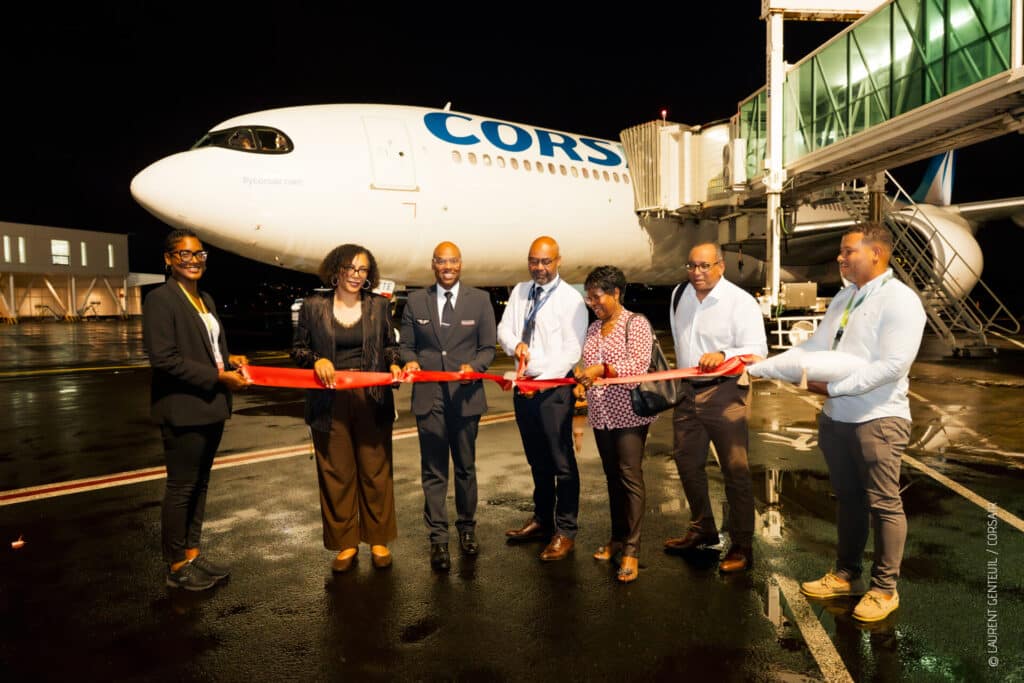
On December 15, 2025, Aimé-Césaire airport welcomed the first direct flight from Bordeaux to Fort-de-France, operated by CORSAIR. This new route marks a strategic turning point for Martinique’s connectivity and accessibility to the Caribbean from south-western France.

A three-way partnership to enhance regional appeal

The arrival of this inaugural flight at 5:47pm is no coincidence. It is the result of several months of collaborative work between three key players: Société Aéroport Martinique Aimé Césaire (SAMAC), the airline CORSAIR and the Comité Martiniquais du Tourisme (CMT).

Nathalie Sébastien, Chairman of SAMAC’s Management Board, hails this collective dynamic: “It’s all about selling a territory, selling a destination. And that’s only possible with the partnership of an airline and the Comité du Tourisme.” For her, this route embodies a clear vision: to open Martinique’s skies to the French provinces, beyond the traditional Parisian gateways of Orly and Charles de Gaulle.

CORSAIR
Nathalie Sébastien

The President underlines the historical, economic and academic links between Bordeaux and Martinique. “It’s a chance for the Martinican community living in Bordeaux to return more often and more easily to Martinique, and vice versa”, she explains. But beyond the diaspora, the entire South-West region now has seamless access to Martinique, without having to transit via Paris.

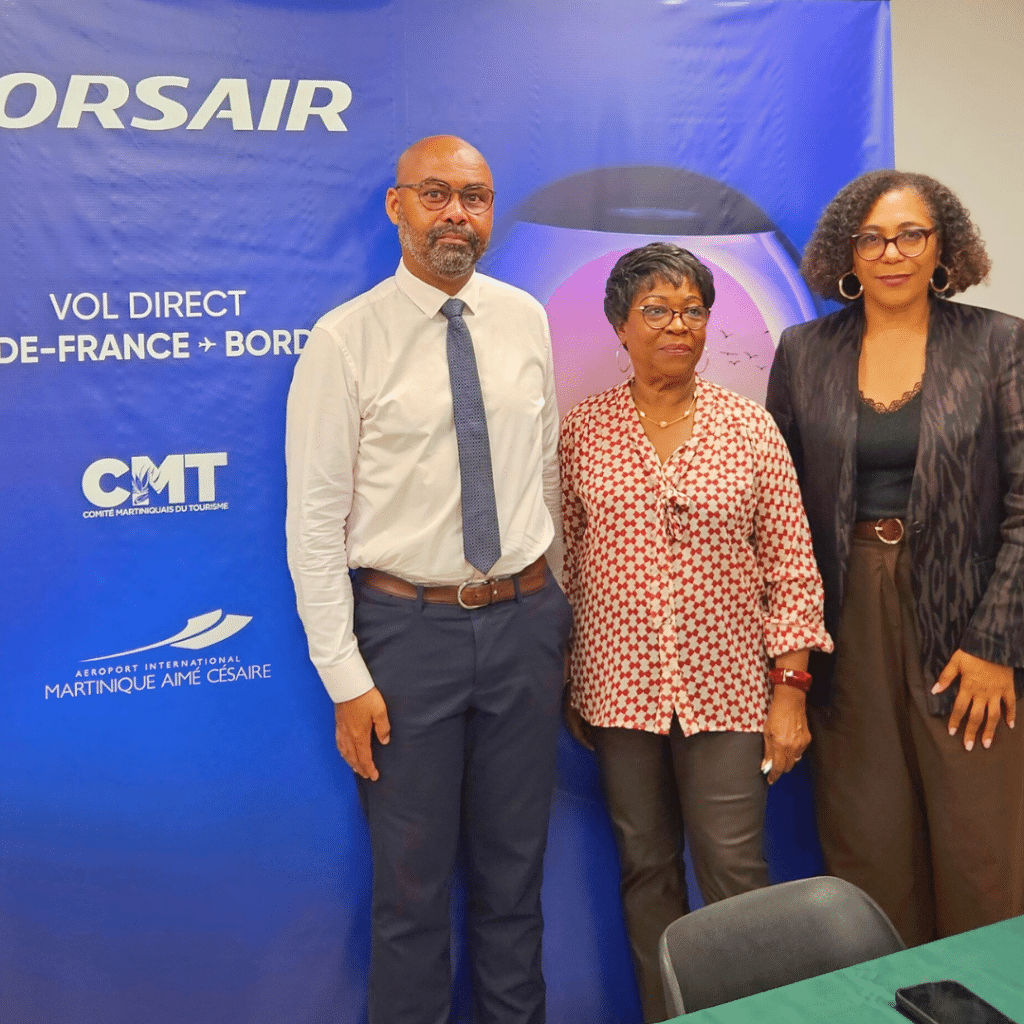
Marie-Ange Ravin, CMT Board member and representative of President Bénédicte Di Geronimo, emphasizes the strategic dimension of this opening: “The development of flows from the provinces is a major strategic focus for the Comité Martiniquais du Tourisme. For a long time focused on Paris, Martinique’s accessibility is now expanding towards high-potential outbound regions.”

CORSAIR
Marie-Ange Ravin

A line designed for mobility and accessibility

Every Monday from December 15, 2025 to April 20, 2026, CORSAIR will operate this seasonal route during the high season. The choice of day and time slots is not an insignificant one. As Nathalie Sébastien explains, “agreeing on the choice of day and time slots is important, as it will have an impact on the passenger experience.” The aim is to facilitate travel for a full week, during a period when Martinique’s airport is very busy.

Eddy Luce, CORSAIR’s Regional Director for the Antilles, confirms this strategic approach: “For us, this is a strong signal to the people of Martinique. CORSAIR continues to invest in the overseas territories to strengthen the island’s accessibility and connect it sustainably to the major French regions.” The company is currently the only one to offer direct flights from the provinces to Martinique, with Bordeaux and Nantes departing from Pointe-à-Pitre.

This route meets strong demand. Load factors have been excellent since sales opened in March 2025. “If you’d like to fly to Bordeaux, I urge you to get your ticket right away, as seats are going to be a bit tight,” warns Eddy Luce with a smile.

CORSAIR
Eddy Luce

A modern fleet for sustainable tourism

CORSAIR has chosen to operate this route with its most modern fleet: the Airbus A330 Neo, which now accounts for 100% of its long-haul operations. These latest-generation aircraft offer a dual advantage: enhanced passenger comfort and a reduced environmental footprint.

“Their technology reduces CO₂ emissions per seat by 25% and the noise footprint by 60%,” Eddy Luce details. For the company, it’s a concrete way of contributing to more sustainable air transport while maintaining essential routes. With an average fleet age of just two years, CORSAIR has the youngest fleet in its category on the market.

This move upmarket also translates into a premium passenger experience. The company has been rewarded two years running by Skytrax as Best Leisure Airline, in 2024 and 2025. “Our ambition is clear: to offer all our customers, whatever their class of travel, a modern, high-quality flying experience,” asserts the Regional Director.

CORSAIR
Airbus A330 Neo ©CORSAIR
CORSAIR

Financial and marketing support to perpetuate the line

Aware that launching a line is not enough, SAMAC has set up a tailor-made support system. “Our aim is also to enable Martiniquais to discover Bordeaux,” explains Nathalie Sébastien. The airport has committed support both in terms of airport charges and marketing, via social networks and targeted promotional actions.

On the CMT side, work on outbound markets began in September 2025 with a major operation in Bordeaux. “We organized a meeting with nearly a hundred travel agents from the Bordeaux and Nouvelle-Aquitaine regions, in partnership with CORSAIR and Bordeaux airport, so that agencies could program and give greater visibility to packages between Bordeaux and Fort-de-France”, explains Gaëtan Paderna.

The program continues with digital campaigns, promotional caravans and easy-to-use packages to encourage bookings. The message is clear: this line must be a long-term one.

CORSAIR
Eddy Luce et Nathalie Sébastien
CORSAIR
Eddy Luce et Marie-Ange Ravin

More than an air link, a human bridge

Beyond the tourism and economic stakes, this new link has a profoundly human dimension. In particular, it meets the mobility needs of young Martiniquans studying in Bordeaux, one of France’s major university cities. “This direct service will make it easier for them to maintain links with their home territory, their families and Martinique”, emphasizes Marie-Ange Ravin.

For families in the diaspora, it’s also a new-found convenience. Travel between the two territories becomes smoother and more accessible, with a reduced carbon footprint thanks to the absence of a Paris stopover.

Nathalie Sébastien concludes with a warm invitation: “Truly, don’t be afraid to set off and discover what these two territories have to offer. A direct link means more opportunities to travel, more opportunities to discover others, even if it’s someone else you think you know. Dare to travel, dare to discover.”

This inaugural Bordeaux – Fort-de-France flight is much more than just a new air route. It’s a bridge between two territories, an opportunity for tourism, the economy, young people and the future of Martinique.

CORSAIR

About CORSAIR CORSAIR is a French airline specializing in long-haul services to French overseas territories and leisure destinations. It operates a 100% Airbus A330 Neo fleet and was voted best leisure airline by Skytrax in 2024 and 2025.

About SAMAC SAMAC: Société Aéroport Martinique Aimé Césaire manages Martinique’s international airport, which has benefited from over 120 million euros of modernization work and can handle over 3 million passengers a year.

About CMT The Comité Martiniquais du Tourisme is responsible for promoting Martinique as a destination to national and international outbound markets.

FAQ

The direct Bordeaux – Fort-de-France flight operated by CORSAIR began on December 15, 2025, with the first inaugural flight welcomed at Aimé-Césaire airport in Martinique.

The service runs once a week, every Monday, from December 15, 2025 to April 20, 2026, during the peak tourist season.

CORSAIR operates this route with Airbus A330 Neo, latest-generation aircraft that reduce CO₂ emissions per seat and enhance passenger comfort.

Leave a Reply

Your email address will not be published. Required fields are marked *

More articles from RK

Doubles, plat de rue de Trinité-et-Tobago composé de deux baras frits et de pois chiches au curry
CULINARY ART
Tolotra

Doubles: The Story of Emamool Deen Behind Trinidad’s Street Food Dish

In Princes Town, in southern Trinidad and Tobago, the “doubles” were born in 1936 from a simple gesture: a customer asking for a second piece of bread. At the time, Emamool Deen and his wife Rasulan were selling curry chickpeas on a single piece of fried bread, unaware that they were inventing the country’s most iconic street food. Nearly a century later, doubles still tell the story of Indo-Trinidadian heritage through this chickpea sandwich, which has become a national symbol. A Morning in Princes Town, 1936 At 4:00 a.m., in a courtyard in Princes Town, in the southern part of Trinidad and Tobago, Rasulan Deen lights the fire that will heat the coconut oil. Her husband, Emamool Deen, is boiling the chickpeas that the couple was able to buy by selling a goat, the only possession they had. The year is 1936, and according to oral tradition preserved by several

Read More »
María Elena Llorente recevant un hommage floral, Ballet Nacional de Cuba
DANCE
Tolotra

María Elena Llorente: 50 Years of Ballet in the Service of Cuba

In May 1977, a Cuban dancer took the stage in New York with the Alvin Ailey Dance Theater. In the audience that evening, actor Harry Belafonte watched the performance and would later describe the evening as a significant historical event. This dancer’s name was María Elena Llorente, prima ballerina and ballet mistress of the Ballet Nacional de Cuba. Her career spans fifty years of dance, spent almost entirely with a single company—the one founded by Alicia Alonso in Havana—on an island where, over the decades, classical ballet has become as much a source of national pride as it is an art form. María Elena Llorente, of the Sociedad Pro-Arte at the National Academy It all began at the Sociedad Pro-Arte Musical, a school in Havana where young Cuban women learned the basics of classical ballet even before the official founding of the national ballet company. María Elena Llorente then continued

Read More »
Two men greeting each other with "Asere, qué bolá" in Havana
HISTORY & HERITAGE
Tolotra

“Asere, ¿qué bolá?”, the street greeting Obama dared to use in Cuba

“Asere, ¿qué bolá?”, this Cuban street greeting, was already in common use in Havana’s working-class neighborhoods long before a U.S. president adopted it as well. On Saturday, March 19, 2016, on the eve of the first presidential trip to the island in nearly nine decades, Barack Obama appeared in a Cuban TV sketch alongside Pánfilo, a comedic character well known to viewers on the island, and delivered a “qué bolá” that no one expected to hear from a U.S. head of state. The next day, upon setting foot in Havana, he did it again on Twitter: “¿Que bolá Cuba? Just touched down here.” In just a few hours, two words of Havana slang had bridged the gap between the street and the world of diplomacy. What does “Asere, ¿qué bolá?” mean? Taken literally, “asere” doesn’t really translate, and “qué bolá”—which comes from “bola,” meaning “ball”—doesn’t convey anything more literal than

Read More »

conTACT RK

we'd love to have your feedback on your experience so far

Join The List

Join our Richès Karayib community!  Sign up for our newsletter.

Want To Maximize Your Business Presence On Riches Karayib?

Complete the form to start the application