MARTINIQUE – When the island shines on the international stage: the Brahman breed takes center stage at the Salon de l’Agriculture

Brahman

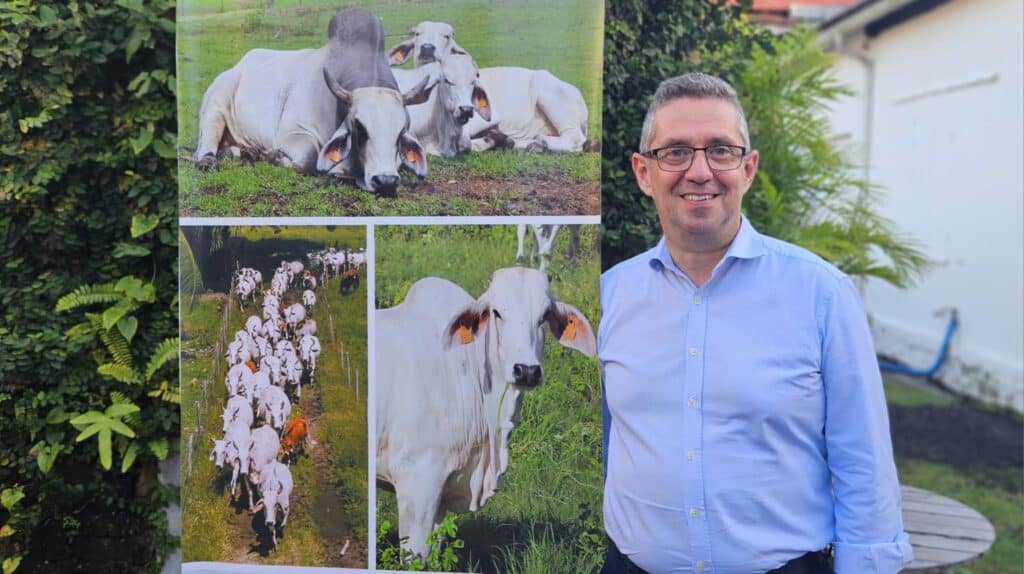
On June 4, in the verdant setting of the former Habitation Dillon, a new page in Martinique agriculture was written. In announcing that the Brahman cattle breed will represent the Salon International de l’Agriculture in Paris in 2026, Salon director Jérôme Despey made more than a symbolic choice: he recognized Martinique as a legitimate, strategic and innovative agricultural player.

The announcement was made thanks to the commitment of Sandrine Hayot, president of the Union des éleveurs de bovins Brahman, genetic coordinator Jessica Perrette, who has been on the payroll for over six years, and breeder André Prosper.

The Salon International de l’Agriculture 2026 will be held at Paris Expo Porte de Versailles, as every year, from February 21st to March 1st 2026.

Brahman
Jérôme Despey

A hardy breed with recognized Caribbean know-how

The Brahman, a cattle breed emblematic of the French West Indies, is adapted to tropical conditions: undemanding, naturally resistant to parasites, and suitable for extensive outdoor rearing. “It’s a very endearing, spectacular animal, ideal for our territories”, confides Jessica Perrette.

In both Martinique and French Guiana, genetic selection programs help maintain the breed’s diversity and quality, promoting local, healthy meat produced with respect for the environment.

Brahman
Jessica Perrette

Regional cooperation in tune with know-how

André Prosper sets out the regional vision: “There’s a real need for inter-island development. We’re still in the embryonic stage, but we need to go much further. Links are being forged with Saint-Martin, Dominica and Guadeloupe. Visits from Caribbean delegations to his farm have revealed the potential of the Martinique model.

Conversely, cooperation with French Guiana is already well advanced: the Brahman breed’s herd book is shared there, structures are actively collaborating (SEBOG cooperative, UEBB), and skills are circulating between breeders. It’s a tangible integration that promises a promising Caribbean dynamic.

Brahman
André Prosper

Territorial influence and collective ambition

For the Salon de l’Agriculture, 600,000 visitors, 4,300 journalists, 88 official debates… The visibility is immense. By choosing a Brahman cow from Martinique, the whole island will be highlighted: its respectful agricultural practices, its committed breeders, its young people in training, all mobilized to accompany the event in Paris.

The project is collective, deeply rooted and a source of pride. As Sandrine Hayot sums up: “It’s a great showcase for Martinique’s agricultural sector, one that innovates, cooperates and inspires.”

Antilles françaises

In Paris in 2026, it’s a whole: an animal, a breed, a know-how, a culture, an agriculture, a territory and its riches that will be represented. The Brahman crystallizes much more than a local success story: it embodies a demanding, inventive, forward-looking Martinique. This choice of muse is a strong signal that Martinique’s agriculture is radiant, seductive and attractive.

It is also becoming a lever for tourism and economic visibility. Through it, an entire island proudly asserts its place on the map of future agriculture.

Leave a Reply

Your email address will not be published. Required fields are marked *

More articles from RK

Bonaire salt marshes: pink ponds and white salt mountains in the south of the island
HISTORY & HERITAGE
Tolotra

Bonaire: 3,700 hectares of salt marshes conceal a history of slavery

At the southern tip of Bonaire, a Dutch-speaking island in the Caribbean, the salt marshes stretch out in pink and white basins across nearly 3,700 hectares—thirteen percent of the island’s total area. This postcard view, photographed every year by thousands of visitors from the coastal road, hides a history dating back more than five centuries, the story of salt that shaped Bonaire’s economy and, for two hundred years, the lives of hundreds of enslaved people. Along EEG Boulevard, which runs along the southern coast of Bonaire, mountains of white salt come into view kilometers before you reach them. Each contains about 10,000 metric tons of salt that is 99.6% pure, piled nearly 15 meters high, with up to 200,000 metric tons stored at any given time. Their whiteness, so intense that you need to keep sunglasses handy, stands in stark contrast to the pink of the neighboring pools. The salt

Read More »
Journées européennes du patrimoine 2026
EVENT MANAGEMENT
Tolotra

European Heritage Days 2026: Martinique Opens Its Archives.

On September 15, at 5 p.m., the conference room of Martinique’s Cultural Affairs Department is already packed. Journalists, cultural leaders, organizations, artists, and heritage professionals have gathered to find out what the 43rd edition has in store. With just four days to go before the 2026 European Heritage Days , scheduled for September 19 and 20, this press conference already feels like a journey across Martinique—from its Creole huts to its lighthouses, from Saint-Pierre to the monuments we sometimes pass by without really noticing them. European Heritage Days 2026: A Lively Conference Johan-Hilel Hamel, Martinique’s director of cultural affairs, opened the meeting without putting on airs. He even warned that the evening would not be a long monologue. The conversation quickly began to flow. A representative from Les Trois-Îlets speaks, followed by Xavier Nicolas from the Directorate of the Sea, Philippe Villard from the Heritage Foundation, Florence Le Gal from

Read More »
caribbean cinema
FILM & VIDEO
Tolotra

S3/10 – Stories of Caribbean Cinema: Two Perspectives on the Year 1980. Texts by Guillaume Robillard. Ciclic, 2026.

With this third episode, *Stories of Caribbean Cinema* moves into the 1980s. The first two installments covered Cuba, Jamaica, Trinidad and Tobago, and Guadeloupe, from the 1960s through the emergence of Caribbean cinema. This time, two films made in the same year take radically different directions. In Jamaica, *Children of Babylon* explores romantic, sexual, and racial relationships with unusual freedom. In Guadeloupe, *Live Free or Die* draws on several centuries of history centered on the legacy of Commander Ignace. This article is the third installment in a series of ten. Two installments have already been published, and seven more will follow in this chronology of Caribbean cinema. 1980: JAMAICA – “CHILDREN OF BABYLON”, BY LENNIE LITTLE-WHITE This film is unique in Jamaican cinema and, more broadly, in Caribbean cinema as a whole. Far from the social deprivation of Kingston’s ghettos, in a villa in the countryside (complete with a swimming

Read More »

conTACT RK

we'd love to have your feedback on your experience so far

Join The List

Join our Richès Karayib community!  Sign up for our newsletter.

Want To Maximize Your Business Presence On Riches Karayib?

Complete the form to start the application