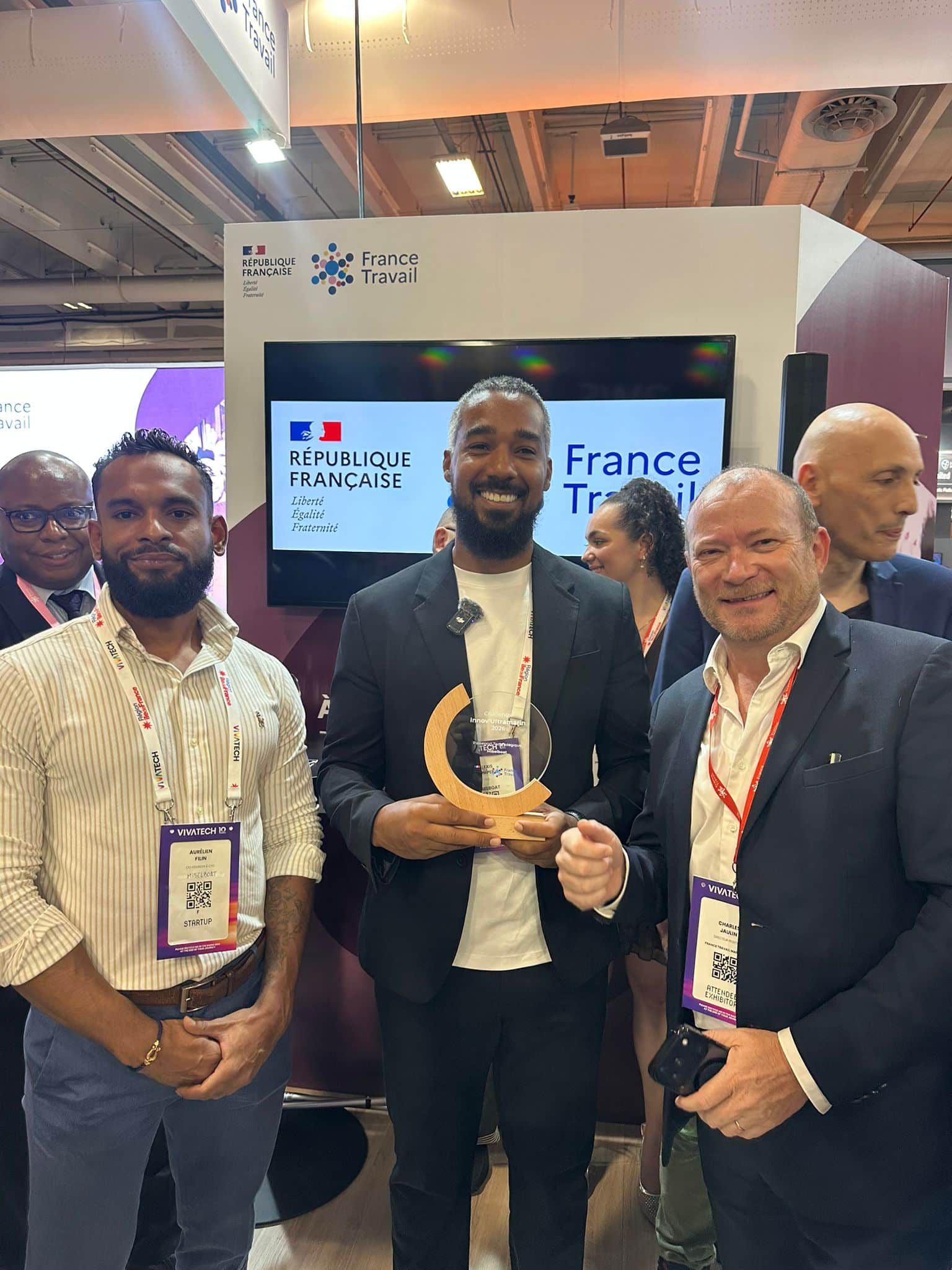
In Paris, amid startups and major tech events, an idea that originated in Martinique has just received national recognition. MiBelBoat was honored on June 17 at VivaTech 2026 as part of France Travail’s first “Challenge Innov’ Outre-Mer.” The startup aims to use artificial intelligence to better connect travelers, water sports operators, and maritime professionals in the Caribbean.
An award for a startup from Martinique
VivaTech 2026 is taking place June 17–20 at Paris Expo Porte de Versailles. For MiBelBoat, its participation in this trade show took on special significance right from the first day. The Martinique-based platform received the “Technology Passport” award during the awards ceremony for the Challenge Innov’ Outre-Mer, organized by France Travail. The project is led by Alexis Mompert and Aurélien Filin. Their goal is simple to state but more complex to achieve: to provide the Caribbean boating industry with a digital tool capable of connecting offerings, operators, itineraries, and travelers.
This topic touches on a very specific sector: boat trips, charter services, water-based activities, marinas, tourism professionals, and customers looking for an easier way to make reservations.

A market that remains fragmented
In many Caribbean regions, access to water sports is still facilitated through fragmented channels: a phone call, a WhatsApp message, an email exchange, or a local recommendation. This personal touch is part of the culture of service, but it can also limit operators’ visibility.
MiBelBoat is based on this observation. According to the startup, the Caribbean’s boating offerings remain difficult to organize on a regional scale. For travelers, it’s not always easy to compare experiences, understand itineraries, or book at the right time. For industry professionals, the fragmentation of sales channels can complicate the management, marketing, and tracking of business. This is where digital tools come into play in the Caribbean. The challenge goes beyond booking. The goal is to make an already active but still underconnected industry more transparent.


AI as a Field Tool
MiBelBoat is a Caribbean-based boat rental platform powered by artificial intelligence. The solution aims to integrate several features: booking, management, itineraries, and nautical concierge services. The goal is to simplify the customer experience while helping operators better organize their offerings.
AI is becoming a tool for sorting, automating, and guiding users. It can help organize information, streamline requests, assist in choosing an experience, or make certain tasks less burdensome for professionals. For the Caribbean, where the sea serves as a space for work, transportation, recreation, and identity, this issue also touches on how these regions make the most of their resources.

An idea born from experience at sea
MiBelBoat draws on the experience gained through Boat Paradise, a company specializing in premium boating experiences in the Caribbean. This venture allowed the founders to identify the needs not only of customers, but also of operators, marinas, and tourism stakeholders. The project isn’t driven solely by a technological trend. It’s rooted in real-world use. Booking a boat trip, planning an itinerary, managing a request, tailoring an experience to a season or a specific audience—these details are what build a platform’s value.
This close connection to the local community also gives the project a more human dimension. Behind MiBelBoat lies a desire to transform a local experience into a regional resource.

A Blue Economy Challenge
The award received at VivaTech comes at a time when Caribbean regions are seeking to better structure their marine-related sectors. Tourism, boating, services, digital technology, and employment: the blue economy cannot remain just a general concept. It must generate tools, opportunities, and revenue for local stakeholders. MiBelBoat aims to contribute to this momentum by helping operators gain visibility and facilitating access to water-based experiences year-round. The goal remains a cautious one: to better organize existing resources, reduce dependence on scattered networks, and build—from Martinique —a solution capable of resonating throughout the entire Caribbean region.
The award received in Paris does not solve all the challenges. Above all, it brings attention to a key question: Who is building the platforms that will organize the Caribbean’s resources, industries, and experiences in the future? With MiBelBoat, Martinique offers one possible answer. It now remains to be seen how this recognition can be translated into tangible benefits for both maritime operators and travelers.
MiBelBoat is a startup based in Martinique that is developing a Caribbean platform dedicated to boating experiences. Its goal is to better connect travelers, boating operators, marinas, and tourism professionals. The platform uses artificial intelligence to streamline booking, request management, itinerary planning, and nautical concierge services.
MiBelBoat won an award at VivaTech 2026 as part of France Travail’s “Innov’ Outre-Mer” Challenge. The startup was recognized for its digital solution, developed in Martinique and tailored to the Caribbean boating industry. This recognition highlights an overseas innovation capable of addressing a concrete need: making the boating industry’s offerings clearer, more accessible, and better organized.
MiBelBoat’s goal is to reduce fragmentation in the Caribbean’s marine tourism sector. Today, many reservations are still made by phone, WhatsApp, email, or direct contact. By centralizing listings and using AI to streamline the experience, MiBelBoat aims to help operators gain visibility and give travelers better access to marine experiences.