
Sidney Poitier, the first Black actor to win the Best Actor award in 1964

Sidney Poitier, actor born in the Bahamas, photographed in the 1960s

Sidney Poitier was born on February 20, 1927, in Miami, Florida, while his Bahamian parents were visiting to sell tomatoes; he later grew up without electricity or running water on Cat Island in the Bahamas. On April 13, 1964, he became the first Black actor to win the Oscar for Best Actor, for his role in *Lilies of the Field*. More than sixty years later, Nassau, the capital of the Bahamas, named one of the bridges connecting Cat Island to Paradise Island after him.

A theater director who tells him he doesn't know how to speak

In 1946, in New York, Sidney Poitier walked into the basement of a library in Harlem where the American Negro Theatre was rehearsing. He was actually looking for a dishwashing job in the classifieds of the Amsterdam News when he stumbled upon an ad that read, “Actors Wanted.” The theater director listened to him read two paragraphs and brusquely sent him away, telling him he could barely speak and would be better off washing dishes. He would later recount that this remark, rather than discouraging him, triggered exactly the opposite reaction. Standing on the street between Lennox and Seventh Avenue, he decided to become an actor—not out of a calling, but to prove that the man was wrong about him.

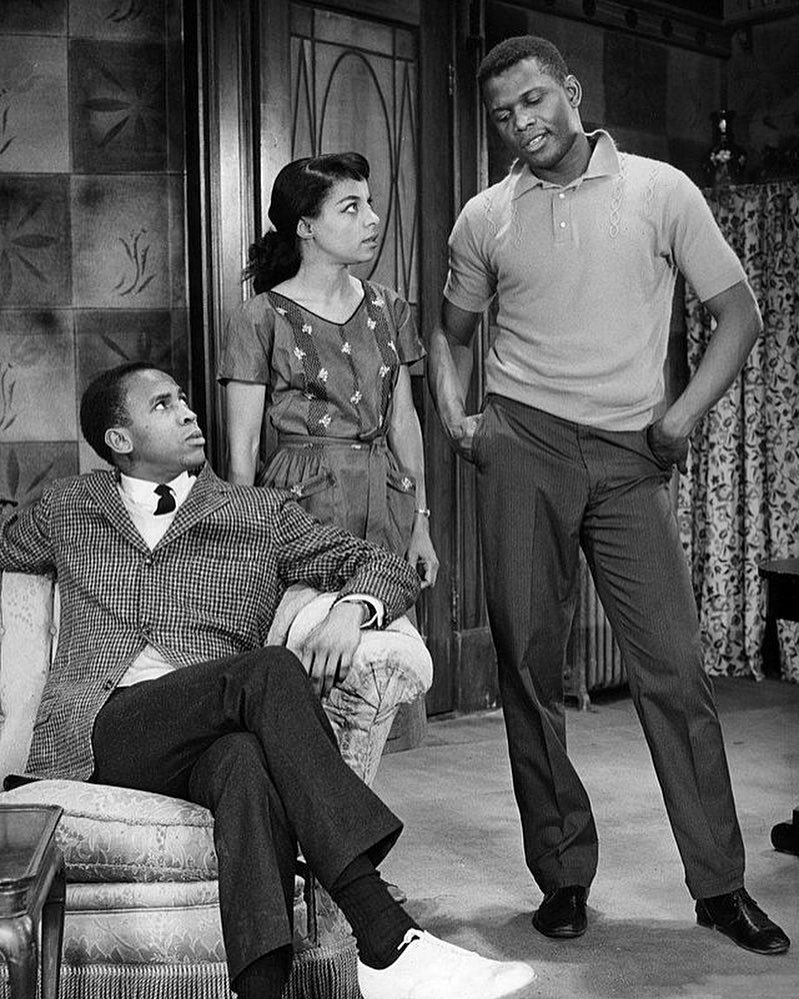
Sidney Poitier on stage early in his New York theater career
On stage, early in his New York career. Credit: Sidney Poitier - Instagram

Sidney Poitier: A Childhood on Cat Island Without Electricity or Running Water

Sidney Poitier grew up on Cat Island in the Bahamas, where his family grew tomatoes. He worked in the fields from the age of five and attended a one-room school sporadically. When he was about ten and a half, after Florida stopped importing Bahamian tomatoes, the Poitier family moved to Nassau, the capital of the Bahamas. There, he saw his first car and his first movie—a cowboy story that left him wondering how so many characters could fit into such a small theater.

At twelve and a half, he left school to help support his family financially, before joining his older brother Cyril in Miami, Florida, at the age of fifteen. After spending a summer washing dishes at a hotel in Georgia, he saved enough money to try his luck in New York, where he arrived at age sixteen, sleeping in bus stations before finding a room in Harlem. Cat Island is located in the Bahamas archipelago, not far from the Exuma archipelago in the Bahamas.

Sidney Poitier with his family near a window
Surrounded by his family. Credit: Sidney Poitier - Instagram
Sidney Poitier photographed with family members at a ceremony
Surrounded by loved ones at an Oscars ceremony. Credit: Sidney Poitier - Instagram
Portrait of Sidney Poitier
Credit: Sidney Poitier - Instagram

Six months to change your accent

After being fired from the American Negro Theatre, Sidney Poitier spent six months working on his diction and his Bahamian accent, poring over newspapers between shifts washing dishes and repeating aloud every word he heard on the radio. He then returned to the theater, offered to work as an unpaid janitor in exchange for acting lessons, and eventually landed a small understudy role in the play *Lysistrata*.

On the night of the performance, the lead actor, a young man named Harry Belafonte, had to help his father empty the ashes from a building’s boiler and couldn’t make it to the show. He stepped in to play the part, forgot his opening lines in front of 1,200 audience members, and sparked laughter, earning him favorable reviews. A Broadway director who was in the audience that night later offered him his first professional role.

Sidney Poitier leaning against a movie camera on a film set
On a movie set. Credit: Sidney Poitier - Instagram

From *No Way Out* to the 1964 Oscars

In 1950, Sidney Poitier made his film debut in *No Way Out*, in which he played a young doctor confronted by a racist patient, a role so powerful that the film was banned in Chicago and several cities in the southern United States, as well as in the Bahamas by the British colonial authorities at the time, for fear of racial tensions. He subsequently turned down several roles he considered demeaning, even when he needed money for the arrival of his second daughter.

In 1958, The Defiant Ones, in which he plays a convict chained to a white fellow inmate, earned him his first Oscar nomination. On April 13, 1964, for his role in Lilies of the Field (1963), Sidney Poitier became the first Black actor to win the Oscar for Best Actor in a leading role, six years after that nomination. Actress Hattie McDaniel had won an Oscar for Best Supporting Actress as early as 1940, but no Black actor had yet been honored for a leading role. He later said that what he enjoyed most about the role was playing a man who was aware of his own worth, neither a servant nor a victim.

Sidney Poitier at an Oscars tribute, holding his statuette
At an Oscars tribute. Credit: Sidney Poitier - Instagram

1967, the year three of his films topped the box office

In 1967, three films starring Sidney Poitier were released: To Sir, with Love, In the Heat of the Night, and Guess Who’s Coming to Dinner. In In the Heat of the Night, he insisted on a scene in which his character, a Black police officer, is slapped by a white suspect and immediately strikes back, contrary to the original script, which had him walking away without reacting. In his own words, he explained to producer Walter Mirisch that the Black community would find such passivity unacceptable on screen. Once the year’s box office receipts were tallied, these three films ranked among the highest-grossing of 1967, making him the biggest box-office draw of his time.

Posters of Sidney Poitier films, including To Sir, with Love
Several of the actor's films, including those released in 1967. Credit: Sidney Poitier - Instagram

A bridge in Nassau—so we won't forget

In 1974, one year after the Bahamas gained independence, Queen Elizabeth II knighted Sidney Poitier. He then served as the Bahamian ambassador to Japan from 1997 to 2007, and as the Bahamian ambassador to UNESCO from 2002 to 2007. In 2009, President Barack Obama awarded him the Presidential Medal of Freedom.

On November 2, 2012, in Nassau, Bahamas, the bridge connecting New Providence Island to Paradise Island was officially renamed the Sidney Poitier Bridge, in the presence of the actor and Bahamian schoolchildren. Prime Minister Perry Christie referred to him as the most famous Bahamian in the world and reminded the children present that day that they represent the country’s future. He died on January 6, 2022, in Los Angeles, at the age of 94.

The Sidney Poitier Bridge in Nassau, the Bahamas
The bridge connecting Nassau to Paradise Island, renamed the Sidney Poitier Bridge in 2012. Credit: Sidney Poitier - Instagram

Sidney Poitier grew up on an island without electricity to become the first Black person to win an Oscar in the top category. His name remains engraved today on a bridge in Nassau, which Bahamians cross every day—though not all of them may know where he came from. How many other stories of people who set out from such a small island in the Caribbean remain to be told?

Sidney Poitier was an actor, director, and diplomat born on February 20, 1927, in Miami, Florida, to Bahamian parents; he grew up on Cat Island and later in Nassau, in the Bahamas. He died on January 6, 2022, in Los Angeles at the age of 94.

On April 13, 1964, Sidney Poitier won the Oscar for Best Actor for his role in *Lilies of the Field* (1963), marking the first time a Black actor had won in this major category. Actress Hattie McDaniel had previously won an Oscar for Best Supporting Actress in 1940.

Sidney Poitier was born to Bahamian parents and grew up on Cat Island and then in Nassau. On November 2, 2012, the bridge connecting Nassau to Paradise Island was renamed the Sidney Poitier Bridge in his honor, and he served as the Bahamas’ ambassador to Japan from 1997 to 2007 and then to UNESCO from 2002 to 2007.

Leave a Reply

Your email address will not be published. Required fields are marked *

More articles from RK

Caribbean cinema
FILM & VIDEO
Tolotra

S2/10 – Stories of Caribbean Cinema: Revolts, Slavery, and Caribbean Self-Assertion. Texts by Guillaume Robillard. Ciclic, 2026.

The Series Stories of Caribbean Cinema continues its journey through several decades of filmmaking in the region. Following a first episode that began in the 1960s—from Cuba to the emergence of Jamaican cinema with *The Harder They Come*—this second installment takes us to Trinidad and Tobago, Cuba, and then Guadeloupe. Amid social conflicts, the legacy of slavery, and political demands, three films demonstrate how Caribbean cinema took on history and power dynamics from the very beginning. This article is the second installment in a series of ten. The first installment is already available on Richès Karayib, and eight more episodes will continue this chronology through 2025. 1974: TRINIDAD AND TOBAGO – BIM, BY HUGH A. ROBERTSON Hugh A. Robertson has had an unconventional career path among Caribbean filmmakers. A New Yorker born to Jamaican parents, he got his start in the film industry at a very young age and held

Read More »
Sidney Poitier, actor born in the Bahamas, photographed in the 1960s
HISTORY & HERITAGE
Tolotra

Sidney Poitier, the first Black actor to win the Best Actor award in 1964

Sidney Poitier was born on February 20, 1927, in Miami, Florida, while his Bahamian parents were visiting to sell tomatoes; he later grew up without electricity or running water on Cat Island in the Bahamas. On April 13, 1964, he became the first Black actor to win the Oscar for Best Actor, for his role in *Lilies of the Field*. More than sixty years later, Nassau, the capital of the Bahamas, named one of the bridges connecting Cat Island to Paradise Island after him. A theater director who tells him he doesn’t know how to speak In 1946, in New York, Sidney Poitier walked into the basement of a library in Harlem where the American Negro Theatre was rehearsing. He was actually looking for a dishwashing job in the classifieds of the Amsterdam News when he stumbled upon an ad that read, “Actors Wanted.” The theater director listened to him

Read More »
Keshi yena, plat national de Curaçao servi avec riz et bananes plantain
CULINARY ART
Tolotra

Keshi yena, the cheese that turned leftovers into a source of pride for Curaçao

In Curaçao, keshi yena is a dish served on special occasions: a Gouda or Edam cheese that has been hollowed out and stuffed with meat, olives, and raisins. The very act of preparing this dish carries the memory of a colonial system in which items deemed worthless were discarded. What slave kitchens made of these leftovers continues to grace the island’s festive tables today. A dish to make as a family Many Curaçaoan families save keshi yena for Sunday meals or major celebrations, when the house is full of guests and they need a dish that can feed everyone. It takes time to prepare: you have to carefully hollow out a whole ball of cheese without piercing the rind, then fill it with a simmered meat stuffing before baking it in the oven until the cheese melts from the inside. This tradition, passed down from kitchen to kitchen, reveals a

Read More »

conTACT RK

we'd love to have your feedback on your experience so far

Join The List

Join our Richès Karayib community!  Sign up for our newsletter.

Want To Maximize Your Business Presence On Riches Karayib?

Complete the form to start the application