The history of Caribbean cinema continues its journey through the 1980s. After three episodes devoted to the early developments of several cinematic movements in the region, this fourth installment brings together two films from Martinique and one from Curaçao.

From the “marronnage” in *Le Sang du flamboyant* to the international trajectory of *Rue Cases-Nègres*, and on to the unique worldof *Almacita di Desolato*, these three works explore different relationships to memory, oral tradition, Africa, and Caribbean imaginaries. This article is the fourth installment in a series of ten. The first three are already available on Richès Karayib, and six more will continue this story through the 2020s.

1981: MARTINIQUE — *The Blood of the Flamingo*, by François Migeat

This film is unique in Caribbean cinema. Indeed, its director is a “Metropolitan” (that is, a white man from mainland France who had no deep-rooted ties to the French West Indies) who married the Martinican actress Émilie Benoît and was invited by the poet and politician Aimé Césaire to lead the first audiovisual training program in the Antilles at the SERMAC (Municipal Cultural Action Service) in the city of Fort-de-France.

Unlike *Dérives* or *The Garden Woman* (1977), *Le Sang du flamboyant*, which received strong support from Césaire, was commercially released in theaters and even had the honor of being screened at the renowned Columbia University in New York. It is based on a historical event, namely the “marronage” (originally, a slave’s escape from the plantation) of Monsieur Beauregard (renamed Alban in the film), who eluded the police in the southern part of the post-slavery colony of Martinique from 1942 to 1949, making him one of the last historical Maroons in the Caribbean.

This feature film is characterized by the central role of the “Nègre marron,” one of the recurring characters in Caribbean cinema as well as in traditional Creole storytelling, who drives most of the plot in a cinematic tradition where oral storytelling continues to thrive. Furthermore, it is one of the first films to incorporate a “magical dimension” into the plot, which poses a challenge for the Béké (a descendant of a slave-owning family), generously portrayed by the famous actor and producer Jacques Perrin.

“Femifocality” is also prominent in the character of Élia (played with gravitas by Émilie Benoît, who was the lead actress in *Dérives* or *La Femme-Jardin*), a “woman who stands tall” who narrates the film’s story alongside her storytelling partner Gélus—a female presence that defies the historical tradition that Creole storytellers are exclusively men.

Caribbean Cinema
Le Sang du flamboyant de François Migeat, 1981 ©Films Molière/CINUCA – Martinique

1983: MARTINIQUE—RUE CASES-NÈGRES, BY EUZHAN PALCY

To date, this is undoubtedly the best-known Caribbean film in the world. It is an adaptation of one of the classics of Caribbean literature, the autobiographical novel *La Rue Cases-Nègres* by Joseph Zobel, a close associate of the “Négritude” poet Aimé Césaire. The film won the Silver Lion and the Volpi Cup for Best Actress, awarded to Darling Légitimus (grandmother of the famous Pascal Légitimus of the comedy trio “Les Inconnus”), marking the culmination of her fifty-year career at the Venice Film Festival in 1983.

In addition, the director won the César Award for Most Promising Newcomer in 1984. Her subsequent career has been exceptional: after moving to Hollywood, she became the first Black woman to direct Hollywood studio films, with works such asA Dry White Season (1989)—a film about apartheid in South Africa that marked Marlon Brando’s return to the big screen—and the Walt Disney production Ruby Bridges’ Struggle (1998), based on the true story of the first Black girl to attend a school for white children in the southern United States.

His career was recently recognized with an Honorary Oscar in 2022. As for *Rue Cases-Nègres*, it brought young Caribbean cinema to international attention, from the United States to Japan. By following the journey of young José (Garry Cadenat) in the post-slavery colony of Martinique in the 1930s, the film actually addresses the harsh conditions faced by sugarcane workers and the lingering legacy of the era of slavery. As in *Coco la Fleur, Candidate* (1979) and *Le Sang du flamboyant* (1981) features the figure of the Creole storyteller—here embodied by old Médouze—as well as the influence of Négritude.

Furthermore, this child’s educational journey reflects both his social emancipation and the process of “cultural assimilation” through the nature of the courses taught, Grandmother Man Tine (Darling Légitimus), a true embodiment of the traditional “female-centered” perspective of Caribbean cinema, tells her grandson: “You’ll go to their school!” A true classic of Caribbean cinema!

Caribbean Cinema
Rue Cases-Nègres d’Euzhan Palcy, 1983 ©NEF Diffusion/JMJ Productions – Martinique

1986: Curaçao – Almacita di Desolato, by Felix de Rooy

After her first feature film, shot in Brooklyn, *Désirée* (1984)—based on the true story of a woman who killed her baby because she was convinced it was possessed by the Devil— the gay couple Felix De Rooy and Norman de Palm shot their second film on the island of Curaçao, where they are from, drawing inspiration from a Caribbean folktale. The landscapes of this small Dutch island of 444 km² off the coast of Venezuela—ranging from caves to desert—serve as the setting for a fusion of magical rituals and the dire reality of an isolated village in an unspecified era.

This legend highlights the African component of Caribbean identities (which can be seen in the village’s architecture, the women’s clothing, traditional knowledge passed down orally, etc.) through a plot that recounts—via a remarkable fictional detour—the transatlantic slave trade and slavery, a history “etched into the skin,” as the film’s voice-over explains.

In addition to its more pronounced fictional nature compared to many Caribbean films—which tend to remain rooted in a certain social or historical reality—this feature film stands out for the multidisciplinary nature of its references, drawn from the background of its director, Felix De Rooy, as a poet, theater artist, and visual artist (among other roles), which lends this work a talented stylistic flair that sets it apart within Caribbean cinema.

Shortly thereafter, the De Rooy-De Palm duo would release another surprising film: Ava & Gabriel (1990), one of the first major stories of romantic desire set within an interethnic love triangle during the colonial era (a “taboo” combination, if ever there was one), one of those films tinged with homosexuality (a very rare subject in the region) through secondary characters and accompanied by a generous exploration of Caribbean arts.

As in Almacita di desolato, the entire work is steeped in the musicality of Papiamento (Papiamentu), a creole language born from the fusion of Dutch, Portuguese, Spanish, English, and words of African and Native American (Arawak) origin, as well as by magical-religious beliefs that lend the film an effective sense of magical realism. Shortly thereafter, this duo of effusive talent would burst onto the scene, giving this second film the air of a precious artistic testament.

Caribbean Cinema
Almacita di Desolato de Felix de Rooy, 1986 ©Hungry Eye Pictures – Curaçao

About the Author

Guillaume Robillard holds a Ph.D. in film studies; he is a professor and researcher, a documentary filmmaker, and a specialist in Caribbean cinema and artistic production. He is the author of two books: *Conquest of Space and Time: Caribbean Cinema (Éditions Jannink, “Hypothèses d’Art,” 2023) and Decolonial Cinema: Characters in Caribbean Cinema (Presses Universitaires des Antilles, “Arts et Esthétique,” 2024).

The release of Magma, a film by French director Cyprien Vial heavily inspired by the 1976 eruption of La Soufrière, which raised fears that the capital city of Basse-Terre (Guadeloupe) would be destroyed, followed by two films directed by Guadeloupeans, namely Fanon (Jean-Claude Barny), about the famous anti-colonialist intellectual during his time in Algeria, and *Zion*, in less than a month, succeeded in drawing the attention of the French media (Le Monde, Libération, etc.) to the potential of Caribbean cinema and, more broadly, of films dealing with the French overseas territories.

"Stories of Caribbean Cinema" series. Episode 3 of 10 is already available on Richès Karayib. Stay tuned for Episode 5 of 10 coming soon.

In Curaçao, keshi yena is a dish served on special occasions: a Gouda or Edam cheese that has been hollowed out and stuffed with meat, olives, and raisins. The very act of preparing this dish carries the memory of a colonial system in which items deemed worthless were discarded. What slave kitchens made of these leftovers continues to grace the island’s festive tables today.

A dish to make as a family

Many Curaçaoan families save keshi yena for Sunday meals or major celebrations, when the house is full of guests and they need a dish that can feed everyone. It takes time to prepare: you have to carefully hollow out a whole ball of cheese without piercing the rind, then fill it with a simmered meat stuffing before baking it in the oven until the cheese melts from the inside. This tradition, passed down from kitchen to kitchen, reveals a history far older than the recipe itself.

Keshi Yena, a Dutch cheese that has become a Curaçao specialty

In Papiamento, the Creole language of Curaçao, “keshi yena ” literally means “stuffed cheese.” The word “keshi” comes from the Dutch word “kaas,” which means “cheese.” This is no linguistic coincidence, Curaçao was long a trading post of the Dutch West India Company, and Gouda or Edam cheese—imported in round wheels from the Netherlands—was among the foods consumed by Dutch settlers on the island. The dish’s name bears a direct trace of this colonial trade, even before one considers what lies inside the wheel of cheese.

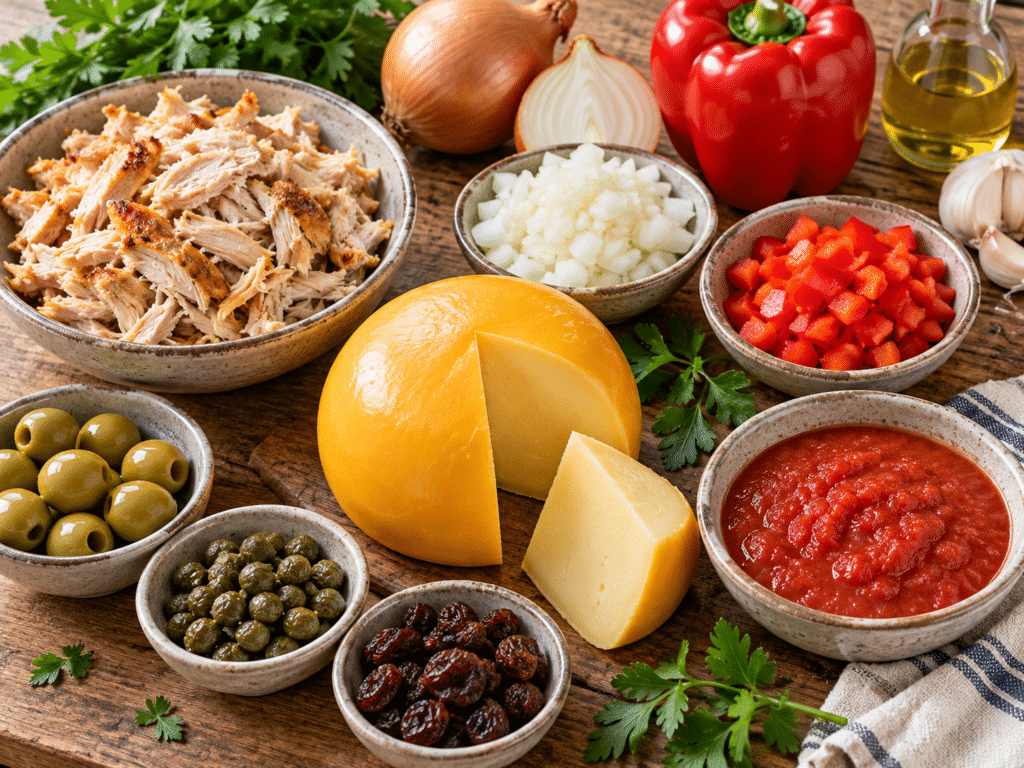
Ingrédients du keshi yena : fromage, viande, olives et raisins secs
Ingrédients traditionnels utilisés pour préparer le keshi yena, plat national de Curaçao : fromage, viande épicée, olives, câpres et raisins secs.
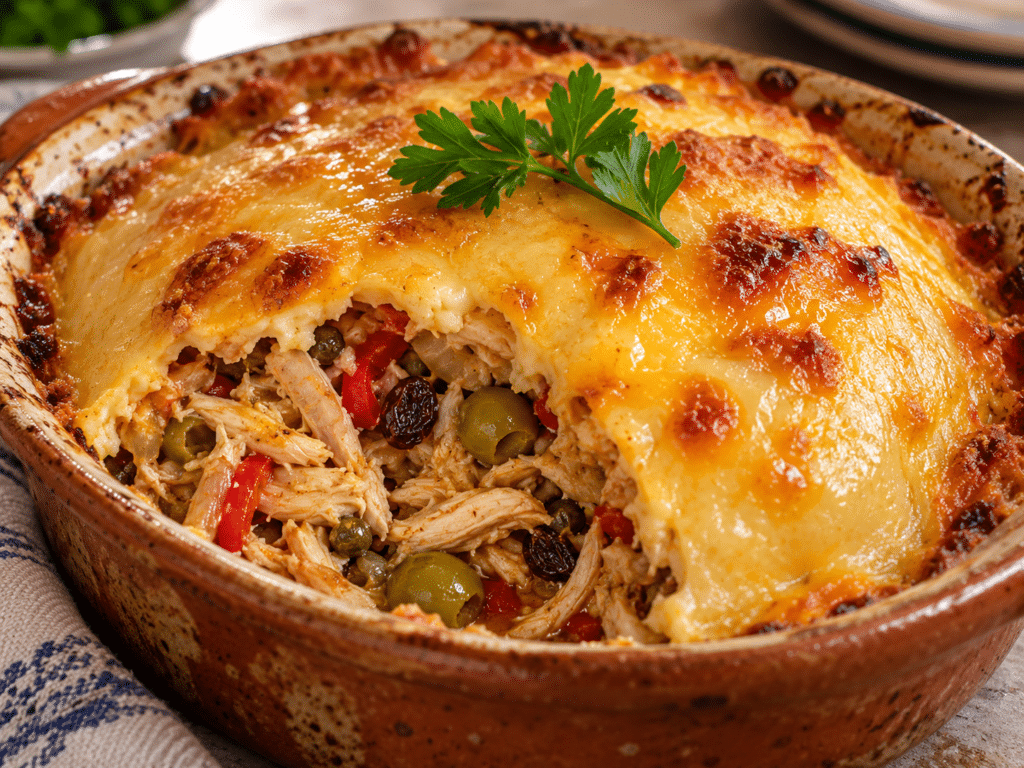
Keshi yena, fromage farci cuit au four, coupé pour révéler sa farce
Le keshi yena tout juste sorti du four, sa croûte fondante cédant sous la fourchette pour révéler la farce généreuse.

The story of an act born of compulsion

According to the story passed down in Curaçao, the keshi yena originated in the kitchens of the plantations, where enslaved people prepared meals for their colonial masters. Once the insides of the Gouda and Edam cheese wheels had been eaten, they left behind a shell of rind that the colonists considered worthless. According to this story, rather than throwing it away, the cooks filled it with leftover meat, vegetables, and spices from the table, then baked it again.

To date, no dated institutional source has made it possible to confirm exactly when this tradition began, but the story has been consistently passed down from one generation of Curaçaoans to the next, to the point that it shapes the way the island itself recounts the origins of this dish.

Curaçao, a hub of Dutch trade

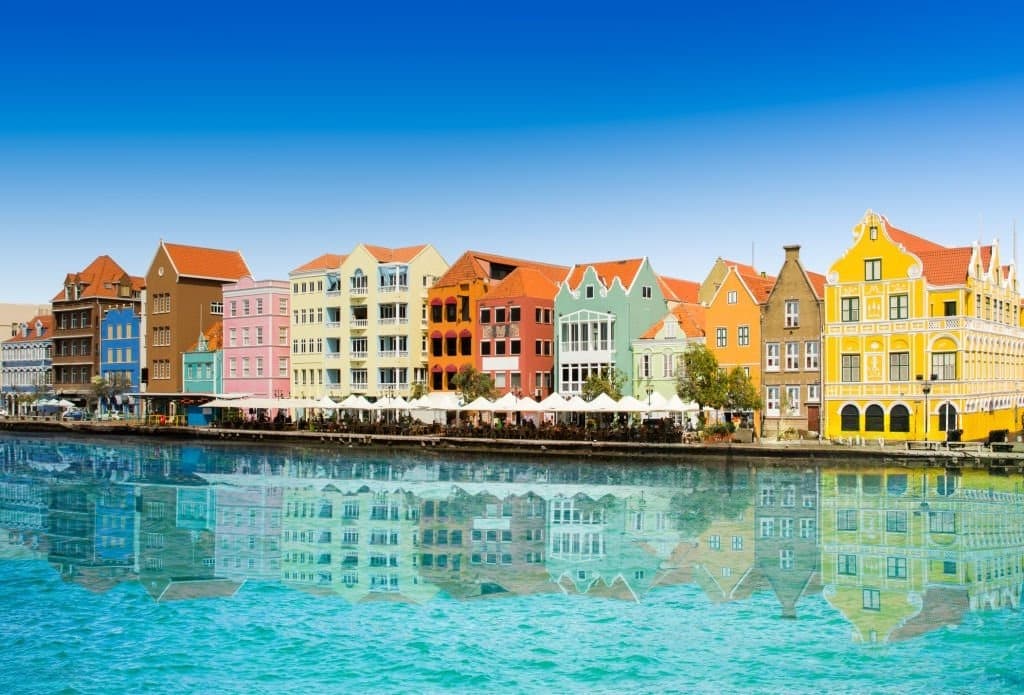
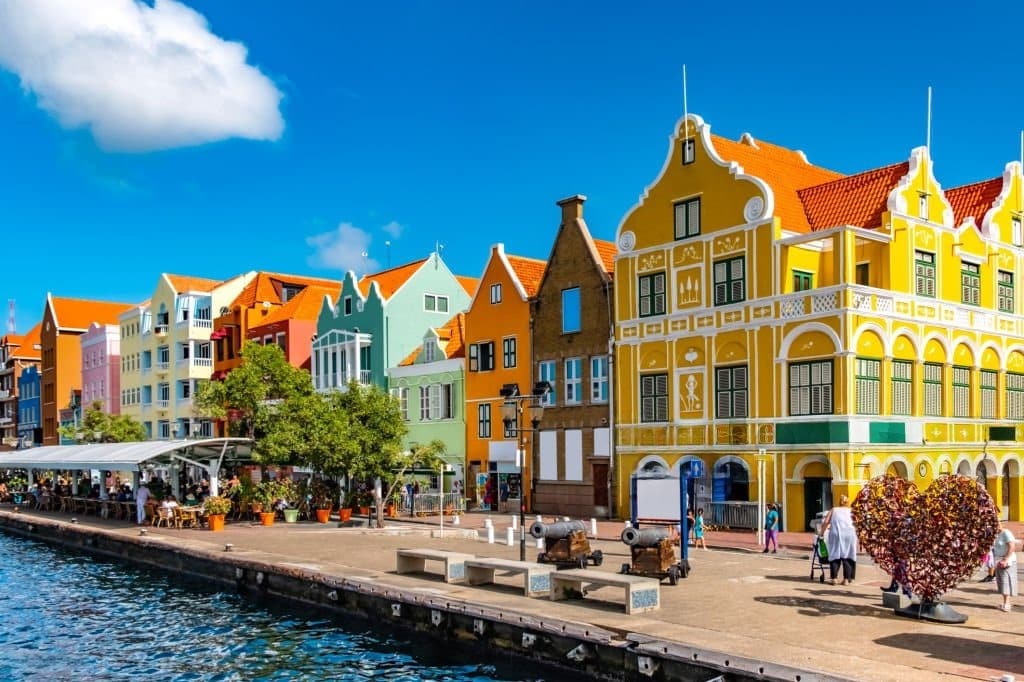
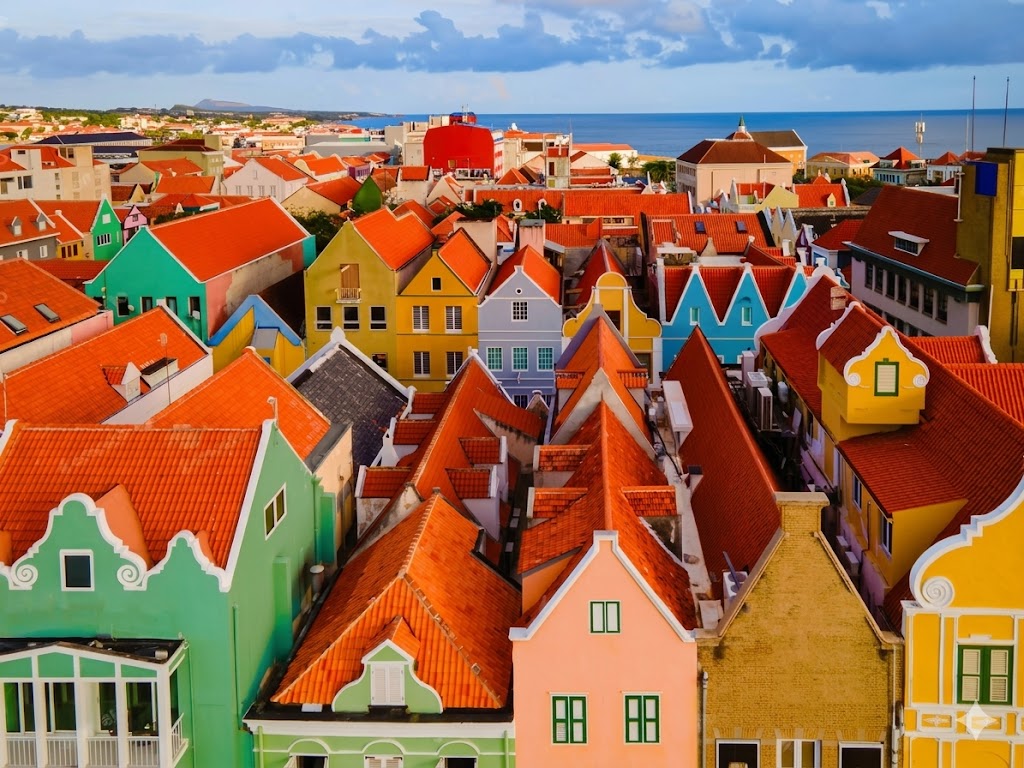
This story takes on its full meaning when viewed within the context of the island’s history. Starting in the seventeenth century, Curaçao played a central role in the Atlantic trade organized by the Netherlands, including the trade in enslaved Africans, who passed through the island before being sent on to other colonies. Willemstad, the capital, still retains its mercantile architecture today, with its colorful facades inherited from Dutch trade.

Keshi yena emerged from this forced encounter between dairy products from Northern Europe and an African workforce that had asked for nothing to do with this trade, yet transformed what was once waste into a dish. Curaçao, already chronicled by Richès Karayib through the Tula revolt, still bears the traces of this Dutch colonial history today.

A dish that Curaçao shares with Aruba

Keshi yena isn’t limited to Curaçao. The neighboring island of Aruba, which shares a similar Dutch colonial history with Curaçao, also claims this stuffed cheese as its own national dish. Both islands follow the same basic recipe, with slight variations from household to household, and neither is willing to yield to the other. Rather than a rivalry, this shared tradition speaks to the Dutch-speaking region of the Caribbean—a common act of cultural appropriation, born out of a shared colonial context, adopted and claimed as their own identity by two distinct territories.

Keshi yena servi à l'assiette avec riz et accompagnements
Le keshi yena servi à l'assiette, avec du riz et des accompagnements, tel qu'on le retrouve sur les tables de fête à Curaçao et à Aruba.

From the Kitchen of Necessity to the Festive Table

Today’s keshi yena bears little resemblance to a dish born of necessity. Over time, the filling has become more elaborate, featuring simmered chicken or beef, raisins, olives, and sometimes prunes, creating a sweet-and-savory balance that sets the dish apart from any other meat pie in the region. Some cooks still bake it in a whole wheel of cheese, just as they did in the old days, while others, short on time, make do with a baking dish or ramekin lined with slices of cheese. The result is unmistakable: a flaky crust that crumbles under the fork to reveal a generous filling.

What the Keshi Yena Continues to Bring Together

Keshi yena no longer belongs to anyone in particular—neither to the colonists whose name it bears, nor to the cooks who invented it out of necessity. Today it belongs to the dining tables of Curaçao and Aruba, where it continues to bring families together around a tradition inherited in spite of itself. It remains to be seen how many Curaçaoan households continue to hollow out an entire melon rather than taking the shortcut of using a ramekin—and what that says about the way an island chooses to remember. Curaçao, already chronicled by Richès Karayib through The Career of Curaçaoan Artist David Paulus, continues to bring to life an identity that is expressed through both art and cuisine.

Keshi yena is a Gouda or Edam cheese that has been hollowed out and stuffed with stewed meat, olives, and raisins; it is considered a national dish in Curaçao and Aruba.

The name comes from Papiamento, the Creole language of Curaçao; “keshi” means “cheese,” borrowed from the Dutch word “kaas,” and “yena” means “stuffed.”

According to a story passed down in Curaçao, the dish originated in plantation kitchens, when enslaved people reused the cheese rinds discarded by Dutch colonists to fill them with leftover meat.

At the Curaçao Museum, faces seem to speak to one another. Some are familiar; others evoke families, trades, stories, and expressions passed down through the generations. Since August 20, 2026, the exhibition “Rumbo i Raís” has brought together more than 100 works: portraits, mixed-media pieces, and three-dimensional creations. Through this collection, David Paulus reflects on his native island, its people, and the memories that continue to shape Curaçao.

The exhibition serves as a meeting point for various aspects of her career. Fashion, visual arts, performance, teaching, and family history all intersect here. Behind the works, a single question keeps recurring: Where do we come from, who shapes us, and what do we choose to pass on?

David Paulus

First Aid in Curaçao

Born in 1986 and raised in Curaçao, David Paulus says he discovered the joy of creating at an early age. As a child, he helped his mother make dolls to sell and watched his grandmother sew her own dresses. He also remembers small fashion shows held in the garden. Today, these domestic activities take on a new significance. They place creativity at the heart of a family tradition, even before it became a profession. Based in the Netherlands since 2003, the artist has built a world in which clothing, imagery, and staging interact.

David Paulus

Fashion as a Testing Ground

David Paulus identifies as an Afro-Caribbean artist and works at the intersection of several disciplines. In fashion, he develops what he calls “Art Couture.” His creations do more than simply clothe; they construct characters, atmospheres, and narratives.

This approach has led him to participate in various events, including Fashion Weeks in Amsterdam, London, Paris, and Curaçao. He also conceives his presentations as performances, with a focus on the models, music, set design, and choreography. This freedom allows him to gradually move beyond the traditional framework of clothing. For him, fashion becomes one language among many, capable of conveying a memory or questioning an identity.

When Roots Become the Subject

In April 2025, the “Paga Tera” clearly pointed in this direction. Presented in Amsterdam, it brought together fashion, identity, family narratives, and Curaçao’s heritage. David Paulus explained at the time that his work also serves to honor the stories of his ancestors and the Afro-Caribbean diaspora. Clothing is therefore no longer merely a form of spectacle. It becomes a medium for looking back, questioning what has been passed down, and bringing to light cultural references that are sometimes absent from mainstream fashion circles.

This research also ties in with his interest in arts education. After largely teaching himself, he began training in the Netherlands to become a teacher of visual arts and design. During a stay in Curaçao in 2023, he focused in particular on new ways to integrate creativity into the local education system.

More than a hundred works, a collective memory

With “Rumbo i Raís”, David Paulus takes this reflection a step further. The Curaçao Museum presents the exhibition as a dialogue between historical legacies, contemporary voices, personal memories, and collective history. The people depicted do not claim to represent the entirety of Curaçaoan society. They constitute an artistic selection shaped by the artist’s research, encounters, and perspective.

This choice is essential. It prevents the exhibition from becoming an official inventory of Curaçao. Instead, the portraits serve as gateways to broader stories—those of families, generations, and cultural references that continue to resonate today.

David Paulus

David Paulus: Between Leadership and His Roots

The title “Rumbo i Raís” can be understood as an encounter between direction and roots. These two ideas also sum up David Paulus’s journey. His work evolves, changes form, and spans multiple disciplines, yet it regularly returns to Curaçao. Perhaps that is where his uniqueness lies. He does not choose between fashion and art, between personal creation and transmission. He uses each medium to ask the same question in a different form.

Today, more than a hundred works invite the public to recognize a face, a story, or a part of themselves. But behind this recognition lies a deeper question. If our roots help define our path, what will we, in turn, choose to leave for future generations? Discover David Paulus, an artist from Curaçao, his journey through Art Couture, memory, and identity, and his exhibition *Rumbo i Raís* at the Curaçao Museum in 2026.

David Paulus is an Afro-Caribbean artist born and raised in Curaçao. His work spans fashion, Art Couture, and the visual arts, with a particular focus on identity, roots, and cultural transmission.

Rumbo i Raís is an exhibition by David Paulus on view at the Curaçao Museum since August 20, 2026. It features more than 100 works, including portraits, mixed-media pieces, and three-dimensional works exploring the themes of memory and Curaçao’s roots.

Curaçao’s roots run deep throughout David Paulus’s artistic journey. His works explore family histories, ancestors, Afro-Caribbean identity, and what each generation chooses to pass on to the next.

In Curaçao, Ser’i Neger today bears witness to the history of the former Fontein plantation. On August 25, 1795, this landscape became one of the main theaters of the revolt led by Tula against slavery. Two hundred thirty-one years later, the story of this battle has returned to the forefront, along with an urgent heritage issue. How can we preserve a site where a crucial chapter in Curaçao’s struggle for freedom was written?

On August 17, 1795, it all began in Kenepa

Eight days before the Battle of Ser’i Neger, the revolt began at the Kenepa plantation, now also known as Knip. On August 17, enslaved people, led by Tula, refused to return to work and demanded their freedom. The official website of Curaçao describes this event as the beginning of the most significant resistance to slavery in the island’s history.

The movement was not limited to Kenepa. The insurgents spread to other plantations, freed prisoners, and sought out weapons and food. According to a historical account preserved by the Digitale Bibliotheek voor de Nederlandse Letteren, the group grew rapidly. In Portomarí, colonial forces attempted to regain control, but an attack launched on August 19 was repelled. The revolt then took on a scale that the authorities could no longer consider an isolated incident.

Ser’i Neger

Ser’i Neger, the site of a decisive battle

After further clashes, the fighters regrouped on the hill known as Ser’i Neger, in the Fontein region. The terrain provided them with a position from which they could resist the forces sent against them. Attempts at negotiation took place. An offer of amnesty was made on the condition that the insurgents return to work. It was rejected. Their demand remains the same: freedom.

On August 25, 1795, colonial forces launched a new attack on Ser’i Neger. The clash was violent. The Antilliaans Dagblad reported that more than 100 enslaved people lost their lives there. Faced with better-armed and more numerous troops, the resistance fighters eventually abandoned the high ground and retreated toward the Mount Christoffel region. The battle did not immediately put an end to the revolt. The resistance continued for several more weeks before its main leaders were gradually arrested. Tula was eventually captured and then executed along with other fighters.

Ser’i Neger
dav

Ser’i Neger: A Landscape That Has Become a Heritage Site

Ser’i Neger is therefore not just a name associated with Tula. The site preserves the physical traces of a pivotal episode in Curaçao’s history. That is precisely what gives it its heritage value today. Unlike a museum or a monument built to commemorate an event, the heritage here is the land itself, a hill, a landscape, a place where men and women resisted, fought, and lost their lives.

This aspect explains the repeated calls for protection. As early as 2006, several heritage organizations called for formal recognition of the site. In 2018, part of the hillside was damaged, resulting, according to the *Antilliaans Dagblad*, in a loss of cultural and archaeological value. The Monumentenraad now hopes that Ser’i Neger will be recognized as a true “Place of Memory,” dedicated to education, the transmission of knowledge, and the commemoration of the history of slavery.

From Tula to the Collective Memory

Tula’s place in official history has itself evolved. In 2010, Curaçao recognized Tula and the other fighters of 1795 as heroes of the resistance. In 2023, the Dutch government also granted Tula official rehabilitation. These recognitions lend particular significance to the current debate. Honoring a historical figure is one step. Preserving the sites where his struggle took place is another.

In August 2026, the Monumentenraad once again called on the government to move forward with the acquisition and protection of Ser’i Neger. Questions were also raised in the Curaçao Parliament regarding its recognition as a site of remembrance. Two hundred thirty-one years after the battle, Ser’i Neger thus connects history, territory, and the passing down of heritage. Preserving this hill means preserving more than just a landscape. It means enabling future generations to know where, in 1795, men and women turned a demand for freedom into resistance. And why this place continues today to challenge Curaçao to reflect on what it chooses to pass on to tomorrow.

Ser’i Neger
Tula Museum, Landhuis Knip Crédit photo, Kattiel / Wikimedia Commons, CC BY-SA 4.0

Ser’i Neger is associated with the 1795 revolt led by Tula against slavery in Curaçao. On August 25, 1795, the site was the scene of a major clash between the insurgents and colonial forces.

The battle resulted in heavy casualties and stands as one of the defining moments of the revolt led by Tula.

The preservation of Ser’i Neger aims to safeguard a site directly linked to the history of slavery and resistance on Curaçao. Heritage advocates, in particular, hope to turn it into a space for remembrance, education, and the passing down of knowledge.

For the first time, Curaçao welcomed more than 400,000 overnight tourists during the first six months of a year. Between January and June 2026, the island recorded 437,086 visitors, a 9% increase compared to the same period in 2025. This is a historic figure. But it doesn’t yet tell the whole story: how can this growth create more value for residents, local businesses, and the island?

Curaçao

Curaçao Reaches a New Milestone

The month of June confirmed this trend. The island welcomed 62,867 overnight visitors, compared with 57,413 a year earlier. These arrivals generated 497,426 overnight stays, up 12%, while the average length of stay reached 7.9 nights. This detail is important. A destination doesn’t just benefit when it attracts more travelers. It benefits most when those visitors stay longer, shop at local businesses, dine at restaurants, choose local activities, and spend their money beyond the major tourist complexes.

In June, 54% of travelers stayed in hotels or resorts, compared with 46% who stayed in alternative accommodations. This near-parity shows that tourism Curaçao is no longer limited to traditional housing providers. It opens up opportunities for smaller providers, but also raises questions about short-term rentals and access to housing.

Curaçao
Curaçao

Markets that don't experience the island in the same way

The Netherlands remains the top source market for tourism. In June, 20,029 Dutch visitors stayed on the island, a 22% increase from the previous year. Their average length of stay was 12.1 nights, significantly longer than that of American or Colombian visitors. The United States ranked second with 16,070 arrivals, despite a 6% decline. According to the Curaçao Tourist Board, this temporary decline is believed to be linked in part to residents who traveled to follow the national team during the World Cup. Some of the available airline seats were reportedly used for departures from the island during that time.

Colombia, for its part, continues to gain momentum, with 7,144 visitors in June—a 24% increase. This growth underscores the geographic proximity of Curaçao along with South America and the growing role of Latin American markets.

Curaçao
Curaçao

A more diverse audience

For the first half of the year as a whole, the Netherlands accounted for 31% of arrivals, ahead of the United States at 27%. Canada and Colombia each accounted for 7%, Brazil for 5%, and Argentina for 4%. This diversification reduces dependence on a single source of travelers. It also requires tourism stakeholders to adapt flight routes, the languages used, cultural offerings, and the services provided. For the island, therefore, the challenge is no longer simply to attract more tourists. It is to better understand their profiles, their travel habits, and their actual contribution to the local economy.

Curaçao

A record alone is not enough to measure success

Tourism supports the hospitality industry, restaurants, transportation, and numerous services. But a rapid increase in visitor numbers also leads to greater demand for water, energy, transportation, housing, and waste management. This is where the record takes on a different nature. It becomes an indicator of success, but also a test of capacity. An island can welcome more visitors while undermining its ecological balance if infrastructure, skilled jobs, and local resources do not keep pace.

The real added value will therefore be seen elsewhere: in the number of jobs created, the portion of spending that stays in the local economy, the growth of local businesses, and the preservation of cultural heritage.

Curaçao
Curaçao

Beyond the Numbers: The Question of the Model

The first half of 2026 confirms Curaçao’s international appeal. Markets are diversifying, overnight stays are on the rise, and the average length of stay is increasing. But the next key indicator may not be a new record for arrivals. We will need to assess what this growth actually means for residents. Welcoming 437,086 visitors in six months is a historic achievement. Turning this visitor traffic into a sustainable driver of growth for Curaçao would be an even greater success.

Curaçao welcomed 437,086 overnight visitors between January and June 2026. This represents a 9% increase compared to the same period in 2025 and is the best first half-year for tourism the island has ever recorded.

The Netherlands remains Curaçao’s largest market, followed by the United States. Canada, Colombia, Brazil, and Argentina are also contributing to tourism growth, reflecting a gradual diversification of visitors.

This growth supports the hospitality, restaurant, and transportation sectors, as well as many local businesses. However, it also increases the demand for housing, water, energy, transportation, and waste management. The main challenge, therefore, is to turn this record growth into sustainable benefits for residents and the local economy.

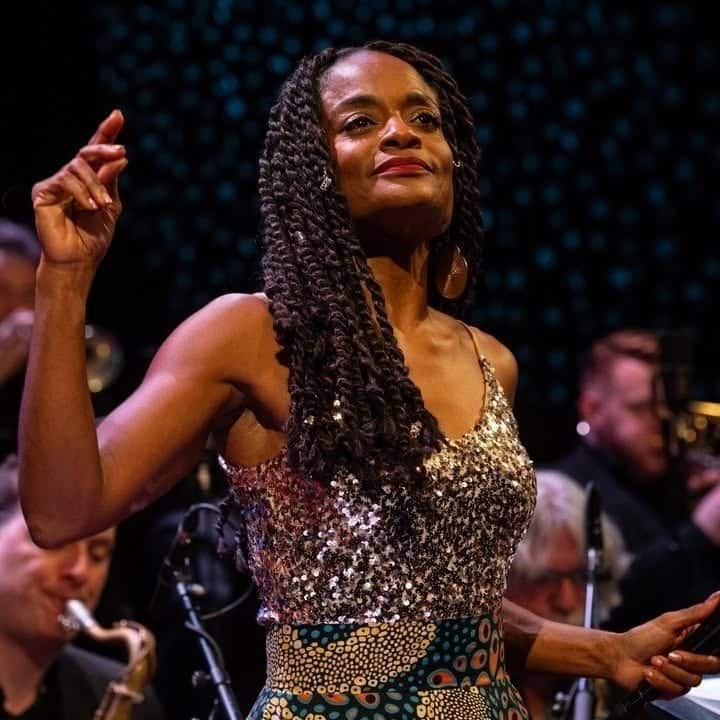
For Izaline Calister, a performance often begins with a language. Even before jazz, before the arrangements, before European recognition, there is this simple yet powerful choice: to sing in Papiamentu, the language of Curaçao. Her voice is a memory, a rhythm, a way of inhabiting the world.

Born in Curaçao in 1969, Izaline Calister has forged a unique path between the Dutch-speaking Caribbean and the Netherlands. As a singer, composer, and lyricist, she has established Papiamentu as a musical genre in its own right. Her story also raises a broader question: how can a minority language spread without losing its roots?

A Childhood Between Voices and an Island

Before the big stages, there’s Curaçao. An island where languages intersect every day. Papiamentu coexists there with Dutch, English, and Spanish. But on the street, within families, and in certain aspects of cultural life, Papiamentu remains a language of intimacy—a language of gestures, memories, and everyday conversations.

Izaline Calister grew up in this world of sound. Her relationship with music began at a very early age. As a child, she sang in the Perlitas choir, which was associated with composer Rudy Plaate. This detail matters. It already places her journey in direct connection with the music of Curaçao—not merely as a backdrop, but as a living force.

At age 18, she left the island for the Netherlands. Her departure could have distanced her from Curaçao. Instead, it made her connection to the island even more apparent. In Groningen, she first studied business administration at the university, then jazz and pop at the Prince Claus Conservatory. That’s when two worlds collided: the discipline of a European education and the rhythmic heritage of her native island.

Izaline Calister
Izaline Calister

Choosing a Language

In Izaline Calister’s career, Papiamentu is an artistic choice. At a time when many Caribbean artists turn to English, French, or Spanish to reach a wider audience, she’s taking a different path. She sings in a language that not everyone understands, but that many can feel.

This choice gives her work a unique character. Her songs blend jazz, Afro-Caribbean rhythms, and Curaçaoan traditions. You can hear the fluidity of jazz, but also deeper, more ancient roots. The tambú—a rhythmic style of Curaçaoan music linked to African heritage—plays a significant role in her musical world. For her, this material is not static. It flows, changes form, takes the stage, and interacts with other sounds.

Izaline Calister does not turn Curaçao into a vague symbol of the Caribbean. She draws on a specific place, a specific language, and a specific memory. And it is precisely this specificity that makes her work accessible beyond the island.

Izaline Calister
Izaline Calister

Speransa, the Turning Point

Izaline Calister has long been a familiar name on the jazz and world music scenes. Her first solo album, *Soño di un muhé*, was released in 2000. Other projects followed, all with the same goal: to showcase the music of Curaçao without confining it to the folk genre.

In 2009, her album *Speransa* won the Edison Award in the World Music category. The title means “hope.” It’s a powerful symbol. Through this album, a Caribbean language that is often underrepresented on major European stages receives significant recognition. This award does not sum up his career, but it marks a turning point. It confirms that his work can reach a wide audience without losing touch with its roots.

This recognition also says something about the place of Caribbean artists in the world. Visibility alone is not enough. One must be able to be visible through one’s language, references, silences, and rhythms. Izaline Calister shows that this fidelity can become a strength.

An Artist Between Memory and Transmission

Her career extends beyond albums. In 2007, a documentary titled *Lady Sings the Tambú* was made about her. The title captures part of her artistic identity: a singer trained in jazz, yet deeply influenced by the rhythms of Curaçao.

More recently, her show *Tula en Juliet* opens up a new space. Through this production, Izaline Calister connects the story of Tula—a major figure in the slave revolt on Curaçao—to that of Juliet, her great-great-grandmother, who was born into slavery and witnessed the 1863 abolition of slavery on the island. Here, music becomes family memory. She seeks a lineage, a wound, a presence.

This aspect adds depth to her portrait. Izaline Calister is a renowned singer, but she is also an artist who explores what we convey when we sing. A language can carry a melody. It can also convey a story that archives alone cannot fully bring to life.

Izaline Calister
Izaline Calister

Why Izaline Calister Matters

In the Caribbean, some languages exist in a space between deep-rooted significance and limited visibility. Papiamentu is one of these powerful languages—spoken, sung, and thought in—yet still too little known outside its homeland. By using it as her stage language, Izaline Calister gives it a platform to be heard.

That is what makes her journey so valuable. She doesn’t ask the audience to forget the difference. She invites them to listen to it. Even without understanding every word, one can sense the warmth of a phrase, the tension of a rhythm, and the gentleness of a language that refuses to disappear amid the clamor of dominant languages.

Curaçao does not appear here as a distant island on the regional map. It is revealed through its voice. Through its Papiamentu. Through an artist who has chosen to share her island with the world without diluting its identity. And perhaps that is where Izaline Calister’s true strength lies: in reminding us that a local language can take the world stage—provided a voice dares to carry it that far.

Izaline Calister is a singer, composer, and songwriter from Curaçao. Born in 1969, she has built a career spanning her native island and the Netherlands, blending jazz, Afro-Caribbean rhythms, and the musical traditions of Curaçao. She is best known for her bold artistic choice: singing in Papiamentu, the language of Curaçao, and turning it into a true musical medium.

Izaline Calister sings in Papiamentu because this language embodies an essential part of her cultural identity. In her work, Papiamentu is not just a language of everyday speech; it becomes a language of the stage, of memory, and of cultural transmission. This choice allows Curaçao to exist musically beyond its borders, without losing its unique character.

The connection between Izaline Calister, Curaçao, and Caribbean heritage is forged through language, rhythms, and history. Her musical world incorporates, in particular, the tambú, a rhythmic tradition from Curaçao linked to its African heritage. With projects such as Tula as Juliet, she also connects music to the history of slavery, family memories, and figures of resistance from her island.

For 22 years, the Soul Beach Music Festival has been synonymous with Aruba. High-end R&B, bright beaches, American comedy, Memorial Day Weekend, all set against a backdrop of palm trees. In 2026, the event is moving. From May 20 to 25, this year’s festival will be held in Curaçao, 80 kilometers from its historic home port. The changeover is not insignificant.

Curaçao in the spotlight

The new address has a precise name: Capital C Dome, in Willemstad, the capital of Curaçao. The choice of the island is no accident. In January 2026, USA Today ranked Curaçao as the top Caribbean destination in its annual rankings, a title that Soul Beach Music Festival organizers now explicitly use in their promotional communications. “You voted Curaçao number 1 in the Caribbean, find out why”, reads the headline on the festival’s official website.

Soul Beach Music Festival

The Soul Beach Music Festival 2026 promises what has made it such a success since the early 2000s: a mix of R&B concerts with American headliners, high-end stand-up comedy shows, DJ nights, and seaside pool parties. Six days, several venues, a dense program designed for the long American Memorial Day Weekend, which traditionally marks the start of the high season for Caribbean tourism from North America.

Soul Beach Music Festival

A new chapter for Soul Beach Music Fest

The uniqueness of the Soul Beach Music Festival deserves to be precisely named. In the crowded landscape of Caribbean festivals: Saint Lucia Jazz, Barbados Reggae Weekend, Curaçao North Sea Jazz, Antigua Carnival, Soul Beach Music Festival occupies a clear niche: the affluent, young-adult to middle-aged African-American diaspora, who want a precise cocktail of music, sunshine and cultural identity. Soul Beach Music Festival is neither purely Caribbean nor purely American. It’s exactly at the intersection, and that’s what makes it so powerful.

Soul Beach Music Festival

The move to Curacao doesn’t erase Aruba. The island of low-lying coasts and long beaches remains the historic birthplace of the festival, and many local voices view the move with a certain nostalgia. But Curaçao brings something else to the table. The island, some 444 km² with a population of 152,000, boasts one of the best-preserved city centers in the Netherlands Antilles. Willemstad was designated a UNESCO World Heritage Site in 1997. The colorful facades of Punda and Otrobanda, the Queen Emma Bridge, the floating market – Curaçao has an urban scene that Aruba does not.

Soul Beach Music Festival

This change of scenery also poses challenges. Curacao’s hotel industry is more dispersed than Aruba’s, which concentrates its capacity on the west coast. Air traffic between the United States and Curacao is less dense than to Aruba. Historically, Aruba has one of the highest air frequency rates with the USA for a Caribbean island of its size. The organizers have anticipated this by adding partnerships with specific airlines for the duration of the festival.

Soul Beach Music Festival
@ticketpointcuracao.com

A dynamic in full effervescence

Alongside the official Soul Beach, a parallel event organized by a different team: Aruba Soul Fest continues to be held in Aruba from May 20 to 25, 2026, with its own program. This friendly competition is not without interest for the region: two R&B festivals on two neighboring islands on the same Memorial Day Weekend, that’s a density of offerings unheard of in the Dutch Caribbean.

For Curaçao, the stakes go beyond the 2026 edition. If the festival takes up permanent residence in Willemstad, which the organizers have not yet officially confirmed, the island could claim a new status on the Caribbean cultural map. The UNESCO Center, the Curaçao Carnival (one of the longest in the world at 9 weeks), the North Sea Jazz Festival, and now Soul Beach. Four cultural pillars is exactly the format that structures a perennial cultural destination.

Next week, from May 22 to 27, Grenada takes over the media spotlight with its Chocolate Festival. The Caribbean follows on. Six islands, six identities, six successive events. If you follow RK, you already know what you need to know.

The Soul Beach Music Festival is a musical and cultural event combining R&B concerts, stand-up comedy shows, DJ nights and pool parties. For over 20 years, it has attracted a predominantly African-American audience for a premium Caribbean experience.

After 22 years in Aruba, the organizers chose Curaçao to provide a new setting for the festival and take advantage of the island’s growing international profile.

No, Soul Beach combines music, humor, nightlife, tourism and lifestyle experiences in a festive, premium atmosphere.

Dushi, in Papiamento, can mean sweet, good, pleasant, tasty or darling. In the ABC islands of Aruba, Bonaire and Curaçao, this word circulates between the street, the kitchen, music and intimacy. It’s a Caribbean way of recognizing what feels good.

A word heard in everyday life

If you step off the plane in Aruba, Bonaire or Curaçao, you’ll soon hear it. On a sign, in a conversation, on a T-shirt, at a snack bar, at the market, in a song. A shop assistant may talk about a dushi cake. A mother may call her child dushi. A friend may say that an evening was dushi, not because it was spectacular, but because it left a good warmth in the memory.

Dushi
Dushi

Translation is not enough

Translation helps, but it’s never quite enough. Dushi comes close to “soft”, “sweet”, “good”, “delicious”, “lovable”, “darling”. Yet none of these words really covers all her territory. The same word can describe a beloved person, a successful dish, a pleasant moment, a familiar landscape or a way of being. Its strength lies precisely in this flexibility. The word doesn’t classify. It connects.

In everyday speech, the word doesn’t always have the same intensity. It can be tender, familial, greedy, friendly or simply positive. That’s why it’s important to understand it within the sentence, depending on the tone, the connection and the situation.

Papiamento or papiamentu: a language of passages

In the ABC islands, the language also carries this history of passages. We generally write Papiamento in Aruba, and Papiamentu in Curaçao and Bonaire. This spelling difference does not erase a common base. It is a reminder that the language was built in societies that were close, but never identical.

Linguists describe Papiamento as a Creole with an Ibero-Romance base, marked by Portuguese, Spanish and Dutch, with other contributions from Caribbean and Atlantic circulations. Its history began in Curaçao. The work of linguist Bart Jacobs places the emergence of Papiamentu in the second half of the 17th century, following the capture of Curaçao by the Dutch West India Company in 1634. The result is not a museum language. It’s a language of family, commerce, song, cooking and school.

Dushi

Important official recognition

Papiamento’s institutional status also reflects its cultural significance. In Aruba, it has been recognized as an official language alongside Dutch since 2003. In Curaçao, Papiamentu is an official language alongside Dutch and English. On Bonaire, in the Caribbean Netherlands, Papiamento is also recognized in public life, notably in education, administrative dealings and the judicial system.

What the word says about the ABC islands

Dushi becomes more than just a pretty word. It condenses a way of talking about the world without separating the emotional from the concrete. A coffee can taste good. A person can be dear. A song can strike a chord. The word doesn’t have to choose between heart, body and palate.

Other islands have their own words of tenderness. In Martinique and Guadeloupe, “doudou” can refer to a loved one. In Caribbean English, “sweet” can mean pleasure, taste, enjoyment. But Dushi, in the ABC islands, retains a particular amplitude. It moves from sentiment to food, from person to place, from intimate detail to collective identity.

Dushi
Dushi
Dushi

An intimate word becomes a collective symbol

In Aruba, this dimension is visible right down to the national anthem Aruba Dushi Tera, adopted with the flag on March 18, 1976. Here, the word is not just an affectionate adjective. It qualifies the land itself. It transforms the island into a beloved presence. That’s why we must avoid reducing the word to a tourist slogan. Before it was printed on objects, it was already circulating in people’s voices.

Perhaps that’s where its uniqueness lies. Dushi doesn’t try to impress. He recognizes what’s important: a simple meal, a special person, an island that’s sweetly named. And next week, RK Words changes horizons: heading for Trinidad, with “lime”, a verb that describes the Caribbean art of spending time together without a precise agenda.

Dushi can mean sweet, good, tasty, pleasant or cherished, depending on the context. In the ABC Islands, the word can refer to a loved one, a successful dish, a touching song or a pleasant moment.

Dushi is mainly used in Aruba, Bonaire and Curaçao, the three ABC islands. The word belongs to Papiamento or Papiamentu, a Creole language spoken in this Dutch-speaking part of the Caribbean.

Dushi is more than just a translation. It expresses an emotional relationship with daily life, food, people and land. In Aruba, it even appears in the national anthem Aruba Dushi Tera, where it describes the island as a beloved land.

On Saturday March 28, at the Centre Aquatique Pierre Samot in Le Lamentin, the CARIFTA Aquatics Championships 2026 press conference was more than just an information meeting. Over the course of an hour and a half, organizers, athletes and partners presented much more than just the sporting program: from April 3 to 8, Martinique will host the 39th edition of the Caribbean’s leading junior aquatic event, ten years after the first edition was so memorable. Twenty-four nations. Three disciplines. A home territory that knows it.

A bid driven by collective memory

In 2024, at the Caribbean Aquatics Association Congress held in the Bahamas, two bids were put forward to host the 2026 CARIFTA Aquatics Championships: Saint Lucia and Martinique. The vote was clear-cut: some thirty votes for Martinique, ten for Saint Lucia.

Behind this result is a story. The 2016 edition, the first ever to be held on home soil, left its mark on the minds of all those who were there: coaches, delegation leaders, officials. In 2024, when it came time to vote, many still remembered that week.

"It was a beautiful edition, and one that will always be remembered."

CARIFTA Aquatics Championships 2026

The other factor was more concrete: Sainte-Lucie did not yet have its own pool. Martinique, on the other hand, can count on the Centre Aquatique Pierre Samot in Le Lamentin, with its ten-lane Olympic pool, 800-seat grandstand and 25-meter warm-up pool. One of the best facilities in the Caribbean.

The organization also emphasized its capacity to welcome delegations from outside the basin, with several accommodation solutions mobilized in the south of the island, supplemented by other structures if necessary. This logistical aspect, rarely secondary in this type of event, reinforced the credibility of Martinique’s bid.

CARIFTA Aquatics Championships 2026

Three disciplines, 24 nations, a demanding format

The CARIFTA Aquatics Championships 2026 will bring together 24 countries: 21 English-speaking Caribbean nations, plus Martinique, Guadeloupe and Guyana. The swimming races will take place over four days: heats in the morning, finals in the afternoon, from Saturday April 5 to Tuesday April 8. Artistic swimming gets underway on Monday during the lunch break, with solos followed by technical events. The duets and teams round off the program on Wednesday morning. On the same Wednesday, the open water event takes place over five kilometers in the Anses d’Arlets.

Competitors: Benjamins (11-12 years), Minimes (13-14 years), Cadets (15-17 years) do not enter as individuals. They are national selections, with the best swimmers from each territory. To enter the Martinique selection, swimmers must satisfy a time grid established over the previous two seasons, which only selects swimmers capable of reaching the finals.

CARIFTA Aquatics Championships 2026

In the minds of the organizers, selection is based on a simple logic: to score points, you have to enter the final, and to enter the final, you have to be among the top eight times in the morning heats. In other words, the swimmers selected are supposed to have a level that enables them to play a real role in the competition, and not just participate.

The Martinique delegation at the CARIFTA Aquatics Championships 2026 has 61 swimmers: 36 in racing, 12 in open water, five of whom also race, and 18 in artistic swimming. The team is led by five captains: Jean-Naël Zozime and Maxime Auguste-Charlery for boys’ racing (15-17 age group), Cyrielle Manin and Sayanne Guivissa for girls’ racing, and Nohemy Marajo for artistic swimming.

Water as starting point and destination

When asked how he got started, Jean-Naël Zozime, captain of the boys’ selection, answers straightforwardly: “I was introduced to swimming so that I wouldn’t drown. Cyrielle Manin, captain of the girls’ selection, tells much the same story: she almost drowned as a child, and that’s what led her to learn to swim.

CARIFTA Aquatics Championships 2026
Cyrielle Manin

These two testimonies, heard just a few minutes apart, say something important about this territory. Two young Martiniquans, initially frightened by the sea, who are now representing their island against twenty-three Caribbean nations. This is more than just a sporting achievement.

"Swimming is a tough sport. You can't expect it to be easy, but with a lot of perseverance, anyone can do it."

CARIFTA Aquatics Championships 2026
Jean-Nael Zozime

Nohemy Marajo, artistic swimming captain, has been practicing for ten years a discipline that the public still knows little about. She explains it concretely: learning choreographies on dry land, rehearsing them in the water, controlling your breathing under the surface while your legs draw figures above. It’s a sport that’s as technically demanding as it is physically demanding, and has as much to do with ballet as it does with endurance.

"You have to know how to endure, how to save every last breath to finish the choreography."

CARIFTA Aquatics Championships 2026
Nohémy Marajo

The conference of the CARIFTA Aquatics Championships 2026 also pointed out that artistic swimming is still a confidential discipline in the Caribbean, due to the infrastructure it requires and the level of preparation required. It requires three-dimensional work and very thorough technical preparation, as well as the support of outside professionals, particularly in dance and gymnastic preparation. For the supervisors, the challenge of CARIFTA is twofold: to support those who are already practising and to encourage new vocations.

What the coaching team observes in these youngsters is a constant: they train, take their exams, compete at weekends, and do it all over again. “Generally, swimmers perform well in their studies too, because they’ve worked on this rigor on a daily basis.” What you learn in the pool also applies elsewhere, and the organizers insist on this daily requirement: it’s not enough to qualify, you have to be able to show up on the day, in a sport where regularity and discipline count as much as talent.

Medals from the hands of the island

The way an event rewards its champions often says a lot about what it stands for. At the CARIFTA Aquatics Championships 2026, the medals were made in Martinique from noble woods: pearwood for gold, mao bleu for silver, mao ghani for bronze. A craftsman from the Nord-Atlantique region produced them, Joseph Galliard signed the engravings, and a local seamstress made the pouches in the three colors of the Martinican flag.

CARIFTA Aquatics Championships 2026

The initiative was spearheaded by the event’s godmother, Coralie Balmy, a former top-level swimmer who had taken part in the CARIFTA four times in her career. An eco-responsible and identity-affirming initiative, hailed as a first on the Caribbean scale.

Every Caribbean athlete who reaches the podium at the CARIFTA Aquatics Championships 2026 will leave with a piece of Martinique, a unique medal made by local craftsmen, unlike any other.

Nohémy Marajo
Coralie Balmy

The conference also specified that trophies would accompany these awards, and that the medals had yet to receive their lanyards before the competition opened. Here too, the aim is clear: to make each award a sporting, local and symbolic object.

CARIFTA Aquatics Championships 2026

A week that mobilizes the whole territory

The CARIFTA Aquatics Championships 2026 won’t just be played out in the pools. Between 1,500 and 1,800 people are arriving in Martinique: swimmers, staff and families spread out over several hotels in the south of the island. Every day, around 150 volunteers ensure the smooth running of the event: former swimmers, parents, locals who sometimes have no direct connection with swimming, but who wanted to get involved.

Among them, the officials play a decisive role: some 26 officials from the Caribbean will reinforce the Martinique officials, bringing the number of people around the pool to around fifty for each morning and afternoon meeting. In addition, there will be first-aid attendants, reception teams, people in charge of awards, delegation escorts and areas open to the public.

CARIFTA Aquatics Championships 2026

Welcoming delegations to the CARIFTA Aquatics Championships 2026 was also thought through in detail. They all had to arrive on April 2, at different times of the day, sometimes very early in the morning, sometimes late at night. In conjunction with the transport company and SAMAC, a precise plan was drawn up at the airport to ensure smooth exits, transfers to buses and settling into accommodation, with particular attention paid to meals depending on the time of arrival.

The opening ceremony of the CARIFTA Aquatics Championships 2026, on Friday April 3 at the Georges Gratiant stadium, is free and open to all: 2,800 seats to fill. The group “Nou Pa Sav” will accompany the parade of delegations. On Saturday, April 4, Les Hommes d’Argile will be on hand as the delegations arrive on site, offering a strong cultural backdrop intended as a symbolic first encounter with Martinican identity. Throughout the week, Martinican cultural groups will be on hand to ensure that visitors leave with a living image of the region, not just competition results.

The CARIFTA Aquatics Championships 2026 ceremony is scheduled to take place from 4 to 6 p.m., and will be broadcast on a giant screen, as well as relayed by media partners and via YouTube for wider distribution in the Caribbean. The ambition is clear: to make Martinique the center of the Caribbean for the duration of the event.

In addition to sport, the organizers of the CARIFTA Aquatics Championships 2026 also have an economic and cultural objective. Bringing in up to 1,800 people means filling accommodation, generating consumption, encouraging car rentals and putting the hotel and restaurant sectors to work. It’s also a way of showcasing Martinique’s culture, notably through the entertainment planned for the opening ceremony and the arrival of the delegations.

CARIFTA Aquatics Championships 2026

The open water event at Anses d’Arlets also serves as a reminder that the sea is a living, fragile environment that deserves protection. The association’s representative at the conference sums up its mission simply: “learn to swim to discover the seas and protect them.”

This educational dimension goes beyond drowning prevention. It also touches on the appropriation of water by the people of Martinique, the discovery of the discipline by the youngest and the broader desire to reinforce the region’s aquatic culture in the long term.

An assertive island

A phrase uttered at the end of the conference sums up the general mood: “We’re ready, and we’ll make the CARIFTA Aquatics Championships 2026 a collective success and a great source of pride for our region.”

What the delegations take away with them on the evening of April 8 is more than just a ranking. It’s an image of Martinique, a territory that knows how to welcome, organize and assert its identity. For six days, the whole Caribbean will be there. It’s up to Martinique to show what it can do.

CARIFTA Aquatics Championships 2026

But the organizers of the CARIFTA Aquatics Championships 2026 also want to leave their mark after the event. The Ligue de Natation de Martinique ended the 2024-2025 season with some 2,540 members, around ten affiliated clubs and, generally speaking, 7 to 8 clubs involved in competition. With this in mind, the CARIFTAs are not intended as a parenthesis, but rather as a possible catalyst to encourage vocations, boost membership and establish swimming as a permanent fixture on the Martinique sports scene.

The organizers of the CARIFTA Aquatics Championships 2026 have also chosen not to reproduce the large village of 2016. In 2026, the activities surrounding the competition are to be more focused, with one day in particular being highlighted, in order to concentrate energy and attendance rather than scattering the highlights.

The CARIFTA Aquatics Championships 2026 is the 39th edition of the Caribbean’s leading junior aquatic event, held in Martinique from April 3 to 8. Twenty-four nations are taking part in racing, artistic and open water swimming, in categories ranging from 11 to 17 years of age.

The swimming race and artistic swimming events take place at the Centre Aquatique Pierre Samot in Le Lamentin. The 5-kilometer open water event takes place in Anses d’Arlets on Wednesday April 8.

Tickets are available on cariftamartinique2026.com and on the Ligue de Natation de Martinique social networks. Prices: €10 in the morning, €20 in the afternoon for adults, 4-day pass at €125. The opening ceremony at the Georges Gratiant stadium is free of charge.

Twenty-four countries are taking part: 21 English-speaking Caribbean nations, plus Martinique, Guadeloupe and Guyana.

The Martinique squad is led by five captains: Jean-Naël Zozime and Maxime Auguste-Charlery for boys’ racing, Cyrielle Manin and Sayanne Guivissa for girls’ racing, and Nohemy Marajo for artistic swimming.

From April 2 to 4, 2026, Curaçao hosts another edition of the BlueSeas Festival a musical event that is gradually establishing itself as one of the most unique cultural events in the Caribbean. Free, open and rooted in the urban space, the festival goes far beyond simple musical programming to become a genuine territorial experience.

Right from the opening night, Thursday April 2 at Kura Hulanda Village, the mood is set: the blues settle into a heritage setting, before taking full possession of the Pietermaai district on April 3 and 4. This two-stage format structures an immersive experience in which music, architecture and local life are seamlessly interwoven.

A free festival that transforms the city into an open-air stage

The BlueSeas Festival is based on the principle of offering free concerts in public spaces. This choice is not insignificant. It widens access to live music, while creating direct interaction between international artists, local residents and visitors. At Pietermaai, the stages are not isolated. They are integrated into the streets and squares, and supported by a network of bars and restaurants that play an active part in the event. This configuration gives the BlueSeas Festival an organic, almost living dimension, where each performance fits into the rhythm of the neighborhood.

The result is clear: the festival isn’t something to be consumed, it’s something to be experienced. You circulate, you discover, you stop, you come back. The experience becomes as important as the program itself.

BlueSeas Festival

Pietermaai, symbol of a successful transformation

The choice of Pietermaai is no accident. This historic district of Willemstad has undergone a profound transformation since the 2000s, from a neglected area to a dynamic space combining restored heritage and intense cultural life. Today, Pietermaai is often compared to a creative district, with charming hotels, cafés, galleries and restaurants within walking distance. By locating the BlueSeas Festival in this setting, the organizers are promoting a vision of cultural tourism based on the urban experience.

In this way, the festival acts as an eye-opener. It puts the spotlight on a neighborhood, while enhancing its attractiveness. This synergy between cultural event and urban revitalization is one of the most interesting points to analyze.

BlueSeas Festival
©corendon
BlueSeas Festival
©mycuracaoguide
©mycuracaoguide
©Pietermaai-District-Curacao

International programming between heritage and renewal

The 2026 edition of the BlueSeas Festival confirms its international positioning with a selection of artists spanning several generations of the blues. Among them, Cedric Burnside embodies a direct link with the history of the genre. Grandson of the legendary R. L. Burnside, he is part of a deep-rooted musical tradition, while offering a contemporary approach to the blues. Alongside him, Samantha Fish brings a different kind of energy, marked by rock influences and a proven stage presence. Her career, punctuated by collaborations with major figures in international music, bears witness to the festival’s ability to attract high-profile artists.

The BlueSeas Festival also showcases a new generation with artists such as Toby Lee, a young British guitarist whose rapid rise on the blues scene illustrates the renewal of the genre. Other names in the line-up include Jackie Venson, Quinn Sullivan Band, Kirk Fletcher and J and the Causeways, confirming the diversity and artistic richness of this year’s event.

BlueSeas Festival
BlueSeas Festival
BlueSeas Festival
BlueSeas Festival
BlueSeas Festival
BlueSeas Festival
BlueSeas Festival
BlueSeas Festival

A cultural project driven by a strategic vision

Behind the BlueSeas Festival is the Fundashon Bon Intenshon Foundation, which plays a central role in Curaçao’s cultural development. Far from limiting itself to the organization of events, this structure makes the festival part of a global strategy of international outreach. The aim is twofold: to attract visitors while promoting local talent and spaces. The festival thus becomes a tool at the service of the region, contributing to its image and economic dynamism.

This approach is reinforced by our collaboration with Mojo Concerts, a recognized player in the organization of musical events, guaranteeing a high level of production.

An experience that goes beyond the simple musical event

What really sets the BlueSeas Festival apart is its ability to create a complete experience. Music is only one point of entry. Around it, multiple dimensions unfold: discovery of heritage, immersion in a lively neighborhood, interaction with the local scene. The free format reinforces this accessibility, while encouraging a diversity of audiences. Residents and visitors share the same spaces, the same concerts, the same moments. This mix contributes to the festival’s identity.

In 2026, the BlueSeas Festival confirms its role in the Caribbean cultural landscape. It’s not just an event for the diary, but a model urban festival that questions how culture can transform a territory.

The BlueSeas Festival 2026 takes place from April 2 to 4, with an opening in Kura Hulanda on April 2 and the main concerts in Pietermaai on April 3 and 4.

Yes, the BlueSeas Festival is a free street festival open to all in Pietermaai’s public spaces.

The festival takes place in Curaçao, mainly in the historic Pietermaai district, with an opening night at Kura Hulanda Village.