
There is currently no direct flight between Guyana and French Guiana. However, following the air services agreement signed on September 30, 2026, which replaces the 1976 agreement, Trans Guyana Airways is planning at least two flights per week between Georgetown and Cayenne, though no dates have been announced.
In Georgetown, Guyana, the journey to Cayenne begins with a three- to four-hour drive to Moleson Creek. Next comes a ferry that departs only once a day, a crossing into Suriname, and then a second border crossing. That’s still what it takes in 2026 to reach French Guiana from English-speaking Guyana. The direct flight between Guyana and French Guiana being planned by Trans Guyana Airways would cut this journey from nearly 24 hours to about 1 hour and 15 minutes, according to the airline.
Direct Flight Between Guyana and French Guiana: What the September 30, 2026 Agreement Unlocks
On September 30, 2026, in Georgetown, Guyana’s Minister of Public Utilities and Aviation, Deodat Indar, and the French Ambassador, Olivier Plançon, signed a new air services agreement. The agreement replaces the one from 1976. For fifty years, air service between Guyana and France had therefore rested on the same framework.
The new agreement covers traffic rights, safety, fares, and code-sharing between airlines. Guyana has designated Trans Guyana Airways, which is preparing two weekly flights between Georgetown and Cayenne, subject to authorization. As of October 13, 2026, neither the aircraft, nor the fares, nor the date of the first takeoff is known.
The issue goes beyond a single airplane. As of November 2025, no direct air link connected France and Guyana, and plans for a Cayenne-Paramaribo-Georgetown route had been scrapped. A direct flight between Guyana and French Guiana would therefore be a concrete answer to this gap, if the project comes to fruition.

Georgetown to Cayenne: Why the Trip Takes Almost a Day
There are no bridges across the Corentyne, the river that separates Guyana from Suriname. The MV Canawaima ferry connects Moleson Creek to South Drain in about an hour and a half. You must drive to Paramaribo, then to Albina, cross the Maroni River toward Saint-Laurent-du-Maroni, and continue for about three hours to Cayenne. Each leg of the journey depends on the previous one, and missing the ferry at Moleson Creek means losing a day.

This route is vulnerable. In August 2026, the MV Canawaima was grounded for nearly a week following a decision by Suriname’s maritime authority, and passengers were stranded on both sides of the river. The ferry resumed service on August 29, 2026, but it is expected to be retired in 2027. On July 1, 2026, Suriname announced that it would single-handedly finance the 3.1-kilometer-long future bridge, a decision that Guyanese President Irfaan Ali said came as a surprise to him.
What a Direct Flight Between Guyana and French Guiana Would Change for French Guiana
In the first half of 2026, French Guiana welcomed 45,465 visitors from outside the territory, 53% more than a year earlier, with estimated spending of 81.4 million euros. Nearly 70% came from mainland France. A connection to Georgetown would add an English-speaking neighbor to this map, and Trans Guyana Airways is already discussing connections in Cayenne with Air France.
One obstacle remains, however. In November 2025, Guyanese citizens who wanted to travel to France had to apply for a visa at the French Embassy in Suriname, at a cost of 90 euros. A 1-hour-and-15-minute flight would shorten the distance, but not this process. French Guiana is also home to residents born in Guyana, 2,403 according to the 1999 census, 1,046 of them in Cayenne. The figure is dated, but these families would be the first to see the distance change.

What Guyana Could Gain
Guyana received 453,489 visitors in 2025 and 360,623 in the first nine months of 2026. Its president announced a 33.3% increase in the first half of 2026. A direct flight between Guyana and French Guiana would connect Georgetown to a French territory of the European Union and offer a new route for travelers and businesses. For both Cayenne and Georgetown, the stakes go beyond tourism. Two neighboring capitals, one English-speaking and the other French-speaking, would be an hour’s flight apart instead of a day’s drive. However, no estimate of the economic impact has been announced, in Georgetown or in Cayenne.
An announcement, but not a schedule yet
On October 3, 2026, Trans Guyana Airways confirmed that it had begun the administrative process. Georgetown and Cayenne, the two capitals of the Guiana Shield, are now awaiting a date. It remains to be seen whether the first passengers will be families, businesspeople, or tourists. The next announcement will reveal whether the direct Guyana-French Guiana flight will take off before the Corentyne ferry is phased out, or whether travelers will still have to rely, for the time being, on that single daily departure.
Frequently Asked Questions
No. Trans Guyana Airways is preparing these flights, but as of October 13, 2026, no launch date or schedule has been announced.
By road, up to 24 hours, including a ferry, taxis, and crossing the Maroni River. By plane, Trans Guyana Airways estimates the flight time at about 1 hour and 15 minutes.
It replaces the 1976 agreement between Guyana and France. It governs traffic rights, safety, fares, and code-sharing, and Guyana has designated Trans Guyana Airways under this agreement.
Gabriel Serville passed away on September 30, 2026, at the age of 67. As president of the Territorial Collectivity of French Guiana, a former mathematics teacher, and an occasional musician, he is remembered as a man of his word and of strong convictions.
Gabriel Serville has passed away
On Wednesday, September 30, 2026, French Guiana learned of the death of its president. Gabriel Serville had been hospitalized at the Cayenne University Hospital since Sunday, September 27—his 67th birthday—and he died three days later. The Territorial Collectivity announced that he had passed away peacefully that morning, surrounded by his loved ones. The next day, flags at all town halls across the territory were flown at half-mast. Tributes poured in from French Guiana to Paris, from Martinique to French Polynesia.
We remember a few simple things about him. He always found the right words. He was approachable, willing to listen, open to discussion, and had a sense of humor. A very endearing man. In public life, where people often have to raise their voices to be heard, this way of being meant a great deal. A teacher explains, repeats, and takes the time. We see this patience reflected in the legacy he leaves behind.

From a Classroom to the Presidency of French Guiana
Gabriel Serville was born in Cayenne on September 27, 1959, to a father who had immigrated from Saint Lucia and a mother originally from Mana. His family history serves as a reminder that French Guiana, on the South American continent, is also part of the greater Caribbean family. He began his career as a math teacher and later became the principal of a vocational high school. He also played jazz in his spare time. The precision of numbers on one hand and the improvisation of music on the other—these are two worlds that already reveal a great deal about a person’s character.
He then entered politics, joining the Democratic Forces of French Guiana. He became mayor of Matoury, a municipality in the Cayenne metropolitan area, and later a member of the National Assembly representing the first district; he was reelected in 2017 after serving nine years in the National Assembly. There, he became one of the leading experts on overseas issues. He then left the Guyanese Socialist Party to found, in 2018, the movement French Guiana, with “péyi” meaning “country” in Creole.
The 2021 territorial elections brought him to the helm of the Territorial Collectivity of French Guiana, a position he had held ever since. After spending several months away from the territory receiving medical treatment, he returned to French Guiana in June 2025.

Gabriel Serville, an elected official focused on the future of his region
In the National Assembly, Gabriel Serville made the fight against illegal gold mining, health, safety, and the fight against discrimination his key priorities. Defending the interests of French Guiana was his guiding principle. As head of the Collectivité, he championed the university hospital project, the change in French Guiana’s legal status, and the development of cooperation with neighboring regions.
These are three long-term projects that affect the health of Guyanese people, their institutions, and their place in the region—and that shape the future far beyond a single term in office. He was nicknamed Gabi. This affectionate nickname speaks volumes about the close bond many people shared with him.

What His Disappearance Leaves Unresolved
Gabriel Serville is leaving in the midst of his work, and for many he will remain “Gabi,” the man remembered for the precision of his words. The Collectivity’s Assembly must now elect a new president within the coming month, and his legacy lives on. The standing committee must be entirely renewed, which, according to the Collectivity, amounts to an almost complete reorganization. Will French Guiana be able to carry on the work he began, with the same way of speaking, persuading, and standing firm?
Sabrina Ajax and the entire Richès Karayib team extend their sincere condolences to his family, loved ones, and all of French Guiana.
Frequently Asked Questions
Gabriel Serville died on Wednesday, September 30, 2026, at the age of 67. He had been hospitalized at the Cayenne University Hospital since Sunday, September 27, according to an announcement by the Territorial Collectivity of French Guiana.
Gabriel Serville had served as president of the Territorial Collectivity of French Guiana since 2021. A former math teacher and principal of a vocational high school, he also served as mayor of Matoury and then as a member of the National Assembly for nine years.
His successor has not yet been named. The Collectivité’s assembly must elect a new president within the next month.
In Guyana, an unexpected promotion is sometimes enough to bring a smile to an entire neighborhood—or even an entire street. A low-key employee suddenly appointed to head a department, an inexperienced cousin catapulted into the role of director, a voice that had gone unnoticed until then and is suddenly being heard by everyone. At times like these, a phrase almost inevitably makes the rounds in street or family conversations: “Monkey turn captain”—literally, “the monkey becomes captain.” It’s a simple image, but one that speaks volumes about the way Guyanese society views—with irony rather than malice—those who suddenly rise to power, without ever quite placing its full trust in them.
What does “Monkey turn captain” mean?
“Monkey turn captain” refers to a person who was previously viewed as frivolous or unqualified but suddenly finds themselves in a position of authority, met by those around them with a mix of surprise and skepticism. The meaning of the proverb goes beyond a simple joke. “Monkey turn captain” questions the legitimacy of new power without always denying it outright, which distinguishes the phrase from outright mockery and brings it closer to a warning passed down from generation to generation. This proverb, like many others in Guyana, is still passed down primarily orally rather than in writing, carried on by families and communities rather than through books.

A statement that passes judgment without always condemning
The expression is used both to comment on a public event and to gently tease a loved one who has been promoted at work. It isn’t necessarily hostile. Above all, it conveys a collective sense of surprise, that of a community watching a hierarchy turn upside down faster than it had expected. When used among close friends and family, the phrase remains lighthearted, almost affectionate.
In a more public context, such as in a column or political commentary, it takes on a more critical tone, especially when the new authority figure quickly fails to live up to expectations. The shift from one register to another, from informal to more formal, is precisely one of the most studied characteristics of Guyanese Creole.

A country where hierarchies are changing rapidly
Guyana has been undergoing rapid economic transformation for the past decade. The discovery of hydrocarbons off the coast in 2015 led ExxonMobil to begin production at the Liza field on December 20, 2019, making the country one of the world’s fastest-growing economies since then. This acceleration has reshaped social and professional dynamics at an unusual pace for a country with a population of approximately 840,000.
In this context, a proverb that speaks precisely of sudden promotions and unexpected new authorities remains particularly relevant, without the need to name any specific cases for everyone to understand what it’s all about. The saying has also spread beyond the country’s borders, carried by a large Guyanese diaspora living in New York, Toronto, and London, who continue to use it to comment, from afar, on the latest developments in their homeland.

Guyanese Creole: A Multilayered Language
Guyanese Creole spans a range of registers, from those closest to Standard English to more colorful forms that include proverbs such as “Monkey turn captain,” as demonstrated as early as 1987 in a seminal academic study devoted to this language. This multi-layered language reflects the very diversity of Guyana, which is populated by descendants of enslaved Africans, indentured laborers from India, as well as Amerindian, Chinese, and Portuguese communities. In this composite linguistic landscape, the proverb embodies folk wisdom transmitted orally rather than having a single, dated origin—a fact that makes it difficult to establish a precise etymology with certainty, though this in no way diminishes the power of the imagery it continues to convey.

A proverb that keeps coming back
“Monkey turn captain” has never needed a specific event to remain relevant. The proverb lives on in everyday conversation, ready to resurface whenever a promotion surprises more than it convinces. RK has already chronicled Guyana through the Umana Yana, this diplomatic pavilion built in Georgetown by Wai-Wai artisans from the interior of the country.
“Monkey turn captain” is perhaps its more biting counterpart, one that reminds us that a new status, on its own, is never enough to earn respect. Who, in Guyana or elsewhere in the Caribbean, is wearing that captain’s uniform today—a rank no one has truly granted him yet—and how much longer before the crew points this out to him?

“Monkey turn captain” literally means “the monkey becomes captain.” The expression refers to a person who was previously viewed as frivolous or unqualified but who suddenly finds themselves in a position of authority.
Guyanese Creole is a language with multiple registers, which has been documented by academic research since the late 1980s and is spoken by a population of African, Indian, Amerindian, Chinese, and Portuguese descent.
Since the discovery of oil in 2015 and the start of production in 2019, Guyana has experienced one of the fastest rates of economic growth in the world, leading to a surge in promotions and sudden changes in status—exactly what this proverb refers to.
The Umana Yana is a national monument in Georgetown, Guyana, built in 1972 in just 80 days by about 60 Wai-Wai artisans. This circular building, carved from wood and palm fronds, hosted the first conference of non-aligned nations held in the Western Hemisphere. Destroyed by a fire in 2014, the Umana Yana was rebuilt and remains today an exhibition space in the heart of the Guyanese capital.
The Umana Yana, an 80-day project led by the Wai-Wai
In 1972, in Georgetown, Guyana, about sixty Wai-Wai artisans arrived from the interior of the country for an unusual project. The Wai-Wai people normally live in the far south of the Rupununi savanna, hundreds of kilometers from the capital, far from the narrow coastal strip where the majority of Guyana’s population is concentrated. These artisans climbed smooth poles with an agility that witnesses at the time considered remarkable.
The project was led by a Wai-Wai chief named Elka, with support from the Ministry of Foreign Affairs and the Department of Internal Development. In 80 days, this team built the Umana Yana, a circular building approximately 26.8 meters in diameter, which was inaugurated on August 8, 1972, in Georgetown.
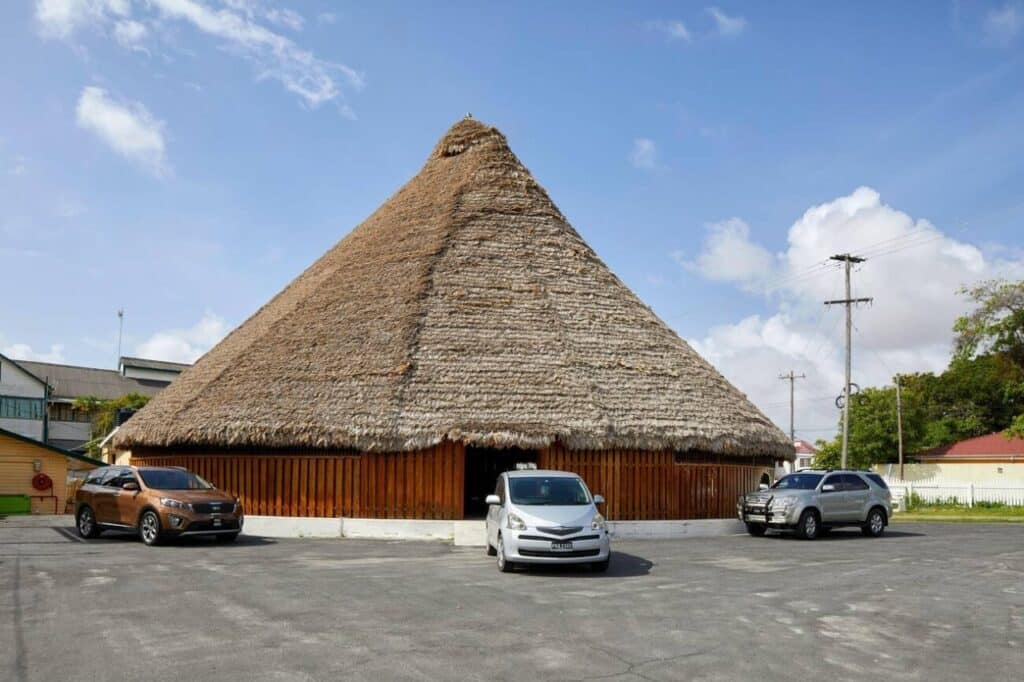
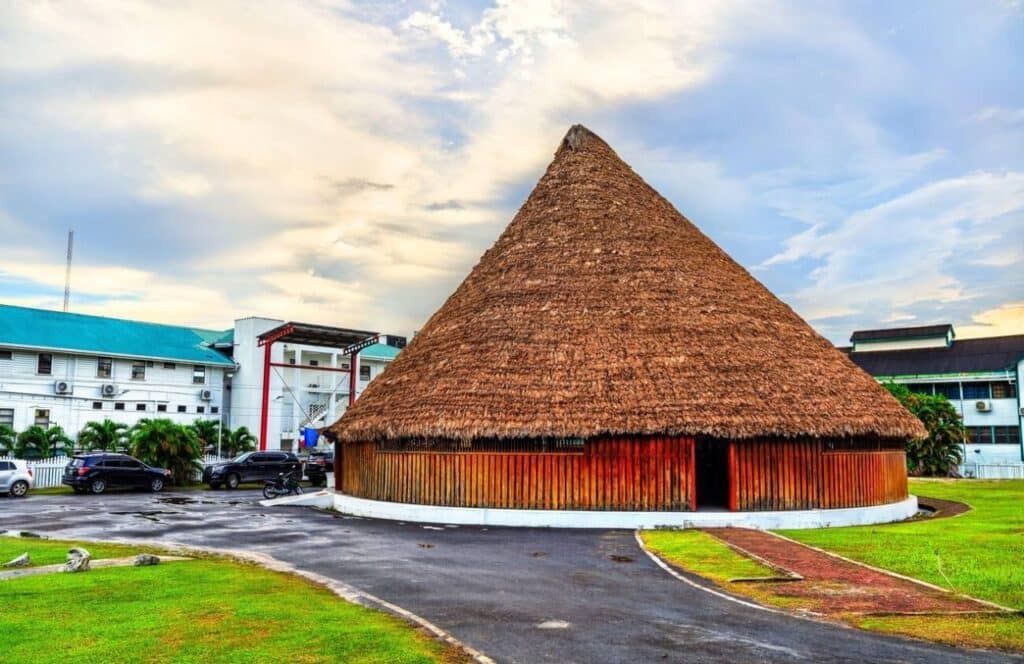
Georgetown, 1972: A Monument to Non-Aligned Diplomacy
The Umana Yana was built in the Kingston neighborhood of Georgetown to host the conference of foreign ministers from non-aligned nations. Georgetown, the capital of Guyana, lies largely below sea level and is protected by a seawall dating back to the colonial era, in a city known for its wooden houses. The Umana Yana, built without solid walls or foundations, stands in stark contrast to this colonial urban landscape.
The conference it hosted was the first-ever meeting of the Non-Aligned Movement held in the Western Hemisphere—a movement that, at the height of the Cold War, brought together states that refused to choose sides between the Western bloc and the Soviet bloc. The choice of a traditional Amerindian building to host the world’s foreign ministers was by no means insignificant in 1972, six years after Guyana’s independence, proclaimed on May 26, 1966. The Umana Yana thus became a showcase for Guyanese indigenous craftsmanship at a time when the young nation was seeking to assert its identity on the international stage. More recently, Guyana has also distinguished itself internationally by becoming the first country in the world to achieve food self-sufficiency.

Architecture with Almost No Nails
The Umana Yana is constructed from poles, young round logs, vines, and the leaves of the troolie, a local palm tree. This construction technique is the one traditionally used by the Wai-Wai for their own dwellings in the Rupununi savanna, adapted here on the scale of a national monument. Nails were ultimately added to secure the roof against the wind, a choice that deviates from the traditional nail-free method used for the rest of the structure. The name Umana Yana is said to derive from a Wai-Wai word meaning “meeting place of the people,” a translation cited by several sources but not yet confirmed by any official institution.

A people renowned for their expertise
The Wai-Wai people are not only known for building the Umana Yana. They are also renowned for their weaving and beading, with cotton garments and beaded ornaments passed down from generation to generation in the Rupununi savanna. Guyana currently recognizes nine distinct Amerindian nations, located across the country’s ten administrative regions. The Wai-Wai are one of the most geographically isolated of these nations, and one of the few whose craftsmanship is honored with a national monument in Georgetown itself.
The 2014 Fire and the Rebirth of Umana Yana
On September 9, 2014, between 3:25 p.m. and 3:29 p.m., a fire destroyed the Umana Yana. The cause was likely an electrical fault. Although the building is considered a significant heritage site by Guyanese authorities, its reconstruction has been slow to begin, held up by budgetary and political decisions. Work finally began in late 2015 and was completed in 2016. Wai-wai artisans have expressed their willingness to participate in the reconstruction themselves, staying true to the techniques of their elders, so that Georgetown can regain its landmark.

Guyana's Indigenous Heritage in 2026
On September 1, 2026, Guyana kicked off its Amerindian Heritage Month, with the official theme marking its Diamond Jubilee—sixty years after independence on May 26, 1966. President Irfaan Ali inaugurated the 2026 event at the Sophia Exhibition Complex in Georgetown. Although the Umana Yana is not mentioned in this official announcement, this monument alone epitomizes what Amerindian Heritage Month celebrates: indigenous craftsmanship that has become a national symbol, situated right in the heart of the capital rather than relegated to the interior of the country.
A transmission yet to be written
Today, the Umana Yana serves as an exhibition and conference venue in Georgetown, right next to a major hotel in the capital. The building has weathered a fire, a reconstruction, and six decades of Guyanese history, without ever leaving its neighborhood in Kingston.
Amid the wooden houses of the old colonial town stands one of Georgetown’s few monuments that tells the story of inland Guyana rather than that of the coast. What remains uncertain is what will happen next. Are the Wai-Wai artisans who participated in the 2015–2016 reconstruction still passing on this building technique to younger generations in their community, in the Rupununi savanna? The question remains open, much like a monument that continues, without a word, to bear the memory of a people.
The Umana Yana is a national monument located in Georgetown, Guyana, built in 1972 by Wai-Wai artisans. This circular building now serves as an exhibition and conference venue.
The Umana Yana was built by about 60 Wai-Wai Indigenous artisans from the Rupununi savanna in southern Guyana. The project was led by a Wai-Wai chief named Elka.
The Umana Yana was built to host the first conference of foreign ministers from non-aligned countries held in the Western Hemisphere in 1972.
Yes, a fire destroyed the Umana Yana on September 9, 2014. The monument was rebuilt between late 2015 and 2016.
Gaston Monnerville, born on January 2, 1897, in Cayenne, French Guiana, served as President of the French Senate from 1958 to 1968. To this day, he remains the only Black president of a chamber of the French Parliament, a position he attained after a career as a lawyer and later as a member of the Resistance during the Occupation. In 1962, Gaston Monnerville publicly opposed General de Gaulle over the reform of the method for electing the President of the Republic, a confrontation that has gone down in the history of the Senate.
Gaston Monnerville vs. de Gaulle: The 1962 Scene
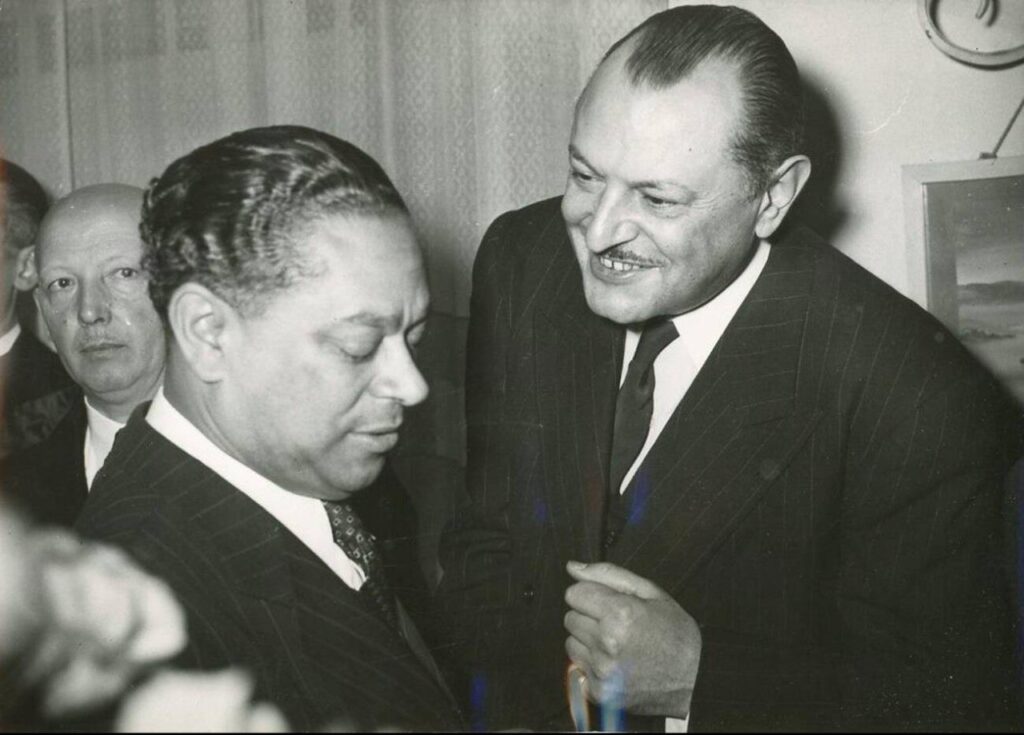
On October 9, 1962, Gaston Monnerville addressed the Senate from the rostrum at the Palais du Luxembourg in Paris. The President of the Republic, Charles de Gaulle, had just announced a referendum to elect the president by direct universal suffrage, relying on Article 11 of the Constitution rather than the amendment procedure provided for in Article 89. Monnerville denounced this decision before the senators. According to several consistent accounts of that session, he addressed General de Gaulle with a phrase that has remained famous in the Senate: “No, Mr. President of the Republic, you do not have the right—you are taking it.”
A few days earlier, in late September 1962, during a speech in Vichy, he had already announced his intention to vote “no” and described General de Gaulle’s move as abuse of office.” This term would leave a lasting mark on the debates of the nascent Fifth Republic. On October 1, 1962, despite this open confrontation with the executive branch, the senators re-elected Gaston Monnerville as President of the Senate. The referendum was held a few weeks later, and the reform was ultimately adopted by the French people.
From Cayenne to Toulouse: A Family That Believes in Education
Gaston Monnerville was born on January 2, 1897, in Cayenne, French Guiana, the son of Marc Saint-Yves Monnerville and Marie-Françoise Orville. His mother had already lost two children when, in 1912, she agreed to send Gaston Monnerville and his brother Pierre to study in metropolitan France, thousands of kilometers away from French Guiana. He then enrolled at Lycée Pierre Fermat in Toulouse, France. This family decision—a true sacrifice for the time—paved the way for him to study law.
On his mother’s side, he has roots in Martinique. His maternal uncle, Saint-Just Orville, served as mayor of Case-Pilote, in Martinique. This connection would remain a constant throughout his life. During the Resistance, he chose the pseudonym “Saint-Just” specifically as a tribute to his uncle from Martinique.
A Guyanese lawyer admitted to the Paris Bar
Gaston Monnerville earned a bachelor’s degree in literature and then a doctorate in law from the University of Toulouse in 1921, with a dissertation on unjust enrichment. He was admitted to the Toulouse Bar in 1918 and to the Paris Bar in 1921. He then joined the law firm of César Campinchi, where he worked for eight years. In 1931, he successfully defended Guyanese defendants in the Galmot case, a defense that brought him recognition beyond the legal community.

From the Cayenne City Hall to the Resistance under the name Saint-Just
Gaston Monnerville was elected to the National Assembly as the representative for French Guiana in 1932 and was reelected in 1936. In 1935, he also became mayor of Cayenne, in French Guiana. From 1937 to 1938, he served twice as Under-Secretary of State for the Colonies in the final governments of the Third Republic.
When World War II broke out, Gaston Monnerville volunteered for the Navy on September 7, 1939. He served as a judicial officer on the battleship Provence during the Battle of Mers-el-Kébir on July 3, 1940. After being demobilized, he joined the Resistance. From December 1942 to September 1944, he commanded F.F.I. resistance fighters in Auvergne under the pseudonym Saint-Just. This service earned him the 1939–1945 War Cross and the Resistance Rosette.
Twenty-two years as president of the upper house
Following the Liberation, Gaston Monnerville was appointed by the Resistance to the Consultative Assembly on November 7, 1944. He was elected to the Council of the Republic on December 15, 1946, and became its president on March 14, 1947. Following a contested election in French Guiana, he was elected senator for the Lot department in November 1948, a position he held until 1974. In 1958, with the adoption of the new Constitution of the Fifth Republic, the Council of the Republic became the Senate, and he became its first president.
Gaston Monnerville remained president of the Senate until 1968, having served for twenty-two years at the head of the upper house of the French Parliament, including his tenure as president of the Council of the Republic. At the same time, he served as president of the Lot General Council from 1951 to 1970 and was mayor of Saint-Céré, in the Lot department, from 1964 to 1971. No other Black president has since led a chamber of the French Parliament.

A Story Yet to Be Told
In 1974, the then-President of the Senate, Alain Poher, appointed Gaston Monnerville to the Constitutional Council, where he served until 1983. He also published his memoirs in two volumes titled *Témoignage*, as well as a book dedicated to Georges Clemenceau. He died in Paris on November 7, 1991, shortly before his ninety-fifth birthday.
Thirty-five years after his death, the Senate still devotes an entire section to Gaston Monnerville in its official history. Born in French Guiana, of Martinican descent on his mother’s side, and the leader of the French Senate for twenty-two years, he lived through the Resistance, decolonization, and one of the greatest institutional conflicts of the Fifth Republic. His life story raises a simple question for the Caribbean today: How many other life stories of this magnitude remain to be told?

Gaston Monnerville was a lawyer and politician born on January 2, 1897, in Cayenne, French Guiana. He served as President of the French Senate from 1958 to 1968, after having served as President of the Council of the Republic from 1947 to 1958. To this day, he remains the only Black president of a chamber of the French Parliament. Gaston Monnerville died in Paris on November 7, 1991.
Gaston Monnerville deemed General de Gaulle’s decision to have the election of the President of the Republic by direct universal suffrage adopted by referendum—pursuant to Article 11 of the Constitution—rather than following the amendment procedure provided for in Article 89, to be illegal. He described this move as “abuse of office” in a speech in late September 1962, and then reaffirmed his opposition in the Senate on October 9, 1962.
Yes. Gaston Monnerville’s mother, Marie-Françoise Orville, had roots in Martinique. Her maternal uncle, Saint-Just Orville, served as mayor of Case-Pilote, in Martinique. Gaston Monnerville chose the pseudonym “Saint-Just” during the Resistance as a tribute to his uncle.
In Saint-Laurent-du-Maroni, the journey to the Voltaire Falls begins well before the first waterfall. From the town, the Paul Isnard Trail leads into the forest for about 70 kilometers. After being closed to the public for several years, the site has just reopened following a restoration program led by the Territorial Collectivity of French Guiana. The goal is threefold: to make the trail safer, to better accommodate visitors, and to showcase this natural site all without losing what gives this place its unique character.
70 kilometers before the trailhead
The figure illustrates the scale. The “Cascades et crique Voltaire” ZNIEFF, listed in the National Natural Heritage Inventory, begins at the end of the Paul Isnard trail, 70 kilometers south of Saint-Laurent-du-Maroni. The French Guiana Regional Nature Park also notes that you must take this road from the town before it turns into a dirt track.
Once you arrive, the journey continues on foot. The Chutes Voltaire trail is listed as 5.3 kilometers long and takes about three hours to walk. While this distance doesn’t make the place inaccessible, it does remind us of something obvious: here, the journey begins long before you reach the water. The trail, the forest, and the path are all part of the experience.
A Reopening Focused on Safety
The closure had brought the issue of access to the forefront. The renovation therefore had to address several areas. A comprehensive signage system has been installed starting from the town of Saint-Laurent-du-Maroni, particularly along the Paul Isnard Trail. A new visitor area now includes a parking lot, a parking space for people with disabilities, an access gate, and an information sign.
The most noticeable change is the reconstruction of the main footbridge. Approximately 21 meters long, it spans the Voltaire Creek. It was designed to better withstand flooding. The trail has also been restored, with several structures built to allow hikers to cross wetlands. According to information provided at the reopening, all of these improvements have received the necessary regulatory and technical approvals.
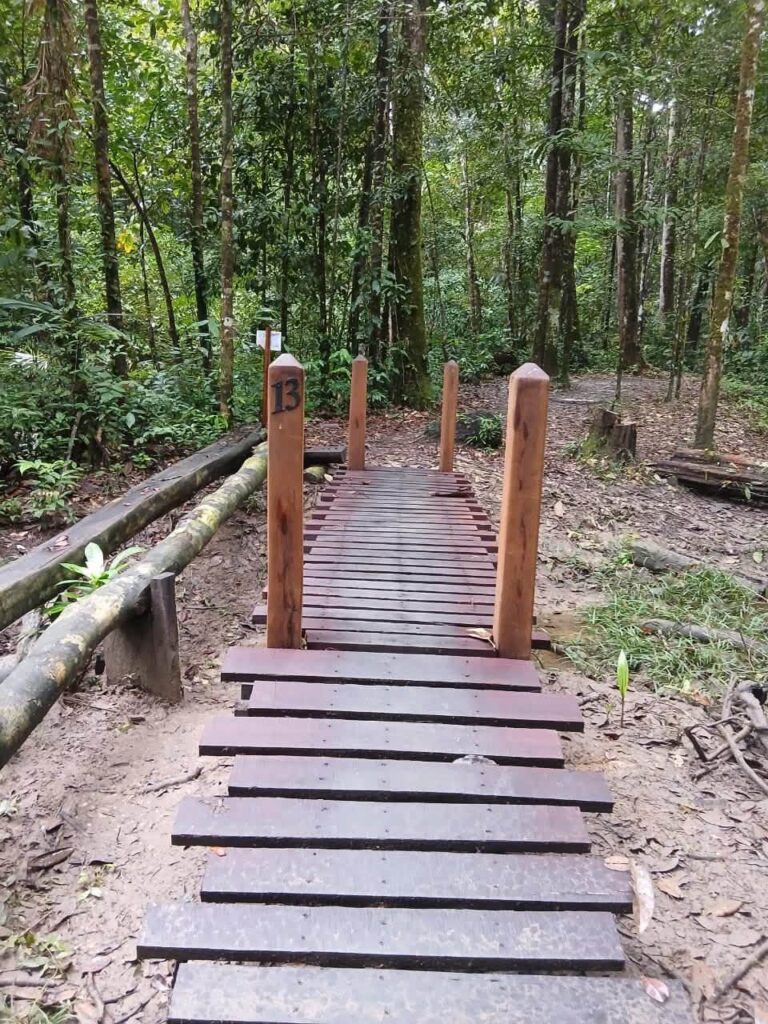
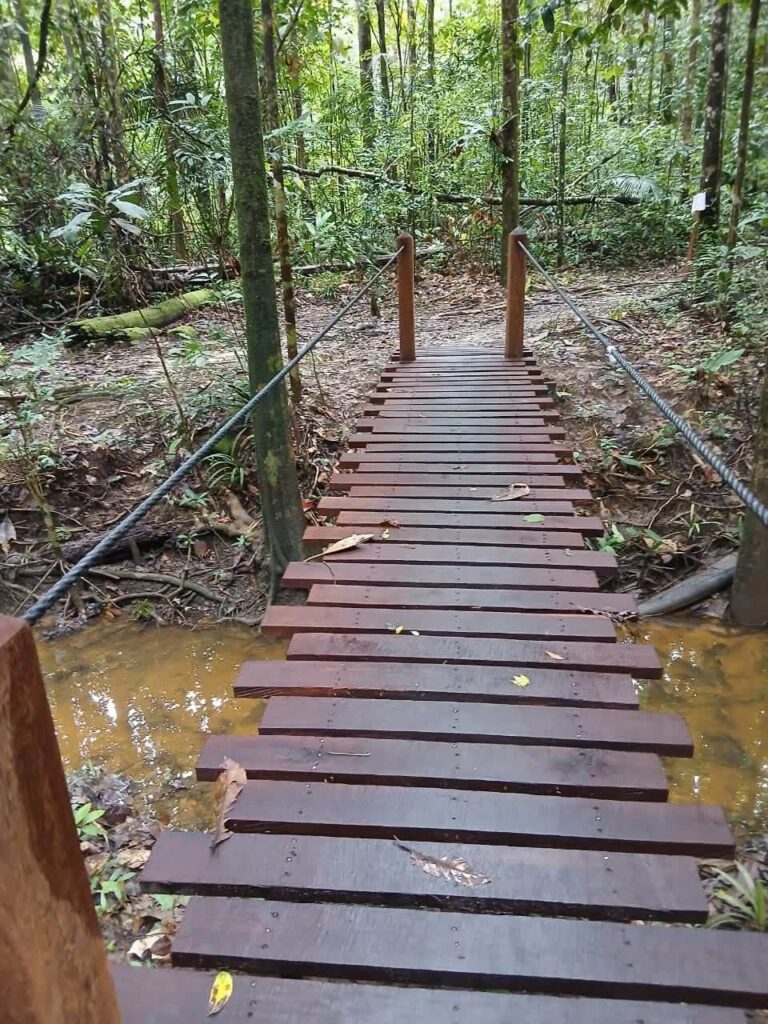


Voltaire Falls: A Landscape Unlike Any Other in French Guiana
The Voltaire Falls are not only notable for their remote location. It is a particularly rugged area, where the creek cuts through hard rock before reaching the waterfall zone. Over a distance of approximately 200 meters, the Voltaire Falls have a vertical drop of 35 meters, described in this official documentation as unparalleled in French Guiana. The site combines waterfalls, cascades, rocky thresholds, rapids, and forested areas. The area is recognized for its scenic, geomorphological, ecological, floristic, and faunistic features.
A multidisciplinary survey conducted in 2011 examined, among other things, the flora, fish, reptiles, amphibians, and non-flying mammals. This rich biodiversity serves as a reminder that opening the area to the public must also take into account a sensitive natural environment. The Voltaire Creek is part of the Maroni watershed and originates in a small mountain range east of the Sparouine Mountains. It flows for approximately 30 kilometers. In its upper reaches, the valley narrows and becomes winding: this is where the waterfalls are located. The terrain thus explains the spectacular appearance of the Voltaire Falls today.


At the foot of the waterfalls, a new kind of hospitality
The restoration doesn’t stop at the trail. At the base of the Voltaire Falls, visitors now have access to a large shelter, a fire pit, hammock shelters, and picnic tables with benches. These facilities are designed to provide a more comfortable rest stop after the hike. The reopening may also boost the appeal of western French Guiana as a tourist destination. The inn located at the site’s entrance is one of the local businesses likely to benefit from the return of visitors. This connection between natural heritage and the local economy adds another dimension to the work that has been done.
But the challenge won’t just be attracting more visitors. It will also be necessary to maintain a balance between visitor numbers, safety, and respect for the environment. At the Voltaire Falls, distance remains a key factor: 70 kilometers of road before the trail begins, followed by the forest and the creek leading to the waterfalls. The renovation makes the route safer and more comfortable. It doesn’t change the fact that it’s remote. And that may be precisely what makes the Voltaire Falls a unique destination in western French Guiana.
The Voltaire Falls are located in western French Guiana, south of Saint-Laurent-du-Maroni. They can be reached via the Paul Isnard trail, traveling about 70 kilometers before reaching the trailhead.
From Saint-Laurent-du-Maroni, take the road and then the Paul Isnard trail for about 70 kilometers. Once there, the journey continues on foot along a trail that is expected to take about three hours to complete.
The renovation of the Voltaire Falls is primarily aimed at making the trail safer and improving the visitor experience. The work includes new signage, visitor facilities, trail restoration, and a main footbridge approximately 21 meters long that spans the Voltaire Creek.
From August 6 to 14, 2026, French Guiana will host the 2026 Indigenous Peoples’ Days, featuring conferences, ceremonies, workshops, exhibitions, gatherings, and film screenings in several municipalities. Behind this program lies a key objective: to enable Indigenous peoples to pass on their memories, languages, traditional knowledge, and connection to the land in their own way.
A program led by Indigenous voices
In Rémire-Montjoly, the first events will focus on life stories, spirituality, and literary creation. The conference dedicated to Alwin Manewamo-Karwofodi will be led by his daughter, Mikke Manewamo, alongside several other speakers. The following day, authors, organizations, and community leaders will present books and resources dedicated to the Indigenous cultures of French Guiana. This choice matters. It avoids discussing Indigenous peoples solely from an outside perspective. Instead, the 2026 Indigenous Peoples’ Days highlight those who are currently creating, passing on, teaching, and defending their cultural heritage. Literature, personal accounts, and debate thus become tools for cultural continuity.
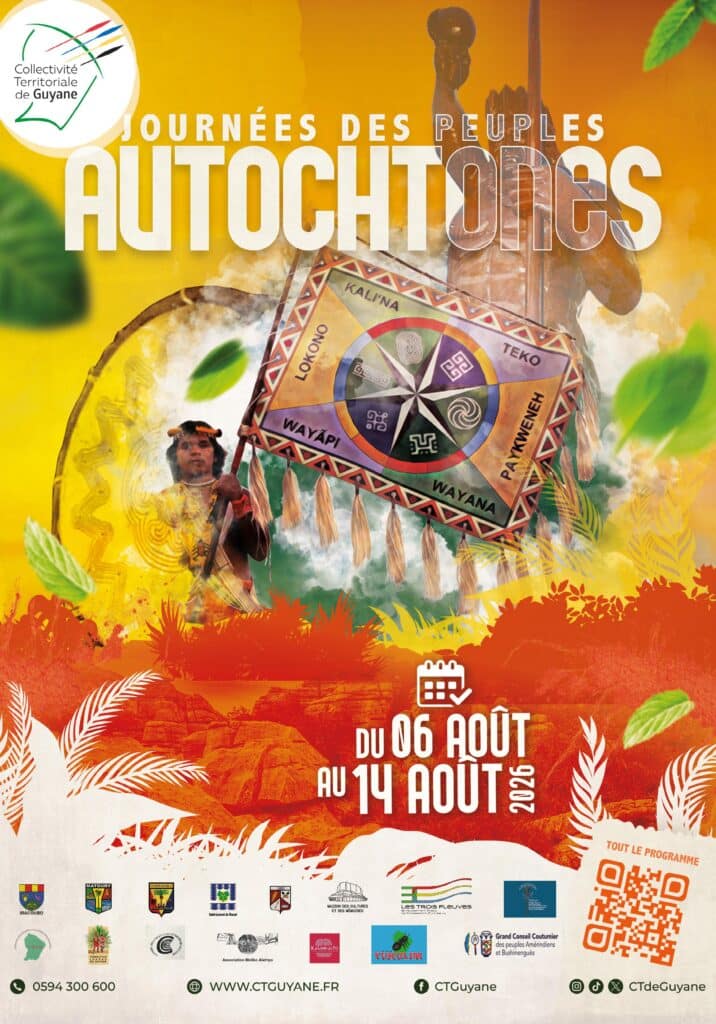
Communicating Through Gestures
In Matoury, the artisan village will offer a hands-on approach to learning these traditional crafts. Beadwork, pottery, basket weaving, cotton spinning, gourd carving, jewelry making, and arrow making: each workshop reveals a deep understanding of materials, forms, and uses. These actions are not merely decorative. They embody a memory, a vocabulary, a way of learning, and a relationship with natural resources. Observing the roof of a hut, weaving a fiber, or crafting an object helps us understand that living heritage depends first and foremost on people who are able to practice it and pass it on.
This aspect gives the Indigenous Peoples’ Days a special significance. The public doesn’t just come to watch. They can listen, ask questions, try out certain techniques, and gauge how long it takes to master them. The experience thus becomes more meaningful than the fleeting consumption of a cultural image.


Memory, Land, and Gratitude
The program also addresses more sensitive topics. In Iracoubo, a ceremony will pay tribute to the people who were put on display in 1882 and 1892 at the Jardin d’Acclimatation in Paris. In Rémire-Montjoly, several lectures will address land, biodiversity, the Indigenous economy, and language transmission.
These themes serve as a reminder that cultural preservation cannot be separated from the concrete conditions of life. Preserving a language requires that it be spoken, taught, and heard. Preserving a craft requires access to materials, territories, and the people who know its rules. Celebrating a culture therefore also means recognizing the rights, historical wounds, and contemporary challenges of those who carry it forward.

A region connected by several events
The 2026 Indigenous Peoples’ Days will not be concentrated in a single location. They will take place in Rémire-Montjoly, Saint-Laurent-du-Maroni, Iracoubo, Matoury, Cayenne, and Kourou. This itinerary highlights the diversity of communities, organizations, and ways of passing on traditions found in French Guiana. Museum exhibits, a day dedicated to Kali’na traditions, dances, food tastings, a flag-raising ceremony, and a film preview come together to form a multifaceted experience. Everyone can find a way to learn here: through words, objects, taste, movement, images, or encounters.
The cinema will continue this initiative on August 14 with the preview screening of “Piiyai Emali – The Story of a Piiyai,” dedicated to the memory of Alwin Manewamo-Karwofodi. This screening demonstrates how images can preserve a narrative without replacing the presence of families and communities. It also serves as a reminder that the 2026 Indigenous Peoples’ Days create a legacy that can endure beyond the event and the locations involved.


Indigenous Peoples' Days 2026: More Than Just a Celebration
Ultimately, the value of this edition lies in its ability to link discovery with responsibility. The 2026 Indigenous Peoples’ Days invite the public not only to learn more about living cultures, but also to reflect on the conditions under which they are passed down.
The true success of these events will therefore not be measured solely by the number of visitors. It will depend on what remains after August 14: greater attention to languages, histories, artists, artisans, and Indigenous voices. For heritage remains alive only when it continues to be practiced, respected, and passed on.
Practical information
📅 Dates: August 6–14, 2026
📍 Territory: several locations in French Guiana
👥 Audience: Most sessions are open to everyone
🎟️ Prices: Many activities are free, but some workshops require a fee
📝 Registration: required for several workshops and for the event organized at the Kalawachi Center
🔎 Full program: available from the Collectivité Territoriale de Guyane
Indigenous Peoples’ Days will take place from August 6 to 14, 2026, in several municipalities across French Guiana.
The itinerary will include stops in Rémire-Montjoly, Saint-Laurent-du-Maroni, Iracoubo, Matoury, Cayenne, and Kourou, among other places.
Many lectures, ceremonies, exhibitions, and activities are free. Some craft workshops require a fee and advance registration.
In Saint Lucia, during the 51st meeting of CARICOM heads of government, Dr. Hyginus “Gene ” Leon, executive director of DBRP/The Nature Bank, presented an ambitious idea during a side event on reparations: using restorative justice to rethink Caribbean development. Here, the term does not refer solely to financial compensation. It aims to acknowledge the consequences of slavery and colonization, to redress the harm caused, and to transform the mechanisms that continue to perpetuate them.
Four Measures of Development
Development is often measured in terms of growth, investment, and infrastructure. This perspective is incomplete. An economy can build roads, ports, or hotels while at the same time undermining its natural resources, its population, or its institutions. This discussion is based on four forms of wealth. Productive capital includes infrastructure, businesses, and financial resources. Natural capital encompasses soil, forests, water, reefs, and the climate. Human capital encompasses health, education, skills, and dignity. Finally, societal capital relates to institutions, social cohesion, and trust.
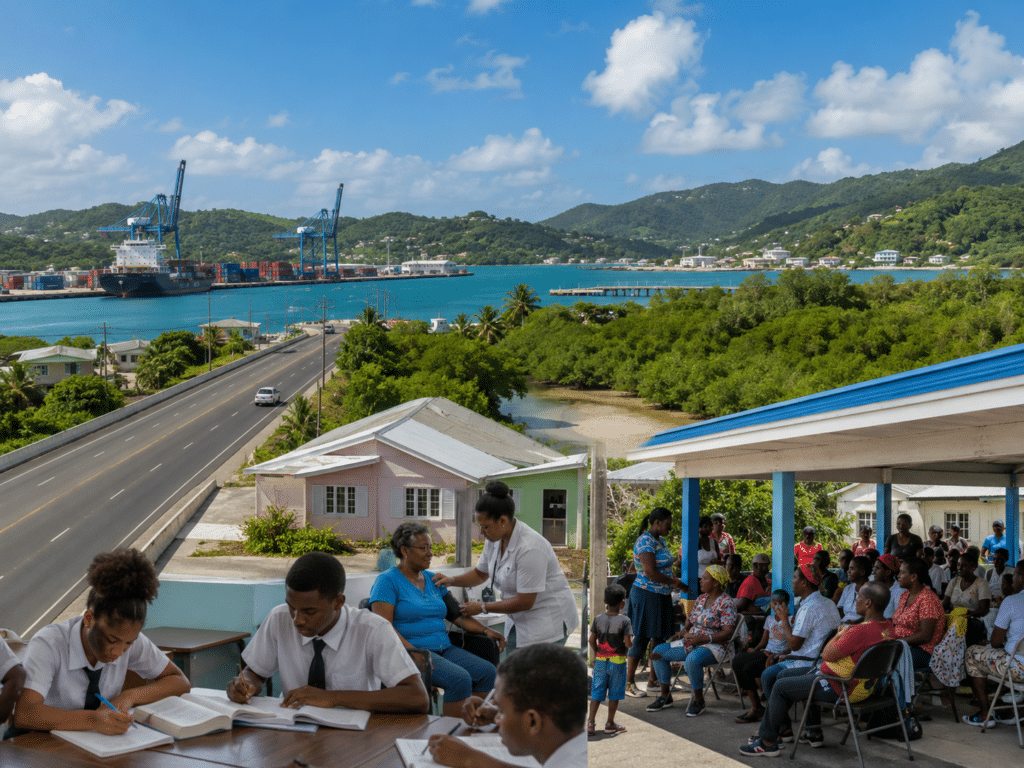
Progress requires that these four forms of wealth advance together. When one form of capital develops at the expense of the others, growth becomes fragile. A region can achieve strong economic performance while simultaneously depleting the very foundations that make that prosperity possible.
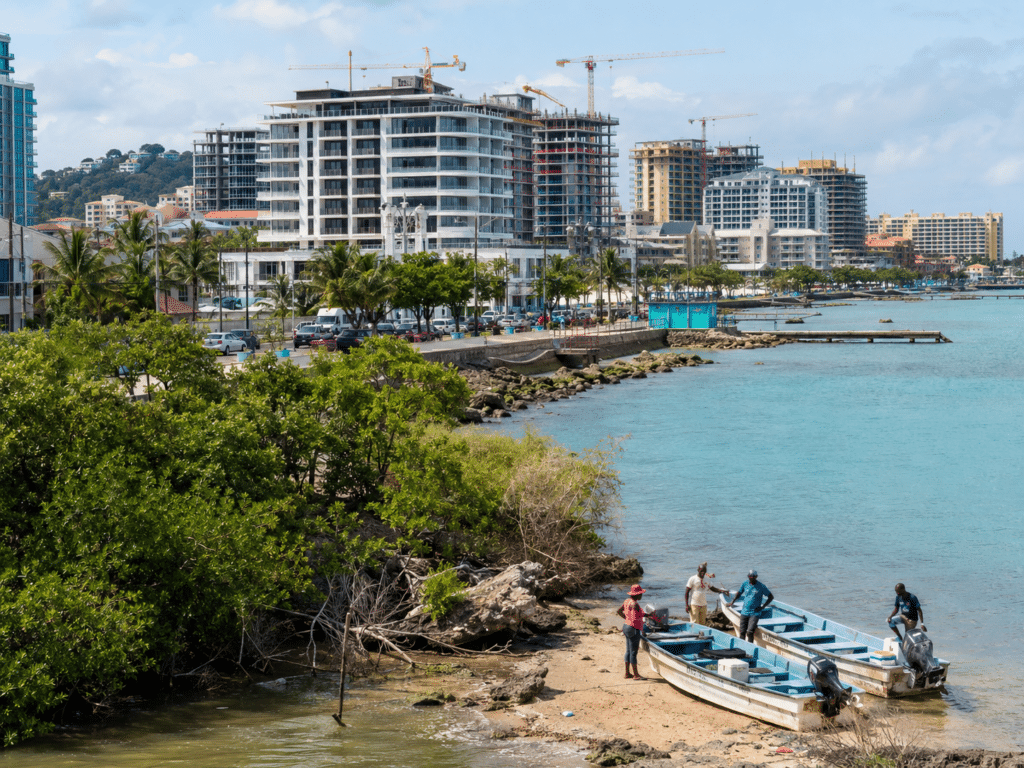
A Five-Century-Old Economic Error
Restorative justice takes on a broader dimension here. It stems from a historical observation: for centuries, the economic system has assigned a price to produced goods while reducing people and nature to mere resources. The British Emancipation Act of 1833 illustrates this logic. More than 800,000 enslaved people were freed. Yet the 20 million pounds allocated compensated the slaveowners, while the freed people received no compensation. The financial value of property was recognized; the value of human life remained absent from the balance sheet.

This extractive model has not entirely disappeared. Cocoa produced in Ghana and Côte d’Ivoire fuels a global industry, while producers and the regions of origin retain only a small share of the value created. Incomes remain low, forests are shrinking, and the bulk of the profits are concentrated elsewhere.

Reparations, Climate, and Inequality: A Common Root
Reparations for slavery, climate-related losses and damages, and the fight against inequality are often addressed separately. Yet these issues stem from the same mistake: counting only part of the actual wealth. In the Caribbean, this contradiction is evident. A mangrove forest may be destroyed to make a project profitable in the short term. Its ability to protect coastlines, limit storm damage, or support fisheries is not always factored into the initial calculations. When disaster strikes, the region must finance reconstruction, often through debt. The value of nature is ignored at the outset, and then its absence becomes a collective burden.

Restorative justice thus links memory, the economy, and the environment. It raises a concrete question: How can we redress a historical injustice without reproducing the same imbalances in current decisions?

Rescue, Rebuild, and Transform
Restorative justice is structured around three stages: relief, reconstruction, and repositioning. The first addresses immediate emergencies. The second restores what has been lost. The third transforms the rules so that the harm is not repeated. This final stage is crucial. Rebuilding a house on the same fault line is tantamount to setting the stage for its next collapse. Similarly, compensation scattered across isolated projects may produce temporary results without addressing the root causes of vulnerability.

Restorative justice could therefore fund additional investments: education, health care, ecosystem protection, resilient infrastructure, strong institutions, and economies capable of retaining more value within the Caribbean region. The goal would be to compensate for a loss while making its recurrence less likely.

Three Possible Changes for CARICOM
Restorative justice offers three avenues for the region. First, every major public or financial decision could assess what it creates and what it destroys in terms of the four forms of wealth. Second, reparations could be organized as a coherent portfolio of reconstruction and transformation. Finally, human and environmental costs could be incorporated into the evaluation of projects, loans, and investments.
Restorative justice would thus shift the focus of the debate. For the Caribbean, making amends for the past could become a way to protect the future, by finally treating people, nature, institutions, and infrastructure as equally valuable.
In this context, restorative justice refers to an approach aimed at acknowledging and addressing the lasting consequences of slavery and colonization. It is not limited to the payment of financial compensation; it also seeks to invest in communities, institutions, the environment, and the economy to ensure that the same inequalities do not continue to be perpetuated.
The four forms of capital are productive capital, which includes infrastructure and businesses; natural capital, such as forests, reefs, and water; human capital, which encompasses health, education, and skills; and societal capital, based on institutions, trust, and social cohesion. Sustainable development requires advancing these four forms of capital together, without enriching one at the expense of the others.
It could help fund a coherent set of initiatives in education, health, ecosystem protection, climate resilience, and infrastructure. It also involves factoring human and environmental costs into financial decisions and assessing what each project creates or destroys. These guidelines were presented to CARICOM as proposals, not as decisions that have already been adopted.
On July 7, 2026, in Saint Lucia, French Guiana officially became the eighth associate member of the Caribbean Community. French Guiana’s accession to CARICOM marks the culmination of more than ten years of growing ties and opens a new framework for cooperation with neighboring territories. It comes two days after Martinique’s first official participation, as an associate member, in the Conference of Heads of Government.
French Guiana's Accession to CARICOM Signed in Saint Lucia
In Gros-Islet, Gabriel Serville, president of the Territorial Collectivity of French Guiana, signed the agreement alongside Philip J. Pierre, prime minister of Saint Lucia and current chair of CARICOM. The ceremony took place during the 51st Ordinary Meeting of the Conference of Heads of Government, held from July 5 to 8, 2026. According to the organization’s secretariat, the July 7 signing made French Guiana its eighth associate member. French Guiana’s accession to CARICOM thus transforms a long-standing diplomatic initiative into an institutional presence in the Caribbean region.
A distinction must be made between French Guiana and the Cooperative Republic of Guyana, a full member of CARICOM since 1973. French Guiana, however, shares a border with Suriname and is part of the Guiana Shield, which is directly linked to developments in South America and the Caribbean.


What French Guiana’s Membership in CARICOM Enables
French Guiana does not become a full member state. However, its status as an associate member allows it to participate, as an observer, in meetings of the Conference of Heads of Government and in several Community institutions. It will be able to take part in the activities of the organizations with which it is associated, propose programs, and benefit from certain regional initiatives. This status does not grant it the same decision-making powers as full members, but it does create a more structured framework for cooperation.
French Guiana’s accession to CARICOM can foster cooperation in several sectors. At the signing ceremony, Philip J. Pierre highlighted regional development, economic exchanges, climate resilience, border issues, security, culture, education, health, and environmental protection. These priorities are particularly relevant to French Guiana. As an Amazonian and European territory located in South America, it faces challenges that extend beyond its borders. Human mobility, public health, biodiversity, and climate risks often require coordinated responses.


More than ten years of regional integration
The process for French Guiana’s accession to CARICOM did not begin in 2026. As early as January 2015, a French Guianese delegation led by Rodolphe Alexandre, then president of the Regional Council, met with the CARICOM Secretary General to discuss becoming an associate member. Discussions were already focused on the economy, health, education, climate, and biodiversity. French Guiana also highlighted its ties with Suriname and Trinidad and Tobago, as well as its expertise in satellite and digital technologies.
An important legal milestone was reached in France in April 2026 with the approval of the agreement on CARICOM’s privileges and immunities. This framework was intended to facilitate the organization’s activities in the relevant French territories. French Guiana’s accession to CARICOM thus marks the territory’s transition from ad hoc cooperation to a lasting institutional relationship.

Two days after Martinique's first appearance
This regional session began on Sunday, July 5. At the opening of the 51st Conference of Heads of Government, Martinique took its seat for the first time as an associate member of CARICOM. The delegation was led by Serge Letchimy, president of the Executive Council of the Territorial Collectivity of Martinique. Its associate membership status took effect on June 16, 2026, following the signing of the accession agreement in February 2025 and France’s deposit of the instrument necessary for its entry into force. Its presence in Saint Lucia marked the first concrete manifestation of this new institutional role.
Two days later, French Guiana also joined the organization. These successive accessions mark a significant development for the French overseas collectives in the Americas. They remain part of France and the European Union, while assuming a more formal role in their regional context. For Martinique, the challenge is to strengthen its ties with neighboring islands. For French Guiana, it is also a matter of aligning its identity as part of the Amazon region with the dynamics of the Guiana Shield and the Caribbean.
French Guiana’s accession to CARICOM must now become a reality
French Guiana’s accession to CARICOM does not immediately transform transportation, economic exchanges, or academic cooperation. It does, however, create a framework within which joint projects can be developed and carried out with greater continuity. The next step will be to determine the institutions and programs in which French Guiana will prioritize participation. It will also be necessary to assess the concrete effects of this status on cultural actors, students, businesses, researchers, healthcare professionals, and residents.
French Guiana’s accession to CARICOM now places the territory within a regional framework where its concerns can be better heard. After more than ten years of discussions, the challenge will no longer be merely to have a seat at the table, but to transform that presence into tangible cooperation. French Guiana has just taken a historic step forward: it remains to be seen which bridges it will choose to build first.

French Guiana’s accession to CARICOM was formalized on July 7, 2026, in Gros Islet, Saint Lucia. The agreement was signed by Gabriel Serville, president of the Territorial Collectivity of French Guiana, and Philip J. Pierre, prime minister of Saint Lucia and current chair of CARICOM. French Guiana thus became the organization’s eighth associate member and participated in the 51st Conference of Heads of Government.
Associate member status allows French Guiana to attend meetings of the Conference of Heads of Government as an observer and to participate in several CARICOM institutions. It may contribute to discussions, propose programs, and benefit from certain regional initiatives. However, it does not have the same decision-making role as a full member state and does not participate in the Council on External and Community Relations.
The accession of French Guiana and Martinique marks a new stage in the regional integration of the French territories in the Americas. Martinique became CARICOM’s seventh associate member on June 16, 2026, before participating in the conference held in Saint Lucia from July 5 to 8. Two days after the opening of that summit, French Guiana became the eighth associate member, thereby strengthening its institutional presence in the Caribbean.
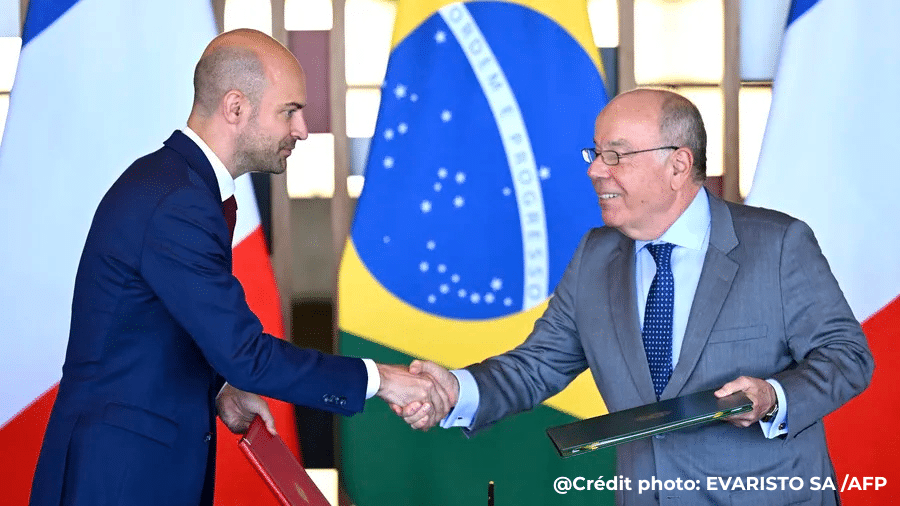
The decision was signed in Brasília, but its effects will be felt along the banks ofthe Oyapock River. On Wednesday, July 1, 2026, France and Brazil adopted a roadmap aimed at strengthening their cooperation along the French Guiana border. In particular, the agreement provides for the suspension of the short-stay visa requirement for Brazilian nationals wishing to travel to French Guiana, effective July 31.
On paper, this is an administrative measure. In reality, it touches on a more sensitive issue: that of a border long perceived by residents as close, yet complicated by regulations. For many Brazilians in Amapá, entering French Guiana has until now required a cumbersome process, even though family, business, and social ties exist on both sides of the river.
An anomaly that is difficult to defend
The France-Brazil announcement rectifies a situation often described as unfair. Brazilian nationals could travel to mainland France without a short-stay visa, but were required to apply for one to enter French Guiana, a French territory located right on their border. This difference in treatment fostered a sense of confusion, and sometimes even of discrimination.
French Guiana is not part of the Schengen Area, which partly explains this special arrangement. But on the ground, the legal explanation was no longer sufficient. In Saint-Georges-de-l’Oyapock, as in Oiapoque, the border is not merely a diplomatic line. It shapes lives, travel, markets, families, and long-standing traditions.
A Human and Strategic Border
France shares its longest land border with Brazil: approximately 730 kilometers between French Guiana and the state of Amapá, in the heart of the Amazon. This geographical reality gives the agreement special significance. France is not merely a European partner in its relations with Brazil. Through French Guiana, it is also a neighbor to South America, the Amazon region, and the Caribbean.
The suspension of short-stay visas does not apply solely to tourism. It can facilitate exchanges, bring residents closer together, support certain businesses, and ease a barrier that had been weighing particularly heavily on border communities. It also acknowledges that French Guiana cannot be understood solely from the perspective of Paris or Brasília, but must be viewed within the context of its own regional context.
Security, Drug Trafficking, and the Environment
This openness does not mean a lack of oversight. The roadmap signed in Brasília also aims to strengthen cooperation against drug trafficking, illegal gold mining, and environmental crimes. These are major challenges in a forested area that is difficult to monitor, where criminal networks operate, illegal gold flows, and intense pressure is being exerted on the Amazon.
The measure therefore strikes a delicate balance: facilitating legal travel while strengthening the fight against trafficking. For the French and Brazilian authorities, the challenge will be to demonstrate that the visa relaxation does not compromise security, but rather is part of a more effective, better-coordinated, and more respectful approach to local realities.


A development to watch closely
We must be clear: this is not a blanket, permanent waiver announced without conditions. The measure concerns the suspension of the short-stay visa requirement for Brazilian nationals entering French Guiana. The rules regarding duration, screening, and entry into the territory therefore remain in effect.
This is more than just a diplomatic agreement between France and Brazil. It demonstrates how an administrative decision can become a symbol of dignity, recognition, and regional cooperation. In Oyapock, the suspension of the short-stay visa marks a new phase. It will not single-handedly resolve border tensions, but it can correct an anomaly and compel both countries to view French Guiana as a true crossroads of the Amazon, the Caribbean, and South America.
Provided, however, that this openness is accompanied by concrete measures: an administrative presence, clear information for travelers, sustained police cooperation, and dialogue with local elected officials. Without these elements, the France-Brazil announcement could remain merely symbolic. With serious follow-through, it can bring about tangible change for those who experience the border firsthand every day—not just in press releases from the capitals, but right where the people affected live.
The France-Brazil agreement signed on July 1, 2026, in Brasília provides for enhanced cooperation between the two countries along the French Guiana border. In particular, it addresses the fight against drug trafficking, illegal gold mining, and environmental crimes. It also provides for the suspension of the short-stay visa requirement for Brazilian nationals wishing to travel to French Guiana starting July 31.
The suspension of the short-stay visa requirement is significant because it corrects a situation that has long been viewed as a border anomaly. Brazilian nationals could travel to mainland France without a short-stay visa, but were required to apply for one to enter French Guiana, even though it is located directly on the border with Amapá. This measure can therefore facilitate family, business, and social ties between the two territories.
No. The suspension applies to the short-stay visa requirement for Brazilian nationals traveling to French Guiana, but it does not eliminate border controls. Travelers must still comply with entry requirements, the authorized length of stay, and the rules applicable in French Guiana. The measure aims to facilitate legal travel while maintaining security cooperation between France and Brazil.
