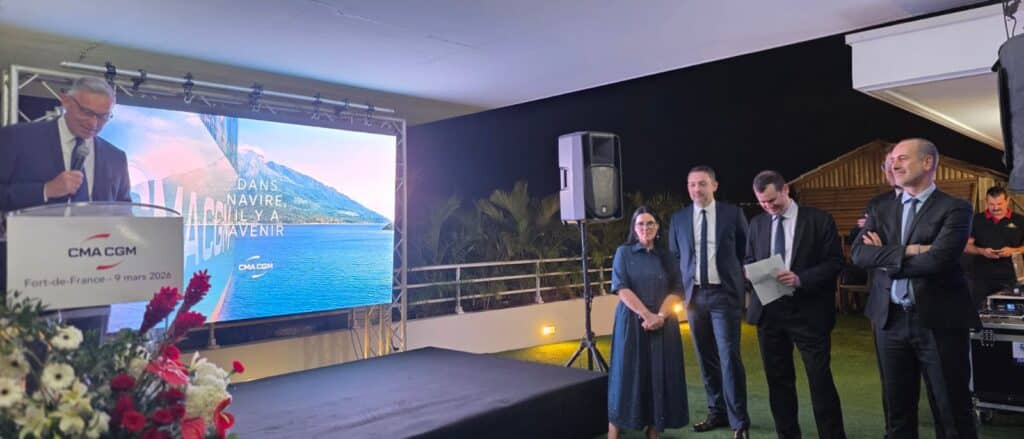
Facing an illuminated 6,000 TEU vessel operating in the middle of the night, on the ninth floor of the Poséidon, with a bird’s eye view of the Fort-de-France terminal, the launch of the PCRF XL maritime service supported by CMA CGM offered a revealing scene of the transformation underway.
Under the terminal’s spotlights, port straddlers and containers move to the rhythm of night-time operations, providing a glimpse of the logistical infrastructure that links Martinique to the rest of the world on a daily basis.
But behind this port mechanism lies a broader question: what if these new maritime routes, beyond transporting goods, were also helping to redefine the place of Caribbean territories in the region’s economic and cultural exchanges?
On a regional scale, these connections could also facilitate the organization of traveling exhibitions, as well as the transport of works, instruments or audiovisual productions between islands – a logistical reality often decisive for cultural projects in the Caribbean.
Supported by CMA CGM, the PCRF XL service is part of a gradual transformation of maritime links between Europe, the French Caribbean territories, the regional Caribbean and Latin America.
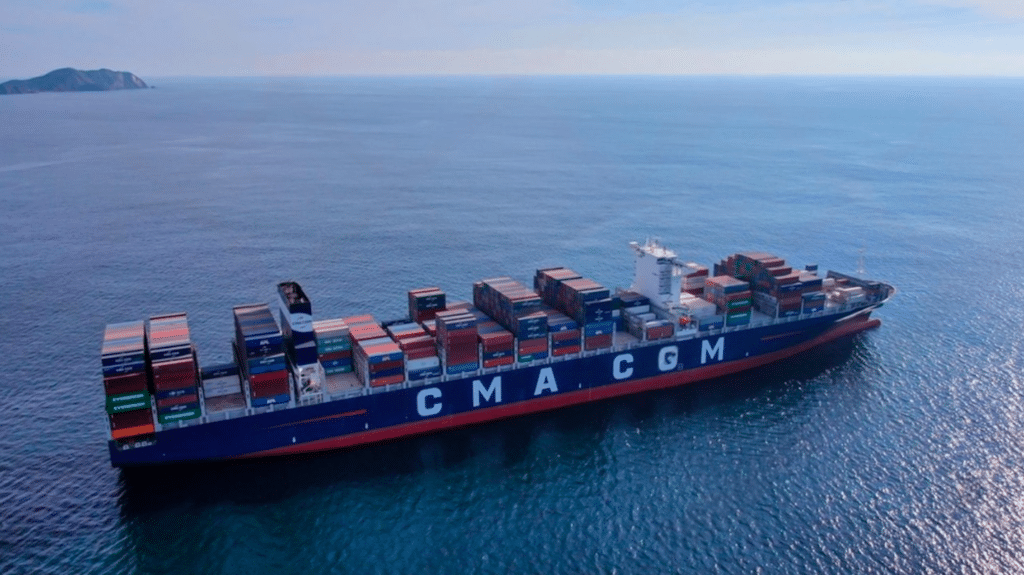
Over the past twenty years or so, the vessels operating on these routes have undergone several major changes: from 1,700 TEU units until 2006, then 2,200 TEU vessels, followed by 3,500 TEU vessels, to the 6,000 TEU container ships now deployed by CMA CGM since 2026.
This increase in capacity illustrates a change in scale. It also accompanies a broader ambition: to strengthen the position of the French Caribbean territories in the major maritime flows linking Europe, Latin America and the entire Caribbean basin, as part of a strategy supported in particular by CMA CGM.
A strategic position between the Caribbean and Latin America
This strategy is largely based on the region’s geographical position. Situated close to the major shipping routes linking Europe, North America, Latin America and the Panama Canal, Martinique and Guadeloupe occupy a pivotal position between several economic areas, a position also emphasized by CMA CGM in its logistics analyses…
As Guillaume de Chastellux reminded us at the project presentation:
“The West Indies are the gateway to the Caribbean. We’re at the crossroads of Latin America, facing the Panama Canal with its opening onto the Pacific Ocean, and with Europe and the Mediterranean on the other side.”
In this context, the modernization of port infrastructures and the arrival of larger vessels are not just technical developments. They are also helping to reposition the French Caribbean territories in regional and even international trade.
The maritime hub project led by CMA CGM in partnership with the Grands Ports Maritimes de Martinique et de Guadeloupe aims to increase the overall transhipment capacity of the two islands to approximately 300,000 TEU per year 68,000 today.
Looking at opportunities on a regional scale
In addition to infrastructure, CMA CGM’s management team emphasized the regional dimension of this development at a presentation organized by CMA CGM.
Guillaume de Chastellux put it explicitly:
“I absolutely invite all our customers and partners to get out of their territory and look at the opportunities in the region – trade, industry, processing, re-export, consolidation of goods. The whole field of possibilities is very broad.”
This invitation to broaden horizons refers directly to the regional dynamics of the Caribbean and Latin America. In this area, made up of archipelagos, coastlines and continental territories, the sea remains a central vector for trade, a fact that CMA CGM regularly emphasizes in its regional development strategies…
Strengthening maritime connections can not only facilitate trade flows, but also encourage new cooperation between territories.

Territorial and cultural roots
While the logistical dimension of the project is central, the event also served as a reminder that the Group’s actions are part of a wider territorial environment. Through its foundation and local initiatives, CMA CGM supports a number of social, cultural and environmental projects in the French Caribbean territories.
These commitments include support for the Yole ronde de Martinique a nautical discipline emblematic of Martinique’s maritime heritage and a living symbol of the relationship between the sea and the island’s identity.
The Group also supports professional integration initiatives for young people, notably through programs run with the RSMA. The company is also involved in a number of solidarity initiatives with local organizations such as the Food Bank and the Red Cross. This commitment is complemented by environmental initiatives, notably to preserve the mangrove swamp.

A new stage in Martinique's maritime role
Today, three CMA CGM shipping lines serve the port of Fort-de-France. On the horizon 2027 this number is expected to rise to six lines as part of a wider network of some nineteen lines operating in the Caribbean zone. This development could strengthen Martinique ‘s position in regional trade, facilitating connections between the Caribbean islands, Central and South America and Europe.
As these connections develop, another question arises: how these new maritime routes could, in time, also contribute to the wider influence of Caribbean territories in the region and beyond.
The Caribbean lies at the crossroads of major shipping routes linking Europe, North America, Latin America and the Panama Canal. Improved maritime connections can therefore facilitate trade, strengthen regional economic relations and increase the flow of goods between the islands and neighboring continents.
The PCRF XL service aims to modernize maritime links between Europe, the French Caribbean territories, the regional Caribbean and Latin America. The use of 6,000 TEU vessels will increase transport capacity and improve logistics efficiency in the region.
Their geographical position at the heart of the Caribbean basin is a strategic advantage. Located between Europe, Latin America and the shipping routes of the Panama Canal, they can serve as transshipment hubs for redistributing goods to neighboring islands and regional markets.
From March 25 to 29, 2026, Guadeloupe will host the 9ᵉ edition of the Nouveaux Regards Film Festival 2026. In less than a decade, the festival has become one of the major events in contemporary Caribbean cinema. Since its inception in 2017, the festival has established itself as an essential platform for new cinematic writing from the region, while promoting exchanges with international creation.
This new edition promises to be a highly anticipated one. With short-film competitions, original screenings, immersive features and professional programs, the Nouveaux Regards Film Festival 2026 confirms its role as a creative laboratory for emerging Caribbean filmmakers.
A 2026 poster combining urban poetry and Caribbean identity
To accompany this ninth edition, the organizers have unveiled an official poster signed by multi-disciplinary visual artist Shahine Héry. The image, from her series Lapwent created in 2025 in Pointe-à-Pitre, captures a fragile moment between the fading night and the dawning day.
In the photograph, a man appears seated on the tip of a building, suspended between reverie and contemplation. The scene evokes a moment of introspection, but also a feeling of freedom and openness. This visual composition speaks directly to the identity of the Nouveaux Regards Film Festival 2026, which seeks to propose new narrative and artistic perspectives.
The city of Pointe-à-Pitre, the beating heart of Guadeloupe, serves here as a symbolic backdrop. The image reflects the urban realities, historical struggles and contemporary aspirations of Caribbean society. This sensitive, engaged dimension is perfectly in keeping with the spirit of the festival, which highlights singular views of the world.

A festival that has become a benchmark for Caribbean cinema
Since its first edition in 2017, the Nouveaux Regards Film Festival 2026 has pursued a clear ambition: to provide a stage for filmmakers who are renewing the narrative and aesthetic forms of Caribbean cinema.
The festival focuses on several major themes:
- – an official competition devoted to short fiction films
- – out-of-competition screenings
- – a VR Room dedicated to immersive experiences
- – the NR Academy a program for professionals in the audiovisual sector
This approach supports emerging talent while building bridges with the international film industry. Over the years, the event has established itself as a place of discovery for Guadeloupe audiences, as well as a meeting place for directors, producers and programmers from all over the Caribbean.
Program 1: seven short films in competition
The short film competition is one of the highlights of the Nouveaux Regards Film Festival 2026. The first program brings together seven films from several Caribbean territories and the diaspora.
These works will be shown :
- – Friday, March 27, 2026 at 6:30 p.m.
- – Saturday, March 28, 2026 at 2:00 p.m.
The screenings will take place in the Auditorium of the Palais de la Culture Félix Proto in Les Abymes.
The selection highlights a diversity of cinematic approaches and sensibilities:
- – Night Shift directed by Lynda Dalexis – Guadeloupe
- – Sunny by German Gruber Jr. – Curaçao
- – The Road We Travel by Mary Cecilia Walker – Barbados
- – The Terrifying Fear of the Void by Anthony Chambeau – Martinique
- – Las, Fiya (Last Fire) by Kat Anderson – Jamaica / Great Britain
- – Stevende Lavado Stubbs – Bahamas / Canada
- – Anba Dlo by Luiza Calagian and Rosa Caldeira – Cuba / Brazil / Haiti
With a total duration of 1 hour and 33 minutes this program reflects the narrative and aesthetic richness of the region’s young filmmakers.


Program 2: six films to explore other narratives
The second competition program continues this exploration of new voices in Caribbean cinema. It includes six short films with a total running time of 1 hour and 26 minutes.
Sessions are scheduled :
- – Friday, March 27, 2026 at 8:30 p.m.
- – Saturday, March 28, 2026 at 5:00 p.m.
Also at the Palais de la Culture Félix Proto this program offers a variety of cinematic worlds.
The selected films are :
- – Hello
- – Fort Buku
- – Gloria
- – Children’s games
- – Kavalyé O Dam
- – Cœur Bleu
This selection illustrates the evolution of themes and narrative forms explored by Caribbean creators, from social issues to intimate experiences and cultural imaginaries.


A platform for new generations of filmmakers
In addition to screenings, the Nouveaux Regards Film Festival 2026 plays a strategic role in structuring the Caribbean audiovisual sector. Visit NR Academy provides a forum for exchange and training for professionals and young creators. Through meetings, workshops and discussions with experts in the sector, this program addresses the challenges of production, distribution and broadcasting of Caribbean cinema.
The presence of international works never before seen in Guadeloupe also reinforces the festival’s openness to other artistic horizons. This international dimension contributes to a broader dialogue between the Caribbean and the world’s cinematographies.
Guadeloupe, home of Caribbean cinema
By hosting the Nouveaux Regards Film Festival 2026, Guadeloupe confirms its central role in the development of the Caribbean’s cultural industries. The festival contributes to the region’s artistic dynamism, while offering local audiences the opportunity to discover works that are rarely shown in traditional circuits. It also helps to raise the profile of Caribbean talent on the international scene.
Through its programming and its commitment to new writing, the Nouveaux Regards Film Festival 2026 pursues an essential mission: to give a voice to filmmakers who tell the story of today’s Caribbean and imagine the Caribbean of tomorrow.
The Nouveaux Regards Film Festival 2026 will take place from March 25 to 29, 2026 in Guadeloupe.
Screenings of the short film competition will take place in the Auditorium of the Palais de la Culture Félix Proto, in Les Abymes.
The festival showcases new writing in Caribbean cinema, supports emerging directors and fosters exchanges between Caribbean creators and the international scene.
The integration of Richès Karayib into the Caribbean Broadcasting Union (CBU) marks a new stage in the development of Caribbean media. This membership formalizes Richès Karayib’s regional roots and reinforces its determination to actively contribute to the structuring of the Caribbean media landscape.
In a context where the circulation of content remains fragmented between linguistic and geographic territories, joining the Caribbean Broadcasting Union represents a strategic lever for boosting the visibility and circulation of Caribbean content.
The Caribbean Broadcasting Union, a pillar of the Caribbean media landscape
The Caribbean Broadcasting Union is the regional organization that federates the Caribbean media, covering radio, television, print and digital platforms. It plays a central role in cooperation between broadcasters, the circulation of content, the professionalization of players in the sector and the promotion of Caribbean productions.
Every year, the Caribbean Broadcasting Union organizes the CBU Media Awards. These awards recognize the most outstanding productions in radio, television, print and digital. These awards are a major event for Caribbean media professionals, helping to raise standards of journalistic and editorial quality in the region. By becoming a member of the Caribbean Broadcasting Union, Richès Karayib joins a structured and recognized network at the heart of regional media dynamics.

A strategic step for Richès Karayib
Since its creation, Richès Karayib has been promoting culture, heritage, tourism and the women and men who shape the Caribbean’s attractiveness and influence. Membership of the Caribbean Broadcasting Union consolidates this trajectory by opening up new prospects:
- – publishing cooperation on a regional scale
- – increased circulation of content
- – professional exchanges between member media
- – enhanced visibility with institutional and economic players
Joining the Caribbean Broadcasting Union also enables Richès Karayib to place its productions within a demanding regional framework, where content quality, journalistic rigor and editorial impact are decisive. This new step comes at a time when the medium is developing its print, digital and audiovisual formats, with a clear ambition: to connect Caribbean territories beyond linguistic borders.

Building a structured Caribbean media space
The Caribbean is rich in talent, culture and initiative. However, content produced in one territory is still not widely distributed to other islands and countries in the region. One of the major challenges of the Caribbean Broadcasting Union is precisely to promote this circulation and encourage regional collaboration.
By joining the Caribbean Broadcasting Union, Richès Karayib is affirming its desire to play an active part in this dynamic. This is not just institutional recognition, but a commitment: to contribute to a more connected, visible and structured Caribbean media.
This approach is in line with Richès Karayib’s mission to promote the region’s talents, initiatives and heritage, while encouraging synergies between regions.
Setting course for the CBU Media Awards
As part of this membership, Richès Karayib will take part in the 37th CBU Media Awards organized by the Caribbean Broadcasting Union. Richès Karayib’s participation is in line with the company’s commitment to professionalization and regional outreach.
Beyond the competition, the CBU Media Awards represent a space for Caribbean media to meet, exchange ideas and gain visibility. For RK, it’s a further opportunity to promote a committed editorial voice in the service of the Caribbean.

A new development phase
Joining the Caribbean Broadcasting Union marks a natural evolution for Richès Karayib. After consolidating its presence in the French-speaking Caribbean, the medium is now taking a decisive step towards wider regional integration.
In a changing media environment, where cooperation, editorial quality and international visibility are essential, joining the Caribbean Broadcasting Union is a strong signal.
Richès Karayib’s ambition is to contribute to a more visible, coherent and assertive Caribbean media.
The Caribbean Broadcasting Union (CBU) is the regional media organization for the Caribbean, covering radio, television, print and digital platforms. It promotes cooperation, the circulation of content and the professionalization of players in the sector.
Membership of the Caribbean Broadcasting Union enables Richès Karayib to join a structured regional network, boost its visibility on a Caribbean scale and develop editorial collaborations with other member media.
The CBU Media Awards are an annual competition organized by the Caribbean Broadcasting Union to recognize the best radio, television, print and digital productions in the region.
Every February 19th, International Whale Day invites us to celebrate these emblematic marine mammals and reflect on their essential role in the health of the oceans. In the Caribbean, International Whale Day resonates with particular intensity: here, the turquoise waters become the scene of a natural ballet that attracts visitors from all over the world, combining wonder, environmental commitment and responsible tourism.
This region is no longer just a migratory stopover for humpback whales. It has become, for curious travelers and nature enthusiasts, a must-see destination for a unique cetacean-watching experience.

A well-established migration season, already active in 2025
The annual migration of humpback whales to the warm waters of the Caribbean continues to be a major seasonal phenomenon. Scientists and local observers confirm that the first individuals are seen as early as January, and that their presence intensifies throughout the following months. This spectacular migration, visible from the waters off Guadeloupe to the protected marine areas of the Dominican Republic, offers a prime viewing window for visitors between December and April, with peak activity often recorded around February and March – precisely when the Caribbean celebrates International Whale Day.
For travellers, these months represent the ideal time to combine vacations, the discovery of marine biodiversity and responsible tourism.


The Caribbean in the global cetacean ecosystem
The Caribbean region is home to a wide variety of cetaceans: whales, sperm whales and dolphins frequent these rich waters at different times of the year. According to the data collected, several species of mysticetes (baleen whales) and odontocetes (toothed whales and dolphins) are present, some permanently, others in transit.
This diversity enriches the observation experience and makes the Caribbean a global world crossroads for the study and conservation of marine mammals. It also offers visitors the chance to see different species on the same expedition.

A real and growing impact on tourism (2024-2025)
Although figures on whale-watching tourism in the Caribbean are still fragmentary, it is undeniable that this activity attracts a significant number of foreign visitors each season. In some of the region’s cruise ports, for example, over 375,000 passengers are expected during the 2024-2025 season, reflecting the strength of the island’s tourism sector as a whole.
If we take into account that whale watching is often integrated into these maritime experiences (excursions, nature stopovers, marine safaris), this shows the extent to which cetaceans have become a strong attraction in the Caribbean tourism offer.
In the most famous areas, such as Samaná Bay in the Dominican Republic, whale-watching activity is already recognized as one of the most important in the region. Dozens if not hundreds of individuals are identified each season, reflecting the importance of this marine area for the breeding and rearing of young whales.

Biodiversity as an attraction
What sets the Caribbean experience apart is the combination of natural spectacle and exceptional biodiversity. Unlike purely visual marine safaris, whale-watching trips here take place in a rich ecological context where different types of cetaceans co-exist: humpback whales, sperm whales and dolphin species, each with their own unique behaviors.
Passionate travelers have the opportunity not only to see these animals, but also to learn more about their life cycles, underwater songs and migration strategies – a scientific and educational dimension that simply transforms “observing” into “understanding”.
Exceptional observation hotspots
The Caribbean boasts several remarkable observation sites:
- – Samaná Bay (Dominican Republic): renowned for hosting numerous humpback whales during their breeding and calving periods.
- – The coasts of Guadeloupe particularly around the islands of Les Saintes and Marie-Galante, offer excellent conditions for watching spectacular whale jumps.
- – Silver Bank (off the coast of the Dominican Republic): a marine sanctuary where you can sometimes enjoy more immersive experiences.
- – French departments of America (Guadeloupe, Martinique) part of the Agoa sanctuary, which protects over 143,000 km² dedicated to marine mammals.


Responsible tourism: challenges and best practices
The growth of whale-watching tourism is not without its challenges. It involves a shared responsibility between tourism operators, local authorities and the travellers themselves. In many areas, ethical approach protocols have been adopted to minimize stress on the animals. These include respectful approach distances, speed limits at sea, controlled observation times, and a ban on swimming with whales without strict scientific supervision.
For travelers, choosing certified service providers committed to conservation has become a marker of quality experience. It’s also a concrete way of supporting sustainable tourism: by respecting the rules, you protect the animals while promoting responsible economic activity that benefits local communities.

An unforgettable human and ecological experience
International Whale Day is a reminder that these species are both jewels of biodiversity and vectors of connection between man and nature. For tourists visiting the Caribbean, whale watching is an encounter with an ancient animal intelligence, an immersion in a unique migratory cycle and an awareness of the importance of preserving these marine giants.
Witnessing these encounters, whether it’s a whale calf playing on the surface or a mother accompanying her calf, is rarely an indifferent experience. And for those with a passion for the Caribbean, the experience becomes a must. source of inspiration and commitment to protecting the oceans.
A call to action as conscious travelers
On International Whale Day, the Caribbean reminds us that it’s not just a postcard destination: it’s a living hub of marine biodiversity, where natural beauty meets environmental responsibility. For travelers and enthusiasts alike, International Whale Day is an invitation to enjoy authentic, informed and respectful experiences, enriching not only their stay but also their understanding of the marine world around us.
Every whale-watching excursion can become a moment of sharing, knowledge and respect, a personal contribution to the preservation of these giants of the sea, today and for future generations.
International Whale Day coincides with the peak migration season of humpback whales to the warm waters of the Caribbean. This makes the region a major breeding and whale-watching site, reinforcing its role in the preservation of marine biodiversity and the development of sustainable tourism.
The whale-watching season generally runs from December to April, with a peak between February and March. It is during this period that humpback whales calve in Caribbean waters, offering visitors ideal viewing conditions.
Yes, when governed by strict rules. Many Caribbean territories apply regulated approach protocols: minimum distance, limited number of boats, controlled speed and operator training. Choosing a certified service provider is essential to guarantee a responsible and sustainable experience.
On February 17, 2026, pastor and civil rights activist Jesse Jackson passed away at the age of 84. A major figure in the fight for racial equality in the United States, Jesse Jackson leaves behind more than half a century of political, social and moral commitment. His death has prompted a wave of tributes around the world, hailing him as a servant of justice whose influence extended beyond American borders.
But it would be a mistake to reduce Jesse Jackson to American political history. His career is part of a much broader diasporic dynamic, in which the Caribbean plays a strategic role. Haiti, Cuba and Guadeloupe were all areas of intervention, reflection and solidarity that shed new light on the legacy of this major figure, and enable us to understand the extent of his international influence.
From segregated America to the world stage
Born October 8, 1941, in Greenville, South Carolina, Jesse Jackson grew up in a society marked by racial segregation. Involved in the civil rights movement from an early age, he joined Martin Luther King Jr. in the 1960s and took part in major mobilizations against discrimination. As a member of the Southern Christian Leadership Conference, he distinguished himself through his oratory skills and ability to mobilize. In particular, he developed the Operation Breadbasket initiative, which used economic boycotts to force companies to hire more African-Americans. This strategy made him one of the most visible faces of the civil rights movement’s fight for economic justice.
In 1971, he founded Operation PUSH, an organization dedicated to the economic and political empowerment of black communities. This structure, followed by the Rainbow Coalition, helped broaden the civil rights struggle into a multiracial and social coalition. As a candidate for the Democratic presidential nomination in 1984 and again in 1988, he became one of the first African-Americans to reach this level of national electoral competition, paving the way for a new generation of black political leaders.
But his influence was not limited to the United States. Early on, he sees the fight for equality as a global struggle linking Africa, the United States and the Caribbean.

The Caribbean, a central space for black consciousness
In the political thought of Jesse Jackson. The Caribbean is never peripheral. It represents a founding space in modern black history, marked by slavery, colonization and the struggle for independence. This historical reading feeds his vision of transnational solidarity between Afro-descendant peoples. For him, the injustices suffered by black communities in the United States cannot be dissociated from the economic and political realities experienced in the Caribbean.
Thus, his international action is part of a diasporic logic in which African-American, Caribbean and African destinies are closely intertwined. This approach explains the positions he has repeatedly taken on major Caribbean issues.


Haiti: economic justice and human dignity
Among the Caribbean territories that have marked this commitment, Haiti occupies a central place. On several occasions, he visited the country to warn of poverty, hunger and political instability. During a particularly significant visit in 2008, he called for the cancellation of Haiti’s debt and for international mobilization in the face of the food crisis. He also denounced inequalities in the treatment of Haitian migrants and insisted on the responsibility of the major powers in the country’s economic situation.
For Jesse Jackson, Haiti symbolizes the historical injustice suffered by societies born of slavery and colonialism. His plea for Haitian dignity is part of a broader vision of global racial justice.

Cuba: parallel diplomacy and dialogue
The relationship between Jesse Jackson with Cuba is another major chapter in this Caribbean commitment. From the 1980s onwards, he was involved in parallel diplomacy missions between Washington and Havana. In 1984, he played a decisive role in the release of American prisoners in Cuba, demonstrating his ability to intervene in sensitive geopolitical issues. Exchanges with Cuban authorities are part of a desire for dialogue and de-escalation between the two countries.
Critical of the US embargo against the island, he advocates a more humane and pragmatic approach to relations between the United States and the Caribbean. This position reinforces his image as an international political player capable of transcending ideological divides.


Guadeloupe: remembering slavery and passing it on
In 2015, the visit of Jesse Jackson at the Mémorial ACTe in Guadeloupe marks an important symbolic moment. For him, this center dedicated to the memory of slavery and the transatlantic slave trade represents an essential place of transmission and historical recognition. In front of a large audience, he saluted the importance of this institution in the construction of a collective black consciousness and in the dialogue between the peoples of the diaspora. His presence in Guadeloupe underlines the importance of Caribbean memory in the global history of the struggle for human dignity.
This milestone illustrates the commitment to a shared memory linking African-Americans and Caribbeans, beyond national borders.

A diasporic vision ahead of its time
Throughout his career, he developed a global approach to black struggles. He supported anti-apartheid movements in South Africa, intervened in crises in Central America and multiplied international mediation initiatives. In this vision, the Caribbean appears as a strategic space where historical, economic and cultural issues intersect. Migration, diplomatic relations with the United States and questions of memory are recurring themes in this commitment.
By articulating these different dimensions, it helps to reinforce the idea of an international black community sharing common struggles.

What legacy for the Caribbean in 2026?
The disappearance of Jesse Jackson comes at a time when issues of racial justice, economic inequality and historical memory remain at the heart of global debates. For the Caribbean, his career is a reminder of the importance of diasporic solidarity and international cooperation. The issues he has championed, whether debt, migration, economic dignity or the memory of slavery, remain highly topical.
His action also highlights the need for the region to continue asserting its place in global discussions on justice and equality.
An American figure, a Caribbean heritage
Jesse Jackson will be remembered as one of the great voices of social justice in the 20th and early 21st centuries. Pastor, activist, mediator and presidential candidate, he dedicated his life to defending marginalized populations and promoting global solidarity. Beyond America, his career reveals the importance of the Caribbean in the construction of an international black consciousness. His interventions in Haiti, Cuba and Guadeloupe bear witness to a political vision in which the region plays a central role in the struggle for dignity and equality.
In the wake of Jesse Jackson’s death, this diasporic reading of his legacy offers an essential key to understanding his influence. Above all, it reminds us that the Caribbean, far from being peripheral, remains at the heart of the history and future of the struggle for global justice.
He was a Baptist minister and a major figure in the U.S. civil rights movement. A close associate of Martin Luther King Jr. he dedicated his life to social justice, racial equality and the defense of marginalized populations on an international scale.
On several occasions, he has been involved in major Caribbean issues. He has pleaded for debt relief for Haiti, led diplomatic missions to Cuba and visited Guadeloupe, notably the Mémorial ACTe, to support the memory of slavery and diasporic solidarity.
His commitment to issues of economic justice, migration, historical memory and international relations remains relevant to the Caribbean. His career is a reminder of the importance of solidarity between Afro-descendant peoples, and of the region’s central role in global debates on equality and dignity.
Maryse Condé remains one of the most powerful voices in Caribbean and French-language literature. In this February 11. On the anniversary of her birth in Pointe-à-Pitre in 1934, her work resonates with particular intensity. More than a novelist, she has shaped critical thinking on colonial history, black identity and the multiple heritages of the Caribbean.
For readers both in the region and in the diaspora, she is the embodiment of a literature that rejects useless ornamentation in favor of a lucid analysis of reality. Her writing has helped reposition the Caribbean in major contemporary intellectual debates.
A literary birth set in Caribbean history
The trajectory of Maryse Condé began in Pointe-à-Pitre, in a Guadeloupe still marked by the social hierarchies inherited from colonization. From her earliest works, she set out to deconstruct simplified narratives of West Indian identity. Her work is not limited to memory: it questions the silences, fractures and contradictions that run through societies born of slavery.
February 11 is therefore not just a biographical date. It recalls the birth of an intellectual who chose literature as a space for historical and political analysis. For Maryse Condé, each novel becomes an investigation into the mechanisms of domination, but also into forms of cultural resistance.

A work that spans continents and centuries
The singularity of Maryse Condé lies in his ability to place the Caribbean within a wider diasporic space. Her novels unfold between Africa, Europe and the Americas, revealing links often ignored by official narratives.
With Ségou, she revisits the history of West Africa, connecting it to Caribbean trajectories. In Moi, Tituba sorcière…, she gives a voice to a marginalized figure in colonial history, questioning power and gender relations. These texts do not seek to idealize the past: they expose its shadows and persistent tensions.
She has always rejected fixed visions of black identity. She questions negritude, recognizing its historical importance while underlining its limitations. This intellectual freedom has made her a major figure in contemporary literature.


International recognition built on high standards
In 2018, the award of the alternative Nobel Prize for Literature recognizes the breadth of the work of Maryse Condé. This international recognition is not a break with the past, but the culmination of a literary career marked by rigor and independence.
Her work has been translated into many languages and studied at universities around the world. Yet she has never ceased to remind us that literature must not become a fixed monument. For her, writing means confronting the present with its contradictions, without giving in to comfortable discourse.
This posture explains the constant modernity of her texts. The issues she raises – memory, migration, multiple identities, colonial legacies – remain at the heart of contemporary debates.


Maryse Condé and the contemporary Caribbean
For today’s Caribbean, Maryse Condé is much more than a literary figure. She embodies a way of thinking about the region in all its complexity. Her work reminds us that Caribbean history is not limited to the colonial period: it extends into today’s social, political and cultural realities.
Young Caribbean writers find her work a major point of reference. She has opened up a space where literature can address the tensions of identity without simplification or romanticization. Today, this demand influences many of the region’s emerging voices.
On this February 11, her legacy is one of living continuity. The questions she posed continue to fuel reflection on the place of the Caribbean in the world, and on how post-colonial societies are building their future.

Literature for uncompromising thinking
The contribution of Maryse Condé is based on a constant conviction: literature should not serve as a refuge, but as a critical space. It invites us to look at history without nostalgia or simplification. This demanding yet accessible approach explains the lasting impact of his work. Her writing reminds us that memory is not a fixed object. It must be questioned, discussed and confronted with the present. This perspective makes Maryse Condé an essential figure for understanding the cultural and social dynamics of the contemporary Caribbean.
Every February 11, the date of her birth becomes an opportunity to re-read a work that continues to shed light on current debates. She gave Caribbean literature a critical and universal dimension. Her legacy remains an invitation to think lucidly about the world.


She has renewed Caribbean literature by addressing colonial history, the memory of slavery and diasporic identities.
His major works include Ségou, Moi, Tituba sorcière… and Traversée de la mangrove, which are studied worldwide.
February 11 marks the birth of Maryse Condé in 1934, an author whose work has had a profound impact on Caribbean cultural and historical thought.
Le February 4, 1794 the French Republic adopted a major decree: the abolition of slavery in the French colonies. The text is voted by the National Convention and directly concerns the Caribbean: Saint-Domingue (future Haiti) , Guadeloupe, Martinique and French Guiana.
This date is often portrayed in textbooks as republican progress. Yet it cannot be understood as an enlightened decision that fell from the sky. The abolition of slavery in the French colonies was first and foremost a response to colonial collapse, triggered by revolts, uprisings and organized resistance by Caribbean slaves.
February 4, 1794 did not mark a moment of political generosity. It marks a moment when the French state no longer has any real choice.
Abolition of slavery born of colonial chaos
Even before the decree was passed, the slave system was already cracking from the inside. Santo Domingo, in 1791, insurrection broke out in the richest French colony. Thousands of slaves rose up, burning plantations, disrupting production and clashing with colonial militias.
This revolt was neither improvised nor isolated. It was based on networks, military leaders, survival and combat strategies. The colonial order soon became impossible to maintain. Revolutionary France, already engaged in European conflicts, found itself faced with an ungovernable colony.
In this context, proclaiming freedom is not an abstract ideal. It’s an attempt to save what can still be saved.

1793: freedom proclaimed before Paris
A fundamental element is often forgotten: theabolition of slavery begins in the field, before Paris. In 1793, in Saint-Domingue, the civil commissioners of the Republic proclaimed the freedom of slaves to avoid the total loss of the colony and rally the former slaves to the Republican camp.
This chronology is essential. The decree of February 4, 1794 did not unleash freedom, it formalized it. It transformed a local reality imposed by war and revolt into a national decision.
It’s a classic reversal of colonial history: the Empire adapts after losing control.


What the decree of February 4, 1794 really says
The text abolished slavery in all French colonies and recognized citizenship for former slaves, regardless of color. In legal terms, the break was clear: slaves ceased to be property and became subjects of law. On a European scale, the act was exceptional. Few states then dared to go so far. But this breakthrough remained fragile, as it was based on an unstable political balance.
The abolition of slavery in the French colonies now exists in law but its reality still depended on local power relations.
Applications vary widely from one region to another
The abolition of slavery in Guadeloupe: conditional freedom
In Guadeloupe, the abolition of slavery was proclaimed in 1794 after the island was taken over by Republican forces. Former slaves were armed, conscripted and mobilized to defend the territory. Freedom was real, but it was linked to the war effort and loyalty to the Republic.
The abolition of slavery in Martinique: freedom suspended
In British-occupied Martinique, the decree did not apply. Slavery persisted despite the Parisian decision. This situation reveals a brutal reality: a law can be passed without ever being implemented.
The abolition of slavery in Saint-Domingue: an irreversible dynamic
In Saint-Domingue, the abolition of slavery was part of a wider movement. The former slaves already controlled entire territories. The break with the colonial order was profound, and would lead, a few years later, to Haiti’s independence in 1804.
These discrepancies show that the abolition of slavery in the French colonies was neither uniform nor guaranteed.


History's forgotten: women, marronnes and smugglers
Behind the decrees and dates, there are lives. Women slaves, marronnes, healers, messengers, often absent from official archives. Yet they played a central role in transmission, survival and resistance. Some fled the plantations, others organized mutual aid networks, hid insurgents and passed on stories and knowledge. Their actions are not enshrined in law, but they played a full part in the collapse of the slave system.
To speak of February 4, 1794 without evoking these trajectories is to reduce abolition to an administrative act, when it is first and foremost a human and collective experience. a human and collective experience.
1802: when the Republic reneged on its own decision
In 1802, under the Consulate, the power led by Napoleon Bonaparte re-established slavery in several colonies. This step backwards was not a discreet one. It was accompanied by repression, deportations and a determination to restore the plantation economy. Free men and women are once again enslaved. This shift reveals a disturbing truth: republican principles give way when colonial interests are deemed paramount.
February 4, 1794 was a fragile and contested interlude.

1848: Abolition of slavery definitive, but incomplete
It wasn’t until 1848 that slavery was definitively abolished in the French colonies. This time, there was no going back. But legal freedom did not solve everything. Former slaves had to cope with new forms of dependence: forced labor, land inequalities, political exclusion. The abolition of slavery marked a legal end, but the fight for real equality had barely begun.
Why is February 4, 1794 so important?
February 4, 1794 is not a fixed symbol. It tells a complex story, made up of struggles, concessions, setbacks and resistance. It reminds us that the Caribbean has never been simply a dominated space, but a territory capable of imposing its own realities on world history.
The abolition of slavery in the French colonies on this day shows that rights are not only born in assemblies, but in the fields, forests, revolts and daily struggles.
Because it formalizes a freedom wrested through the struggles of slaves, and directly concerns several major Caribbean territories.
But not everywhere. Its application depends on local contexts, foreign occupations and political choices.
It shows the fragility of rights when they are not solidly protected, and the priority given, at the time, to colonial economic interests.
Black History Month 2026 is more than just an annual commemoration in the American cultural calendar. February 2026 marks a major historical turning point: the centenary of what was to become Black History Month. A century earlier, in 1926, an intellectual and activist initiative laid the foundations for an in-depth effort to correct a glaring absence: that of the history of black populations in official narratives and educational programs.
In 2026, Black History Month celebrates more than symbolic longevity. It invites us to question the way societies produce, select and transmit their memories, as well as the power relations that determine what deserves – or not – to be taught, recognized and commemorated.
Origins of Black History Month: from Negro History Week to national recognition
The history of Black History Month officially began in 1926 with the creation of Negro History Week the initiative of African-American researchers united within the Association for the Study of Negro Life and History. At a time when black history is largely absent from school textbooks and universities, this initiative aims to produce rigorous, documented and transferable knowledge about the contributions of people of African descent to the United States.
From the outset, the challenge went beyond mere symbolic recognition. It’s about rebalancing the historical narrative, based on research, archiving and educational dissemination. Negro History Week gradually became a space for contesting dominant narratives, highlighting trajectories, struggles and creations long relegated to the margins.

2026, a pivotal year: the centenary of Black History Month
A century after this first initiative, Black History Month 2026 is part of a dynamic of historical rereading. The transformation of a week of commemoration into an officially recognized month in the mid-1970s marked an important, but not definitive, step in the institutional recognition of black history.
The theme chosen for this edition, “A Century of Black History Commemorations”. A century of commemorations is an opportunity to take a critical look at the road we’ve travelled. The aim is not simply to measure the progress made, but to analyze the profound dynamics revealed by a century of commemorations: tensions between institutions and communities, issues of educational transmission, struggles for historical legitimacy.

Miami, Afro-American and Afro-Caribbean crossroads for Black History Month 2026
In this context, Miami occupies a singular place in the celebrations of Black History Month 2026. As a crossroads between North America, the Caribbean and Latin America, Miami embodies a transatlantic black memory, shaped by migration, exile and cultural circulation.
The programming supported by local and community institutions reflects this plurality. It articulates African-American and Afro-Caribbean heritages, underlining the historical continuity between the United States and the Caribbean. In Miami, Black History Month is not just a tribute to the past, but a living space for diasporic dialogue.
Black History Month 2026 program in Miami: highlights
Ceremonies and times of remembrance
- – February 1st – Trayvon Martin Remembrance Gala
- – February 2 – Dr. Martin Luther King, Jr. and Pieces of Black History Exhibition
- – February 3rd – HistoryMiami Icon Awards
– Institutional launches and public events
- – February 6th – Black History Month Kickoff and Exhibit (Miami-Dade County)
- – February 20th – Black History Month Food Truck & Vendor Fair
Music, jazz, gospel and stage creations
- – Concerts and performances throughout the month at the Adrienne Arsht Center, the New World Center and the African Heritage Cultural Arts Center
- – Jazz, spirituals and gospel highlights, including creations dedicated to Malcolm X, Langston Hughes and Margaret Bonds
- – Symphonic and vocal programming combining Afro-American heritage and contemporary expression
Festivals, gastronomy and diasporic culture
- – Heritage Fest (February 7)
- – Culinary events integrated into the South Beach Wine & Food Festival, with an explicit focus on Afro-Caribbean cultures
- – Cultural brunches and community gatherings in Miami’s historic neighborhoods
Exhibitions and events throughout February
- – Art exhibitions at Historic Hampton House, Pérez Art Museum Miami and in the public library network
- – Heritage tours and Black History Bus Tours of historic black neighborhoods
- – Screenings, performances and educational activities throughout the month

Black arts, music and heritage: passing on a living history
Black music and collective memory
Music takes center stage at Black History Month 2026. Jazz, gospel, spirituals and contemporary creations tell the story of a black sound that spans the centuries. These musical forms bear witness to resistance, adaptation and cultural transmission from African and Caribbean worlds, transformed in the American context.
Through concerts and performances, music becomes a tool tool of memory capable of linking the history of slavery with contemporary artistic expression.
Visual arts, exhibitions and urban narratives
The exhibitions and heritage projects presented during Black History Month 2026 contribute to a critical re-reading of urban and social history. They shed light on long-invisibilized narratives, rooted in the neighborhoods, cultural practices and individual trajectories of black communities.
Afro-American and Afro-Caribbean gastronomy: an embodied cultural history
Gastronomy is another essential vector of transmission. Afro-American and Afro-Caribbean cuisines tell a story of constraint, inventiveness and resilience. Born of contexts marked by slavery and migration, they have established themselves as cultural heritages in their own right.
As part of Black History Month 2026, the showcasing of these culinary traditions highlights the historical circulations between the Caribbean and the United States, as well as the contemporary recognition of these heritages.
The Caribbean, an essential dimension of Black History Month 2026
Even when the Caribbean is not explicitly named, it remains omnipresent in Black History Month 2026. Caribbean migrations have profoundly shaped black American cultures, influencing music, religious practices, cuisine and intellectual movements.
Miami illustrates this historical continuity, where Afro-Caribbean and Afro-American narratives intersect and respond to each other. The Caribbean thus appears not simply as a background, but as a structural component of black history in the United States.

A century of commemoration: passing on long-marginalized stories
The centenary of Black History Month raises a fundamental question: how does a society choose to pass on the stories it has long marginalized? The recognition of black history has never been a linear process. It is the result of intellectual struggles, community mobilizations and ongoing institutional negotiations.
In 2026, Black History Month presents itself not as a finished celebration, but as a critical tool for the present. It reminds us that history is a field of debate, where dominant narratives can and must be interrogated.
Black History Month 2026 marks the centenary of Negro History Week, created in 1926 by African-American scholars to document and transmit the history of black populations, long absent from mainstream narratives. This centenary edition invites critical reflection on a century of commemorations and the transmission of historical knowledge.
Miami is a unique Afro-American and Afro-Caribbean crossroads. In 2026, the city will host a dense program of memory, arts, music, gastronomy and heritage, illustrating the historical links between the United States and the Caribbean in the construction of contemporary black cultures.
Yes, the black history of the United States is inseparable from Afro-Caribbean migration and heritage. Black History Month 2026 highlights these cultural circulations, particularly in Miami, where Caribbean music, cuisine and stories play a central role in the celebrations.
There are objects that transcend their primary function to become epoch markers. The bottle of agricultural rum unveiled by the Longueteau distillery for its 130ᵉ anniversary belongs to this rare category. Priced at 130,000 euros, this unique creation is neither a feat of pricing nor an ostentatious display of luxury. It tells a long story, rooted in Guadeloupe, where rhum agricole becomes a cultural language, a family memory and an affirmation of Caribbean know-how on the international stage.

A distillery at the heart of Guadeloupe's history
Founded in 1895 in Capesterre Belle-Eau by Henri Longueteau, the Longueteau distillery was built on a principle that has remained constant: to produce agricultural rum from cane grown on its own estate. This complete mastery, from the land to distillation, has shaped a singular identity in the Caribbean rum landscape, where agriculture is not a decoration but the foundation of production.
Over the generations, the Longueteau distillery has weathered economic, industrial and regulatory changes without breaking with its business model. Family management has favored continuity, productive investment and the transmission of knowledge, rather than growth disconnected from the region. This managerial stability explains the consistency of Longueteau rums, recognizable by their aromatic precision and their strong agricultural roots.
Even today, the family’s governance is in line with this long-term approach. Recent strategic choices – valuing old stocks, demanding blends, symbolic projects – are part of a heritage approach to rhum agricole, where the past is never static, but constantly reinterpreted.

A bottle as cultural manifesto
The bottle designed for this anniversary is not a decorative object. It acts as a manifesto.
Inspired by sugar cane, he places the raw material at the center of the work.
Inside, a shape evokes the first passage between the mills, when the fibers release the juice.
This founding gesture, rarely featured in the world of luxury goods, becomes here a symbol of agricultural work and transformation.
Gold and diamonds are not used to disguise the product’s origin.
They reflect a recognition that agricultural rum, long confined to utilitarian or festive uses, is now recognized as a vehicle for culture, memory and value.

Rum meets jewelry
To give substance to this vision, the Longueteau distillery has teamed up with the Odace jewelry house. The dialogue is not limited to the packaging. The neck of the bottle is set with a hand-crafted ring of 113 grams of gold and 34 carats of laboratory-grown diamonds, integrated with precision and balance.
Working the glass represented a major technical challenge. The inner core, distinct from the bottle, required several attempts and lengthy firing cycles. Thermal constraints, capacity standards, a standardized neck: every detail was thought through to ensure that the object remained functional while assuming its status as a work of art.
The choice of Paris as the venue for the sale places this creation in a symbolic space where haute joaillerie, collectors and luxury institutions meet.
130,000 euros: what this price really means
This price not only sanctions material scarcity. It recognizes the value of accumulated time. The rum in the bottle was distilled in 1940 by Henri Longueteau. Perfectly preserved, it testifies to the rigorous heritage management of stocks, already mobilized in previous commemorative blends.
In the world of wine, cognac or watchmaking, this type of recognition has existed for a long time. Agricultural rum has only recently achieved this status. This creation marks a clear repositioning: Longueteau rum is also becoming a collector’s item, conveying a sense of history and transmission.
What this means for the Caribbean
Beyond the bottle, the message is structuring. It asserts that Caribbean territories can produce ultra-luxury objects without denying their identity. It reminds us that excellence is not born of imitation, but of loyalty to a mastered heritage.
For the region’s young craftsmen, producers and designers, this initiative opens up a concrete prospect: that of a luxury that is rooted, demanding and internationally recognizable. Through this project, the Longueteau distillery is demonstrating that agricultural rum can interact with contemporary codes of prestige without losing its original meaning.


This award reflects the uniqueness of the bottle, the complexity of its hand-crafted manufacture, the use of precious materials and, above all, the rarity of the agricultural rum it contains, distilled in 1940 and preserved in the historic reserves of the Longueteau distillery.
The Longueteau distillery can look back on 130 years of family tradition and agricultural expertise. This anniversary project is part of the continuity of the company’s heritage, highlighting the know-how passed down from generation to generation, without breaking ties with the Guadeloupe region.
It repositioned rhum agricole as a cultural and collectible product, capable of interacting with the international codes of luxury without denying its Caribbean identity or its agricultural roots.
Appointed Deputy CEO in January 2026, Karen Virapin becomes the first woman from the French overseas territories to reach this level of governance within Air Caraïbes. A major development for the airline, but also a strong signal for the Caribbean air transport sector. Beyond the symbolism, this appointment raises a central question: what concrete impact could it have on governance, social dialogue, the regional network and service quality?
An appointment that reflects continuity, but not stasis
Having been with the company for fourteen years, Karen Virapin is no parachute. A former Director of Human Resources, Karen Virapin has been involved in all the company’s structural transformations: organizational changes, workforce growth, adaptation to the economic and social constraints of the airline industry. Her appointment to the position of Managing Director is therefore a logical step in the company’s continuity.
But continuity does not mean standstill. In a sector as exposed as air travel, marked by a fragile balance between costs, social demands, quality of service and local expectations, governance plays a decisive role. And it is precisely at this level that this appointment takes on its full meaning.

First woman from the French overseas territories to reach this level: a signal for Caribbean aviation
Air transport has historically been a very male-dominated sector, particularly in the executive ranks. The arrival of Karen Virapin as Managing Director is therefore a strong marker, both for the representation of women and for that of talent from the French overseas territories.
This signal goes beyond the company’s internal framework. It refers to a broader reality: the ability of companies operating in the Caribbean to recognize locally-built career paths, rooted in a detailed knowledge of the region, and not solely the result of external trajectories. This recognition is not just symbolic; it can influence the way strategic decisions are made, prioritized and implemented.
Social dialogue: a strategic lever, not a slogan
In the airline industry, social dialogue is never a secondary issue. Working conditions, organization of schedules, changes in professions, operational pressures: every decision has a direct impact on the stability of the company and the customer experience.
The fact that the new Managing Director comes from a human resources background is not insignificant. This does not guarantee the absence of tensions or consensual decisions, but it does imply a method. A method based on an understanding of internal balances, the expectations of both flight and ground crews, and the constraints specific to Caribbean services.
In the medium term, the impact will be measured less by rhetoric than by concrete indicators: social climate, ability to anticipate conflicts, continuity of service in sensitive periods.
Caribbean-Guyana regional network: local governance put to the test
Based in Pointe-à-Pitre, Karen Virapin embodies a form of governance rooted in the territories served. This geographic positioning is not neutral. It puts management as close as possible to the realities of the Antilles-Guyane regional network, which is often faced with specific challenges: flight regularity, connections, territorial continuity, and the expectations of residents and tourism professionals alike.
It’s not just a question of maintaining individual lines, but of ensuring their overall coherence. How can we link regional and transatlantic networks? How can we guarantee a clear and reliable offer in a context of increased competition and pressure on costs? Here again, future decisions will enable us to assess the real scope of this so-called “local” governance.

Service quality: maintaining high standards in a context of transformation
One of the major challenges for any airline lies in its ability to transform itself without degrading the quality perceived by passengers. Fleet modernization, internal reorganization, operational adjustments: each change entails a risk for the customer experience.
Against this backdrop, the new Executive Vice President’s career path will be closely scrutinized for consistency between internal transformation and the service promise. Punctuality, regularity, quality of welcome and management of disruptions are all concrete markers for passengers and for the regions that depend on air connectivity.
What territories can expect to see in the coming months
For the French West Indies and Guyana, the stakes go far beyond internal governance. It affects mobility, tourism, economic attractiveness and daily life. The concrete impact of this appointment can be assessed through a number of weak but revealing signals: social stability, legibility of the regional offer, continuity of services, capacity to adapt to unforeseen events. It’s not a question of waiting for spectacular ruptures, but of observing whether the promise of an anchored leadership, attentive to Caribbean realities, is translated into reality.
An appointment observed far beyond the company
Karen Virapin’s appointment to the position of Chief Operating Officer is more than just a new face inAir Caraïbes governance. She also embodies a broader evolution in the relationship between companies, territories and leadership in the French Caribbean. It’s an evolution that’s still fragile, but one that’s full of structural challenges. The next few months will tell whether Karen Virapin’s appointment marks a mere symbolic milestone, or a lasting step forward in the way we think about the governance of Caribbean air transport.
Karen Virapin is a French executive originally from Guadeloupe, appointed Chief Operating Officer of Air Caraïbes in January 2026. She has been with the company for fourteen years, and for over a decade held the position of Director of Human Resources.
Her career has been built up both in France and in the West Indies, with solid experience of organizational management and social dialogue in a demanding air transport sector. Her appointment makes her first woman from the French overseas territories to reach this level of governance within the company.
The Managing Director holds a executive position governance. She works in close coordination with General Management and is directly involved in the company’s strategic, operational and organizational decisions.
- – supervision of internal organization,
- – managing structural transformations,
- – social dialogue with teams,
- – consistency between business strategy, operational constraints and service quality.
Air Caraïbes plays a central role in air connectivity in the French West Indies and French Guiana. The company provides both:
- – essential transatlantic links with France,
- – a structuring regional network for intra-Caribbean mobility.