
Colombo is a spiced meat stew, a staple of Caribbean cuisine, linked to the arrival of Indian indentured laborers in the 19th century. Its name is believed to come from Tamil. It is found in Guadeloupe, Martinique, and French Guiana, with variations depending on the region. Here is its history, its ingredients, and the story it tells.
In the kitchens of Guadeloupe, Martinique, and French Guiana, colombo is prepared for family meals, celebrations, and weddings. On July 26, 2025, in the parking lot of the ACTe Memorial in Pointe-à-Pitre, Guadeloupe, Roselyne Virassamy prepares a goat and lobster colombo over a wood fire. She mixes in massalé spices. All around her, the Colombo Festival is celebrating its fifth edition: a family dish has become a public celebration.


The origin of "colombo," a Tamil word brought over by Indian indentured laborers
The history of the colombo in the Caribbean began after the abolition of slavery in 1848. Sugarcane plantations were short on labor. They therefore recruited contract workers, known as “engagés,” for five-year terms. Martinique welcomed its first convoy on May 6, 1853; Guadeloupe in 1854; and French Guiana in the mid-1850s. Martinique recorded 25,509 arrivals across 55 convoys, of whom 13,271 remained on the island, while French Guiana recorded nearly 8,500 arrivals between 1856 and 1877.
In Guadeloupe, in late December 1854, the three-masted ship L’Aurélie docked at Pointe-à-Pitre after more than 80 days at sea, with over 300 people on board. The first arrivals were mainly Tamils, known as “Malabars” in Guadeloupe. By 1889, more than 42,000 Indians had landed on the archipelago. Their labor and culture enriched society, but historian Christian Schnakenbourg considers their working conditions to be comparable, in several respects, to those of slavery. The history of the dish thus began as a matter of coercion, before becoming a culinary tradition.

The word “colombo” is thought to come from Tamil. It is believed to be a corruption of “kuzhambu,” a spicy sauce served with rice. Other theories have been suggested, such as a connection to Christopher Columbus or the city of Colombo in Sri Lanka, but the Tamil origin is the most widely accepted. The Tamil language has almost disappeared from the French Caribbean under the pressure of assimilation, though culinary terms have survived, including “colombo.” The dish is said to have originated in the nineteenth century from the fusion of the cuisine of indentured laborers with Caribbean ingredients.
What's in a colombo?
A colombo combines meat, vegetables, and a spice blend of the same name. It is served with rice. This stew is a culinary icon of the French Caribbean.
Spice powder
Depending on the recipe, colombo powder typically contains turmeric, cilantro, cumin, fenugreek, black pepper, and mustard seeds. Cloves are sometimes added as well. Some recipes also call for toasted rice, and in the Caribbean, bay leaves, thyme, and allspice are also used. No single list is set in stone, as recipes vary from one cuisine to another.
The meat and the side dish
The dish is traditionally made with goat, chicken, or pork. There are also variations with beef, as well as versions with fish, shrimp, or lobster. Roselyne Virassamy, for her part, cooks goat and lobster together, which shows that the recipe adapts to the occasion and the ingredients available. This stew is often prepared for special occasions.

Indian Cuisine with a Creole Twist
This stew is not a mere imitation of Indian curry. It is the result of a unique fusion between Indian culture and Caribbean traditions. Guadeloupe welcomed more than 42,000 Indian indentured laborers, Martinique more than 25,000, and French Guiana nearly 8,500. The dish has thus taken root in several territories, with variations specific to each.
In the Caribbean, the dish has transcended the boundaries of a single community to become a staple of Creole cuisine throughout society. Indian indentured laborers have left their mark on other Caribbean cuisines, such as that of Trinidad and Tobago with “doubles,” a street food that incorporates spices and frying techniques from India.
A dish to share: colombo in Martinique, French Guiana, and beyond
Colombo isn’t unique to any one island. It’s an iconic dish of both Guadeloupe and Martinique, with variations specific to each island. In Martinique, where the first shipment of indentured laborers arrived on May 6, 1853, the preparation differs from that in Guadeloupe: the flavor and spices are not the same, and the dish is served with carrots and yellow plantains. In Guadeloupe, colombo remains more closely aligned with Indian cuisine.

French Guiana also features colombo in its cuisine. Nearly 8,500 Indian indentured laborers arrived there between 1856 and 1877, coming from Pondicherry, Karikal, and Calcutta. The dish also has counterparts outside the Caribbean: a recipe called kulambu exists in Ceylon and in Tamil cuisine, but the Caribbean colombo differs significantly from it. It thus tells a story shared by several territories—that of the Indian indentured laborers and their descendants—that extends far beyond a single island.
What the dish brings to the regions
Colombo is the most recognizable dish of Indian origin in the French Caribbean. It serves a dual purpose: it preserves the legacy of the indentured labor system and brings residents together around the same table. In Guadeloupe, the ACTe Memorial in Pointe-à-Pitre is a center dedicated to the memory of the slave trade and slavery, which lends this connection particular significance.

The Colombo Festival, organized in 2025 by the Academy of Indo-Guadeloupean Culture and Diversity in partnership with the city of Pointe-à-Pitre, Cap Excellence, the Department, and the Region, is proof of this. Estelle Lejuez, deputy executive director of Cap Excellence, emphasized there that the Indo-Guadeloupean community is part of the territory’s cultural diversity.
Every December 24, Guadeloupe also commemorates the arrival of the Aurélie at the Esplanade du Premier Jour, near the ACTe Memorial. In 2024, to mark the 170th anniversary, a commemorative monument was unveiled there. Food and remembrance thus come together in the same spot in Pointe-à-Pitre, between a July festival and a December ceremony. More than 170 years after L’Aurélie, the dish is still passed from hand to hand, just as Haitian joumou soup, another dish that tells the story of a people. It remains to be seen how Guadeloupe, Martinique, and French Guiana will tell—alongside the recipe—the story of the indentured laborers who brought it with them.
Frequently Asked Questions About Colombo
Colombo is a stew made with meat, vegetables, and a spice blend of the same name, served with rice. It is linked to the arrival of Indian indentured laborers in Guadeloupe, Martinique, and French Guiana in the 19th century, and it is a culinary icon of the French Caribbean.
The word “colombo” is thought to come from Tamil and is similar to “kuzhambu,” a spicy sauce served with rice. There are also theories linking it to Christopher Columbus or the city of Colombo in Sri Lanka, but the Tamil origin is most commonly accepted.
The recipe combines goat cheese, chicken, or pork—and sometimes beef—with vegetables and a spice blend. Depending on the version, this blend includes turmeric, cilantro, cumin, fenugreek, black pepper, and mustard seeds. The dish is served with rice.
We’ve reached the halfway point of the “Stories of Caribbean Cinema” series. The first four episodes have covered nearly three decades of cinema, from Cuba in the 1960s to productions from Martinique and Curaçao in the 1980s. This fifth installment moves into the 1990s with two films set in very different worlds. Euzhan Palcy’s “Siméon” delves into a Caribbean imagination where music, ghosts, and magical realism converge. Raoul Peck’s “The Man on the Quay” looks back at François Duvalier’s dictatorship in Haiti through the eyes of a child.
You are now reading the fifth episode in a series of ten. Four episodes have already been published on Richès Karayib, and five more will follow through 2025.
1992: MARTINIQUE/GUADELOUPE - SIMÉON, BY EUZHAN PALCY
Following his early work in Hollywood, Euzhan Palcy returned to the Caribbean with a film rooted in Caribbean magical-religious folklore, told in the style of a fairy tale and shot in Guadeloupe. In the first twenty minutes, music teacher Siméon, majestically portrayed by Jean-Claude Duverger, passes away. Unable to ascend to heaven, Siméon’s ghost (known as “the spirit of music”) remains with his friends, who have formed a band called “Jacaranda”, whose members are played by the real-life band Kassav’ (led by Jacob Desvarieux and Jocelyne Béroard), who invented zouk.
He’ll help them promote their music to producers in Paris. Partly narrated by the young Orélie (Lucinda Messager), the film’s plot presents the French capital (recreated in studios) as imagined by a young woman from Guadeloupe, in the style of an Épinal print, as a “shift” in perspective: it is now the French mainland (and no longer the overseas territories) that is to be seen as a “postcard.”
Above all, this film cinematographically develops a marvelous realism, a sort of Caribbean fantasy in which supernatural events are experienced without surprise and in which the characters interact quite naturally with a ghost they cannot see (unlike in most ghost movies) but can hear (in a clear celebration of oral tradition). A few years later, *Nord-Plage* (2004), the only film to date directed by a Béké from the French Antilles (a descendant of a slave-owning family), based on a screenplay by Patrick Chamoiseau (1992 Goncourt Prize winner), would brilliantly continue this tradition, which has been tentatively emerging since the earliest films of Caribbean cinema. Siméon, a blend of joy and originality!

1993: HAITI – "The Man on the Quay", by Raoul Peck
Defining Haitian cinema is no easy task. Indeed, unlike other Caribbean film industries that are more “structured,” such as in Cuba or Jamaica, for example, or those with limited production, like Antigua and Barbuda, in Haiti, many films are made, sometimes under precarious technical conditions, and are highly popular with the public despite their semi-professional nature.
One might think, in particular, of films such as Does the President Have AIDS? (2006), starring the famous Jimmy Jean-Louis, who played “the Haitian” in the American series Heroes (2006–2010), and A Zombie’s Love (2010) by Arnold Antonin, starring the future director of Freda (2021), Gessica Généus, a must-see filmmaker best known for his documentaries and his relentless commitment to chronicling everyday life in Haiti.
One date is often mentioned: the release of the medium-length film Anita by Rassoul Labuchin in 1980. As for feature-length fiction films, “L’Homme sur les quais” is a must-see, if only for its international cast and Raoul Peck’s career: among other works, the fictional film “Lumumba” (2000), and the documentaries “I Am Not Your Negro” (2016) about the intellectual James Baldwin, and Orwell: 2+2 = 5 (2025) or the documentary series Exterminate All These Brutes (2021), not to mention his tenure as director of the prestigious FÉMIS film school (2010–2019).
Selected for the official competition at the Cannes Film Festival, “The Man on the Docks” is a rare film in Caribbean cinema due to its reliance on numerous slow-motion effects, achieved through the actors’ performances and frequent camera movements (starting with the very first sequence), which capture the constant tension that existed during the dictatorship of François Duvalier (1957–1971), a tension that, at times, erupts without warning within a consistently understated visual style.
Seen through the eyes of a young girl whose father opposes the regime, and who is staunchly defended by her grandmother, played with dignity by the famous singer Toto Bissainthe (who passed away shortly after the film was released), the film’s plot concludes with the child’s voice-over: “even as my story ceases to be just my own and becomes everyone’s…” A major film about dictatorship.

About the Author
Guillaume Robillard holds a Ph.D. in film studies; he is a professor and researcher, a documentary filmmaker, and a specialist in Caribbean cinema and artistic production. He is the author of two books: *Conquest of Space and Time: Caribbean Cinema (Éditions Jannink, “Hypothèses d’Art,” 2023) and Decolonial Cinema: Characters in Caribbean Cinema (Presses Universitaires des Antilles, “Arts et Esthétique,” 2024).
The release of Magma, a film by French director Cyprien Vial heavily inspired by the 1976 eruption of La Soufrière, which raised fears that the capital city of Basse-Terre (Guadeloupe) would be destroyed, followed by two films directed by Guadeloupeans, namely Fanon (Jean-Claude Barny), about the famous anti-colonialist intellectual during his time in Algeria, and *Zion*, in less than a month, succeeded in drawing the attention of the French media (Le Monde, Libération, etc.) to the potential of Caribbean cinema and, more broadly, of films dealing with the French overseas territories.
"Stories of Caribbean Cinema" series. Season 4, Episode 10 is already available on Richès Karayib. Stay tuned for Season 6, Episode 10 coming soon.
With this third episode, *Stories of Caribbean Cinema* moves into the 1980s. The first two installments covered Cuba, Jamaica, Trinidad and Tobago, and Guadeloupe, from the 1960s through the emergence of Caribbean cinema. This time, two films made in the same year take radically different directions. In Jamaica, *Children of Babylon* explores romantic, sexual, and racial relationships with unusual freedom. In Guadeloupe, *Live Free or Die* draws on several centuries of history centered on the legacy of Commander Ignace.
This article is the third installment in a series of ten. Two installments have already been published, and seven more will follow in this chronology of Caribbean cinema.
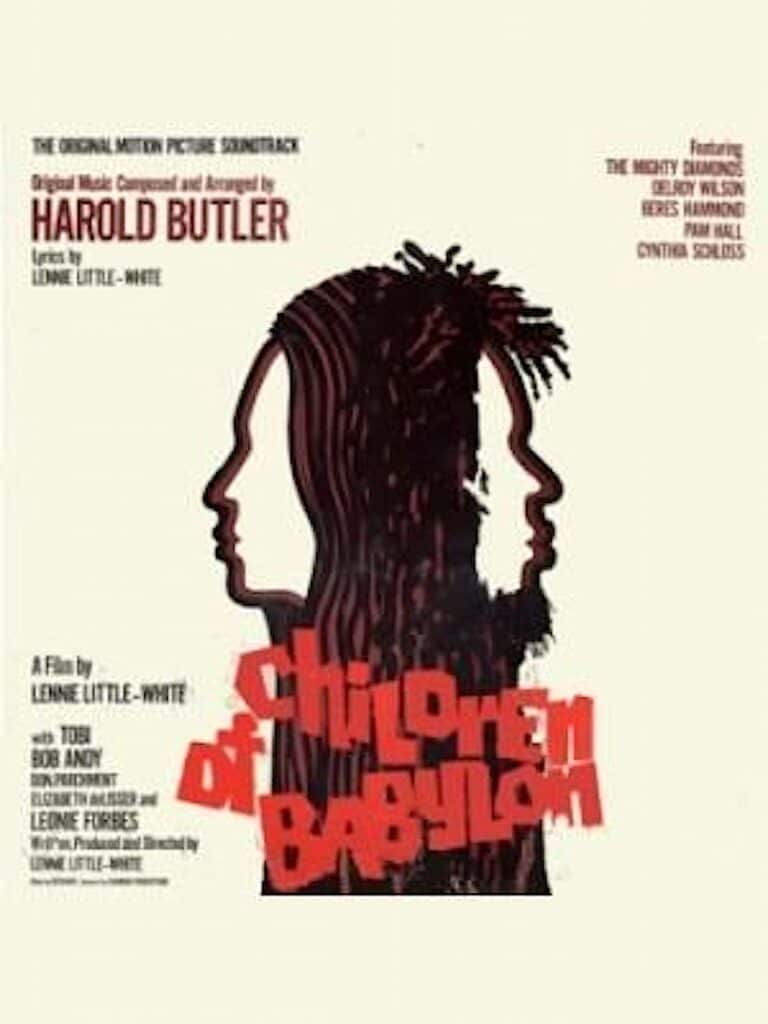
1980: JAMAICA – "CHILDREN OF BABYLON", BY LENNIE LITTLE-WHITE
This film is unique in Jamaican cinema and, more broadly, in Caribbean cinema as a whole. Far from the social deprivation of Kingston’s ghettos, in a villa in the countryside (complete with a swimming pool, champagne, and a gourmet buffet), we follow the adventures of Rick and Penny—a Black man and a white woman—as they discuss art (he’s a painter) and sexuality (she’s conducting research on the subject among rural women—whom we never see on screen).
The film is structured as a “closed-door” drama: a single setting and time counted down on a calendar. The two protagonists experience a passionate romance marked by multiple sexual encounters, parallel to those of a strangely silent maid and Luke, a Rastafarian henchman, who maintain the villa. This film embodies the free-spirited tone of the rise of erotic cinema as well as the emergence of pornographic movie theaters in the 1970s.
Nevertheless, it stands out in Caribbean cinema, where depictions of the sexual act remain rare, with foreplay (kissing, in particular) or the moment afterward often taking center stage, just as nudity is almost always partial—at least in the early decades of these cinematic traditions. Here, however, the nudity is full-frontal, particularly as part of a comedic gag, in a beach scene where, while swimming naked, the couple finds themselves temporarily without clothes after they are stolen by mischievous children.
Two “romantic” threesomes will complicate the plot, all under the curious gaze of the servants: Rick with Penny and another white woman—a situation that will tear the couple apart—and then Penny with Luke, the Rastafarian employed by Rick.
As we’ve seen, in addition to the issue of sexuality, there is a surprising freedom of expression regarding interracial couples (“domino couples,” as they’re called in Guadeloupe and Martinique), in a sexuality liberated from the drama of the colonial past. This is a breakthrough that other Caribbean film industries have yet to achieve—particularly those of Guadeloupe and Martinique—where a certain modesty still prevails.
1980: GUADELOUPE – LIVE FREE OR DIE, BY CHRISTIAN LARA
Live Free or Die is one of four films Christian Lara shot in just two years. This timeless courtroom drama features characters from various historical periods taking the stand, such as Christopher Columbus, Victor Schoelcher, Pèdre (one of the first slave rebels in Guadeloupe), and the Napoleonic general Richepanse, to determine whether or not Commander Ignace’s legacy should be restored.
This debate refers to the “Guadeloupe War” of 1802—namely, three weeks of fighting between Napoleonic troops sent to reestablish slavery following the first abolition of 1794 enacted by the First Republic, and those who resisted the reinstatement of slavery—namely, in addition to Ignace, the famous Colonel Delgrès, the mulatto woman Solitude (who was at one time considered for induction into the Panthéon), and Marthe-Rose.
Her impassioned testimony clearly highlights the important role women played in this resistance. The narrative structure adopted reveals an important characteristic of Caribbean cinema: the past is irrevocably part of the present, and the present is (almost) always intertwined with the past, in a circular or “spiral” conception of time that differs from the Western linear conception (the famous timeline).
The director, grandson of Guadeloupe’s first Black historian, Oruno Lara (with *Guadeloupe in History* in 1921), will revisit this historic event in *Sucre amer* (1998), an unofficial remake of *Vivre libre ou mourir* (once again featuring the excellent actor Robert Liensol, who had previously appeared in *Coco la Fleur, Candidate*), and the historical reenactment 1802, the Guadeloupean Epic (2002), which highlights the character of the mulatto woman Solitude in a surprising battle sequence by the river pitting Guadeloupean women against Napoleonic soldiers. Christian Lara has made this period in history the major defining moment (to date) of Guadeloupean cinema.

About the Author
Guillaume Robillard holds a Ph.D. in film studies; he is a professor and researcher, a documentary filmmaker, and a specialist in Caribbean cinema and artistic production. He is the author of two books: *Conquest of Space and Time: Caribbean Cinema (Éditions Jannink, “Hypothèses d’Art,” 2023) and Decolonial Cinema: Characters in Caribbean Cinema (Presses Universitaires des Antilles, “Arts et Esthétique,” 2024).
"Stories of Caribbean Cinema" Series. Season 2, Episode 10 is now available on Richès Karayib. Stay tuned for Season 4, Episode 10 coming soon.
The Series Stories of Caribbean Cinema continues its journey through several decades of filmmaking in the region. Following a first episode that began in the 1960s—from Cuba to the emergence of Jamaican cinema with *The Harder They Come*—this second installment takes us to Trinidad and Tobago, Cuba, and then Guadeloupe.
Amid social conflicts, the legacy of slavery, and political demands, three films demonstrate how Caribbean cinema took on history and power dynamics from the very beginning. This article is the second installment in a series of ten. The first installment is already available on Richès Karayib, and eight more episodes will continue this chronology through 2025.
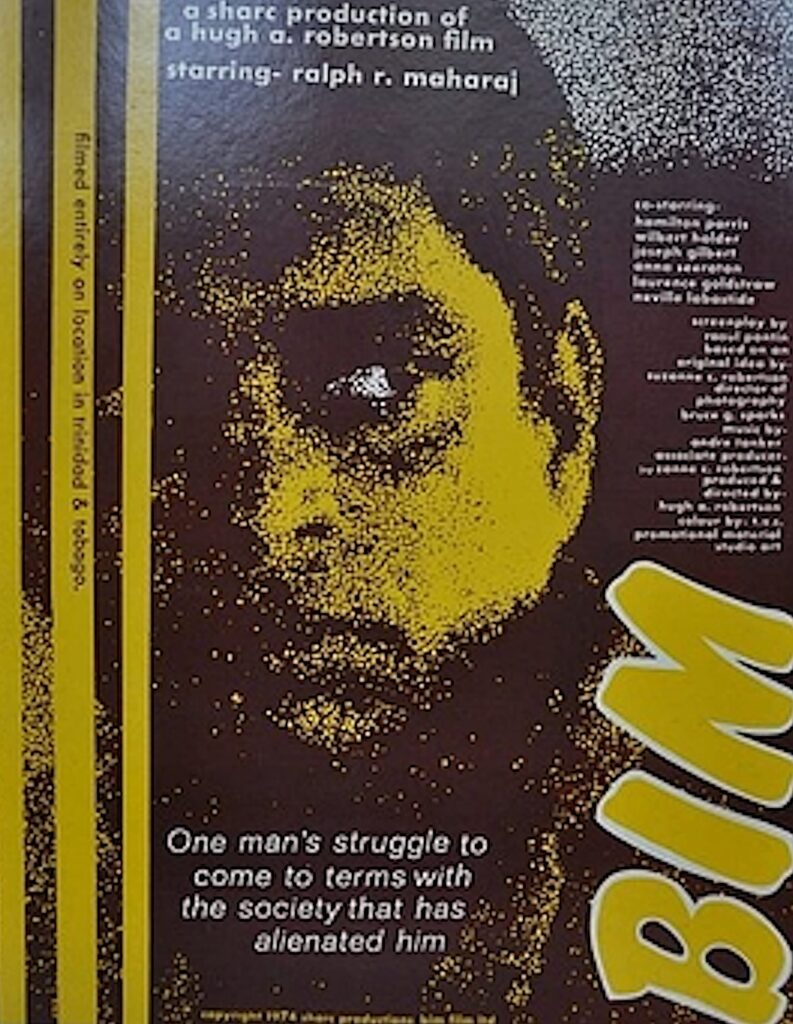
1974: TRINIDAD AND TOBAGO – BIM, BY HUGH A. ROBERTSON
Hugh A. Robertson has had an unconventional career path among Caribbean filmmakers. A New Yorker born to Jamaican parents, he got his start in the film industry at a very young age and held various positions, including that of editor on films such as the famous *Macadam Cowboy* (John Schlesinger, 1969), starring Dustin Hoffman and John Voight, and one of the classics of Blackploitation, *Shaft: The Red Nights of Harlem* (Gordon Parks, 1971), starring Richard Roundtree.
For his first film, he was nominated for an Oscar for Best Film Editing (a first for a Black person) and won the BAFTA that same year. After directing a few television projects and the feature film *Melinda* (1972)—a “Black Film,” as the poster put it—he moved to Trinidad and Tobago with his wife and children, where he directed Bim and then *Obeah* (1987), his second film, which was released upon the director’s death. Bim, modeled after the classic plot of a gangster movie, follows the life of a Trinidadian of Indian descent who, after enduring years of bullying from childhood onward, becomes a crime boss who eventually enters politics.
What stands out in this film is the direct nature of the interethnic conflicts, particularly between people of African and Indian descent (each group accounting for about 40 percent of the island’s population), ranging from the school setting to the political arena (where the white minority seems to be “pulling the strings”) and extending into marital life. Certain sequences have a strong ethnographic dimension: for example, the film opens with a traditional Hindu wedding.
While the latter is predominantly urban, much like *The Harder They Come* (Perry Henzell, 1972), Trinidad and Jamaica—which have major historic cities, Port-of-Spain and Kingston, respectively— work in the sugarcane fields—the historical foundation of most Caribbean societies—is highlighted in a plot set during the colonial era, amid the fervent independence movements of the 1950s and 1960s.
The strong political consciousness of this film echoes certain Trinidadian films that preceded it, such as *The Right and the Wrong* (1970) by Indian director Harbance Kumar, which depicts a revolt on a plantation at an unspecified time. Furthermore, Bim stands out for its energy and Ralph Maharaj’s impressive performance in the lead role. Given Robertson’s standing in the U.S. film industry, it’s not unreasonable to think that Brian De Palma might have seen his film, given Al Pacino’s brilliantly over-the-top performance in Scarface (1983) is so strongly reminiscent of Bim on several occasions.
1976: CUBA - THE LAST SUPPER (LA ÚLTIMA CENA), BY TOMÁS GUTIÉRREZ ALEA
This classic is a must-see film about the portrayal of slavery in the Caribbean, just as *Twelve Years a Slave* is for the southern United States, *Twelve Years a Slave* (Steve McQueen, 2013). Inspired by the novel *El Ingenio* (*The Plantation*) by Manuel Moreno Fraginals (which itself is based on true events), the plot of La Última Cena takes place on a slave plantation in Cuba in the 18th century, during Holy Week.
A wealthy landowner, a devout Catholic nobleman, decides to reenact the Last Supper around a lavishly set table, in the presence of twelve of his slaves. The group eats and drinks to their hearts’ content. The next day, the foreman wakes the slaves to send them to work in the sugarcane fields. A revolt breaks out…
In a film industry that, at first, rarely addressed the “Black Question” (to borrow the title of a book by the Trinidadian intellectual C.L.R. James), this film confronts the history of slavery—a reality shared by the vast majority of Caribbean countries—through a visual and auditory portrayal of rare precision regarding the “racialized” hierarchy specific to plantations: white and Black bodies do not occupy the same space (both literally and figuratively) nor do they have the same right to speak.
The banquet sequence (the famous reenactment of the Last Supper), which lasts nearly 45 minutes, displays great mastery both in terms of theater (dialogue and the actors’ performances) and cinema (technical editing, in which changes in camera angles reflect the power dynamics between characters). As for the final third of the film, it is one of the most beautifully staged depictions—through both camera movements and the framing of bodies and landscapes—of a slave revolt followed by a mass escape (the slaves’ flight from the plantation) ever made. A true masterpiece!

1979: GUADELOUPE - "COCO LA FLEUR," DIRECTED BY CHRISTIAN LARA
This film by the most prolific director from the French Antilles—who achieved the remarkable feat of directing nearly 25 films (even if it was sometimes under challenging technical conditions)—heralds the arrival of Antillean cinema. Two years earlier, in Martinique, the feature film *Dérives ou la femme-jardin* (1977), directed by Jean-Paul Césaire—one of the sons of the poet, politician, and champion of Négritude, Aimé Césaire—had not been given the chance for a commercial theatrical release.
Loosely based onAn Island in the Sun by Robert Rossen (1957), starring the famous Harry Belafonte, *Coco la Fleur, Candidate* is a political comedy that follows the journey of Coco, a so-called “apolitical” candidate controlled by technocrats from the prefecture, who decides during the campaign to take an interest in the future of his “country.” The demand—at the very least—for autonomy for Guadeloupe and Martinique is directly raised by the lead protagonist of this emerging cinema, who repeatedly takes on the role of the traditional Creole storyteller, a central figure in this body of films.
Furthermore, this film makes extensive use of the Creole language. It was a resounding success, drawing more than 100,000 viewers in Guadeloupe and Martinique, according to various sources, and remained in the lineup at the Louxor cinema in Paris for several years. An effective blend of lightheartedness and political activism that the director would brilliantly revisit in his third film, *Mamito* (1980), another classic of this cinematic tradition, whose main character is a Creole mother (a single mother raising her children on her own).
Played by the indispensable Lucrèce Saintol (who also plays Coco’s mother), who clearly illustrates the “feminocentricity” of Caribbean cinema—namely, the nearly systematic presence of strong women (fanm doubout) in this cinema. This significant presence of women was foreshadowed in *Dérives ou la femme-jardin*, a film loosely based on the short story Alléluia pour une femme-jardin by Haitian author René Depestre, featuring its enigmatic protagonist Isa.

About the Author
Guillaume Robillard holds a Ph.D. in film studies; he is a professor and researcher, a documentary filmmaker, and a specialist in Caribbean cinema and artistic production. He is the author of two books: *Conquest of Space and Time: Caribbean Cinema (Éditions Jannink, “Hypothèses d’Art,” 2023) and Decolonial Cinema: Characters in Caribbean Cinema (Presses Universitaires des Antilles, “Arts et Esthétique,” 2024).
"Stories of Caribbean Cinema" Series. Season 1, Episode 10 is already available on Richès Karayib. Stay tuned for Season 3, Episode 10 coming soon.
In Pointe-à-Pitre, a bronze statue depicts a seated man with a ka drum between his legs. It pays tribute to Vélo, one of the greatest masters of gwoka, the Guadeloupean music that emerged from the resistance to slavery. Since 2014, UNESCO has designated it as a World Heritage Site.
A Tambouyé Turned into a Statue
Marcel Lollia, known as Vélo, was born on December 7, 1931, and died on June 5, 1984. He trained several generations of ka players—a drum carved from a tree trunk and covered with a stretched skin. He also inspired Akiyo, a cultural movement advocating for identity founded in 1979, which brought gwoka out of the small circles where it was still surviving.
On June 5, 2004, twenty years after his death, a statue by sculptor Jacky Poullier was unveiled in Pointe-à-Pitre, modeled after an earlier Guadeloupean portrait dedicated to another of the island’s great figures. Two plaques accompany the statue, one of them inscribed in Guadeloupean Creole, as if to remind us to whom this memory belongs first and foremost. Vandalized in 2012, the statue was restored and reinstalled in 2014, the very year that gwoka was added to UNESCO’s list of Intangible Cultural Heritage. These two dates are interconnected and, on their own, tell the story of an art form that was long marginalized but has since become a source of national pride.

Gwoka, a practice born of necessity
The roots of gwoka date back to the Africans who were deported to Guadeloupe and enslaved there as early as the 17th century, who danced and sang despite the restrictions imposed by the colonists. But it was really after the abolition of slavery in 1848 that gwoka established itself as a cultural expression in its own right, rather than a tolerated clandestine practice. It relies on a simple ensemble: two or three ka drums and a calabash.
Two drums, called boula, maintain a repeated rhythm that varies depending on the piece being played. A third drum, the makè, with a higher-pitched sound, responds in real time to the dancer’s steps and movements. It is often the dancer, alone in the center of the circle, who sets the tempo for the musician, rather than the other way around.

Seven Rhythms, One Identity
Tradition recognizes seven fundamental rhythms: toumblak, graj, woulé, léwoz, kaladja, padjanbel, and menndé. The word léwoz refers both to one of these rhythms and to the traditional evening gathering where people dance and play music together, often outdoors, open to anyone who wants to sing, call and respond, or dance in the center of the circle. Elders mingle with the younger generation, in a process of transmission that owes nothing to a textbook.
It was in these léwoz that gwoka was passed down orally, from generation to generation, far from concert halls—much like the Fête de la Musique continues to bring Guadeloupean music to life in public spaces every year. Starting in the 1960s, it also became a political symbol, championed by Guadeloupean identity movements that saw it as an expression of cultural resistance rooted in colonial slavery.

From the Margins to World Heritage
Institutional recognition quickly followed this underlying trend. Gwoka was added to the French National Inventory of Intangible Cultural Heritage in 2013, then to UNESCO’s Representative List in 2014, by Decision 9.COM 10.17, under the exact title “music, songs, dances, and cultural practices representative of Guadeloupean identity.” Barely a year separated the two recognitions. As early as 2010, the government had awarded the title of Master of Art to a craftsman who restores ka drums, proof that a skill as essential as the music itself deserved to be protected.
Such a UNESCO inscription also places an obligation on France, which must report on the measures taken to ensure that gwoka remains a living tradition, rather than merely a museum piece. Today, schools and organizations are keeping the tradition alive in Guadeloupe and on the French mainland, alongside family-based transmission, which remains, for many Guadeloupeans, the primary gateway to gwoka. This trend is also evident in other UNESCO recognitions in the Caribbean region.
A transmission yet to be written
Gwoka is therefore not a relic frozen behind a glass case in a museum. The léwoz continue to bring people together, schools train new tambouyé, and the statue of Vélo stands watch over a square in Pointe-à-Pitre where the history of Guadeloupean resistance continues to be reenacted with every drumbeat.
One question remains—one that the heirs of Vélo, both in Guadeloupe and throughout the diaspora, are asking themselves: how to pass on this rhythm to a generation growing up far from the léwoz circle, and what this world heritage must still prove in order to remain a living tradition rather than just a title. This is a question that extends beyond Guadeloupe alone and concerns all traditions born of suffering that must now learn to thrive in the spotlight of an international designation.
Gwoka is a form of music, song, and dance from Guadeloupe performed to the beat of the ka drum. Originating from the resistance of enslaved Africans in Guadeloupe, it has been recognized by UNESCO as an Intangible Cultural Heritage of Humanity since 2014.
Gwoka has been inscribed on UNESCO’s Representative List of the Intangible Cultural Heritage of Humanity since 2014 because it is a living cultural practice that embodies Guadeloupean identity and is passed down orally from generation to generation.
Marcel Lollia, known as Vélo (1931–1984), was a Guadeloupean tambouyé master who trained several generations of ka players. A statue honoring him has stood in Pointe-à-Pitre since 2004.
In the Caribbean, a high energy bill can slow down a business. A storm can cut off a road, block a port, or jeopardize a harvest. A security crisis can also extend beyond the borders of a single country. It is against this daily reality that the Canada-CARICOM dialogue is taking on a new dimension today.
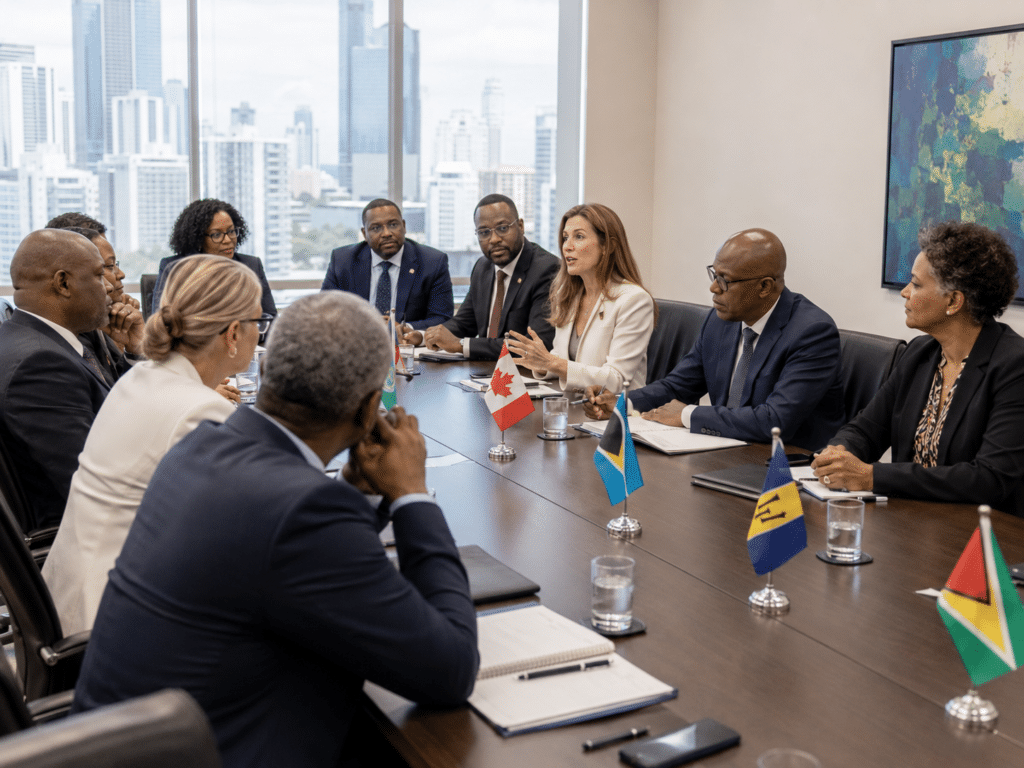
Meeting in Panama City on the sidelines of the 2026 General Assembly of the Organization of American States, the foreign ministers of Canada and CARICOM sought to reinvigorate their strategic partnership. At the heart of their discussions was an action plan focused on three major priorities for the region: security, climate, and the economy.
Cooperation Aimed at Achieving Concrete Results
The Canada-CARICOM partnership builds on the strategic agreement launched in 2023. But the 2026 meeting marks an important milestone: both parties now want to move forward with a plan that is more specific, clearer, and more measurable.
The goal is not merely to demonstrate diplomatic closeness. It is to establish priorities, timelines, and funding mechanisms capable of producing results. For Caribbean countries, this clarity matters. The region faces a range of interrelated challenges: energy costs, climate-related disasters, maritime security, financial vulnerability, and the crisis in Haiti. The Caribbean is not merely asking for aid. It is seeking partners capable of understanding its realities and working alongside it for the long term.
Security: A Regional Emergency
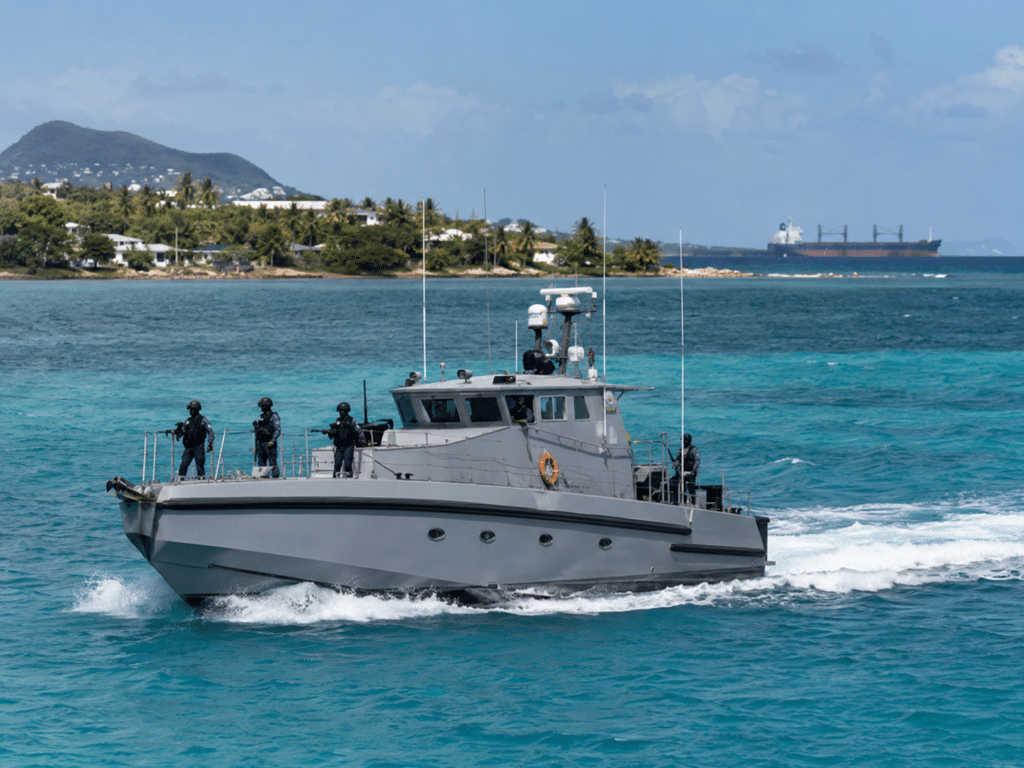
Security is central to this new Canada-CARICOM plan. The ministers discussed transnational crime, gangs, irregular migration, maritime security, and illicit flows. For the region, these issues are not isolated. The sea serves as a link, but it is also an area of vulnerability. Trafficking, criminal networks, cyberthreats, and political crises sometimes spread faster than institutional responses can keep up.
Canada already supports certain regional initiatives through capacity building, targeted interventions, and operational partnerships. The new challenge is to move toward a more coordinated response: better protecting maritime areas, strengthening institutions, sharing relevant information, and limiting the influence of criminal networks.
Haiti: A Crisis That Affects the Entire Caribbean
Haiti is a major focus of the discussions. The political, security, and humanitarian crisis the country is facing has direct consequences for the region. In particular, the ministers highlighted the risks associated with drug and arms trafficking. Support for the Gang Suppression Force was among the topics discussed. This force is intended to help restore security on the ground, with a mandate set to be renewed by the United Nations Security Council.
But the response cannot be limited to security measures alone. The ministers also reaffirmed the right of Haitians to choose their own government. They support the holding of credible elections as soon as conditions permit, as well as efforts to combat corruption and impunity. Haiti serves as a powerful reminder: no lasting stability in the Caribbean can be achieved by leaving a country to face such a profound crisis on its own.

Climate and the Economy: Two Sides of the Same Challenge
The new Canada-CARICOM plan also clearly links climate and the economy. In the Caribbean, a natural disaster is never just a weather event. It affects families, businesses, roads, schools, ports, and public finances. Access to reliable and affordable energy is once again a priority. Overly expensive energy stifles innovation and puts a strain on households. A more stable energy supply can support industry, services, investment, and the transition to more sustainable models.
Trade is also part of the equation. The CARIBCAN program, which grants duty-free access to the Canadian market for most products originating in 18 Caribbean Commonwealth countries and territories, remains an important tool. It serves as a reminder that the Canada-CARICOM partnership is not just about diplomacy. It also encompasses economic opportunities, supply chains, and the ability of Caribbean businesses to expand beyond their local markets.

Greater Attention to the Caribbean's Vulnerability
Another key aspect of the Canada-CARICOM partnership concerns financing. Several Caribbean states are considered middle-income countries. Yet their vulnerability to climate-related disasters, economic shocks, and supply disruptions remains very high. This is one of the region’s major paradoxes. On paper, some countries appear too “advanced” to easily access concessional financing. In reality, a single crisis can undermine years of progress.
The ministers therefore emphasized the need to reform the international financial architecture. The idea is simple: the actual vulnerability of small states must be taken into account more fully—not just their average income.

A plan to follow closely
The coming months will be crucial. Officials still need to finalize the details of the action plan, identify priority initiatives, develop an implementation schedule, and strengthen monitoring efforts. A dialogue among senior officials is scheduled for the fall to advance this work.
The Canada-CARICOM partnership alone will not solve the Caribbean’s challenges. But it says something about the current moment: the region wants to be heard as a strategic area, not just as a vulnerable one. Now the real question remains: Will this new plan bring about visible changes for Caribbean people, businesses, and territories?
The new Canada-CARICOM plan is a roadmap designed to strengthen cooperation between Canada and the Caribbean Community. It is based on three priorities: more resilient economies, climate action, and regional security. The goal is to move from a diplomatic partnership to more concrete actions, with timelines, measurable results, and sustainable financing mechanisms.
Haiti is a key focus because its political, security, and humanitarian crises have repercussions for the entire region. The ministers discussed drug and arms trafficking, support for the Gang Suppression Force, and the right of Haitians to choose their own government. For CARICOM, Haiti’s stability therefore remains a regional issue, not just a national one.
The Canada-CARICOM Partnership directly links climate and the economy. It emphasizes access to reliable and affordable energy, the development of trade, the strengthening of supply chains, and access to financing tailored to the vulnerabilities of small Caribbean states. The goal is to enable the region to better withstand natural disasters, economic shocks, and international crises.
From December 5, 2026, to April 4, 2027, the MSC World Europa will come alive to the rhythms of Caribbean music with the Zouk@Sea by MSC festival. For its third edition, eighteen weeks of musical entertainment will take place on sailings departing from Fort-de-France and Pointe-à-Pitre, featuring artists, live bands, and DJs from Martinique and Guadeloupe. The lineup brings a variety of Caribbean musical styles aboard an international cruise ship: zouk, compas, Creole traditions, urban music, cadence, dancehall, shatta, soca, and DJ sets.

A different lineup every week
Zouk@Sea by MSC operates on a simple principle: each week, an artist, band, or DJ performs on the cruise. Departures are scheduled for Saturdays from Fort-de-France and Sundays from Pointe-à-Pitre. The season will kick off on December 5 and 6, 2026, with SOS Kantik and a lineup dedicated to Chanté Nwèl. Silonvan will take over on December 12 and 13, followed by DJ Raptor on December 19 and 20, and then DJ Moulinex on December 26 and 27.


In January 2027, La Finekip is scheduled for January 2 and 3, followed by Emosyon on January 9 and 10. Misié Sadik, Jessye Belleval, and Zouk’n Groove will take the stage on January 16 and 17. The following weekend, on January 23 and 24, Kwaxikolor will share the stage with Jocelyne Béroard. Thierry Lof and C’Zigla will close out the month on January 30 and 31.


Jocelyne Béroard and Several Generations of Zouk
Jocelyne Béroard’s participation gives this third edition a particularly intergenerational dimension. With Kwaxikolor, the artist—who is closely associated with the history of the group Kassav’—will perform a repertoire rooted in the legacy of zouk. Misié Sadik, Jessye Belleval, and Zouk’n Groove will blend urban sounds, Creole music, and contemporary zouk. While the festival’s name highlights zouk, the lineup extends far beyond this genre.


February: Live Shows, Birthdays, and DJ Sets
DJ Fab will kick off February with shows on February 6 and 7. Kaf Kon’s will follow on February 13 and 14 with an acoustic set featuring Creole covers, audience interaction, and a festive atmosphere. On February 20 and 21, Tanmpo Klassik Live will celebrate its tenth anniversary. DJ Stonekilla & Friends will then take the stage on February 27 and 28.


From Jean-Michel Galva to MKG to close out the season
March will once again bring together a variety of musical styles. Jean-Michel Galva & Koezyon are scheduled to perform on March 6 and 7 with a repertoire blending zouk, cadence, and traditional Caribbean influences. Maty will take the stage the week of March 13 and 14, followed by DJ Raptor & Friends on March 20 and 21. Jean-Marc Ferdinand, billed as a true Caribbean party starter, will perform on the departures on March 27 and 28. MKG will wrap up the lineup on the cruises on April 3 and 4, 2027. However, the schedule is subject to change. The official poster notes that certain artists may be replaced or absent without prior notice.


The MSC World Europa Deployed to the Caribbean
This third edition coincides with the deployment of the MSC World Europa to the French West Indies during the winter of 2026–2027. The ship will depart from Fort-de-France and Pointe-à-Pitre, two ports that will play a central role in this season. MSC Cruises is presenting this initiative as a way to strengthen its regional presence. According to figures released by the company, the Caribbean welcomes 43% of the world’s cruise passengers and accounts for 36% of global cruise capacity.
These figures position Zouk@Sea by MSC within a sector where the region already plays a major role. But the project’s cultural significance lies elsewhere: in the opportunity it offers artists from Martinique and Guadeloupe to perform each week in a venue frequented by travelers from diverse backgrounds. Patrick Pourbaix, CEO of MSC Cruises France, explains that the goal is to transform every cruise into “a true celebration of the Caribbean way of life.” The musical program thus becomes a central part of the onboard experience. Au-delà de sa dimension artistique, cette programmation répond également à une logique de différenciation commerciale. Latitude 15 examines how MSC leverages Caribbean culture as a competitive advantage aboard the MSC World Europa.


A mobile showcase for Caribbean scenes
For passengers, Zouk@Sea by MSC will combine Caribbean port calls with concerts, live performances, and musical evenings. For the featured artists, the ship offers a stage that’s different from the festivals, venues, and events typically held on land. The project, however, raises a broader question. Can an onboard program become a genuine vehicle for promoting Caribbean music, rather than just entertainment tied to the trip?
For eighteen weeks, the MSC World Europa will host Christmas traditions, zouk artists, live bands, and DJs. From SOS Kantik to MKG, this season will above all showcase the diverse Caribbean music scene, which is able to preserve its heritage while showcasing its most contemporary sounds.
Zouk@Sea by MSC is a music festival at sea organized by MSC Cruises aboard the MSC World Europa. For its third edition, the event will feature a different artist, live band, or DJ from Martinique or Guadeloupe each week. The lineup will showcase a variety of Caribbean musical styles, including zouk, compas, Chanté Nwèl, cadence, dancehall, shatta, soca, and Creole urban music.
The Zouk@Sea by MSC season will run from December 5, 2026, to April 4, 2027. Cruises will depart every Saturday from Fort-de-France, Martinique, and every Sunday from Pointe-à-Pitre, Guadeloupe. A different musical lineup will feature each week aboard the MSC World Europa. However, announced artists are subject to change or cancellation without notice.
The lineup will feature SOS Kantik for the Chanté Nwèl, Silonvan, La Finekip, Emosyon, Misié Sadik, Jessye Belleval & Zouk’n Groove, Kwaxikolor feat. Jocelyne Béroard, Thierry Lof & C’Zigla, Kaf Kon’s, Jean-Michel Galva & Koezyon, Maty, Jean-Marc Ferdinand, and MKG. Tanmpo Klassik Live will also celebrate its tenth anniversary on board. Several DJs will be participating in the season, including DJ Raptor, DJ Moolinexx, DJ Fab, and DJ Stonekilla & Friends.
On June 21, 2026, the streets, squares, and cultural venues of Martinique, Guadeloupe, and French Guiana hosted concerts, open-mic nights, and musical gatherings. In these three territories, the Music Festival took on different forms, drawing on local repertoires and featuring both amateur and professional artists.
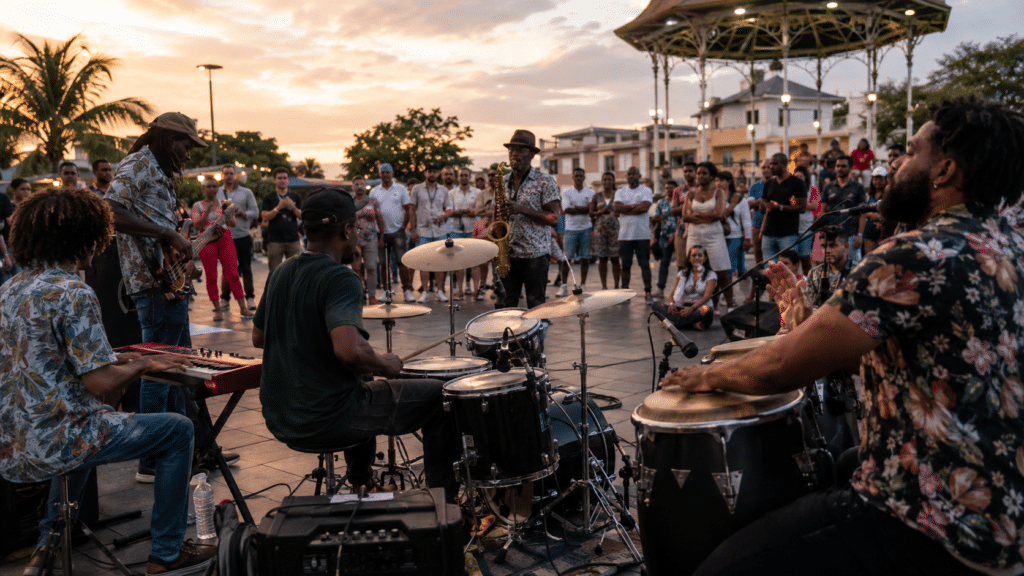
The 45th Music Festival, open to everyone
Created in 1982 at the initiative of Jack Lang, Maurice Fleuret, and Christian Dupavillon, the Music Festival celebrated its 45th edition this year. Its purpose remains the same: to showcase live music, bring together music lovers and professionals, and offer free concerts on June 21. The event is now celebrated in more than a hundred countries.
In France’s Caribbean and Amazonian territories, this common framework is reinterpreted in light of local realities. Zouk, gwoka, biguine, reggae, Creole jazz, percussion, urban music, and South American influences can all come together in a single program. This diversity does not turn the three territories into a uniform whole. Rather, it shows how each one adapts a national event to its own music scenes, languages, and musical trends.
In Martinique, a route connecting the city center and the neighborhoods
In Fort-de-France, the city had announced a musical route designed to bring artists and the public together between the city center and various neighborhoods. The city’s call for participation also involved volunteers in the organization, in keeping with the event’s participatory spirit.
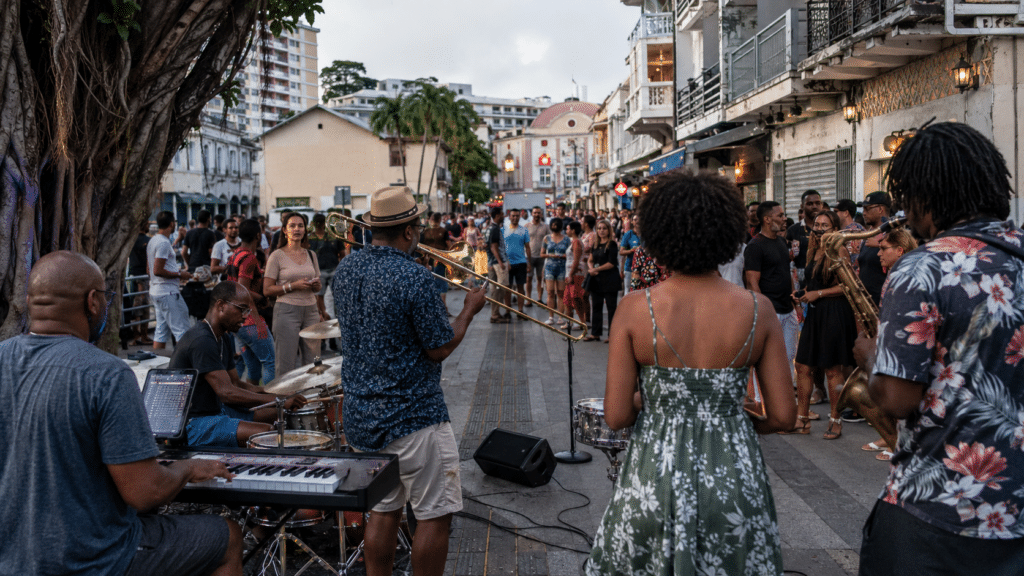
Across the island, the program spanned several municipalities and, in some cases, lasted the entire weekend. At Schœlcher, the Village Musical featured more than 200 artists spread across seven venues. Gospel, reggae, salsa, percussion, traditional music, DJ sets, and urban music were among the offerings. This juxtaposition of generations and musical styles illustrates one of the strengths of the Music Festival: creating a shared stage without imposing a dominant genre.
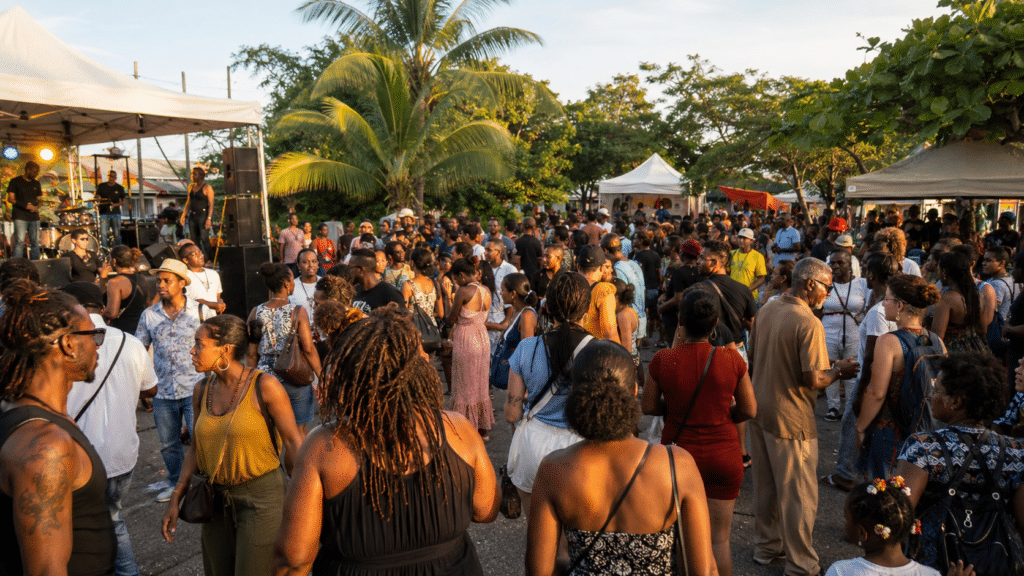
In Guadeloupe, Musical Heritage Takes Center Stage
In Pointe-à-Pitre, the program featured a special edition of the Marché de Kalina, from 8:30 a.m. to 5:00 p.m. at Place de la Victoire, celebrating Guadeloupean culture and traditions, with artistic performances. The event was therefore more of a cultural and musical celebration than a large evening concert.
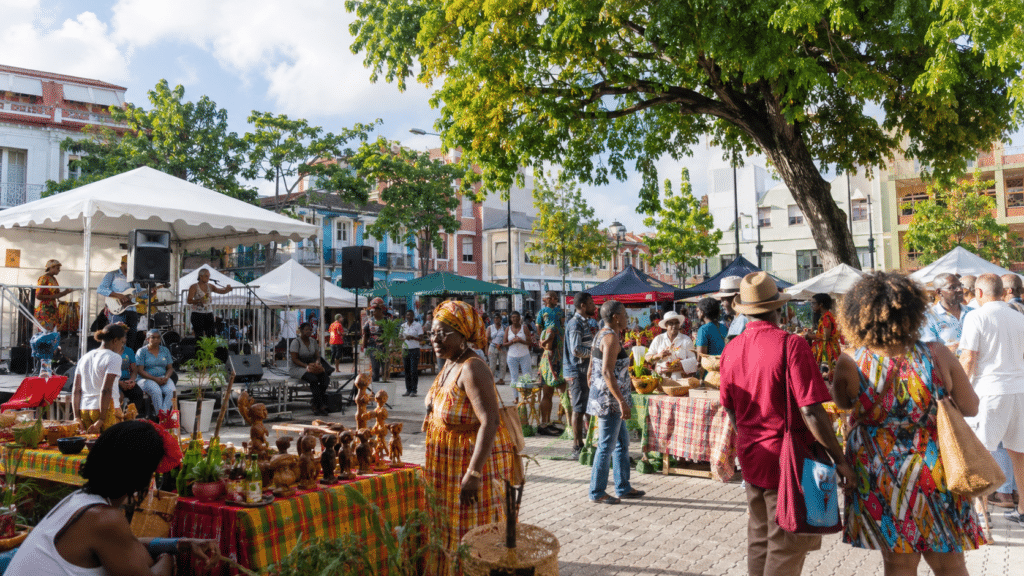
Elsewhere in the archipelago, the programs gave prominent coverage to Guadeloupe’s musical heritage. In Le Moule, the two-day program featured a meeting with Pierre-Édouard Décimus and Maalkhéma, an event centered on the ka, an open mic, as well as zouk, biguine, jazz, and gospel. This lineup serves as a reminder that the Music Festival can also convey musical history, showcase the region’s instruments, and bridge the gap between heritage and contemporary creation.
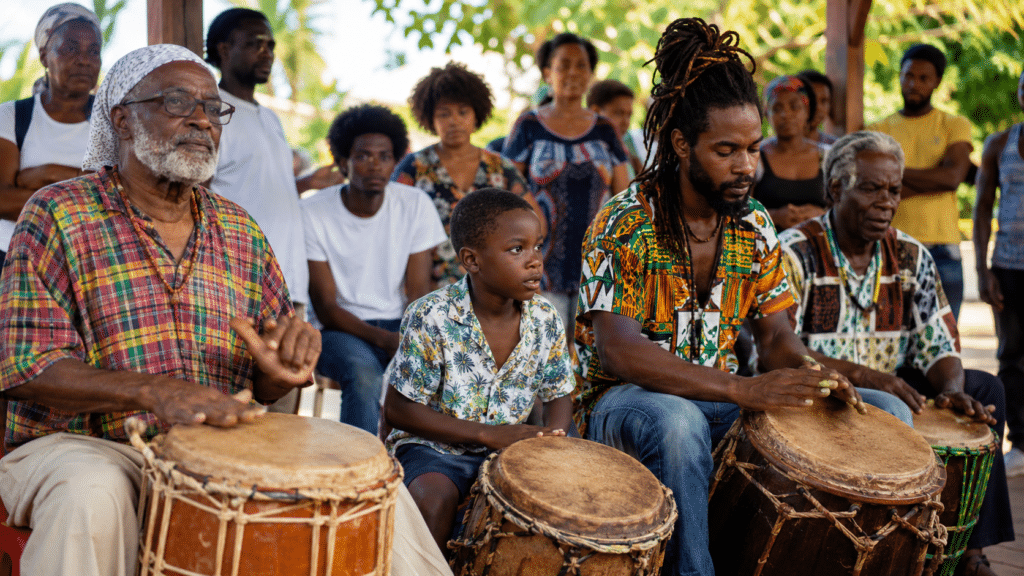
In French Guiana, open-air venues between the city and the Amazon
In French Guiana, the Music Festival took on several forms. In Cayenne, a number of events took place in public spaces. An open-mic stage was scheduled to begin at 4 p.m. on Place des Chaînes Brisées, followed by another event on Place des Palmistes starting at 6 p.m. featuring several DJs. The Kayenn’Art festival, held at La Poudrière over the weekend, also combined visual arts, local creations, and musical performances.
These proposals reflect a unique soundscape. Guyanese music is shaped by its interaction with Creole, Bushinengue, Surinamese, Brazilian, and Caribbean musical traditions. However, we must avoid reducing these exchanges to a single border or a single genre: they follow migration patterns, languages, media, artistic collaborations, and the history of the Guiana Shield.
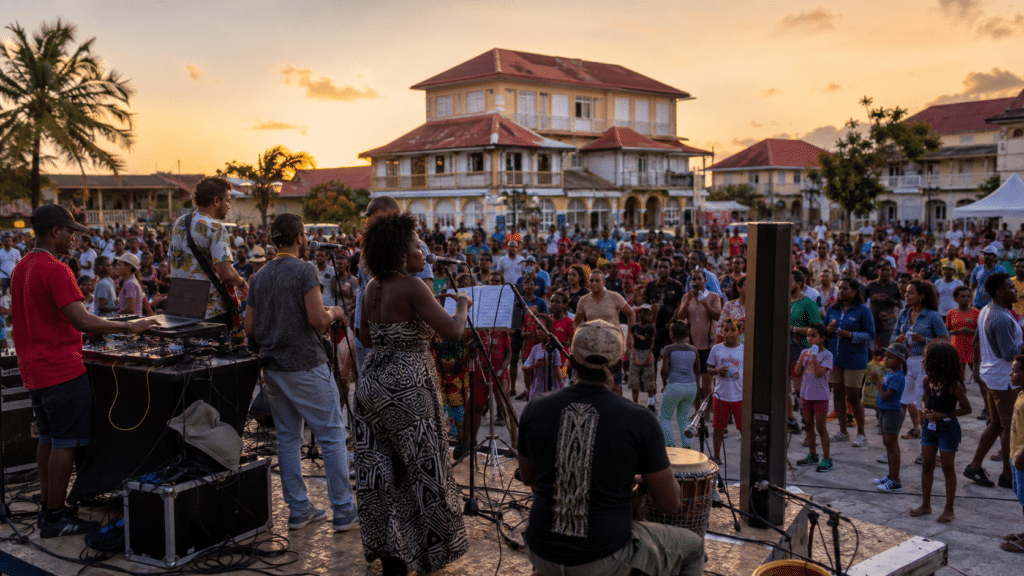
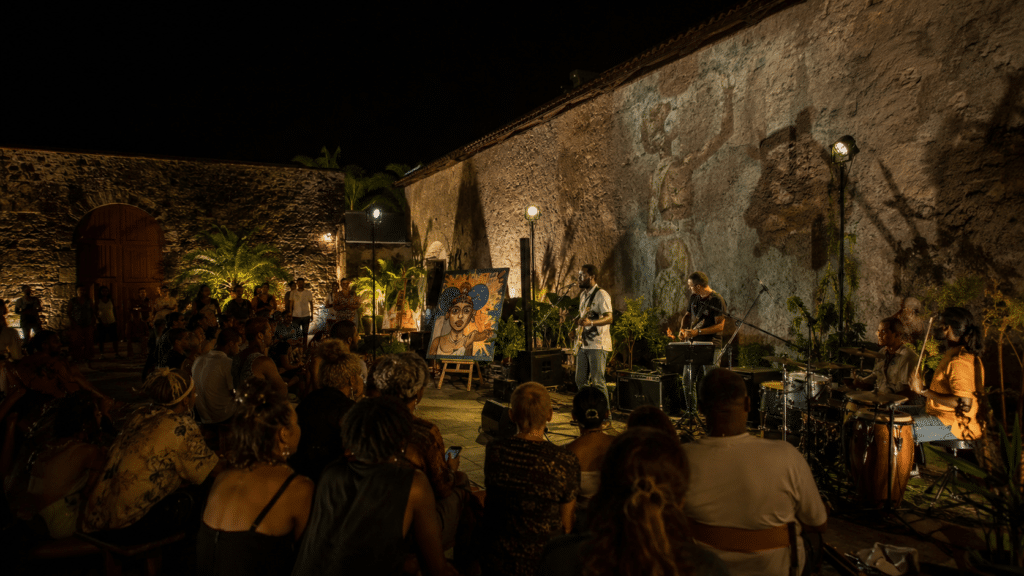
Why does the Music Festival remain accessible?
Free admission remains one of the defining features of the Music Festival. This does not mean that every event can be organized without rules or coordination. Municipalities issue calls for participation, designate venues, and oversee the setup. However, public access to the concerts included in the program remains free.
When it comes to ticketed cultural events, this principle fosters a different relationship with the stage. The audience can move from one venue to another, listen to an unknown band, or stop by an open mic without having to buy a ticket. This accessibility fosters encounters, even if it is not, on its own, sufficient to measure the cultural success of a festival.
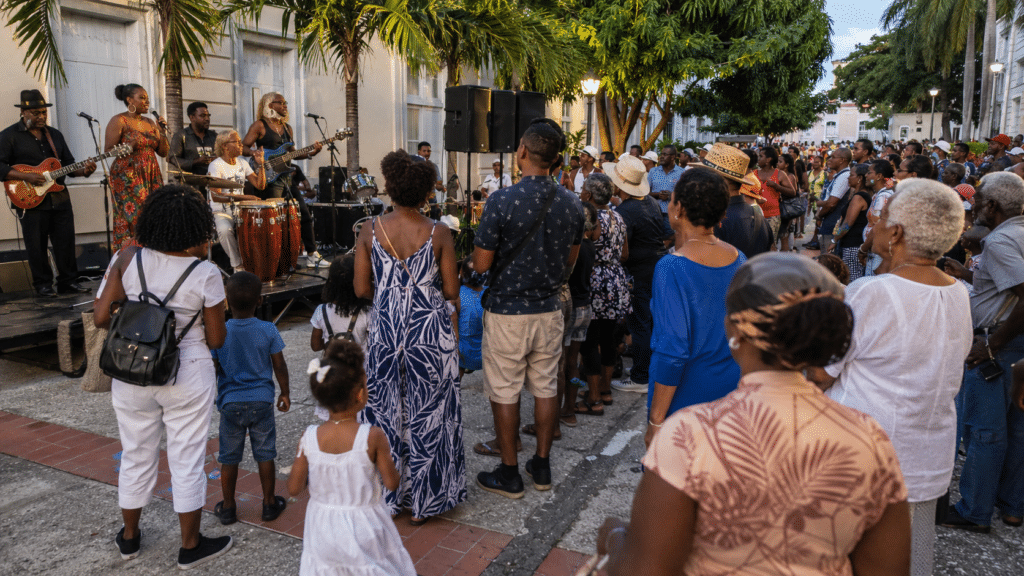
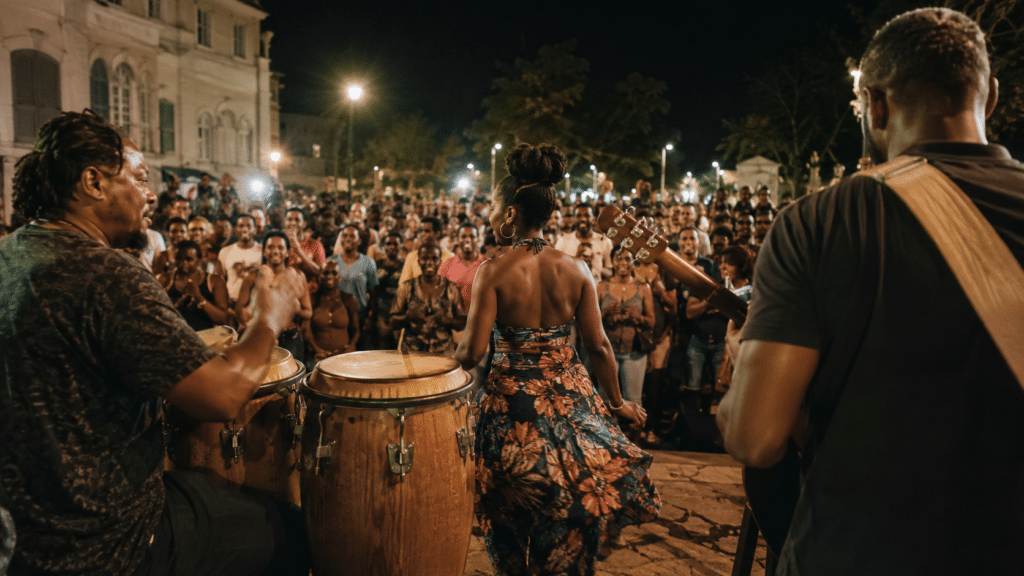
The 2026 Music Festival was officially held on June 21, with some events taking place over several days during the weekend. This 45th edition featured concerts, open-air stages, and cultural events in several towns across Martinique, Guadeloupe, and French Guiana.
In Martinique, Fort-de-France offered a musical tour connecting the city center with the neighborhoods, while Schœlcher featured more than 200 artists across seven venues. In Guadeloupe, the Kalina Market in Pointe-à-Pitre and the activities organized in Le Moule highlighted local cultures. In French Guiana, Cayenne hosted open-air stages at the Chaînes Brisées and Palmistes squares, as well as the Kayenn’Art festival at La Poudrière.
The Music Festival allows amateur and professional artists to perform for free in public spaces. In Martinique, Guadeloupe, and French Guiana, it also highlights local and regional musical genres, such as zouk, gwoka, biguine, reggae, percussion, urban music, and Amazonian influences.
With WHO, Wil Aime signs his first feature film and returns to the West Indies with a team, a method and a story of creation. In Guadeloupe and Martinique, his tour revealed the other side of the story: that of a film that has been supported for years, between independent creation, territorial support and the desire to make his own cinema.
A comeback tour
The public saw the theaters, the meetings, the photos, the post-screening exchanges. Behind this tour of WHO in Guadeloupe and Martinique, there was a precise mechanism. Dates to organize. Partners to mobilize. A team to bring in. Above all, one desire: to present the film where part of its imagination took root.
From May 30 to June 1, 2026, Wil Aime and his team enjoyed a series of highlights: a special screening at Cinestar, a Creative Talk at Café Papier in Jarry, a screening at Madiana, and meetings with professionals, students, media and cultural players. In the interview conducted around this event, Wil Aime explains that presenting the film in the Antilles was important to him. Guadeloupe and Martinique appear to be territories of attachment, inspiration and return.

A film inspired by the West Indies
Some sequences from WHO were shot in Guadeloupe. The film travels between France, the French overseas territories, Belgium, Switzerland, Canada and French-speaking Africa. The work is the brainchild of a Guadeloupean creator, developed in an independent framework, then seeks its audience beyond the usual frontiers of French cinema.
In the Creative Talk, Wil Aime talks about the Antilles as a place that nourished the film. He talks about these islands, their place in the French-speaking world, their position in a wider imaginary. The film reveals something of the relationship with the territory: the landscapes, the tensions, the identities, the way of situating oneself when one comes from an area often presented as small, whereas it produces talents capable of going very far.


Making movies
The heart of this story may lie in a nuance. During the exchange with the audience, Wil Aime talks about the dream of “making my own cinema”. Before the feature film, there were the videos. Short formats. Tales with drawers. Scenarios where detail counts. With WHO, this grammar built on social networks changes scale.
The transition to feature film requires a different kind of discipline. Wil Aime admits it himself: moving from social networks to film meant learning how to convey his vision. On a film, an idea has to be understood, carried and executed by many more people.
Chaque Détail Productions, a team built to last
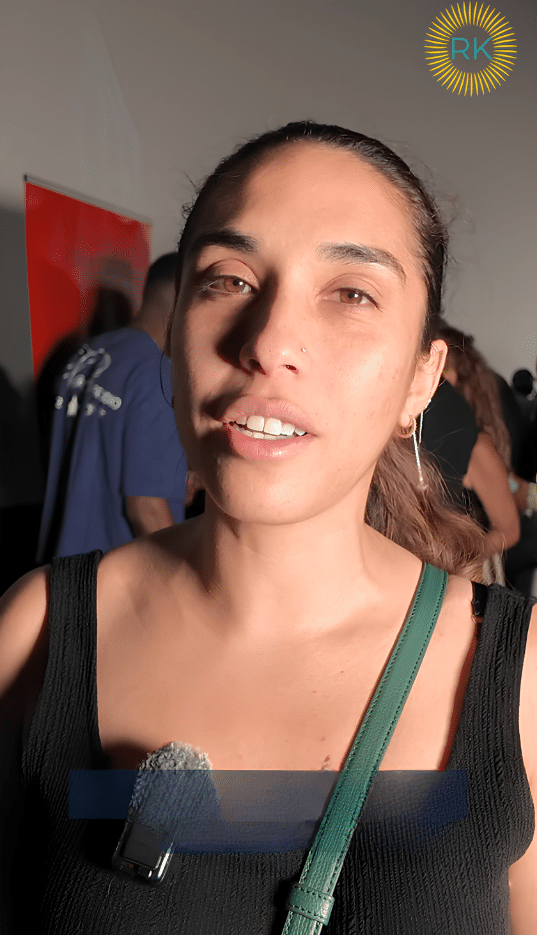
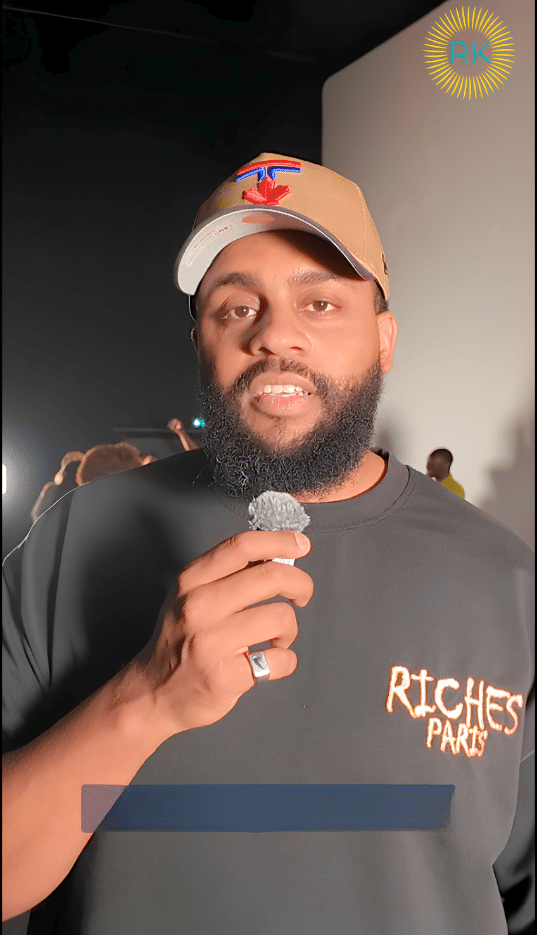
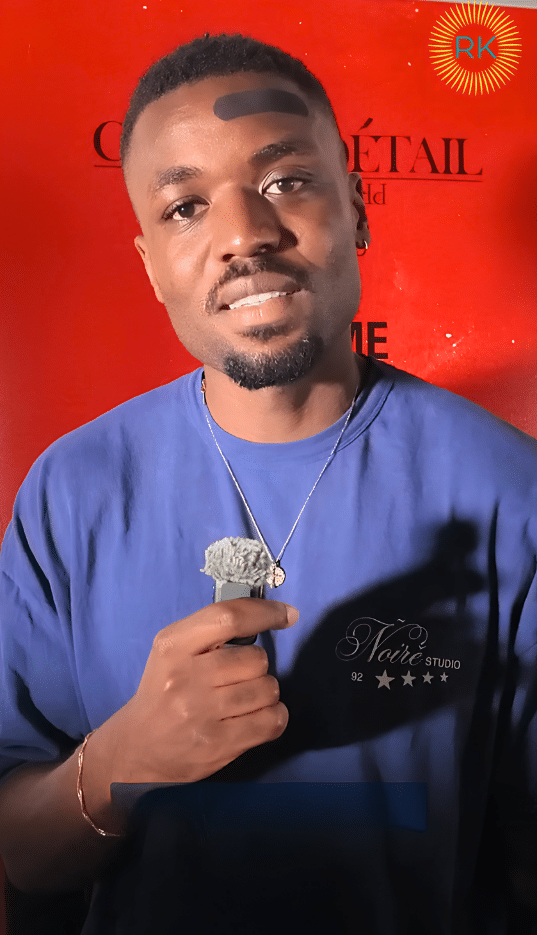
Behind the scenes of WHO, there’s a collective: Ashley, Samira, Gary, Yasser, Emmanuel and the other members of Chaque Détail Productions. Many of them learned on the job. The word that comes to mind is versatility.
Ashley, co-founder and sister of Wil Aime, tells of an adventure that began even before the structure really existed. Samira talks about starting up with a smartphone. Gary talks about his technical apprenticeship. Yasser insists on his role in the field. Emmanuel brings production, distribution and broadcasting experience to the table. This collective gives WHO a concrete dimension. The film moves forward thanks to a team that learns, adapts, looks for solutions and accepts to work outside the most comfortable paths.

Transmitting a vision to 400 people
One of the strongest passages in the interview concerns the challenge of artistic management. Wil Aime explains that his close-knit team works almost as one. With them, ideas flow quickly. The real challenge comes when you have to extend this vision to a much larger team.
He speaks of 400 people having worked on the film. At this scale, the vision has to be transmitted, understood, reformulated and carried by each department. For him, this was one of the greatest difficulties of the project. We had to learn to communicate differently.
Guadeloupe as a creative territory
The Guadeloupe Region provided support for the film, notably for post-production. With the CTIG, it also supported the visit of Wil Aime and his crew to Guadeloupe and Martinique. Behind this support, there’s a broader aim: to show that Guadeloupe can be a welcoming territory for film shoots, a space for audiovisual creation and a place of emergence for new talent.
A film like WHO examines the place of overseas creators in the cultural industries. It shows the importance of bridges between Guadeloupe, Martinique, mainland France, French-speaking Canada and French-speaking Africa.
What WHO opens
In the Creative Talk, one idea runs through several speeches: how do you go big when you come from a territory often perceived as small? Wil Aime responds with usefulness, sincerity and modest beginnings. He talks about family, loved ones and first circles. He reminds us that a project often grows from a small space, a small room, a notebook.
Perhaps this is where WHO has become a textbook case for a generation of Caribbean creators seeking a different way of telling stories, a different way of producing, a different way of circulating. His journey shows the difficulties, the detours, the refusals, the negotiations, the learning.
The future will tell what Chaque Détail Productions will build after this stage. For now, WHO leaves an open question for the Caribbean territories: how can we turn these successes into a sustainable industry, so that other dreams of cinema also find their way to the screen?
WHO marks an important milestone, as it is the first feature-length film by Wil Aime, a Guadeloupean creator known for his short stories and psychological thrillers. The film also highlights Guadeloupe as a territory of creation, inspiration and welcome for audiovisual projects capable of circulating in France, the West Indies, Canada and French-speaking Africa.
Guadeloupe and Martinique were the focus of a special tour around WHO, with screenings, meetings with the public and Creative Talks for professionals, students, media and cultural players. For Wil Aime, this visit to the West Indies was of particular value, as these territories have nurtured the film’s imagination and represent a place of return for his team.
Backstage at WHO shows a collective adventure built over time. Around Wil Aime, the Chaque Détail Productions team moved forward with an independent method, a great deal of versatility and a strong desire to maintain a clear artistic vision. The project also tells the story of a creator’s transition from social networks to cinema, with all the human, technical and creative challenges that implies.
A constraint that can become a value
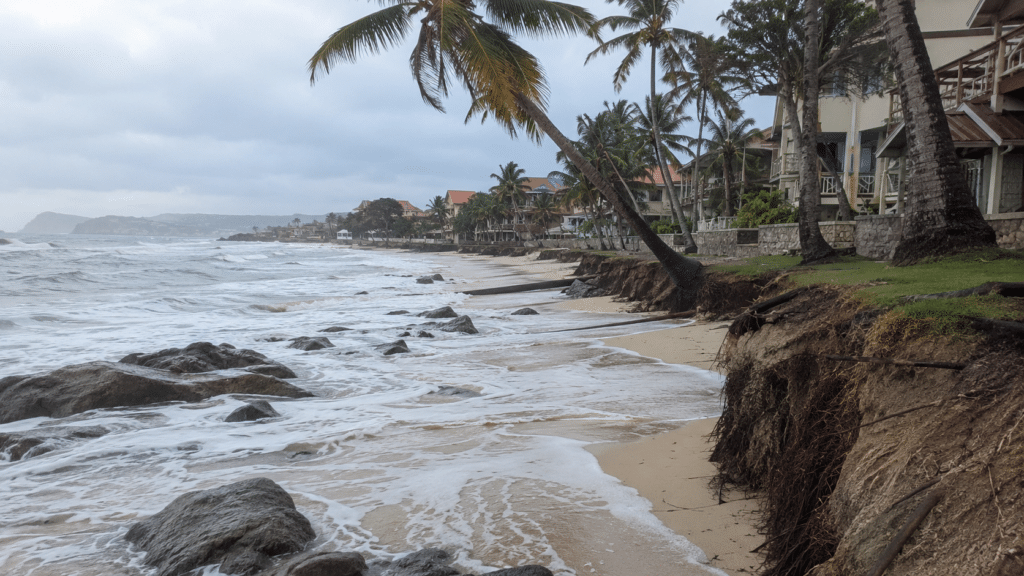
The Caribbean is experiencing climate change directly, brutally and continuously. More intense cyclonic seasons, accelerated coastal erosion, fragile coral ecosystems, energy vulnerability: no island in the region has been totally spared. For a long time, this reality has been presented as a constraint for public budgets, for tourism operators and for economic models based on the classic spa industry.
The Travel Dreams 2026 report by Amadeus, however, suggests a possible turnaround. What was once perceived as a fragility can become a value proposition, as long as it is acknowledged and accurately portrayed. This is where the notion of visible sustainability becomes central.
What travellers say
The study first documents the scale of demand. Of the 6,000 travelers surveyed across six major global markets, 75% say that a hotel’s sustainability commitments are important in their booking decision. More than one in three, precisely 35%, consider them “very important”.
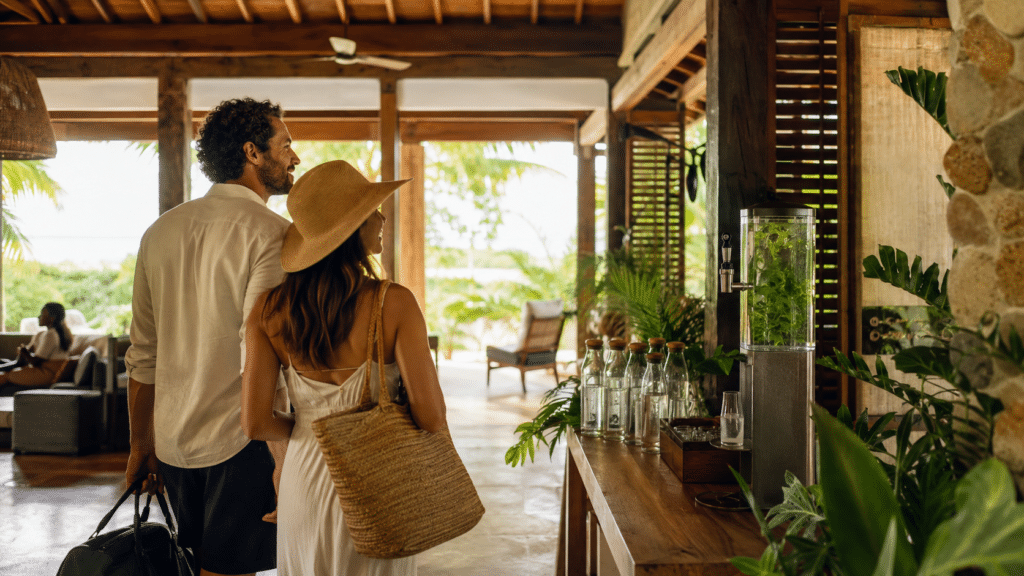
And this concern translates into willingness to pay. Travelers who place importance on this criterion say they are willing to spend an average of 11.7% more per night to stay in an establishment with serious sustainable practices. This represents around $29 more on a $250 room. Among Generation Z travelers, this willingness rises to 14.7%, or almost $37 more per night. Visible sustainability starts here: in a hotel’s ability to communicate why these practices are worth more.
One data point deserves particular attention for the Caribbean: sensitivity to sustainability varies greatly according to source markets. It reaches 93% of travelers surveyed in India and 85% in China, compared to 65% in the UK and Germany. For a region seeking to reduce its dependence on traditional markets, these discrepancies open up a strategic avenue to be handled with caution. These travelers won’t be satisfied with a generic discourse on nature. They’ll be looking for evidence, visible features, documented stories. For the Caribbean, visible sustainability can become a way of speaking to these audiences without denying its local roots.

What hotels do
On the supply side, Amadeus data show a widespread commitment among the hoteliers surveyed. Of the 500 general managers or equivalent profiles consulted across nine countries, all say they plan to spend on sustainability initiatives in the coming year. The average anticipated expenditure represents 6.7% of total company expenditure. And 35% of hoteliers identify sustainability as a key differentiating factor from their competitors.
But the study also highlights a revealing discrepancy. Hotels invest primarily in actions that have an internal operational efficiency rationale: water conservation (33%), sustainable catering supply (33%), responsible supply chains (33%), waste reduction (32%), staff training (32%).

On the other hand, practices that are more visible to the customer, such as renewable energies (28%), biodiversity and community initiatives (27%), and the link between sustainability and loyalty programs (21%), remain less developed. It is this tension that makes visible sustainability strategic: it forces us to move from internal effort to an experience understood by the traveler.
Closing the gap
Joerg Schuler, Head of Global Hospitality Sales at Amadeus, sums up this discrepancy by talking about sustainability as being more “visible, experiential and integrated into the stay”. The formula is important, because it changes the subject. It’s no longer just a question of saying that a hotel consumes less water or reduces its waste. It’s about making these choices understandable, concrete and experienced by the traveler. Visible sustainability therefore requires not only proof, but also an accurate narrative.

This gap is precisely what the Caribbean can bridge. Visible Caribbean sustainability is not an abstract technical program. It can be embodied in visible, relatable, situated practices. Restoring mangroves. Coral reef protection. Local solar energy. Short-distance sourcing from small island producers. Saving water in contexts where the resource is precious. Passing on traditional knowledge of how to use the environment sparingly.

Each of these practices can be both a serious environmental commitment and a story that travelers can experience during their stay. It is this articulation that transforms visible sustainability into perceived value, and thus into pricing leverage.
A value to be documented
A Caribbean hotel that can document, with figures, identified partners and measurable results, its role in restoring a local ecosystem is no longer just selling a room. It’s selling participation in a broader regional project. Travelers surveyed by Amadeus have already indicated their willingness to pay for this. Visible sustainability therefore requires showing what is being done, by whom, with what effects.

This logic goes beyond the individual hotel business. It also concerns destination management bodies, tourism authorities and regional economic players. A region’s ability to credibly communicate its ecological commitment is becoming a competitive variable in the face of other tropical destinations. At destination level, visible sustainability can become a common language for hotels, producers, associations, communities and travellers.

The Caribbean challenge
For the Caribbean, the challenge is not to become sustainable in the sense that other regions understand it. It is to make legible a sustainability that, in many cases, is already practiced at the level of communities, small businesses, local cooperatives and inherited know-how. The global market is willing to pay for it. The question is whether the region will be able to present this reality with the appropriate rigor, coherence and pride.

This series of articles, in its three parts, has attempted to defend the same thesis. The expectations of travelers in 2026 – disconnection, connection to place, visible sustainability – are not constraints that Caribbean players have to endure. They are expectations that the region structurally bears, by virtue of its geography, cultures and history. What remains, as always, is the patient task of putting them into words. This is the editorial mission that Richès Karayib will continue to carry out, alongside the region’s economic, institutional and creative players.
Visible sustainability refers to the set of sustainable commitments that a traveler can actually see, understand or experience during their stay. It’s not just about internal measures, such as reducing water costs or limiting waste behind the scenes. In the Caribbean, this can take the form of solar power clearly integrated into the hotel, a mangrove restoration program, coral reef protection, sourcing from local producers or community actions presented with concrete results. This approach makes the ecological commitment more legible and credible for the traveler.
Visible sustainability can become a competitive advantage as travelers increasingly value hotels’ environmental commitments. According to the data used in the article, a majority of travelers consider these commitments to be important when choosing an establishment, and a proportion are even willing to pay more for serious practices. For Caribbean hotels, the challenge is not only to act, but also to document and tell the story of these actions with precision. An establishment capable of demonstrating its local impact is no longer just selling a room: it is proposing participation in a local project.
Caribbean destinations can better promote their visible sustainability by linking the actions of hotels, producers, associations, local authorities and communities into a coherent narrative. This requires proof: figures, identified partners, measurable results, actions monitored over time. A destination that explains how it protects its reefs, saves water, supports short circuits or restores its ecosystems builds a stronger promise than a simple discourse on nature. For the Caribbean, this storytelling is strategic, as it transforms real climate vulnerability into a cultural, ecological and economic value proposition.
