The Kokobalé is an Afro-Puerto Rican martial art shaped by African heritages and the historical realities imposed on enslaved populations. Born on plantations, in villages and in neighborhoods where popular culture served as a refuge, it combines rhythm, coordination and discipline. This practice, which has long been passed on discreetly, is now finding new impetus thanks to initiatives that are restoring its historical and cultural depth. It tells of a relationship with the body and with memory, but also of a way of transforming constraint into collective intelligence supported by music.
An art born in conditions of control and resistance
In the colonial context, the authorities strictly monitored gatherings and restricted the use of weapons, limiting the machete to agricultural work. To continue developing a functional martial practice, African communities integrated a codified form of combat into a festive space: the Bomba dance. Within this musical framework, the Kokobalé could be transmitted without attracting attention, hidden behind a social ritual already embedded in everyday life. The musical circle then became a forum for strategy, cooperation and self-defense.
When the law even criminalizes threats with a stick, the practice adapts. The stick, now a symbol of continuity, is transformed into a tool for expression, coordination and learning, without the martial logic disappearing. Transmission is maintained through gestures, oral narratives and observation, enabling the Kokobalé to cross generations despite successive bans.
A structured "game" where dance and combat meet
What makes Kokobalé of a simple physical confrontation, it’s the staging that gives it shape. Participants enter a circle animated by the drums, while the audience plays an active role in the dynamics of the moment. The exchange often begins with a theatrical situation, creating symbolic tension before the sticks appear. Every movement is controlled, designed to interact with the music. The aim is neither domination nor injury, but precision, mastery of rhythm and interpretation of a codified body language.
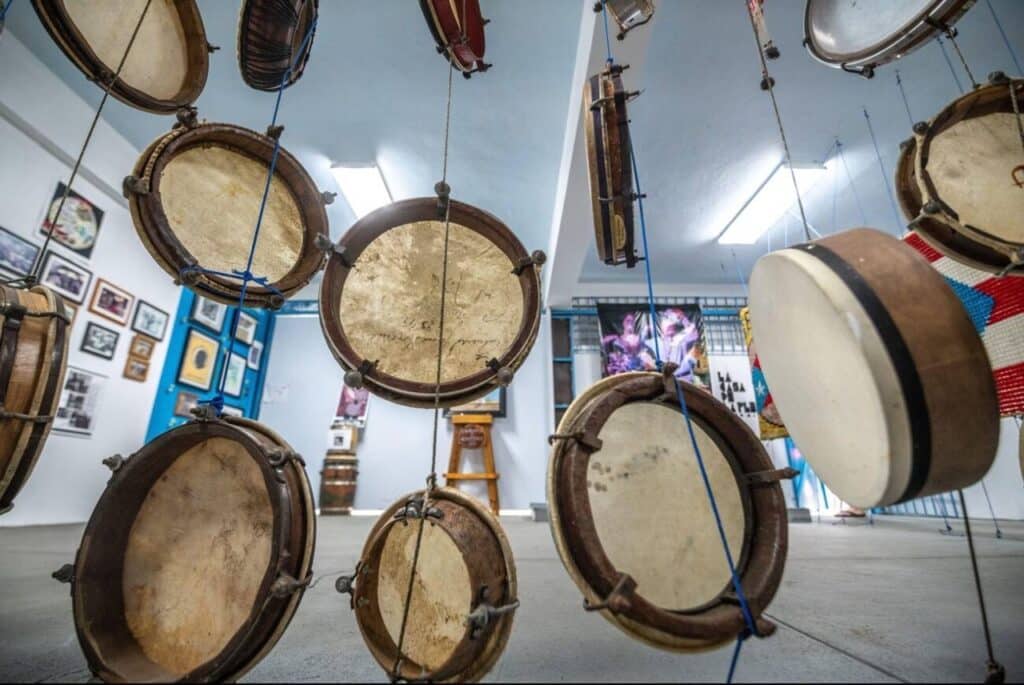
Both practitioners use weapons of identical length, which guarantees fairness and reinforces the importance of technique. The drum, far from being a simple accompaniment, structures the encounter. It marks the cadence, underlines movements and responds to feints. In this way, the Kokobalé becomes an exchange in which the body expresses itself as much as the intention, transforming the confrontation into a choreographic reading.
A tradition preserved by families and cultural projects
One of the reasons why this practice has survived into the XXᵉ century is due to the remarkable work of certain custodians of cultural memory. The Cepeda family, central figures of the Bomba, played a decisive role in presenting the Kokobalé in performances and artistic events. This has enabled the Puerto Rican public to perceive long-invisible dimensions of its heritage, by articulating dance, narrative and history.
Today, initiatives such as Proyecto Kokobalé bring together researchers, teachers and practitioners to study the tradition and organize workshops accessible to different audiences. These initiatives provide a structured framework for a practice long confined to family circles. By linking past and present, they show that the Kokobalé is still socially relevant, particularly in the face of contemporary issues relating to Afro-Puerto Rican visibility and the valorization of cultural heritages.
A language of identity for the younger generation
For many young Puerto Ricans, discovering the Kokobalé represents an encounter with family stories that are often absent from official discourse.
By learning to wield the stick, listen to the drum and find one’s place in the circle, everyone reclaims a part of the island’s social history.
The exercise teaches respect for rules, tension management and solidarity. It also provides a new approach to the memory of ancestors, not just as victims, but as actors capable of cultural invention.
In a society where certain African heritages have been minimized or reduced to folklore, the Kokobalé becomes a vector of pride and knowledge.
It serves as a common thread between discipline, introspection and identity affirmation.
Practitioners find it a way of transforming a painful history into a structured collective force.
Where to see and practice Kokobalé in Puerto Rico?
Although less visible than other art forms such as Bomba or Plena, the Kokobalé is gradually gaining recognition. In San Juan, Loíza and Ponce, several collectives are organizing classes and demonstrations in cultural centers or at community gatherings. The educational initiatives set up by the Cepeda family and Proyecto Kokobalé play an essential role in this dynamic.
At traditional festivals – notably the Festival de Santiago Apóstol in Loíza – this practice appears alongside rhythms, masks and rituals linked to Afro-Puerto Rican heritage. For visitors interested in the deep history of the island, attending a circle of Kokobalé shows how rhythm, memory and coordination are intertwined in a single cultural gesture.
It’s possible, but the deeper understanding lies in the rhythm, as the Bomba structures the steps, transitions and gestural dialogue.
Today, la bomba is an essential part of Puerto Rican cultural life. A practice born of resistance and carried on by Afro-descendant communities, it has become a pillar of Afro-Caribbean tradition. In neighborhoods, folk festivals and community gatherings, it links history, pride and transmission. And above all, it tells the story of another way of living on the island: through rhythm, words and sharing.
African roots shaped by centuries of history
La Bomba took shape in the XVIIᵉ century, in communities descended from enslaved Africans who had arrived as early as the XVIᵉ century. On the plantations, these men and women recreated musical practices inspired by West Africa. These rhythms become a space of cohesion, a means of preserving fragments of identity in a context where everything was done to erase them.
Over time, the practice evolved, blending with other influences and adapting to local realities. This gave rise to distinct styles: those of Loíza, Ponce, Mayagüez and Santurce. Each region brings its own way of singing, dancing and playing, revealing the richness of a deeply-rooted Afro-Caribbean tradition.
Music guided by the drums and the dancer's gesture
The heart of la bomba lies in the barriles, drums made from old rum barrels. The buleador sets the pulse, while the primo (or subidor) improvises.
Around them, the maraca and the cuá: two sticks struck on a piece of wood structure the sound base. A güiro can sometimes be added, but is not essential.
The uniqueness of la bomba lies in its dynamics: the dancer guides the drum.
Every movement – stop, pivot, acceleration – becomes an intention to which the primo responds instantly. This conversation between percussionist and dancer makes bomba an art in which listening, precision and spontaneity are central.
The voice, between improvised solos and chorus choruses, completes this sensitive and powerful musical architecture.
A space for resistance and community expression
For decades, la bomba was relegated to the background of cultural life. In spite of this, it has established itself as a place for speaking out, making claims and recalling what official history has long swept under the carpet. For Afro-descendant communities, it has served as a refuge, but also as a means of asserting a presence, a memory and a dignity in the face of injustice.
Family and community transmission remains at the heart of this continuity. The Cepeda family, an essential reference, is one of the historical guardians of the practice. Ensembles such as Plena Libre have also helped to spread this repertoire, while respecting its roots. Through them, la bomba continues to carry the Afro-Puerto Rican voice and assert the legitimacy of this Afro-Caribbean tradition.
Between renewal, education and urban creativity
For several decades now, la bomba has been undergoing a profound renaissance. Community schools, specialized workshops, university programs and local collectives ensure the transmission of knowledge.
Festivals, notably in Loíza and Ponce, bring together dancers, percussionists and teachers for workshops, tributes and performances open to the public.
This momentum is accompanied by a new sense of ownership among young people.
In urban neighborhoods, many groups mix tradition with jazz, salsa, hip-hop or electro.
These creations show just how much this Afro-Caribbean tradition remains alive, capable of adapting without losing its deeper meaning.
An international outlook that strengthens the practice... and its challenges
Thanks to exchanges with the diaspora and collaborations with artists from Cuba, the Dominican Republic and the United States, la bomba now resonates far beyond the island. On New York stages, in universities, cultural festivals and community centers, it is recognized as a major expression of Afro-Caribbean heritage.
But this visibility also brings risks: folklorization, commercialization or dilution of the sense of community. In response, the tradition-bearers are defending rigorous apprenticeship, highlighting the value of the masters and transmitting the art faithfully to its roots, so that la bomba retains what makes it strong: its precision, depth and human connection.
A tradition that continues to beat to the country's rhythm
La Bomba is much more than a musical heritage. It is a space where memory, dignity and creation meet. Through its drumming, dancing and singing, it tells the story of Afro-Puerto Rican history with accuracy and intensity. Lively, committed and rooted in the community, this Afro-Caribbean tradition remains one of the island’s most powerful cultural landmarks.
An ancient art form, still in motion, supported by those who refuse to let this rhythm, which crosses generations, die out.
La Bomba was born in the XVIIᵉ century among Afro-descendant communities, the heirs of enslaved Africans who had arrived as early as the XVIᵉ century. It drew on West African musical traditions and developed on plantations.
La bomba is based on barrile drums (buleador and primo), accompanied by a maraca and the cuá, played with two sticks on a wooden surface. A güiro can sometimes complete the ensemble.
Because it links memory, resistance, and transmission. It expresses the Afro-Puerto Rican experience, highlights the communities that have shaped it, and continues to nurture a strong, plural cultural identity.
Just a few miles east of Puerto Rico, Vieques juts out like a tongue of land bordered by clear coves, lagoons and ocean-side roads. Here, time slips by smoothly: a conversation on an Esperanza stoop, a horse striding through the village, light lingering on the seaside almond trees. The island doesn’t impose anything, it proposes a rhythm. And it’s a rhythm that the islanders hold dear.
A simple geography, a landscape that breathes
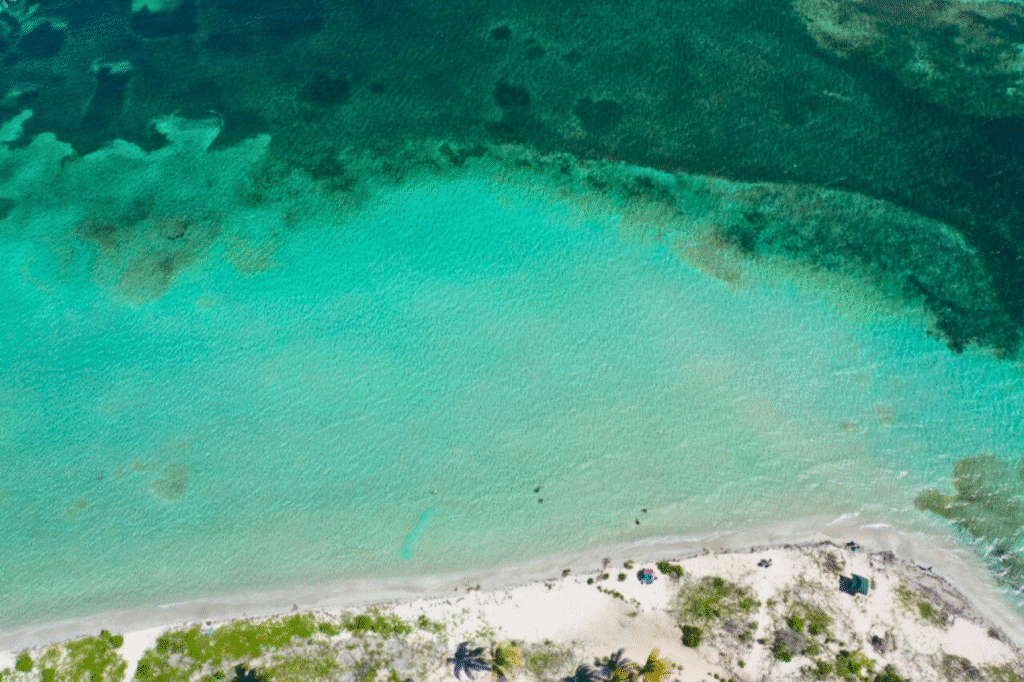
Vieques is easy to read: two small towns – Isabel II to the north, Esperanza to the south – and, between them, an alternation of coves, scrub-covered hills, lagoons and former military roads turned sea trails. The south coast offers a succession of beaches with a distinct character: Sun Bay and its generous arch, Media Luna with its calm waters, Navío hemmed in by rocks, La Chiva and Caracas where the horizon opens up effortlessly. Nothing ostentatious: a line of sand, crystal-clear water and the steady breeze of the trade winds.
Mosquito Bay, the night that lights up
When the moon fades and the wind dies down, Mosquito Bay whispers another Vieques truth. In this protected lagoon, micro-organisms light up at the slightest movement. A stroke of the paddle, an arm brushing the water, and thousands of bluish sparks respond. The spectacle needs no superlatives: it’s striking because it surprises, because it demands slowness and attention. Local guides insist on a few simple rules – limit the use of creams, avoid sudden gestures, respect silence – not out of rigidity, but because beauty lies in this tacit agreement between place and visitor.
Creole horses, village neighbors
In Vieques, you quickly get used to sharing the road. Creole horses move about in their own way: a band trotting along the beach in the morning, a foal sheltering under an almond tree, a group crossing Esperanza’s main street as the fishermen return. Their presence is not the stuff of postcards; it simply expresses the continuity of rural life, the ancient use of pastures, the proud autonomy of a small island. Glances are exchanged, the pace slows and the daily routine continues.
Recent memory, reinvented territory
Vieques wasn’t always as sea-oriented as it is today. For decades, part of the coastline was used for military training. The inhabitants defended access to the beaches, the quality of the water and the possibility of a future that would not be built against nature. From this period remain paths that have been reclaimed by vegetation, batteries won over by salt, and above all a conviction: the value of Vieques is measured by its ability to remain itself. This memory nurtures a public-spiritedness: here, we discuss, we organize, we prefer clarity to haste.
Esperanza: the seaside at human level
The Malecon d’Esperanza rolls out its low-slung houses, its cafés open to the trade winds, its terraces where people linger. The hours take on a different color: in the morning, passers-by greet departing crews; at midday, the shade attracts conversation; in the evening, the bay captures a sky that changes hue at a glance. A few steps are all it takes to go from the murmur of the waves to the voices that answer each other under the verandas. Hospitality often comes in the form of an address, a tip on the state of the sea, or a dish of the day that varies according to the catch.
Island itineraries: walking, paddling, watching
At La Chiva, the transparency of the water can be read from the shore; at Media Luna, the curve of the bay protects against currents; at Navío, the swell sculpts a more pronounced breath. The paths leading to the beaches pass through woods of mancenilla, grape and cactus: a dry, straightforward landscape punctuated by chiaroscuro. On the lagoons, a kayak glides between the mangroves; on the seagrass beds, turtles graze peacefully. The guides insist on simple gestures: don’t walk on the weed beds, keep your distance from the fauna, leave with your garbage. In short, elegance.
A way of being in the world
What we take away from Vieques is not an inventory of places ticked off a list; it’s a feeling of rightness. A windless evening in Mosquito Bay, an early-morning walk on Sun Bay, a greeting exchanged with a horseman, a meal eaten facing the water – these are all moments when the island seems to be saying “take your time”. We leave with the impression of having relearned a simple gesture – looking – and of having found a place at human level, between sea, light and village voices.
Vieques doesn’t look for effects. She prefers links. And perhaps that’s why it stays in the memory for so long.
The Caribbean Connect project marks a decisive step forward for Guadeloupe, Martinique and Puerto Rico. Officially presented on October 15 at the Canal Média building in Baie-Mahault, this new ultra-high-speed submarine infrastructure, supported by the CANAL+ Group, aims to strengthen the connectivity of the Antilles-Guyane territories and secure their place in the great global digital network.
An urgent need for modernization
Behind this technical name, this project responds to an essential challenge: connecting to the world. Until now, Guadeloupe and Martinique have depended on an aging submarine cable, which has become inadequate to cope with the rapid growth in demand for connectivity – an increase of over 40% per year.
For Aymé Makuta Mbumba, Managing Director of CANAL+ Télécom, this development had become essential:
“Today, the Internet depends on two things: terrestrial infrastructures and the link with the global Internet. Caribbean Connect is the undersea railroad that links our territories to the rest of the global network.”
With a capacity of 300 Gb/s, it will multiply speeds, reduce latency and ensure a stable, fluid connection for individuals, businesses and public authorities. This cable symbolizes our determination to anchor territories in a sustainable, high-performance digital continuity.
Aymé Makuta Mbumba
European funding for local development
This project is 70% co-financed by the European Union as part of the Connecting Europe Facility (CEF Digital) program, for a total investment of almost 6 million euros. Present at the conference, Yves Dareau, Secretary General for Regional Affairs, hailed “an emblematic and concrete project, supported by a Europe that connects and invests in the future of its overseas territories”.
This cooperation between public institutions and private players illustrates Europe’s determination to strengthen the digital resilience of its outermost regions. For her part, Alice Bourrouet, representative of the European executive agency HaDEA, emphasized:
“Financing Caribbean Connect means investing in local communities, their inhabitants and their capacity to innovate.
Alice Bourrouet
An exemplary partnership between Europe and the French West Indies and French Guiana
The Guadeloupe Region, represented by Aurélie Bitufwila, President of the Digital Commission, played a key role in bringing the project to fruition. Its presence at the conference testifies to the strong support of local institutions for this strategic infrastructure. Caribbean Connect is not just a technological project: it embodies successful cooperation between Europe and the French overseas territories, in the service of inclusion and digital sovereignty.
CANAL+ Antilles-Guyane: connect, create, transmit
The presentation continued with Sébastien Punturello, new General Manager of CANAL+ Antilles-Guyane, who placed Caribbean Connect within the group’s global vision:
“This cable is essential infrastructure, but it’s also a symbol: that of a group that believes in the power of links – those of connectivity as well as those of cultural development.”
At the same time, the group continues to accelerate the rollout of fiber optics, already accessible to 80% of Guadeloupe households, and supports more than twenty local productions each year (Zion, Wish, Toutoune…). In this way, it is part of a broader approach to transmission, access to culture and regional innovation, serving social cohesion as much as technological progress.
Sébastien Punturello
A lever for the regional digital economy
Caribbean Connect is scheduled to go live progressively in 2025, followed by the arrival of new services from 2026: local hosting, datacenters and regional interconnections. This infrastructure marks a strategic turning point for the Antilles-Guyane digital economy. By guaranteeing a fast, stable and sovereign connection, it opens up new opportunities for local businesses in the fields of tech, education, health and e-commerce.
Caribbean Connect represents a major technological advance, but also an act of sovereignty. By enabling overseas territories to retain control over their infrastructures, it paves the way for long-awaited digital autonomy in the region.
A symbol of unity and the future
Caribbean Connect connects communities, economies and shared ambitions. Its launch illustrates our collective determination to build a future where distance is no longer an obstacle, but a driving force for unity and shared development.
By consolidating the position of the French West Indies and French Guiana in the global digital ecosystem, Caribbean Connect proves that connectivity is not just a matter of cables: it’s a shared desire to build the future together, between the islands and the world.
As the ferry pulls away from the mainland and heads towards Culebra, you feel as if you’ve left behind the rhythm of the ordinary. Here, every beach whispers a story, every cove invites silence, every horizon evokes a space where the soul breathes. Culebra is a gentle invitation to reconnect with the sense of landscape and insularity.
A subtly designed geography
Culebra, a municipality of Puerto Rico, is located some 27 kilometers east of the main island. It is approximately 11 kilometers long and 5 kilometers wide, giving it a modest but harmonious geographic density. Around its coastline lie more than twenty cays and islets, often classified as reserves, which extend the marine territory beyond the visible shoreline.
The Culebra National Wildlife Refuge, established in 1909, covers a significant part of the coast, mangroves and small outlying islands. It protects marine areas, coral reefs, turtle nesting beaches and the forests around Monte Resaca, the island’s highest point. These protected areas embody the balance between biodiversity, sustainable tourism and local pride.
Exceptional beaches and marine atmosphere
The island’s reputation is largely based on its beaches. Flamenco Beach is one of the world’s most renowned, with its bright white sand and clear waters, often hailed in international rankings. Nearby, a rusty old Sherman tank, a relic of the military era, recalls a time when the sea was used for other purposes.
Other, more discreet beaches, such as Carlos Rosario or Tamarindo, offer a more intimate atmosphere, conducive to underwater observation or contemplation. Further offshore, the islet Culebrita, accessible only by boat, reveals a 19thᵉ century Spanish lighthouse and several peaceful coral-lined coves. These places give Culebra a rare depth: a balance between raw beauty and respect for living things.
History, memory and community spirit
Culebra’s modern history has been marked by an American military presence. From the 1930s to the 1970s, the island was used as a naval exercise ground, until the inhabitants united to demand an end to the firing. In 1975, the people won this battle: the navy left the island, making way for a civilian project focused on nature and reconstruction.
Today, the Culebrense community of less than two thousand inhabitants lives by the sea. Artisanal fishing, small-scale commerce and moderate tourism sustain the economy. Here, modernity has not erased the old ways of doing things: repairing a net, maintaining a boat, cooking the day’s catch are still daily practices, handed down with pride.
Trails, secondary beaches and marine routes
To walk in Culebra is to understand the island from the inside. Roads lead to lookouts offering views of the surrounding cayes, and trails wind through areas where vegetation mingles with rock. Monte Resaca, to the north, offers a panoramic view of the chain of protected islets.
For sea lovers, every cove becomes a sensory exploration ground. Around the island, the waters are rich: intact coral reefs, tropical fish, hawksbill turtles and parrotfish color the sea with an abundance of life. The island has become a benchmark for responsible snorkeling and marine ecotourism.
Challenges and vision
Culebra’s challenge lies in its balance: how to preserve the purity of its ecosystems while maintaining a viable economy for its inhabitants? Fresh water, imported from the mainland, remains precious; the modest infrastructure requires maintenance and planning. Yet Culebra’s strength lies in its ability to resist tourist standardization.
Local initiatives encourage a sustainable approach: family-run accommodation, tours guided by locals, restaurants promoting the products of the island’s fisheries and agriculture. This conscious choice for development on a human scale makes the island a possible model for the Caribbean of tomorrow.
An island to be experienced more than visited
What sets Culebra apart is its sincerity. Nothing here is artificially seductive. The charm comes from the wind, the light, the voices of the locals and the swaying of the boats in the bay. The visitor leaves with the memory of a true place, where the sea tells, where silence has meaning.
When the sun dips over Flamenco Beach and the last light is reflected on the waves, the island reveals itself in its most beautiful definition: an island of balance, memory and sea. A space that, without ever raising its voice, reminds us of what the very essence of the Caribbean still means today.
The Caribbean Culture Fund (CCF) has announced its second cohort of grantees, awarding twenty-five grants to creatives and cultural organizations in Puerto Rico, Guadeloupe, Saint Lucia, Saint Vincent and the Grenadines, Curaçao and the Cayman Islands. These projects receive a total of USD 400,000 in funding. These grants, awarded in three categories – Migration, Archiving & Memory, and Caribbean Collaboration – support initiatives that preserve and enhance Caribbean heritage, analyze the cultural impact of migration, and encourage regional artistic cooperation. The Caribbean Cultural Fund thus confirms its commitment to culture diversity and regional creativity.
Subsidy categories
The selection process was carried out by a jury of experts from the eligible countries. Raymona Henry-Wynne, Executive Director of the Saint Lucia Cultural Development Foundation, participated in the evaluation of this second cohort. She describes the experience as “a revealing insight into the immense creative potential of the region”.
Migration
Five projects have been awarded grants of USD 10,000 each to explore the cultural impact of migration and strengthen links between territories. They include:
Narratives of Change (Cayman Islands)
Mama Baranka (Curaçao)
Bigidi (Guadeloupe)
Para Impresionar ¿A Quién? (Puerto Rico)
Lakay (andépandans) (Saint Lucia)
Archiving & Memory
Ten projects have also been awarded grants of USD 10,000 each to document and conserve Caribbean heritage:
Bon Kabei (Good Hair) (Curaçao)
Cinuca (Guadeloupe)
I Am Lolita Lebrón (Puerto Rico)
Matronas de las Luchas (Puerto Rico)
MAC en el Barrio Digital Archive (Puerto Rico)
Mujeres del Cine Boricua (Puerto Rico)
Paradoja en el Paraíso (Puerto Rico)
Bolom Birth (Saint Lucia)
Machete, Masquerade & Memory (Saint Lucia)
O.N.G. (Operation Nex’ Generation) (Saint Vincent and the Grenadines)
Caribbean collaboration
Ten projects promoting artistic cooperation across the region received grants of USD 25,000 each:
News from MAF (Guadeloupe/French Guiana)
Pawòl a Mas (Guadeloupe/Saint Lucia/Trinidad and Tobago)
Temporal: Sanando el Cuerpo y la Tierra (Puerto Rico/Barbados)
Conjunto Antillano (Puerto Rico/Dominican Republic/Cuba)
Bridging the Archipelago (Puerto Rico/Dominican Republic)
La Memoria de la Arcilla (Puerto Rico/Cuba/Dominican Republic)
It Takes a Village: Honoring Caribbean Matriarchs (Puerto Rico/U.S. Virgin Islands)
Entre Cosmovisiones y Resistencia (Puerto Rico/Guadeloupe/Aruba)
Hairouna Film Festival (Saint Vincent and the Grenadines/Haiti)
Music, Film & Storytelling (Saint Vincent and the Grenadines/Trinidad and Tobago)
Impact of the Caribbean Culture Fund
According to CCF Executive Director Kellie Magnus, “the success of our first cohort has enabled us to raise additional funds, making our second cohort even more significant. We believe in regional cooperation and are enthusiastic about opening up new opportunities for creative people in the Caribbean”. The Caribbean Culture Fund thus becomes a key player in the structuring of the regional cultural sector.
Victoria Apolinario, a Dominican filmmaker and beneficiary of the first cohort, illustrates this impact: “Thanks to the CCF, I can now say that I am the coordinator of Muestra Karibe, a cinematographic space dedicated to the Caribbean and its diasporas. It’s more than a professional advancement, it’s also a way of taking a stand, a way of making our artistic identities more visible”.
Wizeman Seide, a Haitian culinary artist, confirms that the CCF is “much more than financial support: it’s a real springboard. It gives legitimacy to cultural initiatives and opens up new horizons”. This support from the Caribbean Culture Fund represents a major step forward for the development of cultural and creative industries.
Future prospects
The mission of the Caribbean Culture Fund is to support creators in the Caribbean by reducing financial barriers and encouraging artistic development. Funding for this second cohort was provided by the Andrew W. Mellon Foundation and the Open Society Foundations. To build on this momentum, the Caribbean Culture Fund is preparing to launch new initiatives, including a matching grants program to attract other cultural funders.
In addition, an online database of funding opportunities will be made available to artists for simplified access to resources. The Caribbean Culture Fund plays a major role in promoting and developing regional artistic creation. By supporting local initiatives and fostering collaborations, the Caribbean Culture Fund contributes to enriching Caribbean cultural expression, while offering it new prospects for expansion.