
Rita Moreno was born on December 11, 1931, in Humacao, Puerto Rico, and moved to New York with her mother when she was only five years old. On April 9, 1962, at the Santa Monica Civic Auditorium in California, she became the first Latina actress to win an Oscar for her role as Anita in West Side Story, before refusing for seven years to return to Hollywood rather than accept the stereotypical roles she continued to be offered. Since 1977, she has been one of the very few people to have won an Oscar, an Emmy, a Grammy, and a Tony, and she was still performing on stage in August 2026, at the age of 94.
Rita Moreno: Seven Years of Silence After the Oscar
On April 9, 1962, at the Santa Monica Civic Auditorium in Santa Monica, California, Rita Moreno received the Oscar for Best Supporting Actress for her portrayal of Anita in *West Side Story*, which had been released the previous year. That evening, she became the first Latina actress to be honored by the Academy of Motion Picture Arts and Sciences.
In an interview with journalist Terry Gross for the NPR program “Fresh Air,” Rita Moreno talks about the hopes she had for that award at the time. “When I won, I thought to myself, ‘Well, that’s it—finally, my career is set.’ And once again, I was disappointed,” she confides.
The disappointment stemmed from the offers she received after winning the Oscar. Rita Moreno was offered the same stereotypical ethnic roles she had received before her win—gang members in minor films. She turned them down. “I didn’t make a movie for seven years. I was offered two or three things—second-rate gangster movies.”
“But I said no, no, no, no,” she tells Terry Gross, adding that she felt her accolades were enough to finally give her the right to turn down those kinds of roles. During those seven years, Rita Moreno continued to perform on stage in London and New York, appeared in cabarets, and took on occasional roles in TV Westerns to make ends meet.

From Humacao to New York: A Childhood Split in Two
Rita Moreno was born Rosa Dolores Alverío on December 11, 1931, in Humacao, a town on the east coast of Puerto Rico. Her parents separated when she was still a baby. Around the age of five, Rita Moreno boarded a ship with her mother bound for New York City in the United States. The two women initially stayed with an aunt in the Bronx before settling permanently in the city. Rita Moreno would later tell Terry Gross that she grew up feeling that Puerto Ricans—and Latinos more broadly—were treated with little respect in the United States. She took the last name of her first stepfather, Edward Moreno, the name by which she would become famous.
Starting at the age of eleven, Rita Moreno earned a living as a voice-over artist for American films dubbed into Spanish. At thirteen, she made her Broadway debut in the play *Skydrift* (1945), under the name Angelina. This connection to Puerto Rico, the island where she was born, would resonate throughout her career—a place whose culture is reflected as much in mofongo, Puerto Rico’s most iconic dish, as in the Puerto Rican expression “ay bendito,” all markers of an island identity that Rita Moreno never denied.
From the New York theater scene to Anita in *West Side Story*
Rita Moreno took on a series of small roles in Hollywood during the 1950s, often confined to caricatured Latin American female characters—a type of role she would later describe as degrading. Her first film, *So Young, So Bad*, was released in 1950. She went on to appear in about ten productions, including *Singin’ in the Rain* (1952) and *The King and I* (1956), though these roles did not bring her the recognition her talent deserved.
In 1961, *West Side Story*, a film adaptation of the Broadway musical, was released. In it, Rita Moreno played Anita, the best friend of the Puerto Rican heroine Maria—a role that allowed her, for the first time, to portray a Puerto Rican character with real dramatic depth rather than a mere stereotype.

The Turning Point: Rejecting Stereotypes Rather Than Playing Into Them
Rita Moreno ended her seven-year hiatus from film in 1968, when her former partner, actor Marlon Brando, helped her land the female lead in *The Night of the Following Day*. She then went on to star in *Popi* (1969) and *Carnal Knowledge* (1971), two films that marked her lasting return to American cinema, this time in roles she chose herself.

Rita Moreno, Among the Few to Have Won an Oscar, an Emmy, a Grammy, and a Tony
In 1972, Rita Moreno won a Grammy Award for her contribution to the album for the educational television show *The Electric Company*, which aired on the American public television network PBS from 1971 to 1977. In 1975, she won the Tony Award for Best Featured Actress in a Play for her role as Googie Gomez, a down-on-her-luck cabaret singer, in the play *The Ritz*. She later recounted that she developed the character by observing New York nightlife. “I coughed, I burped, and out came this crazy Puerto Rican woman,” she said of the creation of Googie Gomez.
In 1977, Rita Moreno won an Emmy Award for her appearance on *The Muppet Show* in the category of Best Supporting Performance, Recurring or Guest, in a Variety or Music Program, according to the official archives of the Television Academy. According to the George Eastman Museum, this win made her the third person in history to win all four major awards—an Oscar, an Emmy, a Grammy, and a Tony—a feat now known by the acronym EGOT. A second Emmy followed in 1978, for her role in the series *The Rockford Files*.
Rita Moreno went on to receive several honors in the United States. In 2004, President George W. Bush presented her with the Presidential Medal of Freedom. In 2009, she was awarded the National Medal of Arts, which was presented to her in February 2010 by President Barack Obama at the White House. In 2015, the Kennedy Center in Washington, D.C., honored her as one of its annual honorees.

94 years old and still on stage
On October 29, 2025, Rita Moreno received the George Eastman Award, the highest honor bestowed by the George Eastman Museum in Rochester, New York, in recognition of her contributions to cinema, becoming the third Hispanic person to receive this award. On December 11, 2025, her 94th birthday, a resolution was introduced in the U.S. House of Representatives to honor her entire career and her commitment to civil rights and equality in the arts.
On August 26, 2026, Rita Moreno traveled to Indianapolis, Indiana, to attend the Drum Corps International finals, forty-six years after she co-hosted the television broadcast of that same competition in 1980 on the public network PBS. When asked by the organizers about that memory, she humorously replied that she remembers that evening well and said she’s ready to come back. Her journey today echoes that of another distinguished Puerto Rican on a historic American stage, Bad Bunny—two generations of Puerto Rican artists who have made it to the biggest stages in the United States.

Rita Moreno is an actress, singer, and dancer born on December 11, 1931, in Humacao, Puerto Rico. In 1962, she became the first Latina actress to win an Oscar, and since 1977, she has been one of the very few people to have won an Oscar, an Emmy, a Grammy, and a Tony.
After winning the Oscar in 1962, Rita Moreno continued to be offered stereotypical roles as ethnic characters, which she considered demeaning. She turned down these offers and did not appear in any films between 1962 and 1968, devoting herself to theater and cabaret, before returning to film with the help of Marlon Brando.
Rita Moreno was born in Humacao, Puerto Rico, and has maintained that connection throughout her career. On December 11, 2025, her 94th birthday, a resolution from the U.S. House of Representatives honored her entire career and her role as a pioneer for Latino artists.
Mofongo is the first dish people ask for in Puerto Rico a generous, garlic-infused puree made from green plantains pounded in a mortar. But its name comes neither from the Taíno nor from Spanish; it comes from Angola. Three cultural heritages: Taíno, African, and Spanish are still pounded together today in the same wooden mortar.
A tradition passed down in the kitchen
In many Puerto Rican families, the first encounter with mofongo takes place on a Sunday at the dinner table, often served with a bowl of broth on the side. Several chefs on the island say they grew up with this tradition, frying green plantains and then mashing them in a wooden mortar long before they understood everything this dish reveals about Puerto Rico’s history.
Mofongo is a purée made from fried green plantains, pounded in a wooden mortar called a pilón, then mixed with chicharrón (fried pork rinds), garlic, and sometimes hot broth. This act of pounding, repeated in home kitchens and restaurants alike throughout San Juan, embodies three cultural heritages that have converged on the island.

A word from Angola
The name of the dish comes neither from the Taíno nor from Spanish. Several food historians who have studied Puerto Rican cuisine explain that the word “mofongo” derives from “mfwenge mfwenge,” a Kikongo expression, a language spoken in Angola, that refers to a large quantity of something. The technique itself : pounding a starchy food while adding liquid and fat to soften it has the same West African origin. It was brought to the island by enslaved Africans, who were already preparing fufu, a pounded dish made from plantains, cassava, or yams.

Three legacies in a single mortar
Before the arrival of fufu, the Taíno, the original inhabitants of Puerto Rico, were already pounding their ingredients in wooden pilónes, as evidenced by archaeological remains found on the island. After the Spanish conquest in the early sixteenth century which decimated the Taíno population through famine, disease, and forced labor on plantations and in mines, this pounding technique endured. Sofrito, a mixture of onion, garlic, herbs, and chili peppers that originated in the Iberian Peninsula, was later added to the mix. Green plantains, which are abundant on the island, and chicharrón, a common item sold by street vendors, did the rest. Few Caribbean dishes have a history so precisely documented that it can be traced back to a specific African language.

Mofongo and mangú: Two Stories, One Tradition
Mofongo is not an isolated case in the region. In the neighboring Dominican Republic, mangú, also made from mashed green plantains, plays an equally central role in home cooking. Researchers studying the national cuisines of the Spanish-speaking Caribbean sum up the difference in a single sentence: plantains are fried in mofongo and boiled in mangú, which distinguishes the two dishes just as much as mashed potatoes differ from French fries. Both share the same African roots, but each tells, in its own way, the story of a specific island.
A festive dish, not an everyday dish
Many Puerto Rican chefs describe mofongo as a festive dish rather than an everyday meal, reserved for Sunday family dinners, accompanied by a cold beer or a piña colada, since its generous and meticulous preparation does not lend itself to a meal eaten in a hurry. In some restaurants on the island, it’s not even on the menu, as the chefs refuse to serve it as long as its long and demanding preparation process cannot be guaranteed to be perfect with every order.
Beyond the family dinner table, mofongo has also made its way onto the menus of the island’s more upscale restaurants, where it is sometimes served stuffed with seafood, chicken, or beef, under the name mofongo relleno. Reimagined in countless ways, it never strays from its core ingredient: plantains pounded in a mortar, proving that an age-old tradition can continue to adapt to modern tastes without losing sight of its origins.
A memory that keeps getting crushed
Many Puerto Ricans say they first discovered mofongo at a family meal, and still remember, decades later, that first bite of mashed plantains topped with sauce and pieces of pork. This sensory memory continues to be passed down today, both on the island and in the diaspora, from person to person rather than through a cookbook.
What Puerto Rico Is Still Grappling With
Mofongo belongs to none of the three peoples who shaped it: neither the Taíno, nor the enslaved Africans, nor the Spanish colonists. It belongs to what they created together, whether by force or out of necessity, in a wooden mortar that continues to be pounded in Puerto Rico. The question remains: how much longer will this specific gesture that of a grandmother pounding for a child be passed down without a written recipe? A previous RK TASTE feature explored another dish with mixed roots: Oil Down from Grenada.

Mofongo is a purée made from fried green plantains, pounded in a wooden mortar (pilón) with garlic and chicharrón; it is considered Puerto Rico’s most iconic dish.
According to historians of Puerto Rican cuisine, the word “mofongo” comes from “mfwenge mfwenge,” a Kikongo expression spoken in Angola that refers to a large quantity of something.
The main difference lies in how the plantains are cooked: they are fried for Puerto Rican mofongo and boiled for Dominican mangú.
As the last weekend of July approaches, Loíza is getting ready to send its masked characters back out onto the streets. Among them, the vejigantes march forward wearing wooden horns and faces carved from coconut shells. Behind their spectacular appearance lies a complex history: that of a Spanish figure that has become, in Puerto Rico, a powerful symbol of Afro-Boricua creativity.
A mask shaped by the region
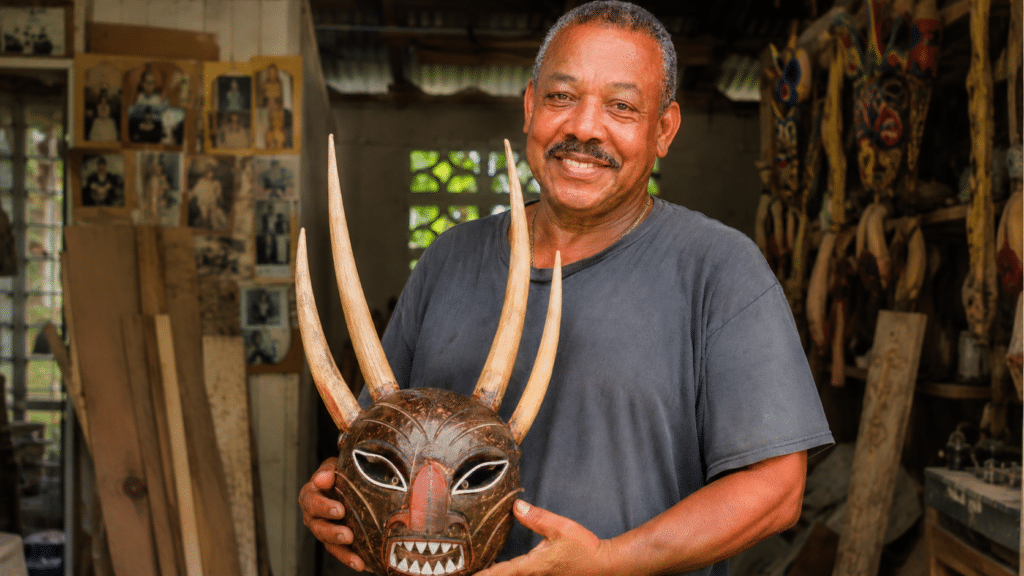
A rounded shell, two eye slits, a toothed mouth, and long horns arranged like a crown. The vejigantes of Loíza are instantly recognizable. The material they’re made of sets them apart from those of Ponce, where the caretas are generally made of papier-mâché. .
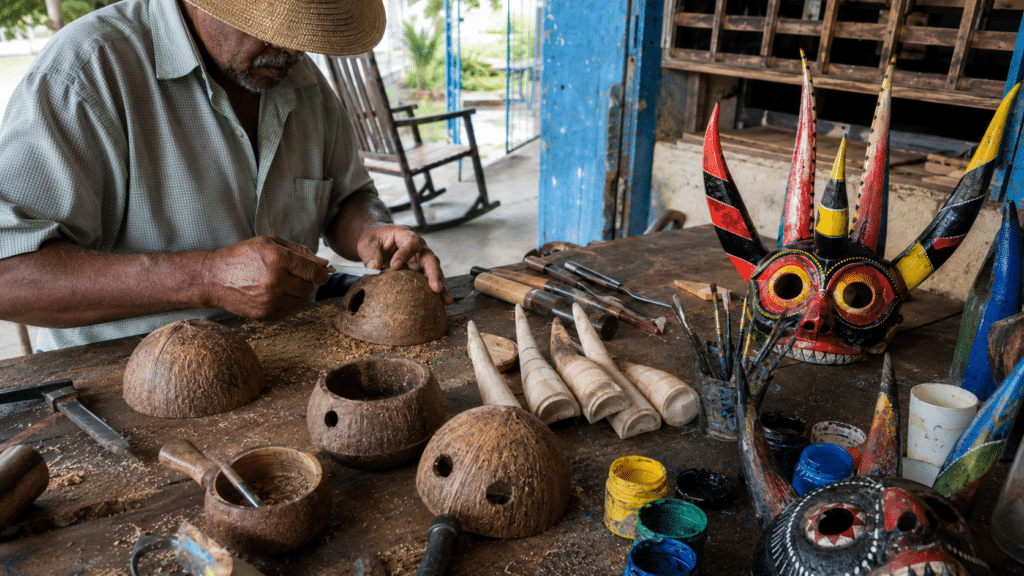
This difference is not merely an aesthetic detail. The coconut ties the mask to the coastal landscape, to the available resources, and to the artisanal craft. The Smithsonian holds several pieces made in Loíza, including a coconut careta attributed to Castor Ayala. The object has become part of a national collection, but it remains the result of knowledge passed down from hand to hand.
A figure from Spain, transformed in Puerto Rico
The vejigante originates from medieval Spanish folklore. Its name is derived from *vejiga*, meaning “bladder,” and *gigante*, meaning “giant.” During celebrations, the character used to carry an inflated animal bladder and hit passersby with it.
Although introduced during the colonial period, this figure has not remained unchanged. In Puerto Rico, the masks, costumes, music, and public performances have incorporated African and Taíno influences. The vejigantes of Loíza bear witness to this transformation. They do not replicate a European model; rather, they express how a community has made a character its own and then given it a local form.
St. James the Apostle: Between Faith and the Streets
The vejigantes of Loíza make their appearance, in particular, during the Fiestas de Santiago Apóstol, celebrated in July. Processions, parades, costumes, food, and music bring the community together around its patron saint. In the streets, the vejigantes rub shoulders with the Spanish caballeros, the viejos, and the locas. This cast brings to life different memories and multiple layers of meaning, particularly the contrast between good and evil. Yet the festival goes far beyond a religious representation. It becomes a space where Loíza asserts its own way of telling its story.

"La bomba" Makes Bodies Speak
La bomba lends celebrations a musical, historical, and collective depth. Originating in the African communities enslaved in Puerto Rico, this music is based on a dialogue between percussion and movement. The lead drummer follows the dancer’s movements, and the dancer responds with his or her body. During the festival, this relationship transforms the street into a space for cultural transmission. Children watch, musicians respond, dancers improvise, and masked figures move among the audience. The vejigantes of Loíza thus only take on their full meaning through this music, these bodies, and this collective participation.

An Afro-Boricuan history without a simplified narrative
To say that the vejigantes are exclusively African would be historically inaccurate. Their origins lie in Spanish folklore. To say, however, that they are solely Spanish would overlook what Loíza has made of them. The Afro-Boricuan heritage embodied by these masks lies in appropriation, transformation, and continuity. It is evident in the materials chosen, in the bomba, in the learned gestures, in the Black presence at the heart of the festival, and in the pride asserted today. Resistance is understood here as the ability to keep a culture visible, transmissible, and alive, rather than as the definitive origin of the character.

When a Mask Becomes a Living Legacy
In 2026, the installation “Hebras y Vejigantes”, which focuses on the masks of Loíza, won the Smithsonian Outwin Audience Choice Award. This recognition raises a question: What becomes of a mask when it leaves the street?
In Loíza, the answer may lie in the movement itself. As long as the caretas are carved, worn, accompanied by drums, and explained to new generations, they will not be mere decorative objects. They will continue to connect various legacies without blurring their distinctions. And every July, their return will serve as a reminder that a community can embrace a tradition, transform it, and make it fully its own.
The vejigantes of Loíza are masked figures who appear during the Fiestas de Santiago Apóstol in Puerto Rico. They wear colorful costumes and horned masks, called masks, usually carved from coconut shells. Their appearance stems from the local adaptation of a figure from Spanish folklore, enriched by the history, craftsmanship, and Afro-Boricua cultural practices of Loíza.
In Loíza, coconut shells have become the signature material for vejigantes masks. Artisans prepare, carve, and paint them, and add wooden horns. This technique distinguishes the vejigantes of Loíza from those of Ponce, where masks are more often made of papier-mâché. The coconut shell thus connects the mask to the local area and to a craft passed down through generations.
The Vejigante has origins rooted in Spanish traditions, but Loíza has given it its own unique cultural expression. The coconut masks, the presence of the bomba, the artisanal traditions, and community participation have gradually linked the character to Afro-Puerto Rican heritage. Today, it represents a living legacy, shaped by various influences and brought to life in the streets during the celebrations of Santiago Apóstol.
A child knocks over a glass. A friend shares some bad news. Someone is exaggerating a story yet again. In Puerto Rico, each of these situations can elicit the same reaction: “Ay bendito!” Yet the expression never means exactly the same thing. Depending on the tone, the look in the speaker’s eyes, and the context, “Ay bendito” can convey compassion, surprise, discontent, or frustration. Thus, these two very simple words are enough to capture a wide range of situations in everyday Puerto Rican life.

An expression that cannot be fully explained by translation alone
Translating “Ay bendito” as “poor little thing,” “my God,” or “oh my” captures only part of its meaning. The Lexical Treasury of Puerto Rican Spanish It is described as an interjectional phrase that expresses, among other things, sorrow, compassion, or supplication. The Real Academia Española adds displeasure, surprise, protest, and frustration to this list. The same phrase can therefore be used to console, react, protest, or make a request. It all depends on the context.
When faced with a child who has just fallen, it can sound like “Oh, poor thing!” After hearing unexpected news, it takes on the meaning of “That can’t be true!” Uttered with a sigh, it can express impatience. In an insistent request, it becomes almost a plea. The words remain the same. The intention, however, changes completely.

When the voice conveys the true meaning
A quick, light “Ay bendito” doesn’t have the same effect as a long “Ayyy, bendito…”. The former might accompany a minor blunder or a funny story. The latter conveys more compassion, weariness, or a deeper emotion.
Facial expressions also complete the sentence. A smile can make the phrase sound affectionate or ironic. Furrowed eyebrows can turn it into a protest. A soft voice makes it sound like a comforting remark. A firmer tone of voice can mean, “Please, stop now.” ” That is why a word-for-word translation quickly reaches its limits. Understanding “Ay bendito” requires listening to the melody of the voice, but also observing the relationship between the people. The expression belongs as much to body language as it does to vocabulary.

From “bendito” to a Puerto Rican interjection
The Spanish word bendito comes from the Latin benedictus. In modern Spanish, it is used, in particular, as an adjective, as a noun, or in expressions such as bendito sea. In Puerto Rico, its use as an interjection has become so characteristic that it has been noted by the Real Academia Española. In “Ay bendito,” the word is therefore not necessarily used in a religious sense. The phrase is used primarily to react to something that has just been seen, heard, or felt.
Its origin remains evident, but everyday use has given it a much broader scope. Puerto Rico does not simply use two words inherited from Spanish. The territory has given them an intonation, rhythm, and nuances all their own. The *Tesoro lexicográfico del español de Puerto Rico* also lists the abbreviated form “¡bendito!” as a variant. Its inclusion in resources dedicated to Puerto Rican vocabulary confirms that the phrase is fully part of the local vernacular.

A formula that brings people together
One of the strengths of “Ay bendito ” lies in its ability to bridge the gap. Instead of remaining silent in the face of someone’s misfortune, clumsiness, or exaggeration, we react. The phrase shows that we’ve seen, heard, or felt something. It can offer comfort without requiring a long sentence. It also allows us to express a reproach without immediately coming across as harsh. Even when it conveys annoyance, it remains directly tied to the person or situation that just triggered the reaction.
This flexibility makes it difficult to replace. A translation usually conveys a specific meaning. “Ay bendito” can convey several meanings at once: compassion, a touch of irony, and a great deal of familiarity.

Two words that describe a way of speaking
Some expressions only take on their full meaning when spoken by those who use them. They reveal the importance of tone, gesture, and closeness in a culture. “Ay bendito” falls into this category. The phrase does more than simply name an emotion. It creates an immediate reaction between people and transforms a feeling into a shared expression.
So the next time she overhears a conversation, she’d be better off paying attention to the speaker’s intent before searching for a perfect translation. Is it compassion, surprise, a complaint, or a protest? In Puerto Rico, the answer is rarely found in just those two words. What if the next RK Words takes us to another Spanish-speaking island, to discover an expression that’s just as familiar and difficult to translate?


In Puerto Rico, “Ay bendito” is an expression used in response to many situations. Depending on the tone and context, it can express compassion, surprise, tenderness, annoyance, frustration, or even a plea. Its translation therefore ranges from “oh, poor thing,” “my God,” “oh my,” to “that’s impossible.”
“Ay bendito” is difficult to translate because its meaning depends as much on intonation as on the words themselves. A soft voice can express compassion, while a sigh or a firmer tone can signal impatience. You must therefore observe the situation, the person’s facial expression, and the relationship between the people involved to understand the true intention.
Puerto Ricans may say “Ay bendito” when a child hurts themselves, when someone tells a moving story, after hearing surprising news, or when faced with an annoying situation. The expression is also used to soften a remark or to show that you share the speaker’s emotions.
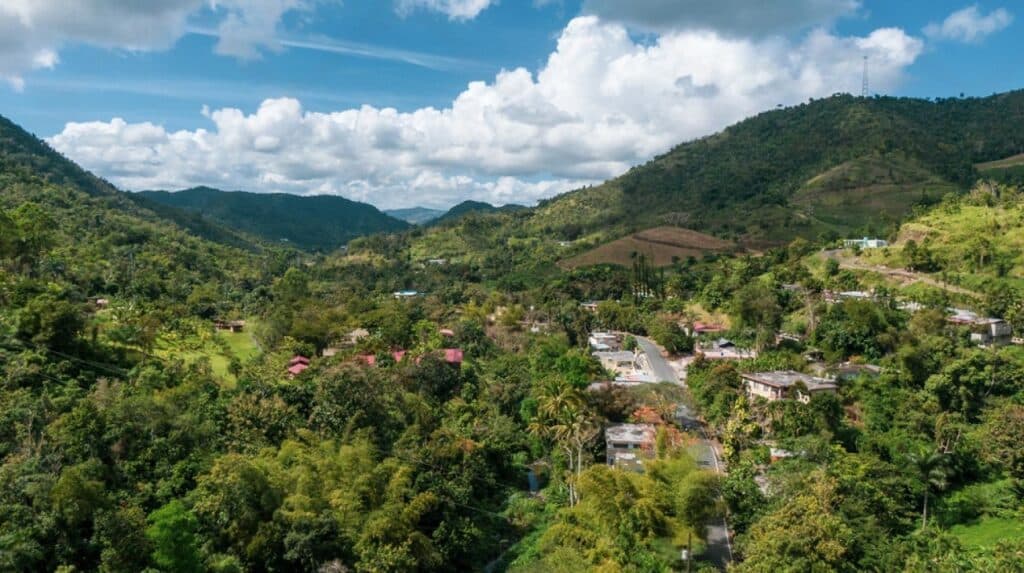
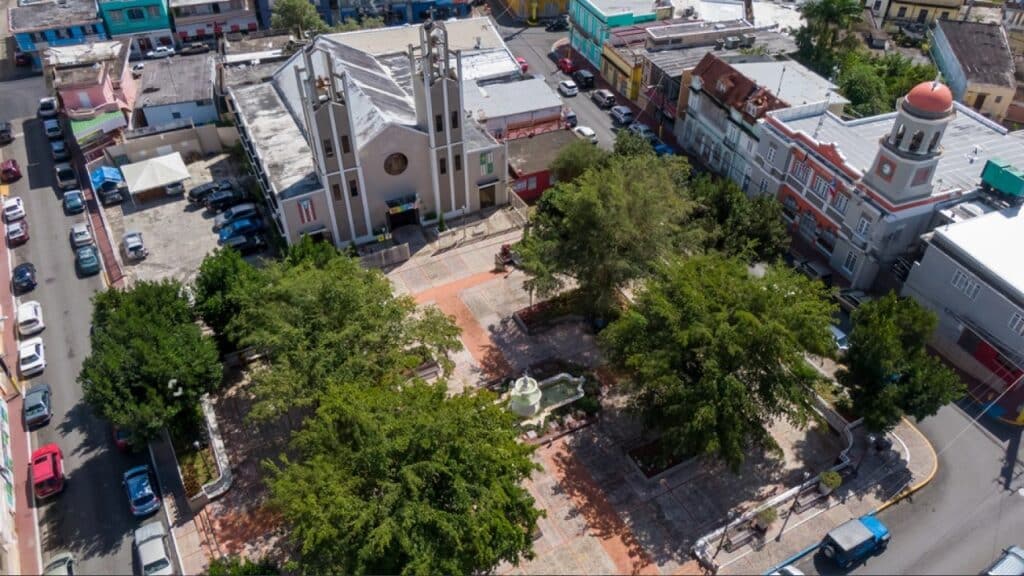
Some 40 kilometers by road from San Juan, in the Cordillera Central, Comerío doesn’t have the visibility of Puerto Rico’s major coastal destinations. The town has fewer than 19,000 inhabitants according to the latest US estimates, but it has a strong nickname: la Cuna de Trovadores, the cradle of trovadores. Every June, this mountain town turns its reputation into a cultural event with the Festival del Jíbaro Comerieño.
2026 edition confirmed
The Festival del Jíbaro Comerieño returns from June 12 to 14, 2026 for its 46th edition. This year’s event takes on a special significance, as Comerío also marks the 200th anniversary of its foundation. The 2025 edition of the Festival del Jíbaro Comerieño took place from June 12 to 15 in the Plaza de la Trova, with a program combining crafts, workshops, trovadores competitions, typical food, jíbaras masses, concerts and meetings around the decima. The format may vary from year to year, but the logic remains the same: to turn the public square into a space for transmission.
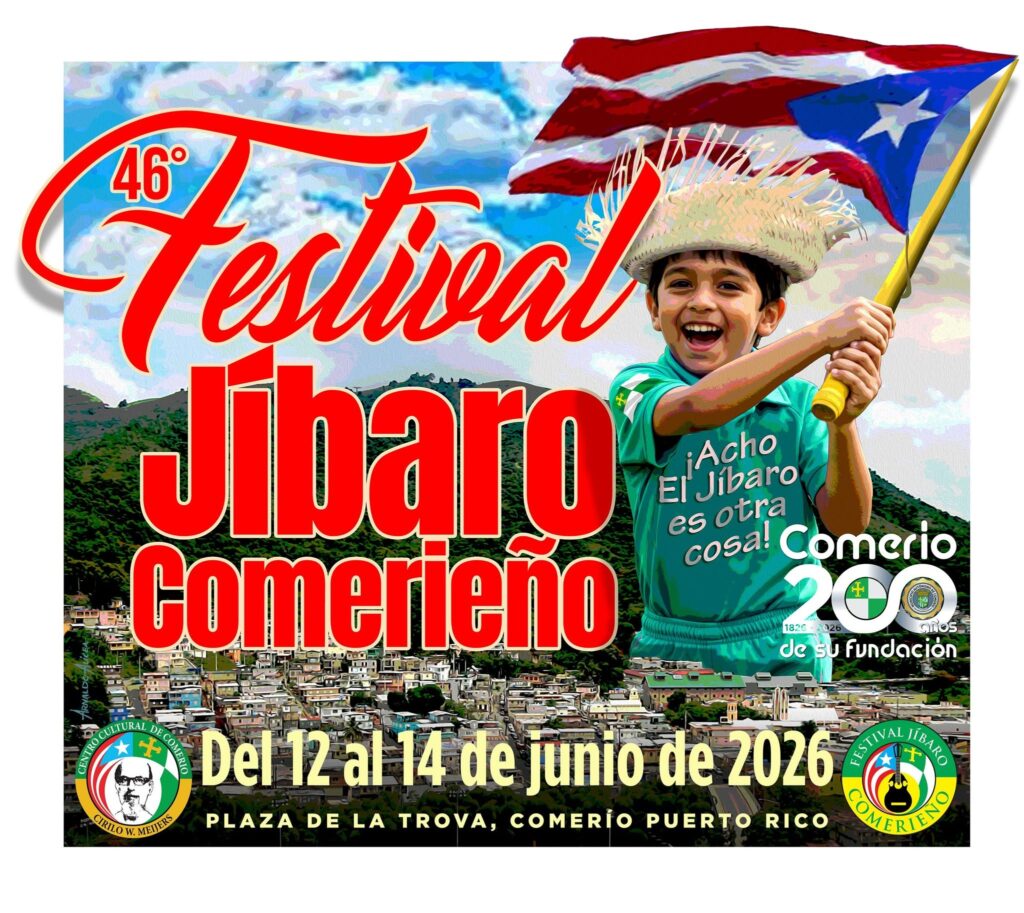
La trova, a language to be learned
In Comerío, tradition is not limited to festival evenings. The Escuela Cuna de Trovadores trains children and teenagers in the improvisation of the decima, a poetic art based on stanzas of ten octosyllabic verses. In the trova, one singer improvises opposite another, on a proposed theme, with a memory for the language and a precise sense of rhythm. When young people aged 8 to 16 learn this exercise, a part of rural Puerto Rican culture is passed on from one generation to the next.
What it means to be jíbaro
The word jíbaro deserves some clarification. Historically, it refers to the rural peasant of the Puerto Rican mountains, associated with the communities of the island’s interior. This figure is linked to a long cultural cross-fertilization between indigenous, Spanish and African heritages, in a society marked by centuries of Spanish colonization. Jíbara culture developed in the valleys and heights of the Cordillera Central, with its own musical forms, instruments and social codes.
The cuatro plays an essential role in this tradition. It’s not a six-string guitar, but a Puerto Rican instrument similar to the guitar, generally with five double strings, i.e. ten strings. It accompanies the música jíbara, in particular the seis and aguinaldo, two central forms of this repertoire. Guitar, güiro and other instruments of the conjunto típico are often added to these sounds. In the Festival del Jíbaro Comerieño, this sound memory remains linked to practice, not just to the stage.

Rehabilitating rural culture
This culture has not always been valued. In the 20th century, as Puerto Rico modernized and many Puerto Ricans moved to New York, Chicago, Orlando and other American cities, the Jíbara identity was sometimes portrayed as rural, poor or backward-looking. But it was much more: a relationship with the land, with words, with music and with the dignity of mountain communities.
The Festival del Jíbaro Comerieño is part of this rehabilitation effort. Its history is linked to the Centro Cultural Cirilo W. Meijers and local initiatives to support Comerieño culture, particularly around the decima. What could have remained a municipal festival has become a reference point for understanding how Puerto Rico protects a part of its rural identity without freezing it.


A collective stage at the Plaza de la Trova
The Festival del Jíbaro Comerieño program is divided into several phases. During the day, the spotlight is on artisans, workshops, kiosks and typical gastronomy, with Puerto Rican dishes such as lechón asado, arroz con gandules, pasteles and alcapurrias. In the evening, the square turns to trovadores competitions, where improvised speech becomes a moment of tension, listening and recognition. Concerts extend this memory with groups committed to the jíbaro repertoire.
Among them, Ecos de Borinquen occupies an important place. The group has been nominated for Grammy Awards and Latin Grammy Awards for its work on jíbara music. Smithsonian Folkways has also released major recordings by the group, helping to spread this tradition beyond Puerto Rico.


A small town, a bridge to the diaspora
This is precisely where the Comerieña uniqueness lies. Many Caribbean territories have folk festivals. Through the Festival del Jíbaro Comerieño, Comerío articulates a popular festival, an oral competition scene, a school of transmission and a musical recognition that goes beyond the island. For a town with a population of less than 19,000, this continuity carries real weight.
The 2026 context adds an extra dimension. June is also Caribbean American Heritage Month in the United States. In 2024, Pew Research Center estimated that there were 6.1 million people of Puerto Rican origin living in the 50 U.S. states and Washington, D.C. The Festival del Jíbaro Comerieño thus acts as a bridge between the Puerto Rican mountain and a diaspora that often keeps music, words and gestures as proof of belonging.
Protecting the transmission
The future poses several questions. How can trova be passed on to children who are growing up with social networks, reggaeton and faster-paced cultural forms? How can we maintain a popular festival in a Puerto Rican economy weakened by hurricanes Maria in 2017 and Fiona in 2022, demographic decline and successive departures? How can we prevent folklore from becoming mere decoration, stripped of its requirements and its memory?
One thing remains. As long as Comerío trains young people in the decima, as long as the Plaza de la Trova brings generations together, and as long as mountain voices continue to respond in music, jíbara culture has a future. The Festival del Jíbaro Comerieño thus reminds us of a simple Caribbean truth: traditions survive not because they are exhibited, but because they are practiced.

The Festival del Jíbaro Comerieño takes place in Comerío, a municipality in Puerto Rico’s Cordillera Central, some forty kilometers by road from San Juan. The event takes place around the Plaza de la Trova, a symbolic location for this town nicknamed the Cuna de Trovadores, the birthplace of Puerto Rican singer-improvisers. This geographical location is important, as it places the festival in the Puerto Rican mountains, where jíbara culture has found one of its strongest roots.
The Festival del Jíbaro Comerieño is important because it focuses on jíbara culture, long associated with rural communities in the interior of Puerto Rico. Through the trova, decima, cuatro and trovadores competitions, the festival doesn’t just showcase a tradition: it makes it practiced, transmitted and heard by several generations. Its cultural interest also stems from its link with the Escuela Cuna de Trovadores, which trains young people in poetic and musical improvisation.
The Festival del Jíbaro Comerieño 2026 is scheduled for June 12-14 in Comerío. The event typically features trovadores competitions, concerts, workshops, handicrafts, Puerto Rican food stalls and moments dedicated to the decima. For visitors and the Puerto Rican diaspora alike, it’s a way of understanding Jíbara culture in its native territory, between music, language, rural memory and family transmission.
IShowSpeed Caribbean Tour transformed a livestream tour into a global showcase for several Caribbean territories. In just a few weeks, beaches, markets, carnivals, popular neighborhoods, natural sites and street scenes were seen by millions of young Internet users. The result goes far beyond entertainment: it raises a central question for the Caribbean. How can viral exposure be transformed into lasting benefits for the territories visited?
A tour conceived as a global digital event
Announced as a tour of 15 Caribbean destinations, the IShowSpeed Caribbean Tour included Antigua and Barbuda, the Bahamas, Barbados, Dominica, the Dominican Republic, Grenada, Guadeloupe, Jamaica, Puerto Rico, Sint Maarten, Saint Kitts and Nevis, Saint Lucia, Saint Vincent and the Grenadines, Trinidad and Tobago and the US Virgin Islands. From the outset, the project did not resemble a conventional tourism campaign. It was an ongoing, unpredictable live event, driven by a very young and responsive community.
The most telling figure comes from the analysis published after the tour: over the period studied, IShowSpeed Caribbean Tour generated some 1.4 million new subscribers, 12.6 million engagements and an estimated conversational reach of 305.9 million. In other words, the Caribbean wasn’t just watched. It was commented on, shared, replayed, discussed and turned into a global topic on social platforms.
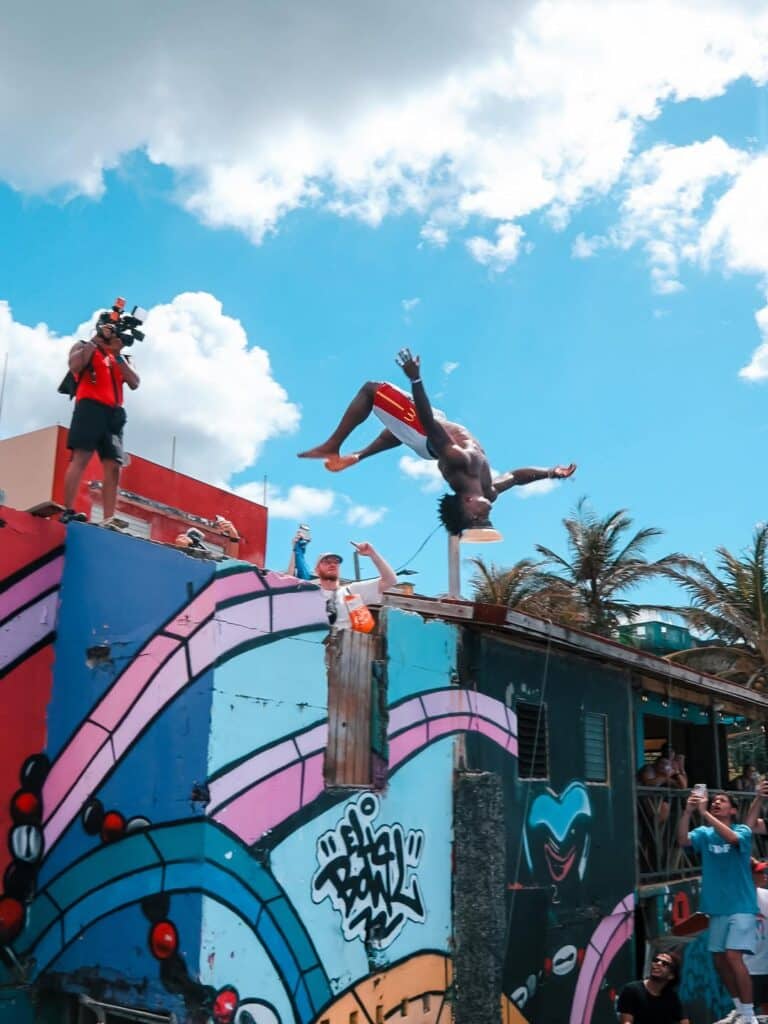
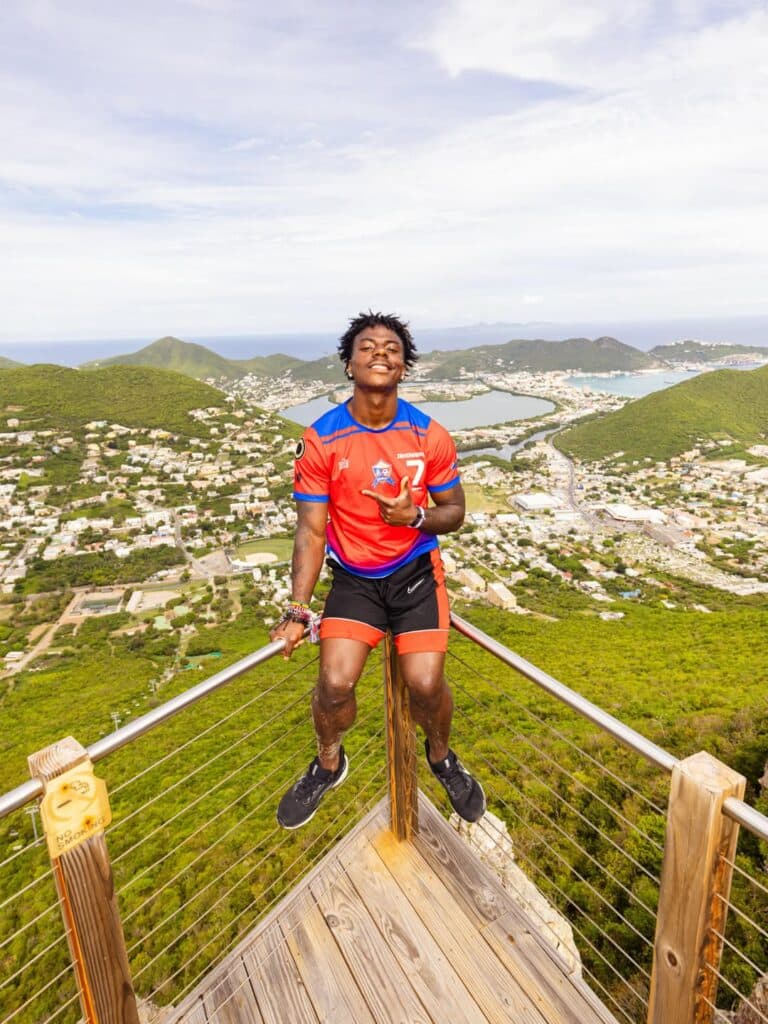
Territories propelled before a young audience
The livestream results show the scale of the phenomenon. The Dominican Republic leads the way with around 7.04 million views. The Dominica, Guadeloupe, Saint Kitts and Nevis and Sint Maarten block follows with around 6.87 million views. Trinidad and Tobago reached around 4.97 million, St. Lucia and St. Vincent and the Grenadines around 4.95 million, and Grenada around 4.32 million. These figures should be read with caution, particularly for the Dominican Republic, where warnings of artificial traffic have been mentioned. But even with this caveat, the order of magnitude remains exceptional for territories often absent from the world’s major digital narratives.
In Trinidad and Tobago, the tour got off to a highly popular start. The visit to Port-of-Spain reportedly attracted around 3,000 people and disrupted traffic around Tragarete Road. But the real impact came from the content on show: tassa, steelpan, cricket, mas, stickfighting, Queen’s Park Oval, Peter Minshall’s presence. Trinidad and Tobago was not reduced to a tropical setting. The territory was presented through its sounds, its gestures, its crowds and its lively relationship with the street.


Saint Lucia, the most measurable example
Saint Lucia offers one of the most interesting cases for measuring tourism impact. The Saint Lucia Tourism Authority reported that the livestream had attracted over 4.4 million viewers. Its General Manager, Louis Lewis, also reported an estimated return on investment of 77 to 1. This means that, for every dollar invested, the destination estimates that it has obtained media value equivalent to $77.
The passage showed Reduit Beach, Pigeon Island, Castries Market, Derek Walcott Square, the Pitons and Sulphur Springs. This choice of locations is important. It combines postcard, heritage, downtown, nature and local experience. In the IShowSpeed Caribbean Tour review, Saint Lucia thus appears as a territory that has tried to transform buzz into a structured visibility strategy.
Antigua and Barbuda: from direct to tourist route
Antigua and Barbuda also capitalized on the exhibition. The May 3 tour attracted over 2.5 million viewers on YouTube alone, according to data reported by the tourist board. The program featured Dickenson Bay, Hellsgate, stingrays, drag racing, Sir Vivian Richards Stadium, Carnival, Burning Flames, the Nyabinghi community, Ffryes Beach, the Antigua Black Pineapple and Barbuda.
Here again, the highlight is not just the number of views. It’s the way in which the region has been able to tell many different stories about itself: beach, sport, music, heritage, gastronomy, spirituality and sister island. IShowSpeed Caribbean Tour has shown that a livestream can become a tourist itinerary, provided that local players know how to transform it into legible, bookable and well-relayed offers.


Jamaica, between cultural power and Generation Z
Jamaica enjoyed massive exposure. The livestream from Kingston exceeded 2.8 million views, with a peak of 194,805 live viewers, 696,349 chat messages and 34,692 new subscribers. These figures are a measure of the attention generated by IShowSpeed’s visit to an area with an already strong cultural image.
The Jamaican challenge was different. The destination didn’t need to prove that it existed culturally. Reggae, dancehall, patois, athletics, gastronomy and street culture are already recognized the world over. But IShowSpeed Caribbean Tour put this power in front of a very young audience, used to consuming the world live, without waiting for institutional campaigns.


A turning point for Caribbean tourism
The partnership with Expedia confirms that this tour is more than just a creative phenomenon. The platform has named IShowSpeed “Official Travel Partner” and launched a space where fans can follow his travels, consult content and book stays, flights or activities inspired by his travels. This is probably one of the most important lessons to be learned from the review: livestreams are becoming a tool for inspiration, and then potentially for tourism conversion.
For the Caribbean, the results are clear. IShowSpeed Caribbean Tour offered visibility that few traditional campaigns can achieve with Generation Z. But visibility isn’t enough. But visibility is not enough. Territories will now have to capture this attention, improve their official content, make their experiences accessible online, better reference the places seen in the videos and involve local players in this new image economy.


The balance sheet is therefore powerful, but incomplete. The views are there. The conversations are there. The crowds were there. The question now is whether this exposure will generate travel, bookings, revenue for local communities and a stronger place for the Caribbean in the global digital imagination. Only then will IShowSpeed Caribbean Tour go from being a viral phenomenon to a useful moment for the Caribbean territories.
The results of the IShowSpeed Caribbean Tour are first and foremost digital. The tour gave several Caribbean territories worldwide exposure to a very young audience, very active on YouTube and social networks. The figures available speak of millions of views, millions of engagements and a very high conversational reach. For the Caribbean, the main impact is therefore in terms of visibility: places, street scenes, natural sites, markets, beaches and local cultural expressions have circulated massively online. On the other hand, the real economic impact must still be measured with caution, as there is as yet no complete official record of tourist bookings or revenue generated.
Several territories took advantage of the IShowSpeed Caribbean Tour, each in their own way. Saint Lucia stands out as one of the most structured examples, with official communication around the media ROI and locations shown during the live tour. Antigua and Barbuda also turned the visit into a tourist itinerary, highlighting beaches, culture, sport, gastronomy and heritage. Jamaica benefited from strong exposure to Generation Z, while Trinidad and Tobago made its mark with street culture, steelpan, carnival and cricket. The impact varies according to each region’s ability to follow up the buzz with a clear tourism strategy.
Yes, but only if Caribbean territories turn this visibility into concrete action. A livestream can create envy, give a more spontaneous image of a territory and reach audiences difficult to reach with traditional campaigns. But for the impact to last, the places seen in the videos need to be well referenced, the experiences easy to book, tourist offices need to publish appropriate content and local players need to be involved in the spin-offs. So the IShowSpeed Caribbean Tour has opened a door: it’s now up to Caribbean destinations to convert this global attention into travel, revenue and visible benefits for local communities.
Shenseea and Daddy Yankee at FIFA 2026: the announcement goes beyond a simple musical release. With “Echo”, Jamaica and Puerto Rico enter the sound universe of the next World Cup together. Behind this track, a part of the urban Caribbean finds a new place in one of the planet’s most popular events.
One FIFA title, two Caribbean voices
On April 28, 2026, FIFA announced the release of “Echo”, the third single from the official FIFA World Cup 2026 album. The track brings together Shenseea, a Jamaican artist associated with contemporary dancehall, and Daddy Yankee, a major Puerto Rican reggaeton figure. FIFA points out that the track is one of a series of musical releases designed to accompany the build-up to the tournament.
This announcement goes beyond the framework of a collaboration between two well-known artists. It brings two Caribbean territories, Jamaica and Puerto Rico, face to face, united in a global production without being melted into a uniform narrative. On one side, Shenseea brings the energy of Jamaican dancehall to an international audience. On the other, Daddy Yankee embodies a Puerto Rican trajectory that has helped make reggaeton one of the great popular musical languages of recent decades.

Shenseea, Jamaica in the world of sound
Shenseea is not just a guest on this project. She represents a generation of Jamaican artists capable of moving from dancehall to international formats, while retaining a sonic identity linked to Kingston, the studios, radios and stages where the genre was built. Her journey from Jamaica to a wider exposure illustrates this permanent tension: speaking to the world without erasing the territory of origin.
This is precisely what makes its presence so interesting. Jamaica has already given the world reggae, dub, dancehall and a unique way of circulating music through soundsystems, producers and diasporic communities. With “Echo”, Shenseea extends this story in a different setting: that of a global sporting event, followed far beyond soccer fans.
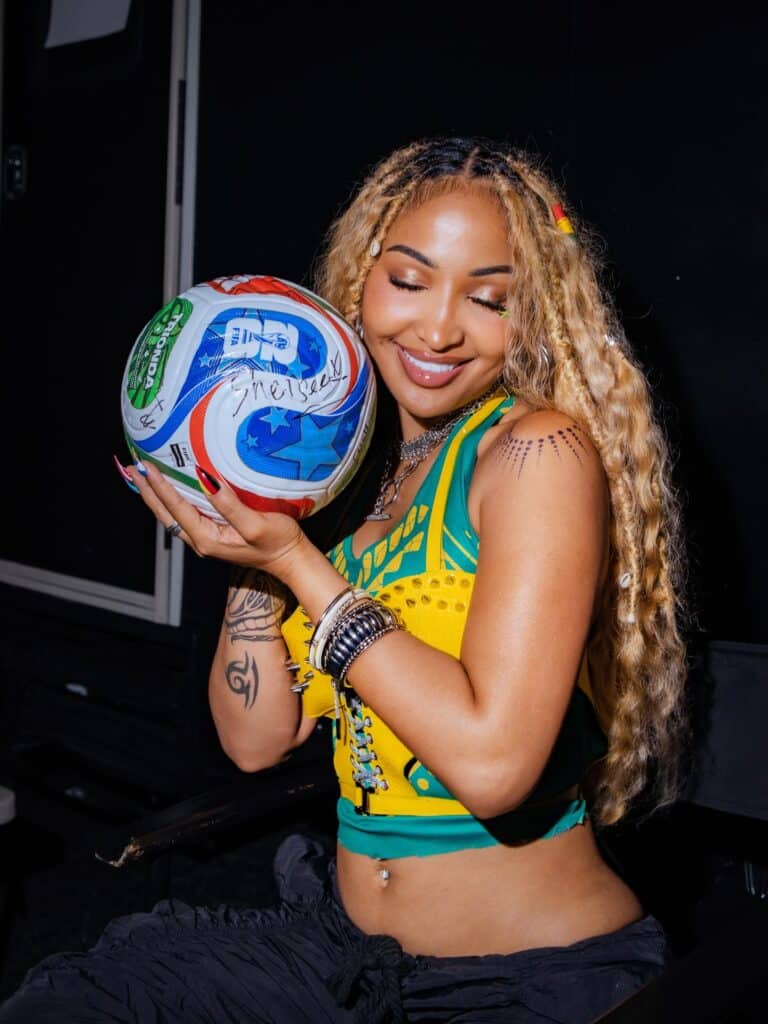
Daddy Yankee, Puerto Rico and the expansion of reggaeton
Opposite her, Daddy Yankee brings another Caribbean memory. Born in Santurce, Puerto Rico, he is described on his official website as one of the artists who brought reggaeton to the world, with a career that began in the 1990s and has sold over 30 million records.
Its name gives the track a strong Spanish-speaking dimension. Reggaeton is not just a music of clubs or international rankings. It is the product of movement between Puerto Rico, Panama, the United States, the Caribbean and Latin America. It carries languages, neighborhoods, migrations and social transformations. In “Echo”, this memory meets Jamaican dancehall, another major urban language born in the region.

Dancehall and reggaeton: two heritages on the same stage
The appeal of this collaboration lies in this precise point: it doesn’t merge two universes to make them indistinct. It places them side by side. Dancehall and reggaeton share rhythmic links, historical circulations and the same ability to make very different audiences dance. But they don’t tell the same story.
Dancehall carries Jamaica, its studios, its deejay voices, its relationship to the street, performance and language. Reggaeton carries Puerto Rico, the Latin-Caribbean world and the crossroads between rap, dembow, Caribbean Spanish and urban culture. Bringing them together on a soundtrack linked to the World Cup means giving voice to a plural Caribbean. A Caribbean that doesn’t want to be summed up, but recognized in its diversity.


FIFA World Cup 2026: a global showcase
The context further amplifies the significance of the piece. The FIFA World Cup 2026 will be the first men’s World Cup to bring together 48 teams, and to be held in three host countries: Canada, Mexico and the United States. In this context, music is never a mere accompaniment. It creates a memory. Certain titles remain associated with an edition, an image, an era. When a track enters the official World Cup environment, it joins a space where sport, media, platforms and audiences meet on a grand scale.
For the Caribbean, this exhibition is important. It is a reminder that the region is not only present in the stands, diasporas or sports qualifications. It is also present in the sounds that accompany the world’s great narratives.
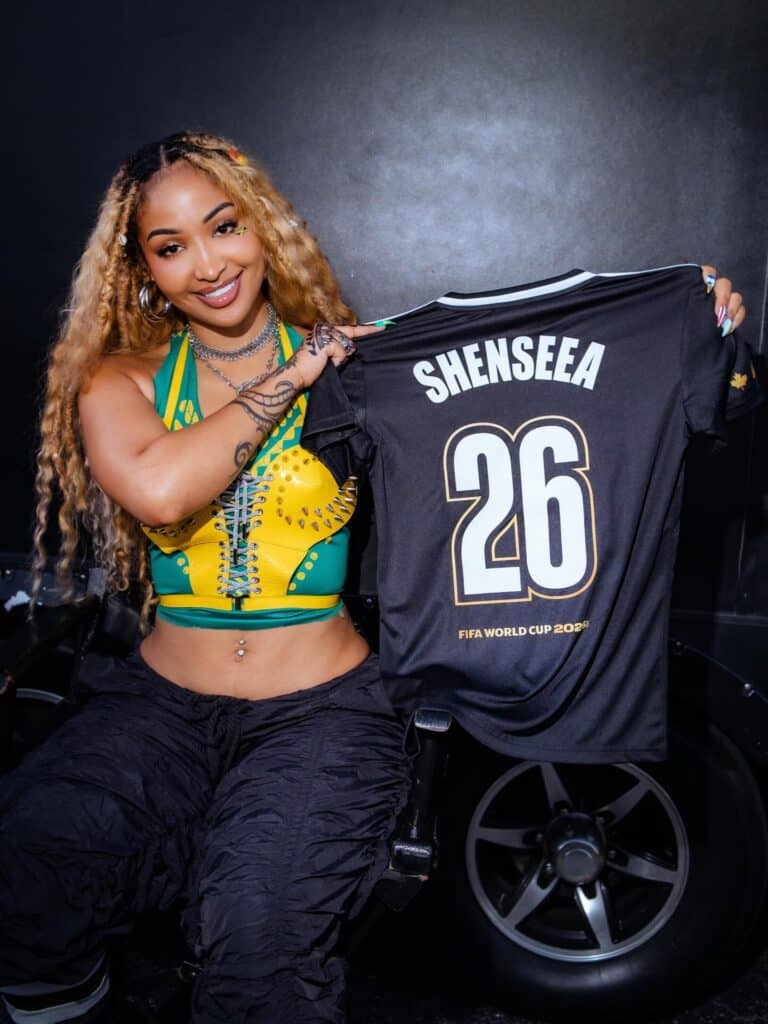
What "Echo" says about Caribbean music today
“Echo” comes at a time when Caribbean music continues to have an impact far beyond its native territory. Reggae, dancehall, reggaeton, soca, kompa, zouk, bouyon or dembow do not follow the same trajectories. Each has its own roots, codes, languages and audiences. But all show that the Caribbean produces cultural forms capable of circulating, transforming and leaving a lasting mark on the popular imagination.
This is where the RK angle becomes essential. It’s not just about saying that Shenseea has “scored a point” for Jamaica. It’s about understanding why this presence matters. She reminds us that the Caribbean is not peripheral to world music. It is one of its silent driving forces, sometimes quoted, often imitated, but not always fully recognized.
With Daddy Yankee and Shenseea reunited on “Echo”, two islands, two musical languages and two Caribbean histories enter the same sound enclosure. The question now is a simple one: after dancehall and reggaeton, what other Caribbean sounds are destined to take the world by storm?
📸 ©Shenseea ©Daddy Yankee / Instagram
Shenseea and Daddy Yankee are reunited on “Echo”, a track associated with the official FIFA World Cup 2026 album. The collaboration features two Caribbean artists from Jamaica and Puerto Rico.
“Echo” brings together two great Caribbean musical universes: Jamaican dancehall driven by Shenseea and Puerto Rican reggaeton associated with Daddy Yankee. The track shows how Caribbean music continues to influence major world events.
This collaboration is important because it places Jamaica and Puerto Rico in the sound environment of the FIFA World Cup 2026. It serves as a reminder that the Caribbean is not just a tourist or sports region, but also a global musical powerhouse.
IShowSpeed Caribbean Tour opens a rare window on the Caribbean. The announcement was broadcast on April 20 on the American creator’s networks, with a live broadcast scheduled for April 25, 2026. The published list mentions fifteen destinations: Antigua and Barbuda, the Bahamas, Barbados, Dominica, the Dominican Republic, Grenada, Guadeloupe, Jamaica, Puerto Rico, Sint Maarten, Saint Kitts and Nevis, Saint Lucia, Saint Vincent and the Grenadines, Trinidad and Tobago and the US Virgin Islands. In the space of a few hours, this tour placed the region in an unusual position of global visibility.
IShowSpeed Caribbean Tour deserves attention for one simple reason: IShowSpeed gathers a gigantic audience. The Associated Press recalls that it surpassed 50 million subscribers on YouTube during its African tour in January 2026. At this scale, every move becomes a live event, picked up by other accounts and transformed into short sequences that circulate quickly. When an entire itinerary is devoted to the Caribbean, the territories, accents, landscapes and everyday customs enter the field of vision of an international audience.
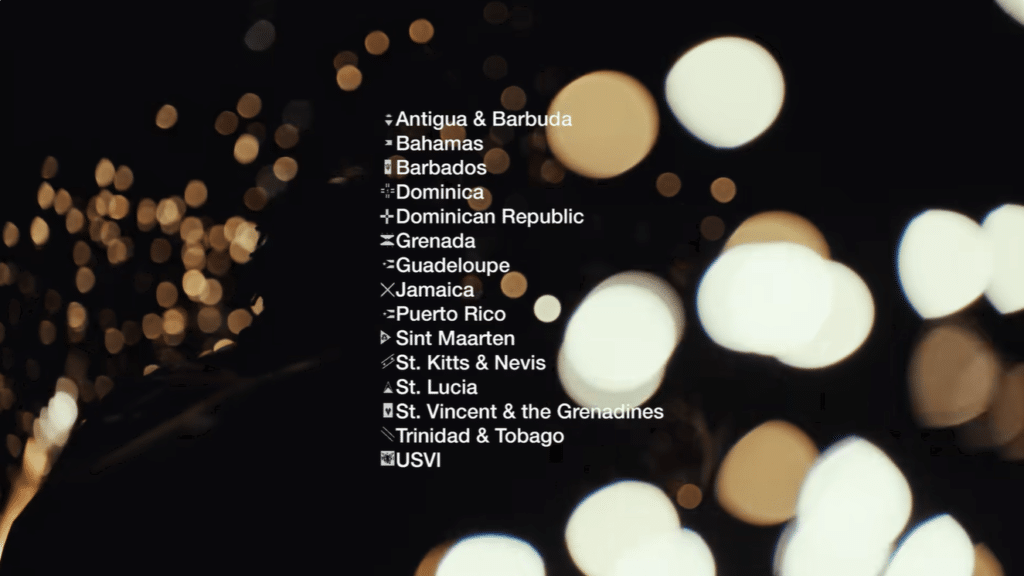
The Caribbean as a whole
The first strength of the IShowSpeed Caribbean Tour lies in the overall picture it produces. The list combines independent states and territories, English-, French-, Spanish- and Dutch-speaking areas. This juxtaposition reminds us that the Caribbean is a multiple region, crossed by different languages and heritages, while retaining deep links.
This regional reading corresponds to a historical reality. Human, musical, commercial, religious and family circulations have existed for centuries from one island to another. Borders have shaped distinct administrations and statuses. They have never erased exchanges. In a single announcement, the Caribbean appears as a legible space for millions of people who often perceive it in a fragmented way.
Visibility through the codes of the present
The format counts almost as much as the list of destinations. IShowSpeed is all about live action, improvisation, immediate reaction and massive sharing. Its audience follows less a program than a presence. This way of filming changes the nature of the exhibition. The viewer watches streets, beaches, markets, journeys, encounters and crowd scenes as they happen.
For the Caribbean, this exhibition has a special significance. Many of the region’s territories suffer from uneven visibility in the major media circuits. The best-known benefit from a well-established image. Others remain absent from global narratives, or reduced to a few clichés. The IShowSpeed Caribbean Tour can therefore play a useful role: showing a diversity of places and atmospheres to a young public that is building its vision of the world through platforms.


An opportunity for cultural and media players
IShowSpeed Caribbean Tour is also of interest to artists, organizers, local media and creators based in the region. A tour of this scale can highlight a dancer, a musician, a culinary tradition, an urban setting, a popular event or a local personality. It can also create connections between territories that rarely communicate at this speed.
However, the added value of IShowSpeed Caribbean Tour will depend on how these moments are accompanied. A viral image attracts attention for a few hours. Serious editorial work extends this interest. It provides reference points, recalls history, clarifies political and cultural contexts, and helps us understand what we’re seeing. This is an opportunity for the Caribbean to tell the story of its plurality with greater mastery.
A visible symbolic impact
It would be premature to announce any quantified tourist effects or immediate economic spin-offs. However, one thing is clear: the Caribbean is gaining a global presence in one of today’s most popular formats.
This is where IShowSpeed Caribbean Tour really comes into its own. IShowSpeed Caribbean Tour brings together in a single movement territories that are often commented on separately. It reminds us that the region possesses a cultural, visual and social force capable of capturing attention on a grand scale. For audiences unfamiliar with the area, it can open a first door. For those who are already familiar with it, it confirms that the Caribbean remains a major hotbed of creation, circulation and energy in the contemporary world.
IShowSpeed Caribbean Tour is a tour announced by American creator IShowSpeed across several Caribbean territories. Beyond the announcement itself, this tour is attracting attention for its media scope and the visibility it can offer the region as a whole.
IShowSpeed Caribbean Tour is attracting a lot of interest because IShowSpeed is one of the most followed creators in the world. When he travels, his videos, live broadcasts and excerpts shared on the networks quickly reach an international audience, giving this tour a much wider reach than a series of stopovers.
IShowSpeed Caribbean Tour is important because it shows the Caribbean as a visible, vibrant and connected regional space. The tour links several territories in a single narrative and reminds us that the region possesses a cultural, linguistic and social richness capable of attracting attention on a large scale.
Yes, IShowSpeed Caribbean Tour can have a real cultural impact. This type of tour can highlight local landscapes, sounds, accents, lifestyles, artists and moods. It can also encourage a new way of looking at the Caribbean, particularly among a younger audience who follow world news via digital platforms.
It’s still too early to accurately measure the impact of the IShowSpeed Caribbean Tour on tourism. On the other hand, this tour can already raise the profile of the Caribbean and feed the curiosity of a global audience. This media exposure can then benefit the territories if it is intelligently relayed by cultural, tourism and media players.
In the northeast of Puerto Rico, El Yunque offers a very different face from the seaside island often promoted. Here, the road climbs up to a humid, wooded relief crossed by mountain rivers. It is the only rainforest massif in the U.S. National Forest System. It extends over eight municipalities and covers just over 110 km², making it a relatively small area, but one of remarkable biological richness.
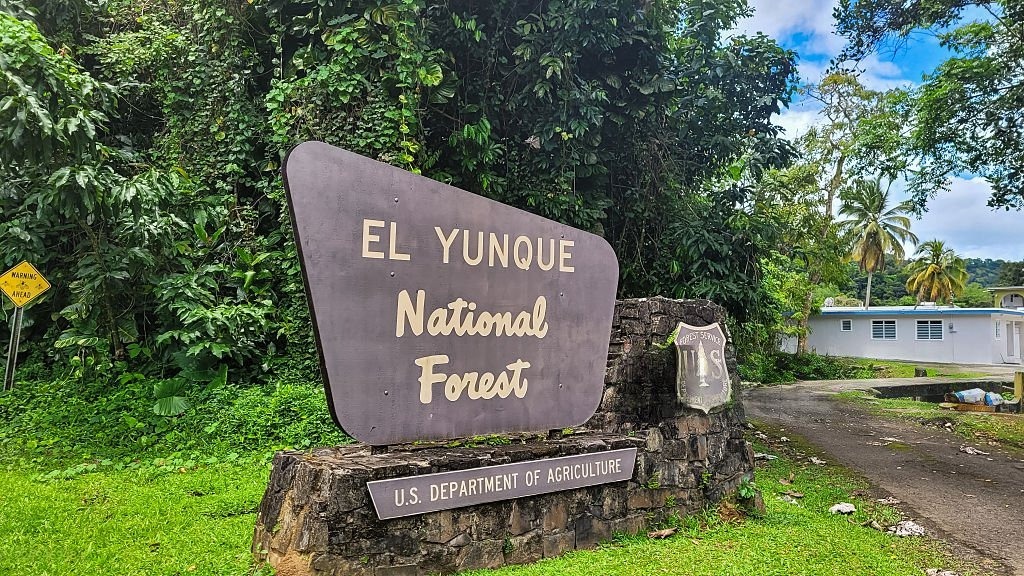
El Yunque, a natural site in a class of its own in Puerto Rico
Talking about El Yunque is not talking about Puerto Rico as a whole, but about a specific, clearly identified place, with its geography, climate and history. This precision makes it a strong subject both editorially and SEO-wise. The massif is located in the Sierra de Luquillo, with an altitude that climbs to over 1,000 meters. Over this gradient, the average annual temperature varies from approximately 25 to 19°C, while annual rainfall ranges from around 2,000 to 5,000 mm. This combination explains the density of vegetation, the constant presence of water and the impression of freshness that marks the visit.
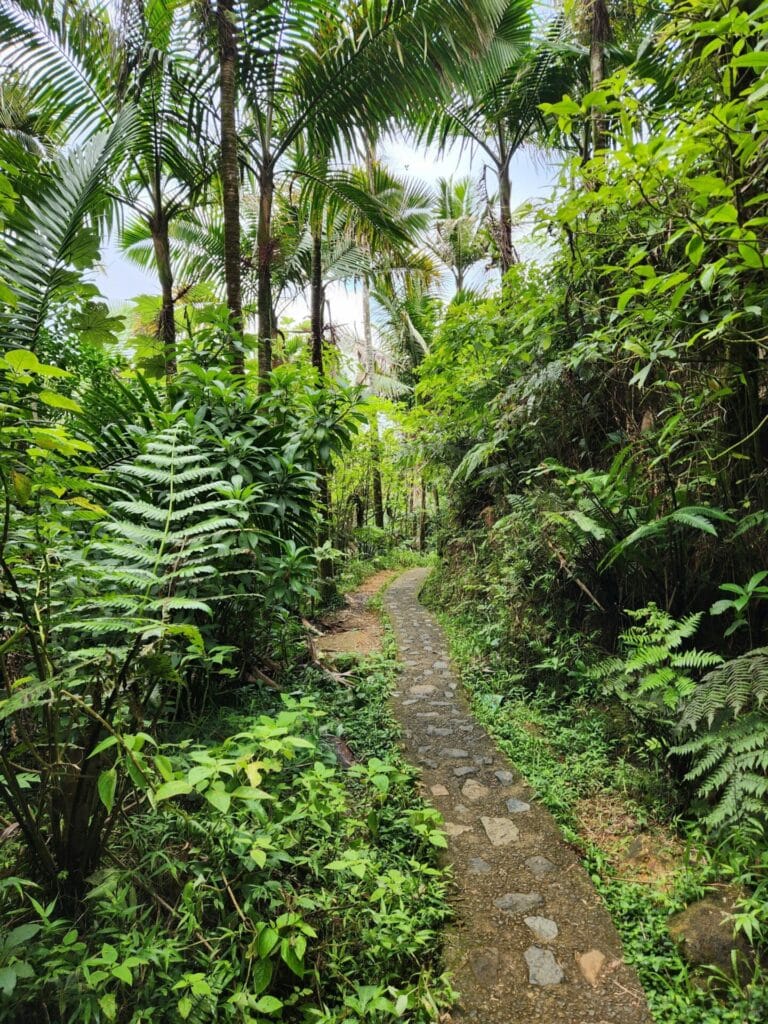
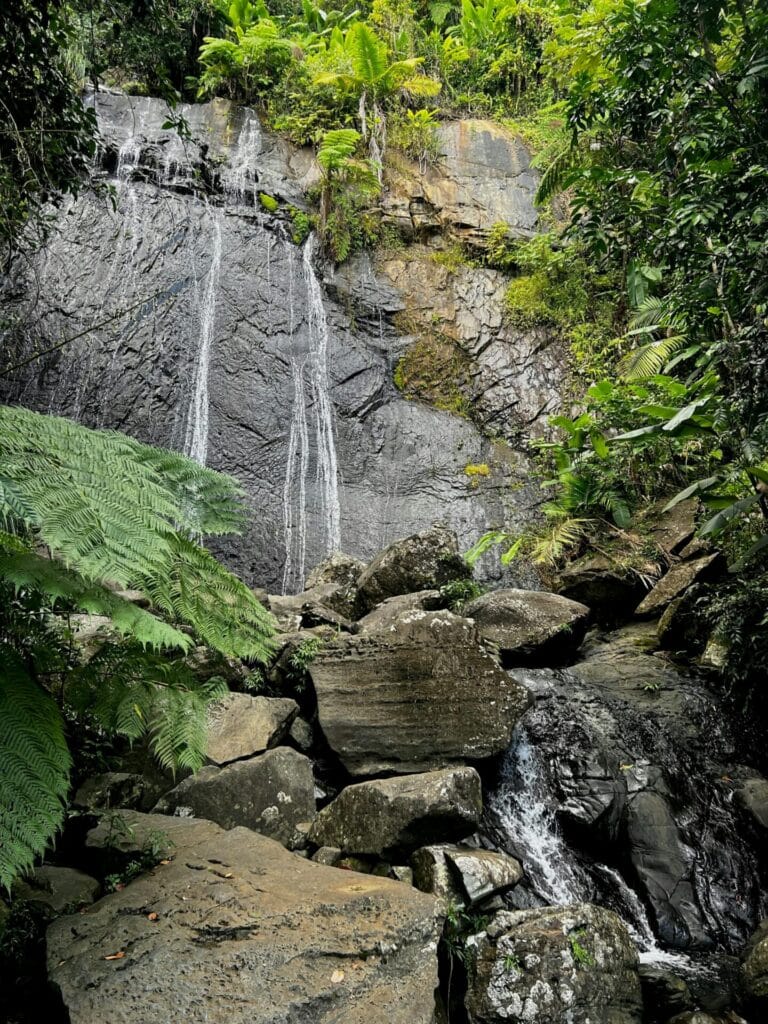


A forest where water, relief and climate shape the landscape
El Yunque is more than just a closed, uniform forest. Relief plays a central role. The slopes capture the moisture carried by the trade winds, nourishing the soils and feeding the rivers, some of which remain among the island’s best preserved. This setting gives rise to a succession of landscapes: very wet undergrowth, unobstructed views of the mountains, fast-flowing streams, natural pools and waterfalls that are accessible depending on which sectors are open to the public. The result is an experience that is more inward, more plant-based and often quieter than the major coastal sites.


El Yunque and its exceptional biodiversity
One of the great attractions of El Yunque is its biodiversity. Official data indicate that the forest is home to 13 of the 17 species of coquí recorded in Puerto Rico. This small amphibian is much more than a curiosity: it’s part of the island’s sonic identity. The site is also home to 97 species of birds, including 45 migratory species, as well as numerous species of reptiles, freshwater fish, shrimp and invertebrates. Among the most symbolic species is the Puerto Rican parrot, which has been closely associated with conservation efforts in the area for decades.


The coquí, El Yunque's signature sound
For many visitors, El Yunque is as much about seeing as hearing. The song of the coquí accompanies the wetlands and immediately reminds us that this forest is not simply a place for strolling, but a living environment where each species occupies a precise place. This is also what gives the site its strong identity in the face of other destinations more focused on the coast.

A long history of protection and research
El Yunque owes its reputation not only to its scenery. Its institutional history is equally important. In 1876, King Alfonso XII of Spain proclaimed a 10,000-hectare forest reserve in the Luquillo mountains. Today, this decision makes it one of the oldest protected forest reserves in the Western Hemisphere. In 1903, Theodore Roosevelt established the Luquillo Forest Reserve, the future nucleus of today’s El Yunque. Over time, the site has also become a major area for scientific research, to the point of being one of the most studied tropical forests in the world.


Why is El Yunque so attractive?
The site attracts visitors for several reasons. Firstly, there’s the promise of an easily identifiable, world-famous tropical rainforest. Then there’s the diversity of possible experiences: walking, observing vegetation, discovering waterways, reading the mountain landscape, a more concrete approach to Puerto Rican biodiversity. Last but not least, it still receives little in-depth treatment in French-language content, even though it has a strong international reputation. It is precisely this discrepancy that makes it a relevant subject to work on.

Access to the site requires checking the latest conditions. Entry via the recreational corridor on PR-191 North in Río Grande is free and does not require a reservation at present, but use remains regulated due to limited parking and ongoing work. Several trails remain closed, including La Mina Trail, Big Tree Trail and Baño de Oro Trail. The trail to El Yunque Peak is open only as far as Los Picachos, the rest remaining closed for safety reasons.
El Yunque National Forest is located in northeastern Puerto Rico, mainly in the municipalities of Río Grande and Luquillo. The massif belongs to the Sierra de Luquillo and is about 45 minutes’ drive from San Juan. This location makes it an accessible excursion while offering a radically different environment from the capital, with its mountainous terrain and much wetter climate.
El Yunque is the only example of tropical rainforest within the U.S. National Forest System. This makes it both a rare and much-studied site. Its ecological richness is based on a combination of factors: altitude, high rainfall and habitat diversity. Over a relatively compact area, it concentrates several types of forest and a large number of endemic species, which clearly distinguishes it from other natural areas in the region.
A visit to El Yunque includes hiking trails, mountain rivers, natural pools and several viewpoints over the massif. Some areas offer access to waterfalls, while others offer a more gradual immersion in the forest. The site also features a visitor center, with educational information on the fauna, flora and history of the area. Depending on the area opened up, the experience can vary from an accessible stroll to a more strenuous hike.
Yes, we strongly recommend that you check the access conditions before visiting the site. Access to the site is restricted due to the limited number of parking spaces available and the fact that some work is still in progress. Not all trails are permanently open, and some areas may be temporarily closed for safety reasons. Consult the official information to avoid unpleasant surprises and optimize your itinerary on site.
El Yunque can be visited all year round, but conditions vary from season to season. As the forest is humid by nature, showers are frequent, even in the so-called dry season. The months from December to April generally offer more stable conditions, while the period from May to November can be rainier, with an increased risk linked to the hurricane season. In all cases, we advise you to bring suitable footwear, water and clothing to cope with the humidity.
The Kokobalé is an Afro-Puerto Rican martial art shaped by African heritages and the historical realities imposed on enslaved populations. Born on plantations, in villages and in neighborhoods where popular culture served as a refuge, it combines rhythm, coordination and discipline. This practice, which has long been passed on discreetly, is now finding new impetus thanks to initiatives that are restoring its historical and cultural depth. It tells of a relationship with the body and with memory, but also of a way of transforming constraint into collective intelligence supported by music.
An art born in conditions of control and resistance

In the colonial context, the authorities strictly monitored gatherings and restricted the use of weapons, limiting the machete to agricultural work. To continue developing a functional martial practice, African communities integrated a codified form of combat into a festive space: the Bomba dance. Within this musical framework, the Kokobalé could be transmitted without attracting attention, hidden behind a social ritual already embedded in everyday life. The musical circle then became a forum for strategy, cooperation and self-defense.
When the law even criminalizes threats with a stick, the practice adapts. The stick, now a symbol of continuity, is transformed into a tool for expression, coordination and learning, without the martial logic disappearing. Transmission is maintained through gestures, oral narratives and observation, enabling the Kokobalé to cross generations despite successive bans.
A structured "game" where dance and combat meet
What makes Kokobalé of a simple physical confrontation, it’s the staging that gives it shape. Participants enter a circle animated by the drums, while the audience plays an active role in the dynamics of the moment. The exchange often begins with a theatrical situation, creating symbolic tension before the sticks appear. Every movement is controlled, designed to interact with the music. The aim is neither domination nor injury, but precision, mastery of rhythm and interpretation of a codified body language.
Both practitioners use weapons of identical length, which guarantees fairness and reinforces the importance of technique. The drum, far from being a simple accompaniment, structures the encounter. It marks the cadence, underlines movements and responds to feints. In this way, the Kokobalé becomes an exchange in which the body expresses itself as much as the intention, transforming the confrontation into a choreographic reading.


A tradition preserved by families and cultural projects
One of the reasons why this practice has survived into the XXᵉ century is due to the remarkable work of certain custodians of cultural memory. The Cepeda family, central figures of the Bomba, played a decisive role in presenting the Kokobalé in performances and artistic events. This has enabled the Puerto Rican public to perceive long-invisible dimensions of its heritage, by articulating dance, narrative and history.
Today, initiatives such as Proyecto Kokobalé bring together researchers, teachers and practitioners to study the tradition and organize workshops accessible to different audiences. These initiatives provide a structured framework for a practice long confined to family circles. By linking past and present, they show that the Kokobalé is still socially relevant, particularly in the face of contemporary issues relating to Afro-Puerto Rican visibility and the valorization of cultural heritages.
A language of identity for the younger generation
For many young Puerto Ricans, discovering the Kokobalé represents an encounter with family stories that are often absent from official discourse.
By learning to wield the stick, listen to the drum and find one’s place in the circle, everyone reclaims a part of the island’s social history.
The exercise teaches respect for rules, tension management and solidarity. It also provides a new approach to the memory of ancestors, not just as victims, but as actors capable of cultural invention.
In a society where certain African heritages have been minimized or reduced to folklore, the Kokobalé becomes a vector of pride and knowledge.
It serves as a common thread between discipline, introspection and identity affirmation.
Practitioners find it a way of transforming a painful history into a structured collective force.

Where to see and practice Kokobalé in Puerto Rico?
Although less visible than other art forms such as Bomba or Plena, the Kokobalé is gradually gaining recognition. In San Juan, Loíza and Ponce, several collectives are organizing classes and demonstrations in cultural centers or at community gatherings. The educational initiatives set up by the Cepeda family and Proyecto Kokobalé play an essential role in this dynamic.
At traditional festivals – notably the Festival de Santiago Apóstol in Loíza – this practice appears alongside rhythms, masks and rituals linked to Afro-Puerto Rican heritage. For visitors interested in the deep history of the island, attending a circle of Kokobalé shows how rhythm, memory and coordination are intertwined in a single cultural gesture.
FAQ
Yes, it’s passed on in various cultural collectives, within families who are guardians of the tradition, and in regular workshops.
Both practices combine music and codified combat, but one relies on the stick while the other favors bare-handed combat.
It’s possible, but the deeper understanding lies in the rhythm, as the Bomba structures the steps, transitions and gestural dialogue.
