TeMeUm 2026 marks a new stage in the policy of supporting local biodiversity initiatives in the French overseas territories. Launched by the French Office for Biodiversity (OFB), this annual campaign aims to finance micro-projects undertaken by associations, small communities and managers of natural areas who are active in the field.

At a time when island ecosystems are under heavy pressure from urbanization, climate change, pollution and biodiversity erosion, this program provides financial and technical resources to transform local initiatives into concrete, measurable actions. Project leaders have until April 14, 2026 to submit their applications via a fully paperless procedure.

Since its creation in 2010, the program has supported more than 420 micro-projects in the French overseas territories, confirming its role as a structuring force in supporting local environmental dynamics.

Financing tailored to small structures

One of the major assets of TeMeUm 2026 lies in its accessibility. The program deliberately targets smaller structures, which often have difficulty accessing traditional financing. Grants awarded range from a few thousand euros to 20,000 euros and can cover up to 80% of the total budget.

Aid is paid out in a single instalment as soon as the project is launched, enabling project sponsors to get their initiatives off the ground quickly, without having to wait for lengthy administrative procedures. This approach responds to a well-known reality in the French overseas territories: local players have solid expertise, but often lack immediate financial resources.

In addition to financial support, the OFB provides technical and administrative assistance to secure the implementation of projects and promote their development on a regional scale.

Three complementary schemes to structure projects

The campaign TeMeUm 2026 campaign is built around three distinct systems, designed to meet a variety of needs.

Springboard: supporting immediate local action

The Tremplin scheme is the operational heart of the program. It supports micro-projects for the protection or restoration of biodiversity, from first experiments in ecological management to innovative pilot initiatives.

Each year, around thirty projects are co-financed for amounts of up to 15,000 euros. The actions supported cover a wide range of fields: species monitoring, restoration of natural habitats, raising public awareness, and experimentation with new ecological management methods.

Among the initiatives supported in 2025 are participatory monitoring of marine biodiversity in Saint-Pierre-et-Miquelon, a project to mobilize citizens around sustainable urban development in French Guiana, and the creation of a botanical trail in Polynesia to preserve endangered endemic flora.

Cooperation: strengthening technical skills

The Cooperation component aims to structure partnerships between biodiversity stakeholders in order to strengthen local technical capacities. With a grant of up to 20,000 euros. This scheme supports collaborative projects involving several organizations.

These cooperative ventures enable us to pool scientific expertise, improve ecological management methods and develop more coherent territorial strategies. In 2025, a wetland restoration project in Mayotte benefited from this funding following a cyclone that weakened local ecosystems.

Companionships: transmission and training in the field

The Compagnonnages program focuses on vocational training and the transmission of know-how. It enables teams from the French overseas departments and territories to spend short periods of time – one to two weeks – working within expert structures.

The OFB will cover travel, accommodation and catering expenses, up to a maximum of 5,000 euros. This format encourages direct technical exchanges and rapid skills transfers.

In 2025, environmental agents in the Indian Ocean were trained in techniques for capturing and studying chiropterans, while an international partnership studied the impact of microplastics on green turtle egg-laying sites and seabird nesting.

TeMeUm 2026
TeMeUm 2026
TeMeUm 2026

Simplified procedures and local support

The program TeMeUm 2026 is based on a clear commitment to administrative simplification. Applications are submitted entirely electronically via the Démarches Simplifiées platform, making it easier for organizations located far from major administrative centers to apply. Applications are examined by local juries made up of biodiversity stakeholders from each region. This organization guarantees an assessment adapted to the ecological and social realities of each overseas zone.

Support doesn’t stop at the selection stage. TeMeUm’s national teams and the OFB’s regional delegations follow project leaders through the entire process, from dossier preparation to operational implementation, evaluation and valorization of results.

A handbook detailing eligibility criteria and expected commitments is available to applicants. Two information webinars are also scheduled on March 23 and 25, 2026 to help structures prepare their bid.

A major challenge for the Caribbean and Indian Ocean territories

For the French overseas territories, biodiversity is both an exceptional natural heritage and a factor of economic, cultural and tourist resilience. The marine and terrestrial ecosystems of the Caribbean, French Guiana and the Indian Ocean play a central role in protecting against climate risks, ensuring food security and enhancing the attractiveness of these territories. Against this backdrop, TeMeUm 2026 represents a strategic opportunity for local players wishing to develop concrete projects, whether to restore natural habitats, protect endemic species or raise public awareness.

The program also contributes to structuring a network of committed players, encouraging the circulation of skills and the sharing of experience between overseas territories.

TeMeUm 2026
©Roatan-Marine-Park
TeMeUm 2026
©zoo-de-Guyane
TeMeUm 2026
©Buccoo-Reef-Trust
TeMeUm 2026
©Roatan-Marine-Park

Local mobilization for sustainable biodiversity

By renewing its call for projects, the OFB confirms the importance of a territorial approach to biodiversity, based on the expertise of local players. TeMeUm 2026 is more than just a funding scheme: it’s part of a global strategy designed to strengthen the capacity for action of structures in the French overseas territories, and to support initiatives tailored to the ecological realities of each territory. Applications for the three schemes – Tremplin, Coopération and Compagnonnages – are open until April 14, 2026. Project sponsors can contact their local OFB delegation or the TeMeUm team directly for further information.

Through this new campaign, TeMeUm 2026 confirms that preserving biodiversity in the French overseas territories depends above all on the commitment of local players, who are capable of transforming targeted initiatives into sustainable solutions for their territories.

TeMeUm 2026 is a program run by the French Biodiversity Office to finance micro-projects to protect and restore biodiversity in the French overseas territories. It supports associations, local authorities and natural area managers working in the field.

Associations, small local authorities, public establishments and managers of natural areas in the French overseas territories are all eligible to apply. The program is designed to be accessible to small structures with concrete projects in favor of biodiversity.

Applications for the Tremplin, Coopération and Compagnonnages schemes are open until April 14, 2026. Applications must be submitted online via the Simplified Procedures platform of the French Biodiversity Office.

The Rézo 2025 seminar, held in Grenada, brought together the directors of the Alliances Françaises of the English-speaking Caribbean, with the same ambition: to consolidate the links between the territories and reinforce the vitality of the French-speaking world in the region.

Having explored the institutional and strategic vision of this regional cooperation in the previous article, “The Alliances Françaises network at the heart of the Caribbean: cooperating, innovating, sharing”, Richès Karayib now turns the spotlight on those who are at its beating heart.

For several days, the participants shared their experiences, challenges and successes, revealing a common conviction: to bring culture and the French-speaking world closer to the people of the Caribbean via the Alliances Françaises.

Alliances Françaises

An essential meeting for a fragmented network

Each Alliance Française operates on an island, often geographically isolated. This seminar, organized with the support of the Service de Coopération et d’Action Culturelle (SCAC) of the French Embassy in Saint Lucia, was a breath of fresh air for the Alliance Française network. The directors emphasized that these meetings are an essential step: they enable them to exchange tools, compare local realities and together find concrete solutions to shared challenges. They all emphasized the strength of the collective, the richness of exchanges in an English-speaking environment and the complementarity of approaches between territories.

These moments offer both a human and a formative dimension: they re-energize, reinforce solidarity and remind us that, despite the diversity of contexts, the Alliances Françaises move forward with the same ambition – to make the French-speaking world live and shine in the Caribbean. From an institutional point of view, Christiane Bourgeois, Cooperation and Cultural Action Advisor, reminded us that this annual seminar is the only time when all the directors can get together to discuss successes, difficulties and common perspectives.

Alliances Françaises

Nine territories, nine realities, but the same conviction: these times of exchange are essential to maintain the network’s momentum and strengthen cooperation in the Caribbean. Beyond these collective exchanges, it is in the field that the vitality of the Alliances Françaises network takes on its full meaning. Each Alliance Française acts in its own way, in line with the realities of its environment and the languages and cultures of its territory.

Alliances Françaises

A deep-rooted network: ten Alliances, one commitment

Although their contexts differ, the Alliances Françaises of the English-speaking Caribbean share the same vocation: to teach, connect and bring the French-speaking world to life on a daily basis. They adapt to local realities with the same conviction: culture and language are levers for social cohesion, openness and the future.

Grenade – Ilona Forte-Gilbert: teaching differently, connecting differently

The Alliance Française de Grenade operates without permanent premises, a situation that Ilona Forte-Gilbert has turned into an asset.

Courses are now offered online, helping to maintain the French language’s presence and reach new audiences. The Alliance is also involved in schools through educational and cultural activities carried out in partnership with teachers. Out-of-home screenings and workshops keep us in touch with the community.

“Our priority is to remain present and useful, even without a building. Digital technology and partnerships enable us to keep the Alliance going.”

Alliances Françaises

Saint Lucia – Aurélie Gbeffa: coordinating and federating

In Saint Lucia, Aurélie Gbeffa runs the local Alliance and is responsible for regional coordination of the ten Alliances Françaises in the Eastern Caribbean. She assists managers with communication, pooling, associative governance, digital transition and cultural revitalization.

It also pilots the Rézo project, an annual seminar supported by the SCAC, which has become a key event for cohesion and collective reflection. In Castries, the Alliance Française de Sainte-Lucie combines language courses, cultural activities and Creole language promotion through exhibitions and workshops.

“Our strength lies in moving forward together while valuing the cultural diversity of our islands.”

Alliances Françaises

Barbados – Océane Gaillard: promoting French in an English-speaking environment

In Barbados, the Alliance Française acts as a linguistic and cultural bridge. Under the leadership of Océane Gaillard, it has consolidated its foothold in a predominantly English-speaking environment. Educational programs have been set up for schools and adults, and the Alliance has trained members of the Regional Security System in French and Haitian Creole.

On the cultural front, it has welcomed the Guianese troupe Ôtepé, and is developing a program open to different French-speaking expressions.

“We represent a plural Francophonie: France, Africa, Canada and the Caribbean. Culture is our best lever for inspiring the desire to learn.”

Alliances Françaises

Trinidad & Tobago – Anyka Batista: an open and inclusive francophonie

In Trinidad & Tobago, Anyka Batista defends an inclusive and creative Francophonie, which values local languages as much as French. Every October, Creole Heritage Month brings together screenings, conferences and concerts, reflecting a strong commitment to cultural diversity.

The Alliance Française also offers courses for children, teenagers and adults, as well as cultural evenings that encourage encounters between communities. Challenges related to visibility and funding persist, but are offset by a collaborative approach with local schools and institutions.

“We want the Francophonie to be seen as part of our culture, not something external.”

Anyka Batista

Jamaïque – Clovis Lemée: creating living spaces

In Jamaica, Clovis Lemée is revitalizing a historic Alliance Française, transforming it into a place for living and creating. The Language Exchanges, monthly multilingual evenings, bring together a varied public around cultural themes, while the French Library Sessions – mini-concerts filmed in the media library – turn language into a tool for encounters and artistic expression.

“Learning a language is about creating links. That’s what the Alliances Françaises are all about.”

This cultural dynamic is attracting a younger audience and helping to restore the French language to its rightful place in the English-speaking Caribbean.

Clovis Lemée

Saint-Kitts & Nevis – Lucille Caulliez : education and ecology

The Alliance Française de Saint-Kitts & Nevis combines language learning with civic engagement. Her Naturally Learn French project, supported by a grant from the French Embassy to the Eastern Caribbean, Barbados and the OECS, offered six months of free tuition to twelve teenagers from disadvantaged backgrounds, combining French language discovery, ecological workshops and cultural activities. Each month, participants explored local ecosystems, cultivated a garden, created with recycled materials or exchanged online with students from Guadeloupe – a concrete and lively way to learn the language while forging links in the Caribbean.

This project, which earned the Alliance the Green Alliance Award from the Global Environment Facility, illustrates the vitality of an open, sustainable and youth-oriented French-speaking community. She is also developing Francoscop, an audiovisual series produced by young people, dedicated to the French-speaking world.

Director Lucille Caulliez sums up the spirit of the program:

“We want to show that French is a tool for openness and creativity.”

Lucille Caulliez

Dominique – Cévinne M’Voula-Henderson: connecting languages and cultures

Established in 1965, the Alliance Française de la Dominique is active in the educational and cultural fields. The Creole & French Spelling Bees, bilingual spelling contests, encourage students to play with the two languages, understand their complementarity and take pride in them. Training workshops and cultural activities support the enhancement of Creole heritage while promoting the French language.

“The aim is to make French and Creole languages of pride and transmission.”

Alliances Françaises

Guyana – Déborah First-Quao: rebuilding and training

In Georgetown, Déborah First-Quao, recently appointed to Guyana, is re-launching a long-standing but low-profile Alliance Française by focusing on training and educational partnerships. She has created a network of French teachers, developed bilingual workshops at the National Library and renewed ties with local institutions. Cultural and educational initiatives aim to put French back into everyday life, despite major logistical constraints.

“We want to restore French to its rightful place in schools, showing that it can be useful, lively and accessible.”

Alliances Françaises

Suriname – Virginie Lemay: building institutional bridges

In Suriname, Virginie Lemay is strengthening links between the Alliance Française and local institutions. Language training is offered to the security forces, the Ministry of Education, businesses and the hotel industry. La Journée Française, organized with the Collectivité Territoriale de Guyane, is a five-day event featuring exhibitions, professional meetings and concerts.

“French becomes a concrete tool for regional cooperation.

This cross-sectoral approach positions the Alliance Française as a key player in the dialogue between Suriname, Guyana and the rest of the Caribbean.

Alliances Françaises

A shared vision: support, connect, promote

For Christiane Bourgeois, Regional Advisor for Cooperation and Cultural Action at the French Embassy in Saint Lucia, this seminar is an essential moment for consolidating the network’s ties. She points out that it’s “the only occasion of the year when we have the opportunity to meet the directors of the Alliances Françaises”, a privileged time to take stock, exchange practices and difficulties, and set up joint projects.

“The Alliances Françaises are an essential tool for embassies, especially in areas like the Caribbean, where there is no Institut Français. They are local organizations, rooted in the territory, with their own board of directors and their own strategy”. She also recalled the key role played by the Alliances in disseminating the French language and promoting dialogue between peoples, stressing that they promote the language, ensure its teaching and maintain the link between the cultural and the educational, between France and the countries of the region.

Alliances Françaises

Aware of the economic fragility of the associative model, Christiane Bourgeois stresses the importance of the support provided by the Service de Coopération et d’Action Culturelle (SCAC) and the French Ministry of Europe and Foreign Affairs.

Last but not least, it pays tribute to Granada, the seminar’s host, and its people:

“It’s an absolutely authentic island, with extremely friendly people. I encourage all French and Caribbean people to come to Grenada, a country that deserves to be known and appreciated.”

Alliances Françaises

Where the French language comes alive

Over and above balance sheets and figures, these meetings are a reminder that the French-speaking world lives and breathes through the people who make it happen. On every island, the Alliances Françaises gather, transmit and inspire. Anchored in their reality, they build bridges between languages, cultures and generations – a living, inclusive and deeply Caribbean Francophonie.

The Alliances Françaises play a central role in French language teaching, cultural dissemination and dialogue between Caribbean territories. Anchored locally, they adapt their actions to the social, linguistic and cultural realities of each island.

The Rézo seminar is the only annual gathering of all the directors of the Alliances Françaises in the Caribbean. It enables them to share practices, strengthen regional cooperation and maintain a collective dynamic in a geographically dispersed network.

The Alliances Françaises develop tailor-made projects: online or face-to-face courses, actions in schools, ecological projects, cultural events, professional training or institutional cooperation. This adaptability is their strength in a predominantly English-speaking environment.
A prestigious title that reinforces Saint Vincent's place in the Caribbean

The Sandals Group has reached a new milestone with its St. Vincent and the Grenadines resort, recently named Best All-Inclusive Resort 2025 at the Travvy Awards. This distinction, awarded by one of the most closely watched organizations in the travel industry, places St. Vincent at the heart of Caribbean destinations that are moving upmarket. This success is helping to establish the archipelago as a credible alternative to the region’s more high-profile tourist destinations.

A resort designed in an unspoilt environment

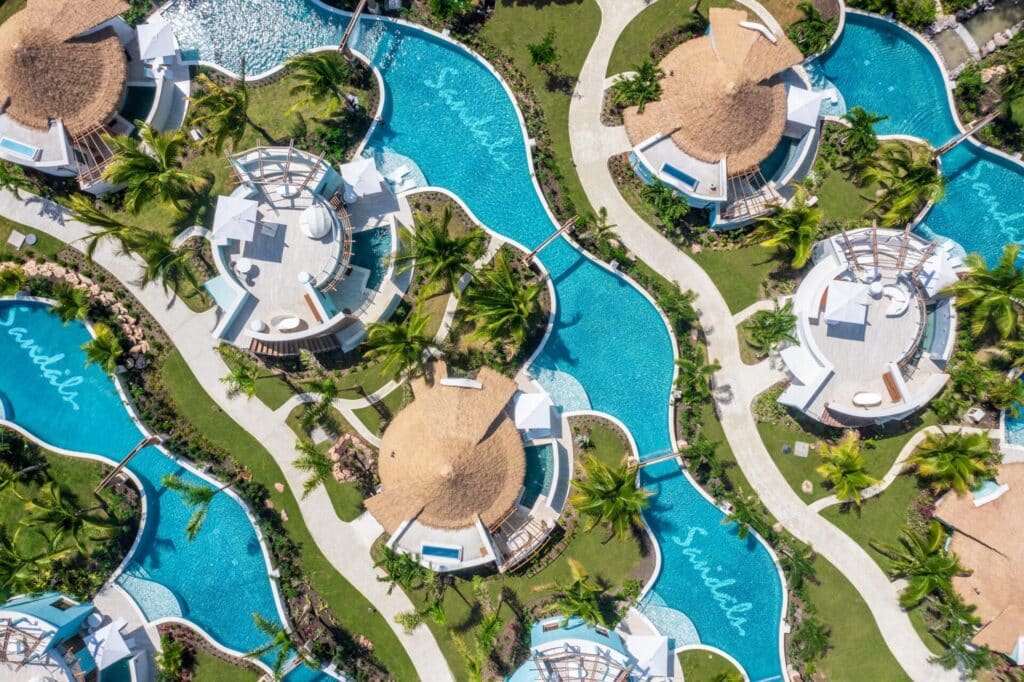
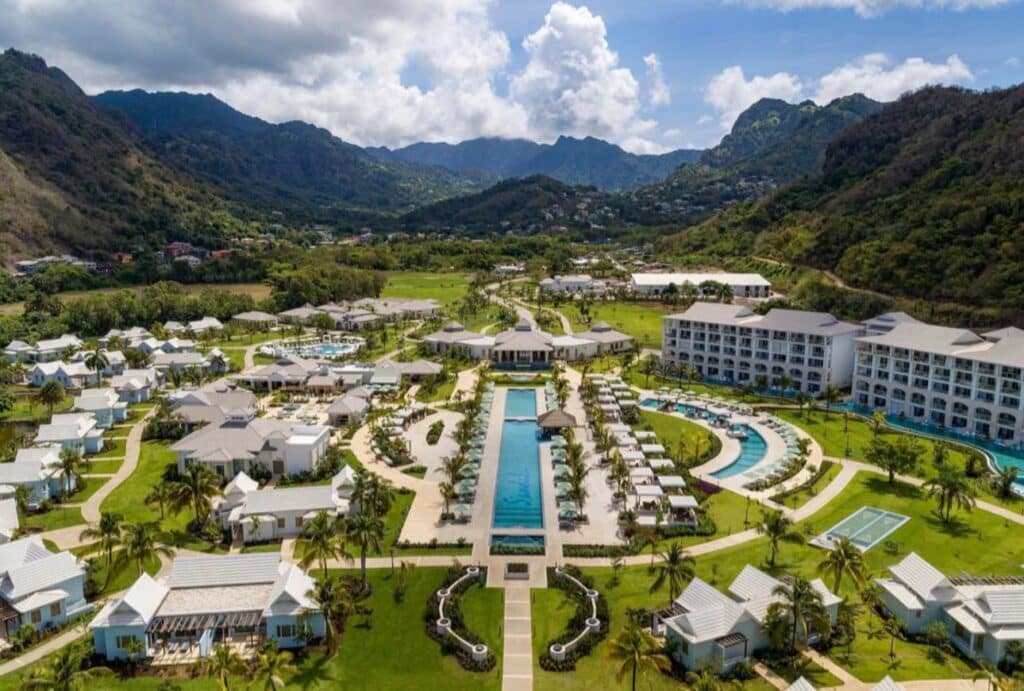
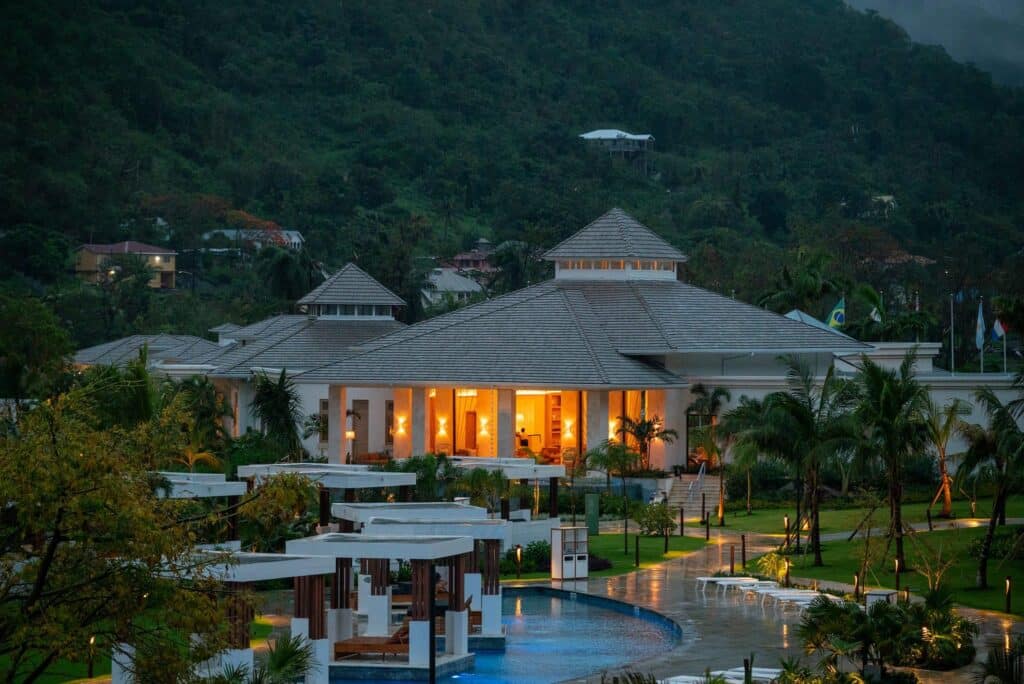
Located in a discreet bay in the south-west of the island, the Sandals resort blends into a largely unspoilt landscape. The relief, vegetation and proximity of a small river provide a setting where the architecture blends into the environment rather than seeking to dominate the site. The concept is based on a simple vision: to offer an upscale experience without upsetting the natural balance of the site.

The resort is distinguished by its water villas, suites with personalized services, Caribbean and international-inspired restaurants and wellness areas. Travelers will find a tranquil atmosphere, far from dense tourist areas.

View of Sandals Saint Vincent, voted Best All-Inclusive Resort 2025
©Rosmond J Archibald.

Why does Sandals stand out at the Travvy Awards 2025?

The recognition Sandals received at the Travvy Awards was based on several criteria observed by the jurors: the quality of the infrastructure, the consistency of the experience offered, the level of service, traveler feedback and innovation in the all-inclusive offer.

In the case of Saint-Vincent, all the elements converge towards a masterful approach to luxury hotels. The restaurants showcase Caribbean cuisine using island products, the communal areas feature lightweight construction, and the Learn-to-Dive diving program helps guests discover the island’s seabed in the best possible conditions. The resort also stands out for its ability to offer personalized luxury without creating too strong a break with the island ecosystem.

View of the pool at Sandals Saint Vincent, voted Best All-Inclusive Resort 2025
©Sandals Resorts
View of the pool at Sandals Saint Vincent, voted Best All-Inclusive Resort 2025
©Sandals Resorts
View of the pool at Sandals Saint Vincent, voted Best All-Inclusive Resort 2025
©Rosmond J Archibald

A real impact on tourism in Saint Vincent and the Grenadines

The Group’s arrival in Saint-Vincent has led to renewed interest in the destination, often referred to as the “Sandals effect” by regional tourism players. Air links have been strengthened, excursions have been diversified, and the local hotel sector is benefiting from a new dynamic.

This international distinction helps to consolidate this progress. It places the archipelago in the category of sought-after destinations for a top-of-the-range all-inclusive stay, while highlighting a development model based on a balance between comfort, landscape and authenticity. For tourism professionals in the Caribbean, the success of the Saint-Vincent resort shows that there is a place for hotel projects that do not distort their immediate environment.
View of Sandals Saint Vincent, voted Best All-Inclusive Resort 2025
©Sandals Resorts

A strong signal for the Group in the region

For Sandals Resorts, this recognition is part of a broader strategy: to consolidate its presence in the Caribbean while renewing its quality standards. The St. Vincent resort plays an important role in this evolution, marking one of the group’s most recent developments. Its international distinction confirms the relevance of a positioning more focused on nature, tranquility and a tailor-made experience.

The Travvy Awards 2025 reinforce the resort’s legitimacy in the Caribbean world of upscale tourism. The brand has demonstrated its ability to evolve with travelers’ expectations, while preserving the uniqueness of the territories in which it operates.

The election of Sandals de Saint-Vincent to the title of Best All-Inclusive Resort 2025 is an essential moment for the destination and for the group. It highlights a resort where luxury hotels find their place in a preserved environment, and where the Caribbean is shown in a more authentic light. For Saint-Vincent, this distinction confirms a trend that has already begun: that of an archipelago that is gradually asserting itself as one of the region’s most promising destinations.

View of Sandals Saint Vincent, voted Best All-Inclusive Resort 2025
©Sandals Resorts
View of Sandals Saint Vincent, voted Best All-Inclusive Resort 2025
©Sandals Resorts
View of Sandals Saint Vincent, voted Best All-Inclusive Resort 2025
©Sandals Resorts

The OECS continues its regional modernization with a landmark initiative in Saint Lucia: the commissioning of automated kiosks at the country’s two main airports. A decisive step towards smoother, more technological and more secure border management in the Caribbean.

A forward-looking regional project

The OECS Commission (Organization of Eastern Caribbean States) has handed over ten self-service kiosks to Saint Lucia: eight at Hewanorra International Airport (HIA) and two at George F. L. Charles International Airport. This state-of-the-art equipment enables travellers to complete entry formalities themselves, reducing waiting times and congestion in arrival halls.

This operation is part of the OECS Border Management Improvement Program, financed by the European Union through the Regional Integration Through Growth Harmonisation and Technology (RIGHT) program. This partnership illustrates the regional organization’s determination to strengthen cooperation between its member states, while relying on technology as a lever for efficiency and security.

OECS
©OECS

Automated kiosks for a better passenger experience

With this installation, Saint Lucia becomes a concrete example of digital transformation at the service of tourism. The new automated kiosks scan passports, capture fingerprints and speed up data verification, while maintaining a high level of security.

The aim is twofold: to facilitate travel for the region’s nationals, particularly those from CARICOM and the OECS, and to strengthen the country’s ability to identify and filter high-risk passengers. This intelligent approach illustrates the balance the region is seeking to strike between opening up tourism and tightening controls.

OECS
©OECS

Strong words from Caribbean leadership

At the official handover ceremony at Hewanorra International Airport, OECS Director General Dr Didacus Jules emphasized the strategic significance of this development:

“As global tourism becomes more competitive, travelers are looking not only for beautiful destinations, but also for an efficient, seamless and secure entry experience.”

Dr Didacus Jules emphasized that modernizing ports of entry is an essential pillar for supporting the economic growth of member states and reinforcing the international perception of an organized, technological and welcoming Caribbean.

OECS
©OECS

For his part, Saint Lucia’s Minister of the Interior, Crime Prevention and Persons with Disabilities, Hon. Jeremiah Norbert, praised the investment:

“To maintain the global competitiveness of our tourism sector and meet security challenges, efficient border management systems are essential. They must deny entry to at-risk passengers while offering smooth passage to legitimate travelers.”

These declarations reflect a shared vision: to make the OECS area a model of harmonized regional management, where technological innovation is integrated with the imperatives of sovereignty and mobility.

OECO
©OECS

A regional program already underway

The handover of ten kiosks in Saint Lucia comes just a few months after a similar initiative in Grenada, where six kiosks were delivered in March 2025. Eventually, the OECS Commission aims to equip all member states: Antigua and Barbuda, Dominica, Saint Kitts and Nevis, Saint Vincent and the Grenadines, Montserrat, as well as associated territories such as Anguilla and the British Virgin Islands.

Beyond infrastructure, the aim is to establish a framework for cooperation and data sharing to harmonize entry procedures, strengthen traceability and ensure better coordination between immigration services.

The initiative is thus aligned with the OECS’ regional priorities, which aim to accelerate digital transformation, boost sustainable tourism and improve regional connectivity. Technology becomes a strategic tool to accompany the mobility of Caribbean citizens while supporting economic competitiveness.

OECO
©OECS
OECO
©OECS

Saint Lucia, showcase of a new Caribbean era

For Saint Lucia, this partnership with the OECS and the European Union symbolizes a major step forward. The island is reinforcing its image as a modern, welcoming destination, with infrastructures that meet international standards. The automation of entry points is set to reduce waiting times, improve visitor satisfaction and optimize the management of tourist flows – a crucial issue for a country where tourism accounts for over 60% of GDP.

But beyond the immediate gain, this initiative reflects the political will to place Saint Lucia on a regional trajectory of digital integration. By relying on the structure and coordination of the OECS, the island benefits from a common framework of expertise, financing and training, while contributing to the construction of an interconnected Eastern Caribbean.

OECO
©OECS

Towards intelligent regional connectivity

OECS is demonstrating its ability to combine vision, financing and execution in projects with a tangible impact. The installation of these terminals is more than just a technological gesture: it symbolizes the growing power of a region that is modernizing its infrastructure, reinforcing safety and making mobility more fluid.

At a time when competition between tourist destinations is intensifying, this modernization positions the Eastern Caribbean in a strategic niche: that of an integrated, safe and technologically advanced area.

By uniting its members around tangible initiatives, the OECS is once again asserting its role as a regional driving force, in the service of a more efficient, more connected and resolutely forward-looking Caribbean.

OECO
©OECS
OECO
©OECS
OECO
©OECS
OECO
©OECS

The Caribbean is facing growing environmental pressure from the massive arrival of sargassum: brown seaweed that washes up on the coast in large numbers, weakening coastal ecosystems and affecting fishing, tourism, public health and the daily lives of island communities. It is against this backdrop that the SARSEA – Sargassum Regional Strategies for Ecosystem-based Actions project was officially launched on October 28, 2025 in Saint Lucia, marking a turning point for regional management of this challenge.

A structuring framework and committed partners

Financed by the Agence Française de Développement (AFD) and implemented by Expertise France in partnership with the Commission of the Organization of Eastern Caribbean States (OECS), the SARSEA project offers the states concerned a framework for cooperation, knowledge and action.

The SARSEA project will focus on a number of key areas:

  • – Strengthen regional cooperation on Sargasso planning and management, to improve political coordination and international visibility of the phenomenon.
  • – Support small island states – notably Dominica, Grenada, Saint Lucia and Saint Vincent and the Grenadines – in implementing integrated sargassum management and recovery initiatives, adopting a circular and sustainable approach.
  • – Support regional scientific cooperation to better understand the phenomenon, anticipate its effects and guide management strategies.
  • – Integrate the gender approach into all Sargasso-related policies and actions, to ensure an inclusive and equitable response.
SARSEA
©OECS

The launch: a key moment for dialogue

The opening ceremony in Saint Lucia was attended by governmental, institutional and scientific representatives from all over the Eastern Caribbean. Among them were the French Ambassador to the Eastern Caribbean, Barbados and the OECS, Marie-Noëlle Duris, and the French Ambassador for regional cooperation in the Atlantic zone, Arnaud Mentré.

Dominica stressed the need for a coordinated, multi-level approach to Sargassum management, citing the role that each island can play in a value chain adapted to its capabilities. Saint Lucia reaffirmed its commitment to playing an active part in this collective response. Grenada, for its part, put forward several priorities: the creation of a regional testing center, the implementation of a grounding monitoring system, a harmonized collection mechanism and a strengthening of sanitary monitoring.

During the event, a partnership protocol was signed between Expertise France and the OECS Commission, reinforcing the institutional framework for regional action. Round tables addressed the national visions of partner countries, followed by the challenges and opportunities of regional cooperation in Sargasso management. The afternoon was devoted to a presentation of the project strategy and a coordination meeting of partners. The following day, participants took part in a collective scientific workshop led by the Institut de Recherche pour le Développement.

SARSEA
©OECS
SARSEA
©OECS

Towards a shared Caribbean strategy

The SARSEA project aims to consolidate a network of public, private and scientific players in the region, with a view to pooling skills, data and best practices. The objective of the SARSEA project is clear: to improve preparedness and response to Sargasso groundings, while strengthening the resilience of coastal territories.

Under the SARSEA project, although four states will benefit directly from the project, all twelve OECS member states will be able to take advantage of the lessons, tools and best practices that emerge. This reinforces the regional and inclusive dimension of the action.

SARSEA
©OECS
SARSEA
©OECS

Why is this project so important?

Massive sargassum groundings in the Caribbean are not an isolated phenomenon: they disrupt coastlines on a daily basis, affect people’s health (toxic gas emissions during decomposition, respiratory problems), weaken marine ecosystems (seagrass beds, corals, mangroves) and threaten key economic sectors such as fishing and tourism.

In this context, fragmented or national management alone is no longer enough. The phenomenon crosses borders, currents and ecosystems. The SARSEA project proposes a coordinated, sub-regional response based on robust science.

Future milestones

  • – Structuring integrated value chains around sargassum: from collection to valorization (possibly into bioproducts, fertilizers, etc.).
  • – Set up harmonized monitoring systems for strandings, collection and sanitary analysis.
  • – Deployment of concerted scientific actions to fill knowledge gaps and guide better-adapted public policies.
  • – Promoting women’s participation and gender mainstreaming in all phases of action.
  • Dissemination of project feedback, tools and best practices to all OECS member states.
SARSEA
©OECS
SARSEA
©OECS

The launch of the SARSEA project marks an essential step in the regional mobilization against the impact of sargassum in the Eastern Caribbean. By combining political, scientific, technical and inclusive cooperation, the island states now have a structured framework for tackling this complex phenomenon. The SARSEA project does not replace national or local work: it amplifies and structures it, giving it scope and resources. With this new impetus, the prospect of concerted, better-informed and sustainable management of sargassum is taking shape in the region.

October 27, 1979 marked a fundamental milestone in Caribbean history: on that day, the archipelago of Saint Vincent and the Grenadines officially became a sovereign state. The independence of Saint Vincent and the Grenadines was not the result of a simple succession of dates, but the culmination of a long, complex and meaningful process: from indigenous resistance to colonization, then from partial autonomy to full sovereignty. Here, we take a look back at the milestones of this emancipation, the inaugural challenges and the legacy still alive today.

A tumultuous past

Before the arrival of Europeans, the main island of St. Vincent was inhabited by Amerindian peoples – notably the Arawak and then the Caribs. From the XVIIIᵉ century onwards, France and Great Britain fought over the archipelago. In 1763, under the Treaty of Paris, Great Britain obtained control of Saint-Vincent, then France took it back in 1779, before London regained it definitively in 1783 via the Treaty of Versailles.

During this period, indigenous populations and maroon Africans resisted: the “Garifuna”, a crossbreeding of Amerindians and Africans, became a symbol of rejection of colonial domination. The final insurrection of the Black Caribs in 1795-96 led to the deportation of thousands of them to the island of Roatán, off the coast of Honduras.
Economically, the colony focused first on sugar plantations, then on bananas in the XXᵉ century, an inherited structure that the Independence of Saint Vincent and the Grenadines would gradually transform.

Saint Vincent and the Grenadines
©Encyclopædia Britannica, Inc.

Towards political autonomy

The XXᵉ century saw an acceleration in demands for self-determination. In 1951, the colony granted universal adult suffrage, opening the political field to the entire population. In 1969, Saint Vincent and the Grenadines was granted the status of a “state associated” with Great Britain: it managed its internal affairs, while defense and foreign affairs remained under British control.
During this period, important political figures emerged, notably Robert Milton Cato, who became the first independent Prime Minister and laid the institutional foundations for the independence of Saint Vincent and the Grenadines.

Saint Vincent et les Grenadines
©Black Canadian Veterans Stories
Saint Vincent et les Grenadines
©Marlon Bobb
Saint Vincent et les Grenadines
©Exploring Caribbean history

Independence Day

On October 27, 1979, Saint Vincent and the Grenadines officially gained independence from Great Britain. The event marked the birth of an independent nation, and its status as the last of the Windward Islands to take this step. A new constitution came into force, establishing a democratic parliament, and the country remained a member of the Commonwealth. The independence of Saint Vincent and the Grenadines thus became the foundation of modern national construction, combining historical continuity with the desire for emancipation.

The challenges of a young nation

This accession did not mean, however, that the challenges would disappear. The small island nation faced several handicaps: a fragile economy, mainly dependent on banana exports, a still limited infrastructure, and constant exposure to natural hazards (volcanoes, cyclones).
In April 1979, a few months before independence, the volcano La Soufrière erupted, causing evacuations and agricultural losses: a strong symbol that the Independence of Saint Vincent and the Grenadines had to be won in a demanding and uncertain context.
One of the major challenges was to diversify the economy, improve public services (health, education) and consolidate the institutional framework to strengthen governance and national resilience.

Saint Vincent and the Grenadines
©Searchlight SVG

Review and legacy after 46 years

Forty-six years after its proclamation, the Independence of Saint Vincent and the Grenadines remains a pillar of national identity and a landmark for its diplomacy, culture and popular pride.
Culturally, the archipelago is asserting a strong Caribbean identity: the English language coexists with Creole traditions, and the Garifuna heritage is gaining increasing recognition.
Politically, the country has established a stable democratic system, despite tensions linked to social cohesion and governance. The election of Ralph Gonsalves and his ULP party since the 2000s illustrates the institutional continuity that stems from the independence of Saint Vincent and the Grenadines.

Economically, progress is visible in tourism and services, but vulnerability remains high: the economy remains sensitive to natural disasters and fluctuations in the agricultural market.
On the environmental front, the country is pursuing its energy transition and strengthening its climate resilience – a concrete extension of the aspirations of the Independence of Saint Vincent and the Grenadines, geared towards sustainability and regional cooperation.

Saint Vincent and the Grenadines
Saint Vincent et les Grenadines

The Independence of Saint Vincent and the Grenadines, celebrated every October 27, is not just a public holiday: it is the living memory of a nation that chose its destiny. Forty-five years on, the country continues to build on this heritage, asserting its voice in the Caribbean and defending solidarity between small island nations. In this, the independence of Saint Vincent and the Grenadines remains a symbol of dignity, resilience and hope for the entire region.

A miniature island with great character

Lost between Canouan and Union Island, Mayreau is the smallest inhabited island in Saint Vincent and the Grenadines. Fewer than 300 inhabitants live here, to the rhythm of the wind and the sea. Accessible only by boat, Mayreau has no airport, giving it a rare charm in the contemporary Caribbean: that of an unspoilt territory on a human scale.

Here, everything seems measured. Time, distance, gestures. A single village, Old Wall, clings to the hillside. Inhabitants cross paths with kindness, children play in the alleys, and in the evening, the golden light stretches out to sea. The island’s atmosphere is one of simplicity that cannot be imitated.

Mayreau
Mayreau
Mayreau

An exceptional geography

Despite its small size – just 4 km² – Mayreau boasts an astonishingly rich geography. The island forms a gentle relief, alternating hills, beaches and seagrass beds. From the summit, near the Divine Mercy Catholic Church, the panorama is breathtaking: a string of turquoise islets form the Tobago Cays, a marine sanctuary world-famous for its translucent waters and protected coral reefs.

This viewpoint, one of the most spectacular in the Caribbean, symbolizes the island’s uniqueness: a tiny island that opens up views of infinity. The view extends over shades of blue and green that change with the day. The ever-present wind also seems to be part of the scenery, like a breath linking sea and land.

Mayreau
Mayreau

A living marine heritage

Life in Mayreau is inextricably linked with the sea. Artisanal fishing remains an essential activity: fish, lobster, lambis and sea urchins feed the local cuisine and form part of trade with neighboring islands. Early in the morning, the colorful boats leave the bay of Saline or Salt Whistle, gliding on the still calm sea.

The locals know every current, every cove, every season. Their relationship with the sea is not touristy, it’s vital. The oldest still tell of journeys between Grenada, Bequia and Saint-Vincent to sell fish or trade salt. This know-how, handed down from generation to generation, remains at the heart of the island’s identity…

Some of the most beautiful beaches in the Caribbean

Mayreau’s beaches are among the most remarkable in the archipelago. Salt Whistle Bay, to the north, forms a perfect curve between two seas: on one side, the calm waters of the lagoon; on the other, the waves of the Atlantic. This site, often mentioned in nautical guides, attracts sailboats who anchor at a respectful distance, aware of the unique character of the place.

Saline Bay, larger and more open, welcomes ferries and fishermen. This is where daily life is concentrated: children bathing, boats leaving and returning, discussions in the shade of almond trees. Each of Mayreau’s beaches has its own atmosphere – one for contemplation, one for movement, all for emotion.

Mayreau
Mayreau

Authenticity on a human scale

In Mayreau, there is only one main road. It links Saline Bay to the top of the village, winding through the hills to the Divine Mercy church. Life is concentrated on this modest road: a few bars, a small market, brightly painted houses and the occasional hand-painted sign indicating a family restaurant.

The inhabitants are naturally kind and live in a local economy. Electricity comes in part from solar panels, accommodation is small and tourism is respectful. Nothing is standardized here. You come for the essential: the sea, the light, the people.

This sobriety is not an absence, but a strength. It makes Mayreau a place where every visitor feels invited to slow down, to walk, to listen. In the evening, sounds mingle: the lapping of the water, the music of a local bar, the wind in the palm trees. It’s a gentle symphony that never completely dies away.

A balance between tradition and sustainability

Like many of the Grenadine islands, Mayreau has to reconcile its ecological preservation with its openness to the world. Water resources are limited, and residents are pragmatic in their approach: rainwater harvesting, rational waste management and solar power generation. This discreet model of sustainability makes the island a silent reference in the region.

Local authorities and the community work together to maintain this fragile balance: welcoming without altering, sharing without denaturing. Tourism is developed in a controlled manner, in keeping with the island’s culture. Visitors who set foot here quickly understand that the island is not an island of consumption, but one of transmission.

Mayreau
Mayreau

The inner Caribbean

Highlighting Mayreau is a reminder that in the heart of the Caribbean, there are islands that refuse to be caught up in the frantic rush of the modern world. Here, beauty doesn’t need to shine brightly to be seen. It’s in the details: a sunrise over Salt Whistle, a child’s smile at the market, a boat slowly pulling away towards the Tobago Cays.

Mayreau embodies this inner Caribbean, sensitive and sincere. A land where the sea is a companion, nature is a guide and silence is a language. In an archipelago often in a hurry, the island reminds us that true luxury is time.

Together for a radiant Caribbean, the Alliances Françaises become bridges between cultures, languages and territories.

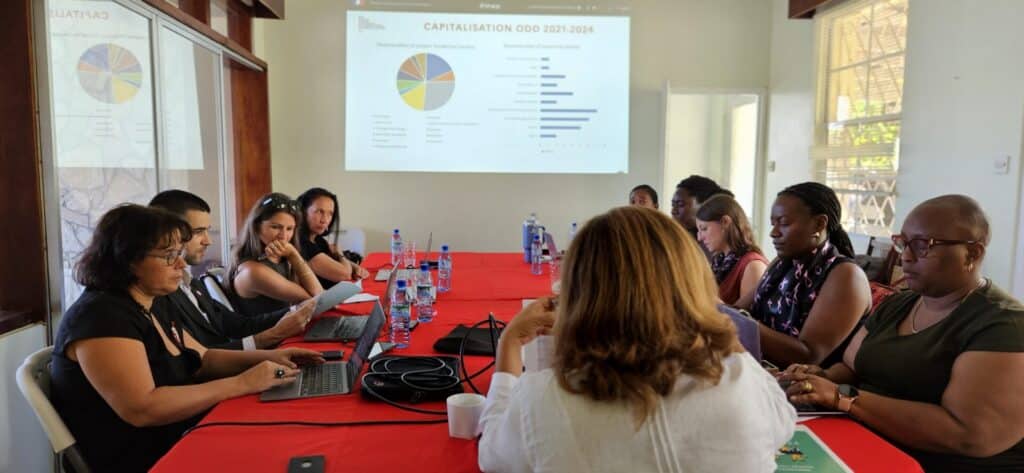
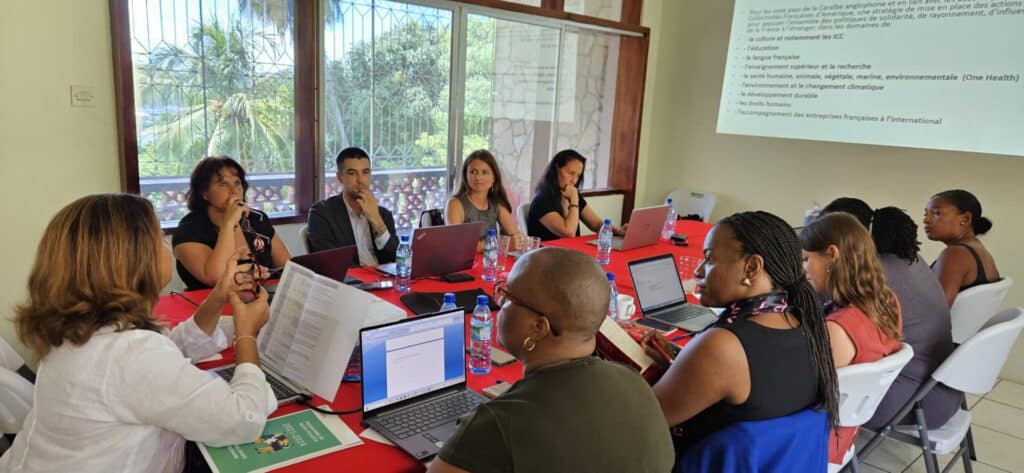
At the RÉZO seminar in Grenada, the directors and presidents of the Alliances Françaises of the English-speaking Caribbean met to strengthen cultural and linguistic cooperation in the region and define new common directions.

Supported by the French Embassy’s Service de Coopération et d’Action Culturelle (SCAC), which also took part in some of the discussions, the seminar was an opportunity to strengthen synergies between the Alliances Françaises network and consolidate dialogue with the SCAC, in a spirit of listening and collaboration.

Alliances Françaises
Suelin Low Chew Tung (President, AF Grenada), Aurélie GBEFFA (Director, AF Saint Lucia and Regional Coordinator), Ilona Fort-Gilbert (Director, AF Grenada) and Christiane Bourgeois (CORCAC)

Between exchanges, common strategies and innovative projects, this meeting outlined the contours of a more open, inclusive and modern French-speaking and multilingual Caribbean.

A key moment for an evolving network, serving a Caribbean that learns, shares and shines.

Alliances Françaises

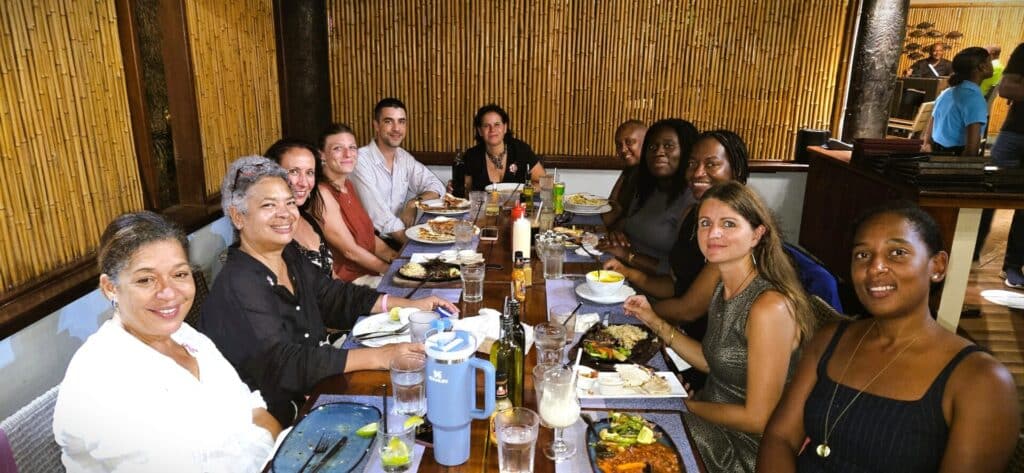
A meeting with a family flavour

Sometimes they’ve known each other for years, sometimes only through a screen. But from the very first minutes, the laughter, hugs and warmth of the reunion remind us that, in the Caribbean, the Alliances Françaises network is above all a human adventure.

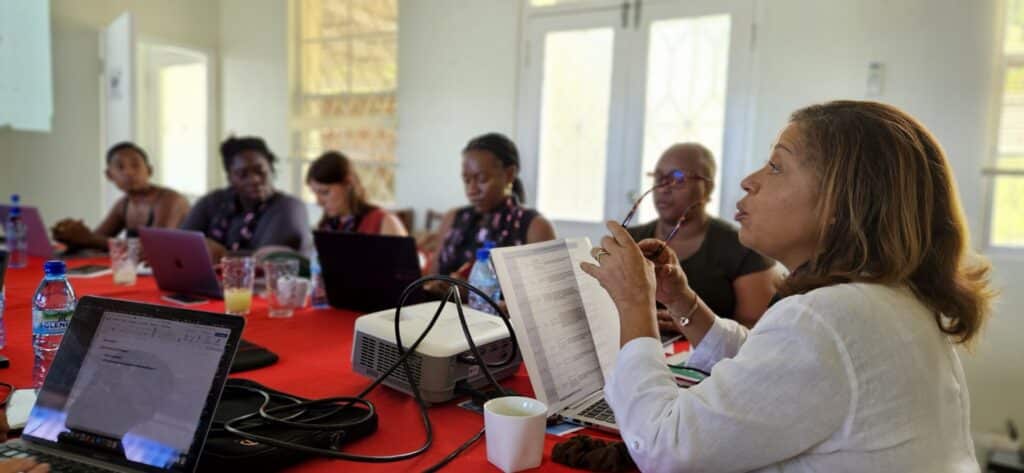
Over the course of three days, directors and presidents shared their experiences from country to country – from day-to-day challenges to local pride and a shared determination to build a stronger, more united and more visible network. In the room, diversity was evident in the accents, the backgrounds and the ideas. From Jamaica to Trinidad and Tobago, each voice brought its own nuance, its own experience, its own way of bringing culture and the French-speaking world to the heart of the territories.

Welcomed by Ilona Fort-Gilbert, Director, and Suelin Low Chew Tung, President of the Alliance Française of Grenada, participants spent several days exchanging ideas and reflections in an atmosphere that was both productive and warm.

Alliances Françaises
Suelin Low Chew Tung (left) and Ilona Fort-Gilbert (right) (Alliance Française de Grenade)
AF Team of Grenada - Dalia Barbour (Support Staff), Mathias Dorel (Honorary Consul of France), Ilona Forte-Gilbert (Director), Nafessah Abdullateef (Secretary of the Executive Committee), Suelin Low Chew Tung (President)

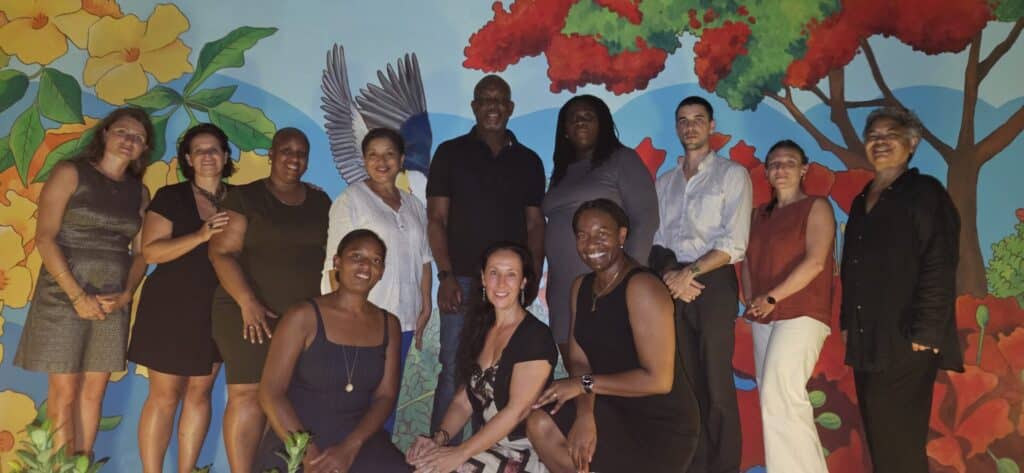
Around the table, the directors: Aurélie Gbeffa (Saint Lucia and regional coordinator of the Alliances Françaises of the Eastern Caribbean), Océane Gaillard (Barbados), Virginie Lemay (Suriname), Lucille Caulliez (Saint Christophe-et-Niévès), Cévinne M’Voula (Dominique), Anyka Batista (Trinidad and Tobago), Ilona Forte-Gilbert (Grenada), Déborah First-Quao (Guyana) and Clovis Lemée ( Jamaica), as well as Christiane Bourgeois (CORCAC – Saint Lucia) and Suelin Low Chew Tung (President – Grenada).

Alliances Françaises

Joining them by videoconference were the presidents: Charlene White-Christian (Dominica), Ruben Del Prado (Suriname), Danielle Parkinson (Trinidad and Tobago), Kara Daly (Saint Kitts and Nevis), Delphine Hadley and her successor Denvil Douglas (Saint Vincent and the Grenadines), and Stuart Defreitas, vice-president (Guyana).

christoane bourgeois
Alliances Françaises

During the discussions, Christiane Bourgeois, Regional Counsellor for Cooperation and Cultural Action (Conseiller Régionale de Coopération et d’Action Culturelle – CORCAC), Head of the Cultural and Cooperation Department (Service de Coopération et d’Action Culturelle – SCAC) of the French Embassy to the Eastern Caribbean, Barbados and the OECS, underlined the essential role of the Alliances Françaises in promoting French and Caribbean culture.

The Regional Counsellor for Cooperation and Cultural Action – CORCAC structures its action around cultural, educational, scientific and economic cooperation, seeking to link French priorities – culture, the French-speaking world, sustainability and human rights – to the specific needs of the countries of the English-speaking Caribbean. We believe that it’s not just the structures, but also the committed men and women on the ground who bring this open, supportive and creative French-speaking community to life.

“The Alliances Françaises are essential partners.”

The presence of Jean-François Hans, Geographical Delegate for Zone C at the Fondation des Alliances Françaises, reminded us from Paris of the importance of the network’s global cohesion.

Charter of values, governance tools, visual identity and support for local teams: the Foundation ensures that quality and ethics are shared across all five continents.

“A large Alliance must always reach out to a smaller one. That’s our collective DNA.”

This solidarity, the driving force behind the movement, takes on its full meaning in the Caribbean, where logistical and human challenges combine with cultural and linguistic richness.

A global Francophonie rooted in local realities

Founded in 1883, the Alliances Françaises network is now the world’s largest cultural network, with over 820 establishments in 135 countries.

In the English-speaking Caribbean, ten Alliances promote the French language and culture: Barbados, Saint Lucia, Dominica, Grenada, Jamaica, Saint Kitts and Nevis, Guyana, Saint Vincent and the Grenadines, Trinidad and Tobago and Suriname.

In 2024, they welcomed over 1,000 learners, delivered 9,000 hours of courses and organized 160 cultural events, bringing together over 7,000 participants.

These figures reflect a living, dynamic reality: the Caribbean Francophonie is not just an idea, it’s a daily presence in classrooms, galleries, festivals and the streets of island capitals. Francophonie thrives on exchanges, local initiatives, and the passion of those who keep the French language alive.

A network in motion: between vision and action

Projet Rézo

Driven by a shared desire to see the network evolve, the RÉZO project is a real driving force for the Alliances Françaises of the English-speaking Caribbean, and a way of thinking about the network differently: more collaborative, more agile, more visible.

Supported by the French Embassy’s Service de Coopération et d’Action Culturelle (SCAC), it aims to strengthen regional coordination, pool tools and professionalize teams. Over the course of the sessions, discussions highlighted a shared ambition: to harmonize practices, encourage pedagogical innovation and strengthen skills, while consolidating the place of the French-speaking world in plural linguistic environments.

Under the coordination of Aurélie Gbeffa, six areas of work were addressed:

  • Associative governance and transparency: strengthening internal management and communication with members.
  • Team training: consolidating skills and promoting regional mobility.
  • Certifications and educational quality: aligning training and evaluation standards across the network.
  • Digital transition: developing collaborative tools and shared digital resources.
  • Setting up RÉZO projects: creating and leading joint projects between Alliances.
  • Revitalizing media libraries: modernizing cultural spaces to better reflect today’s audiences and practices.

Each Alliance leaves with a personalized roadmap, proof of a shared commitment and a strong regional dynamic.

Micro-projects

In the same vein, the SCAC has reiterated its key role in supporting and facilitating micro-projects. These subsidies, allocated each year to local project leaders, are a concrete lever for the implementation of cultural, educational and civic initiatives throughout the region.

A virtuous mechanism that supports local creativity, while promoting training and autonomy for local players. Beyond the financial aspect, this initiative, a signature of the French Ambassy of Saint Lucia, reflects a form of close, human-centered diplomacy that fosters exchange and cooperation between Francophone and Anglophone territories.

From Saint Lucia to Dominica, from Trinidad and Tobago to Grenada, the micro-projects supported reflect the diversity of shared challenges: culture, education, the environment, inclusion and innovation. These are just some of the areas in which the Alliances Françaises, supported by the SCAC, are building bridges between societies and driving sustainable cooperation in the Caribbean.

Alliances Françaises

CARIFRAN

This strategy is also part of the regional dynamic of the CARIFRAN program, dedicated to the training and mobility of teachers of French in the Caribbean.

Implemented by the Organization of American States and funded by the French Embassy to the Eastern Caribbean, Barbados and the OECS to the tune of 453,000 euros, CARIFRAN is helping to strengthen a French-speaking educational community open to inter-island exchanges and linguistic cooperation. It embodies the complementary nature of the network’s educational, cultural and diplomatic activities.

Alliances Françaises

The strength of a fragile network

Over and above the discussions, workshops and decisions, the RÉZO seminar confirmed the vitality of a network in the throes of transformation. But it also served as a reminder of the fragility of an associative model that relies on commitment, passion and solidarity more than on substantial resources.

In the English-speaking Caribbean, as elsewhere, the Alliances Françaises carry out their activities with modest means but remarkable efficiency, and with a real desire to move forward together, thanks to the strength of their teams, their volunteer presidents and the constant support of the SCAC and the Fondation des Alliances Françaises.

Alliances Françaises
The directors of the Alliances Françaises with the Minister of Foreign Affairs, Hon. Joseph Andall

It’s this collective humanity, built on resilience and conviction, that makes the network unique: the ability to forge links, invent and reinvent ourselves, even in the face of uncertainty. And while cultural and linguistic cooperation can sometimes be a challenge, it is also a promise: that of a plural Caribbean, connected, proud of its diversity and capable of writing its future through dialogue between cultures.

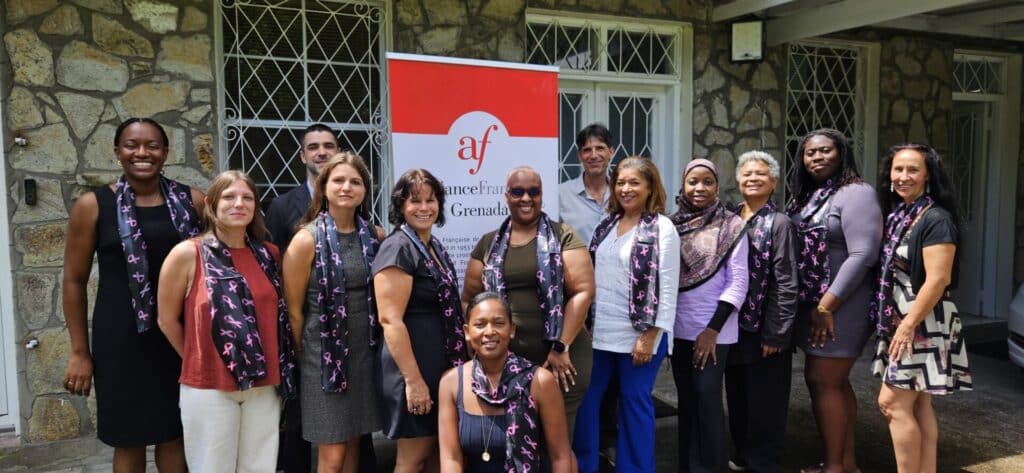
On behalf of the French Embassy, Christiane Bourgeois, advisor for cooperation and cultural action, presented the directors of the Alliances Françaises in the Caribbean with scarves, bracelets, and pins in the colors of Pink October, symbols of commitment and solidarity in the fight against breast cancer.

Cooperation between CARICOM member states has taken on a new dimension since 1ᵉʳ October 2025. Barbados, Belize, Dominica and Saint Vincent and the Grenadines have officially lifted barriers to the movement of their citizens. These four nations have launched an unprecedented agreement that allows their nationals to live, work and settle freely within this Caribbean space without work permits. A strong signal for the construction of a more united and supportive region.

A founding agreement for free regional mobility

Launched under the name “Enhanced Cooperation in Free Movement”, this commitment was ratified by heads of government at the 49ᵉ CARICOM summit in Montego Bay. For the first time, Caribbean countries are fully applying the principles of free movement already outlined in the Treaty of Chaguaramas.

Thanks to this agreement, nationals of Barbados, Belize, Dominica and Saint Vincent and the Grenadines can enter, leave, work and reside in the partner countries without a CSME certificate or special permit. They also enjoy limited but effective access to essential public services, including basic health care and primary or secondary education.

This cooperation between CARICOM member states is the first step in a wider project to unify the region in human and economic terms.

Cooperation between CARICOM member states
©CARICOM
Cooperation between CARICOM member states
©CARICOM

Strategic leverage for four complementary economies

  • – For Barbados, the challenge is clear: to cope with an aging population and a shortage of manpower. Bridgetown hopes to attract young workers from neighboring countries to support the key sectors of tourism, services and healthcare.
  • Belize, whose territory is sixty times larger than that of most Caribbean islands, is keen to encourage the settlement of its rural areas and boost its development. With a population of just 400,000 over 22,000 km², the country sees this cooperation between CARICOM member states as an opportunity to attract talent and boost productivity.
  • Dominica and Saint Vincent and the Grenadines, for their part, are focusing on cultural and historical links. In Kingstown, Prime Minister Ralph Gonsalves pointed out that this initiative also has an identity dimension:

“Our Garifuna brothers and sisters in Belize can come and spend more time here, work if they wish, and our citizens are now free to go there.”

Coopération entre États membres du CARICOM

A shared history, the foundation of integration

This cooperation between CARICOM member states is based on a common historical foundation. The four nations share a British colonial experience, a close linguistic heritage and a similar institutional structure. These affinities have facilitated the implementation of a mobility scheme unprecedented in the region.

A common verification mechanism has been set up to filter applications. The authorities retain the right to refuse entry to any individual representing a risk to public order or a financial burden for the host state. This clause aims to preserve the balance between openness and responsibility.

A laboratory for regional integration

The leaders consider this cooperation between CARICOM member states to be a pilot project. If the results are conclusive, it could be extended to other member countries as early as 2026. Discussions are already underway with Jamaica, Saint Lucia and Trinidad & Tobago to join the initiative.

According to regional economists, this cooperation between CARICOM member states represents a major opportunity to facilitate the exchange of skills and strengthen local value chains. By removing administrative constraints, it encourages professional mobility, entrepreneurship and the networking of Caribbean talent.

©CARICOM
©CARICOM

Sustainable social and human benefits

Beyond the figures, the human impact of this agreement is considerable. Thousands of families can now look forward to a future beyond their national borders. Access to employment, training and basic healthcare paves the way for real integration of Caribbean societies.
This cooperation between CARICOM member states also gives new meaning to the Community’s original project: to build a region of solidarity where citizens share the same fundamental rights. It embodies a new generation of regional policies based on trust and reciprocity.

Towards a united and inclusive Caribbean

The entry into force of this measure confirms the region’s determination to write a new page in its history. Cooperation between CARICOM member states goes beyond economic considerations: it symbolizes the political will to unite peoples and strengthen social stability.

By opening their borders to each other, Barbados, Belize, Dominica and Saint Vincent and the Grenadines are demonstrating that another Caribbean is possible: a Caribbean that is mobile, connected and aware of its common destiny.

An island apart in the Caribbean

Bequia, the second largest island of Saint Vincent and the Grenadines, covers an area of around 18 km². It may seem modest in size, but its history and identity make it a singular territory. As soon as you approach its shores, a direct link with the sea is revealed: fishing boats lined up on the sand, sailboats at anchor in Admiralty Bay, shipyards where wood crafts are perpetuated. Bequia is a land shaped by the sea, its riches and its trials.

The breath of maritime history

© Photos Wilfred Dederer © BTA 2025

Bequia’s memory is deeply linked to whaling. As early as the end of the XIXᵉ century, locals learned from American whalers how to hunt humpback whales. This practice, now classified by the International Whaling Commission as “aboriginal subsistence hunting”, remains limited to a quota of four catches per year, rarely reached. More than a resource, it is now a heritage that illustrates how an island community has built its survival on the sea.
At the same time, Bequia retains a tradition of wooden boat building. In the villages, carpenters still fashion boats by hand. Each boat is a collective work of art, reflecting skills handed down from generation to generation.

Bequia
© Photos Wilfred Dederer © BTA 2025
Bequia
© Photos Wilfred Dederer © BTA 2025

The power of nature and everyday life

The island’s landscapes are a mix of beaches, hills and viewpoints. Princess Margaret Beach, just a stone’s throw from Port Elizabeth, stretches out its blond sand bordered by almond trees. Further south, Friendship Bay opens its waters to the Atlantic, offering a livelier sea. Trails lead up to Peggy’s Rock, a peak that reveals the beauty of the surrounding Grenadines.
These landscapes are also the rhythms of daily life. Fishermen leave the bay at dawn and return laden with tuna, sea bream and lobster. The market comes to life afterwards, reflecting a way of life still centered on the sea and its resources.

Bequia
© Photos Wilfred Dederer © BTA 2025
Bequia
© Photos Wilfred Dederer © BTA 2025

A preserved island culture

Bequia
© Photos Wilfred Dederer © BTA 2025
Bequia
© Photos Wilfred Dederer © BTA 2025

With around 5,000 inhabitants, Bequia remains a community on a human scale. Musical traditions – steelband, reggae, calypso – accompany gatherings, while crafts express the local identity. Meticulously carved models of wooden boats tell of the island’s maritime past, and are on display even in the small stores of Port Elizabeth.
This attachment to the island’s heritage is also expressed in its gastronomy, which focuses on seafood. Each dish is a reminder of the balance between tradition and adaptation.

Bequia
© Photos Wilfred Dederer © BTA 2025
Bequia
© Photos Wilfred Dederer © BTA 2025

Port Elizabeth, an island crossroads

Port Elizabeth, Bequia’s modest capital, nestles at the head of Admiralty Bay. This natural harbor attracts fishermen, sailors and visiting yachts. For decades, it has been a renowned stopover for Caribbean sailing. Here, the liveliness of the anchorage contrasts with the tranquility of the lanes lined with colorful houses and small cafés. The island has not sought to become a mass destination: it favors a measured approach to tourism, based on close contact with the locals.

Bequia
Port Elizabeth. © Photos Wilfred Dederer © BTA 2025

Legacy and future

Bequia illustrates the dilemmas faced by many small Caribbean islands: preserving authenticity while securing an economic base. Controversial whaling is often the focus of debate, but it does not sum up the island. The future also relies on fishing, local agriculture, boating and handicrafts, all sectors that maintain a resilient economy.
This direction reflects a clear choice: to maintain a balance between openness to the world and respect for an identity forged by the sea.

A sensitive and human Caribbean

Bequia is not an island defined by its size or infrastructure, but by its maritime soul. Its landscapes, traditions and people make up a mosaic where every detail carries the weight of history and the hope of the future. On this island of the Grenadines, the sea is more than just a horizon: it is a memory, a resource and a promise.

Bequia
© Photos Wilfred Dederer © BTA 2025
Bequia
Bequia
© Photos Wilfred Dederer © BTA 2025
Bequia
© Photos Wilfred Dederer © BTA 2025
Bequia
© Photos Wilfred Dederer © BTA 2025
Bequia
© Photos Wilfred Dederer © BTA 2025