
IShowSpeed Caribbean Tour transformed a livestream tour into a global showcase for several Caribbean territories. In just a few weeks, beaches, markets, carnivals, popular neighborhoods, natural sites and street scenes were seen by millions of young Internet users. The result goes far beyond entertainment: it raises a central question for the Caribbean. How can viral exposure be transformed into lasting benefits for the territories visited?
A tour conceived as a global digital event
Announced as a tour of 15 Caribbean destinations, the IShowSpeed Caribbean Tour included Antigua and Barbuda, the Bahamas, Barbados, Dominica, the Dominican Republic, Grenada, Guadeloupe, Jamaica, Puerto Rico, Sint Maarten, Saint Kitts and Nevis, Saint Lucia, Saint Vincent and the Grenadines, Trinidad and Tobago and the US Virgin Islands. From the outset, the project did not resemble a conventional tourism campaign. It was an ongoing, unpredictable live event, driven by a very young and responsive community.
The most telling figure comes from the analysis published after the tour: over the period studied, IShowSpeed Caribbean Tour generated some 1.4 million new subscribers, 12.6 million engagements and an estimated conversational reach of 305.9 million. In other words, the Caribbean wasn’t just watched. It was commented on, shared, replayed, discussed and turned into a global topic on social platforms.


Territories propelled before a young audience
The livestream results show the scale of the phenomenon. The Dominican Republic leads the way with around 7.04 million views. The Dominica, Guadeloupe, Saint Kitts and Nevis and Sint Maarten block follows with around 6.87 million views. Trinidad and Tobago reached around 4.97 million, St. Lucia and St. Vincent and the Grenadines around 4.95 million, and Grenada around 4.32 million. These figures should be read with caution, particularly for the Dominican Republic, where warnings of artificial traffic have been mentioned. But even with this caveat, the order of magnitude remains exceptional for territories often absent from the world’s major digital narratives.
In Trinidad and Tobago, the tour got off to a highly popular start. The visit to Port-of-Spain reportedly attracted around 3,000 people and disrupted traffic around Tragarete Road. But the real impact came from the content on show: tassa, steelpan, cricket, mas, stickfighting, Queen’s Park Oval, Peter Minshall’s presence. Trinidad and Tobago was not reduced to a tropical setting. The territory was presented through its sounds, its gestures, its crowds and its lively relationship with the street.


Saint Lucia, the most measurable example
Saint Lucia offers one of the most interesting cases for measuring tourism impact. The Saint Lucia Tourism Authority reported that the livestream had attracted over 4.4 million viewers. Its General Manager, Louis Lewis, also reported an estimated return on investment of 77 to 1. This means that, for every dollar invested, the destination estimates that it has obtained media value equivalent to $77.
The passage showed Reduit Beach, Pigeon Island, Castries Market, Derek Walcott Square, the Pitons and Sulphur Springs. This choice of locations is important. It combines postcard, heritage, downtown, nature and local experience. In the IShowSpeed Caribbean Tour review, Saint Lucia thus appears as a territory that has tried to transform buzz into a structured visibility strategy.
Antigua and Barbuda: from direct to tourist route
Antigua and Barbuda also capitalized on the exhibition. The May 3 tour attracted over 2.5 million viewers on YouTube alone, according to data reported by the tourist board. The program featured Dickenson Bay, Hellsgate, stingrays, drag racing, Sir Vivian Richards Stadium, Carnival, Burning Flames, the Nyabinghi community, Ffryes Beach, the Antigua Black Pineapple and Barbuda.
Here again, the highlight is not just the number of views. It’s the way in which the region has been able to tell many different stories about itself: beach, sport, music, heritage, gastronomy, spirituality and sister island. IShowSpeed Caribbean Tour has shown that a livestream can become a tourist itinerary, provided that local players know how to transform it into legible, bookable and well-relayed offers.


Jamaica, between cultural power and Generation Z
Jamaica enjoyed massive exposure. The livestream from Kingston exceeded 2.8 million views, with a peak of 194,805 live viewers, 696,349 chat messages and 34,692 new subscribers. These figures are a measure of the attention generated by IShowSpeed’s visit to an area with an already strong cultural image.
The Jamaican challenge was different. The destination didn’t need to prove that it existed culturally. Reggae, dancehall, patois, athletics, gastronomy and street culture are already recognized the world over. But IShowSpeed Caribbean Tour put this power in front of a very young audience, used to consuming the world live, without waiting for institutional campaigns.


A turning point for Caribbean tourism
The partnership with Expedia confirms that this tour is more than just a creative phenomenon. The platform has named IShowSpeed “Official Travel Partner” and launched a space where fans can follow his travels, consult content and book stays, flights or activities inspired by his travels. This is probably one of the most important lessons to be learned from the review: livestreams are becoming a tool for inspiration, and then potentially for tourism conversion.
For the Caribbean, the results are clear. IShowSpeed Caribbean Tour offered visibility that few traditional campaigns can achieve with Generation Z. But visibility isn’t enough. But visibility is not enough. Territories will now have to capture this attention, improve their official content, make their experiences accessible online, better reference the places seen in the videos and involve local players in this new image economy.


The balance sheet is therefore powerful, but incomplete. The views are there. The conversations are there. The crowds were there. The question now is whether this exposure will generate travel, bookings, revenue for local communities and a stronger place for the Caribbean in the global digital imagination. Only then will IShowSpeed Caribbean Tour go from being a viral phenomenon to a useful moment for the Caribbean territories.
The results of the IShowSpeed Caribbean Tour are first and foremost digital. The tour gave several Caribbean territories worldwide exposure to a very young audience, very active on YouTube and social networks. The figures available speak of millions of views, millions of engagements and a very high conversational reach. For the Caribbean, the main impact is therefore in terms of visibility: places, street scenes, natural sites, markets, beaches and local cultural expressions have circulated massively online. On the other hand, the real economic impact must still be measured with caution, as there is as yet no complete official record of tourist bookings or revenue generated.
Several territories took advantage of the IShowSpeed Caribbean Tour, each in their own way. Saint Lucia stands out as one of the most structured examples, with official communication around the media ROI and locations shown during the live tour. Antigua and Barbuda also turned the visit into a tourist itinerary, highlighting beaches, culture, sport, gastronomy and heritage. Jamaica benefited from strong exposure to Generation Z, while Trinidad and Tobago made its mark with street culture, steelpan, carnival and cricket. The impact varies according to each region’s ability to follow up the buzz with a clear tourism strategy.
Yes, but only if Caribbean territories turn this visibility into concrete action. A livestream can create envy, give a more spontaneous image of a territory and reach audiences difficult to reach with traditional campaigns. But for the impact to last, the places seen in the videos need to be well referenced, the experiences easy to book, tourist offices need to publish appropriate content and local players need to be involved in the spin-offs. So the IShowSpeed Caribbean Tour has opened a door: it’s now up to Caribbean destinations to convert this global attention into travel, revenue and visible benefits for local communities.
In St. Vincent and the Grenadines, the Garifuna language could leave the circle of commemorative speeches and enter the classroom more clearly. At the 13th International Garifuna Conference, Prime Minister Dr Godwin Friday called for the language to be taught as an essential subject. The announcement touches a deep nerve: that of an Afro-Aboriginal memory long displaced, but never extinguished.
A highly symbolic political statement
The choice of location and subject is not insignificant. In Saint-Vincent and the Grenadines, to speak of the Garifuna language is to return to one of the founding territories of this history. This people, born of African and indigenous Caribbean encounters, carries a memory of resistance, exile and transmission that extends far beyond the borders of the city.
By placing the school at the center of his appeal, Dr. Godwin Friday isn’t just talking about a program to be added. He refers to education as a space where a language can once again become alive, useful, understood and proudly spoken. It’s a major difference between honoring a heritage once a year and giving it a regular place in children’s education.

A language that keeps more than words
The Garifuna language is not just a vocabulary to be protected. A language preserves ways of naming the sea, the land, kinship, plants, everyday gestures and stories passed down through the family. When it recedes, a whole memory system becomes less audible. This is why school can play a decisive role. A child learning the Garifuna language doesn’t just learn new words. They can also reconnect with a song, a place name, a family history, an ancient practice. Transmission then becomes more concrete, less dependent on a few specialists or one-off events.
For students, this approach can also turn pride into knowledge, by linking public ceremonies to family realities, local archives and the voices of elders who still keep the language alive today.


Worldwide recognition, but a future to build
UNESCO recognizes the Garifuna language, dance and music as Intangible Cultural Heritage of Humanity. The organization also points out that the Garifuna language belongs to the Arawakian group and has survived centuries of discrimination and linguistic domination. This international recognition gives special significance to the debate in Saint Vincent and the Grenadines.
But heritage listing is not enough to save a language. It can attract attention, support research and reinforce pride. It does not replace teachers, textbooks, teaching hours, adapted methods or opportunities to speak the language outside the classroom. The survival of the Garifuna language will therefore depend on concrete, long-term decisions.


From Saint Vincent to the Garifuna diaspora
This possible school turning point also resonates beyond the Vincentian archipelago. Garifuna communities can be found in Belize, Honduras, Guatemala and Nicaragua. In these territories, language, music and traditions continue to convey a strong identity, often weakened by migration, economic pressures and the domination of more powerful languages.
If Saint Vincent and the Grenadines moves forward on this front, it will send out an important signal. The country would no longer speak of the Garifuna language only as a historical heritage. It would treat it as a cultural skill to be passed on to new generations. This nuance changes everything: it moves memory from the museum to the classroom.


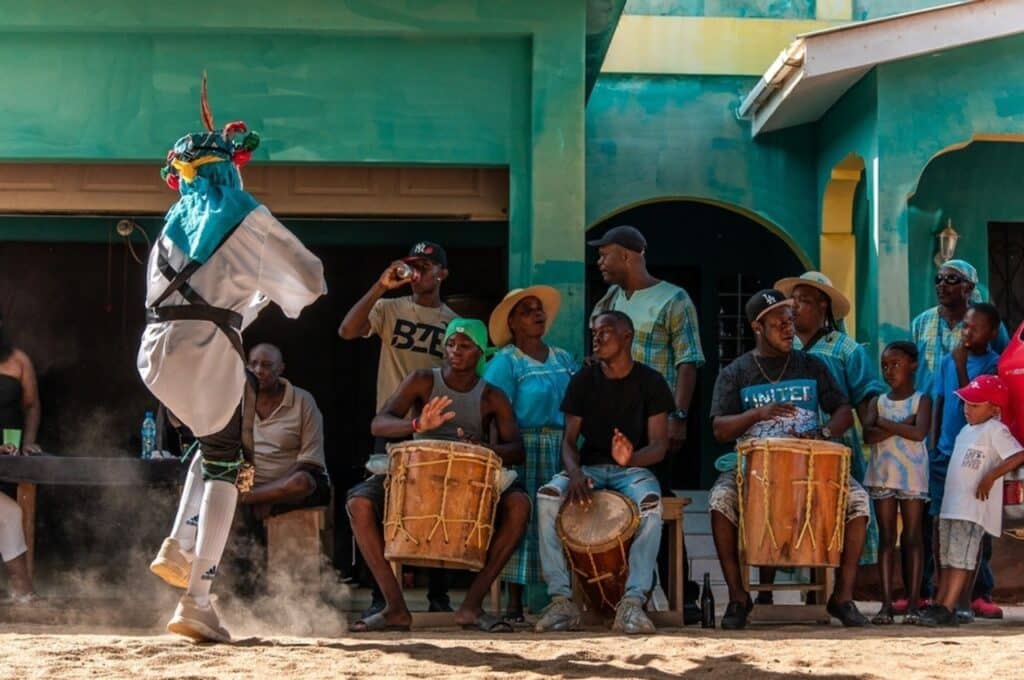
The challenge starts now
Caution is still called for. The Prime Minister’s call does not yet mean that a complete reform has already been implemented in all schools. The real test will come with the practical choices: which levels will be covered, who will train the teachers, what media will be used, what place will be given to speakers and memory keepers? These questions will determine the real strength of the project. A language cannot be repaired with a slogan. It is reinstated through use, patience and respect for the communities that use it.
If the Garifuna language becomes a permanent fixture in schools, Saint Vincent and the Grenadines will not only be teaching children a language. The country will give children a key to understanding an essential part of their history. And in this key, the whole Caribbean could recognize a common question: what remains of a people when its language is no longer transmitted?
The Garifuna language could be taught in the schools of Saint Vincent and the Grenadines to reinforce the transmission of an Afro-Aboriginal heritage linked to the country’s history. The issue is not just linguistic: it also concerns memory, identity and the role of the younger generations in preserving a culture that has long been under threat. By entering the classroom, this language could become a concrete tool of knowledge, pride and cultural continuity.
We must remain cautious: at this stage, we cannot claim that the Garifuna language is already compulsory in all schools in Saint Vincent and the Grenadines. What we are hearing today is a strong political call for it to be taught as an essential subject. For such a measure to become effective, concrete decisions will be needed: official curriculum, teacher training, teaching aids, timetable for implementation and a place for Garifuna speakers.
The Garifuna are a people of African and indigenous Caribbean heritage, with a history strongly linked to Saint Vincent and the Grenadines and several Central American territories. The Garifuna language is one of the major expressions of this identity. It carries stories, songs, place names, family knowledge and a collective memory. That’s why teaching it in schools would have a wider scope than simply learning the language: it would contribute to the transmission of an entire culture.
IShowSpeed Caribbean Tour opens a rare window on the Caribbean. The announcement was broadcast on April 20 on the American creator’s networks, with a live broadcast scheduled for April 25, 2026. The published list mentions fifteen destinations: Antigua and Barbuda, the Bahamas, Barbados, Dominica, the Dominican Republic, Grenada, Guadeloupe, Jamaica, Puerto Rico, Sint Maarten, Saint Kitts and Nevis, Saint Lucia, Saint Vincent and the Grenadines, Trinidad and Tobago and the US Virgin Islands. In the space of a few hours, this tour placed the region in an unusual position of global visibility.
IShowSpeed Caribbean Tour deserves attention for one simple reason: IShowSpeed gathers a gigantic audience. The Associated Press recalls that it surpassed 50 million subscribers on YouTube during its African tour in January 2026. At this scale, every move becomes a live event, picked up by other accounts and transformed into short sequences that circulate quickly. When an entire itinerary is devoted to the Caribbean, the territories, accents, landscapes and everyday customs enter the field of vision of an international audience.
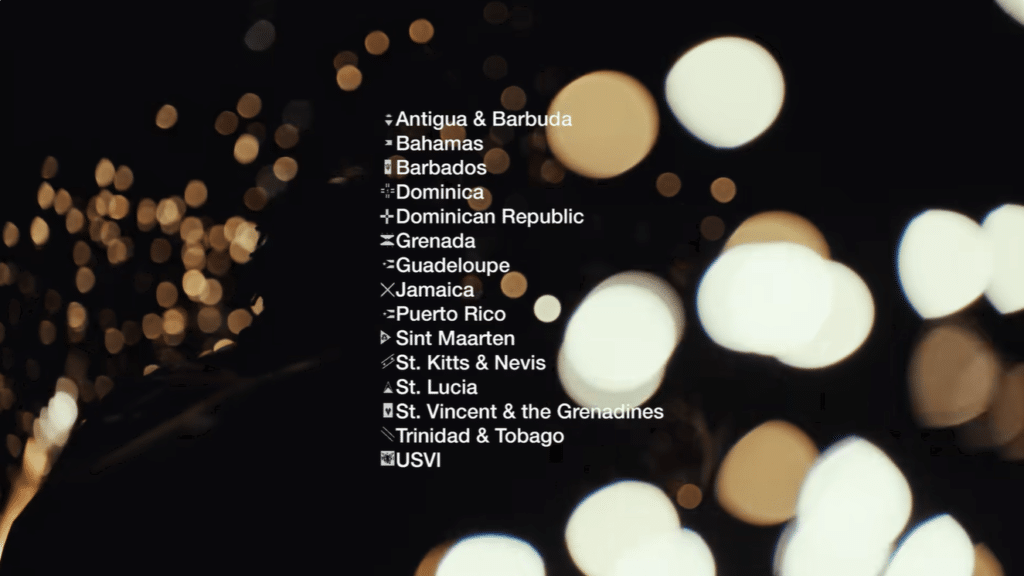
The Caribbean as a whole
The first strength of the IShowSpeed Caribbean Tour lies in the overall picture it produces. The list combines independent states and territories, English-, French-, Spanish- and Dutch-speaking areas. This juxtaposition reminds us that the Caribbean is a multiple region, crossed by different languages and heritages, while retaining deep links.
This regional reading corresponds to a historical reality. Human, musical, commercial, religious and family circulations have existed for centuries from one island to another. Borders have shaped distinct administrations and statuses. They have never erased exchanges. In a single announcement, the Caribbean appears as a legible space for millions of people who often perceive it in a fragmented way.
Visibility through the codes of the present
The format counts almost as much as the list of destinations. IShowSpeed is all about live action, improvisation, immediate reaction and massive sharing. Its audience follows less a program than a presence. This way of filming changes the nature of the exhibition. The viewer watches streets, beaches, markets, journeys, encounters and crowd scenes as they happen.
For the Caribbean, this exhibition has a special significance. Many of the region’s territories suffer from uneven visibility in the major media circuits. The best-known benefit from a well-established image. Others remain absent from global narratives, or reduced to a few clichés. The IShowSpeed Caribbean Tour can therefore play a useful role: showing a diversity of places and atmospheres to a young public that is building its vision of the world through platforms.


An opportunity for cultural and media players
IShowSpeed Caribbean Tour is also of interest to artists, organizers, local media and creators based in the region. A tour of this scale can highlight a dancer, a musician, a culinary tradition, an urban setting, a popular event or a local personality. It can also create connections between territories that rarely communicate at this speed.
However, the added value of IShowSpeed Caribbean Tour will depend on how these moments are accompanied. A viral image attracts attention for a few hours. Serious editorial work extends this interest. It provides reference points, recalls history, clarifies political and cultural contexts, and helps us understand what we’re seeing. This is an opportunity for the Caribbean to tell the story of its plurality with greater mastery.
A visible symbolic impact
It would be premature to announce any quantified tourist effects or immediate economic spin-offs. However, one thing is clear: the Caribbean is gaining a global presence in one of today’s most popular formats.
This is where IShowSpeed Caribbean Tour really comes into its own. IShowSpeed Caribbean Tour brings together in a single movement territories that are often commented on separately. It reminds us that the region possesses a cultural, visual and social force capable of capturing attention on a grand scale. For audiences unfamiliar with the area, it can open a first door. For those who are already familiar with it, it confirms that the Caribbean remains a major hotbed of creation, circulation and energy in the contemporary world.
IShowSpeed Caribbean Tour is a tour announced by American creator IShowSpeed across several Caribbean territories. Beyond the announcement itself, this tour is attracting attention for its media scope and the visibility it can offer the region as a whole.
IShowSpeed Caribbean Tour is attracting a lot of interest because IShowSpeed is one of the most followed creators in the world. When he travels, his videos, live broadcasts and excerpts shared on the networks quickly reach an international audience, giving this tour a much wider reach than a series of stopovers.
IShowSpeed Caribbean Tour is important because it shows the Caribbean as a visible, vibrant and connected regional space. The tour links several territories in a single narrative and reminds us that the region possesses a cultural, linguistic and social richness capable of attracting attention on a large scale.
Yes, IShowSpeed Caribbean Tour can have a real cultural impact. This type of tour can highlight local landscapes, sounds, accents, lifestyles, artists and moods. It can also encourage a new way of looking at the Caribbean, particularly among a younger audience who follow world news via digital platforms.
It’s still too early to accurately measure the impact of the IShowSpeed Caribbean Tour on tourism. On the other hand, this tour can already raise the profile of the Caribbean and feed the curiosity of a global audience. This media exposure can then benefit the territories if it is intelligently relayed by cultural, tourism and media players.
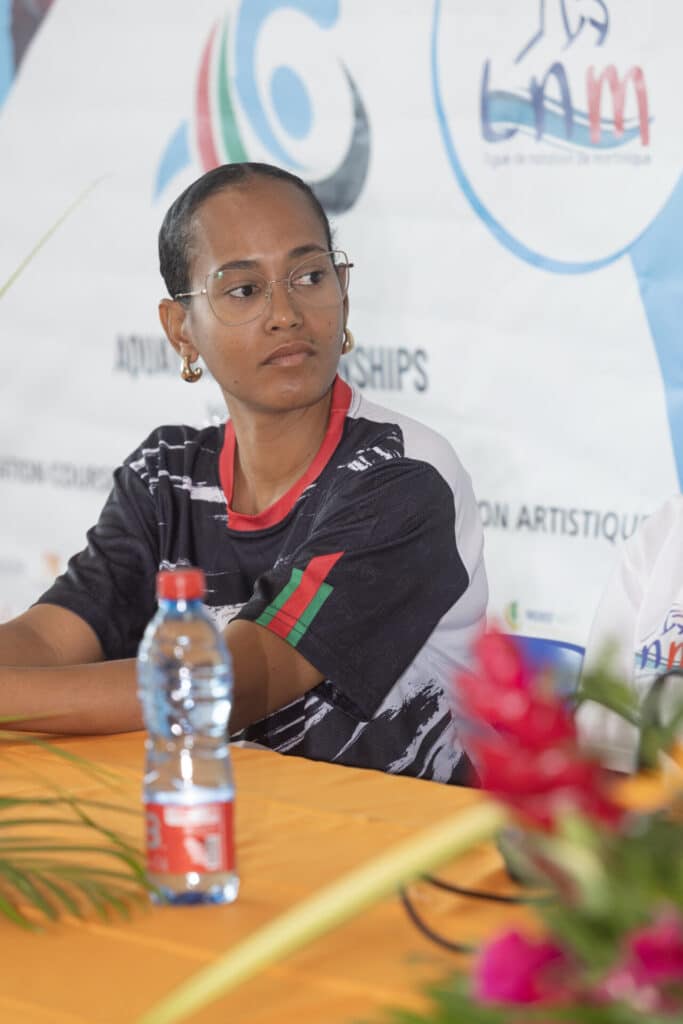
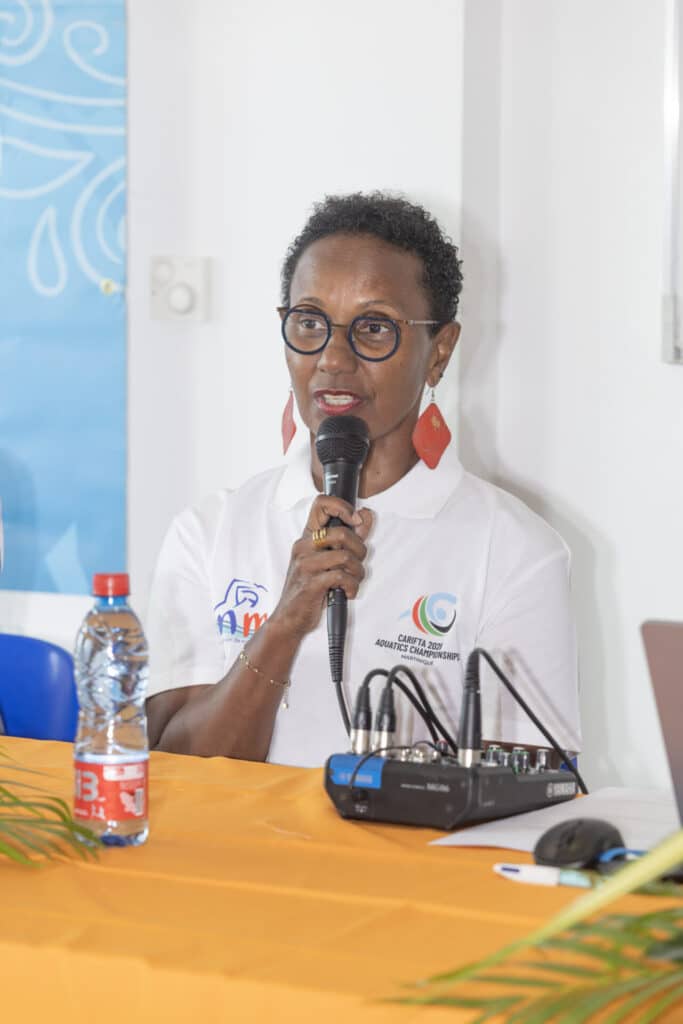
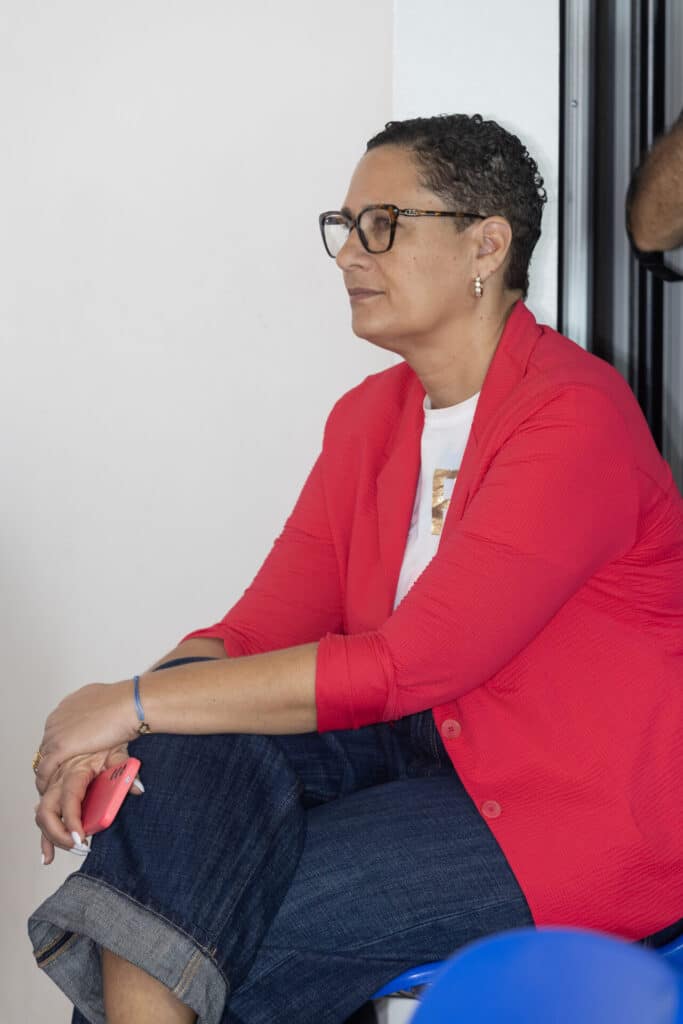
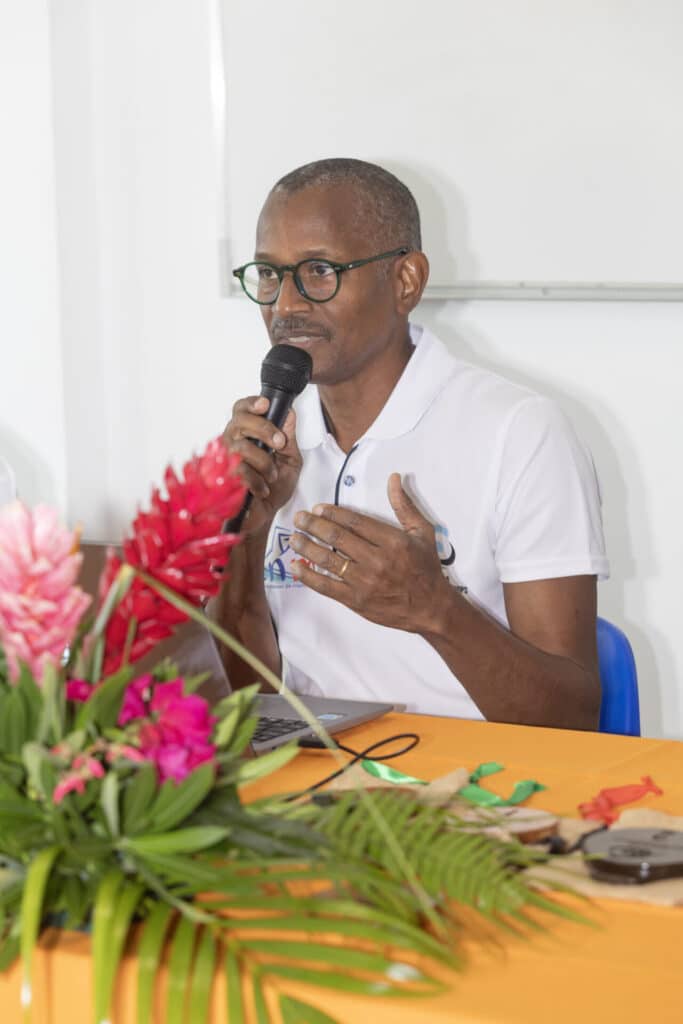
On Saturday March 28, at the Centre Aquatique Pierre Samot in Le Lamentin, the CARIFTA Aquatics Championships 2026 press conference was more than just an information meeting. Over the course of an hour and a half, organizers, athletes and partners presented much more than just the sporting program: from April 3 to 8, Martinique will host the 39th edition of the Caribbean’s leading junior aquatic event, ten years after the first edition was so memorable. Twenty-four nations. Three disciplines. A home territory that knows it.
A bid driven by collective memory
In 2024, at the Caribbean Aquatics Association Congress held in the Bahamas, two bids were put forward to host the 2026 CARIFTA Aquatics Championships: Saint Lucia and Martinique. The vote was clear-cut: some thirty votes for Martinique, ten for Saint Lucia.
Behind this result is a story. The 2016 edition, the first ever to be held on home soil, left its mark on the minds of all those who were there: coaches, delegation leaders, officials. In 2024, when it came time to vote, many still remembered that week.
"It was a beautiful edition, and one that will always be remembered."
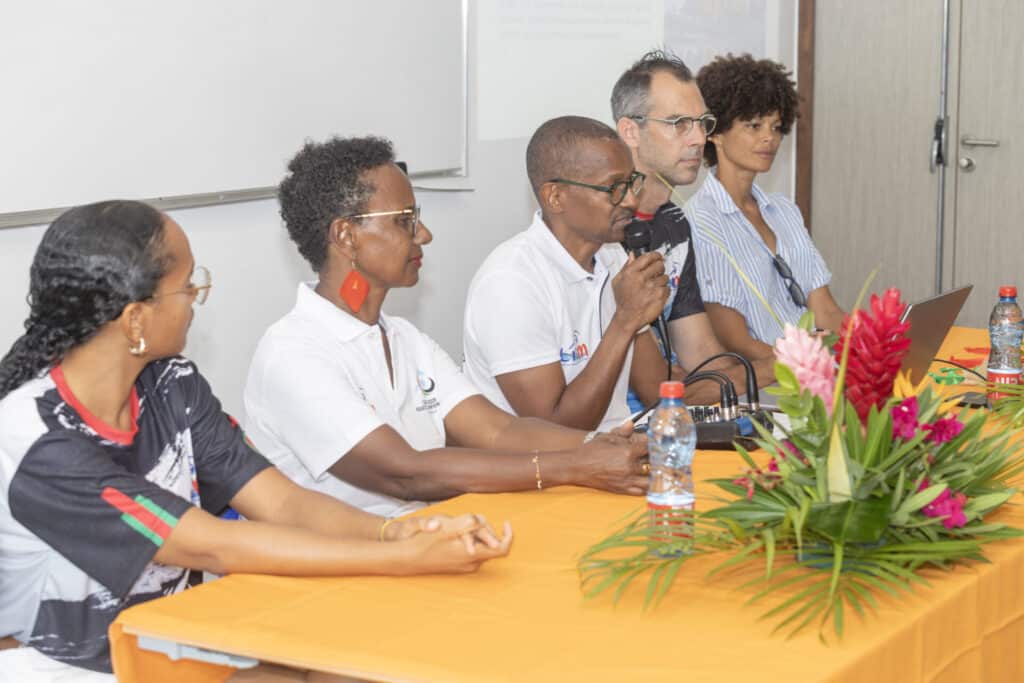
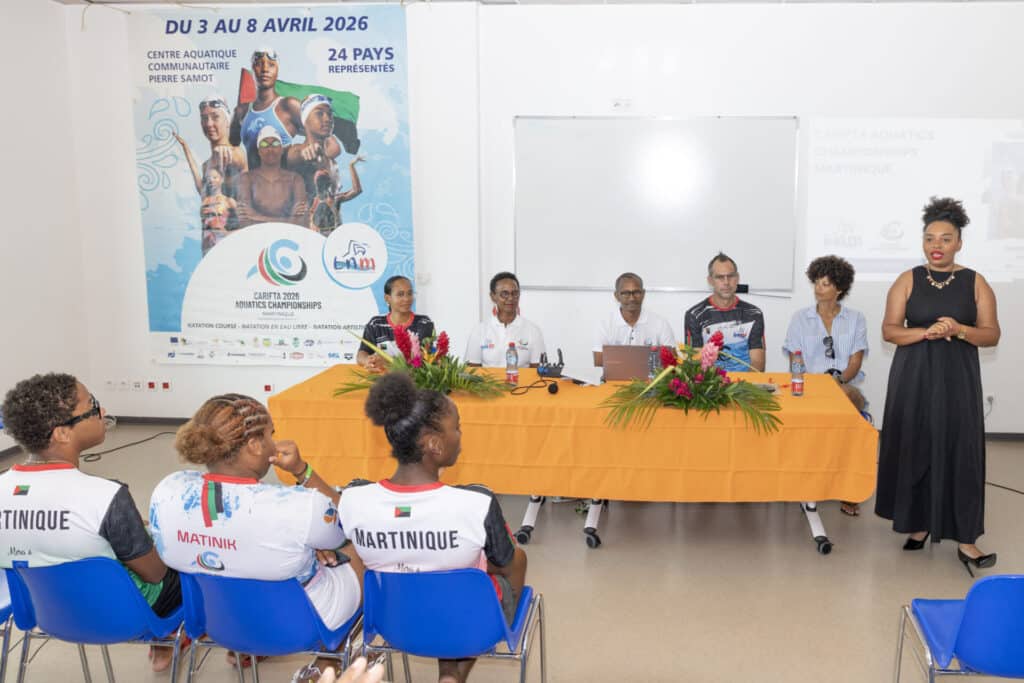
The other factor was more concrete: Sainte-Lucie did not yet have its own pool. Martinique, on the other hand, can count on the Centre Aquatique Pierre Samot in Le Lamentin, with its ten-lane Olympic pool, 800-seat grandstand and 25-meter warm-up pool. One of the best facilities in the Caribbean.
The organization also emphasized its capacity to welcome delegations from outside the basin, with several accommodation solutions mobilized in the south of the island, supplemented by other structures if necessary. This logistical aspect, rarely secondary in this type of event, reinforced the credibility of Martinique’s bid.
Three disciplines, 24 nations, a demanding format
The CARIFTA Aquatics Championships 2026 will bring together 24 countries: 21 English-speaking Caribbean nations, plus Martinique, Guadeloupe and Guyana. The swimming races will take place over four days: heats in the morning, finals in the afternoon, from Saturday April 5 to Tuesday April 8. Artistic swimming gets underway on Monday during the lunch break, with solos followed by technical events. The duets and teams round off the program on Wednesday morning. On the same Wednesday, the open water event takes place over five kilometers in the Anses d’Arlets.
Competitors: Benjamins (11-12 years), Minimes (13-14 years), Cadets (15-17 years) do not enter as individuals. They are national selections, with the best swimmers from each territory. To enter the Martinique selection, swimmers must satisfy a time grid established over the previous two seasons, which only selects swimmers capable of reaching the finals.
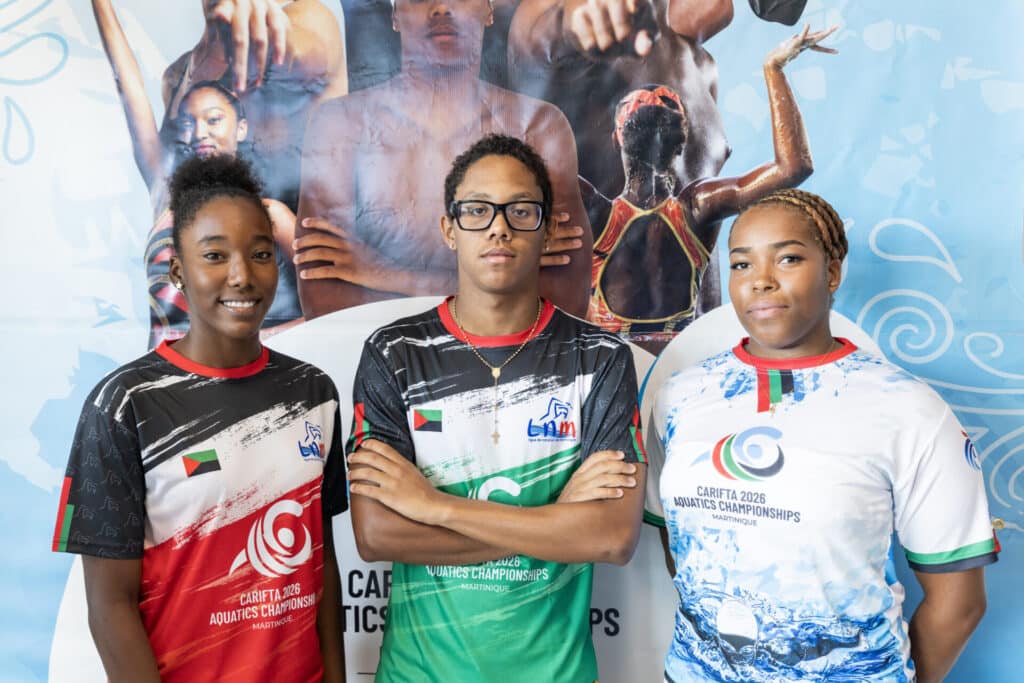
In the minds of the organizers, selection is based on a simple logic: to score points, you have to enter the final, and to enter the final, you have to be among the top eight times in the morning heats. In other words, the swimmers selected are supposed to have a level that enables them to play a real role in the competition, and not just participate.
The Martinique delegation at the CARIFTA Aquatics Championships 2026 has 61 swimmers: 36 in racing, 12 in open water, five of whom also race, and 18 in artistic swimming. The team is led by five captains: Jean-Naël Zozime and Maxime Auguste-Charlery for boys’ racing (15-17 age group), Cyrielle Manin and Sayanne Guivissa for girls’ racing, and Nohemy Marajo for artistic swimming.
Water as starting point and destination
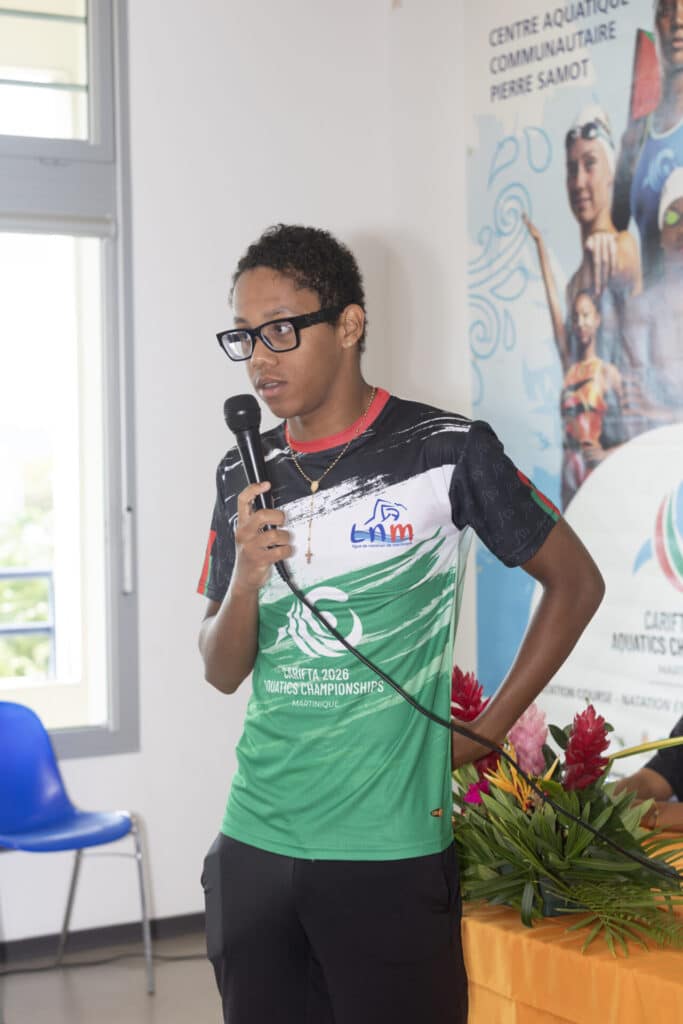
When asked how he got started, Jean-Naël Zozime, captain of the boys’ selection, answers straightforwardly: “I was introduced to swimming so that I wouldn’t drown. Cyrielle Manin, captain of the girls’ selection, tells much the same story: she almost drowned as a child, and that’s what led her to learn to swim.
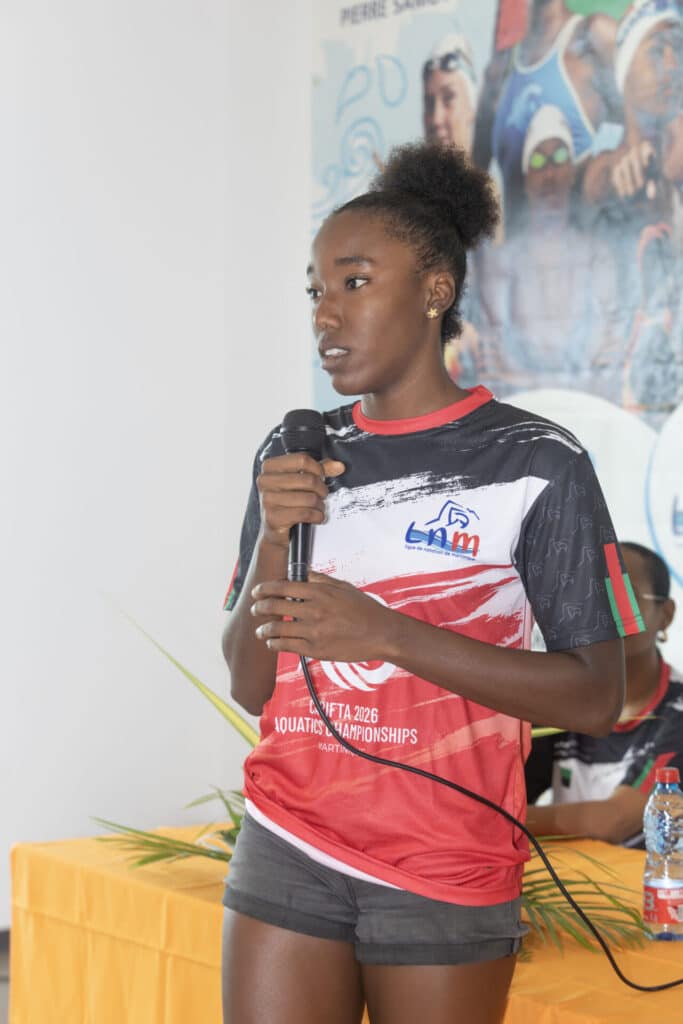
These two testimonies, heard just a few minutes apart, say something important about this territory. Two young Martiniquans, initially frightened by the sea, who are now representing their island against twenty-three Caribbean nations. This is more than just a sporting achievement.
"Swimming is a tough sport. You can't expect it to be easy, but with a lot of perseverance, anyone can do it."
— Jean-Naël Zozime
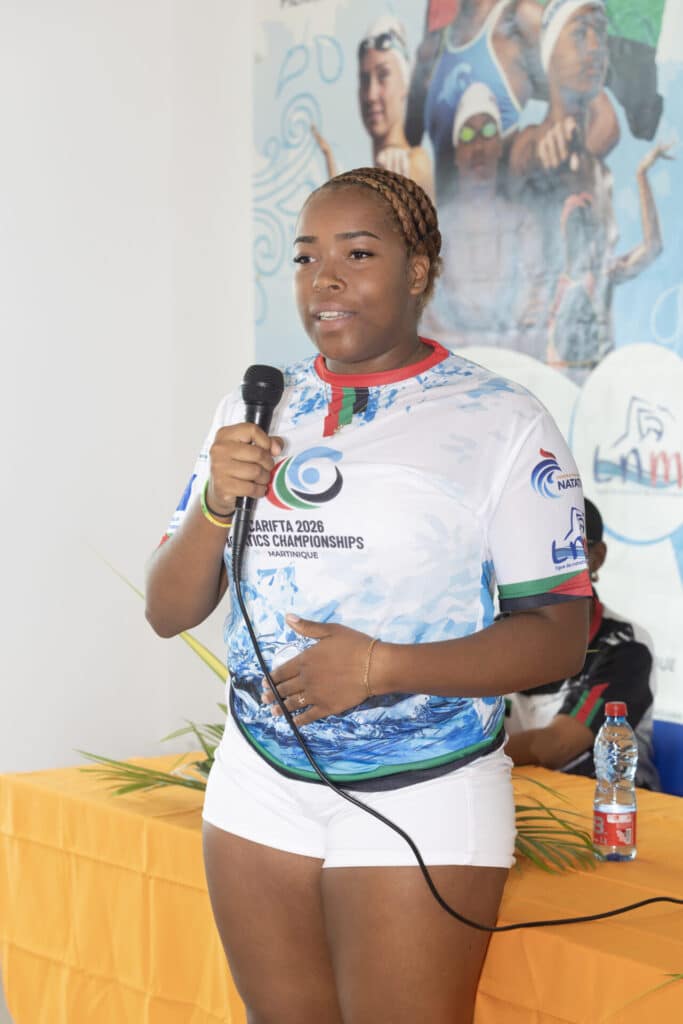
Nohemy Marajo, artistic swimming captain, has been practicing for ten years a discipline that the public still knows little about. She explains it concretely: learning choreographies on dry land, rehearsing them in the water, controlling your breathing under the surface while your legs draw figures above. It’s a sport that’s as technically demanding as it is physically demanding, and has as much to do with ballet as it does with endurance.
"You have to know how to endure, how to save every last breath to finish the choreography."
— Nohemy Marajo
The conference of the CARIFTA Aquatics Championships 2026 also pointed out that artistic swimming is still a confidential discipline in the Caribbean, due to the infrastructure it requires and the level of preparation required. It requires three-dimensional work and very thorough technical preparation, as well as the support of outside professionals, particularly in dance and gymnastic preparation. For the supervisors, the challenge of CARIFTA is twofold: to support those who are already practising and to encourage new vocations.
What the coaching team observes in these youngsters is a constant: they train, take their exams, compete at weekends, and do it all over again. “Generally, swimmers perform well in their studies too, because they’ve worked on this rigor on a daily basis.” What you learn in the pool also applies elsewhere, and the organizers insist on this daily requirement: it’s not enough to qualify, you have to be able to show up on the day, in a sport where regularity and discipline count as much as talent.
Medals from the hands of the island
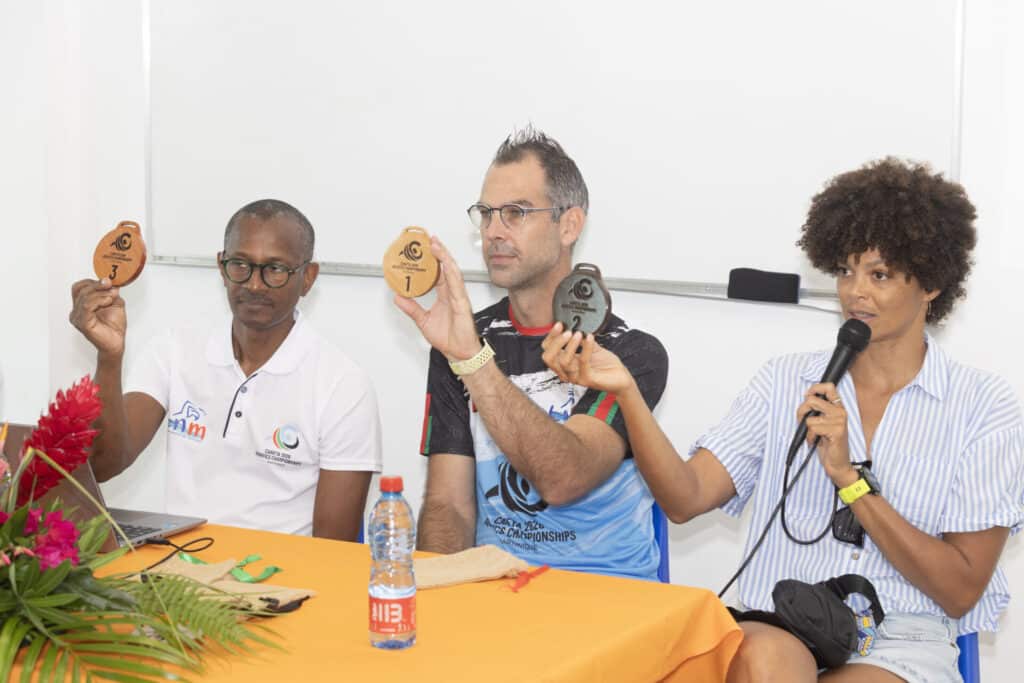
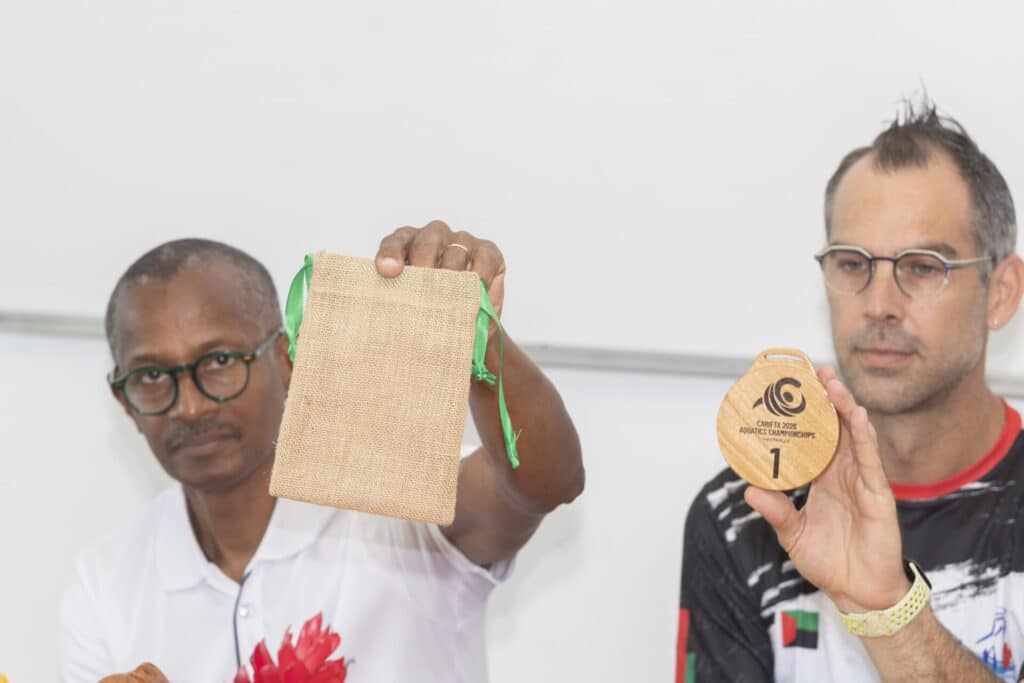
The way an event rewards its champions often says a lot about what it stands for. At the CARIFTA Aquatics Championships 2026, the medals were made in Martinique from noble woods: pearwood for gold, mao bleu for silver, mao ghani for bronze. A craftsman from the Nord-Atlantique region produced them, Joseph Galliard signed the engravings, and a local seamstress made the pouches in the three colors of the Martinican flag.
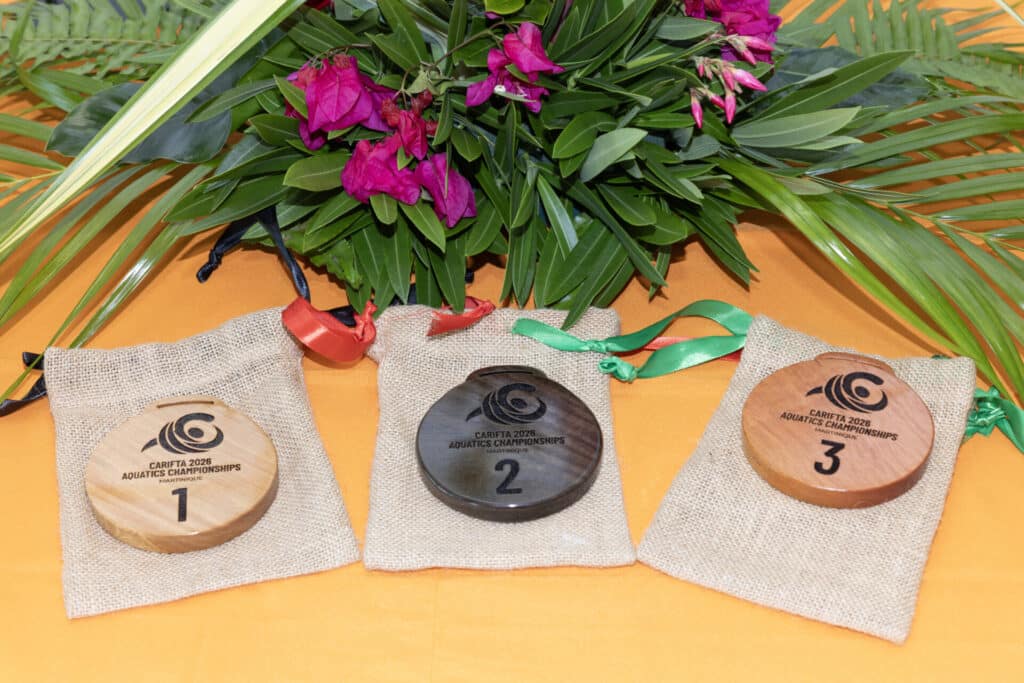
The initiative was spearheaded by the event’s godmother, Coralie Balmy, a former top-level swimmer who had taken part in the CARIFTA four times in her career. An eco-responsible and identity-affirming initiative, hailed as a first on the Caribbean scale.
Every Caribbean athlete who reaches the podium at the CARIFTA Aquatics Championships 2026 will leave with a piece of Martinique, a unique medal made by local craftsmen, unlike any other.
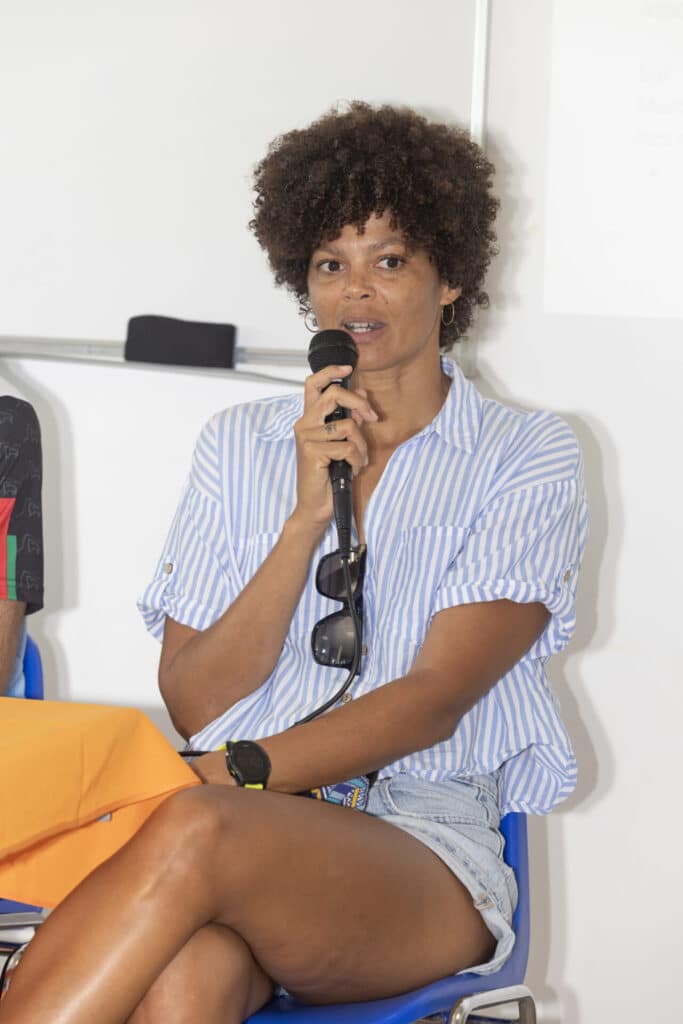
The conference also specified that trophies would accompany these awards, and that the medals had yet to receive their lanyards before the competition opened. Here too, the aim is clear: to make each award a sporting, local and symbolic object.
A week that mobilizes the whole territory
The CARIFTA Aquatics Championships 2026 won’t just be played out in the pools. Between 1,500 and 1,800 people are arriving in Martinique: swimmers, staff and families spread out over several hotels in the south of the island. Every day, around 150 volunteers ensure the smooth running of the event: former swimmers, parents, locals who sometimes have no direct connection with swimming, but who wanted to get involved.
Among them, the officials play a decisive role: some 26 officials from the Caribbean will reinforce the Martinique officials, bringing the number of people around the pool to around fifty for each morning and afternoon meeting. In addition, there will be first-aid attendants, reception teams, people in charge of awards, delegation escorts and areas open to the public.
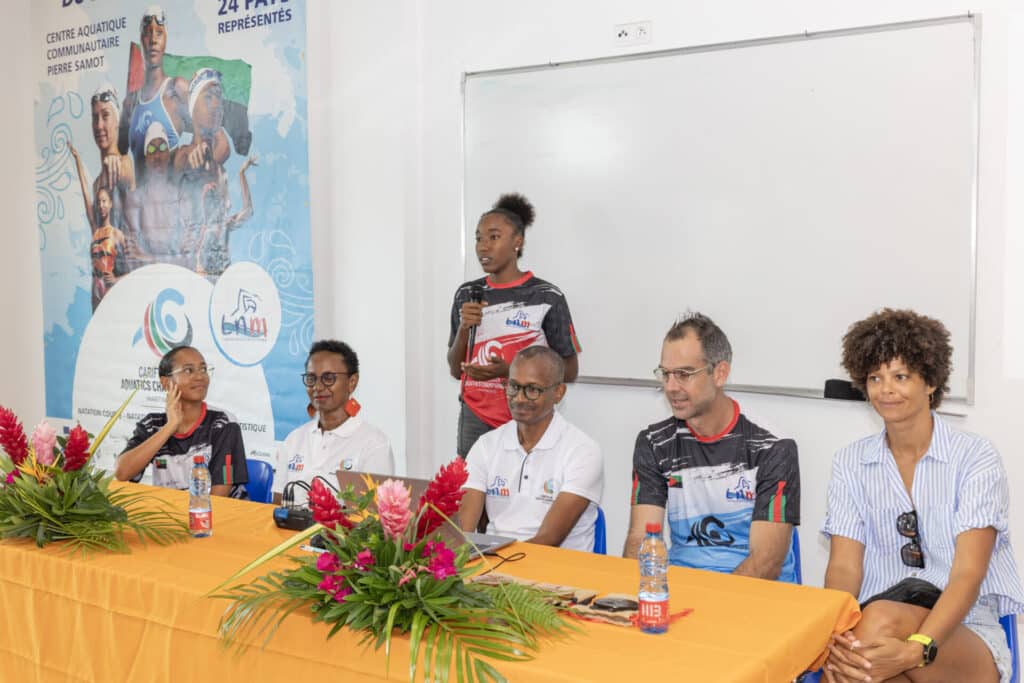
Welcoming delegations to the CARIFTA Aquatics Championships 2026 was also thought through in detail. They all had to arrive on April 2, at different times of the day, sometimes very early in the morning, sometimes late at night. In conjunction with the transport company and SAMAC, a precise plan was drawn up at the airport to ensure smooth exits, transfers to buses and settling into accommodation, with particular attention paid to meals depending on the time of arrival.
The opening ceremony of the CARIFTA Aquatics Championships 2026, on Friday April 3 at the Georges Gratiant stadium, is free and open to all: 2,800 seats to fill. The group “Nou Pa Sav” will accompany the parade of delegations. On Saturday, April 4, Les Hommes d’Argile will be on hand as the delegations arrive on site, offering a strong cultural backdrop intended as a symbolic first encounter with Martinican identity. Throughout the week, Martinican cultural groups will be on hand to ensure that visitors leave with a living image of the region, not just competition results.
The CARIFTA Aquatics Championships 2026 ceremony is scheduled to take place from 4 to 6 p.m., and will be broadcast on a giant screen, as well as relayed by media partners and via YouTube for wider distribution in the Caribbean. The ambition is clear: to make Martinique the center of the Caribbean for the duration of the event.
In addition to sport, the organizers of the CARIFTA Aquatics Championships 2026 also have an economic and cultural objective. Bringing in up to 1,800 people means filling accommodation, generating consumption, encouraging car rentals and putting the hotel and restaurant sectors to work. It’s also a way of showcasing Martinique’s culture, notably through the entertainment planned for the opening ceremony and the arrival of the delegations.
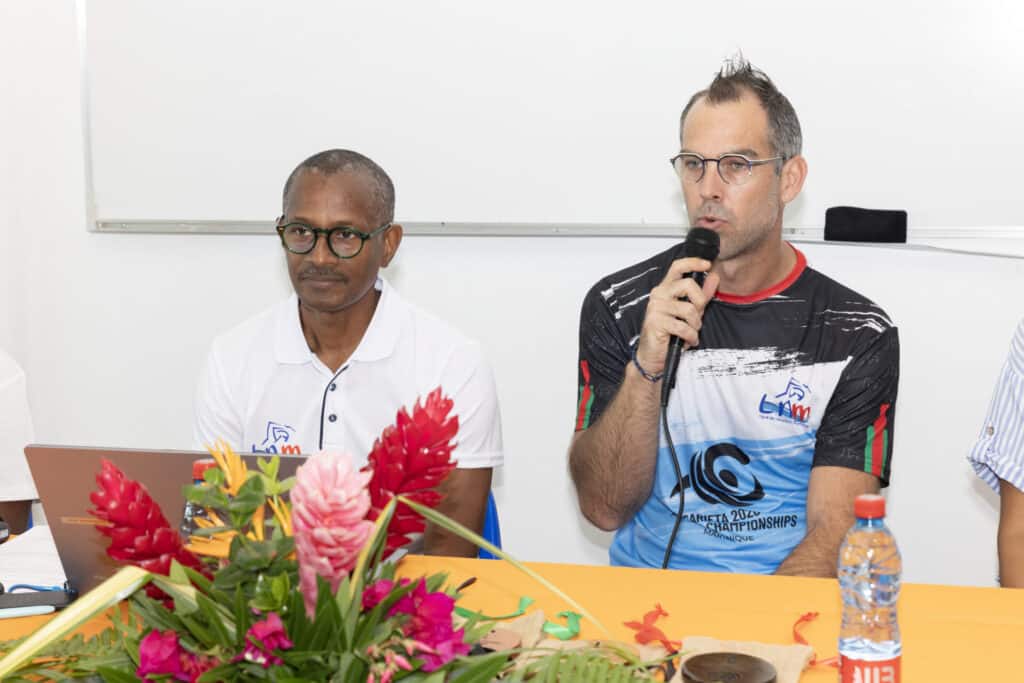
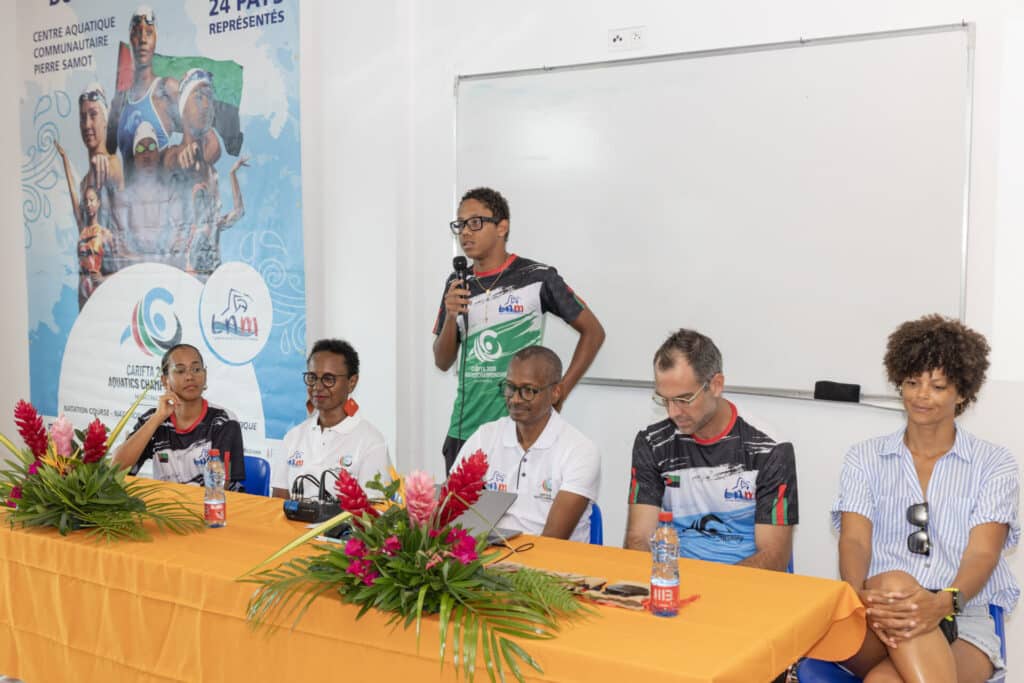
The open water event at Anses d’Arlets also serves as a reminder that the sea is a living, fragile environment that deserves protection. The association’s representative at the conference sums up its mission simply: “learn to swim to discover the seas and protect them.”
This educational dimension goes beyond drowning prevention. It also touches on the appropriation of water by the people of Martinique, the discovery of the discipline by the youngest and the broader desire to reinforce the region’s aquatic culture in the long term.
An assertive island
A phrase uttered at the end of the conference sums up the general mood: “We’re ready, and we’ll make the CARIFTA Aquatics Championships 2026 a collective success and a great source of pride for our region.”
What the delegations take away with them on the evening of April 8 is more than just a ranking. It’s an image of Martinique, a territory that knows how to welcome, organize and assert its identity. For six days, the whole Caribbean will be there. It’s up to Martinique to show what it can do.
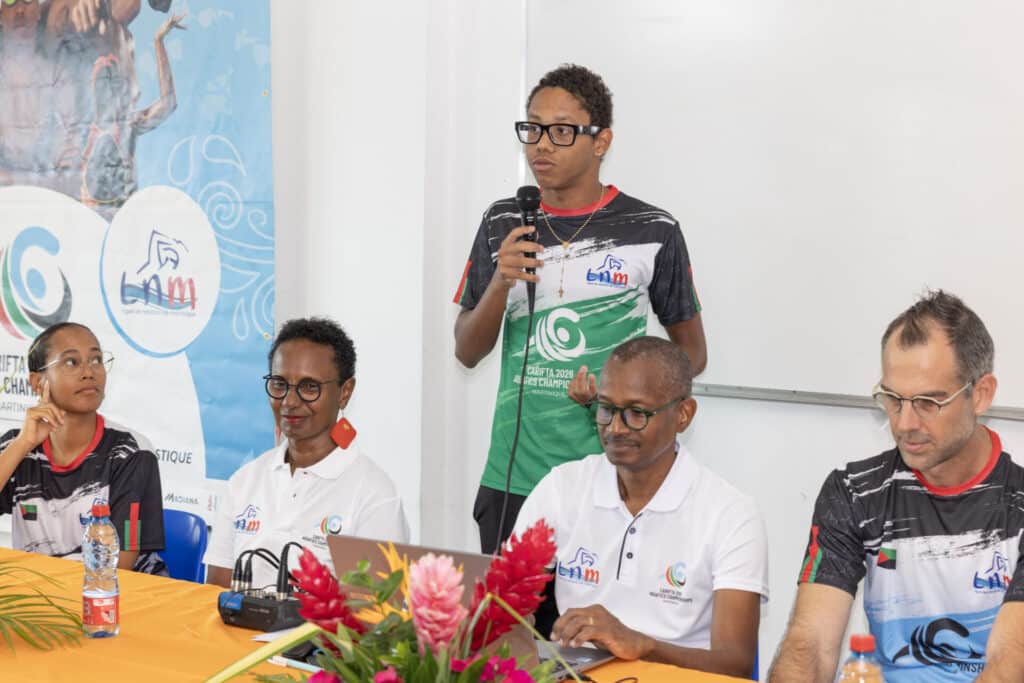
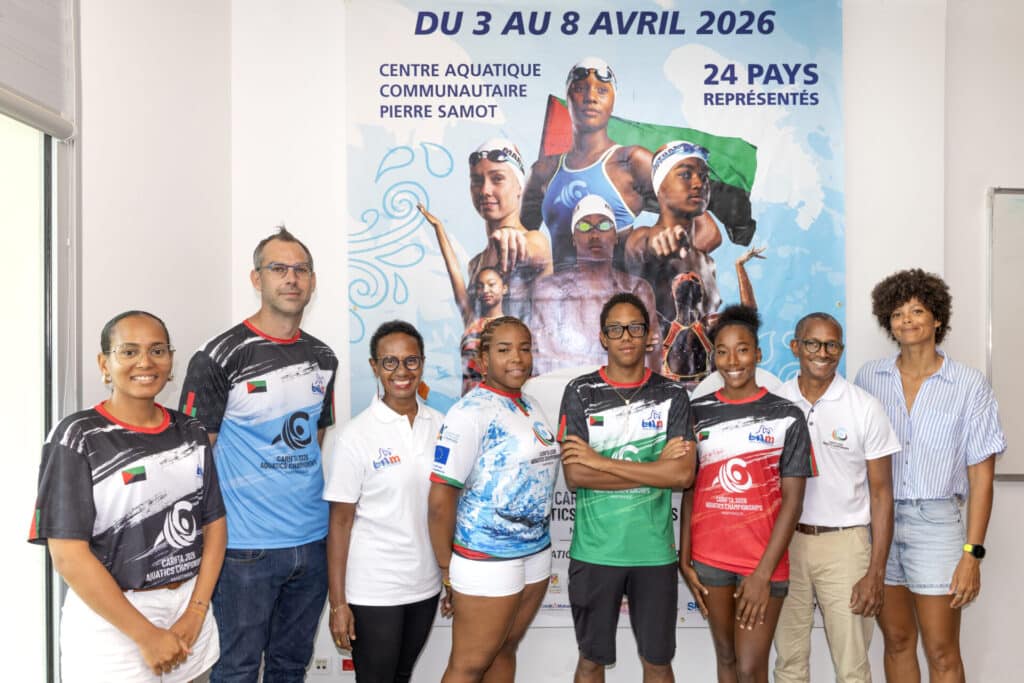
But the organizers of the CARIFTA Aquatics Championships 2026 also want to leave their mark after the event. The Ligue de Natation de Martinique ended the 2024-2025 season with some 2,540 members, around ten affiliated clubs and, generally speaking, 7 to 8 clubs involved in competition. With this in mind, the CARIFTAs are not intended as a parenthesis, but rather as a possible catalyst to encourage vocations, boost membership and establish swimming as a permanent fixture on the Martinique sports scene.
The organizers of the CARIFTA Aquatics Championships 2026 have also chosen not to reproduce the large village of 2016. In 2026, the activities surrounding the competition are to be more focused, with one day in particular being highlighted, in order to concentrate energy and attendance rather than scattering the highlights.
The CARIFTA Aquatics Championships 2026 is the 39th edition of the Caribbean’s leading junior aquatic event, held in Martinique from April 3 to 8. Twenty-four nations are taking part in racing, artistic and open water swimming, in categories ranging from 11 to 17 years of age.
The swimming race and artistic swimming events take place at the Centre Aquatique Pierre Samot in Le Lamentin. The 5-kilometer open water event takes place in Anses d’Arlets on Wednesday April 8.
Tickets are available on cariftamartinique2026.com and on the Ligue de Natation de Martinique social networks. Prices: €10 in the morning, €20 in the afternoon for adults, 4-day pass at €125. The opening ceremony at the Georges Gratiant stadium is free of charge.
Twenty-four countries are taking part: 21 English-speaking Caribbean nations, plus Martinique, Guadeloupe and Guyana.
The Martinique squad is led by five captains: Jean-Naël Zozime and Maxime Auguste-Charlery for boys’ racing, Cyrielle Manin and Sayanne Guivissa for girls’ racing, and Nohemy Marajo for artistic swimming.
TeMeUm 2026 marks a new stage in the policy of supporting local biodiversity initiatives in the French overseas territories. Launched by the French Office for Biodiversity (OFB), this annual campaign aims to finance micro-projects undertaken by associations, small communities and managers of natural areas who are active in the field.
At a time when island ecosystems are under heavy pressure from urbanization, climate change, pollution and biodiversity erosion, this program provides financial and technical resources to transform local initiatives into concrete, measurable actions. Project leaders have until April 14, 2026 to submit their applications via a fully paperless procedure.
Since its creation in 2010, the program has supported more than 420 micro-projects in the French overseas territories, confirming its role as a structuring force in supporting local environmental dynamics.
Financing tailored to small structures
One of the major assets of TeMeUm 2026 lies in its accessibility. The program deliberately targets smaller structures, which often have difficulty accessing traditional financing. Grants awarded range from a few thousand euros to 20,000 euros and can cover up to 80% of the total budget.
Aid is paid out in a single instalment as soon as the project is launched, enabling project sponsors to get their initiatives off the ground quickly, without having to wait for lengthy administrative procedures. This approach responds to a well-known reality in the French overseas territories: local players have solid expertise, but often lack immediate financial resources.
In addition to financial support, the OFB provides technical and administrative assistance to secure the implementation of projects and promote their development on a regional scale.
Three complementary schemes to structure projects
The campaign TeMeUm 2026 campaign is built around three distinct systems, designed to meet a variety of needs.
Springboard: supporting immediate local action
The Tremplin scheme is the operational heart of the program. It supports micro-projects for the protection or restoration of biodiversity, from first experiments in ecological management to innovative pilot initiatives.
Each year, around thirty projects are co-financed for amounts of up to 15,000 euros. The actions supported cover a wide range of fields: species monitoring, restoration of natural habitats, raising public awareness, and experimentation with new ecological management methods.
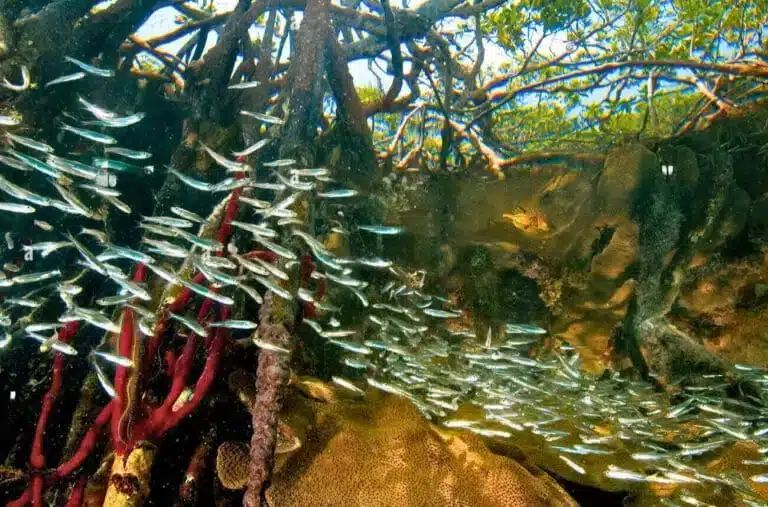
Among the initiatives supported in 2025 are participatory monitoring of marine biodiversity in Saint-Pierre-et-Miquelon, a project to mobilize citizens around sustainable urban development in French Guiana, and the creation of a botanical trail in Polynesia to preserve endangered endemic flora.
Cooperation: strengthening technical skills
The Cooperation component aims to structure partnerships between biodiversity stakeholders in order to strengthen local technical capacities. With a grant of up to 20,000 euros. This scheme supports collaborative projects involving several organizations.
These cooperative ventures enable us to pool scientific expertise, improve ecological management methods and develop more coherent territorial strategies. In 2025, a wetland restoration project in Mayotte benefited from this funding following a cyclone that weakened local ecosystems.
Companionships: transmission and training in the field
The Compagnonnages program focuses on vocational training and the transmission of know-how. It enables teams from the French overseas departments and territories to spend short periods of time – one to two weeks – working within expert structures.
The OFB will cover travel, accommodation and catering expenses, up to a maximum of 5,000 euros. This format encourages direct technical exchanges and rapid skills transfers.
In 2025, environmental agents in the Indian Ocean were trained in techniques for capturing and studying chiropterans, while an international partnership studied the impact of microplastics on green turtle egg-laying sites and seabird nesting.


Simplified procedures and local support
The program TeMeUm 2026 is based on a clear commitment to administrative simplification. Applications are submitted entirely electronically via the Démarches Simplifiées platform, making it easier for organizations located far from major administrative centers to apply. Applications are examined by local juries made up of biodiversity stakeholders from each region. This organization guarantees an assessment adapted to the ecological and social realities of each overseas zone.
Support doesn’t stop at the selection stage. TeMeUm’s national teams and the OFB’s regional delegations follow project leaders through the entire process, from dossier preparation to operational implementation, evaluation and valorization of results.
A handbook detailing eligibility criteria and expected commitments is available to applicants. Two information webinars are also scheduled on March 23 and 25, 2026 to help structures prepare their bid.
A major challenge for the Caribbean and Indian Ocean territories
For the French overseas territories, biodiversity is both an exceptional natural heritage and a factor of economic, cultural and tourist resilience. The marine and terrestrial ecosystems of the Caribbean, French Guiana and the Indian Ocean play a central role in protecting against climate risks, ensuring food security and enhancing the attractiveness of these territories. Against this backdrop, TeMeUm 2026 represents a strategic opportunity for local players wishing to develop concrete projects, whether to restore natural habitats, protect endemic species or raise public awareness.
The program also contributes to structuring a network of committed players, encouraging the circulation of skills and the sharing of experience between overseas territories.


Local mobilization for sustainable biodiversity
By renewing its call for projects, the OFB confirms the importance of a territorial approach to biodiversity, based on the expertise of local players. TeMeUm 2026 is more than just a funding scheme: it’s part of a global strategy designed to strengthen the capacity for action of structures in the French overseas territories, and to support initiatives tailored to the ecological realities of each territory. Applications for the three schemes – Tremplin, Coopération and Compagnonnages – are open until April 14, 2026. Project sponsors can contact their local OFB delegation or the TeMeUm team directly for further information.
Through this new campaign, TeMeUm 2026 confirms that preserving biodiversity in the French overseas territories depends above all on the commitment of local players, who are capable of transforming targeted initiatives into sustainable solutions for their territories.
TeMeUm 2026 is a program run by the French Biodiversity Office to finance micro-projects to protect and restore biodiversity in the French overseas territories. It supports associations, local authorities and natural area managers working in the field.
Associations, small local authorities, public establishments and managers of natural areas in the French overseas territories are all eligible to apply. The program is designed to be accessible to small structures with concrete projects in favor of biodiversity.
Applications for the Tremplin, Coopération and Compagnonnages schemes are open until April 14, 2026. Applications must be submitted online via the Simplified Procedures platform of the French Biodiversity Office.
The Rézo 2025 seminar, held in Grenada, brought together the directors of the Alliances Françaises of the English-speaking Caribbean, with the same ambition: to consolidate the links between the territories and reinforce the vitality of the French-speaking world in the region.
Having explored the institutional and strategic vision of this regional cooperation in the previous article, “The Alliances Françaises network at the heart of the Caribbean: cooperating, innovating, sharing”, Richès Karayib now turns the spotlight on those who are at its beating heart.
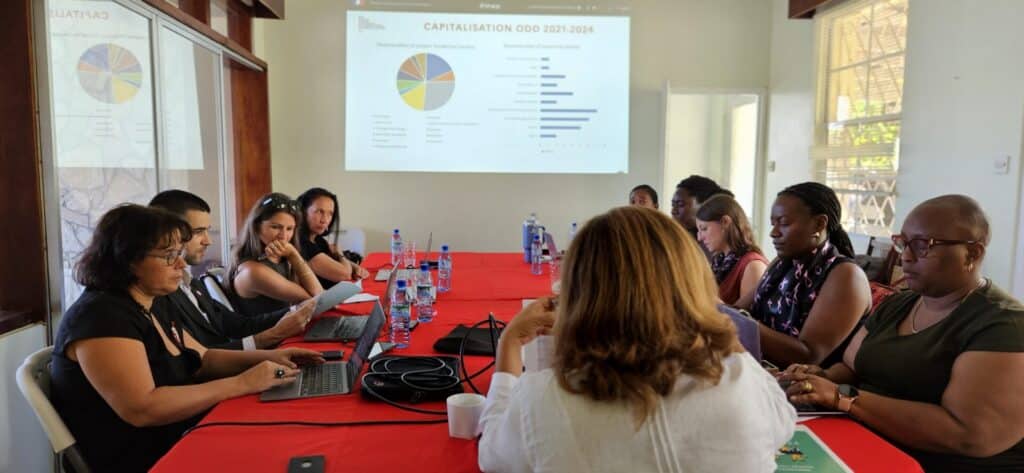
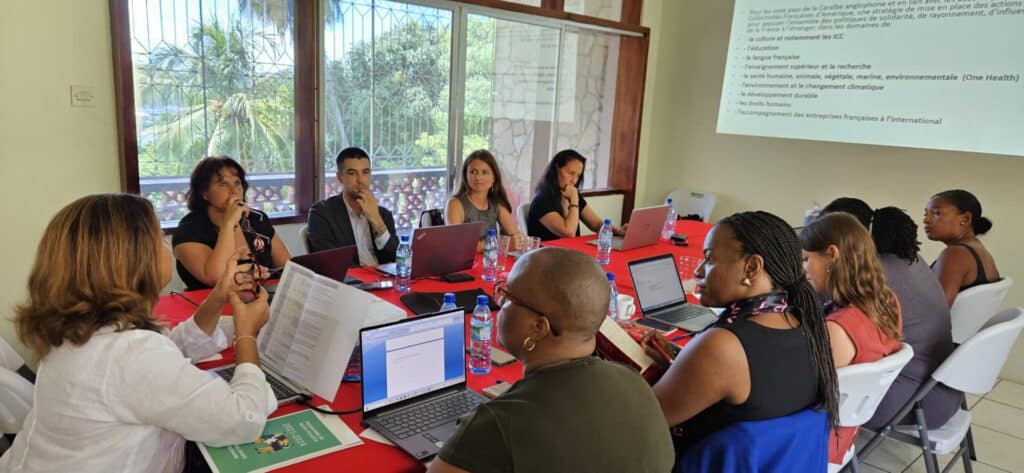
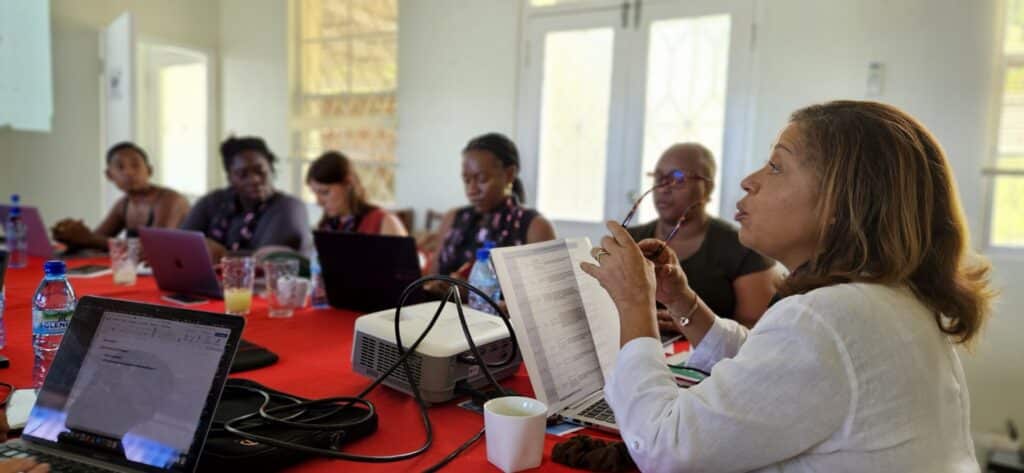
For several days, the participants shared their experiences, challenges and successes, revealing a common conviction: to bring culture and the French-speaking world closer to the people of the Caribbean via the Alliances Françaises.
An essential meeting for a fragmented network
Each Alliance Française operates on an island, often geographically isolated. This seminar, organized with the support of the Service de Coopération et d’Action Culturelle (SCAC) of the French Embassy in Saint Lucia, was a breath of fresh air for the Alliance Française network. The directors emphasized that these meetings are an essential step: they enable them to exchange tools, compare local realities and together find concrete solutions to shared challenges. They all emphasized the strength of the collective, the richness of exchanges in an English-speaking environment and the complementarity of approaches between territories.
These moments offer both a human and a formative dimension: they re-energize, reinforce solidarity and remind us that, despite the diversity of contexts, the Alliances Françaises move forward with the same ambition – to make the French-speaking world live and shine in the Caribbean. From an institutional point of view, Christiane Bourgeois, Cooperation and Cultural Action Advisor, reminded us that this annual seminar is the only time when all the directors can get together to discuss successes, difficulties and common perspectives.
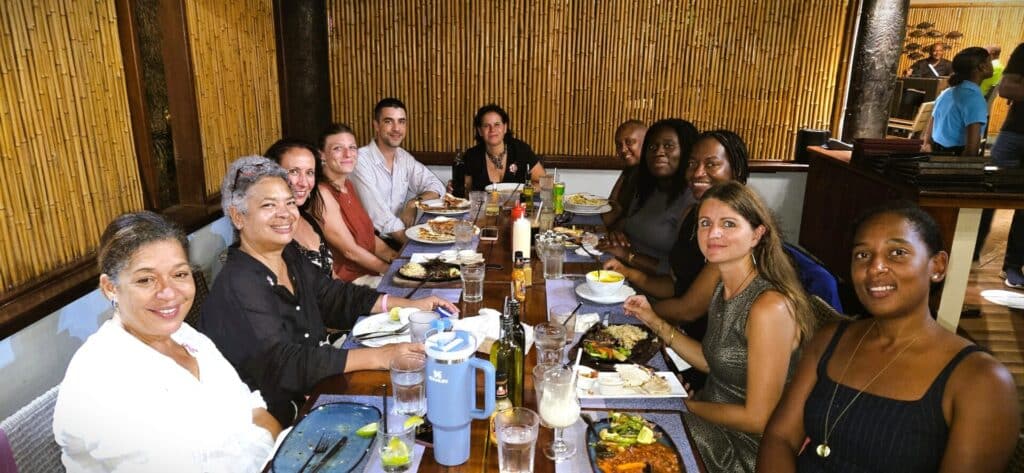
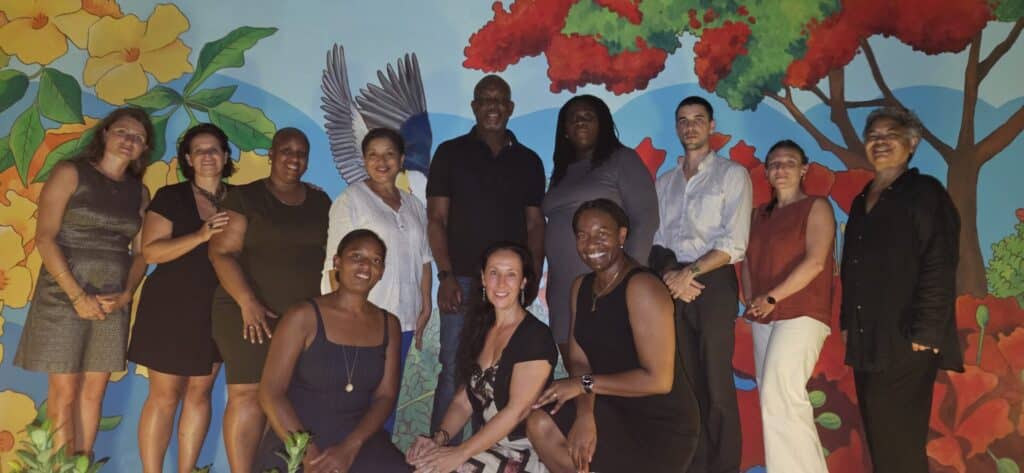
Nine territories, nine realities, but the same conviction: these times of exchange are essential to maintain the network’s momentum and strengthen cooperation in the Caribbean. Beyond these collective exchanges, it is in the field that the vitality of the Alliances Françaises network takes on its full meaning. Each Alliance Française acts in its own way, in line with the realities of its environment and the languages and cultures of its territory.
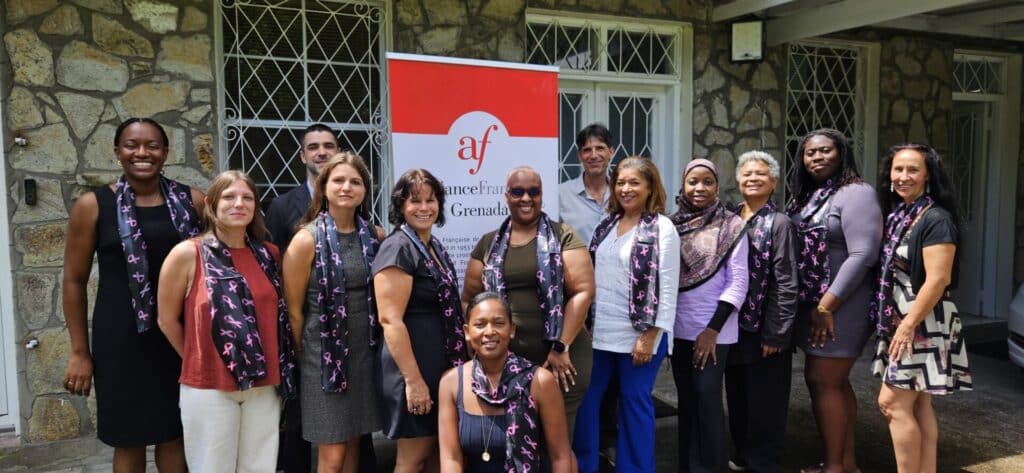
A deep-rooted network: ten Alliances, one commitment
Although their contexts differ, the Alliances Françaises of the English-speaking Caribbean share the same vocation: to teach, connect and bring the French-speaking world to life on a daily basis. They adapt to local realities with the same conviction: culture and language are levers for social cohesion, openness and the future.
Grenade – Ilona Forte-Gilbert: teaching differently, connecting differently
The Alliance Française de Grenade operates without permanent premises, a situation that Ilona Forte-Gilbert has turned into an asset.
Courses are now offered online, helping to maintain the French language’s presence and reach new audiences. The Alliance is also involved in schools through educational and cultural activities carried out in partnership with teachers. Out-of-home screenings and workshops keep us in touch with the community.
“Our priority is to remain present and useful, even without a building. Digital technology and partnerships enable us to keep the Alliance going.”

Saint Lucia – Aurélie Gbeffa: coordinating and federating
In Saint Lucia, Aurélie Gbeffa runs the local Alliance and is responsible for regional coordination of the ten Alliances Françaises in the Eastern Caribbean. She assists managers with communication, pooling, associative governance, digital transition and cultural revitalization.
It also pilots the Rézo project, an annual seminar supported by the SCAC, which has become a key event for cohesion and collective reflection. In Castries, the Alliance Française de Sainte-Lucie combines language courses, cultural activities and Creole language promotion through exhibitions and workshops.
“Our strength lies in moving forward together while valuing the cultural diversity of our islands.”

Barbados – Océane Gaillard: promoting French in an English-speaking environment
In Barbados, the Alliance Française acts as a linguistic and cultural bridge. Under the leadership of Océane Gaillard, it has consolidated its foothold in a predominantly English-speaking environment. Educational programs have been set up for schools and adults, and the Alliance has trained members of the Regional Security System in French and Haitian Creole.
On the cultural front, it has welcomed the Guianese troupe Ôtepé, and is developing a program open to different French-speaking expressions.
“We represent a plural Francophonie: France, Africa, Canada and the Caribbean. Culture is our best lever for inspiring the desire to learn.”

Trinidad & Tobago – Anyka Batista: an open and inclusive francophonie
In Trinidad & Tobago, Anyka Batista defends an inclusive and creative Francophonie, which values local languages as much as French. Every October, Creole Heritage Month brings together screenings, conferences and concerts, reflecting a strong commitment to cultural diversity.
The Alliance Française also offers courses for children, teenagers and adults, as well as cultural evenings that encourage encounters between communities. Challenges related to visibility and funding persist, but are offset by a collaborative approach with local schools and institutions.
“We want the Francophonie to be seen as part of our culture, not something external.”

Jamaïque – Clovis Lemée: creating living spaces
In Jamaica, Clovis Lemée is revitalizing a historic Alliance Française, transforming it into a place for living and creating. The Language Exchanges, monthly multilingual evenings, bring together a varied public around cultural themes, while the French Library Sessions – mini-concerts filmed in the media library – turn language into a tool for encounters and artistic expression.
“Learning a language is about creating links. That’s what the Alliances Françaises are all about.”
This cultural dynamic is attracting a younger audience and helping to restore the French language to its rightful place in the English-speaking Caribbean.

Saint-Kitts & Nevis – Lucille Caulliez : education and ecology
The Alliance Française de Saint-Kitts & Nevis combines language learning with civic engagement. Her Naturally Learn French project, supported by a grant from the French Embassy to the Eastern Caribbean, Barbados and the OECS, offered six months of free tuition to twelve teenagers from disadvantaged backgrounds, combining French language discovery, ecological workshops and cultural activities. Each month, participants explored local ecosystems, cultivated a garden, created with recycled materials or exchanged online with students from Guadeloupe – a concrete and lively way to learn the language while forging links in the Caribbean.
This project, which earned the Alliance the Green Alliance Award from the Global Environment Facility, illustrates the vitality of an open, sustainable and youth-oriented French-speaking community. She is also developing Francoscop, an audiovisual series produced by young people, dedicated to the French-speaking world.
Director Lucille Caulliez sums up the spirit of the program:
“We want to show that French is a tool for openness and creativity.”

Dominique – Cévinne M’Voula-Henderson: connecting languages and cultures
Established in 1965, the Alliance Française de la Dominique is active in the educational and cultural fields. The Creole & French Spelling Bees, bilingual spelling contests, encourage students to play with the two languages, understand their complementarity and take pride in them. Training workshops and cultural activities support the enhancement of Creole heritage while promoting the French language.
“The aim is to make French and Creole languages of pride and transmission.”

Guyana – Déborah First-Quao: rebuilding and training
In Georgetown, Déborah First-Quao, recently appointed to Guyana, is re-launching a long-standing but low-profile Alliance Française by focusing on training and educational partnerships. She has created a network of French teachers, developed bilingual workshops at the National Library and renewed ties with local institutions. Cultural and educational initiatives aim to put French back into everyday life, despite major logistical constraints.
“We want to restore French to its rightful place in schools, showing that it can be useful, lively and accessible.”

Suriname – Virginie Lemay: building institutional bridges
In Suriname, Virginie Lemay is strengthening links between the Alliance Française and local institutions. Language training is offered to the security forces, the Ministry of Education, businesses and the hotel industry. La Journée Française, organized with the Collectivité Territoriale de Guyane, is a five-day event featuring exhibitions, professional meetings and concerts.
“French becomes a concrete tool for regional cooperation.
This cross-sectoral approach positions the Alliance Française as a key player in the dialogue between Suriname, Guyana and the rest of the Caribbean.

A shared vision: support, connect, promote
For Christiane Bourgeois, Regional Advisor for Cooperation and Cultural Action at the French Embassy in Saint Lucia, this seminar is an essential moment for consolidating the network’s ties. She points out that it’s “the only occasion of the year when we have the opportunity to meet the directors of the Alliances Françaises”, a privileged time to take stock, exchange practices and difficulties, and set up joint projects.
“The Alliances Françaises are an essential tool for embassies, especially in areas like the Caribbean, where there is no Institut Français. They are local organizations, rooted in the territory, with their own board of directors and their own strategy”. She also recalled the key role played by the Alliances in disseminating the French language and promoting dialogue between peoples, stressing that they promote the language, ensure its teaching and maintain the link between the cultural and the educational, between France and the countries of the region.


Aware of the economic fragility of the associative model, Christiane Bourgeois stresses the importance of the support provided by the Service de Coopération et d’Action Culturelle (SCAC) and the French Ministry of Europe and Foreign Affairs.
Last but not least, it pays tribute to Granada, the seminar’s host, and its people:
“It’s an absolutely authentic island, with extremely friendly people. I encourage all French and Caribbean people to come to Grenada, a country that deserves to be known and appreciated.”


Where the French language comes alive
Over and above balance sheets and figures, these meetings are a reminder that the French-speaking world lives and breathes through the people who make it happen. On every island, the Alliances Françaises gather, transmit and inspire. Anchored in their reality, they build bridges between languages, cultures and generations – a living, inclusive and deeply Caribbean Francophonie.
The Alliances Françaises play a central role in French language teaching, cultural dissemination and dialogue between Caribbean territories. Anchored locally, they adapt their actions to the social, linguistic and cultural realities of each island.
The Rézo seminar is the only annual gathering of all the directors of the Alliances Françaises in the Caribbean. It enables them to share practices, strengthen regional cooperation and maintain a collective dynamic in a geographically dispersed network.
The Alliances Françaises develop tailor-made projects: online or face-to-face courses, actions in schools, ecological projects, cultural events, professional training or institutional cooperation. This adaptability is their strength in a predominantly English-speaking environment.
A prestigious title that reinforces Saint Vincent's place in the Caribbean
The Sandals Group has reached a new milestone with its St. Vincent and the Grenadines resort, recently named Best All-Inclusive Resort 2025 at the Travvy Awards. This distinction, awarded by one of the most closely watched organizations in the travel industry, places St. Vincent at the heart of Caribbean destinations that are moving upmarket. This success is helping to establish the archipelago as a credible alternative to the region’s more high-profile tourist destinations.
A resort designed in an unspoilt environment
Located in a discreet bay in the south-west of the island, the Sandals resort blends into a largely unspoilt landscape. The relief, vegetation and proximity of a small river provide a setting where the architecture blends into the environment rather than seeking to dominate the site. The concept is based on a simple vision: to offer an upscale experience without upsetting the natural balance of the site.
The resort is distinguished by its water villas, suites with personalized services, Caribbean and international-inspired restaurants and wellness areas. Travelers will find a tranquil atmosphere, far from dense tourist areas.
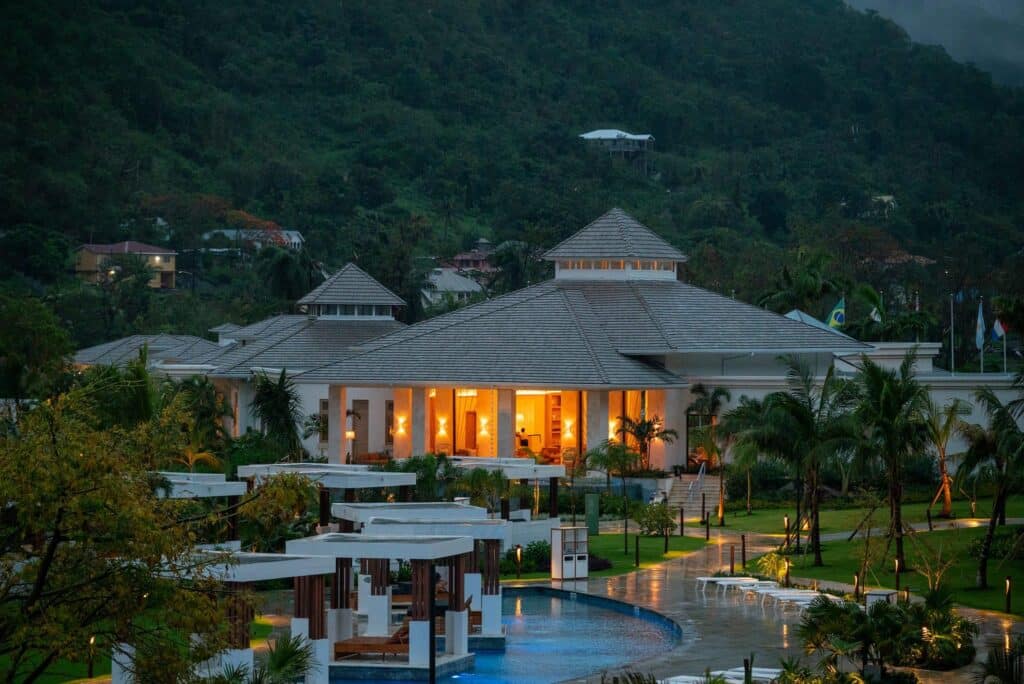
Why does Sandals stand out at the Travvy Awards 2025?
The recognition Sandals received at the Travvy Awards was based on several criteria observed by the jurors: the quality of the infrastructure, the consistency of the experience offered, the level of service, traveler feedback and innovation in the all-inclusive offer.
In the case of Saint-Vincent, all the elements converge towards a masterful approach to luxury hotels. The restaurants showcase Caribbean cuisine using island products, the communal areas feature lightweight construction, and the Learn-to-Dive diving program helps guests discover the island’s seabed in the best possible conditions. The resort also stands out for its ability to offer personalized luxury without creating too strong a break with the island ecosystem.
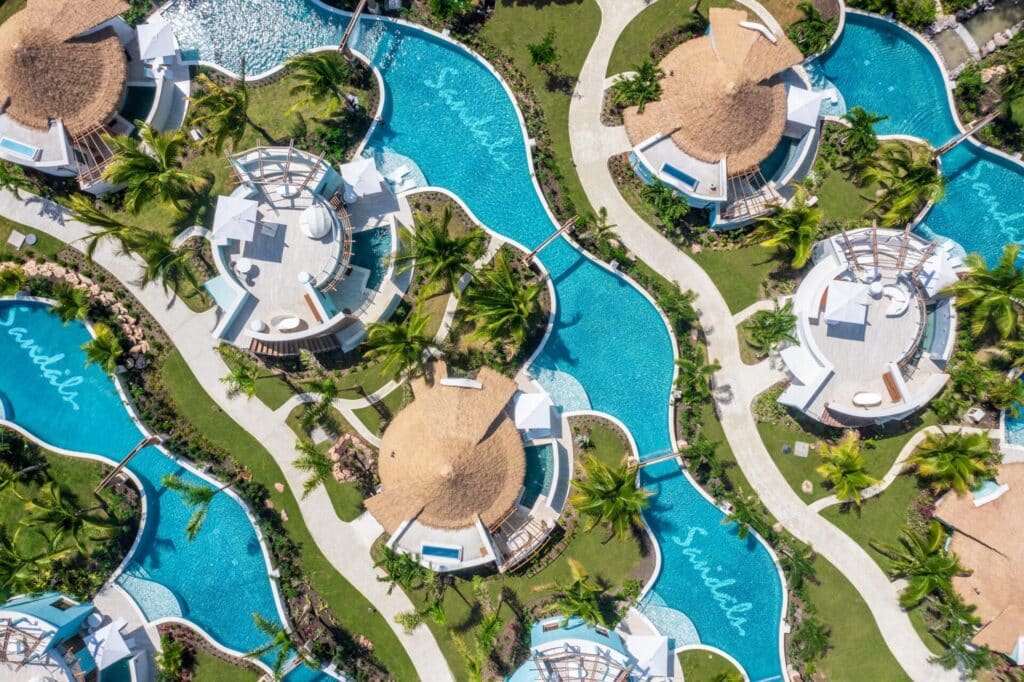
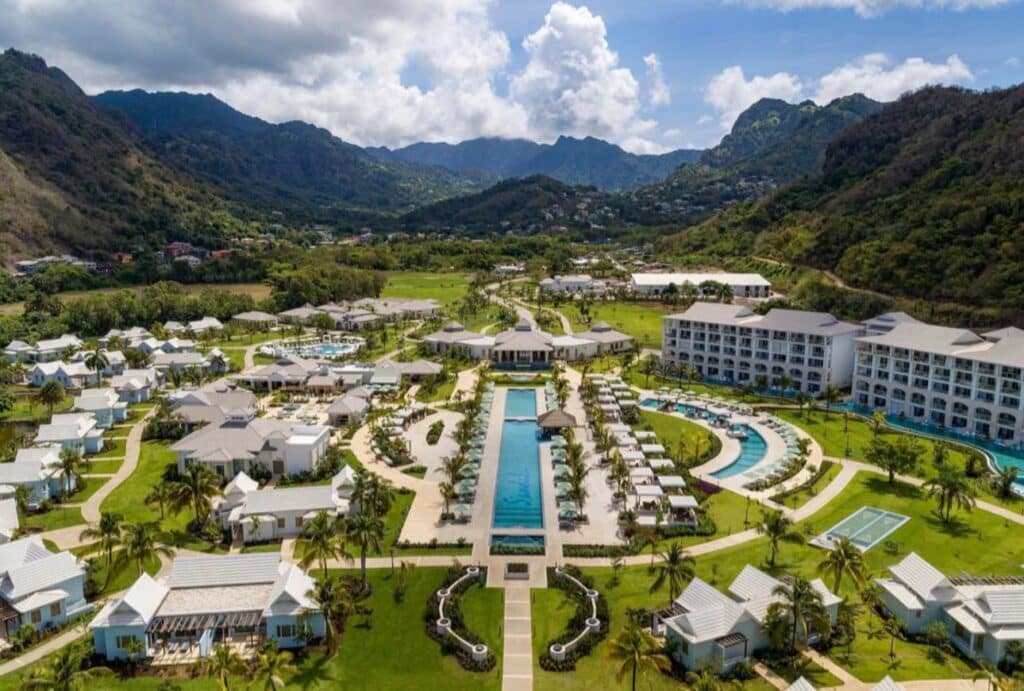

A real impact on tourism in Saint Vincent and the Grenadines
The Group’s arrival in Saint-Vincent has led to renewed interest in the destination, often referred to as the “Sandals effect” by regional tourism players. Air links have been strengthened, excursions have been diversified, and the local hotel sector is benefiting from a new dynamic.
This international distinction helps to consolidate this progress. It places the archipelago in the category of sought-after destinations for a top-of-the-range all-inclusive stay, while highlighting a development model based on a balance between comfort, landscape and authenticity. For tourism professionals in the Caribbean, the success of the Saint-Vincent resort shows that there is a place for hotel projects that do not distort their immediate environment.

A strong signal for the Group in the region
For Sandals Resorts, this recognition is part of a broader strategy: to consolidate its presence in the Caribbean while renewing its quality standards. The St. Vincent resort plays an important role in this evolution, marking one of the group’s most recent developments. Its international distinction confirms the relevance of a positioning more focused on nature, tranquility and a tailor-made experience.
The Travvy Awards 2025 reinforce the resort’s legitimacy in the Caribbean world of upscale tourism. The brand has demonstrated its ability to evolve with travelers’ expectations, while preserving the uniqueness of the territories in which it operates.
The election of Sandals de Saint-Vincent to the title of Best All-Inclusive Resort 2025 is an essential moment for the destination and for the group. It highlights a resort where luxury hotels find their place in a preserved environment, and where the Caribbean is shown in a more authentic light. For Saint-Vincent, this distinction confirms a trend that has already begun: that of an archipelago that is gradually asserting itself as one of the region’s most promising destinations.


The OECS continues its regional modernization with a landmark initiative in Saint Lucia: the commissioning of automated kiosks at the country’s two main airports. A decisive step towards smoother, more technological and more secure border management in the Caribbean.
A forward-looking regional project
The OECS Commission (Organization of Eastern Caribbean States) has handed over ten self-service kiosks to Saint Lucia: eight at Hewanorra International Airport (HIA) and two at George F. L. Charles International Airport. This state-of-the-art equipment enables travellers to complete entry formalities themselves, reducing waiting times and congestion in arrival halls.
This operation is part of the OECS Border Management Improvement Program, financed by the European Union through the Regional Integration Through Growth Harmonisation and Technology (RIGHT) program. This partnership illustrates the regional organization’s determination to strengthen cooperation between its member states, while relying on technology as a lever for efficiency and security.

Automated kiosks for a better passenger experience
With this installation, Saint Lucia becomes a concrete example of digital transformation at the service of tourism. The new automated kiosks scan passports, capture fingerprints and speed up data verification, while maintaining a high level of security.
The aim is twofold: to facilitate travel for the region’s nationals, particularly those from CARICOM and the OECS, and to strengthen the country’s ability to identify and filter high-risk passengers. This intelligent approach illustrates the balance the region is seeking to strike between opening up tourism and tightening controls.

Strong words from Caribbean leadership
At the official handover ceremony at Hewanorra International Airport, OECS Director General Dr Didacus Jules emphasized the strategic significance of this development:
“As global tourism becomes more competitive, travelers are looking not only for beautiful destinations, but also for an efficient, seamless and secure entry experience.”
Dr Didacus Jules emphasized that modernizing ports of entry is an essential pillar for supporting the economic growth of member states and reinforcing the international perception of an organized, technological and welcoming Caribbean.

For his part, Saint Lucia’s Minister of the Interior, Crime Prevention and Persons with Disabilities, Hon. Jeremiah Norbert, praised the investment:
“To maintain the global competitiveness of our tourism sector and meet security challenges, efficient border management systems are essential. They must deny entry to at-risk passengers while offering smooth passage to legitimate travelers.”
These declarations reflect a shared vision: to make the OECS area a model of harmonized regional management, where technological innovation is integrated with the imperatives of sovereignty and mobility.

A regional program already underway
The handover of ten kiosks in Saint Lucia comes just a few months after a similar initiative in Grenada, where six kiosks were delivered in March 2025. Eventually, the OECS Commission aims to equip all member states: Antigua and Barbuda, Dominica, Saint Kitts and Nevis, Saint Vincent and the Grenadines, Montserrat, as well as associated territories such as Anguilla and the British Virgin Islands.
Beyond infrastructure, the aim is to establish a framework for cooperation and data sharing to harmonize entry procedures, strengthen traceability and ensure better coordination between immigration services.
The initiative is thus aligned with the OECS’ regional priorities, which aim to accelerate digital transformation, boost sustainable tourism and improve regional connectivity. Technology becomes a strategic tool to accompany the mobility of Caribbean citizens while supporting economic competitiveness.


Saint Lucia, showcase of a new Caribbean era
For Saint Lucia, this partnership with the OECS and the European Union symbolizes a major step forward. The island is reinforcing its image as a modern, welcoming destination, with infrastructures that meet international standards. The automation of entry points is set to reduce waiting times, improve visitor satisfaction and optimize the management of tourist flows – a crucial issue for a country where tourism accounts for over 60% of GDP.
But beyond the immediate gain, this initiative reflects the political will to place Saint Lucia on a regional trajectory of digital integration. By relying on the structure and coordination of the OECS, the island benefits from a common framework of expertise, financing and training, while contributing to the construction of an interconnected Eastern Caribbean.

Towards intelligent regional connectivity
OECS is demonstrating its ability to combine vision, financing and execution in projects with a tangible impact. The installation of these terminals is more than just a technological gesture: it symbolizes the growing power of a region that is modernizing its infrastructure, reinforcing safety and making mobility more fluid.
At a time when competition between tourist destinations is intensifying, this modernization positions the Eastern Caribbean in a strategic niche: that of an integrated, safe and technologically advanced area.
By uniting its members around tangible initiatives, the OECS is once again asserting its role as a regional driving force, in the service of a more efficient, more connected and resolutely forward-looking Caribbean.


The Caribbean is facing growing environmental pressure from the massive arrival of sargassum: brown seaweed that washes up on the coast in large numbers, weakening coastal ecosystems and affecting fishing, tourism, public health and the daily lives of island communities. It is against this backdrop that the SARSEA – Sargassum Regional Strategies for Ecosystem-based Actions project was officially launched on October 28, 2025 in Saint Lucia, marking a turning point for regional management of this challenge.
A structuring framework and committed partners
Financed by the Agence Française de Développement (AFD) and implemented by Expertise France in partnership with the Commission of the Organization of Eastern Caribbean States (OECS), the SARSEA project offers the states concerned a framework for cooperation, knowledge and action.
The SARSEA project will focus on a number of key areas:
- – Strengthen regional cooperation on Sargasso planning and management, to improve political coordination and international visibility of the phenomenon.
- – Support small island states – notably Dominica, Grenada, Saint Lucia and Saint Vincent and the Grenadines – in implementing integrated sargassum management and recovery initiatives, adopting a circular and sustainable approach.
- – Support regional scientific cooperation to better understand the phenomenon, anticipate its effects and guide management strategies.
- – Integrate the gender approach into all Sargasso-related policies and actions, to ensure an inclusive and equitable response.

The launch: a key moment for dialogue
The opening ceremony in Saint Lucia was attended by governmental, institutional and scientific representatives from all over the Eastern Caribbean. Among them were the French Ambassador to the Eastern Caribbean, Barbados and the OECS, Marie-Noëlle Duris, and the French Ambassador for regional cooperation in the Atlantic zone, Arnaud Mentré.
Dominica stressed the need for a coordinated, multi-level approach to Sargassum management, citing the role that each island can play in a value chain adapted to its capabilities. Saint Lucia reaffirmed its commitment to playing an active part in this collective response. Grenada, for its part, put forward several priorities: the creation of a regional testing center, the implementation of a grounding monitoring system, a harmonized collection mechanism and a strengthening of sanitary monitoring.
During the event, a partnership protocol was signed between Expertise France and the OECS Commission, reinforcing the institutional framework for regional action. Round tables addressed the national visions of partner countries, followed by the challenges and opportunities of regional cooperation in Sargasso management. The afternoon was devoted to a presentation of the project strategy and a coordination meeting of partners. The following day, participants took part in a collective scientific workshop led by the Institut de Recherche pour le Développement.


Towards a shared Caribbean strategy
The SARSEA project aims to consolidate a network of public, private and scientific players in the region, with a view to pooling skills, data and best practices. The objective of the SARSEA project is clear: to improve preparedness and response to Sargasso groundings, while strengthening the resilience of coastal territories.
Under the SARSEA project, although four states will benefit directly from the project, all twelve OECS member states will be able to take advantage of the lessons, tools and best practices that emerge. This reinforces the regional and inclusive dimension of the action.


Why is this project so important?
Massive sargassum groundings in the Caribbean are not an isolated phenomenon: they disrupt coastlines on a daily basis, affect people’s health (toxic gas emissions during decomposition, respiratory problems), weaken marine ecosystems (seagrass beds, corals, mangroves) and threaten key economic sectors such as fishing and tourism.
In this context, fragmented or national management alone is no longer enough. The phenomenon crosses borders, currents and ecosystems. The SARSEA project proposes a coordinated, sub-regional response based on robust science.
Future milestones
- – Structuring integrated value chains around sargassum: from collection to valorization (possibly into bioproducts, fertilizers, etc.).
- – Set up harmonized monitoring systems for strandings, collection and sanitary analysis.
- – Deployment of concerted scientific actions to fill knowledge gaps and guide better-adapted public policies.
- – Promoting women’s participation and gender mainstreaming in all phases of action.
- Dissemination of project feedback, tools and best practices to all OECS member states.


The launch of the SARSEA project marks an essential step in the regional mobilization against the impact of sargassum in the Eastern Caribbean. By combining political, scientific, technical and inclusive cooperation, the island states now have a structured framework for tackling this complex phenomenon. The SARSEA project does not replace national or local work: it amplifies and structures it, giving it scope and resources. With this new impetus, the prospect of concerted, better-informed and sustainable management of sargassum is taking shape in the region.
October 27, 1979 marked a fundamental milestone in Caribbean history: on that day, the archipelago of Saint Vincent and the Grenadines officially became a sovereign state. The independence of Saint Vincent and the Grenadines was not the result of a simple succession of dates, but the culmination of a long, complex and meaningful process: from indigenous resistance to colonization, then from partial autonomy to full sovereignty. Here, we take a look back at the milestones of this emancipation, the inaugural challenges and the legacy still alive today.
A tumultuous past
Before the arrival of Europeans, the main island of St. Vincent was inhabited by Amerindian peoples – notably the Arawak and then the Caribs. From the XVIIIᵉ century onwards, France and Great Britain fought over the archipelago. In 1763, under the Treaty of Paris, Great Britain obtained control of Saint-Vincent, then France took it back in 1779, before London regained it definitively in 1783 via the Treaty of Versailles.
During this period, indigenous populations and maroon Africans resisted: the “Garifuna”, a crossbreeding of Amerindians and Africans, became a symbol of rejection of colonial domination. The final insurrection of the Black Caribs in 1795-96 led to the deportation of thousands of them to the island of Roatán, off the coast of Honduras.
Economically, the colony focused first on sugar plantations, then on bananas in the XXᵉ century, an inherited structure that the Independence of Saint Vincent and the Grenadines would gradually transform.

Towards political autonomy
The XXᵉ century saw an acceleration in demands for self-determination. In 1951, the colony granted universal adult suffrage, opening the political field to the entire population. In 1969, Saint Vincent and the Grenadines was granted the status of a “state associated” with Great Britain: it managed its internal affairs, while defense and foreign affairs remained under British control.
During this period, important political figures emerged, notably Robert Milton Cato, who became the first independent Prime Minister and laid the institutional foundations for the independence of Saint Vincent and the Grenadines.


Independence Day
On October 27, 1979, Saint Vincent and the Grenadines officially gained independence from Great Britain. The event marked the birth of an independent nation, and its status as the last of the Windward Islands to take this step. A new constitution came into force, establishing a democratic parliament, and the country remained a member of the Commonwealth. The independence of Saint Vincent and the Grenadines thus became the foundation of modern national construction, combining historical continuity with the desire for emancipation.
The challenges of a young nation
This accession did not mean, however, that the challenges would disappear. The small island nation faced several handicaps: a fragile economy, mainly dependent on banana exports, a still limited infrastructure, and constant exposure to natural hazards (volcanoes, cyclones).
In April 1979, a few months before independence, the volcano La Soufrière erupted, causing evacuations and agricultural losses: a strong symbol that the Independence of Saint Vincent and the Grenadines had to be won in a demanding and uncertain context.
One of the major challenges was to diversify the economy, improve public services (health, education) and consolidate the institutional framework to strengthen governance and national resilience.

Review and legacy after 46 years
Forty-six years after its proclamation, the Independence of Saint Vincent and the Grenadines remains a pillar of national identity and a landmark for its diplomacy, culture and popular pride.
Culturally, the archipelago is asserting a strong Caribbean identity: the English language coexists with Creole traditions, and the Garifuna heritage is gaining increasing recognition.
Politically, the country has established a stable democratic system, despite tensions linked to social cohesion and governance. The election of Ralph Gonsalves and his ULP party since the 2000s illustrates the institutional continuity that stems from the independence of Saint Vincent and the Grenadines.
Economically, progress is visible in tourism and services, but vulnerability remains high: the economy remains sensitive to natural disasters and fluctuations in the agricultural market.
On the environmental front, the country is pursuing its energy transition and strengthening its climate resilience – a concrete extension of the aspirations of the Independence of Saint Vincent and the Grenadines, geared towards sustainability and regional cooperation.


The Independence of Saint Vincent and the Grenadines, celebrated every October 27, is not just a public holiday: it is the living memory of a nation that chose its destiny. Forty-five years on, the country continues to build on this heritage, asserting its voice in the Caribbean and defending solidarity between small island nations. In this, the independence of Saint Vincent and the Grenadines remains a symbol of dignity, resilience and hope for the entire region.
