
In Princes Town, in southern Trinidad and Tobago, the “doubles” were born in 1936 from a simple gesture: a customer asking for a second piece of bread. At the time, Emamool Deen and his wife Rasulan were selling curry chickpeas on a single piece of fried bread, unaware that they were inventing the country’s most iconic street food. Nearly a century later, doubles still tell the story of Indo-Trinidadian heritage through this chickpea sandwich, which has become a national symbol.
A Morning in Princes Town, 1936
At 4:00 a.m., in a courtyard in Princes Town, in the southern part of Trinidad and Tobago, Rasulan Deen lights the fire that will heat the coconut oil. Her husband, Emamool Deen, is boiling the chickpeas that the couple was able to buy by selling a goat, the only possession they had. The year is 1936, and according to oral tradition preserved by several Trinidadian media outlets, Emamool Deen and Rasulan Deen are unwittingly preparing to create one of the Caribbean’s most famous street foods.
Channa and Bara: The Birth of a Name That Became Doubles
The basic idea can be summed up in one sentence. Rasulan Deen fries chickpeas (kabuli channa) seasoned with toasted cumin, turmeric, garlic, and bandhania—a long-leaved cilantro widely used in Trinidad and Tobago cuisine—and then places them on a bara, a fried flatbread. The dish is called channa and bara, sold by Emamool Deen and his wife on the streets of Princes Town. One day, customers asked for a second piece of bread to better hold the chickpea filling. The name “doubles” is said to have originated from this specific custom: two baras sandwiching a single portion of channa.

Bara and channa: two recipes that have evolved over time
The bara dough, originally made with flour available in the Deen household, gradually shifted to wheat flour, which was more economical for a couple selling their dish day by day on the streets of Princes Town. The channa, meanwhile, continues to be prepared without becoming a thick curry—a deliberate lightness that leaves room for mango, tamarind, or chili chutneys, added according to the customer’s taste. This basic recipe for doubles, passed down through Trinidadian families, then varies from one doubles vendor to another, with each maintaining their own texture for the bara and their own spice blend.

A street food dish with no official status but one that is, in effect, a national dish
Trinidad and Tobago does not have an officially designated national dish, but “doubles” serve as such in the country’s daily life. Today, they can be found at every street corner in Trinidad and Tobago, sold at dawn by vendors known as “doublesmen” for a few Trinidadian dollars, wrapped in newspaper or wax paper. The dish has also spread beyond Princes Town.
As early as 1938, Asgar Ali, Emamool Deen’s brother-in-law, revived the recipe in San Fernando, in southern Trinidad and Tobago, where his family founded what would become the Ali’s Doubles chain, which is still in business today. Other Trinidadian families would follow suit, to the point where a connoisseur can recognize a good doublesman simply by the texture of his bara. Much like the Jamaican beef patty—a street food that has become a national symbol of Jamaica—doubles demonstrate that a street food can embody a country’s identity without official status.

Trinidad and Tobago's Indian Heritage, from Fatel Razack to the Princes Town Dish
The history of this dish cannot be understood without going back to the arrival of the first Indian indentured laborers in Trinidad and Tobago. On May 30, 1845, the ship Fatel Razack docked in Paria Bay with 225 passengers who had departed from Calcutta—the first in a long series of arrivals that would continue until the early twentieth century.
Recruited after the abolition of slavery to work on Trinidad’s sugarcane plantations, these Indian workers brought with them curry, cumin, turmeric, and frying techniques that still shape the cuisine of Trinidad and Tobago. Nearly a century later, in Princes Town, it was the descendants of this migration—such as the Deen and Ali families—who invented an entirely new dish based on this Indian heritage.
A Trinidadian dish, not a copy of the Indian chole bhature
Some observers draw a parallel between doubles and chole bhature from northern India, a chickpea curry served with fried bread. This connection remains a hypothesis rather than a proven link between the two dishes, which primarily share the same concept—that of pairing a spicy legume with fried bread—without one being a direct derivative of the other. This lack of imitation is precisely what makes doubles so compelling—a fully-fledged Trinidadian creation, born of Indian heritage but shaped by the streets of Princes Town and not imported as-is from India.

The Doubles: A Story Passed Down Between Trinidad & Tobago and Its Diaspora
Doubles have since transcended the boundaries of the Indo-Trinidadian community to become a symbol of national identity shared by all of Trinidad and Tobago, regardless of background. They are a staple of workdays, nights out, and national celebrations, and today they travel with the Trinidadian diaspora as far as New York, Toronto, and London, where doubles vendors continue to sell, every morning, the dish born from a goat that was sold and a loaf of bread that someone decided to split in half.
Just like the soup joumou, the only Caribbean dish recognized by UNESCO, as previously described by Richès Karayib, doubles show how a street food dish becomes a symbol shared by an entire diaspora, much like Trini Bites: Trinidadian Cuisine as Told by Richès Karayib on Long Island. One question remains that the children and grandchildren of “doublesmen” ask themselves today: how to pass on a street move—learned in a Princes Town courtyard at four in the morning—to a generation that sometimes discovers “doubles” on social media before experiencing them on the street.

Doubles are a street food from Trinidad and Tobago consisting of two baras—fried flatbreads—enclosing a filling of curried chickpeas called channa. Sold at dawn by vendors known as doublesmen, doubles are widely considered the country’s most popular street food.
According to oral tradition preserved by several Trinidadian sources, the doubles were created in 1936 by Emamool Deen and his wife Rasulan Deen in Princes Town, in the southern part of Trinidad and Tobago. No contemporary documents confirm this account in detail; it continues to be passed down orally by the families of doublesmen.
Doubles draw on spices and frying techniques brought by Indian indentured laborers who arrived in Trinidad and Tobago beginning on May 30, 1845, aboard the ship Fatel Razack. Their descendants, such as the Deen family, later reinvented these traditions into a street food unique to Trinidad and Tobago, distinct from the original Indian cuisine.
The Series Stories of Caribbean Cinema continues its journey through several decades of filmmaking in the region. Following a first episode that began in the 1960s—from Cuba to the emergence of Jamaican cinema with *The Harder They Come*—this second installment takes us to Trinidad and Tobago, Cuba, and then Guadeloupe.
Amid social conflicts, the legacy of slavery, and political demands, three films demonstrate how Caribbean cinema took on history and power dynamics from the very beginning. This article is the second installment in a series of ten. The first installment is already available on Richès Karayib, and eight more episodes will continue this chronology through 2025.
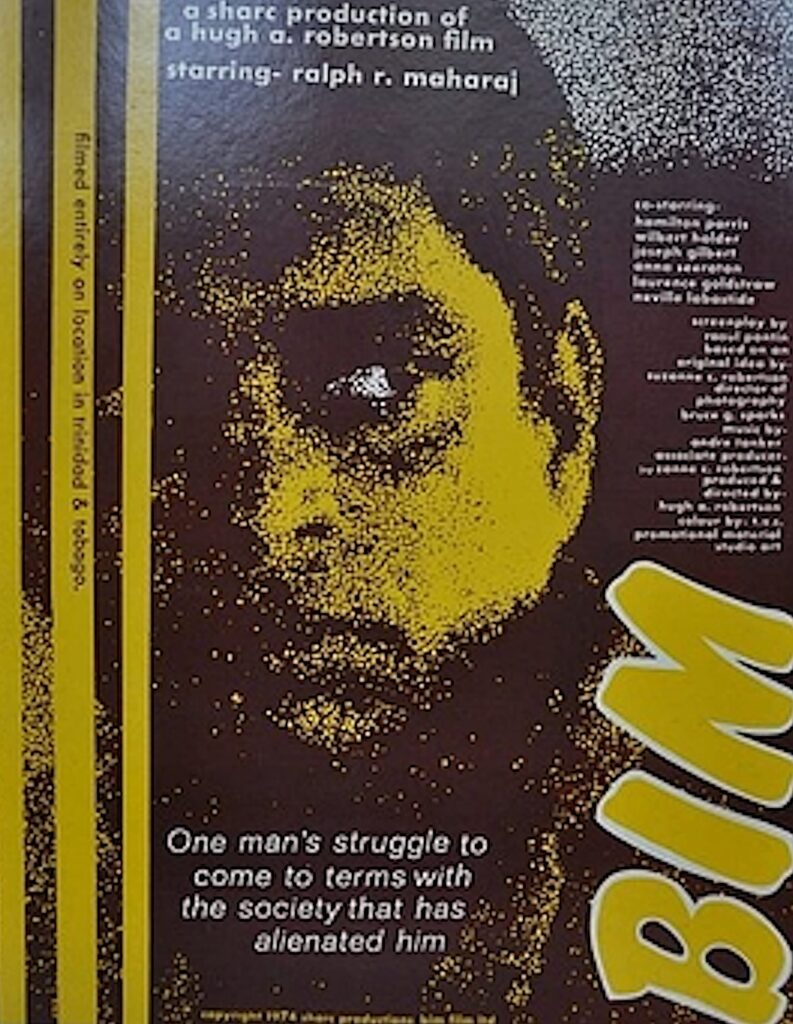
1974: TRINIDAD AND TOBAGO – BIM, BY HUGH A. ROBERTSON
Hugh A. Robertson has had an unconventional career path among Caribbean filmmakers. A New Yorker born to Jamaican parents, he got his start in the film industry at a very young age and held various positions, including that of editor on films such as the famous *Macadam Cowboy* (John Schlesinger, 1969), starring Dustin Hoffman and John Voight, and one of the classics of Blackploitation, *Shaft: The Red Nights of Harlem* (Gordon Parks, 1971), starring Richard Roundtree.
For his first film, he was nominated for an Oscar for Best Film Editing (a first for a Black person) and won the BAFTA that same year. After directing a few television projects and the feature film *Melinda* (1972)—a “Black Film,” as the poster put it—he moved to Trinidad and Tobago with his wife and children, where he directed Bim and then *Obeah* (1987), his second film, which was released upon the director’s death. Bim, modeled after the classic plot of a gangster movie, follows the life of a Trinidadian of Indian descent who, after enduring years of bullying from childhood onward, becomes a crime boss who eventually enters politics.
What stands out in this film is the direct nature of the interethnic conflicts, particularly between people of African and Indian descent (each group accounting for about 40 percent of the island’s population), ranging from the school setting to the political arena (where the white minority seems to be “pulling the strings”) and extending into marital life. Certain sequences have a strong ethnographic dimension: for example, the film opens with a traditional Hindu wedding.
While the latter is predominantly urban, much like *The Harder They Come* (Perry Henzell, 1972), Trinidad and Jamaica—which have major historic cities, Port-of-Spain and Kingston, respectively— work in the sugarcane fields—the historical foundation of most Caribbean societies—is highlighted in a plot set during the colonial era, amid the fervent independence movements of the 1950s and 1960s.
The strong political consciousness of this film echoes certain Trinidadian films that preceded it, such as *The Right and the Wrong* (1970) by Indian director Harbance Kumar, which depicts a revolt on a plantation at an unspecified time. Furthermore, Bim stands out for its energy and Ralph Maharaj’s impressive performance in the lead role. Given Robertson’s standing in the U.S. film industry, it’s not unreasonable to think that Brian De Palma might have seen his film, given Al Pacino’s brilliantly over-the-top performance in Scarface (1983) is so strongly reminiscent of Bim on several occasions.
1976: CUBA - THE LAST SUPPER (LA ÚLTIMA CENA), BY TOMÁS GUTIÉRREZ ALEA
This classic is a must-see film about the portrayal of slavery in the Caribbean, just as *Twelve Years a Slave* is for the southern United States, *Twelve Years a Slave* (Steve McQueen, 2013). Inspired by the novel *El Ingenio* (*The Plantation*) by Manuel Moreno Fraginals (which itself is based on true events), the plot of La Última Cena takes place on a slave plantation in Cuba in the 18th century, during Holy Week.
A wealthy landowner, a devout Catholic nobleman, decides to reenact the Last Supper around a lavishly set table, in the presence of twelve of his slaves. The group eats and drinks to their hearts’ content. The next day, the foreman wakes the slaves to send them to work in the sugarcane fields. A revolt breaks out…
In a film industry that, at first, rarely addressed the “Black Question” (to borrow the title of a book by the Trinidadian intellectual C.L.R. James), this film confronts the history of slavery—a reality shared by the vast majority of Caribbean countries—through a visual and auditory portrayal of rare precision regarding the “racialized” hierarchy specific to plantations: white and Black bodies do not occupy the same space (both literally and figuratively) nor do they have the same right to speak.
The banquet sequence (the famous reenactment of the Last Supper), which lasts nearly 45 minutes, displays great mastery both in terms of theater (dialogue and the actors’ performances) and cinema (technical editing, in which changes in camera angles reflect the power dynamics between characters). As for the final third of the film, it is one of the most beautifully staged depictions—through both camera movements and the framing of bodies and landscapes—of a slave revolt followed by a mass escape (the slaves’ flight from the plantation) ever made. A true masterpiece!

1979: GUADELOUPE - "COCO LA FLEUR," DIRECTED BY CHRISTIAN LARA
This film by the most prolific director from the French Antilles—who achieved the remarkable feat of directing nearly 25 films (even if it was sometimes under challenging technical conditions)—heralds the arrival of Antillean cinema. Two years earlier, in Martinique, the feature film *Dérives ou la femme-jardin* (1977), directed by Jean-Paul Césaire—one of the sons of the poet, politician, and champion of Négritude, Aimé Césaire—had not been given the chance for a commercial theatrical release.
Loosely based onAn Island in the Sun by Robert Rossen (1957), starring the famous Harry Belafonte, *Coco la Fleur, Candidate* is a political comedy that follows the journey of Coco, a so-called “apolitical” candidate controlled by technocrats from the prefecture, who decides during the campaign to take an interest in the future of his “country.” The demand—at the very least—for autonomy for Guadeloupe and Martinique is directly raised by the lead protagonist of this emerging cinema, who repeatedly takes on the role of the traditional Creole storyteller, a central figure in this body of films.
Furthermore, this film makes extensive use of the Creole language. It was a resounding success, drawing more than 100,000 viewers in Guadeloupe and Martinique, according to various sources, and remained in the lineup at the Louxor cinema in Paris for several years. An effective blend of lightheartedness and political activism that the director would brilliantly revisit in his third film, *Mamito* (1980), another classic of this cinematic tradition, whose main character is a Creole mother (a single mother raising her children on her own).
Played by the indispensable Lucrèce Saintol (who also plays Coco’s mother), who clearly illustrates the “feminocentricity” of Caribbean cinema—namely, the nearly systematic presence of strong women (fanm doubout) in this cinema. This significant presence of women was foreshadowed in *Dérives ou la femme-jardin*, a film loosely based on the short story Alléluia pour une femme-jardin by Haitian author René Depestre, featuring its enigmatic protagonist Isa.

About the Author
Guillaume Robillard holds a Ph.D. in film studies; he is a professor and researcher, a documentary filmmaker, and a specialist in Caribbean cinema and artistic production. He is the author of two books: *Conquest of Space and Time: Caribbean Cinema (Éditions Jannink, “Hypothèses d’Art,” 2023) and Decolonial Cinema: Characters in Caribbean Cinema (Presses Universitaires des Antilles, “Arts et Esthétique,” 2024).
"Stories of Caribbean Cinema" Series. Season 1, Episode 10 is already available on Richès Karayib. Stay tuned for Season 3, Episode 10 coming soon.
Four artists, four regions, four journeys. On September 19, 2026, the National Academy for the Performing Arts in Port of Spain will host a ceremony at which Patra, Calypso Rose, Alan Cavé, and Shyne will each receive a special award. The 2026 Caribbean Music Awards will bring them together on the same stage, but their journeys tell different stories about Caribbean music and its ability to transcend borders.
One Scene, Four Legacies
The announcement made by the Caribbean Music Awards highlights four distinct honors. Patra will receive the Lifetime Achievement Award. Calypso Rose will be honored with the Elite Calypso Honors. Alan Cavé will receive the Elite Konpa Honors, while Shyne will be awarded the Global Ambassador Award.
This selection almost maps out the region’s musical landscape. Jamaica, Trinidad and Tobago, Haiti, and Belize are thus represented by artists whose careers have taken very different paths. More than just a list of winners, this selection offers a glimpse into the cultural diversity of the Caribbean.
Patra, a leading figure in Jamaican dancehall
With Patra, the 2026 Caribbean Music Awards are honoring an artist associated with a significant period in the globalization of Jamaican dancehall. Her style, visual identity, and positioning have helped bring to the forefront a strong female presence in a musical world often dominated by male figures.
The Lifetime Achievement Award highlights this aspect of longevity and influence. It is not merely a matter of recalling past successes, but of recognizing an artist whose image remains closely tied to a pivotal moment in the spread of dancehall beyond Jamaica.

Calypso Rose, the Living Legend of Calypso
Calypso Rose represents a different story. A native of Tobago, she has for decades embodied the narrative power of calypso, a genre that reflects society, comments on its times, and transforms the stage into a space for expression.
The Elite Calypso Honors, therefore, highlight more than just an individual career. Through her, it also celebrates a musical tradition deeply rooted in Trinidad and Tobago. Her presence in Port of Spain will give this honor a special significance: that of an artist being honored in the very heart of the land to which her musical history remains intimately tied.

Alan Cavé and the Spread of Konpa
With Alan Cavé, Haitian konpa also takes its place in this regional landscape. The singer is one of those artists whose career has unfolded across Haiti, the diaspora, and audiences located far beyond his homeland.
His *Elite Konpa Honors* serves as a reminder that Caribbean music isn’t limited to the genres that enjoy high visibility in English-speaking markets. Konpa has its own networks, communities, and collective memory. Alan Cavé’s recognition brings this history back to the forefront of a scene designed to celebrate the sounds of the entire Caribbean.

Shyne: An Influence That Goes Beyond Music
Shyne’s career offers a fourth perspective. A native of Belize, he was honored with a Global Ambassador Award—a category that goes beyond musical performance alone. His public career has gradually combined music with representing and promoting his country on the international stage. This award thus broadens the very definition of cultural influence. Promoting the Caribbean can be achieved through a song, a musical genre, or an artistic career, but also through the ability to project a region’s image beyond its borders.

Four Ways to Experience the Caribbean
Bringing together Patra, Calypso Rose, Alan Cavé, and Shyne ultimately reveals what the 2026 Caribbean Music Awards aim to celebrate this year: not a single Caribbean musical identity, but multiple heritages capable of coexisting. Dancehall, calypso, konpa, and cultural representation don’t all tell the same story. Yet each demonstrates how a region can produce a voice that travels, transforms, and reaches new audiences.
In this context, their differences will thus become the true common thread: four distinct legacies, four different relationships with the world, and a shared ability to integrate Caribbean creations into international and sustainable cultural networks. On September 19, these four paths will converge in Port of Spain. And perhaps that is where the strength of this edition lies: in reminding us that the Caribbean shines precisely because it never speaks with a single voice.
Patra, Calypso Rose, Alan Cavé, and Shyne will each receive a special award at the 2026 Caribbean Music Awards.
Patra will receive the Lifetime Achievement Award, Calypso Rose will receive the Elite Calypso Honors, Alan Cavé will receive the Elite Konpa Honors, and Shyne will receive the Global Ambassador Award.
The 2026 Caribbean Music Awards ceremony will take place on September 19, 2026 at the National Academy for the Performing Arts in Port of Spain, Trinidad and Tobago.
In the Caribbean, a high energy bill can slow down a business. A storm can cut off a road, block a port, or jeopardize a harvest. A security crisis can also extend beyond the borders of a single country. It is against this daily reality that the Canada-CARICOM dialogue is taking on a new dimension today.
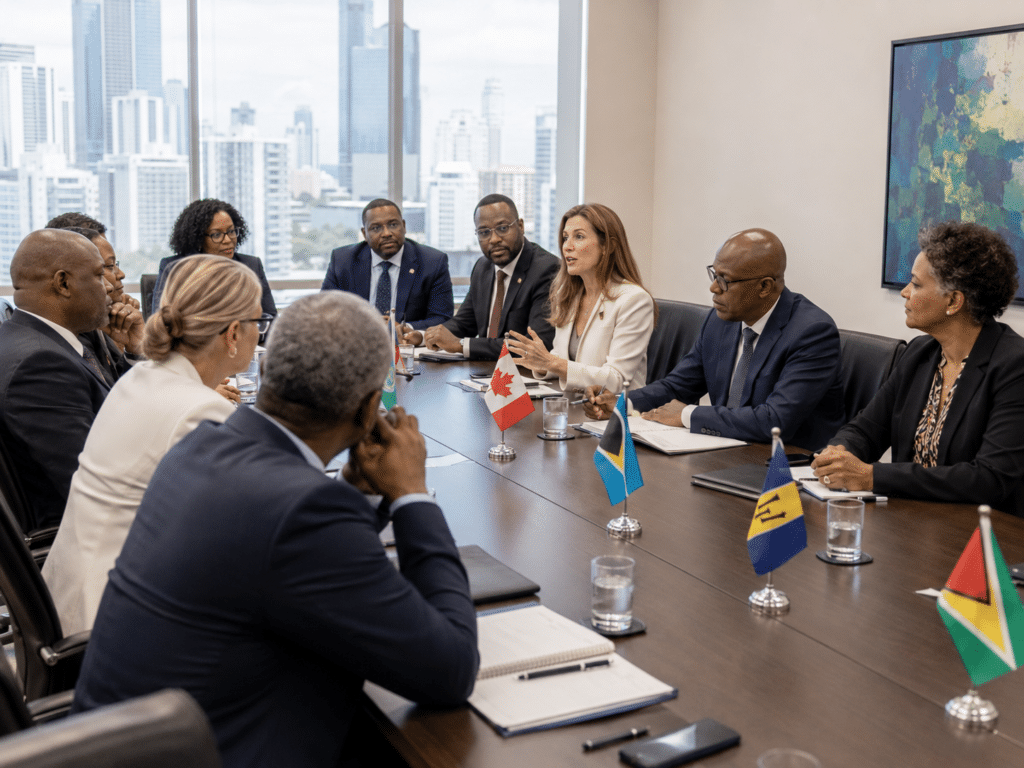
Meeting in Panama City on the sidelines of the 2026 General Assembly of the Organization of American States, the foreign ministers of Canada and CARICOM sought to reinvigorate their strategic partnership. At the heart of their discussions was an action plan focused on three major priorities for the region: security, climate, and the economy.
Cooperation Aimed at Achieving Concrete Results
The Canada-CARICOM partnership builds on the strategic agreement launched in 2023. But the 2026 meeting marks an important milestone: both parties now want to move forward with a plan that is more specific, clearer, and more measurable.
The goal is not merely to demonstrate diplomatic closeness. It is to establish priorities, timelines, and funding mechanisms capable of producing results. For Caribbean countries, this clarity matters. The region faces a range of interrelated challenges: energy costs, climate-related disasters, maritime security, financial vulnerability, and the crisis in Haiti. The Caribbean is not merely asking for aid. It is seeking partners capable of understanding its realities and working alongside it for the long term.
Security: A Regional Emergency
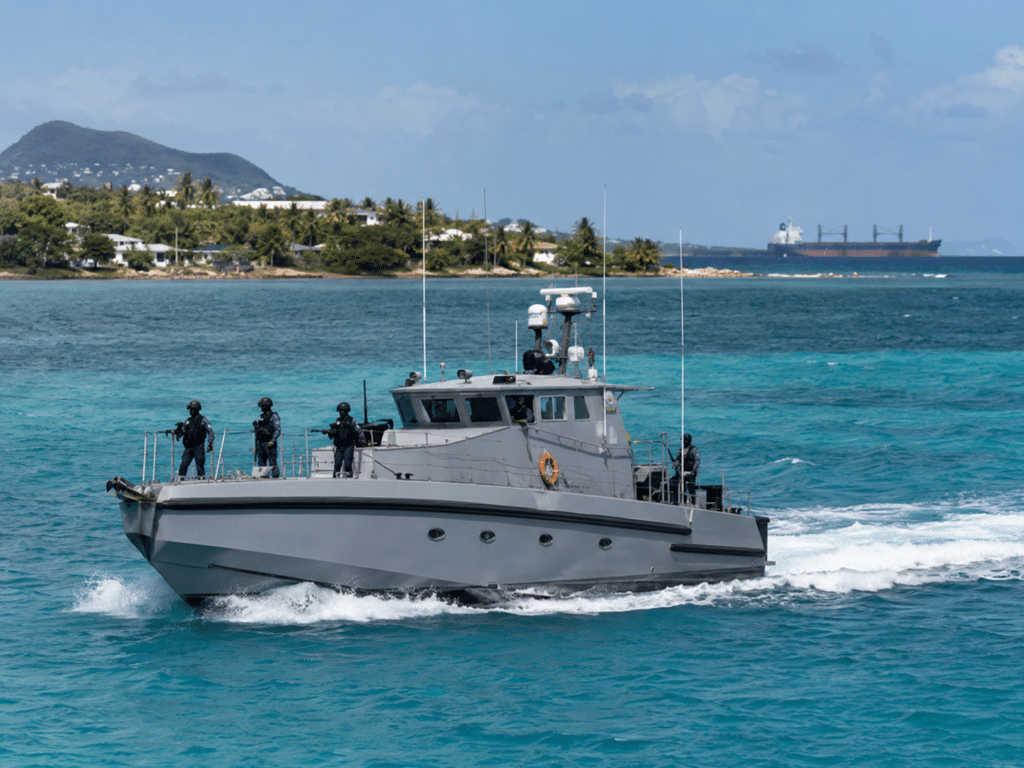
Security is central to this new Canada-CARICOM plan. The ministers discussed transnational crime, gangs, irregular migration, maritime security, and illicit flows. For the region, these issues are not isolated. The sea serves as a link, but it is also an area of vulnerability. Trafficking, criminal networks, cyberthreats, and political crises sometimes spread faster than institutional responses can keep up.
Canada already supports certain regional initiatives through capacity building, targeted interventions, and operational partnerships. The new challenge is to move toward a more coordinated response: better protecting maritime areas, strengthening institutions, sharing relevant information, and limiting the influence of criminal networks.
Haiti: A Crisis That Affects the Entire Caribbean
Haiti is a major focus of the discussions. The political, security, and humanitarian crisis the country is facing has direct consequences for the region. In particular, the ministers highlighted the risks associated with drug and arms trafficking. Support for the Gang Suppression Force was among the topics discussed. This force is intended to help restore security on the ground, with a mandate set to be renewed by the United Nations Security Council.
But the response cannot be limited to security measures alone. The ministers also reaffirmed the right of Haitians to choose their own government. They support the holding of credible elections as soon as conditions permit, as well as efforts to combat corruption and impunity. Haiti serves as a powerful reminder: no lasting stability in the Caribbean can be achieved by leaving a country to face such a profound crisis on its own.

Climate and the Economy: Two Sides of the Same Challenge
The new Canada-CARICOM plan also clearly links climate and the economy. In the Caribbean, a natural disaster is never just a weather event. It affects families, businesses, roads, schools, ports, and public finances. Access to reliable and affordable energy is once again a priority. Overly expensive energy stifles innovation and puts a strain on households. A more stable energy supply can support industry, services, investment, and the transition to more sustainable models.
Trade is also part of the equation. The CARIBCAN program, which grants duty-free access to the Canadian market for most products originating in 18 Caribbean Commonwealth countries and territories, remains an important tool. It serves as a reminder that the Canada-CARICOM partnership is not just about diplomacy. It also encompasses economic opportunities, supply chains, and the ability of Caribbean businesses to expand beyond their local markets.

Greater Attention to the Caribbean's Vulnerability
Another key aspect of the Canada-CARICOM partnership concerns financing. Several Caribbean states are considered middle-income countries. Yet their vulnerability to climate-related disasters, economic shocks, and supply disruptions remains very high. This is one of the region’s major paradoxes. On paper, some countries appear too “advanced” to easily access concessional financing. In reality, a single crisis can undermine years of progress.
The ministers therefore emphasized the need to reform the international financial architecture. The idea is simple: the actual vulnerability of small states must be taken into account more fully—not just their average income.

A plan to follow closely
The coming months will be crucial. Officials still need to finalize the details of the action plan, identify priority initiatives, develop an implementation schedule, and strengthen monitoring efforts. A dialogue among senior officials is scheduled for the fall to advance this work.
The Canada-CARICOM partnership alone will not solve the Caribbean’s challenges. But it says something about the current moment: the region wants to be heard as a strategic area, not just as a vulnerable one. Now the real question remains: Will this new plan bring about visible changes for Caribbean people, businesses, and territories?
The new Canada-CARICOM plan is a roadmap designed to strengthen cooperation between Canada and the Caribbean Community. It is based on three priorities: more resilient economies, climate action, and regional security. The goal is to move from a diplomatic partnership to more concrete actions, with timelines, measurable results, and sustainable financing mechanisms.
Haiti is a key focus because its political, security, and humanitarian crises have repercussions for the entire region. The ministers discussed drug and arms trafficking, support for the Gang Suppression Force, and the right of Haitians to choose their own government. For CARICOM, Haiti’s stability therefore remains a regional issue, not just a national one.
The Canada-CARICOM Partnership directly links climate and the economy. It emphasizes access to reliable and affordable energy, the development of trade, the strengthening of supply chains, and access to financing tailored to the vulnerabilities of small Caribbean states. The goal is to enable the region to better withstand natural disasters, economic shocks, and international crises.
A constraint that can become a value
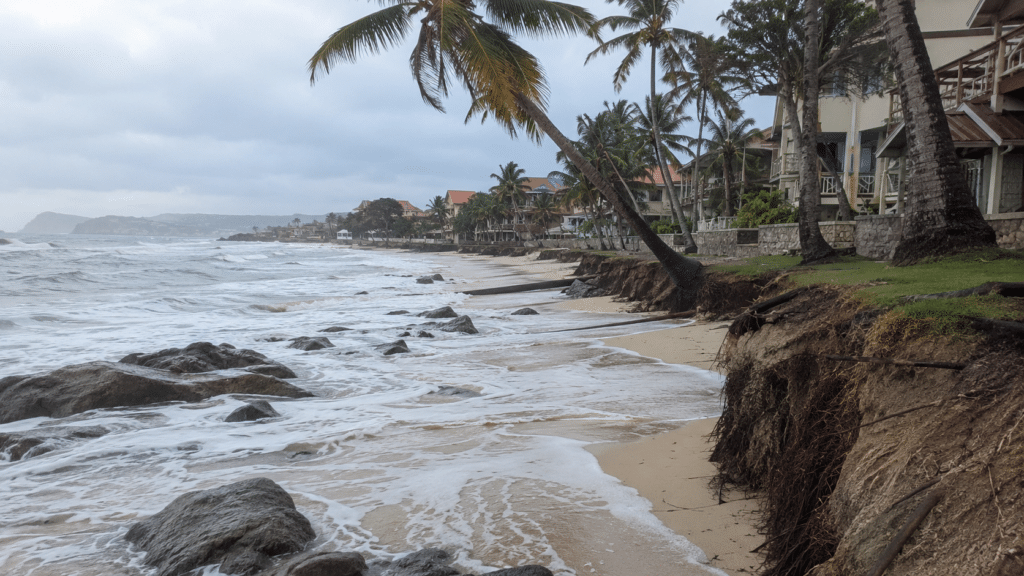
The Caribbean is experiencing climate change directly, brutally and continuously. More intense cyclonic seasons, accelerated coastal erosion, fragile coral ecosystems, energy vulnerability: no island in the region has been totally spared. For a long time, this reality has been presented as a constraint for public budgets, for tourism operators and for economic models based on the classic spa industry.
The Travel Dreams 2026 report by Amadeus, however, suggests a possible turnaround. What was once perceived as a fragility can become a value proposition, as long as it is acknowledged and accurately portrayed. This is where the notion of visible sustainability becomes central.
What travellers say
The study first documents the scale of demand. Of the 6,000 travelers surveyed across six major global markets, 75% say that a hotel’s sustainability commitments are important in their booking decision. More than one in three, precisely 35%, consider them “very important”.
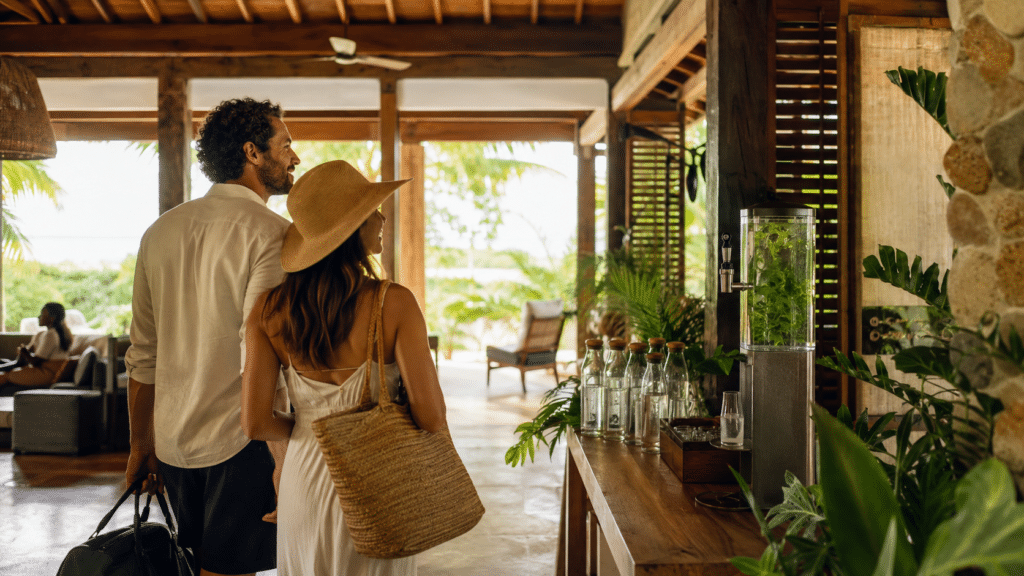
And this concern translates into willingness to pay. Travelers who place importance on this criterion say they are willing to spend an average of 11.7% more per night to stay in an establishment with serious sustainable practices. This represents around $29 more on a $250 room. Among Generation Z travelers, this willingness rises to 14.7%, or almost $37 more per night. Visible sustainability starts here: in a hotel’s ability to communicate why these practices are worth more.
One data point deserves particular attention for the Caribbean: sensitivity to sustainability varies greatly according to source markets. It reaches 93% of travelers surveyed in India and 85% in China, compared to 65% in the UK and Germany. For a region seeking to reduce its dependence on traditional markets, these discrepancies open up a strategic avenue to be handled with caution. These travelers won’t be satisfied with a generic discourse on nature. They’ll be looking for evidence, visible features, documented stories. For the Caribbean, visible sustainability can become a way of speaking to these audiences without denying its local roots.

What hotels do
On the supply side, Amadeus data show a widespread commitment among the hoteliers surveyed. Of the 500 general managers or equivalent profiles consulted across nine countries, all say they plan to spend on sustainability initiatives in the coming year. The average anticipated expenditure represents 6.7% of total company expenditure. And 35% of hoteliers identify sustainability as a key differentiating factor from their competitors.
But the study also highlights a revealing discrepancy. Hotels invest primarily in actions that have an internal operational efficiency rationale: water conservation (33%), sustainable catering supply (33%), responsible supply chains (33%), waste reduction (32%), staff training (32%).

On the other hand, practices that are more visible to the customer, such as renewable energies (28%), biodiversity and community initiatives (27%), and the link between sustainability and loyalty programs (21%), remain less developed. It is this tension that makes visible sustainability strategic: it forces us to move from internal effort to an experience understood by the traveler.
Closing the gap
Joerg Schuler, Head of Global Hospitality Sales at Amadeus, sums up this discrepancy by talking about sustainability as being more “visible, experiential and integrated into the stay”. The formula is important, because it changes the subject. It’s no longer just a question of saying that a hotel consumes less water or reduces its waste. It’s about making these choices understandable, concrete and experienced by the traveler. Visible sustainability therefore requires not only proof, but also an accurate narrative.

This gap is precisely what the Caribbean can bridge. Visible Caribbean sustainability is not an abstract technical program. It can be embodied in visible, relatable, situated practices. Restoring mangroves. Coral reef protection. Local solar energy. Short-distance sourcing from small island producers. Saving water in contexts where the resource is precious. Passing on traditional knowledge of how to use the environment sparingly.

Each of these practices can be both a serious environmental commitment and a story that travelers can experience during their stay. It is this articulation that transforms visible sustainability into perceived value, and thus into pricing leverage.
A value to be documented
A Caribbean hotel that can document, with figures, identified partners and measurable results, its role in restoring a local ecosystem is no longer just selling a room. It’s selling participation in a broader regional project. Travelers surveyed by Amadeus have already indicated their willingness to pay for this. Visible sustainability therefore requires showing what is being done, by whom, with what effects.

This logic goes beyond the individual hotel business. It also concerns destination management bodies, tourism authorities and regional economic players. A region’s ability to credibly communicate its ecological commitment is becoming a competitive variable in the face of other tropical destinations. At destination level, visible sustainability can become a common language for hotels, producers, associations, communities and travellers.

The Caribbean challenge
For the Caribbean, the challenge is not to become sustainable in the sense that other regions understand it. It is to make legible a sustainability that, in many cases, is already practiced at the level of communities, small businesses, local cooperatives and inherited know-how. The global market is willing to pay for it. The question is whether the region will be able to present this reality with the appropriate rigor, coherence and pride.

This series of articles, in its three parts, has attempted to defend the same thesis. The expectations of travelers in 2026 – disconnection, connection to place, visible sustainability – are not constraints that Caribbean players have to endure. They are expectations that the region structurally bears, by virtue of its geography, cultures and history. What remains, as always, is the patient task of putting them into words. This is the editorial mission that Richès Karayib will continue to carry out, alongside the region’s economic, institutional and creative players.
Visible sustainability refers to the set of sustainable commitments that a traveler can actually see, understand or experience during their stay. It’s not just about internal measures, such as reducing water costs or limiting waste behind the scenes. In the Caribbean, this can take the form of solar power clearly integrated into the hotel, a mangrove restoration program, coral reef protection, sourcing from local producers or community actions presented with concrete results. This approach makes the ecological commitment more legible and credible for the traveler.
Visible sustainability can become a competitive advantage as travelers increasingly value hotels’ environmental commitments. According to the data used in the article, a majority of travelers consider these commitments to be important when choosing an establishment, and a proportion are even willing to pay more for serious practices. For Caribbean hotels, the challenge is not only to act, but also to document and tell the story of these actions with precision. An establishment capable of demonstrating its local impact is no longer just selling a room: it is proposing participation in a local project.
Caribbean destinations can better promote their visible sustainability by linking the actions of hotels, producers, associations, local authorities and communities into a coherent narrative. This requires proof: figures, identified partners, measurable results, actions monitored over time. A destination that explains how it protects its reefs, saves water, supports short circuits or restores its ecosystems builds a stronger promise than a simple discourse on nature. For the Caribbean, this storytelling is strategic, as it transforms real climate vulnerability into a cultural, ecological and economic value proposition.
In New York, Caribbean flags are never seen by chance. In June, they tell a family story, a memory of exile, a sense of belonging that crosses American islands and cities. In Manhattan this Monday, June 1, the Caribbean Tourism Organization officially opens Caribbean Week New York 2026. Business forums, professional meetings, cultural presentations: for five days, from June 1 to 5, the American metropolis becomes one of the major meeting points for the organized Caribbean. And this year, the event takes on a special dimension. Caribbean American Heritage Month marks twenty years of national recognition.
A Caribbean week in the heart of New York City
In 2026, Caribbean Week NY will focus on the theme “One Caribbean: Infinite Experiences”. Caribbean American Heritage Month, on the other hand, focuses more broadly on the idea of memory, identity and unity. Three words sum up the spirit of this year’s Caribbean American Heritage Month. Independence, because Caribbean peoples continue to construct their own narratives. Identity, because it is forged as much in the islands as in the cities of the North. Unity, finally, because Caribbean countries, territories and communities can recognize themselves in a common history without erasing their differences.

Claire Nelson, one of the decisive voices of the Caribbean-American month
Claire Nelson knows this story well. Founder of the Institute of Caribbean Studies in Washington, she championed the idea of a national month dedicated to Caribbean contributions to the United States in the late 1990s. After several years of advocacy, the initiative made headway in Congress with the support of Congresswoman Barbara Lee. In June 2006, President George W. Bush signed the Presidential Proclamation officially recognizing June as Caribbean American Heritage Month in the United States. Without Claire Nelson, without the Institute of Caribbean Studies, without Barbara Lee, this national event would probably not have taken on such importance.

From recognition to visibility
Twenty years on, it’s not just about recognition. It’s visibility. The 2026 program reflects this expansion: Caribbean book fairs, Caribbean Restaurant Week, DC Caribbean Film Festival, then a legislative week from June 8 to 11 with exchanges devoted to Caribbean interests on Capitol Hill. In New York, the New York Public Library is also planning activities during the month, starting with a screening of Bob Marley: One Love on June 1 at the Mott Haven Library in the Bronx.


A Caribbean diaspora that counts in the United States
The U.S. Caribbean diaspora is not marginal in the ethnic mosaic of the United States. According to the Migration Policy Institute, immigrants born in the Caribbean region were estimated to number 5.3 million in the United States in 2024, representing around one tenth of the country’s immigrant population. If descendants born on American soil are added, the Caribbean presence far exceeds the first generation. New York, Miami, Boston, Orlando, Tampa, as well as Washington and Atlanta, are home to structured communities, visible in businesses, churches, associations, local media and cultural events.
Jamaicans, Trinidadians, Haitians, Dominicans, Puerto Ricans, Cubans, Barbadians, Guyanese, Bahamians: the list is long, and each community defends its own identity while participating in a shared pan-Caribbean narrative. This diasporic singularity deserves to be named precisely. Unlike other communities with a single national origin, the Caribbean diaspora in the United States often operates on a dual register: national pride and regional awareness. The month of June does not erase the first sense of belonging. It activates the second. It’s a time when island flags can appear together, from Brooklyn to Little Haiti, without each story losing its voice.


Caribbean figures in American history
American history is itself criss-crossed by Caribbean figures that many still ignore. Alexander Hamilton, the first U.S. Secretary of the Treasury and architect of the American financial system, was born in Nevis, in the British West Indies, before he left for the American colonies. Sidney Poitier, a Bahamian-American actor, became the first black actor to win the Oscar for Best Actor in 1964, for Lilies of the Field. Audre Lorde, poet and leading thinker of black feminism, grew up in New York in a family of Caribbean origin. Colin Powell, America’s first black Secretary of State, was the son of Jamaican parents.
The list continues with Harry Belafonte, Cicely Tyson, Stokely Carmichael (now Kwame Ture), Marcus Garvey and Shirley Chisholm. The latter, the first black woman elected to the US Congress, was born in Brooklyn into a family with roots in Barbados and Guyana. These names do not form a symbolic gallery. They show how the Caribbean has participated, sometimes from the margins, in writing central pages in the political, artistic and social history of the United States.
Guyana, Jamaica, Trinidad and Tobago: memories in motion
For the Guyanese diaspora, Caribbean American Heritage Month this year extends the 60th anniversary of Guyana’s independence, marked at the end of May in Brooklyn. In Jamaica, the press revisited the 30th anniversary of the Sinbad Soul Music Festival, associated with Montego Bay and the rise of music tourism aimed at African-American audiences. For Trinidad and Tobago, Caribbean American Heritage Month also spotlights Claudia Jones, a Trinidadian journalist and activist deported from the United States in 1955, considered one of the founding figures of the Caribbean Carnival in London, whose legacy has nourished the Notting Hill Carnival.

A transmission framework for new generations
Twenty years after the 2006 presidential proclamation, Caribbean American Heritage Month is no longer just a calendar or a series of events. It has become a framework for transmission. It enables the diaspora to recognize, document and tell new generations what it means to be Caribbean, American, island, urban, national and regional. The work is not finished. But in 2026, in Manhattan, Brooklyn, Miami, Washington or Boston, millions of Caribbean-Americans are preparing to continue it, each with their own accent, flag and memory.
Each June, Caribbean American Heritage Month is dedicated to recognizing the contributions of Caribbean people and their descendants to the United States. It highlights the history, culture, migratory patterns, public figures and social, artistic and political legacies of the Caribbean. In 2026, it takes on a special dimension, as it marks twenty years of national recognition since the presidential proclamation of 2006.
Caribbean Week NY is important in 2026 because it opens the month of June in a highly symbolic context: the 20th anniversary of Caribbean American Heritage Month. Organized in New York, it brings together tourism players, institutions, diasporic communities and Caribbean representatives with a common goal: to make the Caribbean’s place in the American space more visible. It also shows that culture, tourism and diasporic memory are closely linked.
The Caribbean diaspora plays a major role in the United States, culturally, politically, economically and socially. Present in New York, Miami, Boston, Washington and Atlanta, it brings together communities from Jamaica, Haiti, Trinidad and Tobago, Guyana, Cuba, Puerto Rico, the Dominican Republic, Barbados and the Bahamas. Caribbean American Heritage Month helps us better understand this dual sense of belonging: national pride specific to each island or territory, and a shared Caribbean consciousness.
A global report published in early 2026 by Amadeus reveals what travelers will be looking for in 2026. The Caribbean has always carried it.
There’s a precise moment, in a Caribbean village in the early hours of the morning, when the noise of the world seems to stop. The first lights fall on the facades, a voice answers from one courtyard to another, the smell of coffee mingles with that of the nearby sea. Hardly anyone checks their phone. Life is there, in front of us, denser than any notification. This scene, commonplace for anyone who lives in the Caribbean, is precisely what millions of travellers around the world are now looking for.
When the world is looking to get off the hook
These are the findings of Travel Dreams 2026: From data to delight, a study published in early 2026 by Amadeus, one of the world’s leading technology players in tourism. Conducted by Opinium Research among 6,000 travelers in Australia, China, Germany, India, the UK and the USA, the survey identifies a profound shift in contemporary expectations.
Asked what makes them feel they’ve reached their dream destination, 32% of travelers say “when I stop looking at my phone because real life is more interesting”. This is the top answer, far ahead of the others. Another statistic from the same report extends this observation: 41% of travellers say they want to return from their trip with “a refreshed brain and a calmed nervous system”.


Travel as a response to collective exhaustion
These figures are not anecdotal. They tell of a collective exhaustion. In a world saturated with screens, high-performance productivity and manufactured urgency, travel is no longer a trophy to be collected, but a means of rediscovering a quality of presence. The Amadeus report puts it bluntly: travelers are looking to feel “genuinely alive, not just ticking off landmarks”.


What the Caribbean has always carried
This shift in expectations is global, but it offers the Caribbean a special reading. The region didn’t wait for a study to cultivate what the market is rediscovering today. The density of the Caribbean present, the thickness of a conversation on a doorstep, the slowness of a shared meal, the way in which the landscape imposes its rhythm on those who cross it, is not a marketing strategy. It’s a heritage. It comes from languages, from multiple spiritual heritages, from a long relationship with the sea and the land, from the memory of the peoples who made these islands.


Four global expectations already present in the region
The same Amadeus study identifies four main sensations sought by travellers from a destination: freedom (29%), connection to a place (24%), discovery (22%) and ease (17%). Structurally, the Caribbean offers these four dimensions without having to transform itself. The freedom of open itineraries, connection to places that still resist tourist standardization, ongoing discovery – each island has its own language, its own rhythms, its own history – and the ease of hospitality that is measured not in added services but in the attention paid.


Breaking out of the generic imaginary
The challenge, then, is not for the Caribbean to invent a new offer. It’s about making visible what it already has. All too often, the communication of Caribbean destinations remains trapped in a generic imaginary of beaches, palm trees and sunshine, which says nothing about the real depth of the experience. But what the Amadeus report documents is precisely the end of this imaginary world. Travelers are no longer asking for a postcard. They’re asking for a return to themselves.

A strategic window of opportunity for Caribbean players
For the region’s economic players – DMOs, independent hoteliers, cultural operators, tourism ministries – this global data opens up a strategic window. It validates an intuition that has been circulating in the region for years: the Caribbean doesn’t have to chase global tourism trends. On the contrary, it needs to strongly articulate what sets it apart. Silence is no longer lack. Slowness is no longer delay. The density of a local presence, handed down from generation to generation, is becoming a major economic asset in a market desperate for the real thing.
That leaves us with a question that sets the scene for the next pages in this series. If the Caribbean does indeed have what the world is looking for in 2026, what’s stopping it from saying it with the appropriate force?
Caribbean tourism 2026 responds to a growing expectation: travel to slow down, reconnect with real life and regain mental balance. The Amadeus report highlights travelers who are no longer looking just for landscapes, but for a sense of presence, calm and connection with a place. The Caribbean already possesses these elements in its villages, languages, daily rhythms, community ties, relationship with the sea and different ways of inhabiting time.
The Caribbean can distinguish itself by moving away from a form of communication too limited to beaches, sunshine and postcards. Its strength lies in the depth of its territories: memories, languages, culinary traditions, music, spirituality, inhabited landscapes and human relationships. In 2026, travelers are looking for authenticity, freedom and connection to place. So it’s in the region’s interest to tell a better story about what it already has, rather than copying global tourism trends.
This evolution concerns tourist offices, independent hotels, guides, cultural operators, restaurateurs, craftsmen, local authorities and tourism ministries. Everyone can contribute to repositioning Caribbean tourism 2026 around experiences that are more human, more rooted and more faithful to the territories. The challenge is not only to attract more visitors, but also to make the most of what makes each island unique, while creating fairer economic benefits for local communities.
In Port of Spain, history was never just a matter of archives. It was also told in public squares, in schools, in family conversations, where a colonial society was looking for the words to think differently about itself. Eric Williams understood the power of storytelling very early on. Before becoming head of government, he made history an instrument of collective lucidity.
A historian before the head of government
Born in Port of Spain on September 25, 1911, Eric Williams grew up in a Trinidad still part of the British colonial order. His schooling took him to Queen’s Royal College, then to Oxford University, where he obtained his doctorate in 1938. This passage through one of the great institutions of the imperial world gives his work a special significance: he knows the codes of British academia, but uses them to interrogate the history of empire from the perspective of the Caribbean.
This intellectual trajectory takes on a major dimension with Capitalism and Slaverypublished in 1944. The book defends a thesis that has left a lasting mark on Caribbean studies: slavery, the slave trade and abolition must also be understood in their relationship with British economic interests. According to Britannica, Eric Williams was a Caribbean historian, founder of the People’s National Movement and first Prime Minister of independent Trinidad and Tobago.


1962, an independence conceived as a national pedagogy
When Eric Williams founded the People’s National Movement in 1956, he didn’t just organize an electoral machine. He built a political language. He spoke of history, education and collective responsibility. In a society made up of multiple African, Indian, European, Creole and religious heritages, independence could not be reduced to changing a flag. A common consciousness had to be created without erasing differences.
On August 31, 1962, Trinidad and Tobago became independent. This date remains central in the national memory, as it marks the country’s official entry into sovereignty. But it takes on even greater meaning when we link it to the life of Eric Williams. For him, political independence had to be underpinned by intellectual independence. A people could not simply receive its history from London, from colonial textbooks or from outsiders. They had to learn to read their own past.
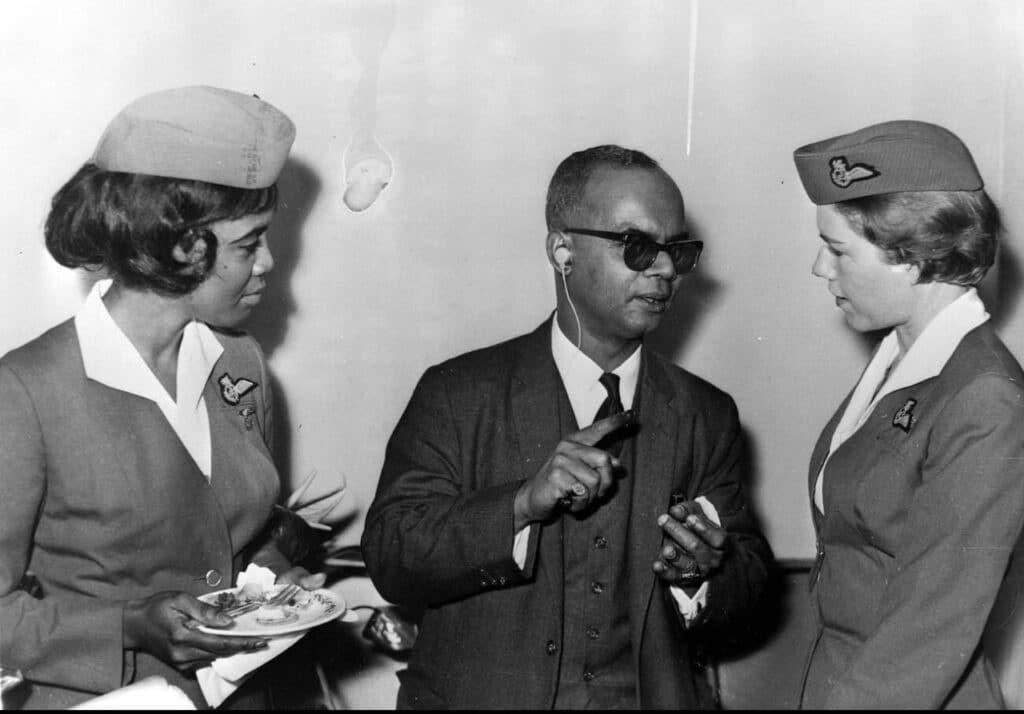

Woodford Square, the open-air university
Eric Williams ‘ uniqueness also lies in the way he transmits. At Woodford Square, in the heart of Port of Spain, his public interventions helped transform the urban space into a place for popular education. It wasn’t a classical amphitheatre. It was a square, with citizens, workers, students, onlookers and opponents. Knowledge came out of the libraries and into civic life.
This method explains part of his authority. Eric Williams didn’t just speak to administrative elites or graduates. He was speaking to a people in political formation. He posited a simple yet demanding idea: understanding the history of slavery, colonization, labor and institutions would help us better understand the choices of a new country. From this perspective, history was not nostalgic. It served to prepare for the future.

A national figure, a Caribbean heritage
After independence, Eric Williams remained in power until his death on March 29, 1981. His political longevity demands a nuanced reading. He remains the central builder of the modern Trinidadian state, but also a figure of authority whose imprint profoundly structured public life. As is often the case with the founding fathers, admiration must not prevent analysis. His legacy is immense because it is also complex.
Yet the regional scope of his work goes beyond national debates. The UNESCO dossier devoted to Eric Williams Collection underlines the importance of his archives for the history of Trinidad and Tobago, the Caribbean and international relations. This recognition shows that his work is not just about a territory. It is part of a broader question: who has the right to tell Caribbean history, and from what point of view?
What his career still has to say to the Caribbean
You have to stay on the right scale. Eric Williams belongs first and foremost to Trinidad and Tobago. His story does not sum up the entire Caribbean. But it speaks to the region because it reveals a common tension: how to transform a colonial memory into a political force, without freezing it in resentment or reducing it to an official symbol?
This is where his singularity remains strong. He did not separate the intellectual from the political. He did not treat history as a patriotic decoration. He used it as a method for building a state, naming dependencies, shaping citizens and giving depth to independence. In a Caribbean still confronted with imported narratives, economic fragility and fragmented memories, this requirement remains relevant today.
Eric Williams leaves us with a wider lesson than his biography. A nation is not only built with laws, buildings and ceremonies. It is also built with the narratives it accepts to transmit, discuss and sometimes correct. In Trinidad and Tobago, as elsewhere in the region, the question remains open: what places today still play the role of Woodford Square in shaping the Caribbean consciousness of tomorrow?


Eric Williams was a Trinidadian historian, founder of the People’s National Movement and first Prime Minister of Trinidad and Tobago after the country’s independence in 1962.
Eric Williams is important because he led Trinidad and Tobago to independence while defending the idea that a Caribbean people should know and write its own history.
The link between Eric Williams and Caribbean history stems in particular from his book Capitalism and Slaverywhich contributed to a new reading of the relationship between slavery, the colonial economy and the British Empire.
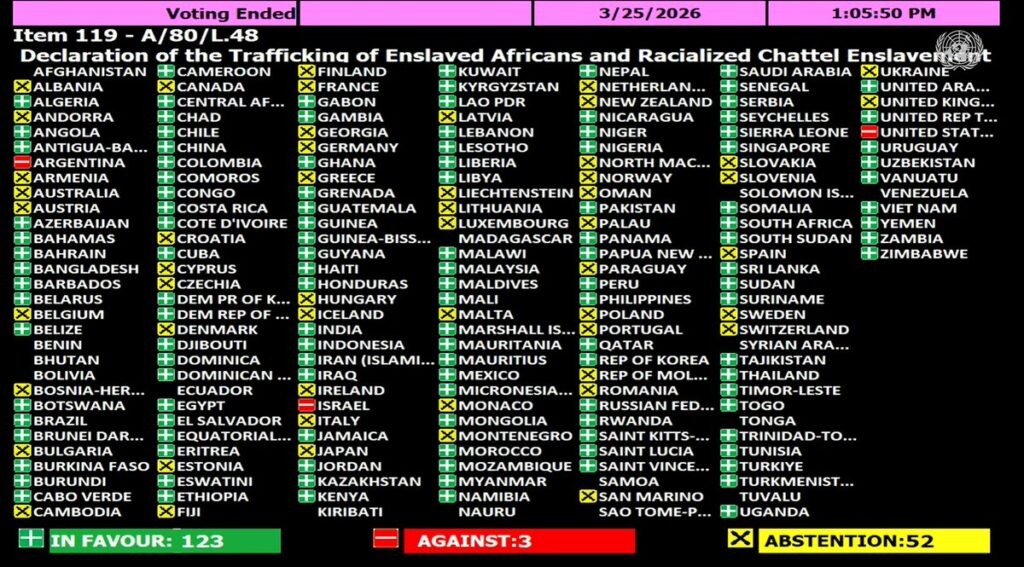
On March 25, 2026, the UN General Assembly adopted a resolution that marks a milestone in the international recognition of the history of slavery. The text qualifies the transatlantic African slave trade and racialized chattel slavery as the most serious crime against humanity. The text, sponsored by Ghana, was adopted by 123 votes in favor, with 3 against and 52 abstentions. Opponents included the USA, Argentina and Israel, while several European countries, including the UK, chose to abstain. Behind this strong wording is more than just a symbolic gesture. For the Caribbean, this decision is part of a historical and political continuity, echoing decades of work, demands and struggles for fairer recognition of this memory.
Recognition that redefines the international debate
By classifying slavery as a major crime against humanity, the UN has crossed a threshold rarely reached by international bodies. This recognition does not create an immediate legal obligation for States, but it profoundly alters the framework of global debate. It introduces a more explicit reading of history, in which the transatlantic slave trade is no longer merely evoked as a past tragedy, but as a crime whose consequences continue into the present.
This evolution in international discourse is not insignificant. It comes at a time when issues relating to colonial legacies, structural discrimination and historical inequalities are taking on increasing importance in public debate. By taking a clear stance, the UN is helping to legitimize the analyses long put forward by Caribbean researchers, institutions and cultural players, who stress that the history of slavery cannot be dissociated from contemporary realities.
The Caribbean, at the heart of history and current issues
For the Caribbean territories, this decision is more than just a historical observation. It has a direct bearing on their very construction. The transatlantic slave trade and the slave system have shaped the region’s economies, societies, languages and cultures. Plantations, land structures, social hierarchies and even some of today’s economic dynamics have their roots in this period.
Recognition by the UN thus confirms a reality that the Caribbean has never ceased to bear: that of a founding history, the effects of which are still visible. It also repositioned the region in the global narrative, not as a peripheral space, but as a central territory in the understanding of the great historical transformations linked to slavery and colonization.
This international recognition also offers a strategic opportunity. It strengthens the capacity of Caribbean territories to influence global discussions on memory, justice and reparations. It gives added legitimacy to the steps already taken by certain regional institutions, which have been working for several years to structure concrete proposals on these issues.


Reparations and memorial justice: a new dynamic
One of the most important effects of this resolution concerns the issue of reparations. By classifying slavery as a major crime against humanity, the UN opens the way to more structured discussions on forms of restorative justice. This includes avenues such as official apologies, the restitution of cultural property, the funding of educational programs and public policies aimed at correcting the inequalities inherited from this history.
In the Caribbean, these issues are not new. They are part of a long-standing process, driven in particular by regional initiatives seeking recognition of the lasting consequences of slavery. The UN decision does not create a binding framework, but it changes the balance of power by giving international support to these claims.
It can also encourage better structuring of remembrance policies. In many regions, the transmission of the history of slavery remains uneven and sometimes fragmented, despite the fact that it is central to understanding today’s societies. UN recognition can serve as a lever to strengthen educational programs, support research and enhance the value of places of remembrance.

Recognition that also reveals tensions
The vote on this resolution highlights persistent differences within the international community. While a large majority of States supported the text, certain oppositions and abstentions show that the issue remains sensitive. The reservations expressed relate in particular to the political and historical implications of this qualification, as well as to the consequences it could have in terms of reparations.
These tensions are a reminder that there is no absolute consensus on the recognition of slavery as a major crime. It remains a subject of debate, where diplomatic stakes, historical responsibilities and economic considerations are intertwined. For the Caribbean, this situation confirms that the battle for full recognition of this history is still ongoing.
Rethinking the Caribbean narrative on a global scale
Beyond the political stakes, this decision offers an opportunity to redefine the way the Caribbean is told internationally. All too often reduced to a simplified tourist or cultural image, the region has a complex history marked by violence, resistance and reconstruction.
The UN’s position puts this history back at the center of the global narrative. It invites us to consider the Caribbean not only as a space of memory, but also as a place of intellectual and political production. The region’s reflections on slavery, colonization and their consequences continue to inform contemporary debates far beyond its borders.
For a medium like RichèsKarayib, this news underlines the importance of offering a demanding, contextualized reading of the Caribbean territories. It reminds us that the region’s culture, history and economic issues are deeply intertwined, and must be approached in their entirety.

Turning recognition into leverage
The real impact of this resolution will depend on the actions that follow. International recognition is a step forward, but it is not enough on its own to bring about concrete change. For the Caribbean, the challenge now is to transform this decision into a lever for action, by strengthening cooperation, structuring public policies and consolidating research and transmission initiatives.
The UN has set an important milestone by classifying the transatlantic slave trade and slavery as a major crime against humanity. For the Caribbean territories, this recognition represents an opportunity to advance essential debates linked to their history and development. It opens up a new way of thinking about international relations, by fully integrating the legacies of the past into the construction of the present and the future.

The UN decision adopted on March 25, 2026 recognizes the transatlantic slave trade and slavery as the most serious crime against humanity. It aims to affirm the historical gravity of these events, and to encourage international discussions on remembrance, justice and reparations.
No, this UN resolution is not legally binding. It does not impose direct obligations, but it does have a strong political and symbolic impact that can influence international discussions and public policy.
The Caribbean has been deeply marked by the transatlantic slave trade and slavery. This recognition by the UN validates a historical reading that has long been held in the region, and can support initiatives linked to remembrance, education and reparations.
The integration of Richès Karayib into the Caribbean Broadcasting Union (CBU) marks a new stage in the development of Caribbean media. This membership formalizes Richès Karayib’s regional roots and reinforces its determination to actively contribute to the structuring of the Caribbean media landscape.
In a context where the circulation of content remains fragmented between linguistic and geographic territories, joining the Caribbean Broadcasting Union represents a strategic lever for boosting the visibility and circulation of Caribbean content.
The Caribbean Broadcasting Union, a pillar of the Caribbean media landscape
The Caribbean Broadcasting Union is the regional organization that federates the Caribbean media, covering radio, television, print and digital platforms. It plays a central role in cooperation between broadcasters, the circulation of content, the professionalization of players in the sector and the promotion of Caribbean productions.
Every year, the Caribbean Broadcasting Union organizes the CBU Media Awards. These awards recognize the most outstanding productions in radio, television, print and digital. These awards are a major event for Caribbean media professionals, helping to raise standards of journalistic and editorial quality in the region. By becoming a member of the Caribbean Broadcasting Union, Richès Karayib joins a structured and recognized network at the heart of regional media dynamics.

A strategic step for Richès Karayib
Since its creation, Richès Karayib has been promoting culture, heritage, tourism and the women and men who shape the Caribbean’s attractiveness and influence. Membership of the Caribbean Broadcasting Union consolidates this trajectory by opening up new prospects:
- – publishing cooperation on a regional scale
- – increased circulation of content
- – professional exchanges between member media
- – enhanced visibility with institutional and economic players
Joining the Caribbean Broadcasting Union also enables Richès Karayib to place its productions within a demanding regional framework, where content quality, journalistic rigor and editorial impact are decisive. This new step comes at a time when the medium is developing its print, digital and audiovisual formats, with a clear ambition: to connect Caribbean territories beyond linguistic borders.
Building a structured Caribbean media space
The Caribbean is rich in talent, culture and initiative. However, content produced in one territory is still not widely distributed to other islands and countries in the region. One of the major challenges of the Caribbean Broadcasting Union is precisely to promote this circulation and encourage regional collaboration.
By joining the Caribbean Broadcasting Union, Richès Karayib is affirming its desire to play an active part in this dynamic. This is not just institutional recognition, but a commitment: to contribute to a more connected, visible and structured Caribbean media.
This approach is in line with Richès Karayib’s mission to promote the region’s talents, initiatives and heritage, while encouraging synergies between regions.
Setting course for the CBU Media Awards
As part of this membership, Richès Karayib will take part in the 37th CBU Media Awards organized by the Caribbean Broadcasting Union. Richès Karayib’s participation is in line with the company’s commitment to professionalization and regional outreach.
Beyond the competition, the CBU Media Awards represent a space for Caribbean media to meet, exchange ideas and gain visibility. For RK, it’s a further opportunity to promote a committed editorial voice in the service of the Caribbean.

A new development phase
Joining the Caribbean Broadcasting Union marks a natural evolution for Richès Karayib. After consolidating its presence in the French-speaking Caribbean, the medium is now taking a decisive step towards wider regional integration.
In a changing media environment, where cooperation, editorial quality and international visibility are essential, joining the Caribbean Broadcasting Union is a strong signal.
Richès Karayib’s ambition is to contribute to a more visible, coherent and assertive Caribbean media.
The Caribbean Broadcasting Union (CBU) is the regional media organization for the Caribbean, covering radio, television, print and digital platforms. It promotes cooperation, the circulation of content and the professionalization of players in the sector.
Membership of the Caribbean Broadcasting Union enables Richès Karayib to join a structured regional network, boost its visibility on a Caribbean scale and develop editorial collaborations with other member media.
The CBU Media Awards are an annual competition organized by the Caribbean Broadcasting Union to recognize the best radio, television, print and digital productions in the region.
