
Mofongo, the Puerto Rican dish that takes its name from an Angolan word

Mofongo pilé au mortier en bois à Porto Rico

Mofongo is the first dish people ask for in Puerto Rico a generous, garlic-infused puree made from green plantains pounded in a mortar. But its name comes neither from the Taíno nor from Spanish; it comes from Angola. Three cultural heritages: Taíno, African, and Spanish are still pounded together today in the same wooden mortar.

A tradition passed down in the kitchen

In many Puerto Rican families, the first encounter with mofongo takes place on a Sunday at the dinner table, often served with a bowl of broth on the side. Several chefs on the island say they grew up with this tradition, frying green plantains and then mashing them in a wooden mortar long before they understood everything this dish reveals about Puerto Rico’s history.

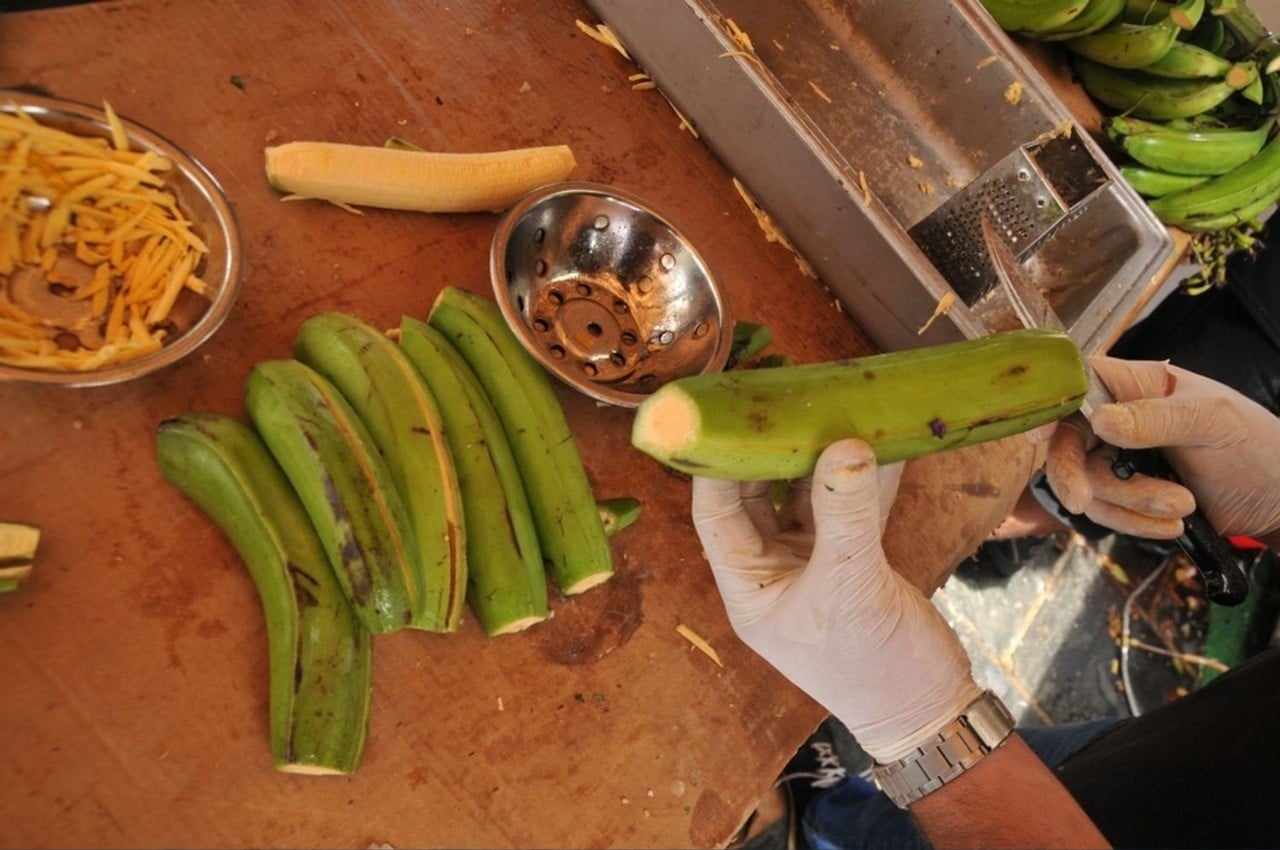
Mofongo is a purée made from fried green plantains, pounded in a wooden mortar called a pilón, then mixed with chicharrón (fried pork rinds), garlic, and sometimes hot broth. This act of pounding, repeated in home kitchens and restaurants alike throughout San Juan, embodies three cultural heritages that have converged on the island.

A word from Angola

The name of the dish comes neither from the Taíno nor from Spanish. Several food historians who have studied Puerto Rican cuisine explain that the word “mofongo” derives from “mfwenge mfwenge,” a Kikongo expression, a language spoken in Angola, that refers to a large quantity of something. The technique itself : pounding a starchy food while adding liquid and fat to soften it has the same West African origin. It was brought to the island by enslaved Africans, who were already preparing fufu, a pounded dish made from plantains, cassava, or yams.

Three legacies in a single mortar

Before the arrival of fufu, the Taíno, the original inhabitants of Puerto Rico, were already pounding their ingredients in wooden pilónes, as evidenced by archaeological remains found on the island. After the Spanish conquest in the early sixteenth century which decimated the Taíno population through famine, disease, and forced labor on plantations and in mines, this pounding technique endured. Sofrito, a mixture of onion, garlic, herbs, and chili peppers that originated in the Iberian Peninsula, was later added to the mix. Green plantains, which are abundant on the island, and chicharrón, a common item sold by street vendors, did the rest. Few Caribbean dishes have a history so precisely documented that it can be traced back to a specific African language.

Mofongo and mangú: Two Stories, One Tradition

Mofongo is not an isolated case in the region. In the neighboring Dominican Republic, mangú, also made from mashed green plantains, plays an equally central role in home cooking. Researchers studying the national cuisines of the Spanish-speaking Caribbean sum up the difference in a single sentence: plantains are fried in mofongo and boiled in mangú, which distinguishes the two dishes just as much as mashed potatoes differ from French fries. Both share the same African roots, but each tells, in its own way, the story of a specific island.

A festive dish, not an everyday dish

Many Puerto Rican chefs describe mofongo as a festive dish rather than an everyday meal, reserved for Sunday family dinners, accompanied by a cold beer or a piña colada, since its generous and meticulous preparation does not lend itself to a meal eaten in a hurry. In some restaurants on the island, it’s not even on the menu, as the chefs refuse to serve it as long as its long and demanding preparation process cannot be guaranteed to be perfect with every order.

Beyond the family dinner table, mofongo has also made its way onto the menus of the island’s more upscale restaurants, where it is sometimes served stuffed with seafood, chicken, or beef, under the name mofongo relleno. Reimagined in countless ways, it never strays from its core ingredient: plantains pounded in a mortar, proving that an age-old tradition can continue to adapt to modern tastes without losing sight of its origins.

A memory that keeps getting crushed

Many Puerto Ricans say they first discovered mofongo at a family meal, and still remember, decades later, that first bite of mashed plantains topped with sauce and pieces of pork. This sensory memory continues to be passed down today, both on the island and in the diaspora, from person to person rather than through a cookbook.

What Puerto Rico Is Still Grappling With

Mofongo belongs to none of the three peoples who shaped it: neither the Taíno, nor the enslaved Africans, nor the Spanish colonists. It belongs to what they created together, whether by force or out of necessity, in a wooden mortar that continues to be pounded in Puerto Rico. The question remains: how much longer will this specific gesture that of a grandmother pounding for a child be passed down without a written recipe? A previous RK TASTE feature explored another dish with mixed roots: Oil Down from Grenada.

Mofongo is a purée made from fried green plantains, pounded in a wooden mortar (pilón) with garlic and chicharrón; it is considered Puerto Rico’s most iconic dish.

According to historians of Puerto Rican cuisine, the word “mofongo” comes from “mfwenge mfwenge,” a Kikongo expression spoken in Angola that refers to a large quantity of something.

The main difference lies in how the plantains are cooked: they are fried for Puerto Rican mofongo and boiled for Dominican mangú.

Leave a Reply

Your email address will not be published. Required fields are marked *

More articles from RK

María Elena Llorente recevant un hommage floral, Ballet Nacional de Cuba
DANCE
Tolotra

María Elena Llorente: 50 Years of Ballet in the Service of Cuba

In May 1977, a Cuban dancer took the stage in New York with the Alvin Ailey Dance Theater. In the audience that evening, actor Harry Belafonte watched the performance and would later describe the evening as a significant historical event. This dancer’s name was María Elena Llorente, prima ballerina and ballet mistress of the Ballet Nacional de Cuba. Her career spans fifty years of dance, spent almost entirely with a single company—the one founded by Alicia Alonso in Havana—on an island where, over the decades, classical ballet has become as much a source of national pride as it is an art form. María Elena Llorente, of the Sociedad Pro-Arte at the National Academy It all began at the Sociedad Pro-Arte Musical, a school in Havana where young Cuban women learned the basics of classical ballet even before the official founding of the national ballet company. María Elena Llorente then continued

Read More »
Two men greeting each other with "Asere, qué bolá" in Havana
HISTORY & HERITAGE
Tolotra

“Asere, ¿qué bolá?”, the street greeting Obama dared to use in Cuba

“Asere, ¿qué bolá?”, this Cuban street greeting, was already in common use in Havana’s working-class neighborhoods long before a U.S. president adopted it as well. On Saturday, March 19, 2016, on the eve of the first presidential trip to the island in nearly nine decades, Barack Obama appeared in a Cuban TV sketch alongside Pánfilo, a comedic character well known to viewers on the island, and delivered a “qué bolá” that no one expected to hear from a U.S. head of state. The next day, upon setting foot in Havana, he did it again on Twitter: “¿Que bolá Cuba? Just touched down here.” In just a few hours, two words of Havana slang had bridged the gap between the street and the world of diplomacy. What does “Asere, ¿qué bolá?” mean? Taken literally, “asere” doesn’t really translate, and “qué bolá”—which comes from “bola,” meaning “ball”—doesn’t convey anything more literal than

Read More »
View of Fortaleza Ozama and its Torre del Homenaje tower, in Santo Domingo
HISTORY & HERITAGE
Tolotra

Fortaleza Ozama, the 1502 fortress where a nation was born

In Santo Domingo, on the banks of the Ozama River, the Fortaleza Ozama has weathered more than five centuries of Dominican history without ever falling into the hands of an attacker. It held the father of Dominican independence captive, served as a political prison under the Trujillo dictatorship, and withstood tank fire during the 1965 civil war. Now a UNESCO World Heritage Site, the oldest European-built fortress still standing in the Americas continues to preserve, almost intact, the memory of a nation. An arrival in chains, August 27, 1844 On August 22, 1844, Juan Pablo Duarte was arrested in Puerto Plata. Five days later, on August 27, he entered the Fortaleza Ozama in Santo Domingo. The government led by Pedro Santana had just declared him a traitor to the nation. Duarte, who had planned and led the young Dominican Republic to independence, was imprisoned in the dungeons of the Torre

Read More »

conTACT RK

we'd love to have your feedback on your experience so far

Join The List

Join our Richès Karayib community!  Sign up for our newsletter.

Want To Maximize Your Business Presence On Riches Karayib?

Complete the form to start the application