
On the future EC$5 bill, the face of Grenadian Olympic champion Kirani James will appear alongside that of former Saint Vincent and the Grenadines Prime Minister Robert Milton Cato. This pairing encapsulates the ambition of the new series: to bring to life, through everyday gestures, the stories of those who have left their mark on the Eastern Caribbean.
On July 9, 2026, the Eastern Caribbean Central Bank (ECCB) unveiled the new designs for the five main denominations of the regional currency. For the first time, the 5, 10, 20, 50, and 100 EC dollar bills will no longer feature the portrait of Queen Elizabeth II. Ten figures from member countries will take her place.
A common currency for eight territories
The EC dollar is the official currency of Anguilla, Antigua and Barbuda, Dominica, Grenada, Montserrat, Saint Kitts and Nevis, Saint Lucia, and Saint Vincent and the Grenadines. These eight member states share a central bank and a currency, but each retains its own national history. The new design specifically seeks to bring these narratives together without blurring them. In the Eastern Caribbean, the banknote thus becomes more than just a means of payment; it becomes a symbol of regional recognition.
Five cuts for ten courses
The $100 bill will feature Saint Lucian economist Sir William Arthur Lewis and Sir John Compton. In 1979, Arthur Lewis received the Bank of Sweden Prize in Economic Sciences for his pioneering work on development. The $50 bill will feature Sir K. Dwight Venner, governor of the ECCB from 1989 to 2015, and Sir Robert Llewellyn Bradshaw. The $20 bill will feature Sir Vere Cornwall Bird Sr. and Dame Mary Eugenia Charles, the first woman elected prime minister in the Caribbean region.
The $10 bill will feature William Henry Bramble and James Ronald Webster. Finally, the $5 bill will feature Robert Milton Cato and Kirani James. As the 2012 Olympic 400-meter champion in London, Kirani James earned Grenada its first-ever Olympic medal.

A decision that has been in the works since 2023
The decision to make this change was not reached in a matter of weeks. On July 21, 2023, the ECCB’s Monetary Council approved the replacement of the image of Elizabeth II. The Central Bank then held public consultations between July and December 2023. According to the ECCB, these discussions revealed strong support for national heroes and the region’s founding figures. The 2026 unveiling thus reflects not only an institutional decision but also the expectations expressed in the countries concerned.
What memory do the tickets choose?
The collection tells a certain story of the Eastern Caribbean . It primarily highlights political leaders, an economist, a pioneer of monetary integration, and an athlete. These figures evoke the region’s path to independence, the building of its institutions, and the determination to establish the region’s presence on the international stage. But the list also sparks debate. Among the ten figures selected, only one is a woman: Dame Eugenia Charles. The arts, literature, and music are not directly represented. This observation does not diminish the significance of the change, but it does show that a currency alone cannot encapsulate the full richness of a region.
By replacing the monarch’s portrait with those of local figures, the Eastern Caribbean is shifting the symbolic center of its currency. They are not merely changing images: they are choosing the faces that will henceforth accompany purchases, wages, and trade. A new question then begins to circulate along with these bills: what other women, artists, thinkers, or builders might one day become part of the shared narrative of the Eastern Caribbean?
📸 @ECCB
The Eastern Caribbean Central Bank is replacing the portrait of Queen Elizabeth II with those of ten prominent figures from the region. This new series aims to better represent the history, achievements, and shared identity of the eight member countries that use the EC dollar.
The five banknotes will feature, among others, economist Sir Arthur Lewis, former Prime Minister Dame Eugenia Charles, former ECCB Governor Sir K. Dwight Venner, and Grenadian Olympic champion Kirani James. Each banknote will feature two regional figures.
The EC dollar is used by eight members of the Eastern Caribbean Monetary Union: Anguilla, Antigua and Barbuda, Dominica, Grenada, Montserrat, Saint Kitts and Nevis, Saint Lucia, and Saint Vincent and the Grenadines.
In the Caribbean, a high energy bill can slow down a business. A storm can cut off a road, block a port, or jeopardize a harvest. A security crisis can also extend beyond the borders of a single country. It is against this daily reality that the Canada-CARICOM dialogue is taking on a new dimension today.
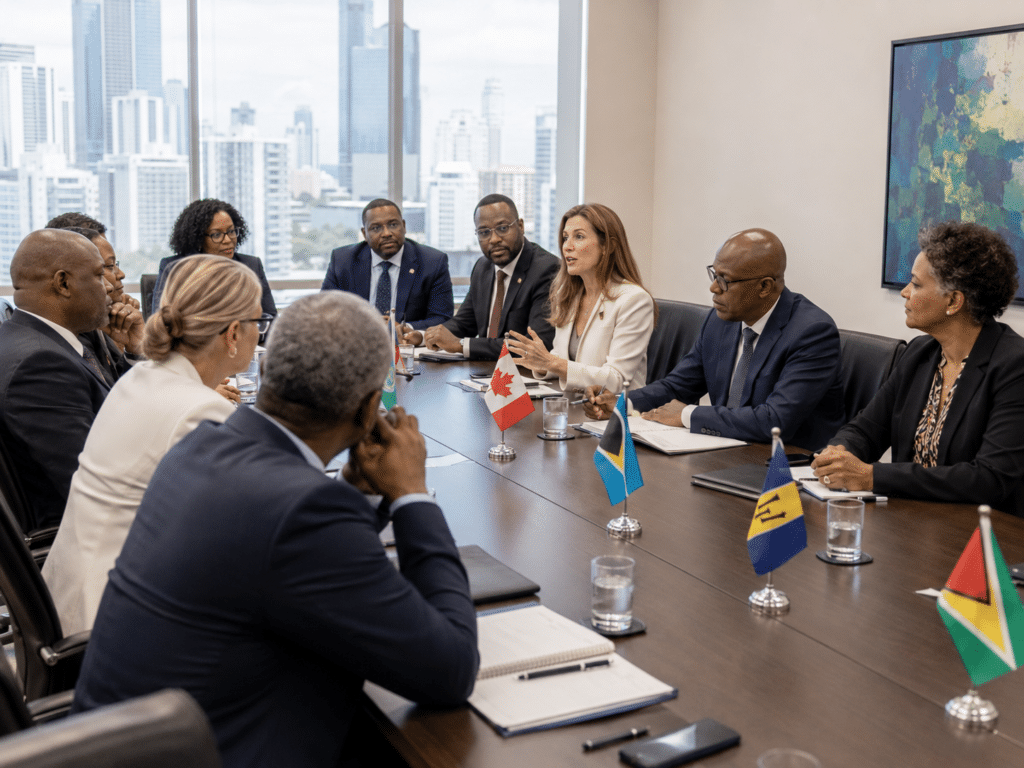
Meeting in Panama City on the sidelines of the 2026 General Assembly of the Organization of American States, the foreign ministers of Canada and CARICOM sought to reinvigorate their strategic partnership. At the heart of their discussions was an action plan focused on three major priorities for the region: security, climate, and the economy.
Cooperation Aimed at Achieving Concrete Results
The Canada-CARICOM partnership builds on the strategic agreement launched in 2023. But the 2026 meeting marks an important milestone: both parties now want to move forward with a plan that is more specific, clearer, and more measurable.
The goal is not merely to demonstrate diplomatic closeness. It is to establish priorities, timelines, and funding mechanisms capable of producing results. For Caribbean countries, this clarity matters. The region faces a range of interrelated challenges: energy costs, climate-related disasters, maritime security, financial vulnerability, and the crisis in Haiti. The Caribbean is not merely asking for aid. It is seeking partners capable of understanding its realities and working alongside it for the long term.
Security: A Regional Emergency
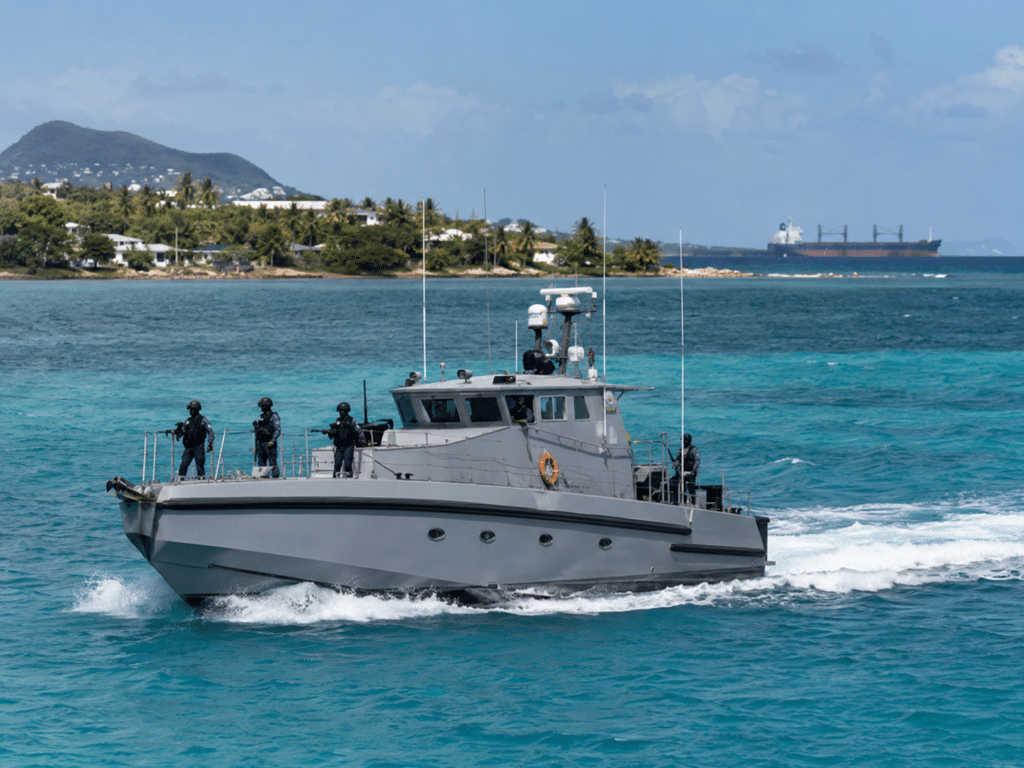
Security is central to this new Canada-CARICOM plan. The ministers discussed transnational crime, gangs, irregular migration, maritime security, and illicit flows. For the region, these issues are not isolated. The sea serves as a link, but it is also an area of vulnerability. Trafficking, criminal networks, cyberthreats, and political crises sometimes spread faster than institutional responses can keep up.
Canada already supports certain regional initiatives through capacity building, targeted interventions, and operational partnerships. The new challenge is to move toward a more coordinated response: better protecting maritime areas, strengthening institutions, sharing relevant information, and limiting the influence of criminal networks.
Haiti: A Crisis That Affects the Entire Caribbean
Haiti is a major focus of the discussions. The political, security, and humanitarian crisis the country is facing has direct consequences for the region. In particular, the ministers highlighted the risks associated with drug and arms trafficking. Support for the Gang Suppression Force was among the topics discussed. This force is intended to help restore security on the ground, with a mandate set to be renewed by the United Nations Security Council.
But the response cannot be limited to security measures alone. The ministers also reaffirmed the right of Haitians to choose their own government. They support the holding of credible elections as soon as conditions permit, as well as efforts to combat corruption and impunity. Haiti serves as a powerful reminder: no lasting stability in the Caribbean can be achieved by leaving a country to face such a profound crisis on its own.

Climate and the Economy: Two Sides of the Same Challenge
The new Canada-CARICOM plan also clearly links climate and the economy. In the Caribbean, a natural disaster is never just a weather event. It affects families, businesses, roads, schools, ports, and public finances. Access to reliable and affordable energy is once again a priority. Overly expensive energy stifles innovation and puts a strain on households. A more stable energy supply can support industry, services, investment, and the transition to more sustainable models.
Trade is also part of the equation. The CARIBCAN program, which grants duty-free access to the Canadian market for most products originating in 18 Caribbean Commonwealth countries and territories, remains an important tool. It serves as a reminder that the Canada-CARICOM partnership is not just about diplomacy. It also encompasses economic opportunities, supply chains, and the ability of Caribbean businesses to expand beyond their local markets.

Greater Attention to the Caribbean's Vulnerability
Another key aspect of the Canada-CARICOM partnership concerns financing. Several Caribbean states are considered middle-income countries. Yet their vulnerability to climate-related disasters, economic shocks, and supply disruptions remains very high. This is one of the region’s major paradoxes. On paper, some countries appear too “advanced” to easily access concessional financing. In reality, a single crisis can undermine years of progress.
The ministers therefore emphasized the need to reform the international financial architecture. The idea is simple: the actual vulnerability of small states must be taken into account more fully—not just their average income.

A plan to follow closely
The coming months will be crucial. Officials still need to finalize the details of the action plan, identify priority initiatives, develop an implementation schedule, and strengthen monitoring efforts. A dialogue among senior officials is scheduled for the fall to advance this work.
The Canada-CARICOM partnership alone will not solve the Caribbean’s challenges. But it says something about the current moment: the region wants to be heard as a strategic area, not just as a vulnerable one. Now the real question remains: Will this new plan bring about visible changes for Caribbean people, businesses, and territories?
The new Canada-CARICOM plan is a roadmap designed to strengthen cooperation between Canada and the Caribbean Community. It is based on three priorities: more resilient economies, climate action, and regional security. The goal is to move from a diplomatic partnership to more concrete actions, with timelines, measurable results, and sustainable financing mechanisms.
Haiti is a key focus because its political, security, and humanitarian crises have repercussions for the entire region. The ministers discussed drug and arms trafficking, support for the Gang Suppression Force, and the right of Haitians to choose their own government. For CARICOM, Haiti’s stability therefore remains a regional issue, not just a national one.
The Canada-CARICOM Partnership directly links climate and the economy. It emphasizes access to reliable and affordable energy, the development of trade, the strengthening of supply chains, and access to financing tailored to the vulnerabilities of small Caribbean states. The goal is to enable the region to better withstand natural disasters, economic shocks, and international crises.
Organized by the Caribbean Chamber of Commerce in Europe (CCCE), the second edition of Caribbean Days brought together various expressions of Caribbean culture at UNESCO headquarters in Paris. Over the course of four days, the event provided a forum for dialogue on regional cooperation, sustainable tourism, and economic relations between the Caribbean and Europe.
A Caribbean-style restaurant with a view of Paris
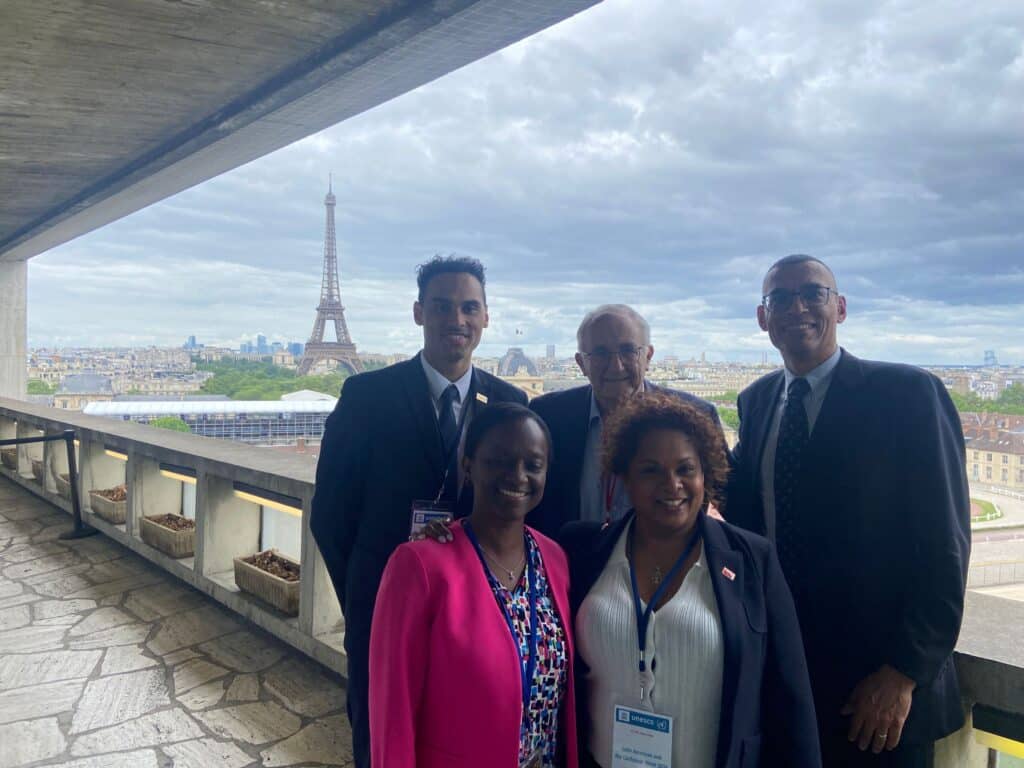
On the roof of UNESCO, Caribbean chefs from the association Les Toques françaises are preparing a three-course Caribbean menu. From the restaurant, guests can see the Eiffel Tower, Les Invalides, and the Left Bank. This scene captures the spirit of the Caribbean Days : to showcase the Caribbean through its creative works and craftsmanship, and then use this cultural presence to foster broader exchanges.
The Caribbean Chamber of Commerce in Europe (CCCE) organized this second edition as part of Latin American and Caribbean Week. Under the theme “Peace, Diversity, and Sustainability,” the event brought together representatives from the cultural, institutional, diplomatic, and economic sectors.
Over the course of four days, the program featured the visual arts, gastronomy, fashion, film, literature, poetry, music, and dance. These disciplines showcased various facets of Caribbean creativity in a venue dedicated to education, science, culture, and heritage.
Creative Industries Take Center Stage
The Caribbean Days highlighted the creative industries as one of the region’s strengths. Cuisine, fashion, film, storytelling, music, and dance served as points of connection between different regions and sectors.
This diversity brought together Caribbean ambassadors, other diplomats, representatives from the public sector, and private-sector stakeholders. Culture thus provided a common framework for discussions on development, investment, and partnerships.
Founded in November 2019, the CCCE’s mission is to facilitate exchanges between the Greater Caribbean and Europe. It also seeks to encourage European investment in the region’s sustainable economic development. In Paris, this mission has taken the form of meetings between institutions, businesses, and Caribbean representatives.
Regional Cooperation Over Lunch
A luncheon discussion focused on cooperation between France’s overseas territories in the Caribbean and CARIFORUM member states. Representatives from the Bank of France, Expertise France, and the OECD gave presentations.
The remarks by French Senator Micheline Jacques, who supports an economic partnership between France’s overseas territories and Haiti, refocused the debate on a concrete question: How can we strengthen ties among the various parts of the Caribbean region?
Through this event, the Caribbean Days brought culture, diplomacy, and the economy closer together. Gastronomy was not merely a backdrop; it served as a framework for dialogue on potential areas of cooperation and on the Caribbean’s role in its relations with Europe.
Sustainable Tourism in the Face of Climate Change
A roundtable discussion was held on sustainable tourism. Geoffrey Lipman, former president of the World Travel and Tourism Council and former deputy secretary-general of the World Tourism Organization, participated alongside Florian Valmy-Desvillers, director of business development for the Caribbean Tourism Organization in the United Kingdom and Europe.
Jo Spalburg, Secretary General of the CCCE, summarized the main message of these discussions. According to him, the acceleration of climate change makes it necessary to develop tourism that is more sustainable and more beneficial to local communities. These communities play a direct role in protecting the region’s natural and cultural heritage for future generations.
This reflection gives the Caribbean Days a specific scope. It links the promotion of Caribbean destinations to the responsibility of preserving what attracts visitors: landscapes, cultural heritage, cultural practices, and local knowledge.

From Cultural Visibility to Partnerships
As this second edition comes to a close, the CCCE is highlighting a collective goal: to transform cultural visibility into collaborations, innovation, and sustainable growth for the region.
The Caribbean Days have shown that culture can foster dialogue among diplomats, institutions, businesses, and creative professionals. What happens next will depend on the ability of the partners gathered in Paris to turn these exchanges into concrete partnerships that benefit Caribbean regions and communities.
Caribbean Days, also known as Journées des Caraïbes, is an event organized by the Caribbean Chamber of Commerce in Europe at UNESCO headquarters in Paris. Over the course of four days, the second edition of the event showcased the visual arts, gastronomy, fashion, film, literature, poetry, music, and dance. The event took place under the theme “Peace, Diversity, and Sustainability,” as part of Latin American and Caribbean Week.
Caribbean Days is organized by the Caribbean Chamber of Commerce in Europe (CCCE). Founded in November 2019, this organization seeks to facilitate exchanges between the Greater Caribbean and Europe, while encouraging European investment in the region’s sustainable economic development. In Paris, the CCCE brought together representatives from the cultural, diplomatic, institutional, and economic sectors to discuss Caribbean culture and challenges.
Caribbean Days combined the promotion of creative industries with discussions on regional cooperation and sustainable tourism. A luncheon forum focused on relations between France’s overseas territories in the Caribbean and CARIFORUM member states. A roundtable discussion also addressed the effects of climate change and the need to develop more sustainable tourism that better benefits local communities working to protect the region’s natural and cultural heritage.
A constraint that can become a value
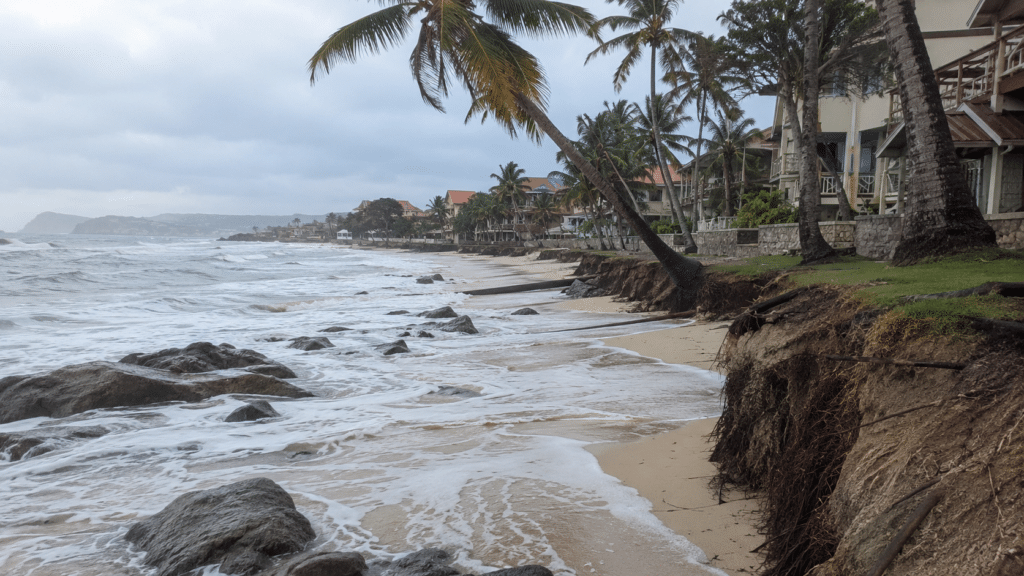
The Caribbean is experiencing climate change directly, brutally and continuously. More intense cyclonic seasons, accelerated coastal erosion, fragile coral ecosystems, energy vulnerability: no island in the region has been totally spared. For a long time, this reality has been presented as a constraint for public budgets, for tourism operators and for economic models based on the classic spa industry.
The Travel Dreams 2026 report by Amadeus, however, suggests a possible turnaround. What was once perceived as a fragility can become a value proposition, as long as it is acknowledged and accurately portrayed. This is where the notion of visible sustainability becomes central.
What travellers say
The study first documents the scale of demand. Of the 6,000 travelers surveyed across six major global markets, 75% say that a hotel’s sustainability commitments are important in their booking decision. More than one in three, precisely 35%, consider them “very important”.
And this concern translates into willingness to pay. Travelers who place importance on this criterion say they are willing to spend an average of 11.7% more per night to stay in an establishment with serious sustainable practices. This represents around $29 more on a $250 room. Among Generation Z travelers, this willingness rises to 14.7%, or almost $37 more per night. Visible sustainability starts here: in a hotel’s ability to communicate why these practices are worth more.
One data point deserves particular attention for the Caribbean: sensitivity to sustainability varies greatly according to source markets. It reaches 93% of travelers surveyed in India and 85% in China, compared to 65% in the UK and Germany. For a region seeking to reduce its dependence on traditional markets, these discrepancies open up a strategic avenue to be handled with caution. These travelers won’t be satisfied with a generic discourse on nature. They’ll be looking for evidence, visible features, documented stories. For the Caribbean, visible sustainability can become a way of speaking to these audiences without denying its local roots.

What hotels do
On the supply side, Amadeus data show a widespread commitment among the hoteliers surveyed. Of the 500 general managers or equivalent profiles consulted across nine countries, all say they plan to spend on sustainability initiatives in the coming year. The average anticipated expenditure represents 6.7% of total company expenditure. And 35% of hoteliers identify sustainability as a key differentiating factor from their competitors.
But the study also highlights a revealing discrepancy. Hotels invest primarily in actions that have an internal operational efficiency rationale: water conservation (33%), sustainable catering supply (33%), responsible supply chains (33%), waste reduction (32%), staff training (32%).

On the other hand, practices that are more visible to the customer, such as renewable energies (28%), biodiversity and community initiatives (27%), and the link between sustainability and loyalty programs (21%), remain less developed. It is this tension that makes visible sustainability strategic: it forces us to move from internal effort to an experience understood by the traveler.
Closing the gap
Joerg Schuler, Head of Global Hospitality Sales at Amadeus, sums up this discrepancy by talking about sustainability as being more “visible, experiential and integrated into the stay”. The formula is important, because it changes the subject. It’s no longer just a question of saying that a hotel consumes less water or reduces its waste. It’s about making these choices understandable, concrete and experienced by the traveler. Visible sustainability therefore requires not only proof, but also an accurate narrative.

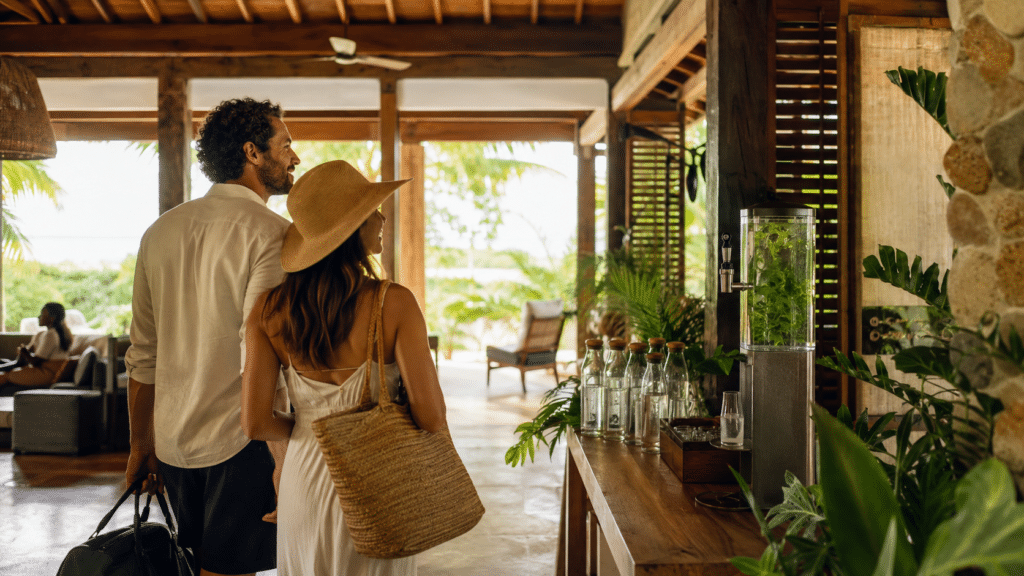
This gap is precisely what the Caribbean can bridge. Visible Caribbean sustainability is not an abstract technical program. It can be embodied in visible, relatable, situated practices. Restoring mangroves. Coral reef protection. Local solar energy. Short-distance sourcing from small island producers. Saving water in contexts where the resource is precious. Passing on traditional knowledge of how to use the environment sparingly.

Each of these practices can be both a serious environmental commitment and a story that travelers can experience during their stay. It is this articulation that transforms visible sustainability into perceived value, and thus into pricing leverage.
A value to be documented
A Caribbean hotel that can document, with figures, identified partners and measurable results, its role in restoring a local ecosystem is no longer just selling a room. It’s selling participation in a broader regional project. Travelers surveyed by Amadeus have already indicated their willingness to pay for this. Visible sustainability therefore requires showing what is being done, by whom, with what effects.

This logic goes beyond the individual hotel business. It also concerns destination management bodies, tourism authorities and regional economic players. A region’s ability to credibly communicate its ecological commitment is becoming a competitive variable in the face of other tropical destinations. At destination level, visible sustainability can become a common language for hotels, producers, associations, communities and travellers.

The Caribbean challenge
For the Caribbean, the challenge is not to become sustainable in the sense that other regions understand it. It is to make legible a sustainability that, in many cases, is already practiced at the level of communities, small businesses, local cooperatives and inherited know-how. The global market is willing to pay for it. The question is whether the region will be able to present this reality with the appropriate rigor, coherence and pride.

This series of articles, in its three parts, has attempted to defend the same thesis. The expectations of travelers in 2026 – disconnection, connection to place, visible sustainability – are not constraints that Caribbean players have to endure. They are expectations that the region structurally bears, by virtue of its geography, cultures and history. What remains, as always, is the patient task of putting them into words. This is the editorial mission that Richès Karayib will continue to carry out, alongside the region’s economic, institutional and creative players.
Visible sustainability refers to the set of sustainable commitments that a traveler can actually see, understand or experience during their stay. It’s not just about internal measures, such as reducing water costs or limiting waste behind the scenes. In the Caribbean, this can take the form of solar power clearly integrated into the hotel, a mangrove restoration program, coral reef protection, sourcing from local producers or community actions presented with concrete results. This approach makes the ecological commitment more legible and credible for the traveler.
Visible sustainability can become a competitive advantage as travelers increasingly value hotels’ environmental commitments. According to the data used in the article, a majority of travelers consider these commitments to be important when choosing an establishment, and a proportion are even willing to pay more for serious practices. For Caribbean hotels, the challenge is not only to act, but also to document and tell the story of these actions with precision. An establishment capable of demonstrating its local impact is no longer just selling a room: it is proposing participation in a local project.
Caribbean destinations can better promote their visible sustainability by linking the actions of hotels, producers, associations, local authorities and communities into a coherent narrative. This requires proof: figures, identified partners, measurable results, actions monitored over time. A destination that explains how it protects its reefs, saves water, supports short circuits or restores its ecosystems builds a stronger promise than a simple discourse on nature. For the Caribbean, this storytelling is strategic, as it transforms real climate vulnerability into a cultural, ecological and economic value proposition.
When luxury is more than just décor
For a long time, luxury in the international hotel industry was measured by the thickness of the marble, the height of the ceilings, the scarcity of objects in the rooms. Some of this grammar still exists. But another, potentially more profitable, is emerging. Cultural luxury is gaining in importance. It is measured by the quality of the connection a traveler can establish with the place he or she is visiting.
This evolution is documented in Travel Dreams 2026: From data to delight, a report published by Amadeus in April 2026, based on a survey conducted by Opinium Research in the fourth quarter of 2025. Asked about the sensations they seek in a destination, 24% of the 6,000 travelers cited “connection to a place: food, experiences, special moments”. This was the second most frequent response, behind freedom. As far as hoteliers are concerned, the figure is becoming strategic: 44% of the 500 general managers surveyed across nine countries identified “concierge and guided experiences” as one of the two main drivers of growth in non-room revenues, on a par with social events.
What travellers are really looking for
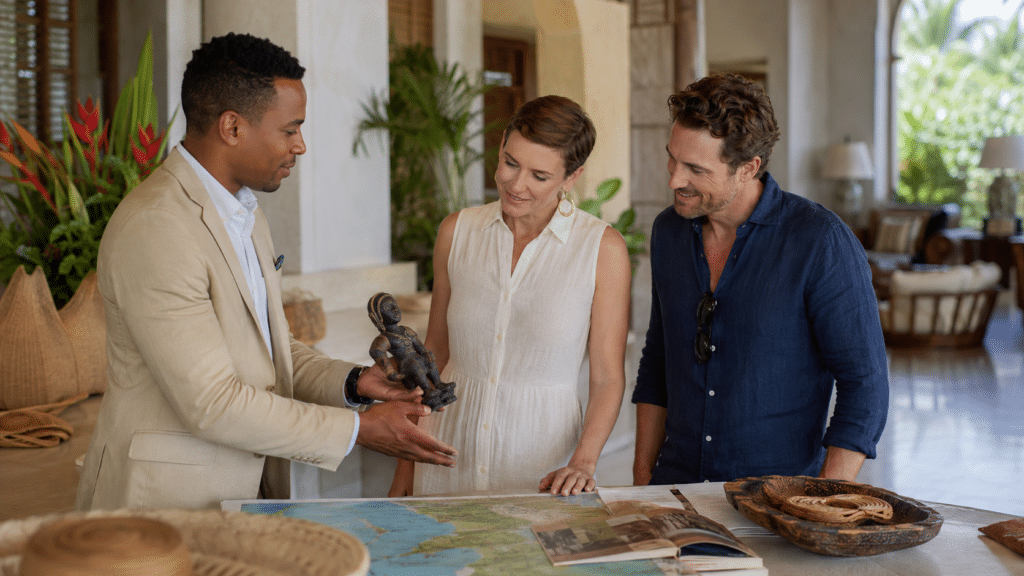
In other words, what travelers are looking for, and what hoteliers worldwide are beginning to monetize in earnest, is the same thing: access to living culture. Cultural luxury is not just about décor or service levels. It’s about creating the right relationship between the visitor, the area and the people who bring it to life.
The Amadeus report goes further, putting a figure on what it calls “local experience kits”: neighborhood guides, handcrafted souvenirs, connections with cultural players. It estimates that a mid-range hotel could generate over $243,000 in additional annual revenue from this type of service, based on a guide price of $20 per kit. Nearly a third of business travelers who extend their stay for leisure purposes say they are prepared to pay more than 15% above the average rate for this type of service. With this in mind, cultural luxury is also becoming an issue of business model, not just image.
The Caribbean's value is still under-structured
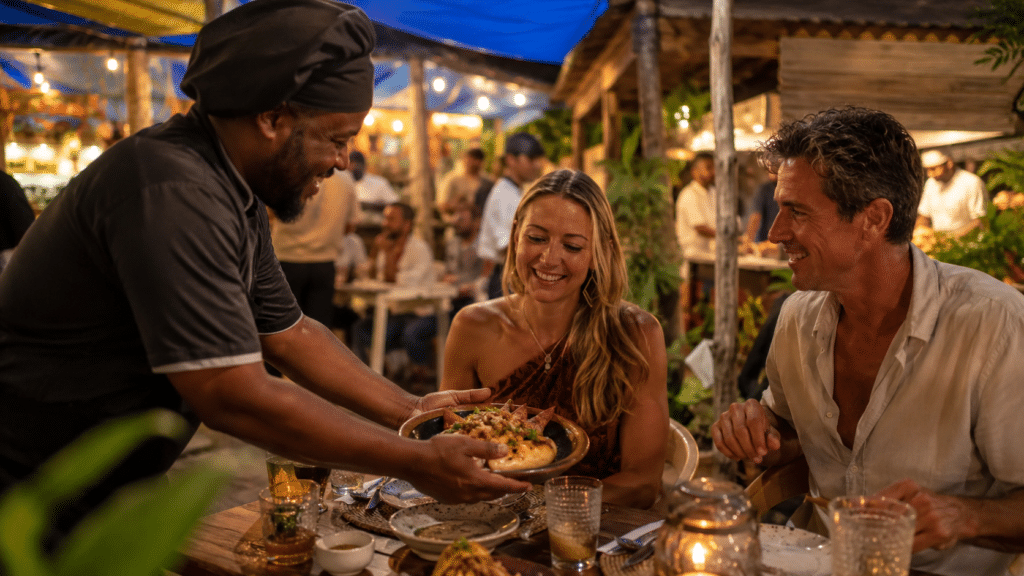
This fact is particularly relevant to the Caribbean. The region’s cultural heritage is alive and well, but still unevenly structured in terms of tourism and hotel offerings. The Kalinago traditions of Dominica, the Creole languages spoken from island to island, the memory of ancient maritime routes, syncretic ritual practices, culinary know-how handed down outside the formal circuits: all this constitutes a capital that still largely escapes the logics of standard hotel valorization. And yet, this is precisely where cultural luxury can find its most solid footing.

Exceptions do exist. Some independent hotels in the Caribbean have long understood that having a traveler dine in a local market, meet with an artisan or enjoy an hour’s silent walk in a heritage district creates a value that is difficult to compare with a standardized spa facility. But these initiatives often remain isolated, barely visible in destination communications, and rarely structured as a coherent economic proposition. To turn cultural luxury into a sustainable lever, we need to move on from one-off initiatives to a clear, profitable offering that respects local players.

Local experiences to be organized differently
The Amadeus report identifies a potentially game-changing trend. According to the study, 41% of hotels surveyed have already created packages linked to regional concerts, cultural events or popular TV series, and 38% plan to do so within the year. The traveler of 2026 no longer comes just to see a place. They come to enter into a relationship with it, through proposals that are constructed, told and embodied. This shift towards cultural luxury is exactly the kind of proposition that the Caribbean can articulate, provided its economic players work together.
This implies a number of shifts. Firstly, we need to move away from competition between islands and think in terms of pan-Caribbean offerings, where the richness of each territory complements rather than cannibalizes each other. Secondly, we need to professionalize the way in which our cultural heritage is presented: not by folklorizing it, but by presenting it with the editorial and visual rigor expected by a well-informed international traveler. Finally, we need to structure the economic relationship between hotels, local cultural players and experience operators, so that the value generated benefits the regions and not just international intermediation platforms. Caribbean cultural luxury can only be as strong as the people who bring it to life.

A journey that also promises personal transformation
Another statistic in the report is worth noting. Asked what they hope to bring back from a trip, 18% of travelers surveyed cite “a new version of themselves: clearer, lighter, more intentional”. This figure rises to 39% among travelers surveyed in China. For Caribbean destinations seeking to diversify their source markets, this signal deserves attention. It does not allow us to generalize to all Asian markets, but it does show that some travelers already associate travel with a form of personal transformation.

Enhancing without diluting
In 2026, cultural luxury is no longer sold in rooms alone. It’s sold in encounters. In hours. In presence. The Caribbean has what it takes to meet these expectations. All that remains is to organize it, to tell its story, to enhance its value without diluting it.
Cultural luxury is a new way of thinking about high-end travel. It’s not just about the comfort of a hotel, the quality of a room or the presence of exclusive amenities. It’s built around the relationship between the traveler and the territory visited. In tourism, this can take the form of a meeting with an artisan, a meal prepared with local produce, a guided tour by a local, or an experience that provides a better understanding of a place’s history, languages, practices and memories. Cultural luxury therefore gives value to that which cannot easily be copied: the living identity of a territory.
Cultural luxury represents a major opportunity for the Caribbean, as the region boasts a rich living heritage: Creole languages, culinary traditions, historical memories, music, craft skills, community practices and indigenous or Afro-descendant heritages. Yet some of this richness remains unstructured in conventional tourism offerings. By developing better-organized local experiences, Caribbean territories can create new revenue streams, boost the attractiveness of their destinations and better involve cultural players in the value generated by tourism. The challenge is not just economic: it also concerns the transmission, recognition and preservation of local identities.
Caribbean hotels can develop cultural luxury by working directly with local players: artisans, guides, chefs, artists, historians, cultural associations, heritage communities and experience operators. The aim is not to turn culture into décor, but to build respectful, rewarding and well-told propositions. This means choosing legitimate partners, presenting traditions accurately, avoiding clichés and guaranteeing that income actually benefits the people who carry this knowledge. A solid cultural luxury doesn’t put culture on display: it creates a fair encounter between the visitor, the place and those who bring it to life.
In New York, Caribbean flags are never seen by chance. In June, they tell a family story, a memory of exile, a sense of belonging that crosses American islands and cities. In Manhattan this Monday, June 1, the Caribbean Tourism Organization officially opens Caribbean Week New York 2026. Business forums, professional meetings, cultural presentations: for five days, from June 1 to 5, the American metropolis becomes one of the major meeting points for the organized Caribbean. And this year, the event takes on a special dimension. Caribbean American Heritage Month marks twenty years of national recognition.
A Caribbean week in the heart of New York City
In 2026, Caribbean Week NY will focus on the theme “One Caribbean: Infinite Experiences”. Caribbean American Heritage Month, on the other hand, focuses more broadly on the idea of memory, identity and unity. Three words sum up the spirit of this year’s Caribbean American Heritage Month. Independence, because Caribbean peoples continue to construct their own narratives. Identity, because it is forged as much in the islands as in the cities of the North. Unity, finally, because Caribbean countries, territories and communities can recognize themselves in a common history without erasing their differences.

Claire Nelson, one of the decisive voices of the Caribbean-American month
Claire Nelson knows this story well. Founder of the Institute of Caribbean Studies in Washington, she championed the idea of a national month dedicated to Caribbean contributions to the United States in the late 1990s. After several years of advocacy, the initiative made headway in Congress with the support of Congresswoman Barbara Lee. In June 2006, President George W. Bush signed the Presidential Proclamation officially recognizing June as Caribbean American Heritage Month in the United States. Without Claire Nelson, without the Institute of Caribbean Studies, without Barbara Lee, this national event would probably not have taken on such importance.

From recognition to visibility
Twenty years on, it’s not just about recognition. It’s visibility. The 2026 program reflects this expansion: Caribbean book fairs, Caribbean Restaurant Week, DC Caribbean Film Festival, then a legislative week from June 8 to 11 with exchanges devoted to Caribbean interests on Capitol Hill. In New York, the New York Public Library is also planning activities during the month, starting with a screening of Bob Marley: One Love on June 1 at the Mott Haven Library in the Bronx.


A Caribbean diaspora that counts in the United States
The U.S. Caribbean diaspora is not marginal in the ethnic mosaic of the United States. According to the Migration Policy Institute, immigrants born in the Caribbean region were estimated to number 5.3 million in the United States in 2024, representing around one tenth of the country’s immigrant population. If descendants born on American soil are added, the Caribbean presence far exceeds the first generation. New York, Miami, Boston, Orlando, Tampa, as well as Washington and Atlanta, are home to structured communities, visible in businesses, churches, associations, local media and cultural events.
Jamaicans, Trinidadians, Haitians, Dominicans, Puerto Ricans, Cubans, Barbadians, Guyanese, Bahamians: the list is long, and each community defends its own identity while participating in a shared pan-Caribbean narrative. This diasporic singularity deserves to be named precisely. Unlike other communities with a single national origin, the Caribbean diaspora in the United States often operates on a dual register: national pride and regional awareness. The month of June does not erase the first sense of belonging. It activates the second. It’s a time when island flags can appear together, from Brooklyn to Little Haiti, without each story losing its voice.


Caribbean figures in American history
American history is itself criss-crossed by Caribbean figures that many still ignore. Alexander Hamilton, the first U.S. Secretary of the Treasury and architect of the American financial system, was born in Nevis, in the British West Indies, before he left for the American colonies. Sidney Poitier, a Bahamian-American actor, became the first black actor to win the Oscar for Best Actor in 1964, for Lilies of the Field. Audre Lorde, poet and leading thinker of black feminism, grew up in New York in a family of Caribbean origin. Colin Powell, America’s first black Secretary of State, was the son of Jamaican parents.
The list continues with Harry Belafonte, Cicely Tyson, Stokely Carmichael (now Kwame Ture), Marcus Garvey and Shirley Chisholm. The latter, the first black woman elected to the US Congress, was born in Brooklyn into a family with roots in Barbados and Guyana. These names do not form a symbolic gallery. They show how the Caribbean has participated, sometimes from the margins, in writing central pages in the political, artistic and social history of the United States.
Guyana, Jamaica, Trinidad and Tobago: memories in motion
For the Guyanese diaspora, Caribbean American Heritage Month this year extends the 60th anniversary of Guyana’s independence, marked at the end of May in Brooklyn. In Jamaica, the press revisited the 30th anniversary of the Sinbad Soul Music Festival, associated with Montego Bay and the rise of music tourism aimed at African-American audiences. For Trinidad and Tobago, Caribbean American Heritage Month also spotlights Claudia Jones, a Trinidadian journalist and activist deported from the United States in 1955, considered one of the founding figures of the Caribbean Carnival in London, whose legacy has nourished the Notting Hill Carnival.

A transmission framework for new generations
Twenty years after the 2006 presidential proclamation, Caribbean American Heritage Month is no longer just a calendar or a series of events. It has become a framework for transmission. It enables the diaspora to recognize, document and tell new generations what it means to be Caribbean, American, island, urban, national and regional. The work is not finished. But in 2026, in Manhattan, Brooklyn, Miami, Washington or Boston, millions of Caribbean-Americans are preparing to continue it, each with their own accent, flag and memory.
Each June, Caribbean American Heritage Month is dedicated to recognizing the contributions of Caribbean people and their descendants to the United States. It highlights the history, culture, migratory patterns, public figures and social, artistic and political legacies of the Caribbean. In 2026, it takes on a special dimension, as it marks twenty years of national recognition since the presidential proclamation of 2006.
Caribbean Week NY is important in 2026 because it opens the month of June in a highly symbolic context: the 20th anniversary of Caribbean American Heritage Month. Organized in New York, it brings together tourism players, institutions, diasporic communities and Caribbean representatives with a common goal: to make the Caribbean’s place in the American space more visible. It also shows that culture, tourism and diasporic memory are closely linked.
The Caribbean diaspora plays a major role in the United States, culturally, politically, economically and socially. Present in New York, Miami, Boston, Washington and Atlanta, it brings together communities from Jamaica, Haiti, Trinidad and Tobago, Guyana, Cuba, Puerto Rico, the Dominican Republic, Barbados and the Bahamas. Caribbean American Heritage Month helps us better understand this dual sense of belonging: national pride specific to each island or territory, and a shared Caribbean consciousness.
A global report published in early 2026 by Amadeus reveals what travelers will be looking for in 2026. The Caribbean has always carried it.
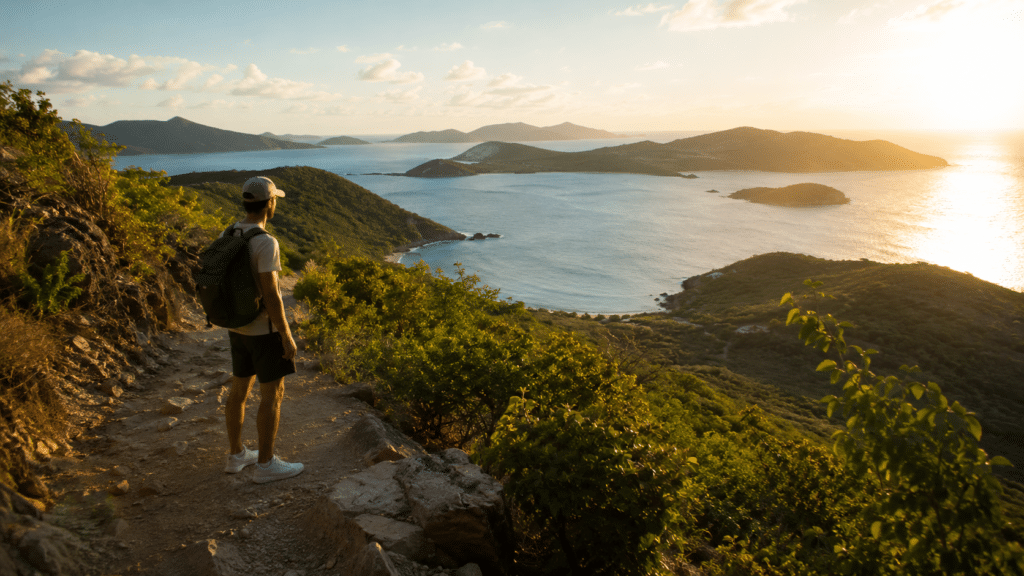
There’s a precise moment, in a Caribbean village in the early hours of the morning, when the noise of the world seems to stop. The first lights fall on the facades, a voice answers from one courtyard to another, the smell of coffee mingles with that of the nearby sea. Hardly anyone checks their phone. Life is there, in front of us, denser than any notification. This scene, commonplace for anyone who lives in the Caribbean, is precisely what millions of travellers around the world are now looking for.
When the world is looking to get off the hook
These are the findings of Travel Dreams 2026: From data to delight, a study published in early 2026 by Amadeus, one of the world’s leading technology players in tourism. Conducted by Opinium Research among 6,000 travelers in Australia, China, Germany, India, the UK and the USA, the survey identifies a profound shift in contemporary expectations.
Asked what makes them feel they’ve reached their dream destination, 32% of travelers say “when I stop looking at my phone because real life is more interesting”. This is the top answer, far ahead of the others. Another statistic from the same report extends this observation: 41% of travellers say they want to return from their trip with “a refreshed brain and a calmed nervous system”.

Travel as a response to collective exhaustion
These figures are not anecdotal. They tell of a collective exhaustion. In a world saturated with screens, high-performance productivity and manufactured urgency, travel is no longer a trophy to be collected, but a means of rediscovering a quality of presence. The Amadeus report puts it bluntly: travelers are looking to feel “genuinely alive, not just ticking off landmarks”.

What the Caribbean has always carried
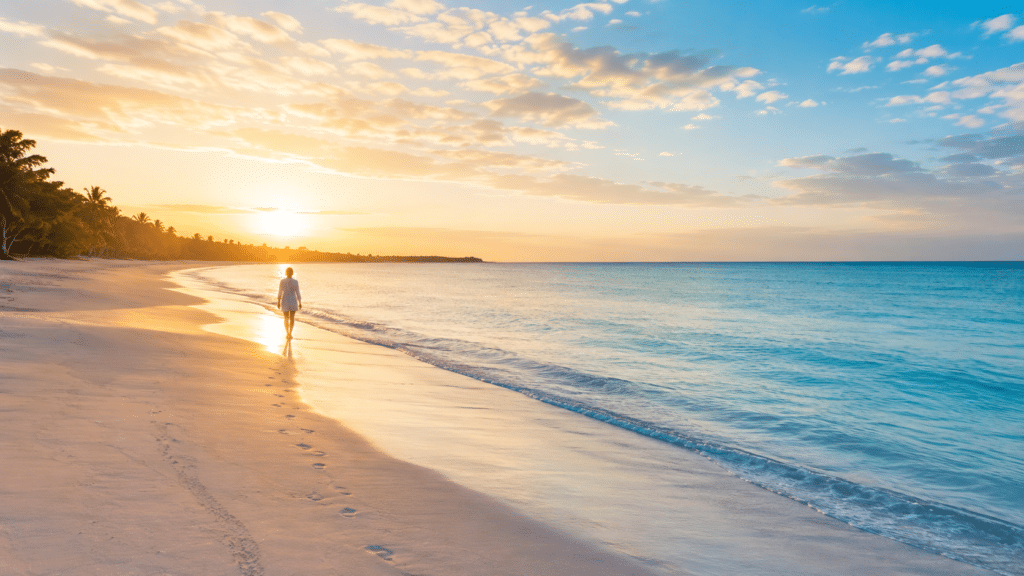
This shift in expectations is global, but it offers the Caribbean a special reading. The region didn’t wait for a study to cultivate what the market is rediscovering today. The density of the Caribbean present, the thickness of a conversation on a doorstep, the slowness of a shared meal, the way in which the landscape imposes its rhythm on those who cross it, is not a marketing strategy. It’s a heritage. It comes from languages, from multiple spiritual heritages, from a long relationship with the sea and the land, from the memory of the peoples who made these islands.


Four global expectations already present in the region
The same Amadeus study identifies four main sensations sought by travellers from a destination: freedom (29%), connection to a place (24%), discovery (22%) and ease (17%). Structurally, the Caribbean offers these four dimensions without having to transform itself. The freedom of open itineraries, connection to places that still resist tourist standardization, ongoing discovery – each island has its own language, its own rhythms, its own history – and the ease of hospitality that is measured not in added services but in the attention paid.


Breaking out of the generic imaginary
The challenge, then, is not for the Caribbean to invent a new offer. It’s about making visible what it already has. All too often, the communication of Caribbean destinations remains trapped in a generic imaginary of beaches, palm trees and sunshine, which says nothing about the real depth of the experience. But what the Amadeus report documents is precisely the end of this imaginary world. Travelers are no longer asking for a postcard. They’re asking for a return to themselves.

A strategic window of opportunity for Caribbean players
For the region’s economic players – DMOs, independent hoteliers, cultural operators, tourism ministries – this global data opens up a strategic window. It validates an intuition that has been circulating in the region for years: the Caribbean doesn’t have to chase global tourism trends. On the contrary, it needs to strongly articulate what sets it apart. Silence is no longer lack. Slowness is no longer delay. The density of a local presence, handed down from generation to generation, is becoming a major economic asset in a market desperate for the real thing.
That leaves us with a question that sets the scene for the next pages in this series. If the Caribbean does indeed have what the world is looking for in 2026, what’s stopping it from saying it with the appropriate force?
Caribbean tourism 2026 responds to a growing expectation: travel to slow down, reconnect with real life and regain mental balance. The Amadeus report highlights travelers who are no longer looking just for landscapes, but for a sense of presence, calm and connection with a place. The Caribbean already possesses these elements in its villages, languages, daily rhythms, community ties, relationship with the sea and different ways of inhabiting time.
The Caribbean can distinguish itself by moving away from a form of communication too limited to beaches, sunshine and postcards. Its strength lies in the depth of its territories: memories, languages, culinary traditions, music, spirituality, inhabited landscapes and human relationships. In 2026, travelers are looking for authenticity, freedom and connection to place. So it’s in the region’s interest to tell a better story about what it already has, rather than copying global tourism trends.
This evolution concerns tourist offices, independent hotels, guides, cultural operators, restaurateurs, craftsmen, local authorities and tourism ministries. Everyone can contribute to repositioning Caribbean tourism 2026 around experiences that are more human, more rooted and more faithful to the territories. The challenge is not only to attract more visitors, but also to make the most of what makes each island unique, while creating fairer economic benefits for local communities.
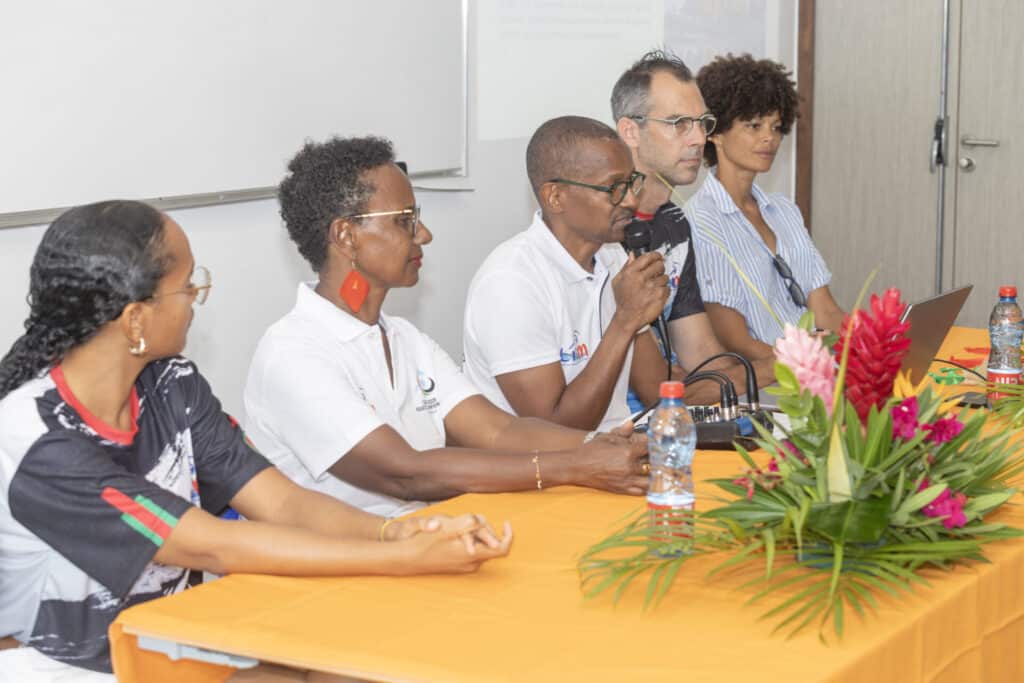
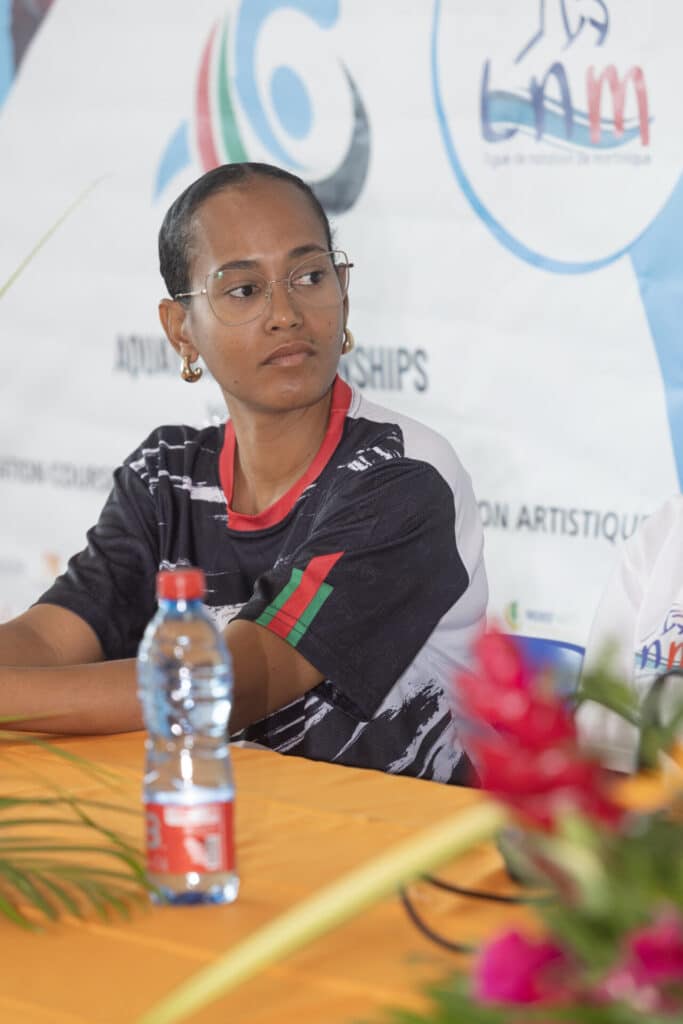
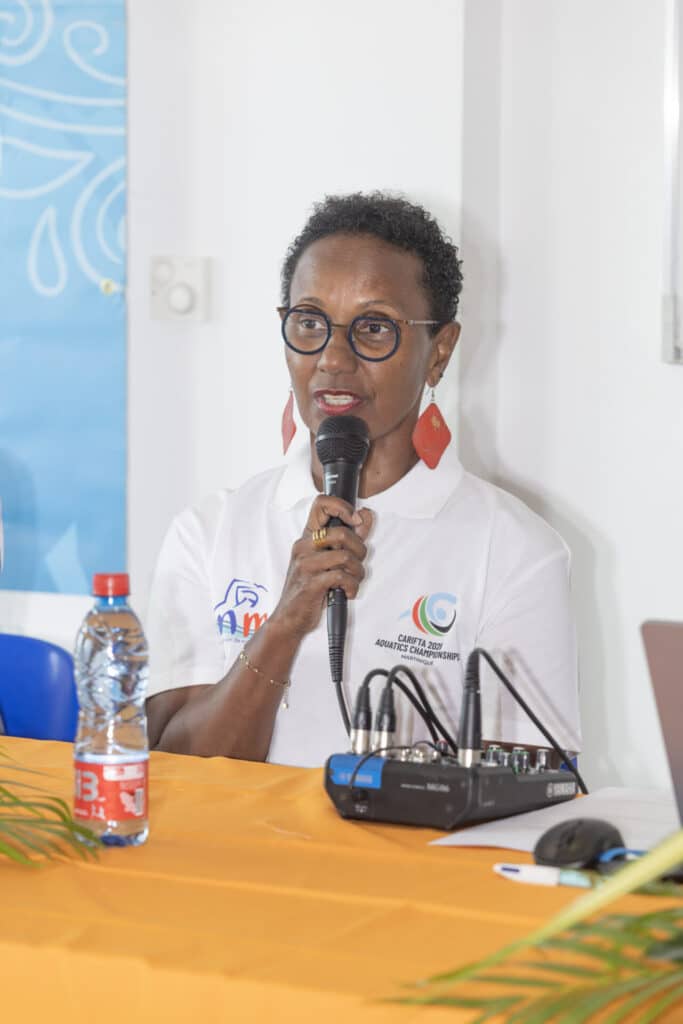
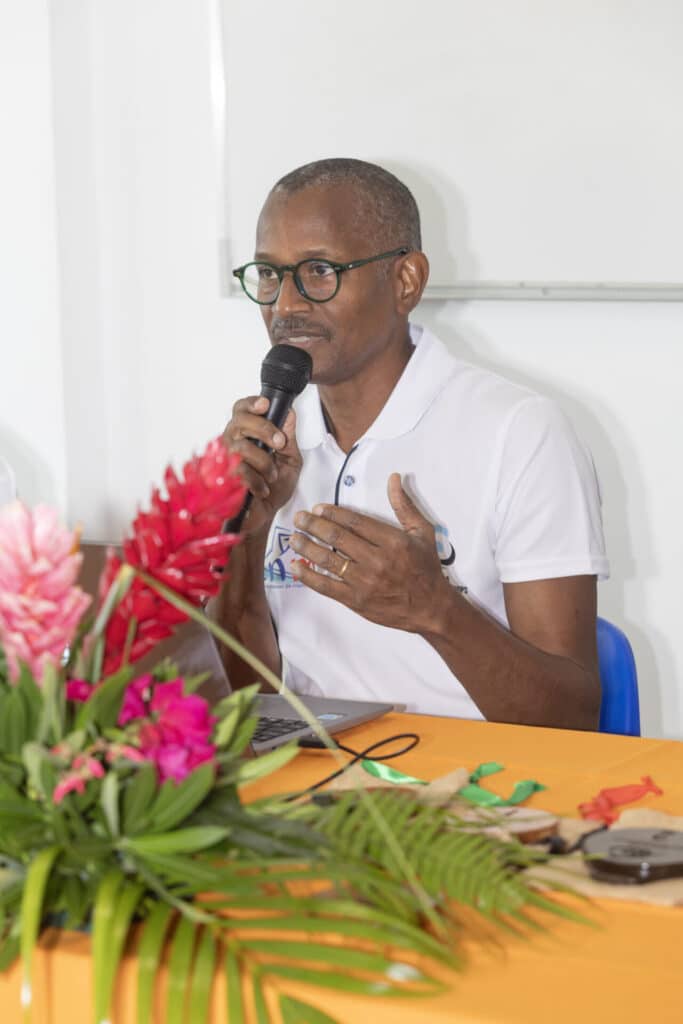
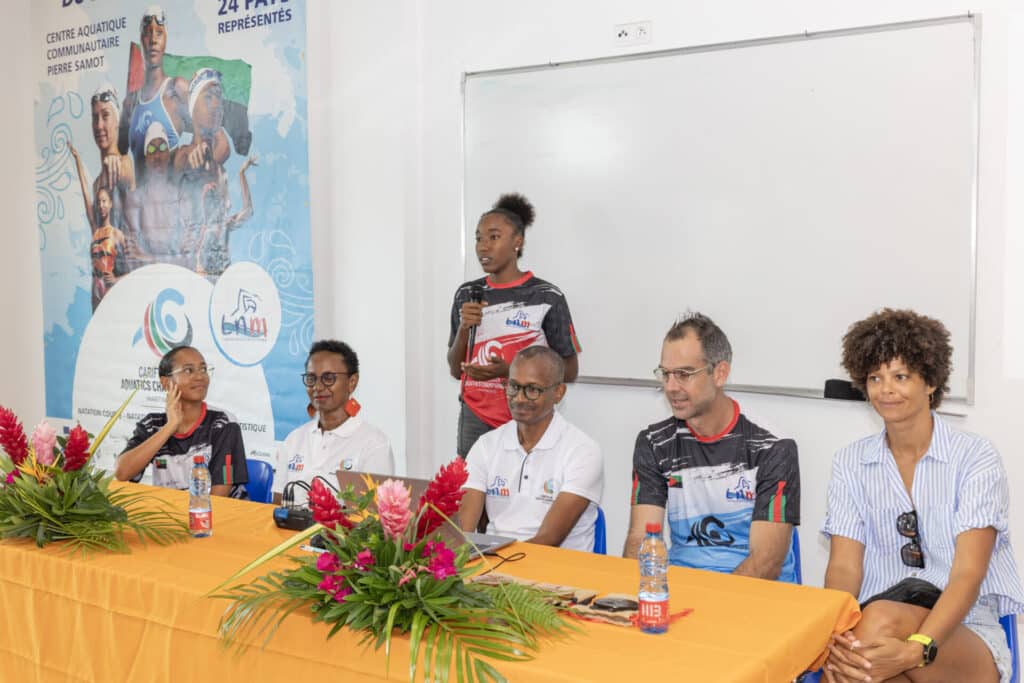
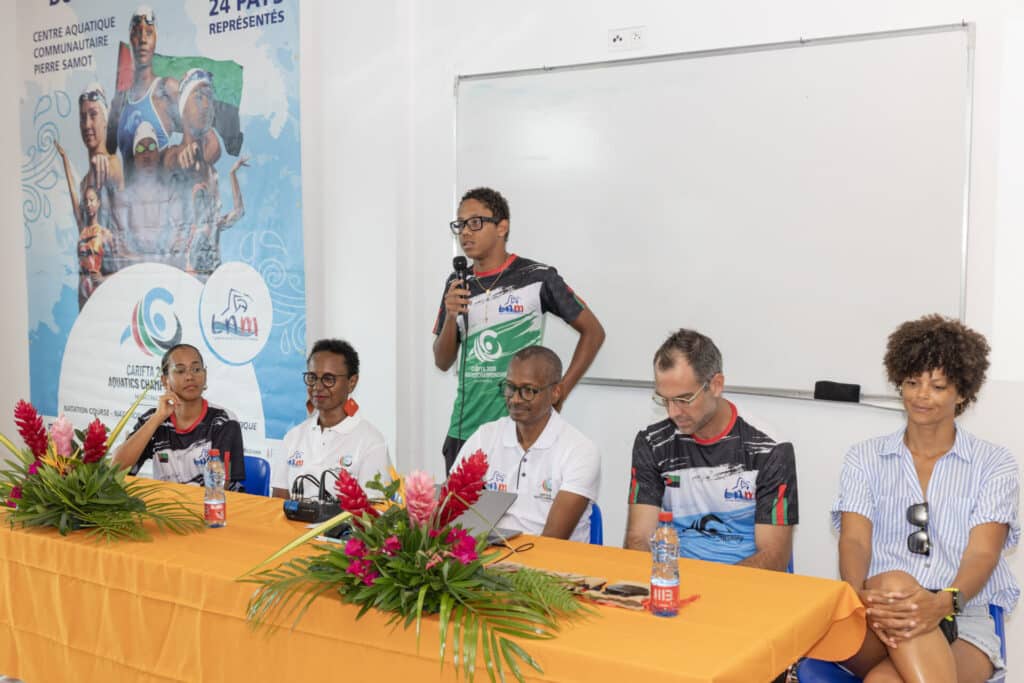
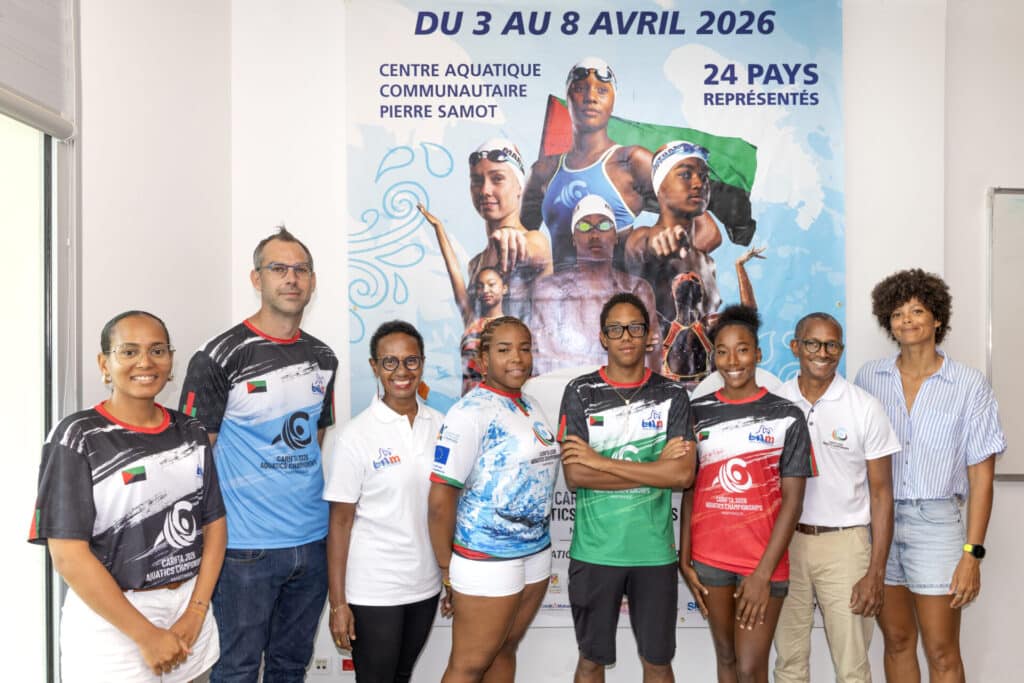
On Saturday March 28, at the Centre Aquatique Pierre Samot in Le Lamentin, the CARIFTA Aquatics Championships 2026 press conference was more than just an information meeting. Over the course of an hour and a half, organizers, athletes and partners presented much more than just the sporting program: from April 3 to 8, Martinique will host the 39th edition of the Caribbean’s leading junior aquatic event, ten years after the first edition was so memorable. Twenty-four nations. Three disciplines. A home territory that knows it.
A bid driven by collective memory
In 2024, at the Caribbean Aquatics Association Congress held in the Bahamas, two bids were put forward to host the 2026 CARIFTA Aquatics Championships: Saint Lucia and Martinique. The vote was clear-cut: some thirty votes for Martinique, ten for Saint Lucia.
Behind this result is a story. The 2016 edition, the first ever to be held on home soil, left its mark on the minds of all those who were there: coaches, delegation leaders, officials. In 2024, when it came time to vote, many still remembered that week.
"It was a beautiful edition, and one that will always be remembered."
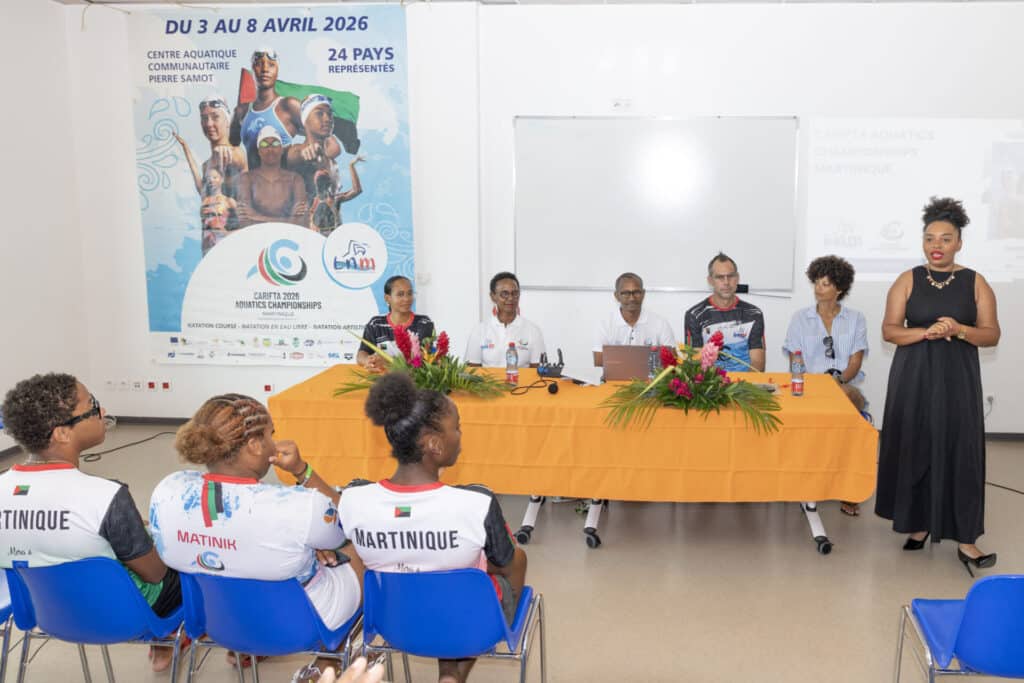
The other factor was more concrete: Sainte-Lucie did not yet have its own pool. Martinique, on the other hand, can count on the Centre Aquatique Pierre Samot in Le Lamentin, with its ten-lane Olympic pool, 800-seat grandstand and 25-meter warm-up pool. One of the best facilities in the Caribbean.
The organization also emphasized its capacity to welcome delegations from outside the basin, with several accommodation solutions mobilized in the south of the island, supplemented by other structures if necessary. This logistical aspect, rarely secondary in this type of event, reinforced the credibility of Martinique’s bid.
Three disciplines, 24 nations, a demanding format
The CARIFTA Aquatics Championships 2026 will bring together 24 countries: 21 English-speaking Caribbean nations, plus Martinique, Guadeloupe and Guyana. The swimming races will take place over four days: heats in the morning, finals in the afternoon, from Saturday April 5 to Tuesday April 8. Artistic swimming gets underway on Monday during the lunch break, with solos followed by technical events. The duets and teams round off the program on Wednesday morning. On the same Wednesday, the open water event takes place over five kilometers in the Anses d’Arlets.
Competitors: Benjamins (11-12 years), Minimes (13-14 years), Cadets (15-17 years) do not enter as individuals. They are national selections, with the best swimmers from each territory. To enter the Martinique selection, swimmers must satisfy a time grid established over the previous two seasons, which only selects swimmers capable of reaching the finals.
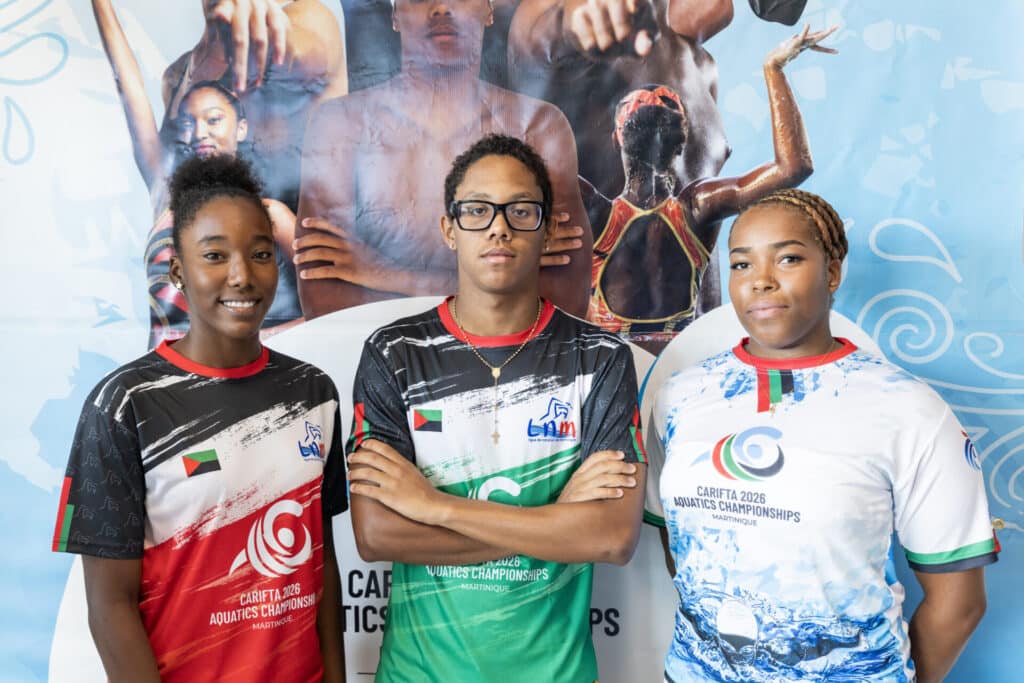
In the minds of the organizers, selection is based on a simple logic: to score points, you have to enter the final, and to enter the final, you have to be among the top eight times in the morning heats. In other words, the swimmers selected are supposed to have a level that enables them to play a real role in the competition, and not just participate.
The Martinique delegation at the CARIFTA Aquatics Championships 2026 has 61 swimmers: 36 in racing, 12 in open water, five of whom also race, and 18 in artistic swimming. The team is led by five captains: Jean-Naël Zozime and Maxime Auguste-Charlery for boys’ racing (15-17 age group), Cyrielle Manin and Sayanne Guivissa for girls’ racing, and Nohemy Marajo for artistic swimming.
Water as starting point and destination
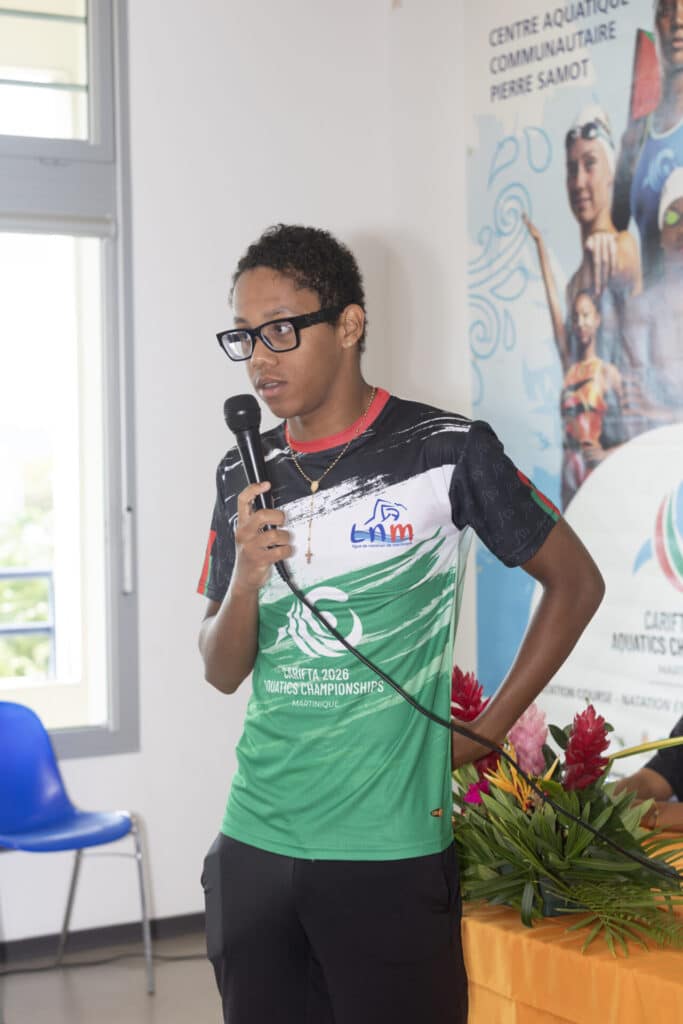
When asked how he got started, Jean-Naël Zozime, captain of the boys’ selection, answers straightforwardly: “I was introduced to swimming so that I wouldn’t drown. Cyrielle Manin, captain of the girls’ selection, tells much the same story: she almost drowned as a child, and that’s what led her to learn to swim.
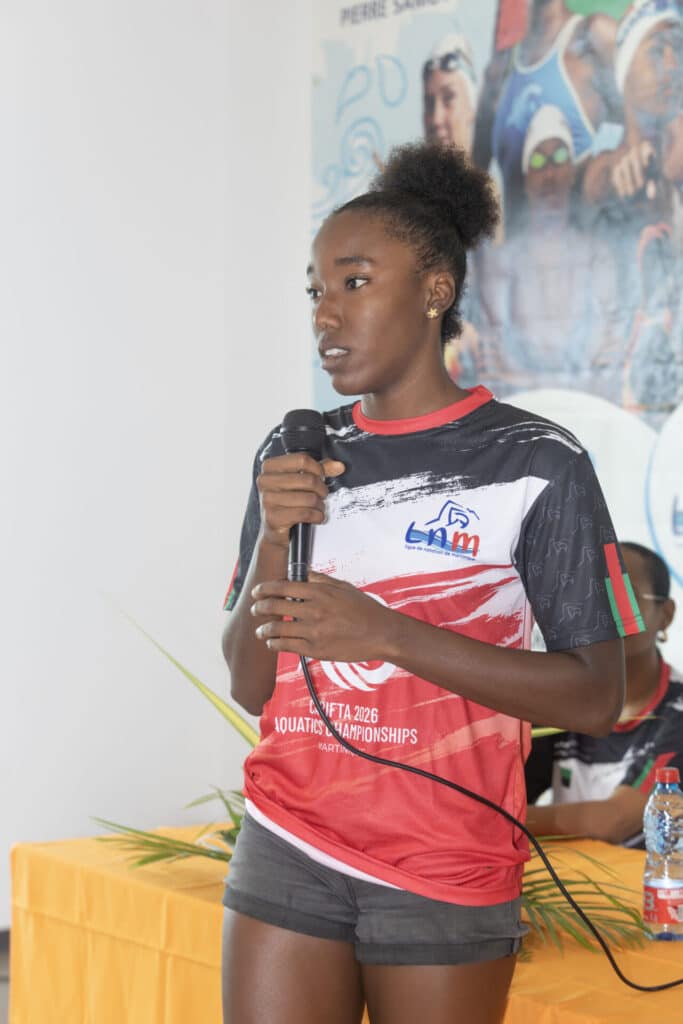
These two testimonies, heard just a few minutes apart, say something important about this territory. Two young Martiniquans, initially frightened by the sea, who are now representing their island against twenty-three Caribbean nations. This is more than just a sporting achievement.
"Swimming is a tough sport. You can't expect it to be easy, but with a lot of perseverance, anyone can do it."
— Jean-Naël Zozime
Nohemy Marajo, artistic swimming captain, has been practicing for ten years a discipline that the public still knows little about. She explains it concretely: learning choreographies on dry land, rehearsing them in the water, controlling your breathing under the surface while your legs draw figures above. It’s a sport that’s as technically demanding as it is physically demanding, and has as much to do with ballet as it does with endurance.
"You have to know how to endure, how to save every last breath to finish the choreography."
— Nohemy Marajo
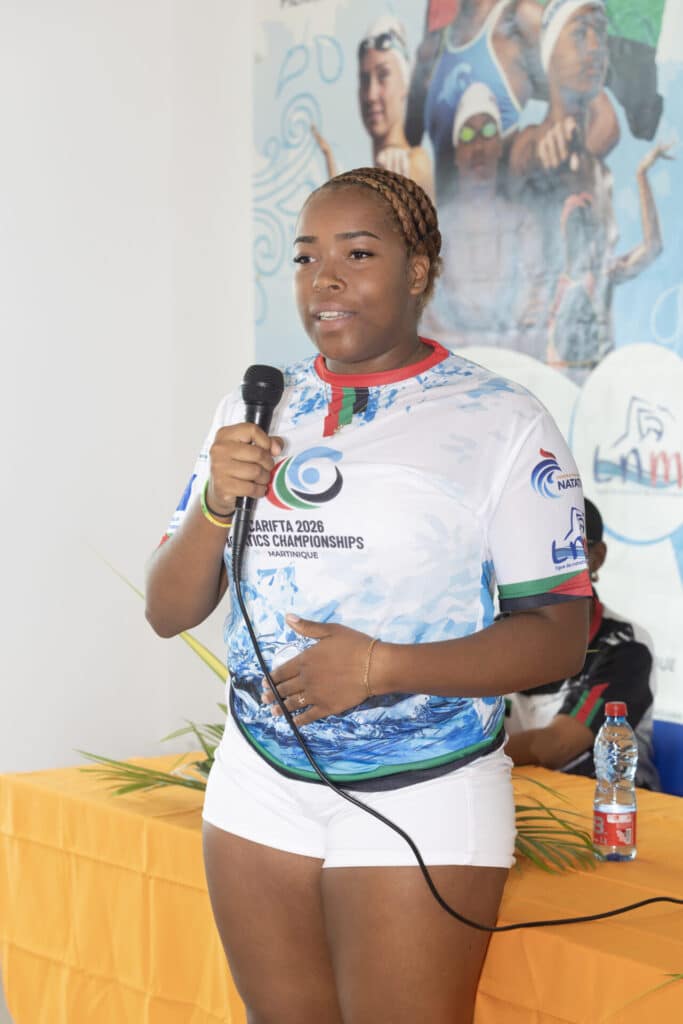
The conference of the CARIFTA Aquatics Championships 2026 also pointed out that artistic swimming is still a confidential discipline in the Caribbean, due to the infrastructure it requires and the level of preparation required. It requires three-dimensional work and very thorough technical preparation, as well as the support of outside professionals, particularly in dance and gymnastic preparation. For the supervisors, the challenge of CARIFTA is twofold: to support those who are already practising and to encourage new vocations.
What the coaching team observes in these youngsters is a constant: they train, take their exams, compete at weekends, and do it all over again. “Generally, swimmers perform well in their studies too, because they’ve worked on this rigor on a daily basis.” What you learn in the pool also applies elsewhere, and the organizers insist on this daily requirement: it’s not enough to qualify, you have to be able to show up on the day, in a sport where regularity and discipline count as much as talent.
Medals from the hands of the island
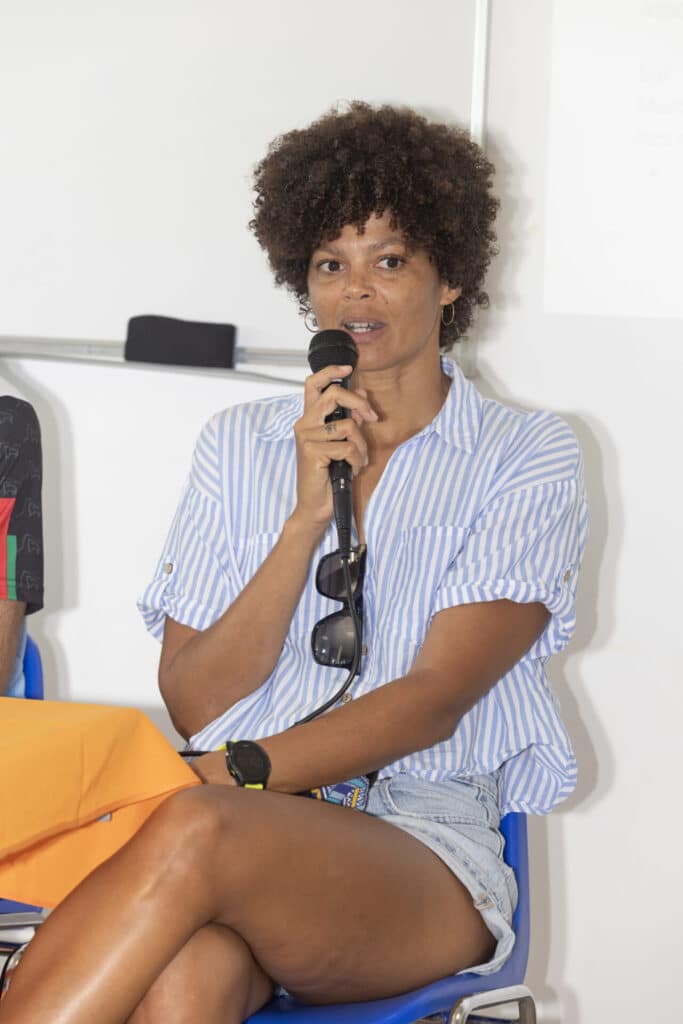
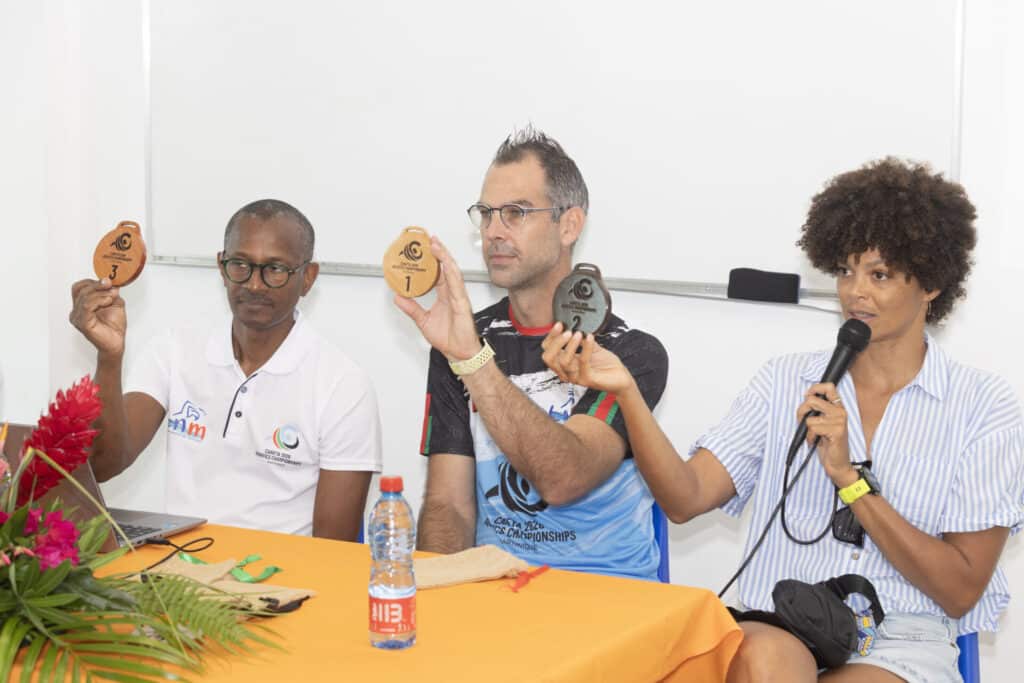
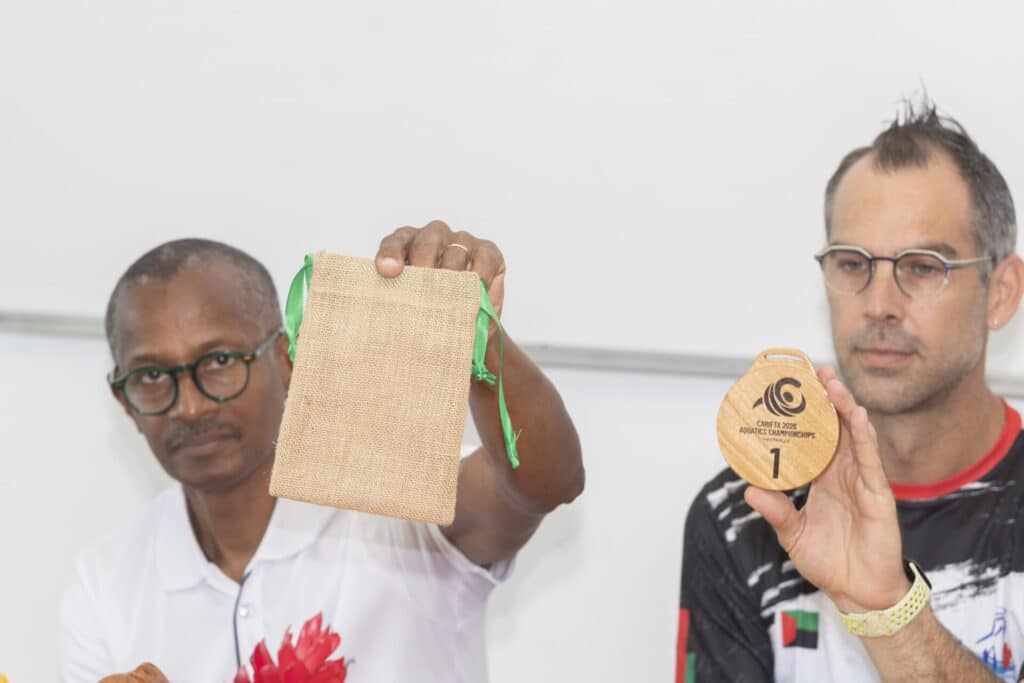
The way an event rewards its champions often says a lot about what it stands for. At the CARIFTA Aquatics Championships 2026, the medals were made in Martinique from noble woods: pearwood for gold, mao bleu for silver, mao ghani for bronze. A craftsman from the Nord-Atlantique region produced them, Joseph Galliard signed the engravings, and a local seamstress made the pouches in the three colors of the Martinican flag.

The initiative was spearheaded by the event’s godmother, Coralie Balmy, a former top-level swimmer who had taken part in the CARIFTA four times in her career. An eco-responsible and identity-affirming initiative, hailed as a first on the Caribbean scale.
Every Caribbean athlete who reaches the podium at the CARIFTA Aquatics Championships 2026 will leave with a piece of Martinique, a unique medal made by local craftsmen, unlike any other.
The conference also specified that trophies would accompany these awards, and that the medals had yet to receive their lanyards before the competition opened. Here too, the aim is clear: to make each award a sporting, local and symbolic object.
A week that mobilizes the whole territory
The CARIFTA Aquatics Championships 2026 won’t just be played out in the pools. Between 1,500 and 1,800 people are arriving in Martinique: swimmers, staff and families spread out over several hotels in the south of the island. Every day, around 150 volunteers ensure the smooth running of the event: former swimmers, parents, locals who sometimes have no direct connection with swimming, but who wanted to get involved.
Among them, the officials play a decisive role: some 26 officials from the Caribbean will reinforce the Martinique officials, bringing the number of people around the pool to around fifty for each morning and afternoon meeting. In addition, there will be first-aid attendants, reception teams, people in charge of awards, delegation escorts and areas open to the public.
Welcoming delegations to the CARIFTA Aquatics Championships 2026 was also thought through in detail. They all had to arrive on April 2, at different times of the day, sometimes very early in the morning, sometimes late at night. In conjunction with the transport company and SAMAC, a precise plan was drawn up at the airport to ensure smooth exits, transfers to buses and settling into accommodation, with particular attention paid to meals depending on the time of arrival.
The opening ceremony of the CARIFTA Aquatics Championships 2026, on Friday April 3 at the Georges Gratiant stadium, is free and open to all: 2,800 seats to fill. The group “Nou Pa Sav” will accompany the parade of delegations. On Saturday, April 4, Les Hommes d’Argile will be on hand as the delegations arrive on site, offering a strong cultural backdrop intended as a symbolic first encounter with Martinican identity. Throughout the week, Martinican cultural groups will be on hand to ensure that visitors leave with a living image of the region, not just competition results.
The CARIFTA Aquatics Championships 2026 ceremony is scheduled to take place from 4 to 6 p.m., and will be broadcast on a giant screen, as well as relayed by media partners and via YouTube for wider distribution in the Caribbean. The ambition is clear: to make Martinique the center of the Caribbean for the duration of the event.
In addition to sport, the organizers of the CARIFTA Aquatics Championships 2026 also have an economic and cultural objective. Bringing in up to 1,800 people means filling accommodation, generating consumption, encouraging car rentals and putting the hotel and restaurant sectors to work. It’s also a way of showcasing Martinique’s culture, notably through the entertainment planned for the opening ceremony and the arrival of the delegations.
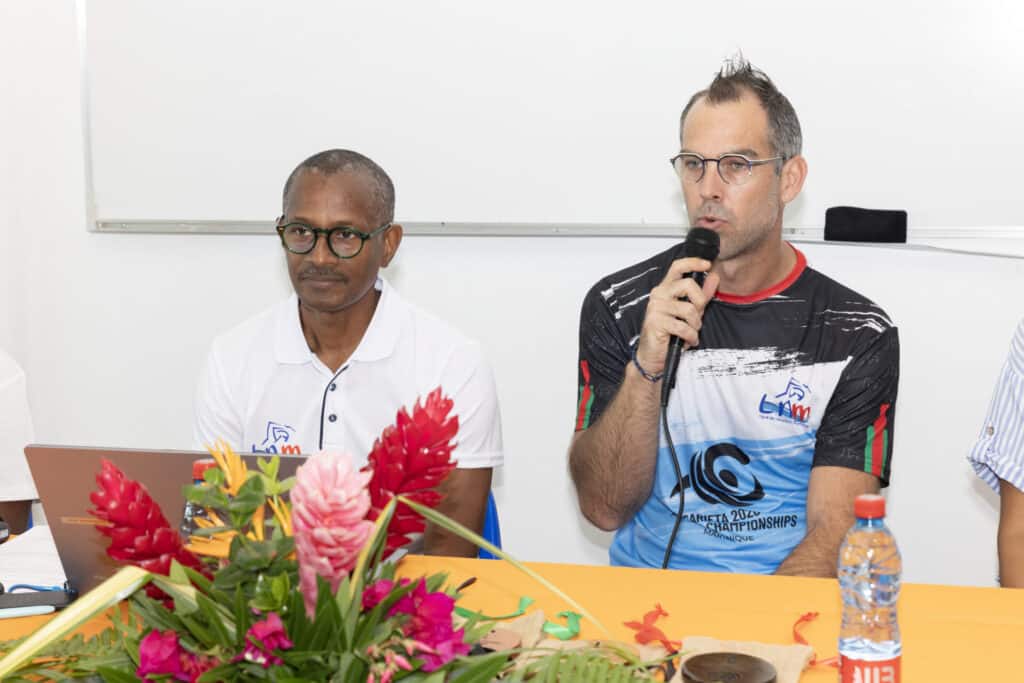
The open water event at Anses d’Arlets also serves as a reminder that the sea is a living, fragile environment that deserves protection. The association’s representative at the conference sums up its mission simply: “learn to swim to discover the seas and protect them.”
This educational dimension goes beyond drowning prevention. It also touches on the appropriation of water by the people of Martinique, the discovery of the discipline by the youngest and the broader desire to reinforce the region’s aquatic culture in the long term.
An assertive island
A phrase uttered at the end of the conference sums up the general mood: “We’re ready, and we’ll make the CARIFTA Aquatics Championships 2026 a collective success and a great source of pride for our region.”
What the delegations take away with them on the evening of April 8 is more than just a ranking. It’s an image of Martinique, a territory that knows how to welcome, organize and assert its identity. For six days, the whole Caribbean will be there. It’s up to Martinique to show what it can do.
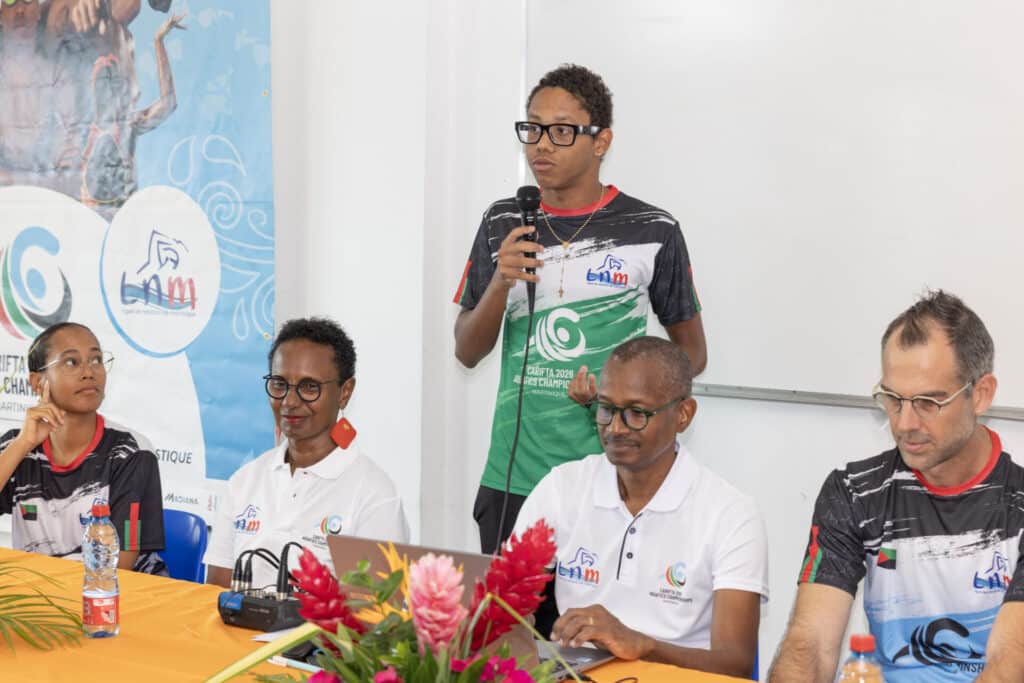
But the organizers of the CARIFTA Aquatics Championships 2026 also want to leave their mark after the event. The Ligue de Natation de Martinique ended the 2024-2025 season with some 2,540 members, around ten affiliated clubs and, generally speaking, 7 to 8 clubs involved in competition. With this in mind, the CARIFTAs are not intended as a parenthesis, but rather as a possible catalyst to encourage vocations, boost membership and establish swimming as a permanent fixture on the Martinique sports scene.
The organizers of the CARIFTA Aquatics Championships 2026 have also chosen not to reproduce the large village of 2016. In 2026, the activities surrounding the competition are to be more focused, with one day in particular being highlighted, in order to concentrate energy and attendance rather than scattering the highlights.
The CARIFTA Aquatics Championships 2026 is the 39th edition of the Caribbean’s leading junior aquatic event, held in Martinique from April 3 to 8. Twenty-four nations are taking part in racing, artistic and open water swimming, in categories ranging from 11 to 17 years of age.
The swimming race and artistic swimming events take place at the Centre Aquatique Pierre Samot in Le Lamentin. The 5-kilometer open water event takes place in Anses d’Arlets on Wednesday April 8.
Tickets are available on cariftamartinique2026.com and on the Ligue de Natation de Martinique social networks. Prices: €10 in the morning, €20 in the afternoon for adults, 4-day pass at €125. The opening ceremony at the Georges Gratiant stadium is free of charge.
Twenty-four countries are taking part: 21 English-speaking Caribbean nations, plus Martinique, Guadeloupe and Guyana.
The Martinique squad is led by five captains: Jean-Naël Zozime and Maxime Auguste-Charlery for boys’ racing, Cyrielle Manin and Sayanne Guivissa for girls’ racing, and Nohemy Marajo for artistic swimming.
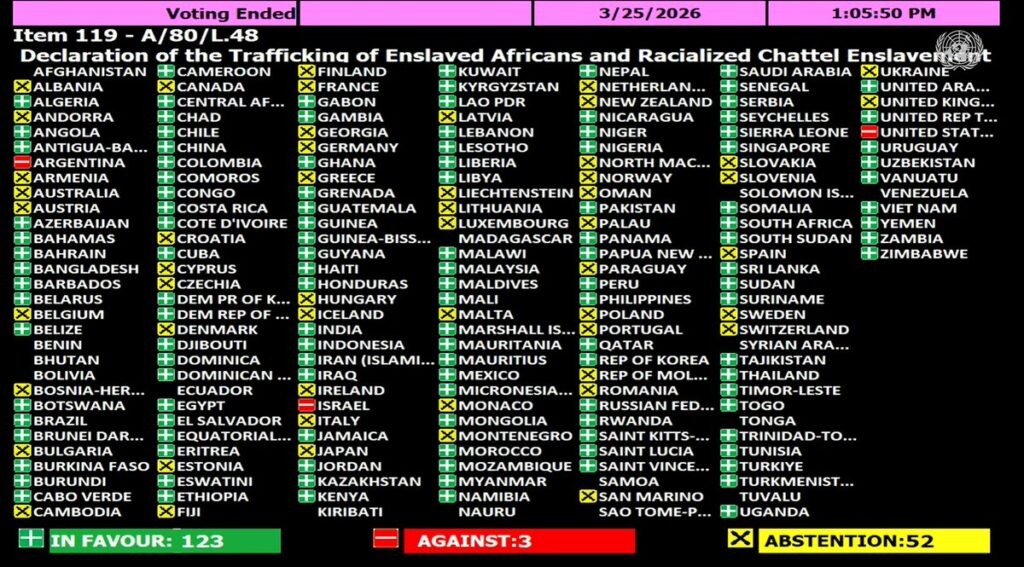
On March 25, 2026, the UN General Assembly adopted a resolution that marks a milestone in the international recognition of the history of slavery. The text qualifies the transatlantic African slave trade and racialized chattel slavery as the most serious crime against humanity. The text, sponsored by Ghana, was adopted by 123 votes in favor, with 3 against and 52 abstentions. Opponents included the USA, Argentina and Israel, while several European countries, including the UK, chose to abstain. Behind this strong wording is more than just a symbolic gesture. For the Caribbean, this decision is part of a historical and political continuity, echoing decades of work, demands and struggles for fairer recognition of this memory.
Recognition that redefines the international debate
By classifying slavery as a major crime against humanity, the UN has crossed a threshold rarely reached by international bodies. This recognition does not create an immediate legal obligation for States, but it profoundly alters the framework of global debate. It introduces a more explicit reading of history, in which the transatlantic slave trade is no longer merely evoked as a past tragedy, but as a crime whose consequences continue into the present.
This evolution in international discourse is not insignificant. It comes at a time when issues relating to colonial legacies, structural discrimination and historical inequalities are taking on increasing importance in public debate. By taking a clear stance, the UN is helping to legitimize the analyses long put forward by Caribbean researchers, institutions and cultural players, who stress that the history of slavery cannot be dissociated from contemporary realities.
The Caribbean, at the heart of history and current issues
For the Caribbean territories, this decision is more than just a historical observation. It has a direct bearing on their very construction. The transatlantic slave trade and the slave system have shaped the region’s economies, societies, languages and cultures. Plantations, land structures, social hierarchies and even some of today’s economic dynamics have their roots in this period.
Recognition by the UN thus confirms a reality that the Caribbean has never ceased to bear: that of a founding history, the effects of which are still visible. It also repositioned the region in the global narrative, not as a peripheral space, but as a central territory in the understanding of the great historical transformations linked to slavery and colonization.
This international recognition also offers a strategic opportunity. It strengthens the capacity of Caribbean territories to influence global discussions on memory, justice and reparations. It gives added legitimacy to the steps already taken by certain regional institutions, which have been working for several years to structure concrete proposals on these issues.


Reparations and memorial justice: a new dynamic
One of the most important effects of this resolution concerns the issue of reparations. By classifying slavery as a major crime against humanity, the UN opens the way to more structured discussions on forms of restorative justice. This includes avenues such as official apologies, the restitution of cultural property, the funding of educational programs and public policies aimed at correcting the inequalities inherited from this history.
In the Caribbean, these issues are not new. They are part of a long-standing process, driven in particular by regional initiatives seeking recognition of the lasting consequences of slavery. The UN decision does not create a binding framework, but it changes the balance of power by giving international support to these claims.
It can also encourage better structuring of remembrance policies. In many regions, the transmission of the history of slavery remains uneven and sometimes fragmented, despite the fact that it is central to understanding today’s societies. UN recognition can serve as a lever to strengthen educational programs, support research and enhance the value of places of remembrance.

Recognition that also reveals tensions
The vote on this resolution highlights persistent differences within the international community. While a large majority of States supported the text, certain oppositions and abstentions show that the issue remains sensitive. The reservations expressed relate in particular to the political and historical implications of this qualification, as well as to the consequences it could have in terms of reparations.
These tensions are a reminder that there is no absolute consensus on the recognition of slavery as a major crime. It remains a subject of debate, where diplomatic stakes, historical responsibilities and economic considerations are intertwined. For the Caribbean, this situation confirms that the battle for full recognition of this history is still ongoing.
Rethinking the Caribbean narrative on a global scale
Beyond the political stakes, this decision offers an opportunity to redefine the way the Caribbean is told internationally. All too often reduced to a simplified tourist or cultural image, the region has a complex history marked by violence, resistance and reconstruction.
The UN’s position puts this history back at the center of the global narrative. It invites us to consider the Caribbean not only as a space of memory, but also as a place of intellectual and political production. The region’s reflections on slavery, colonization and their consequences continue to inform contemporary debates far beyond its borders.
For a medium like RichèsKarayib, this news underlines the importance of offering a demanding, contextualized reading of the Caribbean territories. It reminds us that the region’s culture, history and economic issues are deeply intertwined, and must be approached in their entirety.

Turning recognition into leverage
The real impact of this resolution will depend on the actions that follow. International recognition is a step forward, but it is not enough on its own to bring about concrete change. For the Caribbean, the challenge now is to transform this decision into a lever for action, by strengthening cooperation, structuring public policies and consolidating research and transmission initiatives.
The UN has set an important milestone by classifying the transatlantic slave trade and slavery as a major crime against humanity. For the Caribbean territories, this recognition represents an opportunity to advance essential debates linked to their history and development. It opens up a new way of thinking about international relations, by fully integrating the legacies of the past into the construction of the present and the future.

The UN decision adopted on March 25, 2026 recognizes the transatlantic slave trade and slavery as the most serious crime against humanity. It aims to affirm the historical gravity of these events, and to encourage international discussions on remembrance, justice and reparations.
No, this UN resolution is not legally binding. It does not impose direct obligations, but it does have a strong political and symbolic impact that can influence international discussions and public policy.
The Caribbean has been deeply marked by the transatlantic slave trade and slavery. This recognition by the UN validates a historical reading that has long been held in the region, and can support initiatives linked to remembrance, education and reparations.
The Organisation internationale de la Francophonie has published a figure that reshuffles the deck in the global language debate: 396 million people now speak French. With this total, the French language in the world rises from 5th to 4th position behind English, Mandarin and Spanish, but ahead of standard Arabic. This is more than just an announcement. It marks a fundamental change in the place of French on the international stage, and confirms that the language continues to make headway in strategic areas such as education, economic exchanges, digital technology and cultural mobility.
Global progress changes the narrative around French
For years, French has often been portrayed as a language of great influence, but weakened in the face of global competition. The OIF’s 2026 report introduces an important corrective. The French language in the world is not only holding its own: it is gaining ground in terms of the number of speakers and international visibility. Moving up to 4th place in the world ranking not only gives it strong symbolic weight, but also political, educational and economic weight. A language that rises in the world rankings is not simply a language handed down by heritage; it’s a language that continues to be learned, used, relayed and invested in.
French should not be analyzed solely as an institutional or diplomatic language. It remains a language of concrete circulation, spoken, taught, worked on and adapted to very different contexts. The French language in the world today is driven by demographic and social realities that go far beyond the European framework, and this is precisely what the 2026 report highlights.

396 million speakers: what this figure really means
The figure of 396 million must be read with care. It refers to a linguistic community spread over the five continents and not a homogeneous block. This means that French continues to exist in a wide variety of contexts: as a mother tongue for some, as a language of instruction for others, and as an administrative, professional, cultural or communication language in multilingual societies. This diversity is at the heart of the French language in the world as it really exists in 2026.
This fact also has a strong editorial impact. It reminds us that we can no longer speak of French as a language confined to a single territory or a single national history. French circulates in very different spaces, with multiple uses and its own dynamics. It is this plurality that is its strength today. So the figure of 396 million doesn’t just tell of an increase; it tells of the geographical, social and cultural scope of a global language.

Africa, the decisive center of gravity for the French language worldwide
One of the key findings of the 2026 report is the importance of the African continent. The OIF states that 65% of French speakers live in Africa. This proportion alone is enough to shift the focus. The future of French is no longer being played out primarily in the areas where it has long concentrated its institutional prestige; it is now being played out in young, numerous, urban, creative African societies, with profound educational and economic issues at stake.
This reality forces us to rethink old ideas. Talking about french language around the world without acknowledging the central role of Africa would be to miss the main point of the report. The growth of the French language today depends not only on powerful demographic dynamics, but also on the ability of African education systems, media, cultural industries and French-speaking economies to maintain and expand the use of French. The report’s focus on Africa is not a footnote; it is a structuring element.
A language that's also moving forward through schools, digital technology and business
The 2026 report points out that French is the 2nd most widely-learned foreign language in the world, with almost 170 million learners, confirming its importance in education systems and its appeal well beyond the French-speaking world… It is also listed as 4th most popular language on the Internet and 3rd language of business and economics. These factors give substance to the figure of 396 million: they show that the growth of the French language is based not only on demographics, but also on learning, digital uses and the professional value of the language.
This data is extremely important today. A world language doesn’t just exist through its past or its official status. It also exists through its ability to remain visible in search engines, digital content, educational networks, platforms, commercial exchanges and working environments. The report therefore suggests a more comprehensive reading: the The French language continues to be of practical use around the world, which helps to explain its resilience and progress.
2050: why do IOF projections already count today?
The report’s other strong point is its projection for the coming decades. The IOF estimates that, on current trends, French could be spoken by 590 million people in 2050 including 9 out of 10 in Africa. This is not a mechanical certainty, but a projection based on observed dynamics. It highlights a central issue: the future progress of French will depend less on symbolic rhetoric than on policies for education, training, transmission and access to content.
In other words, the future of the French language in the world is more than just a flattering ranking. It depends on very concrete decisions: quality of teaching, presence of French in career paths, adaptation to digital uses, cultural and media production, the place of the language in student and economic mobility. The 2026 report therefore gives a positive signal, but this signal remains linked to conditions of consolidation.

What the 396 million figure really says
TheOIF ‘s 2026 report not only delivers an impressive total. It redraws the mental map of contemporary Francophonie. 396 million people speak French; the language is moving up the world rankings; its African roots are strengthening; and its weight in learning, the digital world and the economy remains significant. Taken together, these elements provide a more accurate picture of the French in the world: an international language, diverse, in transformation, and still capable of widening its scope.
For a media outlet, a cultural player, an educational institution or a company, this observation has a clear consequence: French should not be seen as a language of retreat, but as a language of the future, provided it is considered in all its geographical and social diversity. This is where the real interest of the 2026 report lies: behind the number lies a reshaping of the global linguistic landscape.
According to the report The French language in the world 2026 published by the Organisation internationale de la Francophonie, 396 million people around the world now speak French. This is an important figure, as it shows that the French language retains real international weight and continues to make inroads into the global linguistic landscape. It is not just a language inherited from a shared history between several countries, but one that is still transmitted, learned and used in very different educational, economic, administrative and cultural contexts.
According to the OIF, French is now the 4th most widely spoken language in the world, behind English, Chinese and Spanish, and ahead of standard Arabic. This change in rank is significant, as it reflects a concrete evolution in the place of French on a global scale. This ranking reinforces the idea that French remains a major international language, present in many fields, and that it should no longer be considered as a purely institutional or heritage language.
The growth of the French language can be explained by a number of complementary factors. Firstly, the language benefits from a strong demographic dynamic in several French-speaking countries, particularly in Africa, where the majority of French speakers now live. Secondly, French continues to play an important role in education, international cooperation and certain economic sectors. The OIF also points out that French remains the 2nd most widely-learned foreign language, with almost 170 million learners, showing that it continues to attract people far beyond the territories where it is an official language.
