From March 16 to 21, 2026, 35 programmers from mainland France, Quebec and the French overseas territories are in Martinique to meet with local artists and companies. Organized by the Office National de Diffusion Artistique (ONDA), this week of meetings is a concrete opportunity for Martinique’s performing arts professionals to forge lasting links with national and international venues.
An unprecedented delegation to promote the arts in Martinique
Thirty-five performing arts professionals made the trip to Martinique this week. Among them were directors of national stages, festival programmers including the co-programmer of the Avignon Festival, heads of national drama centers, and a director of a festival for young audiences from Montreal. A composition that testifies to the growing interest of the French network in Martinique’s creations.
"For the first time, there are people from all the overseas territories in the delegation. There are people from Guadeloupe, Reunion and Guyana. And a programmer from Quebec as well, so we know it's not that far away."
— Marie-Pia Bureau, directrice de l'ONDA
The delegation was drawn up in collaboration with the Direction des Affaires Culturelles (DAC), Tropiques Atrium Scène Nationale, Korzémo L’Envol, Les Coulisses de Saint-Esprit and other local structures. This territorial network ensures that the encounters reflect the true diversity of the island’s artistic ecosystem.
Multiple disciplines, professional artists
Encounters cover the full range of performing arts: theater, dance, circus, creative music (improvised jazz, contemporary music), spoken word and visual arts. This last dimension is a specific feature of Martinique, recognized by the delegation itself: several of the venues represented have galleries and are interested in visual artists.
The artists we met this week are professionals, some of them very young and still emerging, but all part of a contemporary creative process. ONDA does not support the reproduction of traditional forms per se, but is interested in approaches that work with tradition to take it elsewhere.
"We tend to encourage contemporary approaches. Sometimes tradition is very interesting when it's not just about reproducing gestures, but also taking you somewhere."
— Marie-Pia Bureau, directrice de l'ONDA
Around fifty artists from Martinique are presented over the course of the week, in a variety of formats: indoor shows, presentations strolling around the territory, work tables. Some don’t have the space to show a full show, but are able to present their work directly to programmers, which, at this level of the network, is already a decisive step.


Young audiences, a strategic focus for artistic dissemination in Martinique
Among the professionals present this week is Estelle Picot-Derquenne, Director of Scènes d’enfance, ASSITEJ France, the national association that federates players in artistic creation for children and young people. Her presence in Martinique illustrates one of the delegation’s key areas of focus: young audiences, already highlighted by the visit of a Quebec programmer specializing in youth festivals.
"I coordinate regional networks that bring together programmers and artists around issues of cooperation, distribution and circulation of works and artists."
— Estelle Picot-Derquenne, directrice de Scènes d'enfance – ASSITEJ France

It also supports the Rézo Filibo network for young audiences in Martinique, with an entire day devoted to it on Monday March 23, featuring meetings between professionals, elected representatives, journalists and institutions. The aim is clear: to make life easier for artists and promoters who choose to work with young audiences, by creating the conditions for a lasting relationship between local players and the national network.
Artistic dissemination: what these encounters produce in concrete terms
Artistic distribution is built up, often slowly, through the accumulation of links and trust. Marie-Pia Bureau is clear on this point: with each edition of these traveling meetings, organized every four years in each of the French overseas territories, two or three artists find new long-term partners in France.
"I'm thinking of Véronique Kanor, for example, who is now an associate artist at the scène nationale de Chambéry and whose productions have been supported for three years. She's the one who comes to me, but there are others like her every time."
— Marie-Pia Bureau, directrice de l'ONDA
These links can take many forms: a programming date, an invitation to a residency, a co-production. The logic is often one of progressive loyalty: first we welcome, then we co-produce, then we program. Johan Hillel Hamel, Director of the DAC Martinique, stresses the economic importance of these openings for local companies.
"The possibility of distribution outside Martinique is absolutely fundamental to a company's economy, but also to the diversity of audiences it will reach and the feedback it will have on the artists' work."
— Johan Hillel Hamel, directeur de la DAC Martinique

A changing gaze: the end of exoticism
Twenty years ago, being programmed as a Martinican artist in France often meant being associated with a folkloric image: music, rum, sunshine. This is no longer the dominant image. The programmers who make the trip to Martinique aren’t looking for exoticism: they’re looking for singular voices, artistic points of view that broaden their own understanding of French history and society.
"We try to listen to singular voices that look at our entire history from a different angle, and share it on set - not necessarily for overseas populations, but for all French people."
— Marie-Pia Bureau, directrice de l'ONDA
It’s a significant cultural shift. For Martinican artists, it opens up a space for artistic dissemination that is no longer based on the need to conform to an expected image, but on the singularity of their approach.


A week to build bonds that last
The Rencontre Itinéraire ONDA in Martinique runs from March 16 to 21, 2026. It is a dense sequence: performances at Tropiques Atrium, presentations at Korzémo L’Envol (Ducos), Les Coulisses in Saint-Esprit, Espace A’zwel in Schoelcher, Campus Caraïbéen des Arts, Terre d’Arts and ETC Caraïbes in Fort-de-France. A performance laboratory closes the week at Savane des Pétrifications, in the presence of Annabel Guérédrat and other Martinican performance artists.
For the island’s artists and cultural professionals, this week is less a one-off event than a starting point. The links forged here can lead to tours, residencies and co-productions. ONDA is committed to supporting the resulting projects, provided they are the result of a genuine, long-term encounter.

ONDA (Office National de Diffusion Artistique) is a public operator that supports the distribution of performing arts in France. It is a signatory to the Pacte de Visibilité des Artistes Ultramarins (Visibility Pact for Overseas Artists) with the French Ministry of Culture and the Ministry of Overseas France. Its role is to strengthen links between artists from the French overseas territories and programmers in France, notably through touring meetings organized every four years in each territory.
ONDA events in Martinique cover theater, dance, circus, creative music (improvised jazz, contemporary music), spoken word and visual arts. ONDA mainly supports contemporary artistic approaches, including those that reinterpret traditional forms in innovative ways.
The meetings enable artists to present their work directly to programmers from national stages, national drama centers and festivals. Collaborations may result: programming dates, residencies, co-productions. ONDA then supports the projects that come to fruition. By way of example, Véronique Canor is currently associate artist at the Chambéry national stage, a link born of this type of encounter.
On Saturday March 14, 2026, the Hotel de l’Assemblée de la CTM in Fort-de-France hosted the 6th edition of the Caribbean Business Cruise (CBC). Organized by Isanaja Consulting in partnership with Martinique Développement this economic morning brought together Caribbean entrepreneurs from Guadeloupe, Saint Lucia and Antigua & Barbuda to work towards a common goal: to turn the Caribbean into a concrete area of economic cooperation.
A business cruise, a pioneering concept in the Caribbean
The Caribbean Business Cruise is no ordinary networking event. Created in 2019 by Isabelle Adelis Flandrina, founder and CEO of Isanaja Consulting, the Caribbean Business Cruise is presented as the first Caribbean business cruise. The concept is to enable business leaders to meet aboard a ship, away from busy schedules, to build real business relationships.
"Together with my husband, we created the first edition of the Caribbean Business Cruise in 2019, which was originally founded to enable business leaders to go on mission with their families."
— Isabelle Adelis Flandrina, fondatrice d'Isanaja Consulting
In six years, Caribbean Business Cruise has evolved to include an increasingly structured economic dimension. Caribbean Business Cruise 6 now boasts a partnership agreement with the Organization of Eastern Caribbean States (OECS), making Isanaja Consulting one of the few private French companies to hold this partnership, according to its founder. This recognition opens up access to an English- and Spanish-speaking network that Martinique is still struggling to exploit to the full.
Martinique as a host and investment destination
The Caribbean Business Cruise kicked off with a speech by Alexandre Ventadour, territorial councillor at the Martinique Assembly and President of Martinique Développement. His message: Martinique isn’t waiting for investors, it’s getting ready to receive them.
"Our Martinican companies are here to showcase what Martinique can do best."
— Alexandre Ventadour, président de Martinique Développement

Yann Yala also of Martinique Développement, gave an economic overview of the region: GDP in excess of €10 billion, with growth of around 1%, per capita GDP of €29,000, a population of 356,000, and a trade balance that is largely in deficit, with a coverage rate of around 20% by 2025. Three sectors have been identified as priority development drivers: tourism (6% of GDP, €600 million in annual sales), renewable energies and the digital economy.

With this diagnosis in mind, the question of export support became central. Martinique Développement focuses on attractiveness and installation support, while the Martinique Chamber of Commerce and Industry (CCIM) has taken over responsibility for exports, notably via the Caribbean Trade Facilitation Team. Stéphanie Pujar, project manager for Caribbean cooperation at the CCIM, presented this bilingual (French and English) program, which supports companies from Martinique, Guadeloupe and Guyana in their export development.
"International business support is truly a tailor-made service. Every company has its own project, so every company also has services that suit it."
— Stéphanie Pujar, responsable coopération Caraïbes, CCIM

French companies can benefit from grants from the French Ministry for Overseas France covering between 50% and 75% of the cost of international assignments. It’s a little-known lever that’s regularly highlighted at this type of event.
Caribbean entrepreneurs in search of partners
Caribbean Business Cruise 6 gave a dozen companies the opportunity to present themselves in two minutes, before getting down to B2B business. A deliberately tight format to get straight to the point.
Among the English-speaking participants, Celia Samuel representative of Go To Enterprise (Antigua & Barbuda) and board member of the Antigua Chamber of Commerce, was back for the second year running. She distributes wholesale food products: fruits, vegetables, meats, agro-processed products, from producer to end customer, and is looking for manufacturers wishing to export to the English-speaking Caribbean.
"I am passionate about working with other Caribbean islands and other Caribbean companies. Time waits for no man. So if you see an opportunity, jump on it. "
"I'm passionate about working with other Caribbean islands and companies. Time waits for no one. So if you see an opportunity, seize it."
— Celia Samuel, Go To Enterprise, Antigua & Barbuda
Her testimonial is a concrete illustration of the value of the Caribbean Business Cruise: during the previous edition, she forged a relationship with a producer in Grenada, and is now the exclusive distributor of his brand in Antigua, with prospects for expansion to other islands.
Chantal Alexander, General Manager of Abby’s Exotic Blends (Saint Lucia), was presenting a range of preservative-free agro-processed products based on plantain, breadfruit, sweet potato and green banana, potato chips, confectionery and rum punches, and was looking for distributors or production partners.
On the Guadeloupe side, the sectors represented covered a broad spectrum: cybersecurity with CyberCorsair (Jérémy Benallal) water and renewable energy engineering with Prest’eau Caraïbes (Luigi Apoari), management consulting with Auxiliary Being (Franciane Morvany), software and digital training with ISP Informatique and cultural and tourist development with the association Fout Gwada Bel (Leslie Morvany). Guadeloupe’s Chambre des Métiers de l’Artisanat was also on hand to promote its Artisans Pays de Guadeloupe label and explore synergies with its counterparts in Martinique.
A mindset to build
Isabelle Adelis Flandrina was keen to point out a reality with which the room is familiar: French-speaking and English-speaking entrepreneurs don’t arrive at the same meetings with the same frame of mind.
On the English side, when they go there, they go there to do business. Clearly, if they come to meet you, it's to find out if you can meet their demand."
— Isabelle Adelis Flandrina
This difference in entrepreneurial culture runs like a thread through the successive CBCs. This year, the Martinique and Caribbean delegations were more cautious than expected: the founder refers in particular to the Caribbean geopolitical context linked to US policies and its impact on regional business dynamics. A Haitian delegation, initially scheduled, was unable to join the event for logistical reasons.
Despite these absences, the Caribbean Business Cruise 2026 confirmed the usefulness of these regional meetings. The B2B exchanges that followed the presentations, in the Assembly hall, materialized what the CBC seeks to provoke: real connections between players who, geographically close, do not spontaneously cross paths.
Digicel Business a partner of the event, emphasized through the voice of its Administrative and Financial Director René Klock the importance of this type of initiative in strengthening the regional economic fabric around Caribbean VSEs and SMEs.
The 7th edition of the Caribbean Business Cruise is already on the cards, with organizers hoping for a larger Martinique delegation on board.

The Caribbean Business Cruise (CBC) is the first Caribbean business cruise, created in 2019 by Isanaja Consulting. Each year, it brings together business leaders from all over the Caribbean – French, English and Spanish speakers – for B2B exchanges and regional partnership opportunities. The 6th edition was held on March 14, 2026 in Fort-de-France, Martinique.
Martinique boasts a GDP of over 10 billion euros, a largely service-based economy and identified growth sectors: tourism, renewable energies and digital technology. Martinique Développement and the Martinique Chamber of Commerce and Industry offer tailor-made support for setting up and exporting, with grants covering 50-75% of the costs of international missions for French companies.
The 6th edition of the Caribbean Business Cruise in Fort-de-France brought together companies in five sectors: agro-processing (Abby’s Exotic Blends, Saint Lucia), cybersecurity (CyberCorsaire, Guadeloupe), water and environmental engineering (Prest’eau Caraïbes, Guadeloupe), distribution and international trade (Go To Enterprise, Antigua), and business training and support.
The partnership between CTO and The Travel Foundation marks an important step in the evolution of tourism policies in the Caribbean. At the ITB Berlin 2026 international trade fair, the region’s tourism leaders confirmed that they would strengthen their cooperation to support a more sustainable tourism model, more resilient to climate change and more focused on local communities.
In a region where the economy is heavily dependent on tourism, climate change is no longer an abstract issue. The effects of global warming, the intensification of weather phenomena and the erosion of coastal ecosystems now represent immediate challenges for many island territories. It is against this backdrop that the partnership between CTO and The Travel Foundation takes on a strategic dimension. The objective is clear: to transform climate commitments into concrete actions capable of supporting the economic and social future of Caribbean destinations.
ITB Berlin, a strategic venue for the voice of the Caribbean
Every year, ITB Berlin brings together the world’s key tourism players: ministries, international organizations, airlines, destinations and industry experts. For the Caribbean, this event is an essential platform for recalling a reality that is often underestimated on an international scale: small island states are among the territories most exposed to the effects of climate change.
At a session devoted to the gap between climate risks and adaptation solutions in tourism, the Secretary General and CEO of the Caribbean Tourism Organization, Dona Regis-Prosper, highlighted the region’s real-life experience. The devastating hurricanes that regularly hit the Caribbean, rising sea levels and increasing pressure on marine ecosystems have had a profound impact on the territories. Today, this first-hand experience is a driving force for rethinking the region’s tourism strategies. The partnership between CTO and The Travel Foundation is precisely in line with this dynamic of transformation.

Moving from climate talk to concrete solutions
At the heart of the partnership between CTO and The Travel Foundation lies one overriding conviction: climate strategies must now go beyond declarations of intent. Caribbean destinations already have numerous studies, scientific data and prospective scenarios on climate risks. However, a persistent challenge remains: transforming this information into genuinely funded and operational projects.
This is one of the points raised by Narendra Ramgulam, Deputy Director of Sustainable Tourism at the Caribbean Tourism Organization. According to him, the region has no shortage of ideas and analyses, but the concrete implementation of projects is often hampered by a lack of access to funding. In this context, the partnership between CTO and The Travel Foundation aims to bridge the gap between strategic planning and real action on the ground.

A tourism model focused on local communities
One of the major thrusts of the partnership between CTO and The Travel Foundation concerns the role of local populations in tourism development. In many Caribbean destinations, the economic benefits of tourism sometimes remain concentrated in certain segments of the industry. The new cooperation framework aims to foster a more inclusive approach in which tourism projects generate direct benefits for communities.
This vision also implies a strengthening of local skills in sustainable tourism professions, as well as increased support for economic initiatives that enhance the region’s natural and cultural resources. This approach is in line with a global trend in the tourism sector. Today’s travelers are increasingly interested in responsible, authentic experiences that are closely linked to the realities of the areas they visit.
Caribbean tourism faces structural transformation
The partnership between CTO and The Travel Foundation comes at a pivotal time for the Caribbean tourism industry. Several profound transformations are redefining the future of the sector. The intensification of extreme climatic phenomena, the gradual weakening of coral reefs, the erosion of certain beaches and the evolution of travelers’ expectations in terms of sustainability are gradually changing the balance of regional tourism.
These elements are not just about the environment. They directly influence the tourism experience, the competitiveness of destinations and the livelihoods of many local populations. Against this backdrop, strengthening the resilience of Caribbean tourism is becoming as much an economic priority as an environmental one.
International cooperation to strengthen resilience
The renewal of the partnership between CTO and The Travel Foundation formalizes a strengthened collaboration between two organizations committed to the transformation of global tourism. The Travel Foundation has been working for several years on initiatives to make tourist destinations more sustainable, notably through climate planning, tourism flow management and ecosystem protection.
For its part, the Caribbean Tourism Organization represents the tourism interests of many of the region’s territories and plays a central role in coordinating regional policies. By combining their expertise, the two institutions aim to develop tools and strategies that will enable Caribbean destinations to better anticipate climate risks, while maintaining their attractiveness to tourists.
A regional vision for the future of Caribbean tourism
Beyond technical cooperation, the partnership between CTO and The Travel Foundation is also part of a broader vision: that of a coordinated regional approach to sustainable tourism. The Caribbean shares many common realities. The economies of many territories rely heavily on tourism, the islands remain particularly exposed to climatic risks, and the region boasts an exceptional natural and cultural heritage.
In view of these common characteristics, regional cooperation appears to be an essential lever for developing solutions tailored to the specific characteristics of island destinations. This approach is also in line with the ambitions of the CTO Reimagine Plan, a strategy that aims to reposition Caribbean tourism around sustainability, innovation and resilience.
The Caribbean, a global laboratory for sustainable tourism
Through the partnership between CTO and The Travel Foundation, the Caribbean is also seeking to assert its role in international debates on the future of tourism. The challenges facing the region today could foreshadow those that other tourist destinations will have to face in the coming decades. From this perspective, the Caribbean can become a veritable laboratory of innovation for climate-resilient tourism strategies, sustainable management of island destinations and the integration of communities into the tourism economy.
The stakes involved in the partnership between CTO and The Travel Foundation extend far beyond regional borders. The solutions developed in the Caribbean could inspire other regions of the world facing similar challenges.
The partnership aims to develop concrete strategies to make Caribbean tourism more resilient in the face of climate change, while supporting local communities.
Caribbean destinations have to cope with intensifying hurricanes, beach erosion, coral reef degradation and rising sea levels.
The Caribbean Tourism Organization aims to position the Caribbean as a sustainable destination, capable of reconciling tourism development, ecosystem protection and benefits for local populations.
Facing an illuminated 6,000 TEU vessel operating in the middle of the night, on the ninth floor of the Poséidon, with a bird’s eye view of the Fort-de-France terminal, the launch of the PCRF XL maritime service supported by CMA CGM offered a revealing scene of the transformation underway.
Under the terminal’s spotlights, port straddlers and containers move to the rhythm of night-time operations, providing a glimpse of the logistical infrastructure that links Martinique to the rest of the world on a daily basis.
But behind this port mechanism lies a broader question: what if these new maritime routes, beyond transporting goods, were also helping to redefine the place of Caribbean territories in the region’s economic and cultural exchanges?
On a regional scale, these connections could also facilitate the organization of traveling exhibitions, as well as the transport of works, instruments or audiovisual productions between islands – a logistical reality often decisive for cultural projects in the Caribbean.
Supported by CMA CGM, the PCRF XL service is part of a gradual transformation of maritime links between Europe, the French Caribbean territories, the regional Caribbean and Latin America.
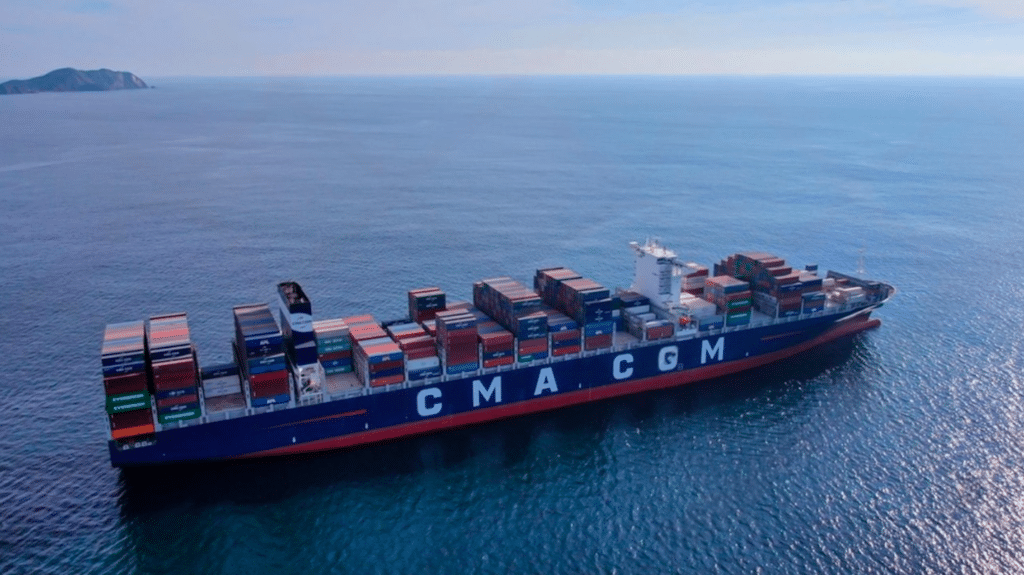
Over the past twenty years or so, the vessels operating on these routes have undergone several major changes: from 1,700 TEU units until 2006, then 2,200 TEU vessels, followed by 3,500 TEU vessels, to the 6,000 TEU container ships now deployed by CMA CGM since 2026.
This increase in capacity illustrates a change in scale. It also accompanies a broader ambition: to strengthen the position of the French Caribbean territories in the major maritime flows linking Europe, Latin America and the entire Caribbean basin, as part of a strategy supported in particular by CMA CGM.
A strategic position between the Caribbean and Latin America
This strategy is largely based on the region’s geographical position. Situated close to the major shipping routes linking Europe, North America, Latin America and the Panama Canal, Martinique and Guadeloupe occupy a pivotal position between several economic areas, a position also emphasized by CMA CGM in its logistics analyses…
As Guillaume de Chastellux reminded us at the project presentation:
“The West Indies are the gateway to the Caribbean. We’re at the crossroads of Latin America, facing the Panama Canal with its opening onto the Pacific Ocean, and with Europe and the Mediterranean on the other side.”
In this context, the modernization of port infrastructures and the arrival of larger vessels are not just technical developments. They are also helping to reposition the French Caribbean territories in regional and even international trade.
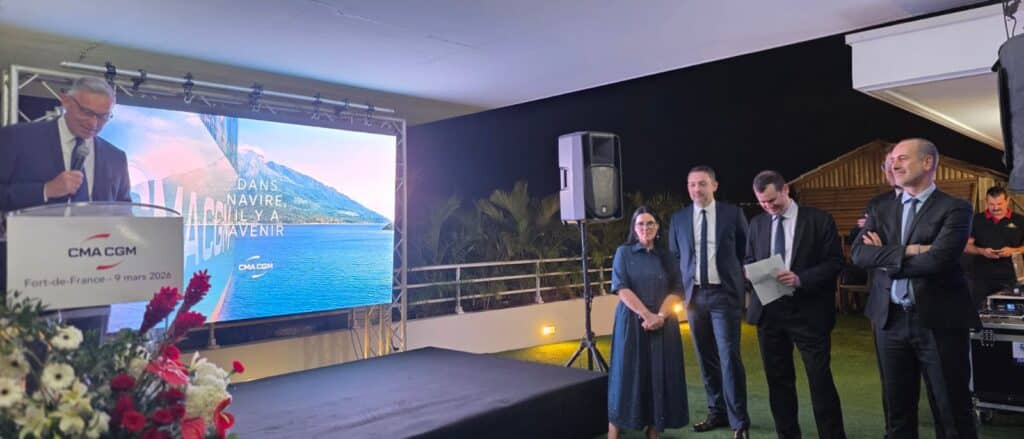
The maritime hub project led by CMA CGM in partnership with the Grands Ports Maritimes de Martinique et de Guadeloupe aims to increase the overall transhipment capacity of the two islands to approximately 300,000 TEU per year 68,000 today.
Looking at opportunities on a regional scale
In addition to infrastructure, CMA CGM’s management team emphasized the regional dimension of this development at a presentation organized by CMA CGM.
Guillaume de Chastellux put it explicitly:
“I absolutely invite all our customers and partners to get out of their territory and look at the opportunities in the region – trade, industry, processing, re-export, consolidation of goods. The whole field of possibilities is very broad.”
This invitation to broaden horizons refers directly to the regional dynamics of the Caribbean and Latin America. In this area, made up of archipelagos, coastlines and continental territories, the sea remains a central vector for trade, a fact that CMA CGM regularly emphasizes in its regional development strategies…
Strengthening maritime connections can not only facilitate trade flows, but also encourage new cooperation between territories.

Territorial and cultural roots
While the logistical dimension of the project is central, the event also served as a reminder that the Group’s actions are part of a wider territorial environment. Through its foundation and local initiatives, CMA CGM supports a number of social, cultural and environmental projects in the French Caribbean territories.
These commitments include support for the Yole ronde de Martinique a nautical discipline emblematic of Martinique’s maritime heritage and a living symbol of the relationship between the sea and the island’s identity.
The Group also supports professional integration initiatives for young people, notably through programs run with the RSMA. The company is also involved in a number of solidarity initiatives with local organizations such as the Food Bank and the Red Cross. This commitment is complemented by environmental initiatives, notably to preserve the mangrove swamp.

A new stage in Martinique's maritime role
Today, three CMA CGM shipping lines serve the port of Fort-de-France. On the horizon 2027 this number is expected to rise to six lines as part of a wider network of some nineteen lines operating in the Caribbean zone. This development could strengthen Martinique ‘s position in regional trade, facilitating connections between the Caribbean islands, Central and South America and Europe.
As these connections develop, another question arises: how these new maritime routes could, in time, also contribute to the wider influence of Caribbean territories in the region and beyond.
The Caribbean lies at the crossroads of major shipping routes linking Europe, North America, Latin America and the Panama Canal. Improved maritime connections can therefore facilitate trade, strengthen regional economic relations and increase the flow of goods between the islands and neighboring continents.
The PCRF XL service aims to modernize maritime links between Europe, the French Caribbean territories, the regional Caribbean and Latin America. The use of 6,000 TEU vessels will increase transport capacity and improve logistics efficiency in the region.
Their geographical position at the heart of the Caribbean basin is a strategic advantage. Located between Europe, Latin America and the shipping routes of the Panama Canal, they can serve as transshipment hubs for redistributing goods to neighboring islands and regional markets.
At the far end of the Village de la Poterie in Martinique, a dazzling facade immediately catches the eye. Artificial flowers, painted fish, a profusion of bold hues: it’s impossible to pass by without slowing down. This is where Maryl Musard, known as the artist Artimuse has set up its studio gallery: Happy Place By Artimuse. A place conceived as a visual breathing space, where color is expressive. Settled in Martinique a few years ago, she has put down her brushes to anchor a universe where color becomes a living energy.
Maryl Musard, known as Artimuse: painting as a matter of course
“Ever since I was a little girl, I’ve been drawing, painting, writing poems and illustrating them. For Maryl Musard, creation is a continuous process. As a child, she wrote poems that she illustrated. The gesture is already there: writing, drawing, associating words with shapes.
Her career path, however, is not that of an artist trained from the outset in a fine arts school. She worked at Nice airport. There, she observed and captured attitudes, silhouettes and everyday scenes. She turned them into comic strips inspired by passengers and real-life situations. Drawing becomes a means of interpreting reality.
She then trained in interior design to learn the techniques of trompe-l’œil, faux wood and faux stucco. This gave her a technical understanding of materials and effects. It was here that she met artists – a trompe-l’œil specialist, a colorist – and confirmed an intuition: her job is not to make color, but to paint.
Today, she works in acrylics, using pure hues. She doesn’t mix her colors. She chooses a brand rich enough not to have to create her own shades. Sometimes she superimposes, but she assumes straightforward flat tints. This decision gives her work a direct, uncompromising intensity.

A Caribbean reinterpreted by color
Artimuse’s universe is deeply rooted in Caribbean aesthetics. It evokes the intensity of color in the Caribbean, the light that changes from one minute to the next, contrasts and bold assemblages.
But she doesn’t seek to faithfully represent what she sees; rather, she speaks of “recoloring” reality. The canvas is not a mirror; it’s a transformation: Mount Pelée can become more striking than it really is, or the sea can take on an unexpected tone. The objective is not documentary, but emotional.
A stay in Panama enriched her approach. There, she discovered Arawak art and the power of simplification. Two strokes can be enough to suggest an insect or a character. This economy of means left a lasting impression on her. Since then, she has tended towards pure, legible forms, without unnecessary overload.
Some of her works include specific references. She cites a painting that, for her, represents the map of Martinique, including Grand Rivière and the Caravelle peninsula. Other compositions, on the other hand, are not necessarily intended to be precisely understood. You can simply let yourself be carried away by the image: a watermelon heart, a leaf in front of a face. As the artist suggests, you don’t always have to explain. Sometimes, you just have to let yourself go… and smile.


The heart-shaped mouth: an identifiable signature
One detail recurs almost systematically in his portraits: the heart-shaped mouth. The lips come together to visually create an assertive little heart. It’s not just a stylized smile, but a deliberate graphic choice.
This heart-shaped mouth has become Artimuse’s signature. It immediately conveys softness and tenderness, almost an emotional dimension. The face appears benevolent, accessible. Without speech, the shape conveys a clear intention: here, color is accompanied by positive energy.
The eyes, on the other hand, are treated with restraint. They are neither overly laughing, nor marked by sadness. Their expression remains open, almost neutral. This choice allows the viewer to project his or her own emotions. The mouth asserts joy; the eyes leave room for interpretation. This combination creates a balance between artistic direction and freedom of interpretation.


Paint on any surface, integrate wax
Artimuse paints with acrylics on any support. Canvas, small objects, various surfaces: “anything that passes through my fingers can undergo colorful and radical transformations”, she says.
She is particularly fond of wax. This is a material with which she has developed a singular approach. During a stay in Dominica, where traditional supports were harder to find, she began experimenting with painting directly on fabric. This constraint quickly became a source of creativity.
Today, she can paint directly on the wax or integrate her motifs into her work. The “little zigouigouis”, as she calls them, become graphic elements in their own right. They structure the space, create rhythm and dialogue with the flat areas of pure color.
This relationship with textiles introduces a dimension that is both tactile and cultural. The motif is not simply decorative: it is integrated into the composition, sometimes absorbed, sometimes contrasted.


Happy Place By Artimuse: a place to live
The move to the Village de la Poterie came about through encounters and circumstances. Maryl Musard speaks of a natural alignment. The place corresponds to her rhythm: artisanal, open, lively. The studio and gallery cohabit. She paints on the spot, continuously. Visitors can catch her in the midst of creation, “under the ocean” or “in Mount Pelée”, depending on the work in progress. She invites them to interrupt. The encounter is part of the experience.
Audience reactions are constant: they talk of color, cheerfulness and a soothing effect. Some enter out of curiosity, leaving with a smile. Others return, settle in and have a coffee. The space becomes an anchor. The name Happy Place By Artimuse is not a slogan. It expresses a clear intention: to create an environment where color acts as energy. As Maryl Musard puts it, “I have to be able to give people happiness”.


Maryl Musard is a painter based in the Village de la Poterie in Martinique. Under the name Artimuse, she develops a pictorial universe deeply marked by the intensity of Caribbean colors. She paints with acrylics on a variety of supports – canvas, objects and wax fabrics – and is distinguished by a recognizable graphic signature, notably the heart-shaped mouth present in her portraits. Her work is based on pure, unmixed colors and a deliberate simplification of form, inspired in particular by Arawak art discovered during a stay in Panama.
Happy Place By Artimuse is located at the end of the Village de la Poterie, in Martinique. It is both a studio and a gallery, where the artist paints in the presence of the public. Visitors can discover colorful works inspired by the Caribbean, sometimes incorporating wax motifs and local geographical references such as Mount Pelée or the Caravelle peninsula. The space is identifiable by its colorful entrance, decorated with flowers and painted fish. The experience is not limited to contemplation: the place is designed as a space for exchange and sharing.
What sets Artimuse apart is her treatment of color and faces. She uses pure, unadulterated hues, giving her works an immediate visual intensity. Her most recognizable signature is the heart-shaped mouth, present in many of her canvases, a symbol of gentleness and joy. Conversely, the eyes of his figures remain deliberately neutral, leaving the viewer free to interpret. Her aim is clear: to convey positive energy and make color a vehicle for well-being.
On March 7, 2026, the Keyce Academy campus in Fort-de-France was transformed into a travel forum. Students in the BTS Tourisme Martinique program orchestrated the third edition of the “Challengers du Monde”: a fictitious but fully professional show, where each destination – from Japan to Brazil, from Dominica to New Orleans, from London to Martinique – was told through a mythical film.

A student-driven project from A to Z
Lilia and three other students in the BTS Tourisme Martinique program welcome visitors. Behind her, carefully constructed stands, entertainment and the smell of cooking – the Keyce Academy campus has taken on the air of an international tourism trade fair.

The concept is simple in statement, demanding in execution. Second-year teams choose a film, then build their entire sales pitch around the destination featured in the film: travel offers, events, communication media. First-year teams, on the other hand, manage the event’s communications. This is the role played by Nolan and Loémy, both in their first year.
"The aim is to present tourist destinations through a mythical film. For example, we have Pirates of the Caribbean with Dominica - and many others. There will be tastings on the stands, little games and entertainment."
— Nolan, 1ère année BTS Tourisme Martinique
Teeyane, New Orleans and Creole flavors
One of the stands that stood out was that of Teeyane and her fictitious agency Louisiane Vibes. Based on the theme of The Princess and the Frog, it offers a complete package: Fort-de-France-Miami-New Orleans flight, three-star hotel in the French Quarter, bayou cruise and five-day discovery pass.

"We're offering a trip from Fort-de-France to New Orleans at €2,008 per person, which includes the flight with a stopover in Miami, a three-star hotel in the French Quarter, a cruise through the bayous - the marshes found in New Orleans - and a discovery pass for museums and activities."
— Teeyane, étudiante en BTS Tourisme Martinique, agence fictive Louisiane Vibes
The stand also played on the senses, with games to discover spices, New Orleans-style beignets, and activities based on the history of Louisiana. A choice that resonates with Martinique, a Caribbean island that shares a common Creole history with Louisiana.
A few steps away, Davelie transported visitors to London with the fictitious Windsor Palace a royal tour in the footsteps of Queen Elizabeth II, including English tea and scones.

"We're based in London. We work mainly on the royal route, retracing the footsteps of Queen Elizabeth II, who died in 2022. We offer visitors the chance to discover the historical monuments that retrace her path to the Crown. And we're also offering you the chance to take part in our events and win lots of prizes."
— Davelie, 2ieme année BTS Tourisme Martinique
Japan, Brazil, Dominica, Martinique and many others were also among the destinations honored – each carried by the breath of a film, each defended with the same professional seriousness.
What two days at the show can really teach you
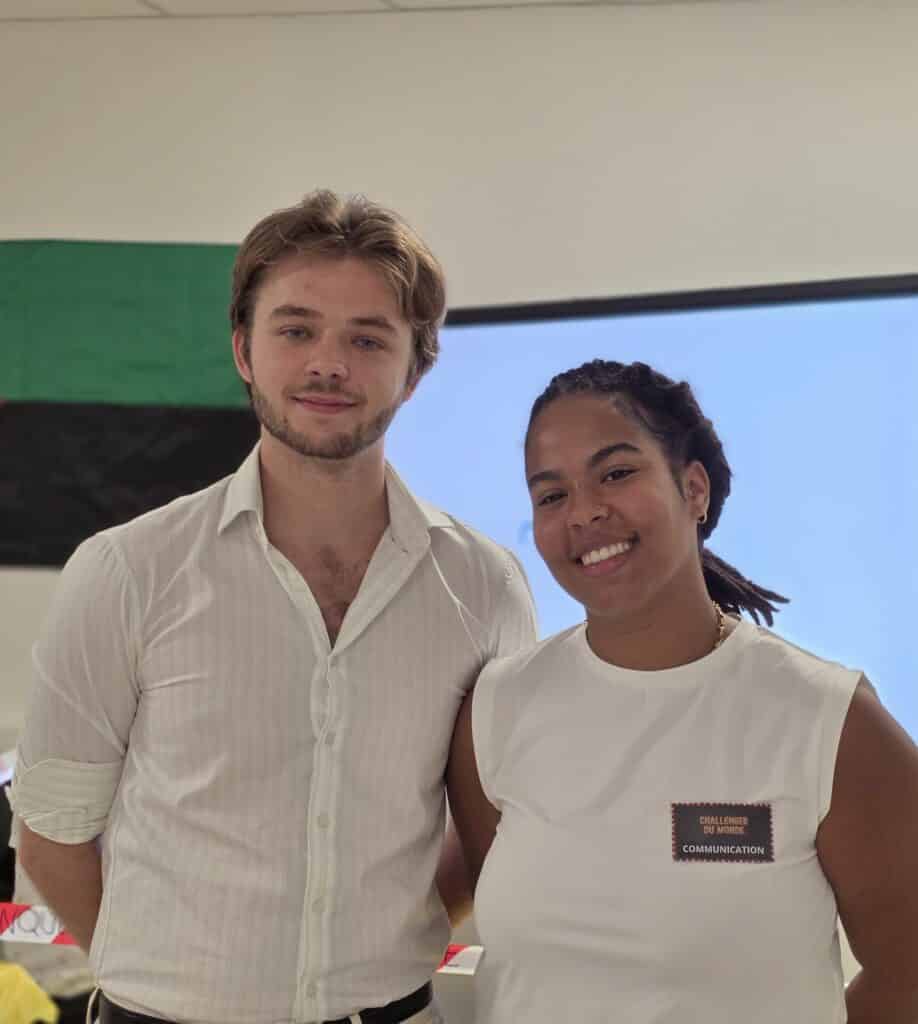
The event was held in conjunction with Keyce Academy’s Open Day. The students welcomed high-school students, families and journalists at the same time – a confrontation with a real audience that makes the exercise all the more valuable.
"The important thing is really to endure tourism, to endure the public. It's having the public in front of you, working on your oratory and practicing how to receive them. That's very important for us in tourism."
— Nolan, 1ère année BTS Tourisme Martinique
As for Loémy, she remembers the human richness of the experience – and in particular the discovery of the second years, whose stands she was able to visit and measure the work accomplished.
"During the show, we got to know our second-year BTS Tourism students a little better. We were able to talk with them and discover their stand - which was very interesting. In a word, what I'd take away from it: collaboration."
— Loémy, 1ère année BTS Tourisme Martinique
Keyce Academy: work-study at the heart of training
Keyce Academy Martinique offers post-baccalaureate training in four sectors – Commerce, Tourism, IT, Health – from bac+2 to bac+5, with work-study as the common thread. For Mr. Lecurieux Lafferronnay, Director of the Training Division, the Challengers du Monde embody precisely this pedagogical philosophy.
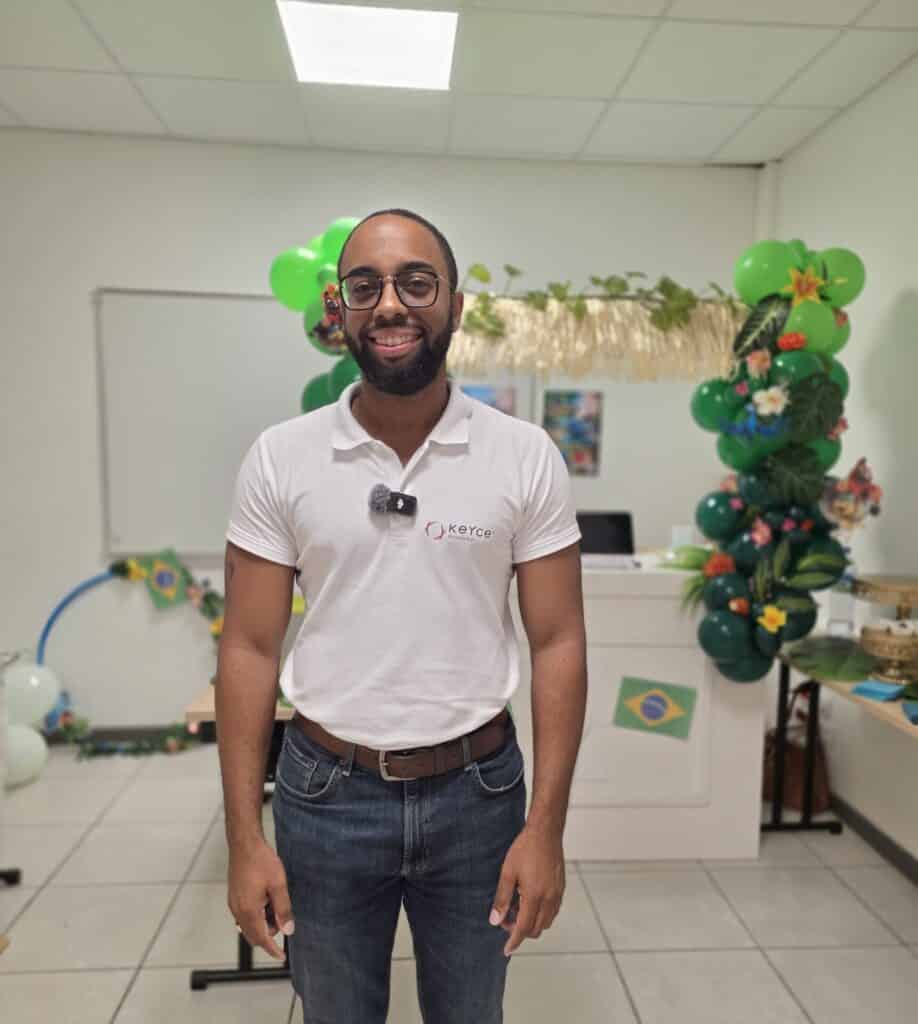
"The Challengers du Monde is an integral part of the curriculum for students who choose to do a BTS in Tourism. It allows them to combine theory and practice, and to show visitors what our young people are capable of."
— M. Lecurieux Lafferronnay, Directeur Pôle Formation, Keyce Academy Martinique
"This year was incredible. Our young people are committed, involved and creative. And visitors came away reassured that our young people have talent."
— M. Lecurieux Lafferronnay, Directeur Pôle Formation, Keyce Academy Martinique
These students in Martinique’s BTS Tourism program, who are selling New Orleans, Tokyo or Rio today, will be ambassadors for their own island tomorrow. They have learned to tell the world. They’ll know how to tell the story of Martinique.
Les Challengers du Monde is a fictional tourism trade show organized each year by Keyce Academy’s BTS Tourisme Martinique students. Each team designs a stand around a destination featured in a mythical film, with travel offers, animations and a professional sales pitch.
A BTS in Tourism in Martinique enables you to train for a career in tourism in a dynamic Caribbean region, combining theory and real-life situations. Keyce Academy offers this sandwich course, from bac+2 to bac+5, in Fort-de-France.
Yes, film tourism generates a flow of visitors to film locations. In the Caribbean, destinations such as Dominica (Pirates of the Caribbean) and Martinique benefit from this visibility. The Martinique Tourism BTS integrates this reality into its teaching methods.
The 5ᵉ edition of Fanm Dijital 2025 was dedicated to five female entrepreneurs from Martinique, whose digital projects address concrete local issues. Organized by the Collectivité Territoriale de Martinique, the ceremony was held on February 26, 2026, following a demanding selection process. Out of 49 applications submitted and 20 finalists auditioned, the jury awarded the “Gran Flanm” prize to Sabrina Ajax for a project aimed at developing the digital ecosystem supported by ASIS WI.
This award marks an important milestone in the development of an initiative born of a clear ambition: to structure a digital ecosystem linking culture, tourism and the promotion of local know-how.
Fanm Dijital 2025: a competition that has become an indicator of digital maturity
Since its inception, the Fanm Dijital 2025 competition has established itself as a strategic tool for supporting women entrepreneurs in the digital sector in Martinique. The aim is twofold: to encourage innovation by women, and to support digital solutions that meet local needs.
The 2025 edition confirms this growing momentum. The projects submitted cover a wide range of sectors, including tourism, healthcare, the circular economy and the environment. The jury, chaired by the local councillor in charge of research and innovation, assessed the soundness of the business models, the territorial impact and the capacity for deployment.
The “Gran Flanm” prize is the major award of the competition. It is awarded to a project that is already structured and capable of entering an acceleration phase. It is accompanied by a financial award of 10,000 euros from the Collectivité Territoriale de Martinique, as well as support from business partners.
ASIS WI: an ecosystem at the crossroads of media, culture and regional development
The award-winning project at Fanm Dijital 2025 is based on a simple but structuring principle: to foster connections between visitors, local residents and local players around immersive local experiences. The ASIS WI ecosystem acts as a digital framework facilitating connections between those offering know-how – crafts, gastronomy, living heritage, traditions – and a public in search of authenticity.
Over the years, more than 20,000 participants have taken part in the events organized within this framework, while the associated digital ecosystem generates almost 18,000 monthly visitors. These figures reflect a real dynamic and an ability to federate an active community.
The project is not limited to a transactional platform. It is part of a broader approach to regional structuring. By facilitating direct contact, it enables memory-bearers, craftspeople and cultural players to benefit from increased visibility and simplified access to new audiences.
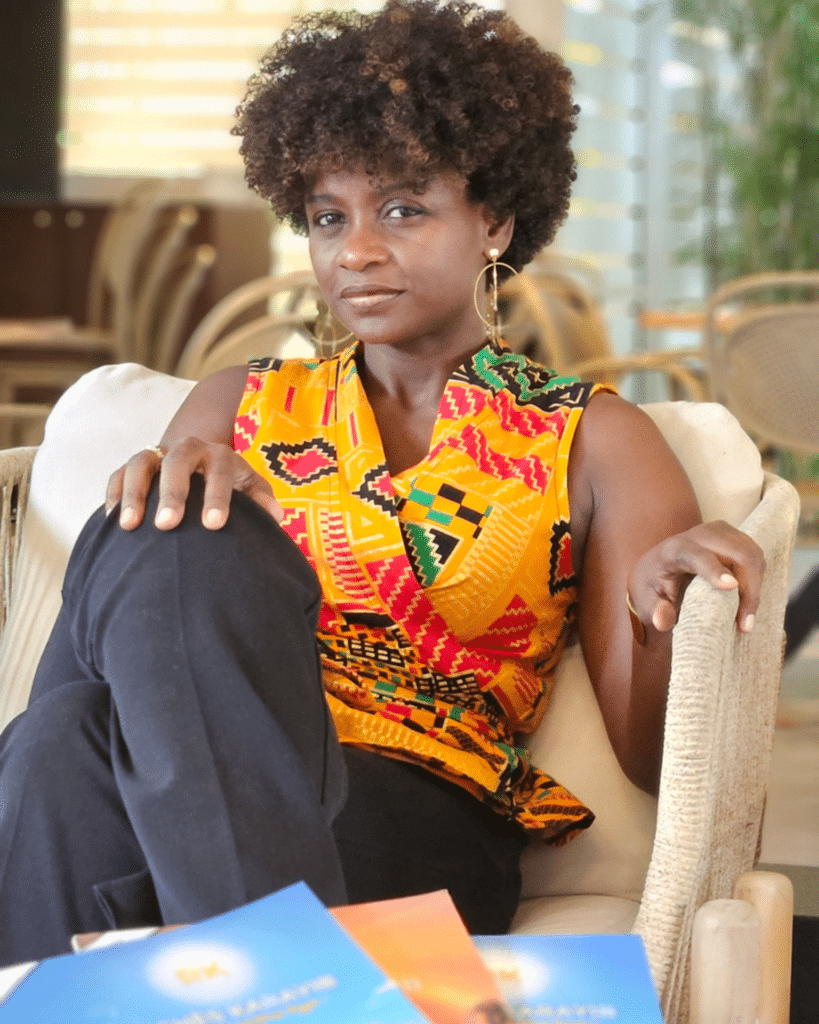
MEETING WITH SABRINA AJAX
What does the Gran Flanm prize at Fanm Dijital 2025 mean to you, and how does it fit in with the development of the ecosystem you're building with ASIS WI?
This award is obviously a source of immense pride, but it also represents a very special moment for me. When I first started talking about creating an ecosystem capable of linking culture, tourism and local initiatives through digital technology, the idea sometimes seemed a little abstract, even ambitious for some.
Basically, my conviction was simple: Martinique and the Caribbean possess an extraordinary wealth of human, cultural and creative talent, but this talent is not always sufficiently visible or connected.
Through ASIS WI, we try to build these bridges. Richès Karayib helps tell the story of the region’s cultural and heritage dynamics, while Latitude 15 focuses on the air and sea ecosystems that link the Caribbean to the rest of the world.
Receiving this prize today is much more than a personal reward. It’s an encouraging signal that projects rooted in our culture, our territory and our openness to the world can also become structuring digital projects.
From ASIS WI to Richès Karayib: building an integrated ecosystem
From the outset, ASIS WI was conceived as a facilitator, a creator of links and opportunities, capable of supporting local structures in their development on a Caribbean and international scale.
However, the project was born in a particularly complex period: a fortnight before the first Covid-19 confinement. Under these conditions, we had to quickly rethink the initial trajectory and imagine other ways of creating connections between local players.
This is how the idea of Richès Karayib.
Initially, it was a blog, designed to showcase Caribbean talent and highlight the region’s initiatives, whatever the sector: culture, tourism, entrepreneurship or innovation.
Gradually, the project has gained momentum.
INTERREG co-financing has enabled us to structure and develop the platform, raise its profile and organize concrete initiatives in the Caribbean, notably through cultural events. These included a Caribbean singing competition, which provided a springboard for the development and recognition of the medium.
Today, Richès Karayib is more than just a media outlet.
It has become a veritable ecosystem, combining editorial production, networking of players, event organization and digital tools, with a clear ambition: to create links, promote talent and contribute to the influence of the Caribbean’s cultural, tourist and economic dynamics.
A prize list that illustrates the diversity of innovation in Martinique
While the “Gran Flanm” prize was awarded to Sabrina Ajax, four other female entrepreneurs were honored at Fanm Dijital 2025.
Meggan Cavalier was awarded the “Démaraj” prize for KOPA.APP, a solution designed to combat food waste by enabling businesses to offer their unsold produce at reduced prices. Today, the application federates around a hundred partners and several thousand users.
Laura Lameynardie was awarded the “Ansanm” prize for her collaborative third place in Lamentin, incorporating a Low Tech Fab Lab where projects are documented and shared in open source to encourage reproduction and transmission.
Natacha Corolus, winner of the “Lidé Nèf” prize, is developing a solution to facilitate the management of third-party payment for healthcare professionals. Since 2023, several practitioners have benefited from support to optimize debt recovery.
Maria Galbert was awarded the “An Mitan Tchè” prize for T-WAVE, an application dedicated to the health of Martinique’s coastline, integrating interactive mapping, citizen reporting and an environmental alert system.
This award shows that women’s digital innovation in Martinique is not limited to a single sector. It irrigates essential areas of economic and social development.

Institutional recognition with concrete implications
Victory at Fanm Dijital 2025 represents much more than a trophy. It represents institutional validation of a business model rooted in local realities. It also opens up prospects for acceleration, thanks to the support and partnerships associated with the competition.
At a time when digital competition is fierce, and online visibility requires structured strategies, this award reinforces the credibility of a project that has been consistently implemented. It confirms that territorial innovation can emerge from a cultural medium and evolve into a structuring economic tool.
By highlighting women entrepreneurs capable of transforming ideas into operational solutions, Fanm Dijital 2025 affirms a clear ambition: to make digital technology a concrete lever for development in Martinique.
The consecration of Sabrina Ajax (founder of Richès Karayib) is fully in line with this dynamic. It illustrates the ability of an ecosystem born of a desire to promote culture to transform itself into a structuring digital tool with territorial impact.
Fanm Dijital 2025 is the 5ᵉ edition of the competition organized by the Collectivité Territoriale de Martinique aimed at supporting and rewarding women entrepreneurs developing innovative digital solutions to serve the territory.
Sabrina Ajax was awarded the Prix Gran Flanm at Fanm Dijital 2025 for her ASSIS WI platform, a digital tool linking visitors and local players to promote Martinique’s know-how and immersive experiences.
This year, 49 projects were submitted. Twenty finalists were auditioned by the jury, and five winners were rewarded in different categories.
Aimé Césaire remains one of the most structuring intellectual and political figures in contemporary Caribbean history. A major poet of French-language literature, a key anti-colonial thinker and a central figure in Martinique’s public life for over half a century, he had a profound impact on the cultural and political consciousness of the 20th century.
Today, his work and commitment continue to inform debates on identity, memory, social justice and the place of the Caribbean in the world.
Excellent training at the heart of anti-colonial awareness
Aimé Césaire was born into a modest family in Basse-Pointe, Martinique, on June 26, 1913. A brilliant student at the Lycée Schœlcher in Fort-de-France, he won a scholarship to study in Paris. He entered the lycée Louis-le-Grand, then the École normale supérieure in 1935, where he specialized in literature.
In Paris, he met Léopold Sédar Senghor and Léon-Gontran Damas. Together, they took part in the intellectual adventure of The Black Student in 1934. It was in this context that the notion of Negritude of which Aimé Césaire became one of the main theorists. Its aim was to assert black identity in the face of colonial assimilation and restore a long-denied historical and cultural dignity.
Aimé Césaire’s Négritude is more than an assertion of identity. It is a profound reflection on history, memory and the place of colonized peoples in modernity.

Cahier d'un retour au pays natal: a seminal work
First published in 1939, Cahier d’un retour au pays natal is considered one of the major texts of twentieth-century French literature.
In this long poem, he questions the colonial condition, cultural dispossession and the need to reclaim the self. The work is distinguished by a poetic language of rare power, combining striking images, incantatory rhythm and political reflection.
This text marks a break in literary history: it proposes a new way of telling the world from the perspective of the Caribbean, fully embracing the complexity of its history. Cahier d’un retour au pays natal quickly became a reference text for many writers and thinkers in the French-speaking world.

Discourse on colonialism: a radical critique of the colonial system
Published in 1950, Discourse on Colonialism is one of the most important essays in anti-colonial thought.
In it, Aimé Césaire dismantles the ideological foundations of European colonialism and criticizes the notion of a “civilizing mission”. He shows how colonialism produces widespread dehumanization and contributes to trivializing violence. The essay became a reference text for the decolonization movements and many twentieth-century intellectuals.
Even today, Discourse on Colonialism is still studied in universities, and continues to fuel reflections on colonial legacies and their contemporary extensions.

A theatrical work at the heart of historical issues
Aimé Césaire’s dramatic work is an extension of his intellectual commitment.
With The Tragedy of King Christophehe explores the political and social tensions of post-independence Haiti. A Season in the Congo traces the fate of Patrice Lumumba and the challenges facing newly independent African states. A Tempesta free adaptation of Shakespeare, offers a critical reading of colonial relations through the prism of theater.
These works reflect on the power, freedom and responsibilities of societies born of colonization. They bear witness to Aimé Césaire’s determination to place the Caribbean and Africa at the heart of global historical debates.
A lasting political commitment in Martinique
Aimé Césaire’s political action is inseparable from his literary work.
Elected mayor of Fort-de-France in 1945, he held this position until 2001, making a lasting mark on the development and cultural life of the Martinique capital. In 1946, he became deputy for Martinique in the French National Assembly, a position he held until 1993.
He played a decisive role in the adoption of the Departmentalization Act of 1946, which transformed Martinique, Guadeloupe, French Guiana and Reunion into French departments. This reform was seen as a lever for social and legal equality for these territories.
In 1956, he left the French Communist Party and founded the Martinique Progressive Party. He progressively defended a vision of Martinican autonomy within the Republic, seeking to reconcile local development, social justice and cultural recognition.

Tropiques: a Caribbean intellectual laboratory
In 1941, Aimé Césaire co-founded the magazine Tropiques in Martinique. The publication quickly became an essential forum for cultural and political reflection.
Tropiques contributes to the valorization of Martinican and Caribbean culture, while opening up a dialogue with international intellectual currents. The magazine plays a major role in structuring an autonomous Caribbean way of thinking, capable of asserting itself in the face of dominant models.
A lasting intellectual and cultural legacy
Aimé Césaire died on April 17, 2008 in Fort-de-France. His national funeral testifies to the recognition of his historic role. Martinique’s international airport now bears his name, symbolizing a legacy deeply rooted in the Caribbean landscape.
His influence extends far beyond Martinique. His work has influenced generations of writers, artists and thinkers, from the Caribbean to Africa and the Americas. It continues to fuel contemporary reflections on identity, memory and power relations.

A key figure in understanding the contemporary Caribbean
To understand the contemporary Caribbean, Aimé Césaire’s trajectory remains essential. He showed that an intellectual from a colonized territory could produce universal thought without renouncing his roots.
His career illustrates the possibility of combining literary creation, political action and historical reflection. He has contributed to making the Caribbean a major area of intellectual production, capable of dialogue with the world while asserting its singularity.
Aimé Césaire’s work and commitment continue to provide essential insights into the cultural and political dynamics of the contemporary world.
Aimé Césaire was a Martinican poet, playwright, essayist and politician who was born in 1913 and died in 2008. Co-founder of Négritude, he had a profound impact on anti-colonial thought and political life in Martinique.
Aimé Césaire was one of the main founders and theorists of Négritude in the 1930s. This intellectual movement affirmed black cultural identity and criticized colonial assimilation.
Aimé Césaire helped redefine the cultural and political dignity of the Caribbean territories. His literary work and institutional commitment have had a lasting influence on contemporary Caribbean thought.
Treemonisha is set to be one of the major cultural events in Martinique at the start of 2026. On Saturday February 28, 2026 at 7:30pm, the Tropiques Atrium – Scène nationale de Fort-de-France will host a unique performance of Scott Joplin’s iconic ragtime opera, featuring an exceptional international and Martinican cast.
This ambitious production, both artistic and memorial, brings together cultural institutions, opera artists, musicians, dancers and the Martinican choir to perform a major work of African-American musical heritage.
Treemonisha, a pioneering African-American opera
Completed in 1910 and published in 1911 by Scott Joplin, Treemonisha is considered one of the first African-American operas in history. A pioneer of black opera known as “ragtime”, the composer sought to open the doors to classical music at a time when this universe remained largely the preserve of whites. Through this work, he put forward strong themes such as education, human dignity and fundamental rights, presented as levers of emancipation for the African-American community.
But the opera goes beyond ragtime. With its syncopated, jazz-like rhythms, gospel influences and operetta-inspired passages, Treemonisha is now part of the international repertoire, regularly performed on stages around the world.

A story of emancipation through education
The action of Treemonisha is set on an Arkansas plantation surrounded by dense forest, at a time when the former white owners have left and the black population is organizing to build a new society. Ned and his wife Monisha take over management of the plantation. Eager to see the birth of a generation freed from obscurantist beliefs, they pray to welcome a child they can raise in a wholesome upbringing, without recourse to superstition.
Their wish came true in September 1866, when they discovered a baby abandoned under a tree. They adopted her and named her Treemonisha. From childhood, the young girl worked for a white family in exchange for an education, the school being too far away. She thus becomes the only educated person in the neighborhood. Meanwhile, three characters – Zodzetrick, Luddud and Simon – make their living selling gris-gris and exorcisms, keeping the population in fear and ignorance. As an adult, Treemonisha chooses education and non-violence to free her community from these practices. The opera thus symbolizes the victory of knowledge and conscience over obscurantism.


Scott Joplin, a major figure in American music
Scott Joplin’s work has had a profound impact on the history of music. Ragtime, of which he is one of the leading exponents, fueled the birth of jazz and influenced many composers of art music, including Debussy, Ravel, Milhaud and Poulenc. The rediscovery of his compositions in the 20th century owes much to the cinema. In 1974, the soundtrack to the film The scam (The Sting), inspired by his work and adapted by Marvin Hamlisch, put the spotlight back on his repertoire and contributed to its international rediscovery. Two years later, in 1976, Scott Joplin was posthumously awarded a special Pulitzer Prize for his outstanding contribution to American music.

What is ragtime?
To fully understand Treemonisha It’s essential to return to the meaning of ragtime. The term is made up of two elements: “rag”, which in American slang designates something of little value or a worn-out fabric, and “time”, which refers to time, the era and musical meter.
Ragtime appeared at the end of the 19th century in the Midwestern United States. It is characterized by a pronounced syncopated rhythm, played mainly on the piano, but which can also be performed by an orchestra or brass band. This musical style is one of the major sources of jazz, and introduces a new rhythmic freedom to American music. In 1974, the music for the film The scam by George Roy Hill, starring Paul Newman and Robert Redford, based on the work of Scott Joplin and adapted by Marvin Hamlisch, won seven Oscars, including Best Picture. In 1976, Scott Joplin was posthumously awarded a special Pulitzer Prize for his outstanding contribution to American music.
Exceptional production in Martinique
The performance of Treemonisha at the Tropiques Atrium will feature a top-class cast. Renowned South African soprano Zandile Mzazi will play the lead role, surrounded by an essentially Martiniquan cast of soloists, dancers and choristers. The original staging, created by Patricia Panton, will be presented in keeping with her artistic vision. First produced at the Cape Town Opera in South Africa, then in France at La Turbie in 2006 and in Martinique in 2009, this production will be dedicated to his memory after his death on December 26, 2025 in Monaco.
The Fondation d’Entreprise SPHERE wished to pay tribute to Patricia Panton with this new performance. Alfredo Troisi, a close friend of the director, has honored her last wish by respecting her staging, with the assistance of Hervé-Claude Ilin. Choreography is by Christiane Emmanuel. Sets, costumes and lighting were created by Alfredo Troisi, offering a close visual and choreographic dialogue with Scott Joplin’s music.

Musical direction and performers
The opera will be conducted by Peter Valentovič, with Kodo Yamagishi on piano, musicians from the Presburg Orchestra and the Chœur Sainte-Thérèse du Père Élie.
Soloists
Treemonisha – Zandile Mzazi (soprano)
Monisha – Marie-Claude Bottius (soprano)
Lucy – Leïla Brédent (soprano)
Ned – Jean-Loup Pagésy (bass)
Remus – Mathys Lagier (tenor)
Zodzetrick – Steeve Brudey Nelson (baritone)
Andy – Joël O’Cangha (tenor)
Parson Alltalk / Simon – Halidou Nombre (baritone/bass)
Cephus – Elvis Miath (tenor)
Luddud – Alexandre Thésée (baritone)
Christiane Emmanuel Dance Company
Klayd Bonheur, Alison Desort, Livia Gercé, Cathy Magloire, Kaiser Remer, Fabrice Vaillant.
Presburg Orchestra
Kodo Yamagishi (piano), Lukáš Szentkereszty (1st violin), Alžbeta Godovičová (2nd violin), Martin Mierny (viola), Michal Haring (cello), František Výrostko (double bass), Barbora Gálová (flute), Jozef Kamencay (clarinet), Ľubomír Petic (horn), Richard Gajdos (trumpet), Mikuláš Havrila (trombone), Marián Michalec (percussion), Alžbeta Struňáková (oboe).

Le Chœur Sainte-Thérèse du Père Élie
Choir director: Guilène Bertrand, originally from Fort-de-France, has been involved in choral singing since the age of 11, and has directed the Sainte-Thérèse choir for almost fifteen years.
A production supported by the SPHERE Foundation
Created in 2004, the SPHERE Corporate Foundation is committed to supporting the art of music and the rediscovery of major works that have fallen into oblivion. It has contributed to the revival of Treemonisha by Scott Joplin, as well as quartets and sonatas by Le Chevalier de Saint-George, the opera L’Amant Anonymeand the international career of soprano Christiane Eda-Pierre.
In 2026, the foundation will produce the opera in tribute to Philippe Persenda and Patricia Panton, continuing its work of transmitting musical heritage.
Tropiques Atrium and cultural partners
Created in 2015 from the merger of CMAC and L’Atrium, Tropiques Atrium – Scène nationale is a public cultural cooperation establishment with the Scène nationale label from the French Ministry of Culture. With an overall budget of 4 million euros and a permanent staff of 32, it programs around 160 performances per season. Its actions are aimed at supporting artists, reinforcing artistic and cultural education, developing partnerships and promoting a mixed audience.
The opera is co-directed with the Tropiques Atrium and co-produced with the Opéra Paris Outre-Mer association, a cultural bridge between France and the French overseas territories, which promotes opera artists and instrumentalists from the French overseas territories and encourages dialogue between the classical repertoire and musical traditions.
Treemonisha will be presented on Saturday February 28, 2026 at 7:30pm at the Tropiques Atrium – Scène nationale de Fort-de-France for a one-off performance.
South African soprano Zandile Mzazi takes on the role of Treemonisha, surrounded by a mostly Martiniquan cast and the Presburg Orchestra conducted by Peter Valentovič.
Treemonisha is an opera in three acts, completed in 1910 and published in 1911 by Scott Joplin. Considered one of the first African-American operas, it focuses on education and emancipation from superstition in a post-slavery black American community.
Schoelcher Nautical Week is currently at the heart of the nautical news in Martinique. For its 34th edition, the competition organized by the Cercle Nautique de Schoelcher confirms its status as a major event in Caribbean light sailing. Since Saturday, February 14, 2026, the Schoelcher waterway has welcomed a particularly high level of participation and a diversity of delegations rarely seen in recent years.
A strong mobilization for the Schoelcher 2026 Nautical Week
The Schoelcher Nautical Week is experiencing an exceptional mobilization. Around 150 competitors have signed up for this 2026 edition. Including the organizing teams, referees, coaches and volunteers, nearly 200 people are mobilized on the water during the four days of competition.
Such a level of participation had not been achieved for several years. The enthusiasm shown by clubs and delegations confirms the growing appeal of the Schoelcher Nautical Week, which continues to establish itself as a strategic stage for many young and experienced sailors.


A remarkable international presence
The regional and international dimension of this event is confirmed by the presence of numerous delegations. Among the territories represented are Switzerland, Belgium, Saint Kitts, Sint Maarten, Saint Martin, Guadeloupe, Saint Barthélemy, Saint Lucia, France and Antigua. This diversity reinforces the competition’s influence beyond Martinique. For some participants, this is their first experience of sailing outside their home territory. For others, with more experience, it represents an important preparation stage for national and international events.
The Guadeloupe delegation is particularly noteworthy for its size. With nearly fifty representatives, it was the largest on Martinique’s waters, illustrating the close sporting ties between the Caribbean territories.


A formative event for young sailors
In addition to sporting performance, the Schoelcher Nautical Week also fulfills an essential mission of training and exchange. For many young racers, the competition represents a first international outing and an opportunity to sail on a body of water renowned for its technical skills. Schoelcher is known for its wind variations and demanding conditions. Sailors must constantly adjust their strategies, which makes this event a privileged learning ground for young light sailing talents.
The coaches present emphasized the importance of these trips for the sporting development of young athletes. Sailing outside their usual environment allows them to gain experience, build confidence and raise their level of competition.


Wingfoil confirms its rise to prominence
The Schoelcher Nautical Week also highlights the growing popularity of wingfoil, a fast-developing discipline. This category attracts a number of well-known athletes and promises high-level confrontations. The presence of champions and young hopefuls reinforces the sporting intensity on the water. Their participation illustrates the evolution of light sailing towards more modern and dynamic supports, while attracting a wider public.
The weather conditions forecast for this 2026 edition should enable the events to run smoothly. Without extreme winds, but with sufficiently sustained conditions, the competitors have a favorable terrain to express their potential.

A competition running until February 17
Since February 14, the starters have been lining up on the Schoelcher race course. The race committee is planning up to twelve heats per class over the course of the competition, allowing the sailors to fully express their performance. Each day is punctuated by the successive starts of the different classes, offering a continuous sporting spectacle. The organizers provide the coordination and security necessary to ensure the smooth running of the event.
The 34th edition of the Schoelcher Nautical Week will close with an awards ceremony on February 17. The champions of the Schoelcher Nautical Week will be honored alongside all the participants and teams involved.


A structuring event for Caribbean sailing
Over the years, it has established itself as a structuring event for sailing in the Caribbean. It fosters exchanges between clubs, encourages the progress of young athletes and raises Martinique’s profile on the regional sailing scene. The 2026 edition confirms this dynamic. The number of participants, the quality of the delegations and the diversity of disciplines testify to the vitality of light sailing in the region. Running until February 17, the Schoelcher Nautical Week is once again a highlight of the Martinique and Caribbean sporting calendar.
The Schoelcher Nautical Week 2026 takes place from February 14 to 17 in Martinique, with four days of competition on the Schoelcher race course.
Around 150 competitors are taking part in the 2026 event, along with the organizing teams, bringing the total number of people involved to almost 200.
The Schoelcher Nautical Week is a major event in Caribbean light sailing, promoting the training of young sailors, exchanges between territories and preparation for international competitions.