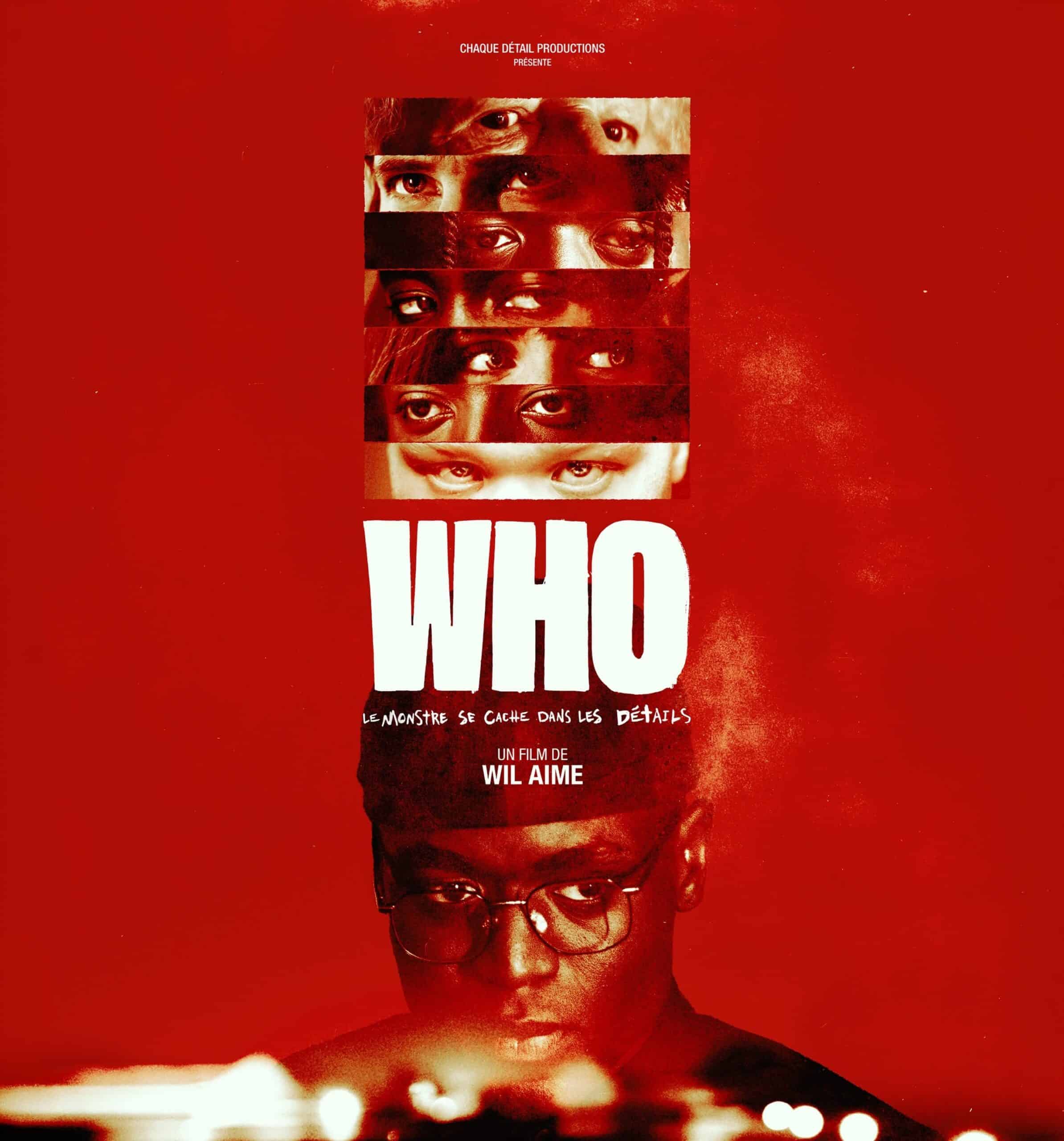
With WHO, Wil Aime signs his first feature film and returns to the West Indies with a team, a method and a story of creation. In Guadeloupe and Martinique, his tour revealed the other side of the story: that of a film that has been supported for years, between independent creation, territorial support and the desire to make his own cinema.
A comeback tour
The public saw the theaters, the meetings, the photos, the post-screening exchanges. Behind this tour of WHO in Guadeloupe and Martinique, there was a precise mechanism. Dates to organize. Partners to mobilize. A team to bring in. Above all, one desire: to present the film where part of its imagination took root.
From May 30 to June 1, 2026, Wil Aime and his team enjoyed a series of highlights: a special screening at Cinestar, a Creative Talk at Café Papier in Jarry, a screening at Madiana, and meetings with professionals, students, media and cultural players. In the interview conducted around this event, Wil Aime explains that presenting the film in the Antilles was important to him. Guadeloupe and Martinique appear to be territories of attachment, inspiration and return.

A film inspired by the West Indies
Some sequences from WHO were shot in Guadeloupe. The film travels between France, the French overseas territories, Belgium, Switzerland, Canada and French-speaking Africa. The work is the brainchild of a Guadeloupean creator, developed in an independent framework, then seeks its audience beyond the usual frontiers of French cinema.
In the Creative Talk, Wil Aime talks about the Antilles as a place that nourished the film. He talks about these islands, their place in the French-speaking world, their position in a wider imaginary. The film reveals something of the relationship with the territory: the landscapes, the tensions, the identities, the way of situating oneself when one comes from an area often presented as small, whereas it produces talents capable of going very far.


Making movies
The heart of this story may lie in a nuance. During the exchange with the audience, Wil Aime talks about the dream of “making my own cinema”. Before the feature film, there were the videos. Short formats. Tales with drawers. Scenarios where detail counts. With WHO, this grammar built on social networks changes scale.
The transition to feature film requires a different kind of discipline. Wil Aime admits it himself: moving from social networks to film meant learning how to convey his vision. On a film, an idea has to be understood, carried and executed by many more people.
Chaque Détail Productions, a team built to last
Behind the scenes of WHO, there’s a collective: Ashley, Samira, Gary, Yasser, Emmanuel and the other members of Chaque Détail Productions. Many of them learned on the job. The word that comes to mind is versatility.
Ashley, co-founder and sister of Wil Aime, tells of an adventure that began even before the structure really existed. Samira talks about starting up with a smartphone. Gary talks about his technical apprenticeship. Yasser insists on his role in the field. Emmanuel brings production, distribution and broadcasting experience to the table. This collective gives WHO a concrete dimension. The film moves forward thanks to a team that learns, adapts, looks for solutions and accepts to work outside the most comfortable paths.


Transmitting a vision to 400 people
One of the strongest passages in the interview concerns the challenge of artistic management. Wil Aime explains that his close-knit team works almost as one. With them, ideas flow quickly. The real challenge comes when you have to extend this vision to a much larger team.
He speaks of 400 people having worked on the film. At this scale, the vision has to be transmitted, understood, reformulated and carried by each department. For him, this was one of the greatest difficulties of the project. We had to learn to communicate differently.

Guadeloupe as a creative territory
The Guadeloupe Region provided support for the film, notably for post-production. With the CTIG, it also supported the visit of Wil Aime and his crew to Guadeloupe and Martinique. Behind this support, there’s a broader aim: to show that Guadeloupe can be a welcoming territory for film shoots, a space for audiovisual creation and a place of emergence for new talent.
A film like WHO examines the place of overseas creators in the cultural industries. It shows the importance of bridges between Guadeloupe, Martinique, mainland France, French-speaking Canada and French-speaking Africa.
What WHO opens
In the Creative Talk, one idea runs through several speeches: how do you go big when you come from a territory often perceived as small? Wil Aime responds with usefulness, sincerity and modest beginnings. He talks about family, loved ones and first circles. He reminds us that a project often grows from a small space, a small room, a notebook.
Perhaps this is where WHO has become a textbook case for a generation of Caribbean creators seeking a different way of telling stories, a different way of producing, a different way of circulating. His journey shows the difficulties, the detours, the refusals, the negotiations, the learning.
The future will tell what Chaque Détail Productions will build after this stage. For now, WHO leaves an open question for the Caribbean territories: how can we turn these successes into a sustainable industry, so that other dreams of cinema also find their way to the screen?
WHO marks an important milestone, as it is the first feature-length film by Wil Aime, a Guadeloupean creator known for his short stories and psychological thrillers. The film also highlights Guadeloupe as a territory of creation, inspiration and welcome for audiovisual projects capable of circulating in France, the West Indies, Canada and French-speaking Africa.
Guadeloupe and Martinique were the focus of a special tour around WHO, with screenings, meetings with the public and Creative Talks for professionals, students, media and cultural players. For Wil Aime, this visit to the West Indies was of particular value, as these territories have nurtured the film’s imagination and represent a place of return for his team.
Backstage at WHO shows a collective adventure built over time. Around Wil Aime, the Chaque Détail Productions team moved forward with an independent method, a great deal of versatility and a strong desire to maintain a clear artistic vision. The project also tells the story of a creator’s transition from social networks to cinema, with all the human, technical and creative challenges that implies.