
Martinique – Tourism: Investing in Talent to Build the Future

Tourisme

Relying on talent to build the future of tourism in Martinique: this is the conviction that brought together, on March 28, 2025 at the Habitation Fonds Rousseau in Schœlcher, all the players in the sector on the occasion of the 3rd Week of Tourism Professions.
In the presence of Nathalie Delattre, Minister Delegate in charge of Tourism, this morning was an opportunity to emphasize the importance of training, support for career paths, and recognition of local skills. Through the exchanges, speeches and awards presented, a common vision was affirmed: that of a demanding and sustainable tourism industry in Martinique, based on the development of local talent.

A place steeped in memory to host this meeting

Pierre Sainte-Luce, owner of the Habitation Fonds Rousseau, opened the doors of this heritage site to host the event. His speech, sober and marked by emotion, recalled the deep attachment of this site to the history of Martinique. In a setting steeped in memory, discussions on the future of the tourism professions took on a special dimension, resonating with the vocation of transmitting and promoting the territory’s roots.

Tourisme
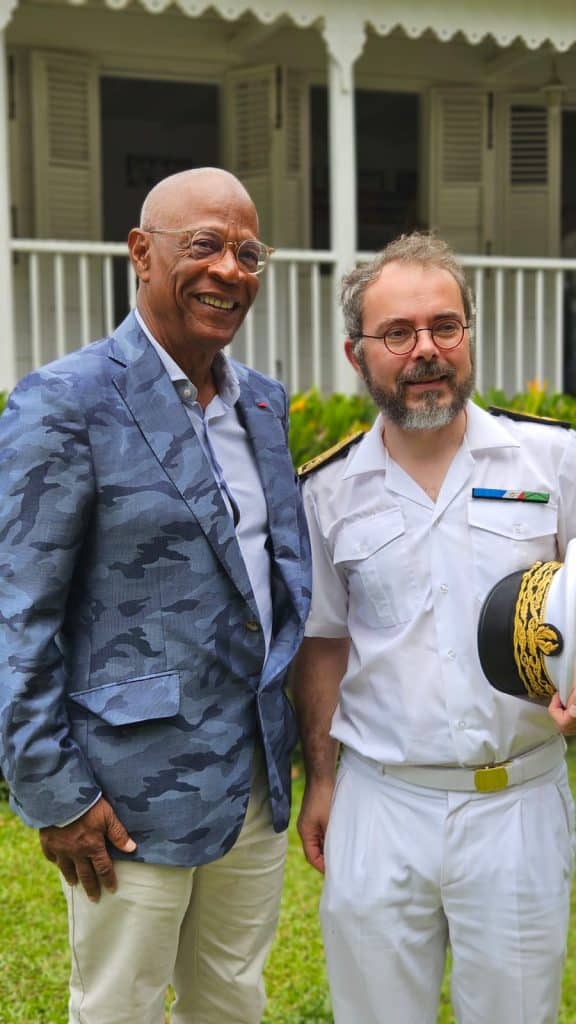
Pierre Sainte-Luce with Prefect Etienne Desplanques

Training, mobilizing, enhancing: a shared territorial strategy

Marie-Luce Lebon, sub-prefect of the Centre district, recalled the challenges facing Martinique to strengthen its competitiveness: environmental and digital transition, accessibility, diversification of the offer, skills development, and above all, adaptation to new customer expectations. She stressed the essential role of human resources in this process.

She also stressed the importance of strategic positioning, in the face of Caribbean competition sometimes based on a price war to which Martinique cannot – and must not – respond. The solution is to move upmarket through skills, innovation in hospitality and the promotion of trades.

This means not only strengthening our training systems, but also changing the way we look at the tourism professions, which often suffer from a poor image. In this context, the Week of Professions is an invaluable lever for raising awareness, showcasing the diversity of possible career paths and stimulating vocations.

Tourisme

Tourism: an economic pillar weakened by labor shortages

In her speech, Nathalie Delattre placed tourism in the national context. This sector represents 8% of GDP, 200 billion euros in sales, and 2 million direct and indirect jobs. In Martinique, almost a million visitors are welcomed every year, creating around 10,000 jobs, making it a driving force behind the local economy.

But this engine is running out of steam due to a lack of manpower. In 2022, 60% of hotel and catering businesses said they had slowed down due to a lack of staff. This alarming observation is shared in France and Martinique.

The Minister stressed the diversity of tourism professions – more than “a thousand and one”, in her words – and the difficulty of making them visible. That’s the whole point of the Week of Professions : to enable young people, as well as people undergoing retraining, to meet professionals directly, ask their questions and, in some cases, make a difference.

She also praised the rise in the number of initiatives awarded the label, from 2,500 to over 3,200 this year, proof of growing mobilization. She stressed the importance of inspiring testimonials, such as that of Nina Métayer, World’s Best Pastry Chef 2023-2024, this year’s national patron.

Tourisme

A vibrant and collaborative local dynamic

Another highlight of the morning was a speech by Catherine Vatblé, DEETS project manager and national coordinator of Tourism Professions Week. Visibly moved, she praised the commitment of the many Martinique partners, despite their sometimes limited financial resources.

This year’s event focused on the sea, thanks to the collaboration of the Campus des Métiers de la Mer, the Maritime Cluster, the Direction de la Mer and numerous cultural associations, including Cariculture, Watouabi and Tambou Gornal.

A “causer”, organized in the afternoon in Fort-de-France, aimed to bring together the worlds of culture, education, business and politics, around a powerful idea: to transform traditional cultural events (carnival, Tour des Yoles…) into genuine levers for sustainable economic development.

The final pavilion of the week was to be located in the cocoa and chocolate village, embodying a desire to link heritage, transmission, local economy and outreach.

Tourisme

An active partner in the event, the town of SchÅ“lcher played a key role in the organization of the Martinique leg of Tourism Trades Week. Present on behalf of the municipality, Mr. Gonier, a member of the technical team, was warmly applauded for his commitment. This logistical and human support testifies to the municipality’s determination to become involved in the structuring of locally-rooted tourism, capable of building bridges between education, culture and the economy.

Tourisme
Josette Cinna (Martinique Terroir d'Excellence) - Nathalie Delattre - Emile Gonier - Catherine Rodap

Building long-term, value-driven career opportunities

Catherine Rodap, President of MEDEF Martinique, praised the Minister’s attentiveness to Martinique’s realities, which went far beyond a simple protocol visit. She emphasized the extent to which every company and every tourist activity relies above all on passionate, skilled men and women.

She insisted on the key role of training, which must be expert and adapted, but also known to the general public. For her, it’s essential to combat preconceived ideas and show that a career in tourism is not only possible, but also rewarding.

“Excellence cannot be decreed, it has to be built day after day”, she reminded us, calling for stronger bridges between the worlds of education and business. The MEDEF, she assured us, will continue to be fully involved in this collective dynamic.

Tourisme

Fabrice Di Geronimo, representing France Travail Martinique, stressed the importance of making the tourism professions more visible and accessible. In particular, he insisted on the need to raise awareness among young people, starting in secondary school, to give them a better understanding of the opportunities offered by this often little-known sector. Against a backdrop of tightness on the job market, he pointed out that many tourism companies are struggling to recruit, due to a lack of trained or informed profiles. France Travail is therefore committed to offering appropriate support schemes, designed to bring people who are far from employment closer to the concrete needs expressed by professionals in the sector.

Tourisme

Two outstanding careers honored with the Tourism Medal

The highlight of the morning was the presentation of tourism medals to two personalities whose careers embody two complementary visions of tourism development in Martinique.

Françoise Riveti, General Manager of the Hôtel Bambou, was awarded the bronze medal for transforming a family-run hotel into a benchmark resort, while maintaining a clear focus on comfort, environmental quality, accessibility and West Indian culture. Driven by a human and demanding vision of hospitality, it embodies the revival of Martinique’s hotel industry in the face of regional competition.

Hector Elisabeth, sociologist and former director of the Martinique Regional Tourism Development Agency (ARDTM), was awarded the gold medal. A visionary and strategist, he worked for decades to place Martinique’s tourism sector on an integrated development footing, closely linked to local identity, training, sector structuring and the emergence of domestic tourism accessible to all. His commitment laid the foundations for what was to become the Comité Martiniquais du Tourisme.

These two awards were a tribute to both heritage and innovation, strategy and field management, memory and adaptation. A tribute to the men and women who, through their commitment, are helping to build a more resilient, more responsible form of tourism in Martinique, one that is deeply rooted in its territory.

Tourisme
Françoise Riveti - Nathalie Delattre - Hector Elizabeth
Tourisme
Tourisme
Tourisme
Tourisme
Tourisme
Tourisme

One Response

Leave a Reply

Your email address will not be published. Required fields are marked *

More articles from RK

Festival del Jíbaro Comerieño
EVENT MANAGEMENT
Tolotra

Festival del Jíbaro Comerieño: Puerto Rico’s mountain festival

Some 40 kilometers by road from San Juan, in the Cordillera Central, Comerío doesn’t have the visibility of Puerto Rico’s major coastal destinations. The town has fewer than 19,000 inhabitants according to the latest US estimates, but it has a strong nickname: la Cuna de Trovadores, the cradle of trovadores. Every June, this mountain town turns its reputation into a cultural event with the Festival del Jíbaro Comerieño. 2026 edition confirmed The Festival del Jíbaro Comerieño returns from June 12 to 14, 2026 for its 46th edition. This year’s event takes on a special significance, as Comerío also marks the 200th anniversary of its foundation. The 2025 edition of the Festival del Jíbaro Comerieño took place from June 12 to 15 in the Plaza de la Trova, with a program combining crafts, workshops, trovadores competitions, typical food, jíbaras masses, concerts and meetings around the decima. The format may vary from

Read More »
KARULINK
COOPERATION
Tolotra

KARULINK: Guadeloupe wants to reweave the Caribbean’s shipping lanes

On June 2 and 3, 2026, public and economic players from Guadeloupe, Antigua and Barbuda, Dominica and St. Kitts and Nevis sat around the same table in Guadeloupe to work on a very concrete question: how can we better connect nearby islands, whose exchanges are still hampered by transport breaks? The first KARULINK steering committee is not yet launching new lines. It is setting up a method, partners and a timetable to examine the feasibility of regular maritime passenger services. A first COPIL to move from principle to method This meeting marks an important milestone for KARULINK, a European territorial cooperation project co-financed by the European Union as part of the INTERREG Caribbean 2021-2027 program. Discussions focused on three areas: feasibility studies for future maritime services, the development of more environmentally-friendly transport solutions, and prospects for economic and tourism cooperation between the partner territories. This framing is essential. There’s more

Read More »
Sonia Sotomayor
HISTORY & HERITAGE
Tolotra

Sonia Sotomayor: Puerto Rican, first Latina on the US Supreme Court

The Oath of a Bronx Kid On August 8, 2009, at the seat of the U.S. Supreme Court, Sonia Sotomayor raises her right hand and takes the oath of office. She became the third woman in U.S. history to sit on the Supreme Court, and the first Hispanic, the first Latina, to enter the institution. At that very moment, the child of Puerto Rican-born parents from the Bronx public housing project became one of the nine people charged with interpreting the U.S. Constitution. A Puerto Rican family in the Bronx Sonia Maria Sotomayor was born on June 25, 1954 in the South Bronx, New York. Her parents, Juan Sotomayor and Celina Báez, were both born in Puerto Rico and moved to the Americas after the Second World War. Juan worked in a tool factory. Celina, who had served in the Women’s Army Corps, became a nurse. The family lives in

Read More »

conTACT RK

we'd love to have your feedback on your experience so far

Join The List

Join our Richès Karayib community!  Sign up for our newsletter.

Want To Maximize Your Business Presence On Riches Karayib?

Complete the form to start the application