
Bridgetown was built in successive layers around the same Amerindian bridge, which in turn became a slave port, a Sephardic synagogue, and a British garrison, with a street layout that has remained organic where other Caribbean colonial cities opted for a grid pattern. Since 2020, Bridgetown has been removing the statues of its colonial past one by one, while working to have its historic buildings designated as a UNESCO World Heritage Site.
Bridgetown, a capital city born from a bridge
Before it was called Bridgetown, the place had another name, Indian Bridge, after a wooden bridge built by Native American peoples over the Careenage—the natural cove where ships would be laid on their sides for repairs—and around which the city would grow. English settlers established themselves there on July 5, 1628, under the authority of London merchants. The name Bridgetown would come later, in honor of a governor, Sir Tobias Bridge. Eleven years after colonization, in 1639, Barbados established a Parliament, which is now the third-oldest in the Commonwealth still in operation.
The city, then, is not merely a colonial trading post situated on a white-sand beach. From its very first century, it has administered, legislated, and governed an entire island from this very neighborhood clustered around the bridge.


The Economy That Built Bridgetown
This early success came at a price. Between 1627 and 1807, approximately 387,000 enslaved Africans were sent to Barbados to fuel the sugar economy that made the city’s fortune. Sugar, rum, and molasses were then shipped from the docks of the Careenage to Europe and the Americas, shipment after shipment. The warehouses, docks, and beautiful facades we see today in the old town were built through this triangular trade, and acknowledging this is part of the city’s complete history—not just a footnote we quickly skip over.


A community that left its mark on Bridgetown
It was in this same Bridgetown that, in 1654, Sephardic Jewish refugees settled after being expelled from Dutch Brazil following its reconquest by Portugal. A Jewish presence there had already been reported as early as 1628, one year after the arrival of the English. A year after their arrival, in 1655, an ordinance issued by the Council of Barbados granted them civil rights—a rare gesture for the time. These families also brought with them valuable knowledge—that of sugarcane cultivation—which they passed on to the island’s planters. Their community grew to about eight hundred people by the eighteenth century.
Their synagogue, Nidhe Israel, still stands today; it was rebuilt after a hurricane in 1831 thanks to ninety congregants, and then saved from scheduled demolition in 1985. In 2008, an excavation beneath the rabbi’s house—prompted by a remark from Israeli tourists—unearthed a 17th-century ritual bath, one of the oldest in the Americas.


Bridgetown, a true showcase of the Empire
A few streets away, the Saint Ann Garrison served as the base for the British West Indies Regiment during the 18th and 19th centuries. This regiment, established in 1795, initially drew its ranks from men purchased as slaves on sugar plantations to serve as soldiers, before a law passed in 1807 finally granted them their freedom. Its vast parade ground, the Garrison Savannah, has hosted horse races popular with officers and dignitaries since the mid-eighteenth century, a tradition that continues today.
The city also proudly displays its loyalty to the Crown. In 1813, the city erected a statue of Admiral Nelson in Trafalgar Square, thirty years before London erected its own column in his memory. For a long time, it sought to be the impeccable showcase of the Caribbean’s “Little England.”

Bridgetown Comes to Terms with Its Past
This superficial loyalty eventually began to crack. Barbados declared its independence on November 30, 1966. In 1999, Trafalgar Square became National Heroes Square. In 2011, UNESCO inscribed “Historic Bridgetown and its Garrison” on the World Heritage List, noting in particular its non-grid street layout, a legacy of medieval English towns rather than the Spanish or Dutch grid patterns that characterize the rest of the colonial Caribbean.
Then, on November 16, 2020—International Day for Tolerance—the statue of Nelson was moved from the square to the Barbados Museum, housed in the former buildings of the Garrison Regiment. On November 30, 2021, exactly fifty-five years after gaining independence, Barbados became a republic and removed the British monarch from the position of head of state.
The city, therefore, does not choose between memory and modernity. It places certain symbols in a museum and has its historic buildings protected by UNESCO—all as part of the same effort, within almost the same decade. The original bridge, however, has long since disappeared, replaced by more modern versions, the latest of which dates from 2006. But the place it marks remains the same. The question this capital city poses today is not whether its colonial past should be forgotten, but which of its many faces—indigenous, mercantile, religious, slave-owning, or military—it still chooses to show to those who pass through it every day.

The site was originally called Indian Bridge, named after a wooden bridge built by Native American tribes across the Careenage. After English settlers arrived in 1628, the name Bridgetown eventually took hold in honor of Governor Sir Tobias Bridge.
English settlers established themselves on the site on July 5, 1628. Eleven years later, in 1639, Barbados established a Parliament, which is now the third-oldest in the Commonwealth still in operation.
In 2011, UNESCO inscribed “Historic Bridgetown and its Garrison” on the World Heritage List, recognizing in particular its organic street layout—a legacy of medieval English towns—which contrasts with the Spanish or Dutch grid patterns found in other Caribbean colonial cities.
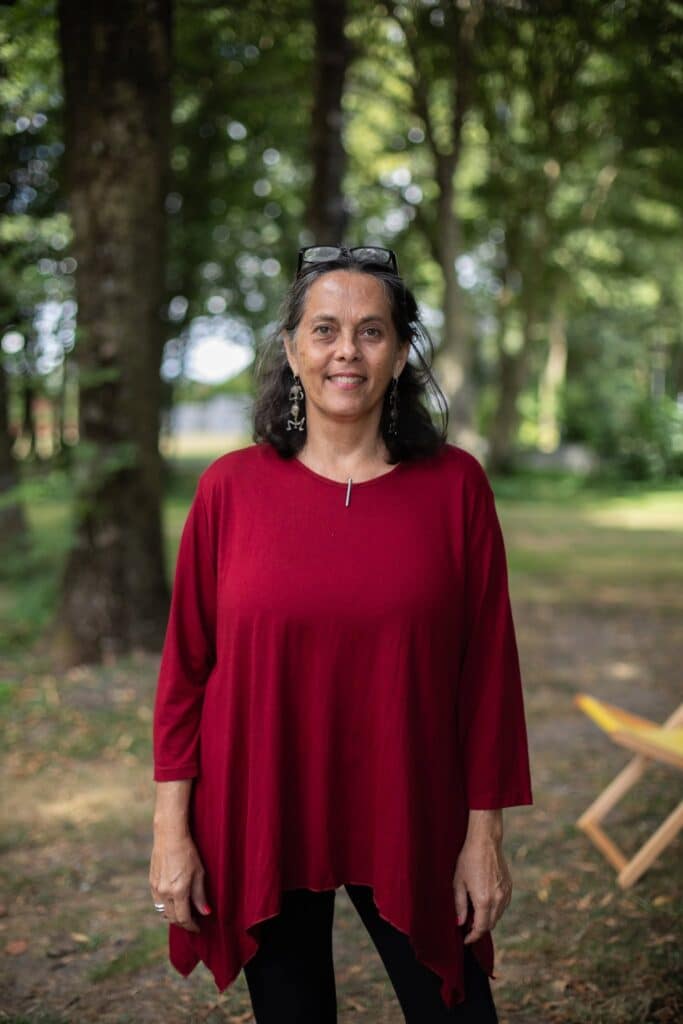
In Venice, Annalee Davis did not bring any abstract images of Barbados. For the 2026 Art Biennale, the artist brought plants from her garden, textiles, drawings of palm trees, and a life-size reproduction of a bird now believed to be extinct to the Arsenale. Behind this installation, a single question runs through her work: what to do with a land whose history remains steeped in plantation culture?
Creating from the very heart of history
Annalee Davis was born in 1963 in Saint Michael and now lives in Saint George, in the Barbados. Her studio is located at Walker’s Dairy, on a former sugar plantation where her Creole family has lived for several generations. The place is not merely a backdrop: it shapes her practice. Her family history adds a special depth. The estate, a former sugarcane plantation, was acquired by her paternal great-grandmother before being converted into a dairy farm. Annalee Davis has lived and worked there for over twenty years. The land thus becomes at once a family archive, a trace of the colonial system, and a space of the present.
An Artist at the Intersection of Biography, History, and Place
A visual artist, author, educator, and cultural organizer, Annalee Davis explores the intersection of biography and history. She is interested in “post-plantation economies” and the ways in which colonial legacies continue to shape Caribbean landscapes and societies. Her commitment extends beyond her own studio. She is the founding director of Fresh Milk and has co-founded several pan-Caribbean artistic initiatives, including Caribbean Linked, Tilting Axis, and Sour Grass. For her, creating is not just about producing artworks, but also about building spaces where artists from the region can meet, circulate, and think together.
After planting, what will happen to the soil?
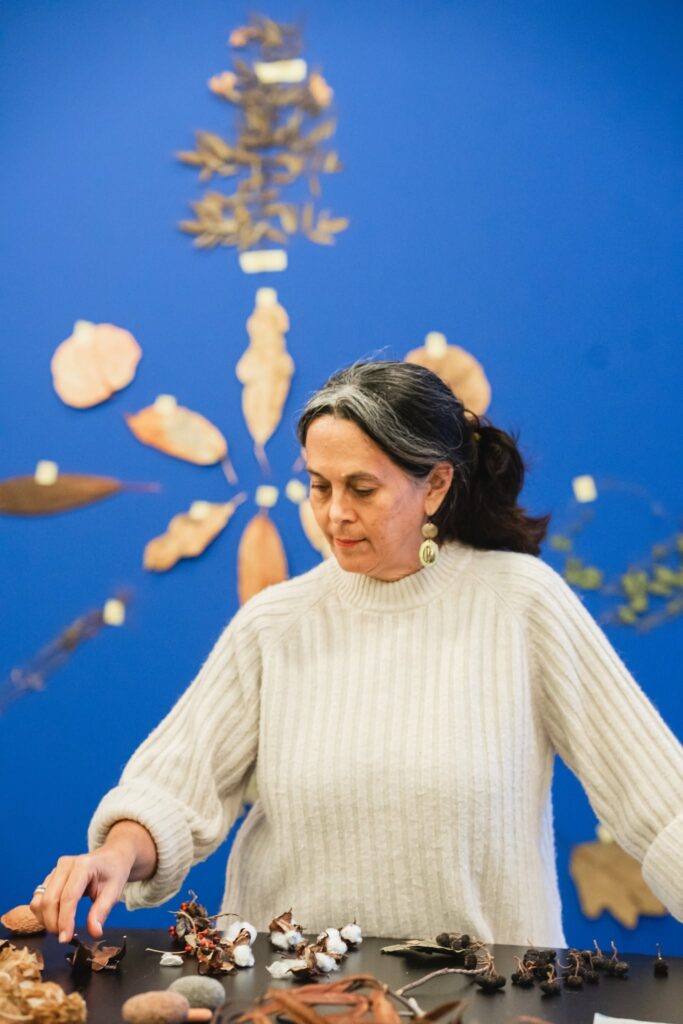
For more than a decade, Annalee Davis has been exploring what she calls post-plantation restoration. The idea isn’t to erase the past. Rather, it’s about examining what it has left behind in the soil, in customs, in social relationships, and in memories—and then imagining new ways of relating to the place. At Walker’s Dairy, she walks, observes, cultivates, and works with plants. Gardens, medicinal herbs, and living plots become ways to reflect on healing, care, and passed-down knowledge. Her work thus reimagines planting: from an inherited economic system, it becomes a terrain to be reinterpreted, challenged, and transformed.


Repair Without Deleting
This is what makes Davis’s approach unique. She does not seek to transform a former plantation into a static heritage site. Instead, she works with its inherent contradictions. The site was once a sugar plantation, then a dairy farm; the artist notes that it is now in the process of transitioning to a business related to alternative energy. This succession of uses already tells the story of several lives within the same territory. Davis adds another possibility: that of a space capable of preserving traces of the past while generating new uses, new knowledge, and new forms of care. Here, “reparation” is therefore not synonymous with “forgetting.”
From Barbados to Venice
With “Let This Be My Cathedral”, presented at the 2026 Arte Biennale, this reflection takes on a particularly concrete form. The installation includes, among other things, a wall herbarium made up of plants grown in her Barbadian garden, a hand-embroidered textile, drawings of palm trees on the floor, and a life-size reproduction of the Eskimo curlew. The bird has a specific history: it was last sighted in Barbados in 1963, the year of the birth of Annalee Davis, and the species is now presumed extinct. In this way, the artist connects ecological memory, colonial history, and extinction. Venice does not erase Barbados: it becomes the place where a very local fragment of its landscape takes on a broader significance.


The Earth as an archive, but also as a possibility
Annalee Davis’s portrait ultimately tells less of a story about the conversion of a plantation than it does of a different way of looking at the land. The same soil can bear the violence of a system, the stories of a family, medicinal plants, agricultural practices, and contemporary artworks. This is where her work becomes distinctly Caribbean without seeking to speak on behalf of the entire Caribbean: it starts from a specific place and embraces its complexity. If former plantations are archives of the past, can they also become spaces where we can invent other futures?
Annalee Davis is a Barbadian visual artist, author, educator, and cultural organizer. Her work explores, among other things, the connections between colonial history, memory, territory, ecology, and the legacy of plantations in the Caribbean.
Annalee Davis lives and works at Walker’s Dairy, a former sugar plantation in Barbados linked to her family history. She uses this place to reflect on the legacies of the plantation and to envision new relationships between land, memory, creation, and healing.
Let This Be My Cathedral is the installation presented by Annalee Davis at the 2026 Venice Art Biennale. It combines plants from her Barbadian garden, textiles, drawings of palm trees, and ecological memory to explore the history and transformation of territories.
At first glance, they catch the eye with their wooden facades, their colors, and their simple proportions. Yet Barbados’ chattel houses are not merely an architectural signature. Their form reflects a specific social reality: for a long time, some residents could own their homes without owning the land on which they stood. A chattel house therefore had to be movable.
Chattel House: A Home Designed for Traveling
To understand this unique aspect, we must look back to the post-emancipation period. In Barbados, the emancipation of enslaved people was completed in 1838. However, the island’s land structure remained deeply shaped by the sugar economy. As early as the 17th century, the expansion of sugarcane cultivation had led to the concentration of land in the hands of large plantations.
After emancipation, many workers still lived on land belonging to the plantations. They could build a home and own it, without owning the plot of land itself. If the land had to be vacated, the house had to be able to move with them. It is this situation that gives this type of dwelling its full meaning. In English, “chattel” refers to movable property—a possession that can be moved. These wooden houses were therefore designed to be dismantled, transported, and then reassembled elsewhere. The house belonged to them. The land, not necessarily.


Architecture Closely Tied to Lifestyle
This mobility was no minor detail. It determined how the houses were built. Chattel houses were wooden structures set on blocks rather than permanently anchored to the ground. This system made it possible to move the dwelling when a change in land conditions required it. The house could also evolve along with the household. Early models might have been relatively simple, but new sections could be added as the family grew or as their financial means increased. The dwelling was therefore not necessarily designed as a permanent structure: it could expand along with its occupants.
This construction method partly explains the appearance we associate today with the Chattel House. But above all, it reminds us of one thing: its form was a response to very practical constraints. Behind the wood and decorative elements lay a way of coping with limited access to the ground.

Owning a home without owning the land
Owning one’s own home could provide a form of material autonomy. But this ownership had an obvious limitation: while the dwelling belonged to its occupant, the land could remain in the hands of a landowner or a plantation. This distinction between the house and the land provides a better understanding of post-emancipation Barbados. The end of slavery changed people’s status, but the land structures inherited from the plantation economy did not disappear with it.
The Chattel House embodies this contradiction even in its construction: sturdy enough to serve as a home, yet mobile enough not to be permanently tied to a specific plot of land. In other words, the house’s mobility reveals the persistence of a problem that is far less mobile: that of access to land.
This is what gives these dwellings a significance that goes far beyond their aesthetics. What we now view as a recognizable architectural style is also the physical manifestation of a specific social organization.

When the Chattel House Becomes a Historic Landmark
Over time, these houses have become a distinctive feature of Barbados’ architectural heritage. In Tyrol Cot, in the parish of St. Michael, a heritage village dedicated to chattel houses was established as these structures were rapidly disappearing from the landscape in the 1980s and 1990s. It features replicas of seven houses selected for their architectural characteristics, as well as a house from the 1920s that has been converted into a museum.
The reversal is striking: a home designed to be left behind is now preserved precisely because people no longer want to see it disappear. But preserving one of these houses solely for its charm or its colors would be like preserving only the facade of its history. For behind these structures lie issues of ownership, labor, and access to land. They also show how families adapted their living spaces to a situation they did not fully control.


What These Houses Still Tell Us
Today, Chattel House offers a new perspective on Barbados’s landscape. Its value lies not only in the wood, the proportions, or the ornamentation. Above all, it stems from what its architecture still allows us to understand: a family could own, expand, and live in a house while still having to keep it ready to be removed from the land on which it stood.
Perhaps that is where the true power of this architecture lies: a house once intended to be moved has become a fixture in Barbados’ collective memory. And when we protect a Chattel house, what are we really trying to preserve: an architectural style or the social history embedded in its walls?
A Chattel house is a traditional wooden house from Barbados, historically designed to be dismantled and moved. It belonged to its occupant, even when the land on which it stood did not belong to him or her.
After emancipation, many workers lived on land they did not own. The Chattel house was therefore built in such a way that it could be moved if the family had to leave the plot.
The Chattel House tells a story that goes far beyond architecture. It bears witness to people’s relationships with the land, work, and property in post-emancipation Barbados. Today, it has become a recognizable part of Barbados’ architectural heritage.
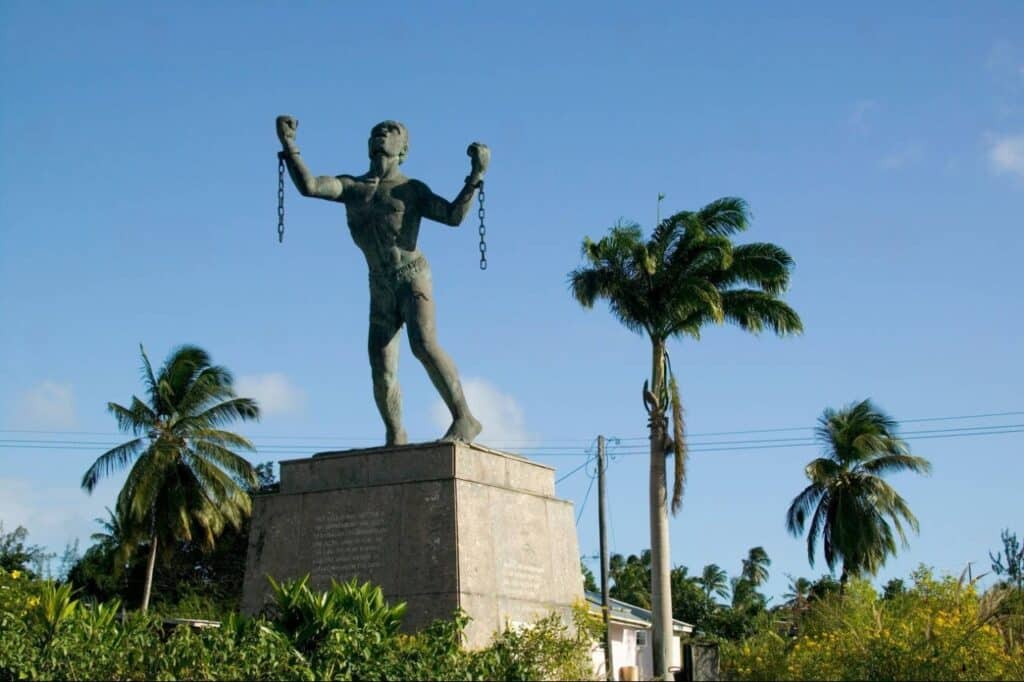
In Barbados, two bronze arms rise up, their wrists still encircled by broken chains. Sculptor Karl Broodhagen imbued this figure with a power that is immediately apparent: that of a body that now refuses enslavement. Often referred to as the Bussa statue, the work has become one of the most visible symbols of emancipation on the island. As August 1 approaches, this image serves as a reminder that Emancipation Day is more than just a holiday. In several former British colonies in the Caribbean, the date provides an opportunity for reflection. It invites us to consider the struggles, the suffering, and the freedoms won, but also what today’s societies choose to pass on.
Emancipation Day: What Does August 1 Actually Commemorate?
The Slavery Abolition Act was passed by the British Parliament in 1833 and took effect on August 1, 1834. However, that date did not mark complete freedom for everyone. A large proportion of formerly enslaved people were subjected to an “indentured servitude” system, which kept them working for their former masters.
This system came to an end in 1838 in the relevant British colonies. This timeline is crucial. It serves as a reminder that legal abolition and the actual exercise of freedom do not always coincide. Emancipation Day, therefore, has a more complex history than simply a break between slavery and freedom.
In Barbados, Bussa embodies resistance
The statue known as the Bussa Statue commemorates the revolt that broke out in Barbados in April 1816. The British National Archives describe it as an insurrection organized by enslaved women and men. Bussa, himself a slave, became one of its leading figures.
In Barbados, Emancipation Day also highlights the resistance movements that preceded abolition. The monument, therefore, does not merely recount a decision made in London; it places Caribbean action at the center of the narrative. The broken chains serve as a reminder that enslaved people were not merely beneficiaries of an imperial decision. They challenged the system, organized revolts, and defended their own vision of freedom.
In Jamaica, freedom looks up to the sky
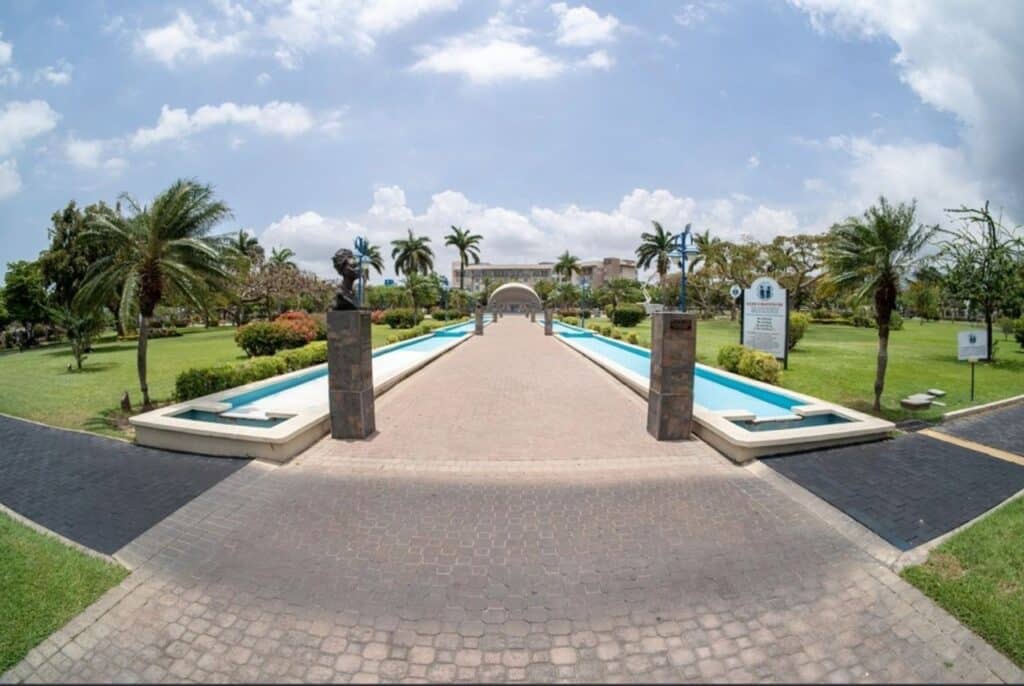
In Kingston, Emancipation Park is hosting “Redemption Song”, a sculpture by Laura Facey unveiled in 2003. Two black bronze figures—a woman and a man—stand naked, gazing toward the sky. The artist sought to depict a sense of elevation following the violence of slavery. In Jamaica, Emancipation Day thus finds a contemporary expression in the public sphere. The work does not seek to recreate a historical scene. Rather, it offers a symbolic language composed of bodies, water, and gazes. In a popular park in the heart of the capital, emancipation is no longer just a chapter in a textbook: it becomes an everyday presence.

In Dominica, Neg Mawon commemorates the freedom that was won
In Roseau, the Neg Mawon monument pays tribute to the Maroons and those who resisted the slave system. The Dominican government has presented it as a place intended to commemorate their role in the struggle for freedom. In Dominica, Emancipation Day recalls that the history of freedom was also shaped by marronage and resistance. The symbol affirms that emancipation began before 1834. It was also forged through escapes to the mountains, maroon communities, acts of defiance, and confrontations. This memory engages with sites associated with the history of slavery, such as the former market in Roseau.

One Date, Many Caribbean Memories
Barbados, Jamaica, and Dominica all commemorate a history tied to the British Empire, but they do not tell that story in the same way. One highlights a revolt and its heroes. Another turns to contemporary art to express liberation. The third emphasizes the Maroon legacy and sites of resistance. This diversity prevents the Caribbean from being reduced to a single narrative. Emancipation Day thus becomes a meeting point for distinct regional histories. Monuments, ceremonies, conferences, music, and community gatherings extend this memory beyond the archives.
The real challenge, however, remains the transmission of this history. Emancipation Day retains its power only if the commemoration helps us understand what was abolished, what has survived, and what continues to influence Caribbean societies. When the August 1 ceremonies come to an end, what place does this history hold in the lives and concerns of the younger generations?
Emancipation Day commemorates the abolition of slavery in several former British colonies. It is primarily celebrated on August 1 in various Caribbean territories.
August 1 marks the effective date of the Slavery Abolition Act in 1834. However, the “indentured servitude” system kept many formerly enslaved people in a form of forced labor until 1838.
Emancipation Day is celebrated with ceremonies, cultural activities, lectures, and community gatherings. Monuments such as the statue of Bussa in Barbados or “Redemption Song” in Jamaica also help to preserve this memory.
In Barbados, a surprise doesn’t always elicit a simple “wow.” In a lively conversation, upon hearing unexpected news, or when faced with a scene that’s hard to believe, another phrase might come up: “Cheese on bread!” Said with energy, it isn’t an order for a meal. Rather, it transforms a very ordinary image into a spontaneous reaction that’s instantly recognizable to many Barbadians.
What does “Cheese on bread!” really mean?
The expression is primarily used to convey surprise. It can express admiration for a performance, disbelief at surprising news, or irritation when a situation pushes one’s patience to the limit. Its translation therefore depends less on the specific words used than on the tone. In French, it could be translated as “Waouh!”, “Mon Dieu!”, “Eh bien!”, or even “Ce n’est pas possible!”.
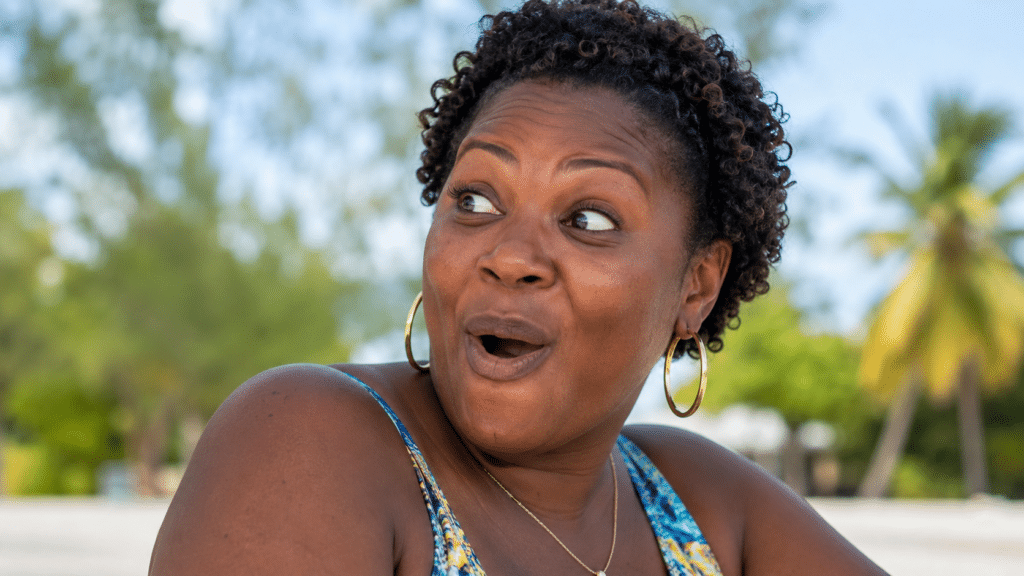
Imagine someone discovering the unexpected price of an item. They open their eyes wide and exclaim, “Cheese on bread!” A few minutes later, the same phrase might be used to celebrate a spectacular play during a game or a particularly stylish outfit. The words remain the same, but the voice, facial expression, and context change their meaning. It is precisely this flexibility that makes the expression so vivid.

Bread and cheese, but no recipes
Taken literally, “Cheese on bread!” simply means “cheese on bread.” There seems to be no obvious reason why this food combination would express surprise. Yet everyday language rarely functions according to a purely literal logic. It is enriched by figurative language, imagery, and expressions whose power comes from collective usage.
The exact origin of the expression remains difficult to establish with certainty. It would therefore be unwise to invent a specific origin for it or to attribute it to any one person. What sources on local speech do confirm, however, is its use as an exclamation of surprise in Barbados. Its enduring popularity is likely due less to an official history than to its transmission through everyday conversation.

A Gateway to Bajan
“Cheese on bread!” belongs to this linguistic world often referred to as Bajan. English is the official language of Barbados, while Bajan is a local Creole language based primarily on English. It has its own sounds, vocabulary, rhythms, and sentence structures. To reduce it to “broken English” would be to ignore its history and the social practices that have shaped it.

Colloquial expressions play a key role here. They convey emotions with a precision that translation doesn’t always capture. Someone might understand every English word in “Cheese on bread!” without immediately grasping what a Barbadian speaker is trying to convey. To fully appreciate the nuance, you need to hear the intonation and understand the context.
This difference serves as a reminder that a language is never limited to a dictionary. It lives on in family conversations, jokes, disagreements, markets, public transportation, and get-togethers with friends. Every phrase conveys a way of responding to the world. In just a few syllables, “Cheese on bread!” adds a touch of local color to the surprise.

A Barbadian symbol of recognition
For the diaspora, hearing this expression far from the island can also bring back a memory. A familiar voice, a conversation from childhood, or a frequently repeated reaction suddenly comes to mind. The phrase then becomes more than just an exclamation: it serves as a sign of belonging. It can also create an immediate bond between two people who don’t know each other. The place then emerges in the conversation even before it’s named, thanks to a shared exclamation.
This power explains why local expressions deserve serious attention. They may sometimes seem lighthearted or amusing, but they preserve traces of communal life. They reveal how a region plays with language, names its emotions, and recognizes those who share its cultural references. “Cheese on bread! ” is thus an expression from Barbados that doesn’t simply translate its reactions into standard English. It formulates them in its own way, with humor, intensity, and creativity. Behind the bread and cheese lies a small demonstration of linguistic inventiveness.
The next time surprise leaves you speechless, you might know what to say. But be careful: just saying the words isn’t enough. For “Cheese on bread!” to really hit home, you still need to strike the right tone. And in your part of the world, what everyday expression immediately gives away where you’re from?
In Barbados, “Cheese on bread!” is a Bajane exclamation used to express surprise, admiration, disbelief, or sometimes annoyance. Its exact meaning depends on the context and intonation.
Barbadians use “Cheese on bread!” as a spontaneous reaction to an unexpected situation. The exact origin of the expression remains unclear, but its widespread use makes it a recognizable hallmark of Bajan speech.
No. Even though its literal translation is “cheese on bread,” “Cheese on bread!” does not generally refer to a dish when used in conversation. It is primarily a popular exclamation in Barbados.
In Saint Lucia, during the 51st meeting of CARICOM heads of government, Dr. Hyginus “Gene ” Leon, executive director of DBRP/The Nature Bank, presented an ambitious idea during a side event on reparations: using restorative justice to rethink Caribbean development. Here, the term does not refer solely to financial compensation. It aims to acknowledge the consequences of slavery and colonization, to redress the harm caused, and to transform the mechanisms that continue to perpetuate them.
Four Measures of Development
Development is often measured in terms of growth, investment, and infrastructure. This perspective is incomplete. An economy can build roads, ports, or hotels while at the same time undermining its natural resources, its population, or its institutions. This discussion is based on four forms of wealth. Productive capital includes infrastructure, businesses, and financial resources. Natural capital encompasses soil, forests, water, reefs, and the climate. Human capital encompasses health, education, skills, and dignity. Finally, societal capital relates to institutions, social cohesion, and trust.
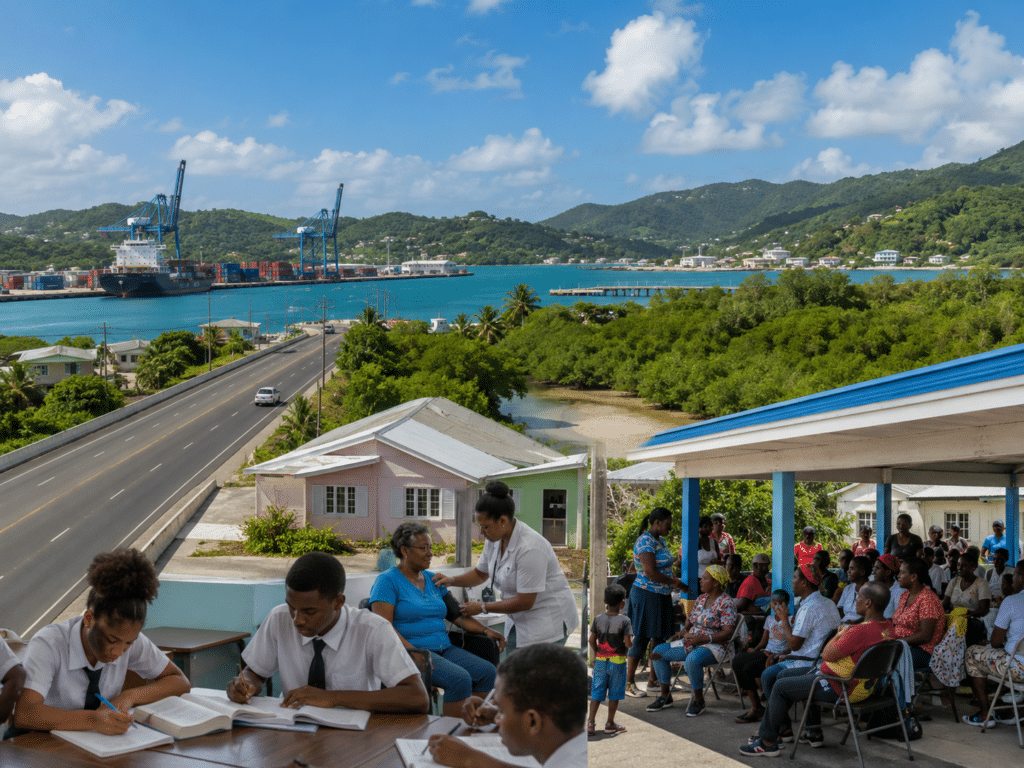
Progress requires that these four forms of wealth advance together. When one form of capital develops at the expense of the others, growth becomes fragile. A region can achieve strong economic performance while simultaneously depleting the very foundations that make that prosperity possible.
A Five-Century-Old Economic Error
Restorative justice takes on a broader dimension here. It stems from a historical observation: for centuries, the economic system has assigned a price to produced goods while reducing people and nature to mere resources. The British Emancipation Act of 1833 illustrates this logic. More than 800,000 enslaved people were freed. Yet the 20 million pounds allocated compensated the slaveowners, while the freed people received no compensation. The financial value of property was recognized; the value of human life remained absent from the balance sheet.

This extractive model has not entirely disappeared. Cocoa produced in Ghana and Côte d’Ivoire fuels a global industry, while producers and the regions of origin retain only a small share of the value created. Incomes remain low, forests are shrinking, and the bulk of the profits are concentrated elsewhere.

Reparations, Climate, and Inequality: A Common Root
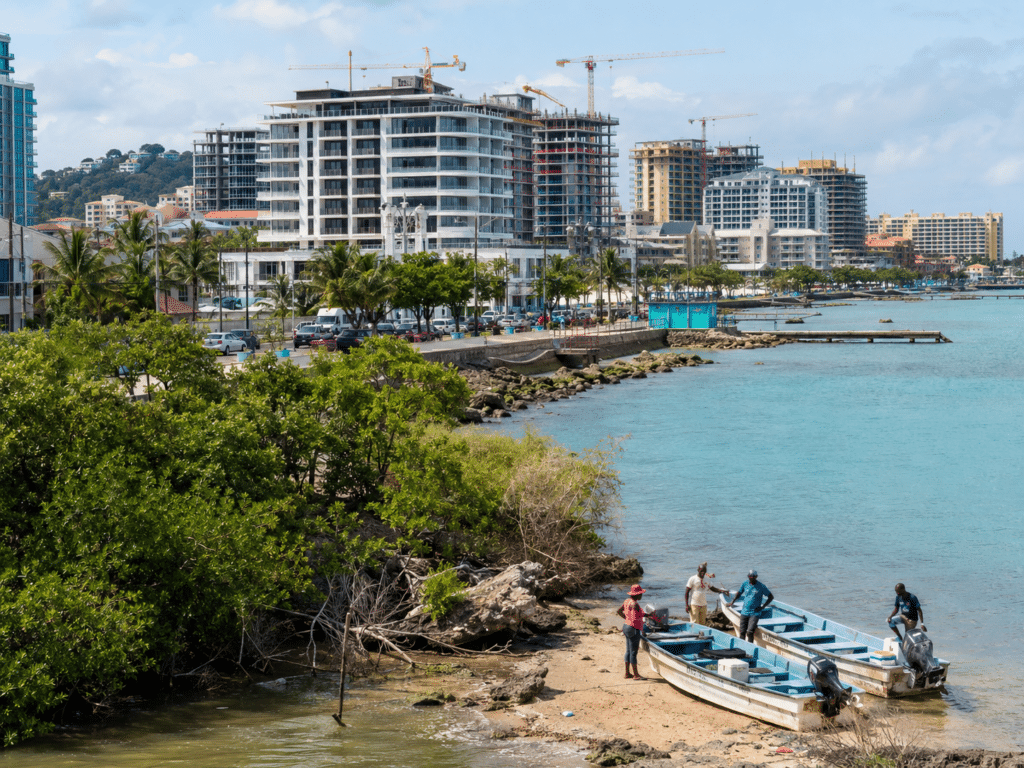
Reparations for slavery, climate-related losses and damages, and the fight against inequality are often addressed separately. Yet these issues stem from the same mistake: counting only part of the actual wealth. In the Caribbean, this contradiction is evident. A mangrove forest may be destroyed to make a project profitable in the short term. Its ability to protect coastlines, limit storm damage, or support fisheries is not always factored into the initial calculations. When disaster strikes, the region must finance reconstruction, often through debt. The value of nature is ignored at the outset, and then its absence becomes a collective burden.

Restorative justice thus links memory, the economy, and the environment. It raises a concrete question: How can we redress a historical injustice without reproducing the same imbalances in current decisions?

Rescue, Rebuild, and Transform
Restorative justice is structured around three stages: relief, reconstruction, and repositioning. The first addresses immediate emergencies. The second restores what has been lost. The third transforms the rules so that the harm is not repeated. This final stage is crucial. Rebuilding a house on the same fault line is tantamount to setting the stage for its next collapse. Similarly, compensation scattered across isolated projects may produce temporary results without addressing the root causes of vulnerability.

Restorative justice could therefore fund additional investments: education, health care, ecosystem protection, resilient infrastructure, strong institutions, and economies capable of retaining more value within the Caribbean region. The goal would be to compensate for a loss while making its recurrence less likely.

Three Possible Changes for CARICOM
Restorative justice offers three avenues for the region. First, every major public or financial decision could assess what it creates and what it destroys in terms of the four forms of wealth. Second, reparations could be organized as a coherent portfolio of reconstruction and transformation. Finally, human and environmental costs could be incorporated into the evaluation of projects, loans, and investments.
Restorative justice would thus shift the focus of the debate. For the Caribbean, making amends for the past could become a way to protect the future, by finally treating people, nature, institutions, and infrastructure as equally valuable.
In this context, restorative justice refers to an approach aimed at acknowledging and addressing the lasting consequences of slavery and colonization. It is not limited to the payment of financial compensation; it also seeks to invest in communities, institutions, the environment, and the economy to ensure that the same inequalities do not continue to be perpetuated.
The four forms of capital are productive capital, which includes infrastructure and businesses; natural capital, such as forests, reefs, and water; human capital, which encompasses health, education, and skills; and societal capital, based on institutions, trust, and social cohesion. Sustainable development requires advancing these four forms of capital together, without enriching one at the expense of the others.
It could help fund a coherent set of initiatives in education, health, ecosystem protection, climate resilience, and infrastructure. It also involves factoring human and environmental costs into financial decisions and assessing what each project creates or destroys. These guidelines were presented to CARICOM as proposals, not as decisions that have already been adopted.
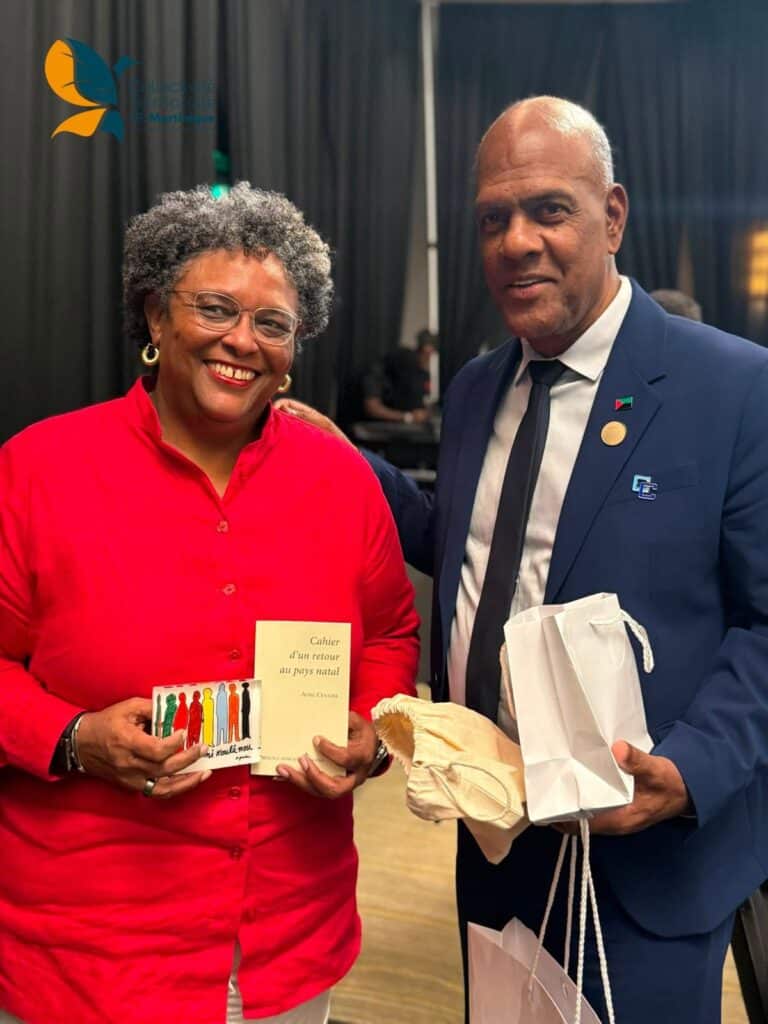
At the CARICOM summit, Martinique did more than just take a new seat. On July 7, 2026, on the sidelines of the meeting held in Saint Lucia, Serge Letchimy and Mia Amor Mottley signed a cooperation agreement between Martinique and Barbados. A concrete goal is taking shape: to transform the Caribbean’s geographical proximity into projects that are monitored, funded, and evaluated.
A first-time participation already focused on action
This signing comes at a special time for Martinique. Having officially become the seventh associate member of CARICOM on June 16, 2026, it was participating for the first time in a Conference of Heads of Government of the regional organization. The agreement with Barbados immediately gives this new phase an operational dimension. It is no longer simply a matter of affirming that Martinique belongs to the Caribbean region. The agreement establishes a bilateral framework for cooperation with a regional neighbor capable of sharing expertise, experiences, and common priorities.
Serge Letchimy sums up this ambition with a clear statement: Martinique is not merely “taking a seat at the table” of CARICOM. It wants to build, propose, and take action. This commitment elevates cooperation beyond a mere diplomatic symbol.
Nine sectors to bring the two regions closer together
The agreement covers nine major areas: cultural and creative industries, sports, education, vocational training, risk management, health, tourism, fisheries, and trade facilitation.
This diversity shows that the relationship we are seeking is not limited to institutions. It directly involves students, artists, athletes, tourism professionals, fishermen, businesses, and healthcare providers.
For young people, this could involve new training programs, skills exchanges, or joint programs. For the cultural sectors, this agreement can build bridges between two neighboring territories that share a regional space but whose languages, administrative systems, and economic networks often remain separate.
Culture as a Tool for Development
The inclusion of the cultural and creative industries among the priorities is by no means secondary. It recognizes culture as an economic sector, a means of regional exchange, and a space for identity-building. Between French-speaking Martinique and English-speaking Barbados, artistic collaborations can also serve as a very concrete way to bridge the gap. Music, film, cultural heritage, visual arts, and digital creation can circulate more easily when institutions organize exchanges, mobilize resources, and oversee projects.
This is where the agreement can take on a truly Caribbean character: not by erasing the differences between the two territories, but by drawing on their unique characteristics to foster new collaborations.
A system designed to deliver results
The agreement provides for a Joint Cooperation Committee, co-chaired by Barbados and the Territorial Collectivity of Martinique. This body will be responsible for defining priorities, approving programs, monitoring their implementation, and reviewing their results. A Technical Secretariat will be responsible for operational oversight. An annual report must detail the actions taken, the resources mobilized, performance indicators, challenges encountered, and the planned program for the following year.
These mechanisms are one of the most important elements of the agreement. Regional cooperation initiatives are often announced with great ambition, but their impact ultimately depends on the timeline, funding, and administrative continuity. By providing for regular evaluations, Martinique and Barbados are demonstrating their commitment to making the relationship measurable—and, above all, to making its effects visible to the populations concerned.
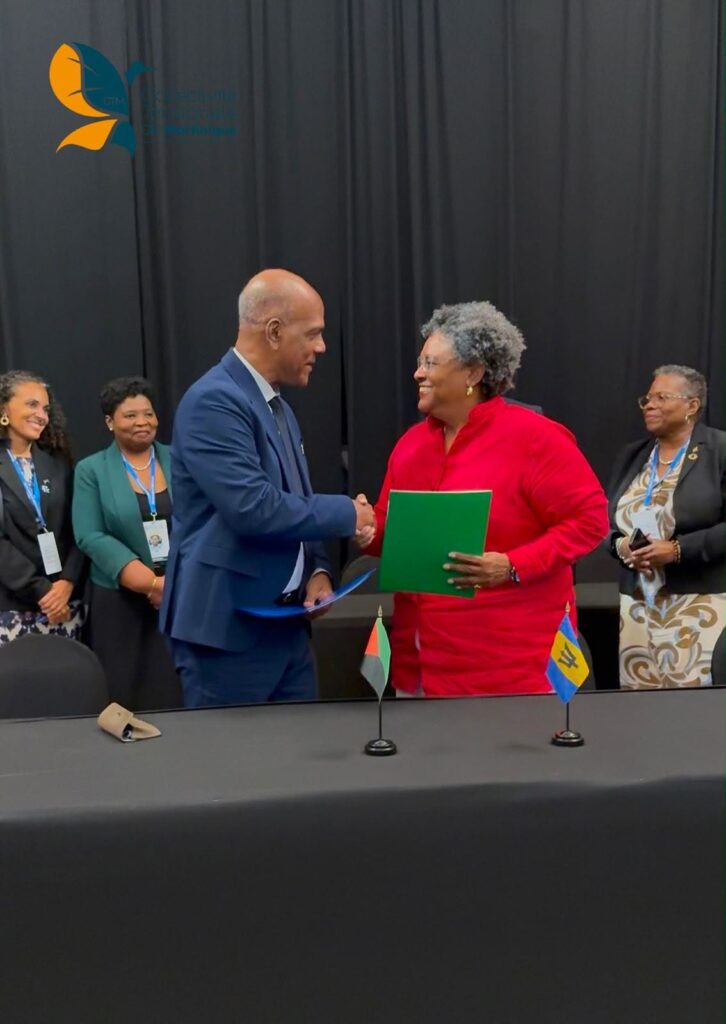
Five years to build a lasting partnership
Signed for five years and renewable, the agreement gives both territories time to develop projects beyond one-off meetings. It also provides a stable framework for their relationship, as Martinique seeks to strengthen its position between the Caribbean, Europe, the Americas, and Africa.
The real test will now begin with the first selected programs. Which projects will be launched first? Which groups will benefit directly? The answer will reveal whether this agreement marks merely a new institutional milestone or the beginning of a partnership capable of bringing about tangible changes in exchanges between Martinique and Barbados.
The agreement establishes a framework for cooperation in nine sectors: cultural and creative industries, sports, education, vocational training, risk management, health, tourism, fisheries, and trade facilitation. It is intended to enable the two territories to develop joint programs and concrete projects.
The cooperation agreement between Martinique and Barbados is valid for a renewable term of five years. This period is intended to allow both partners to launch initiatives, assess their results, and build a lasting relationship that extends beyond one-off institutional meetings.
A Joint Cooperation Committee will set priorities, approve programs, and evaluate results. A Technical Secretariat will provide operational oversight. Each year, a joint report will outline the actions taken, the resources mobilized, the challenges encountered, and the planned program for the following year.
In Bridgetown, an award ceremony capped off years of effort. Barbados was named “Climate-Smart Country of the Year” at the first Climate Smart Awards, presented at the Caribbean Climate-Smart Accelerator summit in Bridgetown. Behind this distinction lies a journey rooted in energy, financing, and resilience.
An award based on five criteria
The jury did not limit its assessment to stated commitments. Racquel Moses, Executive Director of the Caribbean Climate-Smart Accelerator, explained that the evaluation was based on five areas: the ambition of the Nationally Determined Contributions (NDCs) under the Paris Agreement, the growth of renewable energy, the scope of clean energy goals, the climate finance mobilized, and the country’s performance on the ND-GAIN index. This tool measures a country’s climate vulnerability and its capacity to prepare its response.
Barbados has distinguished itself in each of these areas. According to the organization, the country’s renewable energy production has increased since the Paris Agreement. The island submitted its climate commitments on time and secured funding on a scale that is notable in the region. The award recognizes the policies implemented, rather than a single announcement.
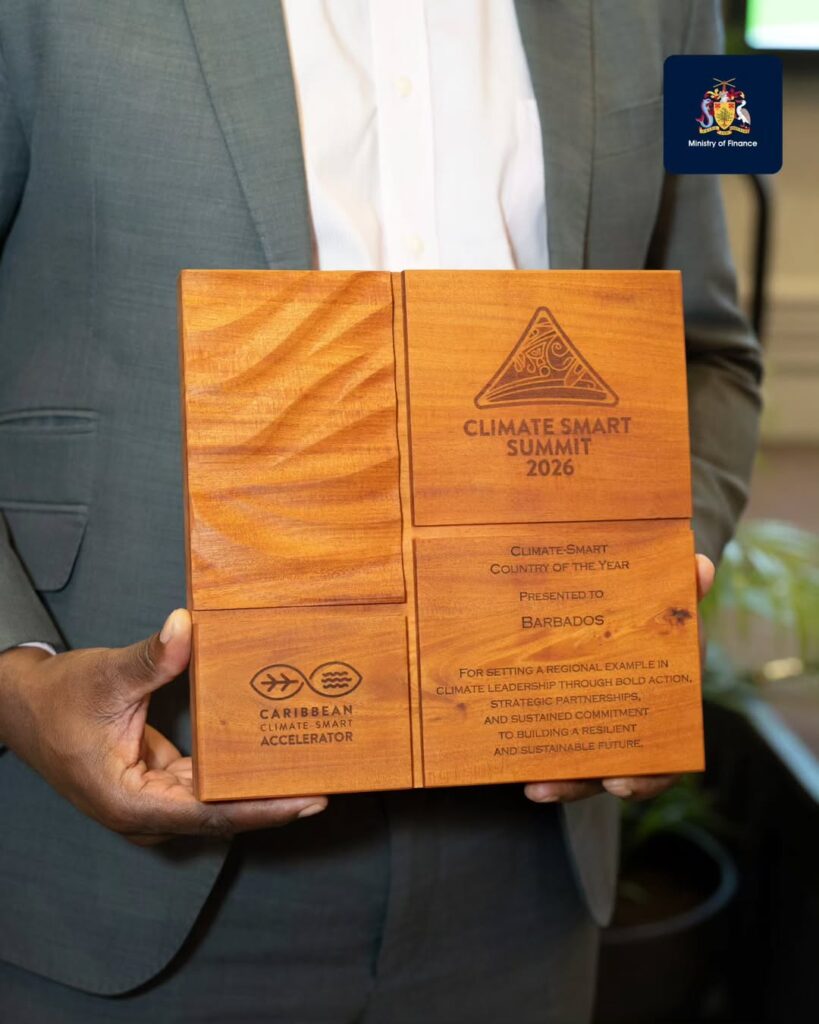
Solar Energy: A Transformation That Has Become Visible
For Ryan Straughn, Minister of Finance and Economic Affairs, this success is also thanks to the residents. Families have installed solar panels on their roofs. Entrepreneurs have invested in clean technology. Young people have chosen careers related to the green and blue economies.
This effort was supported by several government policies. Tariff concessions reduced the cost of equipment. The Renewable Energy Rider allowed households and businesses to sell electricity back to the grid. Other programs encouraged larger-scale commercial installations. The transition did not happen on its own; it relied on mechanisms capable of transforming a national ambition into accessible options.
When Finance Becomes a Tool for Resilience
The award highlights Barbados’ role in financial innovation. In December 2024, the country carried out a transaction described as the first debt-for-climate-resilience swap. It replaced more expensive debt with cheaper financing, generating approximately 125 million U.S. dollars in budget savings.
These resources are intended to support water management, food security, and infrastructure capable of withstanding the effects of climate change. The mechanism’s value lies in one key aspect: creating room for investment without increasing the overall burden of public debt. For a small island nation vulnerable to droughts, storms, and rising sea levels, financial engineering thus becomes a concrete protective measure.

Mia Mottley and a Voice Heard Around the World
This recognition is also part of the diplomatic efforts led by Prime Minister Mia Amor Mottley. Through the Bridgetown Initiative, launched in 2022, her government has called for reform of international financing so that vulnerable countries can more easily access long-term, affordable, and disaster-resilient resources.
Barbados did not single-handedly invent all of today’s tools, but it helped shift the conversation. It has argued that the countries least responsible for global warming cannot finance their adaptation efforts through traditional loans, which are costly and ill-suited to climate emergencies.
Rihanna: Another Face of Barbadian Activism
The ceremony also honored the Clara Lionel Foundation, founded by Rihanna. The foundation received the People’s Choice Award as well as recognition for its philanthropic work in particularly vulnerable communities. This dual appearance on stage brought together public policy, civic engagement, and cultural influence.
For Barbados, this partnership holds symbolic significance. A national institution and a foundation led by a global figure have been honored for the same cause. In this way, the country is projecting its identity beyond its beaches and tourism industry.

A prize, then the test of results
The title of “Climate-Smart Country of the Year” does not mean that all challenges have been resolved. Rather, it presents Barbados with a new challenge: to demonstrate that its goals can sustainably improve daily life, protect resources, and make energy more accessible.
The next step will be closely watched throughout the Caribbean. Barbados’ solutions cannot be copied wholesale, as each territory faces its own constraints. They can, however, raise a crucial question: How can small islands transform their climate vulnerability into the capacity to take action, without waiting for the rest of the world to decide for them?
Barbados received this award for its achievements in five areas: its commitments under the Paris Agreement, the expansion of renewable energy, its clean energy goals, the climate finance it has mobilized, and its ability to respond to environmental risks. The award thus recognizes a policy implemented over several years that combines energy transition, resilience, and financial innovation.
Barbados has facilitated the purchase of clean energy equipment through customs incentives and encouraged solar power generation among both households and businesses. Certain programs also allow users to sell the electricity they generate back to the grid. At the same time, the country has secured funding for water management, food security, and the protection of infrastructure vulnerable to the effects of climate change.
Barbados speaks on behalf of small island states in international discussions on climate and development financing. Under the leadership of Mia Amor Mottley, the country advocates for greater access to the resources needed for adaptation. Its experience can inspire other Caribbean territories, even though each island must adapt its energy and financial mechanisms to its own realities.
Organized by the Caribbean Chamber of Commerce in Europe (CCCE), the second edition of Caribbean Days brought together various expressions of Caribbean culture at UNESCO headquarters in Paris. Over the course of four days, the event provided a forum for dialogue on regional cooperation, sustainable tourism, and economic relations between the Caribbean and Europe.
A Caribbean-style restaurant with a view of Paris
On the roof of UNESCO, Caribbean chefs from the association Les Toques françaises are preparing a three-course Caribbean menu. From the restaurant, guests can see the Eiffel Tower, Les Invalides, and the Left Bank. This scene captures the spirit of the Caribbean Days : to showcase the Caribbean through its creative works and craftsmanship, and then use this cultural presence to foster broader exchanges.
The Caribbean Chamber of Commerce in Europe (CCCE) organized this second edition as part of Latin American and Caribbean Week. Under the theme “Peace, Diversity, and Sustainability,” the event brought together representatives from the cultural, institutional, diplomatic, and economic sectors.
Over the course of four days, the program featured the visual arts, gastronomy, fashion, film, literature, poetry, music, and dance. These disciplines showcased various facets of Caribbean creativity in a venue dedicated to education, science, culture, and heritage.
Creative Industries Take Center Stage
The Caribbean Days highlighted the creative industries as one of the region’s strengths. Cuisine, fashion, film, storytelling, music, and dance served as points of connection between different regions and sectors.
This diversity brought together Caribbean ambassadors, other diplomats, representatives from the public sector, and private-sector stakeholders. Culture thus provided a common framework for discussions on development, investment, and partnerships.
Founded in November 2019, the CCCE’s mission is to facilitate exchanges between the Greater Caribbean and Europe. It also seeks to encourage European investment in the region’s sustainable economic development. In Paris, this mission has taken the form of meetings between institutions, businesses, and Caribbean representatives.
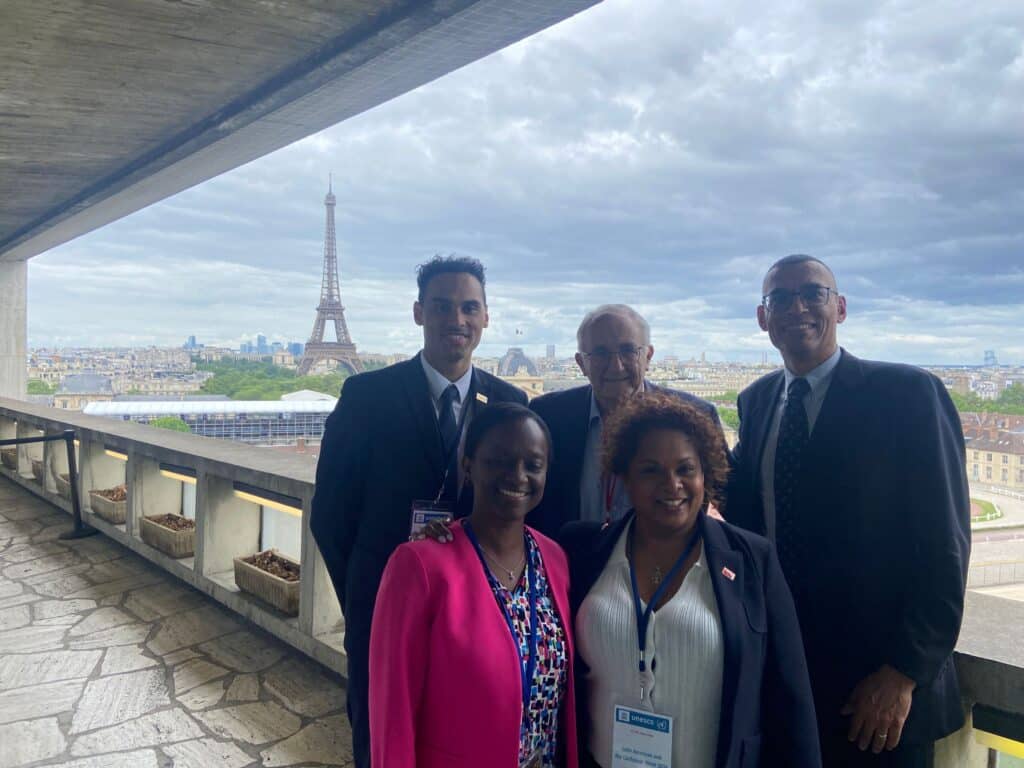
Regional Cooperation Over Lunch
A luncheon discussion focused on cooperation between France’s overseas territories in the Caribbean and CARIFORUM member states. Representatives from the Bank of France, Expertise France, and the OECD gave presentations.
The remarks by French Senator Micheline Jacques, who supports an economic partnership between France’s overseas territories and Haiti, refocused the debate on a concrete question: How can we strengthen ties among the various parts of the Caribbean region?
Through this event, the Caribbean Days brought culture, diplomacy, and the economy closer together. Gastronomy was not merely a backdrop; it served as a framework for dialogue on potential areas of cooperation and on the Caribbean’s role in its relations with Europe.
Sustainable Tourism in the Face of Climate Change
A roundtable discussion was held on sustainable tourism. Geoffrey Lipman, former president of the World Travel and Tourism Council and former deputy secretary-general of the World Tourism Organization, participated alongside Florian Valmy-Desvillers, director of business development for the Caribbean Tourism Organization in the United Kingdom and Europe.
Jo Spalburg, Secretary General of the CCCE, summarized the main message of these discussions. According to him, the acceleration of climate change makes it necessary to develop tourism that is more sustainable and more beneficial to local communities. These communities play a direct role in protecting the region’s natural and cultural heritage for future generations.
This reflection gives the Caribbean Days a specific scope. It links the promotion of Caribbean destinations to the responsibility of preserving what attracts visitors: landscapes, cultural heritage, cultural practices, and local knowledge.

From Cultural Visibility to Partnerships
As this second edition comes to a close, the CCCE is highlighting a collective goal: to transform cultural visibility into collaborations, innovation, and sustainable growth for the region.
The Caribbean Days have shown that culture can foster dialogue among diplomats, institutions, businesses, and creative professionals. What happens next will depend on the ability of the partners gathered in Paris to turn these exchanges into concrete partnerships that benefit Caribbean regions and communities.
Caribbean Days, also known as Journées des Caraïbes, is an event organized by the Caribbean Chamber of Commerce in Europe at UNESCO headquarters in Paris. Over the course of four days, the second edition of the event showcased the visual arts, gastronomy, fashion, film, literature, poetry, music, and dance. The event took place under the theme “Peace, Diversity, and Sustainability,” as part of Latin American and Caribbean Week.
Caribbean Days is organized by the Caribbean Chamber of Commerce in Europe (CCCE). Founded in November 2019, this organization seeks to facilitate exchanges between the Greater Caribbean and Europe, while encouraging European investment in the region’s sustainable economic development. In Paris, the CCCE brought together representatives from the cultural, diplomatic, institutional, and economic sectors to discuss Caribbean culture and challenges.
Caribbean Days combined the promotion of creative industries with discussions on regional cooperation and sustainable tourism. A luncheon forum focused on relations between France’s overseas territories in the Caribbean and CARIFORUM member states. A roundtable discussion also addressed the effects of climate change and the need to develop more sustainable tourism that better benefits local communities working to protect the region’s natural and cultural heritage.
A constraint that can become a value
The Caribbean is experiencing climate change directly, brutally and continuously. More intense cyclonic seasons, accelerated coastal erosion, fragile coral ecosystems, energy vulnerability: no island in the region has been totally spared. For a long time, this reality has been presented as a constraint for public budgets, for tourism operators and for economic models based on the classic spa industry.
The Travel Dreams 2026 report by Amadeus, however, suggests a possible turnaround. What was once perceived as a fragility can become a value proposition, as long as it is acknowledged and accurately portrayed. This is where the notion of visible sustainability becomes central.
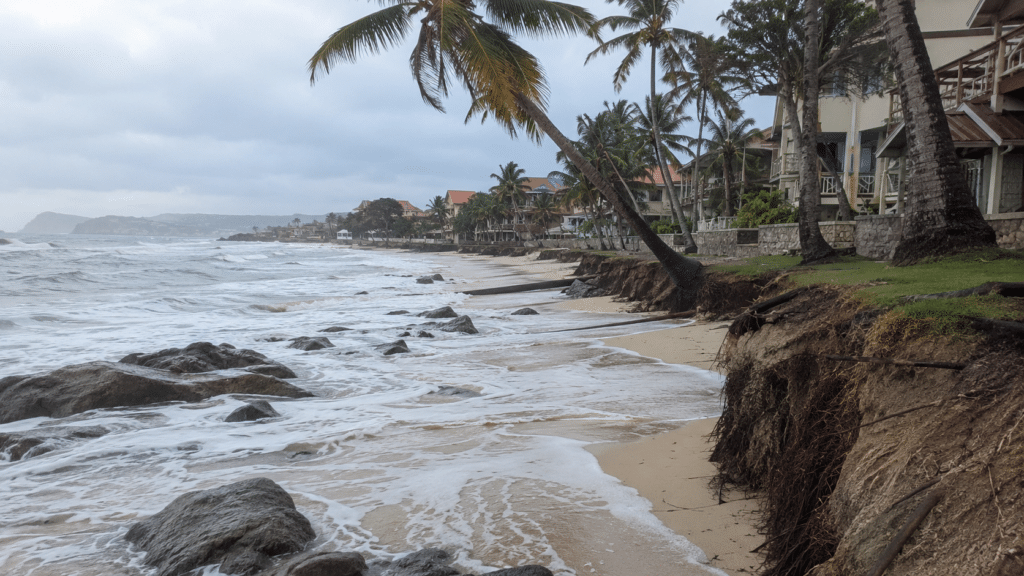
What travellers say
The study first documents the scale of demand. Of the 6,000 travelers surveyed across six major global markets, 75% say that a hotel’s sustainability commitments are important in their booking decision. More than one in three, precisely 35%, consider them “very important”.
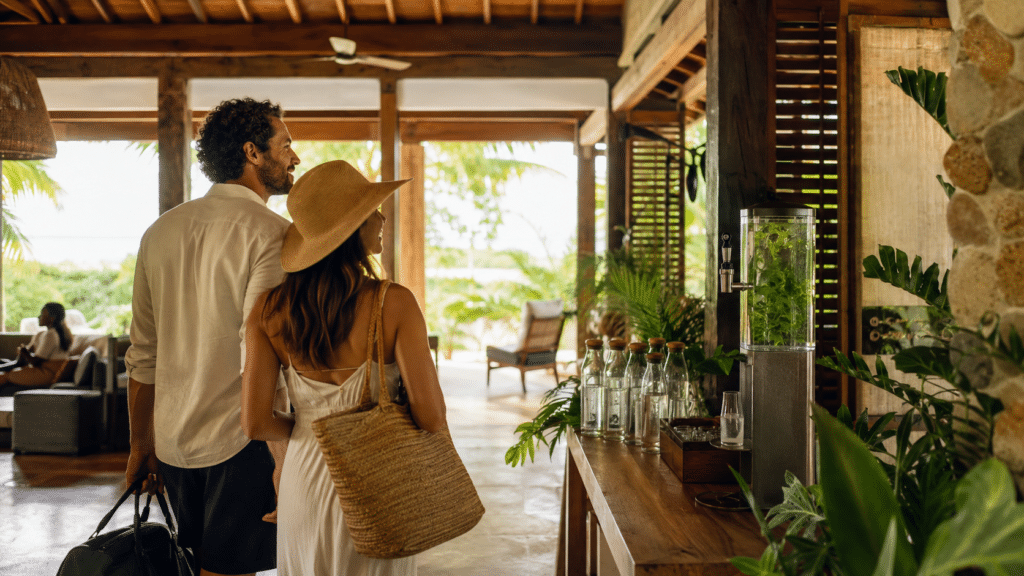
And this concern translates into willingness to pay. Travelers who place importance on this criterion say they are willing to spend an average of 11.7% more per night to stay in an establishment with serious sustainable practices. This represents around $29 more on a $250 room. Among Generation Z travelers, this willingness rises to 14.7%, or almost $37 more per night. Visible sustainability starts here: in a hotel’s ability to communicate why these practices are worth more.
One data point deserves particular attention for the Caribbean: sensitivity to sustainability varies greatly according to source markets. It reaches 93% of travelers surveyed in India and 85% in China, compared to 65% in the UK and Germany. For a region seeking to reduce its dependence on traditional markets, these discrepancies open up a strategic avenue to be handled with caution. These travelers won’t be satisfied with a generic discourse on nature. They’ll be looking for evidence, visible features, documented stories. For the Caribbean, visible sustainability can become a way of speaking to these audiences without denying its local roots.

What hotels do
On the supply side, Amadeus data show a widespread commitment among the hoteliers surveyed. Of the 500 general managers or equivalent profiles consulted across nine countries, all say they plan to spend on sustainability initiatives in the coming year. The average anticipated expenditure represents 6.7% of total company expenditure. And 35% of hoteliers identify sustainability as a key differentiating factor from their competitors.
But the study also highlights a revealing discrepancy. Hotels invest primarily in actions that have an internal operational efficiency rationale: water conservation (33%), sustainable catering supply (33%), responsible supply chains (33%), waste reduction (32%), staff training (32%).

On the other hand, practices that are more visible to the customer, such as renewable energies (28%), biodiversity and community initiatives (27%), and the link between sustainability and loyalty programs (21%), remain less developed. It is this tension that makes visible sustainability strategic: it forces us to move from internal effort to an experience understood by the traveler.
Closing the gap
Joerg Schuler, Head of Global Hospitality Sales at Amadeus, sums up this discrepancy by talking about sustainability as being more “visible, experiential and integrated into the stay”. The formula is important, because it changes the subject. It’s no longer just a question of saying that a hotel consumes less water or reduces its waste. It’s about making these choices understandable, concrete and experienced by the traveler. Visible sustainability therefore requires not only proof, but also an accurate narrative.

This gap is precisely what the Caribbean can bridge. Visible Caribbean sustainability is not an abstract technical program. It can be embodied in visible, relatable, situated practices. Restoring mangroves. Coral reef protection. Local solar energy. Short-distance sourcing from small island producers. Saving water in contexts where the resource is precious. Passing on traditional knowledge of how to use the environment sparingly.

Each of these practices can be both a serious environmental commitment and a story that travelers can experience during their stay. It is this articulation that transforms visible sustainability into perceived value, and thus into pricing leverage.
A value to be documented
A Caribbean hotel that can document, with figures, identified partners and measurable results, its role in restoring a local ecosystem is no longer just selling a room. It’s selling participation in a broader regional project. Travelers surveyed by Amadeus have already indicated their willingness to pay for this. Visible sustainability therefore requires showing what is being done, by whom, with what effects.

This logic goes beyond the individual hotel business. It also concerns destination management bodies, tourism authorities and regional economic players. A region’s ability to credibly communicate its ecological commitment is becoming a competitive variable in the face of other tropical destinations. At destination level, visible sustainability can become a common language for hotels, producers, associations, communities and travellers.

The Caribbean challenge
For the Caribbean, the challenge is not to become sustainable in the sense that other regions understand it. It is to make legible a sustainability that, in many cases, is already practiced at the level of communities, small businesses, local cooperatives and inherited know-how. The global market is willing to pay for it. The question is whether the region will be able to present this reality with the appropriate rigor, coherence and pride.

This series of articles, in its three parts, has attempted to defend the same thesis. The expectations of travelers in 2026 – disconnection, connection to place, visible sustainability – are not constraints that Caribbean players have to endure. They are expectations that the region structurally bears, by virtue of its geography, cultures and history. What remains, as always, is the patient task of putting them into words. This is the editorial mission that Richès Karayib will continue to carry out, alongside the region’s economic, institutional and creative players.
Visible sustainability refers to the set of sustainable commitments that a traveler can actually see, understand or experience during their stay. It’s not just about internal measures, such as reducing water costs or limiting waste behind the scenes. In the Caribbean, this can take the form of solar power clearly integrated into the hotel, a mangrove restoration program, coral reef protection, sourcing from local producers or community actions presented with concrete results. This approach makes the ecological commitment more legible and credible for the traveler.
Visible sustainability can become a competitive advantage as travelers increasingly value hotels’ environmental commitments. According to the data used in the article, a majority of travelers consider these commitments to be important when choosing an establishment, and a proportion are even willing to pay more for serious practices. For Caribbean hotels, the challenge is not only to act, but also to document and tell the story of these actions with precision. An establishment capable of demonstrating its local impact is no longer just selling a room: it is proposing participation in a local project.
Caribbean destinations can better promote their visible sustainability by linking the actions of hotels, producers, associations, local authorities and communities into a coherent narrative. This requires proof: figures, identified partners, measurable results, actions monitored over time. A destination that explains how it protects its reefs, saves water, supports short circuits or restores its ecosystems builds a stronger promise than a simple discourse on nature. For the Caribbean, this storytelling is strategic, as it transforms real climate vulnerability into a cultural, ecological and economic value proposition.
