While the energy transition is often discussed from an economic perspective, it also raises major challenges for Caribbean territories, their natural heritage, and the future of their appeal to tourists.
Caribbean Energy Week 2026 marks a major turning point for the Caribbean economy. Long perceived as a region essentially dependent on tourism and services, the Caribbean is now establishing itself as a strategic territory in the global energy sector. The event, scheduled from March 30 to April 1, 2026 in Paramaribo, Suriname, brings together governments, investors, energy companies and financial institutions around a common goal: to transform the region’s energy potential into a sustainable economic driver.
This new edition takes place against a backdrop of profound transformation. Oil discoveries in Guyana and Suriname, the consolidation of Trinidad and Tobago’s energy role and the boom in renewable energy projects on several islands are repositioning the Caribbean on the global economic map. Caribbean Energy Week 2026 is thus a strategic platform for understanding how energy is redefining regional economic balances.
A regional platform for energy investments
Caribbean Energy Week 2026 is more than just an industry conference. The event is positioned as a genuine platform for investment and economic cooperation. Held at the Royal Torarica Hotel in Paramaribo, it will bring together heads of state, ministers, international investors, development banks and energy companies around concrete projects aimed at accelerating the region’s energy transformation.
The objective is clear: to connect Caribbean projects with international capital. The organizers hope to facilitate partnerships between states and investors, accelerate the implementation of energy infrastructures, and present projects deemed “bankable” and likely to attract international financing. This economic dimension makes Caribbean Energy Week 2026 a pivotal event for the region’s financial future.
Beyond technical discussions, the event aims to transform exchanges into real agreements and investments. Round tables will bring together governments and investors to identify concrete development opportunities, while networking sessions will help forge long-term strategic partnerships.
Caribbean Energy Week 2026 comes at a time when the economic geography of the Caribbean is being redrawn. Oil discoveries in Guyana and Suriname have already begun to transform financial flows and investment priorities in the region. Guyana, which has become one of the world’s fastest-growing countries thanks to offshore oil, is now attracting capital, business and skilled labor. Suriname, host of the 2026 edition, is preparing to follow a similar trajectory.
This trend is not limited to hydrocarbon-producing countries. It is influencing the entire region. Caribbean states are seeking to diversify their economies, strengthen their infrastructures and develop local skills in order to reap the economic benefits of this energy boom. Caribbean Energy Week 2026 provides an ideal opportunity to coordinate these regional strategies.
The Caribbean is no longer just a tourist destination. It is gradually asserting itself as an energy and industrial investment zone, capable of attracting international capital and developing regional value chains. This economic transformation is at the heart of the discussions scheduled for the event.
The official theme of Caribbean Energy Week 2026, “Leveraging Energy Diversity Across the Caribbean”, highlights the diversity of the region’s energy resources. The Caribbean boasts a range of energy sources, from offshore oil to renewable energies, natural gas and carbon credits. This diversity represents a strategic lever for regional economic growth.
Hydrocarbons remain an important pillar. Oil and gas continue to attract massive investment, notably in Guyana, Suriname and Trinidad & Tobago. However, the event also focuses on renewable energies, such as solar, wind and geothermal power. Several island territories are seeking to reduce their dependence on imported fuels by developing local energy infrastructures.
Caribbean Energy Week 2026 will also address carbon markets, energy storage and the critical minerals needed for the global energy transition. These sectors represent new economic opportunities for Caribbean countries, which can position themselves as resource suppliers or energy innovation hubs.
One of the major consequences of regional energy transformation concerns employment. Energy projects require specialized skills in engineering, logistics, maintenance and project management. Caribbean Energy Week 2026 will highlight the need to strengthen training and local skills development to enable Caribbean populations to benefit directly from these new opportunities.
Several sessions will be devoted to local capacity building and workforce training. The aim is to reduce dependence on foreign labor and promote the integration of Caribbean talent into energy projects. This social and economic dimension is essential to ensure that energy growth truly benefits local populations.
The rise of the energy sector could also stimulate other sectors, including construction, financial services, logistics and digital technologies. Caribbean Energy Week 2026 will highlight these multiplier effects on the regional economy.
Infrastructure and regional connectivity
Energy development also entails investment in infrastructure. Ports, power grids, pipelines and storage facilities are among the projects planned in several countries. These infrastructures are essential to support economic growth and improve regional connectivity.
Caribbean Energy Week 2026 will showcase a number of infrastructure projects aimed at strengthening the region’s energy integration. Cooperation between Caribbean states is seen as a key factor in optimizing resources and reducing costs. Discussions will focus on electricity interconnections, natural gas transport and the creation of regional logistics hubs.
These investments could transform the mobility of goods and services in the Caribbean, facilitating trade and strengthening regional competitiveness. Energy thus becomes a vector for economic integration.
One of the major challenges facing Caribbean Energy Week 2026 is its ability to attract international capital. The region is seeking to position itself as a reliable and stable investment destination. Development banks, investment funds and international financial institutions will be present to assess the opportunities offered by the Caribbean’s energy transformation.
The participation of international players strengthens the credibility of regional projects and facilitates access to financing. Caribbean Energy Week 2026 will serve as a showcase to present investment opportunities and demonstrate the economic viability of Caribbean energy projects. This international visibility is essential to attract the capital needed for infrastructure development.
The influx of financing could also help to diversify Caribbean economies and reduce their dependence on certain traditional sectors. Energy is becoming a lever for economic stability and long-term growth.
A transition to a more diversified economy
Caribbean Energy Week 2026 illustrates a broader transition towards a diversified Caribbean economy. While tourism remains an important pillar, energy is opening up new prospects. Countries in the region are looking to develop complementary industries, strengthen their technological capabilities and improve their economic resilience.
This diversification is essential to cope with external shocks, whether economic or climatic. By investing in energy and infrastructure, the Caribbean can reduce its vulnerability and strengthen its economic sovereignty. Caribbean Energy Week 2026 is part of this structural transformation process.
Caribbean Energy Week 2026 is more than just a gathering of experts and decision-makers. It symbolizes the Caribbean’s entry into a new economic era. The region, long dependent on traditional sectors, is now positioning itself as a strategic player in the global energy landscape.
The discussions and partnerships that emerge from this event could have a lasting impact on Caribbean economies. Investment, jobs, infrastructure and regional cooperation are at the heart of this transformation. Caribbean Energy Week 2026 thus offers a concrete vision of the region’s economic future.
At a time when the Caribbean is redefining itself on the international stage, this event appears to be a pivotal moment. It enables us to anticipate future economic developments and measure the scale of the transformations underway. For the region’s decision-makers, investors and populations, Caribbean Energy Week 2026 represents much more than a conference: it marks the emergence of a new Caribbean economic dynamic.
This event brings together governments, investors and businesses to accelerate energy projects, attract international capital and strengthen the regional economy.
It covers oil, gas, renewables, power infrastructure, carbon credits and critical minerals linked to the energy transition.
The soca, “Soul of Calypso” is more than just carnival music. It represents a cultural revolution born between 1972 and 1973 in Trinidad and Tobago, symbolizing the fusion of two major heritages, African and Indo-Caribbean. In 2026, as the Caribbean prepares for a new cycle of large-scale carnival festivities, it remains more relevant than ever, serving both as a common thread of identity for the world’s diasporas and as a structuring economic driver for tourism.
Revolutionary origins: when an island reinvents itself
In the early 1970s, Trinidad and Tobago saw its traditional calypso music gradually lose ground to Jamaican reggae and American soul and funk influences. It was against this backdrop of cultural recomposition that Ras Shorty I, real name Garfield Blackman (1941-2000), emerged as the central figure of change.
Originally from Lengua Village, a territory where African traditions and Indian musical heritage coexist, Garfield Blackman intuitively understood that a truly Trinidadian music must integrate all the island’s peoples. Between 1970 and 1973, he deliberately fused calypso with Indo-Caribbean instruments such as the dholak, tabla and dhantal, giving birth to a new sonic identity.
The turning point came in 1973 with the track “Indrani”, a musical tribute to an Indian deity, organically integrating Indian instruments into a calypso structure. The “Endless Vibrations” album (1974) marked the explosion of this genre of music, thanks in particular to the track “Om Shanti”, based on a sacred Hindu mantra, whose success extended beyond the Caribbean borders to India.
By 1974 and 1975, soca had established itself as the new national musical direction, rapidly adopted by major figures such as Lord Kitchener and Mighty Sparrow.
The evolution of soca: sub-genres and constant reinvention
Fundamental musical characteristics
It features several structural elements:
– high tempos, ranging from 115 to 163 beats per minute depending on the sub-genre
– frequent use of the tresillo rhythm, with the bass accentuating the second and fourth beats
– an instrumental fusion combining African percussion, Indian drums, Caribbean brass and modern synthesizers
– constant exposure to outside influences, notably hip-hop, R&B, dancehall and, more recently, Afrobeats
The main sub-genres
Power Soca, developed in the 1990s by Superblue in particular, is characterized by extreme energy and tempos reaching 155 to 163 BPM. It quickly became the dominant soundtrack for carnival routes, with direct vocal instructions and an assumed physical intensity.
Groovy Soca, which emerged in 2005, is a reaction to this intensity. It favors melody, groove and soul and R&B influences. Robin Imamshah contributes to its popularization with “Frenchman”, while Precision Productions refines its sonic aesthetic.
Chutney Soca, initiated in 1987 by Drupatee Ramgoonai, fuses traditional Indo-Caribbean chutney with soca. This sub-genre enabled the Indo-Trinidadian community to take full ownership of this musical expression. Rikki Jai became one of its main ambassadors with the track “Sumintra”.
Ragga Soca, influenced by Jamaican dancehall, took off in the 1990s. It gained international visibility thanks to artists from Saint-Vincent, notably Kevin Lyttle with the worldwide hit “Turn Me On”.
Major soca figures
Ras Shorty I, founding visionary
After the success of “Endless Vibrations”, Garfield Blackman continued his artistic exploration. In 1984, disappointed by the commercial evolution of soca, he announced his conversion to Christianity and developed “jamoo”, a contraction of Jah Music. This sub-genre incorporates elements of gospel and reggae, and is ideologically consistent with Ras Shorty I’s assertion that music should convey messages of positivity and spiritual uplift.
Ras Shorty I
Calypso Rose, feminist pioneer
Calypso Rose, born in 1940, upset the patriarchal norms of calypso and soca. In 1977, she became the first woman to win the Carnival Road March with “Give More Tempo”. In 1978, she won both the Road March and the competition then renamed Calypso Rose, firmly establishing the place of women in Caribbean musical history.
Calypso Rose
Lord Kitchener and Mighty Sparrow, tutelary figures
Lord Kitchener (1922-2007) won eleven Road March titles, a long-standing record. Mighty Sparrow, born in 1935 and nicknamed the “King of Calypso”, won eight, demonstrating a remarkable ability to adapt to the evolution of calypso towards soca.
Machel Montano, born in 1983, has established himself as the most influential artist of the last four decades. With eleven Road March titles and twenty-one competitive titles combined, he embodies the modernization of the genre. In 2025, he won the Road March with “Pardy” and became the first soca artist to be featured on NPR’s Tiny Desk Concert.
Machel Montano
Destra Garcia, world female voice
A native of Laventille, Destra Garcia stands out for her ability to integrate international pop references into soca structures. Her adaptations include Cyndi Lauper’s “Time After Time” in “It’s Carnival” (2003) and A-ha’s “Take On Me” in “Bonnie and Clyde” (2004). Her work with multiple artistic identities reinforces her position as a major female figure in the genre.
Destra Garcia
Fay-Ann Lyons and Nailah Blackman, generational continuity
Fay-Ann Lyons, daughter of Superblue, wins three Road March titles as a solo artist, a unique achievement. In 2009, while pregnant, she won the Soca Monarch Internationals in the Power category.
Nailah Blackman, born in 1997 and granddaughter of Ras Shorty I, illustrates the intergenerational transmission of this kind of music. Her track “Origins” (2025) explicitly links the family heritage with contemporary R&B and Afrobeats influences.
Fay-Ann Lyons
Nailah Blackman
Soca and Caribbean carnivals in 2026
Trinidad and Tobago’s Carnival remains the epicenter of this musical genre. Competitions such as the Road March, Soca Monarch and International Soca Monarch structure the regional musical year. Other major carnivals reinforce this dynamic in 2026, including the Dominica Carnival, the Saint Lucia Carnival, the Grenada Spicemas and the Saint Vincent Carnival, each bringing a stylistic variation and identity to this genre of music.
A musical identity, social and economic
It is a direct expression of Trinidad’s multicultural identity. It inherits Canboulay’s traditions of resistance and remains a space for social critique, memory and collective celebration.
In the diaspora, it acts as a powerful emotional and cultural link, structuring festivals in New York, Toronto, London and Miami. Its economic potential remains considerable, particularly in the tourism, music cruise and specialized events sectors.
In 2026, soca remains a living, constantly evolving creation, true to its founding essence. From Ras Shorty I to Machel Montano, from Calypso Rose to Destra Garcia, from Fay-Ann Lyons to Nailah Blackman, it embodies the Caribbean ability to transform heritage, resistance and joy into a universal language. Through Caribbean carnivals and the global diaspora, it continues to carry the voice of a region that has turned rhythm into a tool for liberation, cohesion and projection into the future.
This musical genre was born in Trinidad and Tobago in the early 1970s. Derived from calypso, it incorporates African and Indo-Caribbean influences and is characterized by fast rhythms, a strong dance dimension and a close link with carnival.
Calypso places greater emphasis on text, social satire and narrative. Soca, while inheriting this tradition, emphasizes rhythm, physical energy and dance, while incorporating more varied instruments and influences.
It was created by Ras Shorty I, real name Garfield Blackman, between 1972 and 1973. He deliberately fused calypso with Indo-Caribbean instruments and rhythms to create a music representative of Trinidadian society as a whole.
The Rézo 2025 seminar, held in Grenada, brought together the directors of the Alliances Françaises of the English-speaking Caribbean, with the same ambition: to consolidate the links between the territories and reinforce the vitality of the French-speaking world in the region.
Having explored the institutional and strategic vision of this regional cooperation in the previous article, “The Alliances Françaises network at the heart of the Caribbean: cooperating, innovating, sharing”, Richès Karayib now turns the spotlight on those who are at its beating heart.
For several days, the participants shared their experiences, challenges and successes, revealing a common conviction: to bring culture and the French-speaking world closer to the people of the Caribbean via the Alliances Françaises.
An essential meeting for a fragmented network
Each Alliance Française operates on an island, often geographically isolated. This seminar, organized with the support of the Service de Coopération et d’Action Culturelle (SCAC) of the French Embassy in Saint Lucia, was a breath of fresh air for the Alliance Française network. The directors emphasized that these meetings are an essential step: they enable them to exchange tools, compare local realities and together find concrete solutions to shared challenges. They all emphasized the strength of the collective, the richness of exchanges in an English-speaking environment and the complementarity of approaches between territories.
These moments offer both a human and a formative dimension: they re-energize, reinforce solidarity and remind us that, despite the diversity of contexts, the Alliances Françaises move forward with the same ambition – to make the French-speaking world live and shine in the Caribbean. From an institutional point of view, Christiane Bourgeois, Cooperation and Cultural Action Advisor, reminded us that this annual seminar is the only time when all the directors can get together to discuss successes, difficulties and common perspectives.
Nine territories, nine realities, but the same conviction: these times of exchange are essential to maintain the network’s momentum and strengthen cooperation in the Caribbean. Beyond these collective exchanges, it is in the field that the vitality of the Alliances Françaises network takes on its full meaning. Each Alliance Française acts in its own way, in line with the realities of its environment and the languages and cultures of its territory.
A deep-rooted network: ten Alliances, one commitment
Although their contexts differ, the Alliances Françaises of the English-speaking Caribbean share the same vocation: to teach, connect and bring the French-speaking world to life on a daily basis. They adapt to local realities with the same conviction: culture and language are levers for social cohesion, openness and the future.
The Alliance Française de Grenade operates without permanent premises, a situation that Ilona Forte-Gilbert has turned into an asset.
Courses are now offered online, helping to maintain the French language’s presence and reach new audiences. The Alliance is also involved in schools through educational and cultural activities carried out in partnership with teachers. Out-of-home screenings and workshops keep us in touch with the community.
“Our priority is to remain present and useful, even without a building. Digital technology and partnerships enable us to keep the Alliance going.”
Saint Lucia – Aurélie Gbeffa: coordinating and federating
In Saint Lucia, Aurélie Gbeffa runs the local Alliance and is responsible for regional coordination of the ten Alliances Françaises in the Eastern Caribbean. She assists managers with communication, pooling, associative governance, digital transition and cultural revitalization.
It also pilots the Rézo project, an annual seminar supported by the SCAC, which has become a key event for cohesion and collective reflection. In Castries, the Alliance Française de Sainte-Lucie combines language courses, cultural activities and Creole language promotion through exhibitions and workshops.
“Our strength lies in moving forward together while valuing the cultural diversity of our islands.”
Barbados – Océane Gaillard: promoting French in an English-speaking environment
In Barbados, the Alliance Française acts as a linguistic and cultural bridge. Under the leadership of Océane Gaillard, it has consolidated its foothold in a predominantly English-speaking environment. Educational programs have been set up for schools and adults, and the Alliance has trained members of the Regional Security System in French and Haitian Creole.
On the cultural front, it has welcomed the Guianese troupe Ôtepé, and is developing a program open to different French-speaking expressions.
“We represent a plural Francophonie: France, Africa, Canada and the Caribbean. Culture is our best lever for inspiring the desire to learn.”
Trinidad & Tobago – Anyka Batista: an open and inclusive francophonie
In Trinidad & Tobago, Anyka Batista defends an inclusive and creative Francophonie, which values local languages as much as French. Every October, Creole Heritage Month brings together screenings, conferences and concerts, reflecting a strong commitment to cultural diversity.
The Alliance Française also offers courses for children, teenagers and adults, as well as cultural evenings that encourage encounters between communities. Challenges related to visibility and funding persist, but are offset by a collaborative approach with local schools and institutions.
“We want the Francophonie to be seen as part of our culture, not something external.”
Jamaïque – Clovis Lemée: creating living spaces
In Jamaica, Clovis Lemée is revitalizing a historic Alliance Française, transforming it into a place for living and creating. The Language Exchanges, monthly multilingual evenings, bring together a varied public around cultural themes, while the French Library Sessions – mini-concerts filmed in the media library – turn language into a tool for encounters and artistic expression.
“Learning a language is about creating links. That’s what the Alliances Françaises are all about.”
This cultural dynamic is attracting a younger audience and helping to restore the French language to its rightful place in the English-speaking Caribbean.
Saint-Kitts & Nevis – Lucille Caulliez : education and ecology
The Alliance Française de Saint-Kitts & Nevis combines language learning with civic engagement. Her Naturally Learn French project, supported by a grant from the French Embassy to the Eastern Caribbean, Barbados and the OECS, offered six months of free tuition to twelve teenagers from disadvantaged backgrounds, combining French language discovery, ecological workshops and cultural activities. Each month, participants explored local ecosystems, cultivated a garden, created with recycled materials or exchanged online with students from Guadeloupe – a concrete and lively way to learn the language while forging links in the Caribbean.
This project, which earned the Alliance the Green Alliance Award from the Global Environment Facility, illustrates the vitality of an open, sustainable and youth-oriented French-speaking community. She is also developing Francoscop, an audiovisual series produced by young people, dedicated to the French-speaking world.
Director Lucille Caulliez sums up the spirit of the program:
“We want to show that French is a tool for openness and creativity.”
Dominique – Cévinne M’Voula-Henderson: connecting languages and cultures
Established in 1965, the Alliance Française de la Dominique is active in the educational and cultural fields. The Creole & French Spelling Bees, bilingual spelling contests, encourage students to play with the two languages, understand their complementarity and take pride in them. Training workshops and cultural activities support the enhancement of Creole heritage while promoting the French language.
“The aim is to make French and Creole languages of pride and transmission.”
Guyana – Déborah First-Quao: rebuilding and training
In Georgetown, Déborah First-Quao, recently appointed to Guyana, is re-launching a long-standing but low-profile Alliance Française by focusing on training and educational partnerships. She has created a network of French teachers, developed bilingual workshops at the National Library and renewed ties with local institutions. Cultural and educational initiatives aim to put French back into everyday life, despite major logistical constraints.
“We want to restore French to its rightful place in schools, showing that it can be useful, lively and accessible.”
Suriname – Virginie Lemay: building institutional bridges
In Suriname, Virginie Lemay is strengthening links between the Alliance Française and local institutions. Language training is offered to the security forces, the Ministry of Education, businesses and the hotel industry. La Journée Française, organized with the Collectivité Territoriale de Guyane, is a five-day event featuring exhibitions, professional meetings and concerts.
“French becomes a concrete tool for regional cooperation.
This cross-sectoral approach positions the Alliance Française as a key player in the dialogue between Suriname, Guyana and the rest of the Caribbean.
A shared vision: support, connect, promote
For Christiane Bourgeois, Regional Advisor for Cooperation and Cultural Action at the French Embassy in Saint Lucia, this seminar is an essential moment for consolidating the network’s ties. She points out that it’s “the only occasion of the year when we have the opportunity to meet the directors of the Alliances Françaises”, a privileged time to take stock, exchange practices and difficulties, and set up joint projects.
“The Alliances Françaises are an essential tool for embassies, especially in areas like the Caribbean, where there is no Institut Français. They are local organizations, rooted in the territory, with their own board of directors and their own strategy”. She also recalled the key role played by the Alliances in disseminating the French language and promoting dialogue between peoples, stressing that they promote the language, ensure its teaching and maintain the link between the cultural and the educational, between France and the countries of the region.
Aware of the economic fragility of the associative model, Christiane Bourgeois stresses the importance of the support provided by the Service de Coopération et d’Action Culturelle (SCAC) and the French Ministry of Europe and Foreign Affairs.
Last but not least, it pays tribute to Granada, the seminar’s host, and its people:
“It’s an absolutely authentic island, with extremely friendly people. I encourage all French and Caribbean people to come to Grenada, a country that deserves to be known and appreciated.”
Where the French language comes alive
Over and above balance sheets and figures, these meetings are a reminder that the French-speaking world lives and breathes through the people who make it happen. On every island, the Alliances Françaises gather, transmit and inspire. Anchored in their reality, they build bridges between languages, cultures and generations – a living, inclusive and deeply Caribbean Francophonie.
The Alliances Françaises play a central role in French language teaching, cultural dissemination and dialogue between Caribbean territories. Anchored locally, they adapt their actions to the social, linguistic and cultural realities of each island.
The Rézo seminar is the only annual gathering of all the directors of the Alliances Françaises in the Caribbean. It enables them to share practices, strengthen regional cooperation and maintain a collective dynamic in a geographically dispersed network.
The Alliances Françaises develop tailor-made projects: online or face-to-face courses, actions in schools, ecological projects, cultural events, professional training or institutional cooperation. This adaptability is their strength in a predominantly English-speaking environment.
Together for a radiant Caribbean, the Alliances Françaises become bridges between cultures, languages and territories.
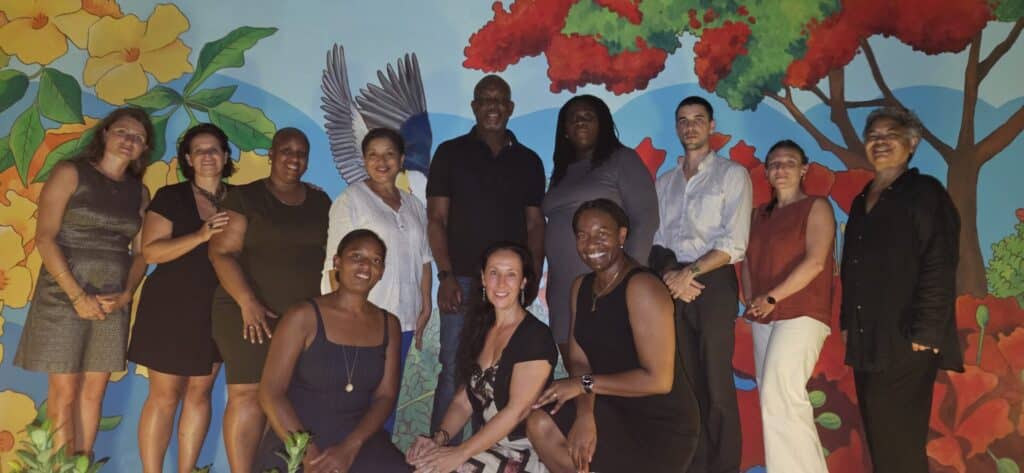
At the RÉZO seminar in Grenada, the directors and presidents of the Alliances Françaises of the English-speaking Caribbean met to strengthen cultural and linguistic cooperation in the region and define new common directions.
Supported by the French Embassy’s Service de Coopération et d’Action Culturelle (SCAC), which also took part in some of the discussions, the seminar was an opportunity to strengthen synergies between the Alliances Françaises network and consolidate dialogue with the SCAC, in a spirit of listening and collaboration.
Suelin Low Chew Tung (President, AF Grenada), Aurélie GBEFFA (Director, AF Saint Lucia and Regional Coordinator), Ilona Fort-Gilbert (Director, AF Grenada) and Christiane Bourgeois (CORCAC)
Between exchanges, common strategies and innovative projects, this meeting outlined the contours of a more open, inclusive and modern French-speaking and multilingual Caribbean.
A key moment for an evolving network, serving a Caribbean that learns, shares and shines.
A meeting with a family flavour
Sometimes they’ve known each other for years, sometimes only through a screen. But from the very first minutes, the laughter, hugs and warmth of the reunion remind us that, in the Caribbean, the Alliances Françaises network is above all a human adventure.
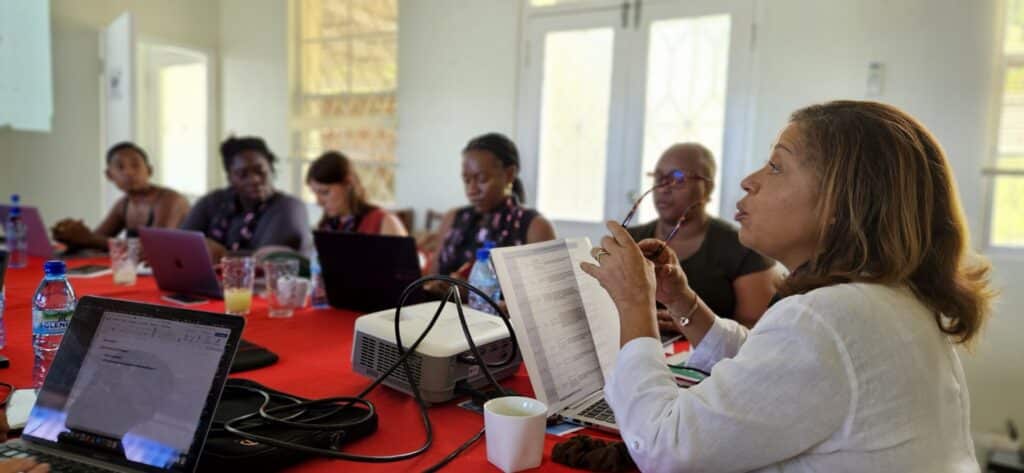
Over the course of three days, directors and presidents shared their experiences from country to country – from day-to-day challenges to local pride and a shared determination to build a stronger, more united and more visible network. In the room, diversity was evident in the accents, the backgrounds and the ideas. From Jamaica to Trinidad and Tobago, each voice brought its own nuance, its own experience, its own way of bringing culture and the French-speaking world to the heart of the territories.
Welcomed by Ilona Fort-Gilbert, Director, and Suelin Low Chew Tung, President of the Alliance Française of Grenada, participants spent several days exchanging ideas and reflections in an atmosphere that was both productive and warm.
Suelin Low Chew Tung (left) and Ilona Fort-Gilbert (right) (Alliance Française de Grenade)
AF Team of Grenada - Dalia Barbour (Support Staff), Mathias Dorel (Honorary Consul of France), Ilona Forte-Gilbert (Director), Nafessah Abdullateef (Secretary of the Executive Committee), Suelin Low Chew Tung (President)
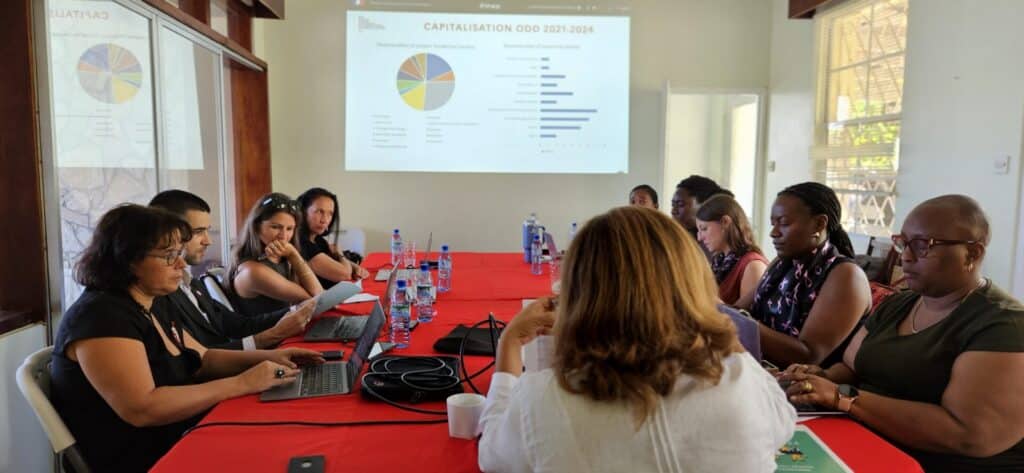
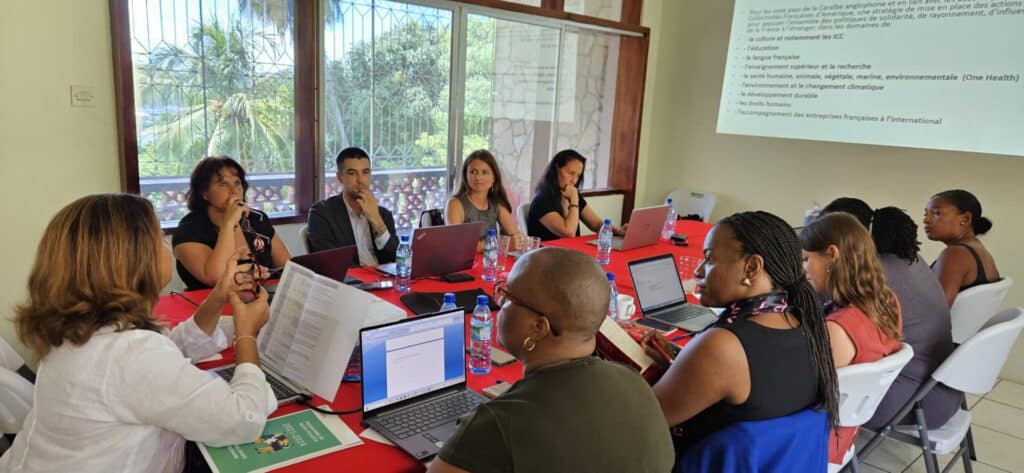
Around the table, the directors: Aurélie Gbeffa (Saint Lucia and regional coordinator of the Alliances Françaises of the Eastern Caribbean), Océane Gaillard (Barbados), Virginie Lemay (Suriname), Lucille Caulliez (Saint Christophe-et-Niévès), Cévinne M’Voula (Dominique), Anyka Batista (Trinidad and Tobago), Ilona Forte-Gilbert (Grenada),Déborah First-Quao (Guyana) and Clovis Lemée ( Jamaica), as well as Christiane Bourgeois (CORCAC – Saint Lucia) and Suelin Low Chew Tung (President – Grenada).
Joining them by videoconference were the presidents: Charlene White-Christian (Dominica), Ruben Del Prado (Suriname), Danielle Parkinson (Trinidad and Tobago), Kara Daly (Saint Kitts and Nevis), Delphine Hadley and her successor Denvil Douglas (Saint Vincent and the Grenadines), and Stuart Defreitas, vice-president (Guyana).
During the discussions, Christiane Bourgeois, Regional Counsellor for Cooperation and Cultural Action (Conseiller Régionale de Coopération et d’Action Culturelle – CORCAC), Head of the Cultural and Cooperation Department (Service de Coopération et d’Action Culturelle – SCAC) of the French Embassy to the Eastern Caribbean, Barbados and the OECS, underlined the essential role of the Alliances Françaises in promoting French and Caribbean culture.
The Regional Counsellor for Cooperation and Cultural Action – CORCAC structures its action around cultural, educational, scientific and economic cooperation, seeking to link French priorities – culture, the French-speaking world, sustainability and human rights – to the specific needs of the countries of the English-speaking Caribbean. We believe that it’s not just the structures, but also the committed men and women on the ground who bring this open, supportive and creative French-speaking community to life.
“The Alliances Françaises are essential partners.”
The presence of Jean-François Hans, Geographical Delegate for Zone C at the Fondation des Alliances Françaises, reminded us from Paris of the importance of the network’s global cohesion.
Charter of values, governance tools, visual identity and support for local teams: the Foundation ensures that quality and ethics are shared across all five continents.
“A large Alliance must always reach out to a smaller one. That’s our collective DNA.”
This solidarity, the driving force behind the movement, takes on its full meaning in the Caribbean, where logistical and human challenges combine with cultural and linguistic richness.
A global Francophonie rooted in local realities
Founded in 1883, the Alliances Françaises network is now the world’s largest cultural network, with over 820 establishments in 135 countries.
In the English-speaking Caribbean, ten Alliances promote the French language and culture: Barbados, Saint Lucia, Dominica, Grenada, Jamaica, Saint Kitts and Nevis, Guyana, Saint Vincent and the Grenadines, Trinidad and Tobago and Suriname.
In 2024, they welcomed over 1,000 learners, delivered 9,000 hours of courses and organized 160 cultural events, bringing together over 7,000 participants.
These figures reflect a living, dynamic reality: the Caribbean Francophonie is not just an idea, it’s a daily presence in classrooms, galleries, festivals and the streets of island capitals. Francophonie thrives on exchanges, local initiatives, and the passion of those who keep the French language alive.
A network in motion: between vision and action
Projet Rézo
Driven by a shared desire to see the network evolve, the RÉZO project is a real driving force for the Alliances Françaises of the English-speaking Caribbean, and a way of thinking about the network differently: more collaborative, more agile, more visible.
Supported by the French Embassy’s Service de Coopération et d’Action Culturelle (SCAC), it aims to strengthen regional coordination, pool tools and professionalize teams. Over the course of the sessions, discussions highlighted a shared ambition: to harmonize practices, encourage pedagogical innovation and strengthen skills, while consolidating the place of the French-speaking world in plural linguistic environments.
Under the coordination of Aurélie Gbeffa, six areas of work were addressed:
– Associative governance and transparency: strengthening internal management and communication with members.
– Team training: consolidating skills and promoting regional mobility.
– Certifications and educational quality: aligning training and evaluation standards across the network.
– Digital transition: developing collaborative tools and shared digital resources.
– Setting up RÉZO projects: creating and leading joint projects between Alliances.
– Revitalizing media libraries: modernizing cultural spaces to better reflect today’s audiences and practices.
Each Alliance leaves with a personalized roadmap, proof of a shared commitment and a strong regional dynamic.
Micro-projects
In the same vein, the SCAC has reiterated its key role in supporting and facilitating micro-projects. These subsidies, allocated each year to local project leaders, are a concrete lever for the implementation of cultural, educational and civic initiatives throughout the region.
A virtuous mechanism that supports local creativity, while promoting training and autonomy for local players. Beyond the financial aspect, this initiative, a signature of the French Ambassy of Saint Lucia, reflects a form of close, human-centered diplomacy that fosters exchange and cooperation between Francophone and Anglophone territories.
From Saint Lucia to Dominica, from Trinidad and Tobago to Grenada, the micro-projects supported reflect the diversity of shared challenges: culture, education, the environment, inclusion and innovation. These are just some of the areas in which the Alliances Françaises, supported by the SCAC, are building bridges between societies and driving sustainable cooperation in the Caribbean.
CARIFRAN
This strategy is also part of the regional dynamic of the CARIFRAN program, dedicated to the training and mobility of teachers of French in the Caribbean.
Implemented by the Organization of American States and funded by the French Embassy to the Eastern Caribbean, Barbados and the OECS to the tune of 453,000 euros, CARIFRAN is helping to strengthen a French-speaking educational community open to inter-island exchanges and linguistic cooperation. It embodies the complementary nature of the network’s educational, cultural and diplomatic activities.
The strength of a fragile network
Over and above the discussions, workshops and decisions, the RÉZO seminar confirmed the vitality of a network in the throes of transformation. But it also served as a reminder of the fragility of an associative model that relies on commitment, passion and solidarity more than on substantial resources.
In the English-speaking Caribbean, as elsewhere, the Alliances Françaises carry out their activities with modest means but remarkable efficiency, and with a real desire to move forward together, thanks to the strength of their teams, their volunteer presidents and the constant support of the SCAC and the Fondation des Alliances Françaises.
The directors of the Alliances Françaises with the Minister of Foreign Affairs, Hon. Joseph Andall
It’s this collective humanity, built on resilience and conviction, that makes the network unique: the ability to forge links, invent and reinvent ourselves, even in the face of uncertainty. And while cultural and linguistic cooperation can sometimes be a challenge, it is also a promise: that of a plural Caribbean, connected, proud of its diversity and capable of writing its future through dialogue between cultures.
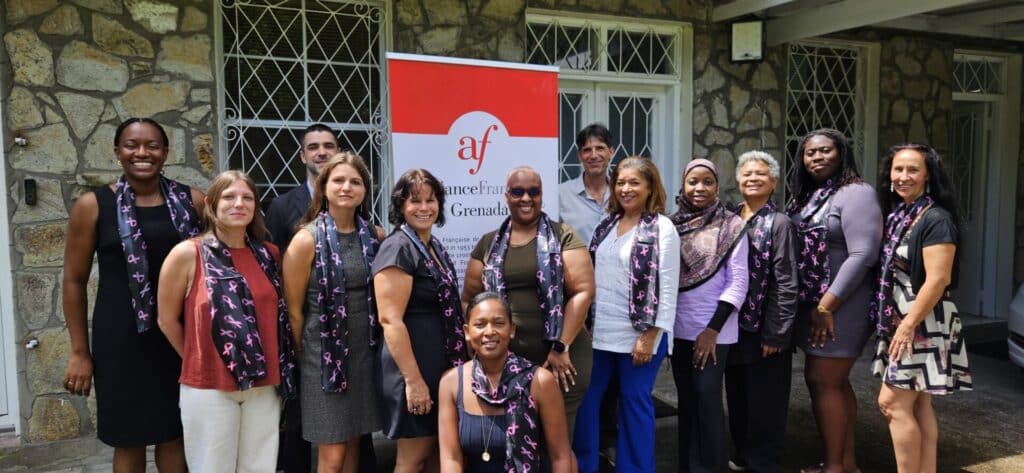
On behalf of the French Embassy, Christiane Bourgeois, advisor for cooperation and cultural action, presented the directors of the Alliances Françaises in the Caribbean with scarves, bracelets, and pins in the colors of Pink October, symbols of commitment and solidarity in the fight against breast cancer.
A strategic conference in Trinidad and Tobago
The press conference held in Trinidad and Tobago on October 6, 2025, as part of the ACI-LAC 2025 ANNUAL ASSEMBLY – CONFERENCE AND EXHIBITION, brought together the region’s leading airport industry executives. Around Mónica Infante (President of ACI-LAC and CEO of Aerodom), from the Dr. Rafael Echevarne (Managing Director, ACI-LAC) and Hayden Newton (Managing Director, Airports Authority of Trinidad and Tobago), discussions focused on traffic growth, sustainability and the investments needed to support the growth of air transport in the Caribbean and Latin America.
ACI-LAC which stands for Airports Council International – Latin America & Caribbean, is the regional branch of the worldwide airport organization. It represents the interests of 91 members operating over 360 airports in 42 countries and territories in the region.
ACI World confirms record figures
Data released during the ACI-LAC 2025 Annual Meeting show that passenger traffic in Latin America and the Caribbean will reach 789 million passengers by the end of 2025.
The best-performing countries will be :
– Colombia 105 million (+5.6%)
– Mexico 191 million (+4.5%)
– Brazil: 221 million (+2.1%)
The region (Latin America and the Caribbean) is expected to handle nearly 821 million passengers in 2026 according to official ACI World projections. These figures reflect the strength of the post-pandemic recovery and the Caribbean’s growing place in international connectivity.
Long-term forecasts and a global pace
Regional air traffic is expected to reach 1.725 billion passengers by 2053, with an average annual growth rate (CAGR – Compound Annual Growth Rate) of 2.9% over the next thirty years, a rate similar to the global average. The ACI World report also states that traffic will double between 2024 and 2047, from 758 million to 1.482 billion passengers. Annual growth projections by sub-region confirm :
– Mexico: +3.4%, driven by the expansion of its international hubs ;
– Brazil: +2.4%, sustained by growth in domestic traffic ;
– Caribbean: +2%, more moderate growth, due to the small size of island markets, their dependence on tourism and the current limitations of inter-island connectivity;
– Other Latin American countries (excluding Mexico and Brazil) : +3%, thanks to economic diversification and new regional air corridors.
Colossal investments for sustainable growth
Capital expenditure requirements (CAPEX) for the period 2026-2040 amount to US$82.6 billion, of which over US$30 billion will be devoted to the construction of new greenfield airports. According to data from the ACI-LAC 2025 Annual Meeting, every million additional passengers generates 9,500 jobs and $25 million in GDP, demonstrating the direct economic impact of air transport on the region.
Carbon neutrality and accessibility: regional leadership
On the environmental front, speakers highlighted the results of the Airport Carbon Accreditation (ACA) program at the ACI-LAC 2025 ANNUAL ASSEMBLY. By September 2025, 621 airports worldwide were certified, including 104 in Latin America and the Caribbean. The region thus ranks second in the world for the number of airports committed to this approach. This internationally recognized program assesses and rewards airports’ efforts to reduce their carbon emissions, in line with ACI World’s Net Zero 2050 objective.
The other indicator of progress concerns Accessibility Enhancement Accreditation (AEA): of the 47 airports certified worldwide, 17 are in the LAC region. This distinction confirms the role of the Caribbean and Latin America as world leaders in air accessibility for passengers with disabilities.
Connectivity and liberalization: the pillars of the future
Looking beyond the figures, Mónica Infante and Rafael Echevarne stressed the urgent need to strengthen intra-Caribbean connectivity. For Mónica Infante, the priority is to break down regulatory barriers and create a framework enabling new regional airlines to operate freely. For his part, Rafael Echevarne reiterated that air transport liberalization is essential to boost competition and reduce costs for passengers.
“Aviation is not just an economic sector, it’s a vital infrastructure for the integration and sustainable development of our territories,” he declared.
Finally, Hayden Newton underlined the Airports Authority of Trinidad and Tobago’s commitment to modernizing infrastructure through biometrics, automated systems and digital innovations.
The ACI-LAC 2025 ANNUAL ASSEMBLY confirmed the dynamic growth, innovation and sustainability of the airport sector in Latin America and the Caribbean. With solid forecasts, massive investment and a vision focused on carbon neutrality, the region is establishing itself as a model of resilience and transformation in global air transport.
From August 1 to 31, Trinidad and Tobago will be vibrating to the rhythm of Steelpan Month 2025, a national celebration dedicated to one of the island’s most powerful cultural symbols: the steelpan. Much more than just a music festival, this Pan Trinbago event promises to be a moment of transmission, pride and innovation for an entire nation.
Born of resistance
The history of the steelpan is inextricably linked with the struggle against oppression. As early as the 17th century, enslaved Africans in Trinidad and Tobago had turned percussion into a means of expression and community cohesion. But in 1881, British colonial authorities banned drumming, fearing its insurrectionary potential.
Deprived of this outlet, marginalized populations invented the tamboo bamboo, using bamboo tubes to create powerful rhythms. This practice was also banned in the 1930s, prompting young people to experiment with the materials at hand. Thus was born the steelpan: hammered oil cans recycled as melodic instruments. Winston “Spree” Simon was one of the pioneers who foresaw the musical potential of these metal containers.
Even today, the manufacture of a steelpan relies on a meticulous chain of operations. It all begins with sinking, which involves hammering the bottom of the can into a concave surface. This is followed by the tracing of the notes, their acoustic separation by grooving, heat treatment, and then tuning, carried out by highly skilled tuners. Each instrument thus becomes a functional work of art.
The steelpan family has expanded over the decades: tenor pan, double second, guitar pan, six bass… So many complementary voices that make up orchestral ensembles capable of performing everything from calypso to classical symphonies. Steelpan Month 2025 will be an opportunity to discover all the richness of these instruments.
Founded in 1969 and legalized by an Act of Parliament in 1986, Pan Trinbago leads the development of the steelpan movement. Once again this year, the organization is coordinating Steelpan Month 2025, with a dense and strategic program that culminates on August 11, World Steelpan Day, now recognized by the United Nations.
In addition to concerts in the traditional panyards, Steelpan Month 2025 will feature workshops in schools, interactive exhibitions and round-table discussions on the future of the instrument. The aim is to bring together generations, disciplines and regions around a living heritage.
Far from being limited to the cultural sphere, steelpan represents a genuine economic sector. In 2017, the industry generated TT$23.5 million, including more than $16 million from exports. To support manufacturers and craftsmen, the government of Trinidad and Tobago has set up a TT$5 million assistance fund. These measures will be reinforced at Steelpan Month 2025, where several local value-adding schemes will be highlighted.
This momentum was amplified in August 2024, with the award of the geographical indication (GI) “Steelpan de Trinidad et Tobago”. This official recognition, similar to that for champagne or Roquefort cheese, guarantees the authenticity of locally-made instruments and protects craftsmen against counterfeiting.
Steelpan, cultural ambassador and tourism driver
As part of Steelpan Month 2025, the government is also aiming to promote the instrument as a tourist attraction. Immersive tours are offered to visitors, including visits to panyards, live manufacturing demonstrations and initiations to the game. This cultural tourism generates economic spin-offs while fostering a deeper understanding of the Trinidadian identity.
At local level, steelbands play a structuring role in communities, particularly among young people. They provide a positive framework for discipline and creativity in neighborhoods that are often under threat. It is this social dimension of steelpan that Pan Trinbago intends to reinforce through the many actions of Steelpan Month 2025.
A meaningful instrument
The steelpan, the only acoustic instrument invented in the 20th century, is much more than a Caribbean invention: it embodies the history of a people who have managed to transform censorship into creation, recuperation into innovation, marginalization into national pride.
With Steelpan Month 2025, Trinidad and Tobago is celebrating more than just a musical tradition. The country is asserting its identity, sharing its heritage with the world, and preparing future generations to keep this extraordinary invention alive, evolving and shining.
The Trinidad and Tobago Film Festival returns in 2025, generating unprecedented excitement among Caribbean filmmakers and film lovers. Recognized as one of the most influential platforms for regional cinema, the festival attracts talent from across the Caribbean every year, providing a unique stage for the region’s cultural and linguistic diversity.
Genesis and Mission of the Trinidad and Tobago Film Festival
Origins and developments since 2005
Founded in 2005 by film historian and producer Dr. Bruce Paddington, the Trinidad and Tobago Film Festival is dedicated to promoting Caribbean cinema and highlighting local voices and stories. For nearly two decades, it has helped many filmmakers from Trinidad and Tobago, Jamaica, Haiti, the Bahamas and other countries in the region gain international recognition.
Notable figures to have passed through the festival include Storm Saulter and Gabrielle Blackwood (Jamaica), Kareem Mortimer and Maria Govan (Bahamas), Bruno Mourral (Haiti), Vashti Anderson, Ian Harnarine and Damian Marcano (Trinidad & Tobago).
A springboard for Caribbean filmmakers
The Trinidad and Tobago Film Festival has played a key role in the development of Caribbean cinema. It has enabled emerging talents to make a name for themselves, and original works to be screened before a wider audience. Thanks to this platform, the Caribbean is now a rich and varied space for cinematographic creation, where each country brings its own unique sensibility and stories to the table.
Trinidad and Tobago Film Festival
A new direction and a stronger identity
Mariel Brown: a director leading the revival
The new director of the Trinidad and Tobago Film Festival, Mariel Brown, herself an award-winning director, is breathing new energy into the event. Her objective is clear: to reinforce the festival’s Caribbean identity and offer greater visibility to works from the entire region. She underlines the palpable enthusiasm surrounding the festival’s return, on the part of filmmakers, audiences and partners alike.
“There’s a real excitement around the festival this year,” confides Mariel Brown. “Supporters are pouring in, and submissions are up 40% from the last edition in 2023. We’re on track to reach more than 340 submissions, proof that Caribbean storytelling is experiencing a remarkable boom.”
Mariel Brown
A programming team focused on regional diversity
Under the management of SAVANT Ltd, the Trinidad and Tobago Film Festival is committed to representing the entire Caribbean, showcasing films from English, Spanish, Dutch and French-speaking territories. This openness reflects the cultural richness of the region, and gives often little-known works access to an international audience.
The importance of Caribbean representation on screen
Highlighting local voices
For Mariel Brown and her team, it’s essential that Caribbean audiences can recognize themselves on screen. Too often, audiences in the region consume foreign productions without seeing their own realities, languages, music or lifestyles. The Trinidad and Tobago Film Festival is committed to changing this by promoting authentic stories told by and for Caribbean people.
“There’s something profoundly powerful about seeing and hearing ourselves on screen, in our own language, with our own music, our own culture,” Brown explains. “That’s what the Trinidad and Tobago Film Festival has always stood for: telling our stories to our community, for our community.”
Impact on audiences and creators
The visibility offered by the Trinidad and Tobago Film Festival not only boosts the self-esteem of Caribbean audiences, but also encourages local creation. Young filmmakers find the festival a source of inspiration and an opportunity to break into the film industry, knowing that their stories can reach a wide audience.
Trinidad and Tobago Film Festival 2025: figures, dates and news
An edition marked by an increase in submissions
For this 19th edition, the Trinidad and Tobago Film Festival records a remarkable rise in submissions, with a 40% increase over the last edition. Over 340 films are expected to be screened, testifying to the vitality of Caribbean cinema and the growing interest in this unique platform.
Festival highlights in Port of Spain
The festival will be held from September 24 to 30, 2025 in the lively Woodbrook district of Port of Spain, the capital of Trinidad and Tobago. The program includes the screening of 80 films, each of which will be shown at least twice to enable the greatest possible number of spectators to discover them, and to offer maximum visibility to the filmmakers. This organization encourages exchange between the public and the creators, while contributing to the recognition of the works presented.
A prestigious advisory board
This year’s Trinidad and Tobago Film Festival is supported by an advisory board made up of well-known figures from the world of film, design and the cultural industry. Among them:
Melanie Archer, designer and curator (Trinidad and Tobago)
Leslie Fields-Cruz, Executive Director, Black Public Media (United States)
Kareem J. Mortimer, executive producer and director (Bahamas/United States)
Renee Robinson, film industry expert (Jamaica)
Donna N. Thomas, business consultant (Trinidad and Tobago)
Their expertise helps steer the festival towards new horizons, while consolidating its links with the region’s cultural institutions and associations.
Filmmakers wishing to present their work at the Trinidad and Tobago Film Festival can submit their film via the FilmFreeway platform until May 12, 2025. This process is open to all Caribbean filmmakers, whatever their experience, provided their film highlights a strong regional identity.
The Trinidad and Tobago Film Festival provides a unique stage for the region’s creativity and diversity. With renewed leadership, bold programming and a strong commitment to local representation, it helps bring the voices and talents of the Caribbean to the international stage. Whether you’re an experienced filmmaker or a film enthusiast, the Trinidad and Tobago Film Festival invites you to celebrate the richness and plurality of the Caribbean seventh art.
The MAGHIC 2 project, launched in March in Pointe-à-Pitre with the support of the INTERREG Caribbean program, marks a decisive step in the development of a low-carbon maritime sector adapted to the realities of the Caribbean.
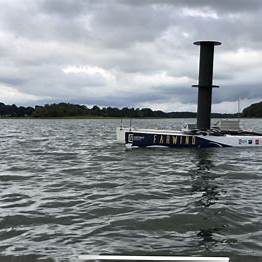
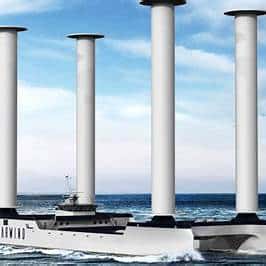
At a time when climate issues are calling for far-reaching changes, the Caribbean is asserting its determination to become a pilot region for sustainable maritime transport. It is against this backdrop that FARWIND Energy, a start-up committed to decarbonizing maritime transport, is coordinating the MAGHIC 2 project, with the aim of structuring a genuine industrial and scientific sector around vele propulsion and hydrogen in the region.
Financed with €2.2 million in ERDF funds via INTERREG Caribbean, MAGHIC 2 embodies an alliance between technological innovation, academic research and regional ambition.
Innovative marine propulsion tested under real-life conditions
At the heart of the MAGHIC 2 project, the rotor sail developed by FARWIND Energy promises a significant reduction in CO₂ emissions, up to 40% less fuel for ships. This technology, proven in severe maritime environments, opens up concrete prospects for more responsible shipping, in line with European climate objectives and those of the IMO.
But MAGHIC 2 goes further: the project also explores innovative hydrogen storage solutions, both on land and at sea, capable of holding between 10 and 100 tonnes, with reduced land impact. A response to the logistical and energy challenges specific to island geography.
A Caribbean research and industry network to support the transition
One of the project’s strengths lies in its ability to create a regional dynamic around skills and knowledge. FARWIND Energy brings together a network of leading academic institutions:
Caribbean Maritime University (Jamaica)
University of Trinidad and Tobago
Centro Nacional de Investigaciones Cientificas (Cuba)
Universidad Autonoma de Campeche (Mexico)
These establishments will focus their work on the service life of materials and the adaptation of solutions to the specific climatic and maritime conditions of the Caribbean.
On the industrial side, SARA (Société Anonyme de la Raffinerie des Antilles) is joining the project to promote technology transfer and strengthen local skills. The ambition is clear: to structure asustainableregional ecosystem around low-carbon marine propulsion and the hydrogen industry.
A strategic vision for Caribbean energy sovereignty
By consolidating a base of regional skills and leveraging appropriate technologies, MAGHIC 2 sets the Caribbean on the path to an ambitious and coherent maritime energy transition. The project is helping to build energy sovereignty to enhance the competitiveness and resilience of Caribbean territories.
“This project illustrates an integrated approach combining innovation, industrialization and scientific cooperation, and represents a major step forward for more sustainable shipping,” says Arnaud Poitou, President of FARWIND Energy.
Launched in Guadeloupe, MAGHIC 2 is helping a smarter, bolder Caribbean emerge, capable of inventing its own answers to global energy challenges while making the most of its natural resources, know-how and strategic position.
The exhibition Paris Noir will be a major cultural event in 2025. From March 19 to June 30, the Pompidou center is highlighting an often overlooked dimension of artistic history: the influence of Afro-descendant artists in Paris between 1950 and 2000. Nearly 400 works and documents showcase the work of 150 artists from Africa, the Americas and the Caribbean, some of whom have never before been exhibited in France. This retrospective highlights the role of the French capital as a place of resistance and transformation for contemporary artistic currents.
A historiographical challenge met
The exhibition Paris Noir undertakes the task of documenting and presenting an often marginalized artistic history. From the creation of the magazine Présence Africaine in 1947 to the distribution of Revue Noire in the 1990s, it traces half a century of expression and affirmation in Paris. In the face of scattered works and gaps in research, this initiative is an essential memorial contribution.
This chronological journey coincides with major historical events: African independence, the fall of apartheid in South Africa and the struggle for civil rights. The Paris Noir exhibition links these political contexts with artistic creation, highlighting the role of art as an instrument of resistance and identity affirmation.
Paris, refuge and creative crossroads
For artists such as Gerard Sekoto, whose self-portrait marks the entrance to the exhibition, or Beauford Delaney and his abstract compositions, Paris was a refuge from segregation, apartheid and political censorship. The city became a unique space for artistic and intellectual interaction, fostering encounters between creators from different horizons.
The diversity of practices, ranging from identity awareness to the search for new plastic expressions, bears witness to this dynamic. Paris Noir highlights how these artists have enriched artistic currents and opened up new aesthetic perspectives.
Estate of Beauford Delaney, by permission of Derek L. Spratley, Esquire, Court Appointed Administrator, Courtesy of Michael Rosenfeld Gallery LLC, New York
From anti-colonialism to artistic affirmation
The title Paris Noir reveals a central political dimension. The exhibition places the works in the context of anti-colonial and post-colonial struggles. From the magazine African presence to the Revue Noires show how these publications contributed to the recognition of Afro-descendant artists.
The archives, photographs and films on display illustrate how art has served as a means of expression in societies marked by colonial legacies.
Exceptional creative diversity
The exhibition highlights emblematic figures such as Wifredo Lam and Roseman Robinot, as well as lesser-known artists such as Christian Lattier and Guido Llinas. It reveals paths and influences that are still little explored in France.
The majority of the works on display have never before been shown in the country. Drawn from public and private collections, they have been brought together thanks to in-depth research. Paris Noir offers a fresh look at the contributions of Afro-descendant artists to modern art.
The exhibition revolves around a central installation representing the Black Atlantic, evoking transatlantic cultural circulations and interactions. This space puts into perspective how Paris became a place of convergence for these artists.
Contemporary installations by Valérie John, Nathalie Leroy Fiévee, Jay Ramier and Shuck One enrich the itinerary and resonate with the themes addressed.
A Parisian base
The exhibition unfolds a never-before-seen cartography of Paris, highlighting the places that saw the birth of this artistic effervescence. Montparnasse, Saint-Germain-des-Prés and the Goutte d’Or emerge as spaces of creation and interaction.
A historical and cultural impact
Paris Noir highlights the French capital’s role as a pan-African laboratory for artistic expression. Institutions such as the École des Beaux-Arts contributed to the recognition of African, American and Caribbean artists, who participated in the redefinition of modernism and postmodernism.
The exhibition focuses on art as a form of resistance to postcolonial realities. It features committed works that bear witness to the struggle for independence and against racial discrimination.
A Paris-wide event
A number of Parisian galleries will be presenting exhibitions in connection with Paris Noir. Among them, Galerie Clémentine de la Féronnière will present works by George Hallett, William Melvin Kelley and James Barnor from March 19 to May 17, 2025. Galerie Hauser & Wirth will be showing collages by Frank Bowling until May 25.
L’Archipel cinema, the Maison Européenne de la Photographie and other institutions will be organizing film screenings and meetings with art historians and critics.
Practical information
The exhibition Paris Noir will be held at the Pompidou center from March 19 to June 30, 2025, from 11am to 9pm, except Tuesdays and May 1st. Tickets are available online or on site, with reduced rates for certain audiences. Guided tours and audio guides are also available.
The orange economy, based on creativity, innovation and cultural knowledge, has become a strategic development lever in the Caribbean.
But what does this mean in practical terms for our regions?
In a region rich in living heritage, artistic expression and community dynamics, it paves the way for new sustainable economic models, driven by local talent.
One of the most promising developments is creative tourism – or orange tourism – which combines cultural immersion, know-how enhancement and active visitor participation. At a time when travelers’ expectations are changing, this type of tourism offers a more authentic and inclusive alternative, in phase with the ecological, social and digital transitions underway.
From mass tourism to sustainable and creative travel
The evolution of tourism is closely linked to global economic transformations and technological advances. Since the 1950s, the expansion of the middle class and rising disposable incomes have led to an explosion in international travel – from 25 million tourists in the 1950s to 1.5 billion in 2019. But this growth has revealed a fragility: tourism is extremely sensitive to economic crises. In 2008, for example, the first budget cuts made by households concerned vacations.
This model of mass tourism has gradually given way to alternative, more responsible and sustainable forms, driven by a new type of traveler: the conscious tourist. These travelers are looking for more than just entertainment: they aspire to authentic experiences, cultural immersion and respect for the environment. It’s in this context that ecotourism, rural tourism, community tourism and educational and religious travel have emerged.
Sustainable tourism is based on a hybrid approach, combining government initiatives (top-down) and the participation of local communities (bottom-up). It recognizes that to be viable, tourism must respect the environment, value cultures, be economically profitable and socially just – including gender equality and the preservation of traditional knowledge.
The emergence of the orange economy and creative tourism
The term “orange economy” was popularized in 2011 by British writer John Hawkins. Also known as the creative or cultural economy, it encompasses economic activities based on creativity and intellectual property: arts, music, film, design, technology, advertising, etc. According to UNESCO, this economy represents 3% of global GDP and more than 30 million jobs worldwide.
Orange tourism lies at the crossroads of this creative economy and the tourism sector. Unlike traditional tourism, it doesn’t just consume culture: it invites you to immerse yourself in it. This involves staying in local communities, taking part in craft workshops, traditional music classes, cooking lessons or sailing initiations. It’s not just about seeing, it’s about doing with the locals, interacting and sharing. This type of tourism fosters commitment, frequent returns, and sometimes even forms of personal investment in the communities visited.
Orange tourism also paves the way for indirect job creation through digital technologies – app development, activity booking platforms, or tools facilitating administrative procedures, logistics and hospitality. The aim: to turn creative ideas into economic opportunities through cultural and digital innovation.
What could orange tourism look like in the Caribbean?
Orange tourism in the Caribbean could take a variety of forms, rooted in the cultural realities, local know-how and creative aspirations of the territories. Several concrete avenues can be explored to structure this offer:
– Agricultural tourism, for example, would enable visitors to take part in immersive experiences on local farms, such as permaculture or hydroponics, learning about Caribbean farming techniques and taking part in the harvest. – Traditional nautical activities, such as sailing lessons or artisanal navigation, could combine the transmission of knowledge, adventure and the enhancement of maritime heritage. – Music workshops would offer visitors the opportunity to learn how to make and play traditional instruments (drums, cordophones, percussion), while discovering the cultural roots of local music. – Craftwork, with sessions to create dolls, jewelry, pottery or textiles inspired by local traditions, would reinforce the link between creativity, collective memory and the solidarity economy. – Gastronomy, for its part, is a powerful gateway to exploring the Caribbean identity: cooking workshops focusing on local products and ancestral recipes could enhance the destination’s appeal, while promoting short distribution channels.
Added to these experiences are the opportunities offered by digital technology. Whether facilitating access to information, enhancing the value of cultural offerings or streamlining the traveler experience, digital tools are playing a growing role in the transformation of Caribbean tourism. The development of local initiatives in this direction could enhance the attractiveness of these territories while supporting creative ecosystems.
Finally, structuring initiatives such as the creation of living museums or immersive heritage trails could enable key moments in Caribbean culture – carnivals, festivals, emblematic competitions – to be relived through physical or virtual installations, combining memory, transmission and innovation.
An opportunity for Caribbean territories
Today, orange tourism represents a way forward for Caribbean territories. At the crossroads of culture, creativity and innovation, it transforms intangible resources – knowledge, stories, local practices – into meaningful experiences for visitors, and sustainable economic opportunities for communities.
Anchored in the orange economy, this tourism model opens up new horizons: it enhances cultural identities, stimulates job creation in sectors that cannot be relocated, and strengthens the resilience of territories in the face of global crises. But it needs to be supported by appropriate public policies, suitable infrastructures and active support for cultural and creative projects.
By focusing on orange tourism, the Caribbean doesn’t just welcome the world: it invites it to enter into a dialogue with its territories, peoples and imaginations.