
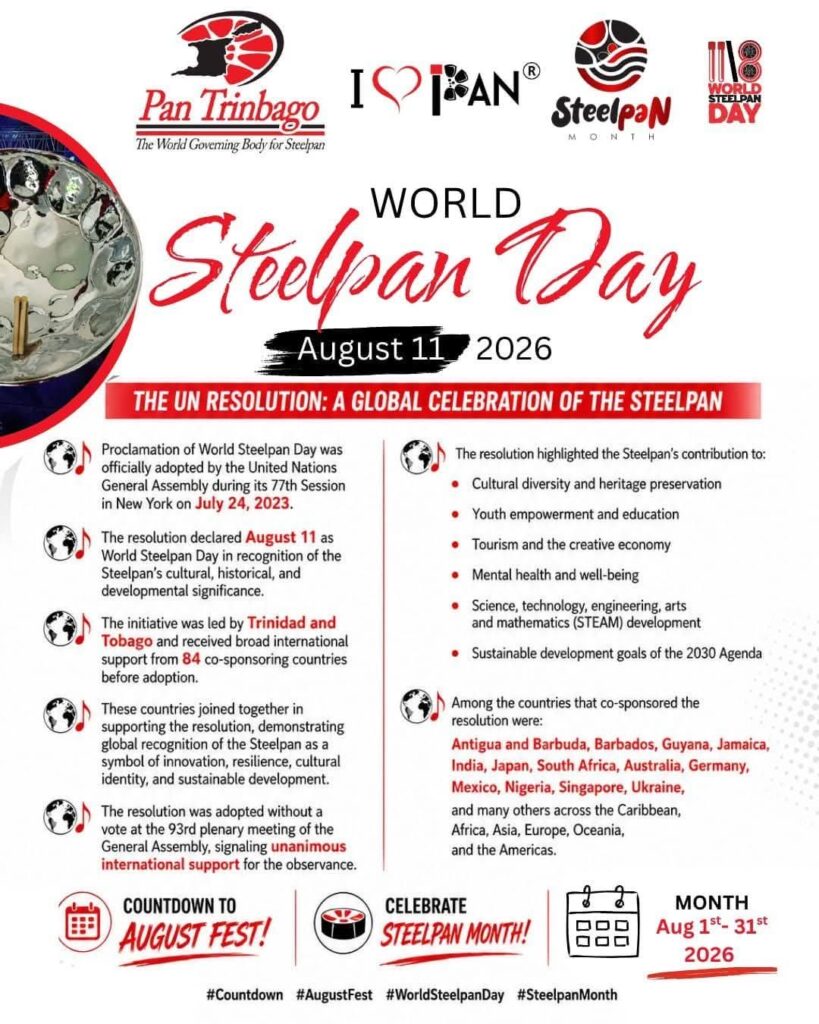
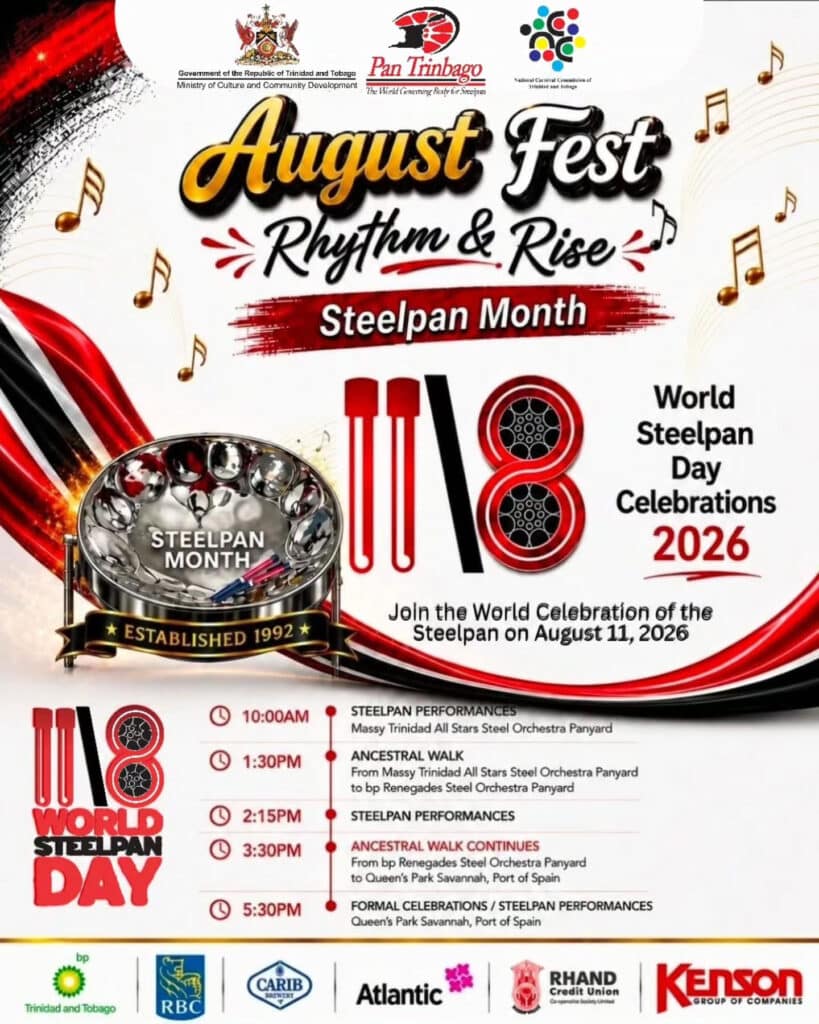
This Tuesday, August 11, Trinidad and Tobago celebrates World Steelpan Day with a program built around a powerful idea: connecting those who shaped the movement with the generation that must now carry it forward. In Port of Spain, performances by youth orchestras, the Ancestral Walk, and a closing concert come together to create a day where memory does not stand still. It flows, is played out, and is passed on.
In Port of Spain, a day designed to symbolize a passing of the torch
Pan Trinbago has chosen “Rhythm and Rise: Youth. Discipline. Culture. Community.” as the theme for the 2026 edition. This choice is no coincidence. For this World Steelpan Day, the organization is clearly placing youth at the center of the program, while paying tribute to the movement’s pioneers. The celebration begins at the Massy Trinidad All Stars Steel Orchestra’s panyard, featuring youth ensembles from various regions of the country.
This approach immediately gives the event a different meaning. It is not just about celebrating an instrument that has become one of Trinidad and Tobago’s most recognizable cultural symbols. It is also about showing how a legacy continues to live on when it is entrusted to new hands.
The Ancestral Walk: At the Heart of the Tradition
At 1:30 p.m., the Ancestral Walk winds through the streets of Port of Spain in tribute to the pioneers of the steelpan movement. The walk then proceeds to the bp Renegades Steel Orchestra’s panyard, where a new showcase dedicated to young pannists is announced. This is likely the most powerful gesture of this World Steelpan Day. The elders are not honored in a segment separate from the rest of the program. Their legacy is directly linked to those who play today. The march thus becomes a symbolic bridge between generations: recognizing those who paved the way, then giving a voice to those who will continue along that path.
Youth in the Spotlight
The rest of the day follows this same theme. At 5:30 p.m., Queen’s Park Savannah will host a concert featuring several youth steel orchestras from across the country. Pan Trinbago is presenting this event as a tribute to the past, present, and future of the steelpan.
On World Steelpan Day, young people are not relegated to the sidelines of an official ceremony. They take center stage at the performances, the panyards, and the closing event. The message goes beyond the musical performance. It serves as a reminder that passing on a culture also depends on spaces where young people can learn, rehearse, play together, and find their place in a community.

Global recognition, rooted in Trinidad and Tobago
Since 2023, August 11 has been recognized by the United Nations General Assembly as World Steelpan Day. The resolution highlights, in particular, the cultural and historical significance of the instrument, which originated in Trinidad and Tobago, as well as its potential contribution to sustainable development, inclusive communities, and youth empowerment. This recognition gives the steelpan international visibility. But the celebration held in Port of Spain reminds us of something essential: global recognition is no substitute for local roots. The steelpan continues to be passed down through steelbands, panyards, families, and communities that keep this tradition alive on a daily basis.
In 2026, the World Steelpan Day thus demonstrates that international recognition truly comes into its own when it flows back to the region, its communities, its traditions, and those who carry them forward.

Bringing Heritage to Life, Beyond Celebration
World Steelpan Day can thus be seen as more than just a commemorative date. In Port of Spain, it takes the form of a dialogue between memory and the future. The pioneers are honored, young people take the stage, and the audience joins in.
The real challenge, however, begins after the concerts. A global day of celebration may honor a cultural heritage, but it does not guarantee its transmission. That depends on the musicians, educators, steelbands, and venues that enable new generations to practice. So on this August 11, Trinidad and Tobago reminds us of a simple truth: for the steelpan to continue to resonate tomorrow, we must make room today for those who will write its next chapter.
World Steelpan Day is celebrated every August 11. Recognized by the United Nations General Assembly since 2023, it highlights the cultural and historical significance of the steelpan, an instrument native to Trinidad and Tobago.
In 2026, the celebrations in Port of Spain will focus on intergenerational transmission. The program includes performances by youth steel orchestras, an Ancestral Walk honoring the pioneers, and a concert at Queen’s Park Savannah.
The 2026 theme, “Rhythm and Rise: Youth. Discipline. Culture. Community.”, puts youth at the center. The goal is to show that the steelpan tradition is passed on through the new generations who are learning, practicing, and evolving this cultural heritage.
When Nailah Blackman takes the stage at NAPA on September 19, 2026, her role will go beyond that of a host. The Trinidadian singer will accompany the symbolic return of a ceremony that originated in New York to the region whose voices she celebrates. For the first time, the Caribbean Music Awards will be held in the Caribbean.
After three editions at the Kings Theatre in Brooklyn, the event has chosen Port of Spain to begin a new chapter. The fourth Caribbean Music Awards ceremony will be held at the National Academy for the Performing Arts, in the heart of Trinidad and Tobago’s capital. It will be the highlight of a program taking place September 18–20 under the theme “Sounds of the Caribbean.”
From Brooklyn to Port of Spain
This move is not just a simple change of venue. Brooklyn allowed the event to take shape in close contact with one of the most influential Caribbean diasporas. Artists, professionals, and audiences from various regions have found a shared platform there. By leaving New York this year, the organizers are not turning their backs on this history. They are seeking to build on these early foundations.
The arrival of the Caribbean Music Awards in Trinidad and Tobago brings the celebration closer to the cultures that inspire it. The choice of Port of Spain makes particular sense. UNESCO describes the city as the birthplace of the steelpan, calypso, and Carnival. Soca and chutney are also integral to its musical identity. Hosting a regional awards ceremony in this capital city thus serves to connect contemporary recognition, popular memory, and vibrant artistic creation.


Three days to extend the ceremony
The 2026 edition will be more than just an awards show. The Caribbean Music Awards Elite Weekend Experience is set to bring together artists, fans, the media, creators, and industry professionals over the course of three days. A welcome reception, pre-ceremony activities, an official after-party, and a steelpan concert presented by Stars and Steel are among the events announced. The guest artists and the full program will be revealed at a later date.
This format transforms the Caribbean Music Awards into a true cultural event. It creates spaces for people to come together not only around music, but also around those who produce, distribute, and tell its stories. This ambition can strengthen the ties between local music scenes, the creative industries, and the diaspora—provided that artists from different regions are truly given a platform.

Nailah Blackman, the face of this comeback
Nailah Blackman ’s presence as co-host gives this transition a human touch. She has previously experienced the ceremony as a spectator, an interpreter, a nominee, and a winner. Hosting it now in her home country, alongside Majah Hype, connects her personal journey to the event’s evolution. Majah Hype, for his part, will serve in this role for the fourth consecutive year.
The organizers are also considering rotating future editions among several Caribbean destinations. This prospect could support cultural tourism and the creative economy, but it will need to be monitored beyond mere announcements. Will the rotation benefit local artists, technicians, the media, and host communities?

For Trinidad and Tobago, the challenge will also be to demonstrate that hosting a major music event can leave a lasting impact. An inclusive lineup, local collaborations, and balanced regional coverage will help determine whether this ambition truly extends beyond the prestige of a single televised Caribbean event.
The inaugural Caribbean Music Awards in Trinidad and Tobago thus opens up a broader possibility: that of a Caribbean capable of producing, hosting, and telling the story of its own major musical celebrations. Following Brooklyn, Port of Spain is becoming a testing ground. It remains to be seen whether this inaugural regional event will mark the beginning of a sustainable, traveling festival.
The 2026 Caribbean Music Awards will be held at the National Academy for the Performing Arts in Port of Spain, Trinidad and Tobago.
The main ceremony will take place on September 19, 2026. It will be part of a cultural weekend scheduled for September 18–20, 2026.
It will be the first edition held in the Caribbean, following three ceremonies hosted in Brooklyn, New York.
On September 19, 2026, Nailah Blackman will take center stage at the National Academy for the Performing Arts in Port of Spain. Alongside comedian Majah Hype, she will co-host the fourth annual Caribbean Music Awards. After three ceremonies held in Brooklyn, the event will take place in the Caribbean for the first time. For the Trinidadian artist, this evening encapsulates nearly her entire journey: carrying forward a musical legacy, sharing it with the world, and opening up new horizons for it.
A ceremony that brings Caribbean music back home
The selection of Nailah Blackman as co-host holds special significance. The Caribbean Music Awards will be the centerpiece of a weekend of events taking place September 18–20, featuring a reception, the awards ceremony, an official gala, and a concert dedicated to the steelpan. By hosting this year’s event in Trinidad and Tobago, the organizers are bringing soca, calypso, and other regional musical genres closer to one of their historic birthplaces.
This responsibility, therefore, goes beyond the role of emcee. It entrusts a young local artist with the mission of embodying a Caribbean music scene that is confident in its roots yet mindful of its international reach. Nailah Blackman comes to this event with a family history that could easily become overwhelming. Instead, she has made it a starting point.
Nailah Blackman, an heiress who chooses her own path
His grandfather, Garfield Blackman—known as Lord Shorty and later Ras Shorty I—is widely recognized as the father of soca. In the 1970s, he worked to blend calypso with rhythms and instruments drawn from Trinidad’s Indian heritage. He even spelled it “sokah” to emphasize this cultural and spiritual intent. His daughter Abbi Blackman, Nailah’s mother, has also built a career in calypso.
Growing up in a family like that means being surrounded by songs, stories, and a sense of responsibility. Yet Nailah Blackman has never been content to simply replicate a sound from the past. Her official website highlights her interest in hip-hop and acoustic styles, while her productions regularly blend soca, dancehall, pop, R&B, and African influences. Her heritage remains evident, but it’s never presented as a constraint.


"Workout," the journey to another dimension
Her profile really took off with “Workout,” recorded with Kes for the 2017 carnival season. The song reached the finals of the International Soca Monarch and gave the singer a whole new level of exposure. She was only 19 at the time, but already had several years of experience performing, writing, and appearing on stage.
Above all, this success highlights her ability to hold her own in a highly codified musical world. Her voice retains an almost intimate softness, even when the production urges the crowd to dance. This tension has become one of her hallmarks. Nailah Blackman can tap into the energy of Carnival without overshadowing the singer and songwriter behind the performance.
She then went on to collaborate with a wide range of artists, notably from Jamaica, Nigeria, and other Caribbean scenes. This trend is not the result of a contrived quest for crossover. Rather, it reflects a contemporary understanding of the Caribbean: islands that are interconnected but also look toward Africa, North America, and Europe.
Spreading the word about soca without distorting its essence
The 2025 announcement of the album *Born a Diamond* confirmed this desire to expand her musical vocabulary with touches of R&B and Afrobeats. The collaboration “Miss Continental” with Nigerian DJ Obi also illustrates this dialogue. Nailah Blackman sees it as a reconnection with shared African roots, made more direct by today’s digital and artistic exchanges.
This openness does not distance him from Trinidad and Tobago. On the contrary, it allows him to present soca as a genre of music capable of engaging with other cultures without losing its distinct character. In August 2026, the artist is scheduled to perform in Belgium at the Antilliaanse Feesten, followed by a performance in Sweden. These European performances are an extension of a project he began several years ago: to take soca beyond the confines of the carnival season and give it a broader reach.


A transmission that's still in motion
Nailah Blackman’s journey ultimately raises a fundamental question: How can one honor a tradition without freezing it in time? Her answer lies in fusion, performance, and a conscious commitment to her family’s history. She does not seek to shed the Blackman name; rather, she takes it in a new direction. In September, when she welcomes artists from across the region to Port of Spain, Nailah Blackman will represent a generation that understands the origins of its rhythms yet refuses to look solely to the past. The soca she has inherited continues to evolve. Perhaps that is the best way to keep it alive.
Nailah Blackman is a singer, songwriter, and composer from Trinidad and Tobago. She creates a contemporary style of soca that blends her family heritage with pop, R&B, dancehall, and African influences.
Nailah Blackman is the granddaughter of Ras Shorty I, a Trinidadian artist widely recognized as one of the pioneers of soca. She carries on this legacy while developing her own musical style.
Nailah Blackman is helping to spread the word about soca beyond Carnival and Trinidad and Tobago. Her international collaborations and performances are helping this Caribbean music genre reach new audiences.
In the summer of 2026, Anthony Joseph is active on two fronts at once. His tenth album, The Ark continues its musical exploration, while the collection Haunting the Black Air, released on July 2, brings his poetry back to themes of memory, the diaspora, and sound. For the Trinidadian artist, writing, singing, and storytelling are all part of the same creative process.
Anthony Joseph, a voice shaped by Trinidad and London
Born in Trinidad and now based in London, Anthony Joseph has spent several decades building a body of work that defies easy categorization. A poet, novelist, musician, and scholar, he currently teaches creative writing at King’s College London. This versatility is not merely a collection of professions; it reflects a Caribbean way of circulating the word across the page, the stage, rhythm, and oral tradition.
Music entered his life as a writer at an early age. He began writing poetry at age eleven, trying to come up with his own lyrics for popular songs. This childhood endeavor already embodied the essence of his creative journey: listening to a form, absorbing it, and then transforming it until he developed his own distinctive voice.
For Anthony Joseph, Trinidad remains a sonic landscape. The rhythms of calypso, the inflections of the Trinidadian speech, jazz, funk, and the Afrofuturist imagination all resonate with one another. His work refuses to trap the Caribbean in nostalgia. He uses memory as a dynamic force, capable of questioning the present and imagining alternative futures.


Anthony Joseph and Family Memory in *Sonnets for Albert*
International literary recognition was cemented with *Sonnets for Albert*, published in 2022. This autobiographical collection reflects on the figure of a largely absent father. In it, Anthony Joseph seeks not so much to pass judgment as to capture fragments: a gesture, a manner, a memory, a contradiction. He himself has described the book as a work of unconditional love and a process of coming to terms with his father’s memory.
The book won the 2022 T. S. Eliot Prize, announced in January 2023, and then the poetry prize at the 2023 OCM Bocas Prizes. This dual recognition is significant. It places a Trinidadian family experience at the heart of two literary spheres: contemporary British poetry and Caribbean literature.
The form of the sonnet contributes to this power. Though it is a traditional, precise, and restrictive framework, it nonetheless gives rise to a musicality shaped by Trinidad. The structure becomes a space of tension between discipline and movement, silence and rhythm, absence and presence. The book’s success shows that a deeply rooted story can reach a very wide audience without losing its uniqueness.

Anthony Joseph, from Lord Kitchener to The Ark
Collective memory also runs through his novels. In Kitch: A Fictional Biography of a Calypso Icon, Published in 2018, Anthony Joseph reimagines the life of calypso artist Lord Kitchener. He does not write a conventional biography: instead, he blends research, imagination, and a sense of rhythm to bring to life an artistic presence linked to Trinidad, migration, and British cultural history.
His music follows a similar pattern. Released on April 24, 2026, and produced by Dave Okumu, The Ark is presented by the Heavenly Sweetness label as its tenth album. The project blends surrealist poetry, cosmic jazz, funk, and Caribbean roots. The words are carried by the instruments without becoming mere song lyrics. The voice narrates, chants, suggests, and creates space.


His new collection, Haunting the Black Air, continues this exploration of memory, diaspora, and sound. These closely spaced publications reveal the coherence of his work: the books resonate with the albums, the performances extend the poems, and Trinidad remains both an intellectual hub and a point of origin.
Anthony Joseph thus occupies a unique position. He gives voice to the Caribbean through international literary and musical forms while preserving its rhythms, its thinkers, and its contradictions. His career reminds us that a Caribbean voice can span disciplines without losing its essence. This ability to connect the personal with the collective explains his impact: each project begins with a specific experience and then touches on universal themes of lineage, exile, creation, and belonging. How far will this ark of words and sounds carry the memory of Trinidad from here on out?

Anthony Joseph is a poet, novelist, musician, and scholar who was born in Trinidad and Tobago and lives in London. His work bridges literature, calypso, jazz, funk, family memory, and the experience of the Caribbean diaspora.
Anthony Joseph occupies a unique place thanks to his ability to bring the rhythms and imagery of Trinidad to life in contemporary poetry. His collection *Sonnets for Albert*, dedicated to the memory of his father, won the 2022 T. S. Eliot Prize and the 2023 OCM Bocas Prizes poetry award.
Anthony Joseph’s music blends spoken word, cosmic jazz, funk, calypso, and Afrofuturist influences. On his album The Ark, her voice narrates, chants, and interacts with the instruments, bringing the themes explored in her books to life on stage.
At Christmas, black cake is a staple on the table. We admire its dark color, its dense texture, and the aroma of the fruit. Yet behind every slice, someone has planned ahead, measured ingredients, waited, and repeated the same steps over and over. With her short film *Black Cake*, Keisha Bissram asks a question: What becomes of a tradition when the woman who kept it alive is no longer there?
Keisha Bissram recounts a grieving process that goes beyond the absence of a loved one
The film follows Sherry Sankar, an Indo-Caribbean woman grappling with the loss of her mother and profound family upheavals during Christmas. Keisha Bissram does not treat grief as an isolated event. The loss reveals a quiet system: recipes preserved, gatherings organized, tensions absorbed, and traditions upheld—all without us always realizing the effort involved. A mother leaves behind more than just possessions. She may leave behind gestures that no one has learned, responsibilities that have never been named, and a way of holding the family together. The legacy becomes ambiguous: it offers comfort because it connects us to the past, but it can also weigh heavily on those who must carry it forward.


Keisha Bissram Transforms Black Cake into a Domestic Archive
In the filmmaker’s family, her mother lets fruit macerate for several months before the holidays and bakes several cakes. Keisha Bissram explains that she often helped her mother without ever learning the recipe. This detail lies at the heart of the film. Witnessing an action your whole life does not guarantee that you will know how to pass it on. The black cake functions as a paperless archive. It preserves flavors, proportions, patience, and sensory memory. A recipe may specify an amount of rum or a baking time, but it doesn’t necessarily capture the desired texture, the moment when the batter seems ready, or the memories attached to a particular kitchen.
Keisha Bissram Reveals the Invisible Work of Passing on Knowledge
The film offers one interpretation: culture is sustained through domestic and feminine labor. Preparing for celebrations, preserving recipes, passing down music, maintaining family ties, and hosting relatives all take time. Because these tasks are carried out repeatedly in private, they seem natural. *Black Cake* brings them to light. This acknowledgment avoids idealizing Indo-Caribbean women. Keisha Bissram portrays characters who are funny, resilient, and generous, yet also weary, contradictory, or frustrated. They are not guardians of tradition. They can love their families while refusing to make certain sacrifices. This nuance brings the characters to life.


Keisha Bissram views the diaspora as a culture in motion
In the diaspora, preserving a tradition never means replicating it exactly. Ingredients change, schedules adapt, and different generations assign different meanings to rituals. Black cake travels with the family, but it also evolves alongside them. The film goes beyond nostalgia. It doesn’t ask how to preserve the past. It explores how to choose what is worth carrying on. A tradition can foster a sense of belonging while also imposing expectations. Passing it on sometimes means adapting it so that it remains alive, rather than repeating it mechanically.
Keisha Bissram Expands the Caribbean Narrative on Screen
After studying business, Keisha Bissram trained as an actress and rarely saw families like her own in screenplays. So she began writing the roles that were missing. Her approach goes beyond simply adding Indo-Caribbean faces to the screen: she empowers them to drive the plot, the humor, the conflict, and the emotion. *Black Cake* reminds us that accurate representation stems from specific details. The sound of the parang at Christmas, a recipe prepared months in advance, or a quarrel between sisters speaks volumes more than any discourse on identity. The more a story embraces its roots, the more it can resonate beyond its own community.
With Keisha Bissram, the black cake becomes more than just a cultural symbol. It reveals who is carrying on the work of remembrance, what the girls receive, and what they are allowed to transform. One question remains: How many traditions do we think we know, when they still live on in the actions of a single person?
Keisha Bissram is a Trinidadian-American screenwriter, actress, and filmmaker. Her work highlights Indo-Caribbean families and women through stories that explore identity, cultural memory, and intergenerational relationships.
Black Cake follows an Indo-Caribbean woman coping with her mother’s death during the Christmas season. Through grief, family tensions, and the preparation of a traditional cake, the film explores what mothers pass on to their daughters and what may be lost when they are gone.
Black cake is more than just a Christmas dessert. It has become a family archive made up of recipes, traditions, memories, and knowledge passed down orally. In Keisha Bissram’s film, it symbolizes both the Indo-Caribbean cultural heritage and the responsibility of the next generation.
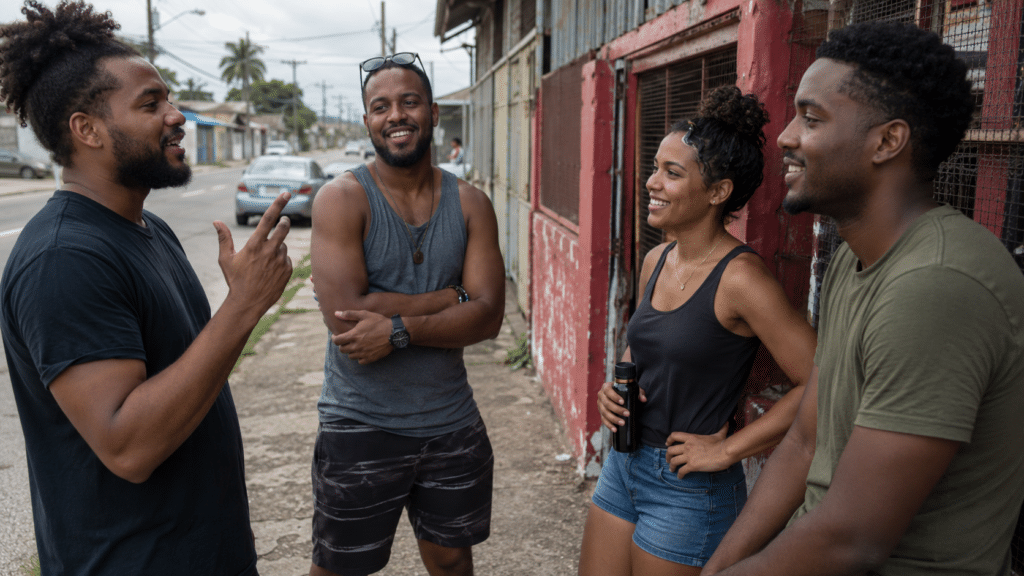
A comment keeps running through your mind. A coworker spoke too hastily, a loved one criticized your decision, or a minor annoyance suddenly feels like a big deal. In Trinidad, a simple response might be: “Doh study it / Doh study dat.” Depending on the situation, it means “don’t worry about it,” “don’t pay attention to it,” or “don’t let it get to you.”
“Doh study it / Doh study dat” is part of Trinidad English Creole, an English-based creole language used in informal communication in Trinidad. The Atlas of Pidgin and Creole Language Structures notes that it plays an important role in everyday communication and national identity, while coexisting with official English. Trinidadian Creole also differs from the Creole spoken in Tobago, even though the two islands form a single country.

What does “Doh study it / Doh study dat” really mean?
In standard English, the verb to study First and foremost, it refers to the act of studying, examining, or carefully considering something. In this Trinidadian expression, the meaning shifts. Study can refer to paying attention to a person, their words, or a problem to the point of being unsettled. A study filed in the archives of the University of the West Indies provides a telling example. When asked about his classmates’ lack of interest in schoolwork, one student replied, “I doh study dem, I does do my work.” The researcher interprets this phrase as meaning “I don’t really take dem on”: he doesn’t let himself be distracted and continues with his work.
“Doh study it / Doh study dat” doesn’t mean you should open a notebook. Rather, the phrase advises against dwelling on a source of frustration. It encourages you to shift your focus away from a problem that may not be worth all that much energy.

A useful expression, but not a universal answer
The translation depends on the context. When faced with a minor concern, “Doh study it / Doh study dat” can be reassuring: “Don’t worry about it.” After an unpleasant comment, it can mean: “Don’t let it get to you.” When someone is dwelling on an incident that’s already over, it’s similar to “Let it go” or “Move on.”
The tone is key. When spoken gently, the phrase offers support. When said quickly or impatiently, it can seem to downplay how the other person feels. Like many everyday phrases, it doesn’t work in isolation from facial expressions, the relationship, and the situation. It would therefore be inappropriate to use it in response to deep pain or a serious problem. The phrase’s strength lies elsewhere: it’s suited for annoyances that grow because we keep dwelling on them.

Why does the word "study" change in meaning?
Creole languages are not incorrect versions of European languages. They have their own usage, structures, and nuances. In Trinidadian Creole, a word of English origin can retain part of its meaning while taking on a local function. Here, the idea of “considering carefully” shifts toward that of worrying about someone, taking someone into account, or giving them too much importance.
This shift makes a literal translation misleading. Translating each word separately would result in a strange sentence in French. Understanding “Doh study it / Doh study dat” This involves observing what the person is trying to do: calm the situation, offer advice, put things into perspective, or cut the conversation short. This expression also shows that a language is recognized in its everyday choices. It doesn’t exist solely in official speeches, books, or classrooms. It takes shape in the off-the-cuff responses exchanged among friends, in family advice, and in phrases repeated until they become second nature.
“Doh study it / Doh study that”: A Brief Philosophy of Attention
This approach doesn’t promise that the problems will go away. It asks a more practical question: Is this situation still worth your time? In that sense, “Doh study it / Doh study dat” expresses a way to conserve one’s energy without pretending that nothing matters. Just three words are enough to reassure someone, put criticism in its place, or remind them that sometimes it’s possible to move on without responding to everything.
The next time a pointless thought pops into your head, “Doh study it / Doh study dat” can come back. Not as a call for indifference, but as a choice: deciding what truly deserves your attention. And you—what expression do you use in your culture to say it’s time to let it go?


It can mean “don’t worry,” “don’t pay any attention to it,” or “don’t let it get to you.” Its exact meaning depends on the context, the tone used, and the relationship between the people involved.
This is appropriate when someone is worried about a comment, criticism, or relatively minor annoyance. It can be used to reassure them, advise them to put things into perspective, or remind them that a problem isn’t worth spending any more energy on.
No. It belongs to the Trinidadian English Creole, in which the verb study can mean either “to worry about someone” or “to place too much importance on someone.” A literal translation, therefore, does not capture the full nuance of the phrase.
In Moriah, a wedding procession will wind its way through the streets as in days of old. In Les Coteaux, tales of mysterious creatures will take center stage once again. In Pembroke, the traditional meal will become a means of passing on traditions. From July 16 to August 1, the 2026 Tobago Heritage Festival will transform the island’s communities into chapters of a shared history.
For its 39th edition, the festival has adopted a theme that feels as much like an invitation as it does a responsibility: “Let’s Tell the Whole Story”, or in other words, “Let’s Tell the Whole Story.” For 17 days, folk music, theater, cooking, oral storytelling, and historical reenactments will showcase a heritage that isn’t preserved solely in museums. It’s still practiced in everyday life.

Tobago Heritage Festival 2026: Each Village Tells Its Story
The 2026 Tobago Heritage Festival will kick off on July 16 with a gala at the Shaw Park Complex. Starting the very next day, the Ole Time Heritage Fair will take place on the Scarborough Esplanade, followed by events in Golden Lane and Mt. Cullane Courtship Codes, a production exploring traditional ways of meeting, courting, and forming a couple. This transition from one community to another is one of the festival’s strengths. Tobago does not present a uniform vision of its identity. Instead, each village chooses a tradition, a story, or a practice that is unique to it.
On July 18, Moriah will host the famous Tobago Ole Time Wedding. The villagers reenact a traditional wedding, complete with period costumes, a wedding procession, and social customs. The bride and groom walk through the village surrounded by participants in traditional attire. Much more than just a performance, this reenactment shows how a community portrays the family and social relationships of a bygone era.


A story acted out rather than told
The schedule for the 2026 Tobago Heritage Festival is based on a simple idea: cultural heritage becomes easier to understand when it comes to life. In Charlotteville, Natural Treasures Day on July 20 will feature local culture, a parade, folk songs, tambou bambou, and traditional cuisine. Visitors will be able to observe certain stages of the cocoa processing and sample dishes such as cassava pone and coconut tart.
Three days later, Les Coteaux will present its *Folk Tales and Superstitions*. These stories, passed down orally from generation to generation, draw notably on West African and French Creole influences. They tell of creatures, fears, beliefs, and social norms that have long helped families make sense of the world around them. The festival, therefore, does not merely ask the audience to observe; it invites them to listen to the voices, accents, and imaginations that have shaped Tobago.

From Moriah to Pembroke: A Memory in Many Forms
The program will continue on July 25 in Plymouth with a J’ouvert inspired by the carnivals of yesteryear, followed by Cocoa in the Sun and the Heritage Calypso Monarch. On July 27, Roxborough will revisit the Belmanna Riots. Goodwood will then dedicate a day to yams, followed by the Salaka Feast in Pembroke on July 29. Through these events, the Tobago Heritage Festival 2026 shows that an island’s history isn’t limited to official dates. It can also be found in a recipe, a song, a procession, a musical instrument, or a story told at dusk.
This diversity explains the choice of the 2026 theme. “Telling the whole story” means accepting that Tobago’s heritage cannot be summed up by a single image. The traditions inherited from African, European, and Creole populations have intersected, evolved, and taken root in different ways depending on the community.

A festival that also paves the way for the next generation
Since its first editions in the late 1980s, the festival has sought to preserve Tobago’s unique cultural traditions. Official sources place particular emphasis on the languages, dances, music, cuisine, and oral traditions passed down in the villages. But preservation does not mean mechanically replicating the past. The 2026 Tobago Heritage Festival also poses a fundamental question to young people: what do they wish to retain, reinterpret, and pass on in turn?
On August 1, the program will culminate with Emancipation Day commemorations, including a parade in Scarborough. This finale will serve as a reminder that the cultural practices showcased during the festival also tell stories of resistance, adaptation, and reconstruction. For 17 days, Tobago will do more than simply celebrate its heritage. The island will empower its communities to tell their own stories. And when the final procession leaves Scarborough, one question will remain: What stories still need to be heard so that Tobago can truly tell its full story?
The 2026 Tobago Heritage Festival is a major cultural event taking place from July 16 to August 1 in Tobago. Over the course of 17 days, various communities on the island will showcase their traditions through performances, storytelling, historical reenactments, music, dance, and culinary demonstrations.
The program includes the Ole Time Heritage Fair, the Tobago Ole Time Wedding in Moriah, the stories and superstitions of Les Coteaux, the culinary traditions of Pembroke, and a J’ouvert inspired by the carnival of yesteryear in Plymouth. Each village highlights a unique aspect of Tobago’s heritage.
The 2026 Tobago Heritage Festival enables communities to share their own history, traditions, and knowledge. The festival demonstrates that Tobago’s heritage is not limited to archives or museums: it remains alive in villages, songs, recipes, processions, and stories passed down from one generation to the next.
In Saint Lucia, during the 51st meeting of CARICOM heads of government, Dr. Hyginus “Gene ” Leon, executive director of DBRP/The Nature Bank, presented an ambitious idea during a side event on reparations: using restorative justice to rethink Caribbean development. Here, the term does not refer solely to financial compensation. It aims to acknowledge the consequences of slavery and colonization, to redress the harm caused, and to transform the mechanisms that continue to perpetuate them.
Four Measures of Development
Development is often measured in terms of growth, investment, and infrastructure. This perspective is incomplete. An economy can build roads, ports, or hotels while at the same time undermining its natural resources, its population, or its institutions. This discussion is based on four forms of wealth. Productive capital includes infrastructure, businesses, and financial resources. Natural capital encompasses soil, forests, water, reefs, and the climate. Human capital encompasses health, education, skills, and dignity. Finally, societal capital relates to institutions, social cohesion, and trust.

Progress requires that these four forms of wealth advance together. When one form of capital develops at the expense of the others, growth becomes fragile. A region can achieve strong economic performance while simultaneously depleting the very foundations that make that prosperity possible.
A Five-Century-Old Economic Error
Restorative justice takes on a broader dimension here. It stems from a historical observation: for centuries, the economic system has assigned a price to produced goods while reducing people and nature to mere resources. The British Emancipation Act of 1833 illustrates this logic. More than 800,000 enslaved people were freed. Yet the 20 million pounds allocated compensated the slaveowners, while the freed people received no compensation. The financial value of property was recognized; the value of human life remained absent from the balance sheet.

This extractive model has not entirely disappeared. Cocoa produced in Ghana and Côte d’Ivoire fuels a global industry, while producers and the regions of origin retain only a small share of the value created. Incomes remain low, forests are shrinking, and the bulk of the profits are concentrated elsewhere.

Reparations, Climate, and Inequality: A Common Root
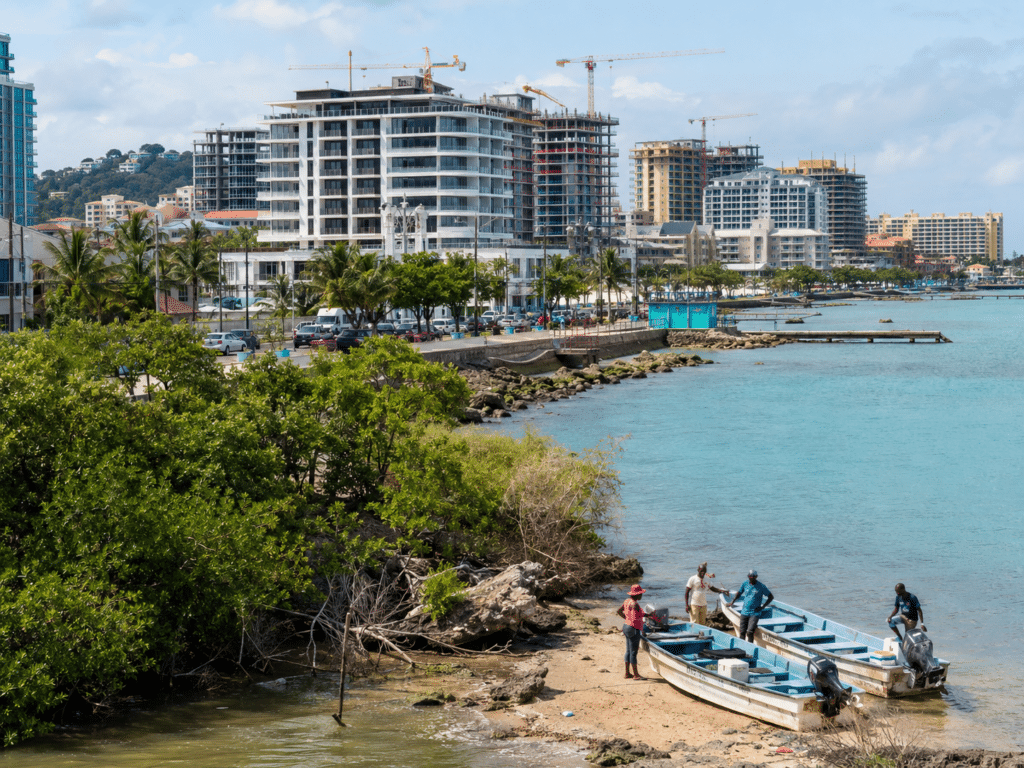
Reparations for slavery, climate-related losses and damages, and the fight against inequality are often addressed separately. Yet these issues stem from the same mistake: counting only part of the actual wealth. In the Caribbean, this contradiction is evident. A mangrove forest may be destroyed to make a project profitable in the short term. Its ability to protect coastlines, limit storm damage, or support fisheries is not always factored into the initial calculations. When disaster strikes, the region must finance reconstruction, often through debt. The value of nature is ignored at the outset, and then its absence becomes a collective burden.

Restorative justice thus links memory, the economy, and the environment. It raises a concrete question: How can we redress a historical injustice without reproducing the same imbalances in current decisions?

Rescue, Rebuild, and Transform
Restorative justice is structured around three stages: relief, reconstruction, and repositioning. The first addresses immediate emergencies. The second restores what has been lost. The third transforms the rules so that the harm is not repeated. This final stage is crucial. Rebuilding a house on the same fault line is tantamount to setting the stage for its next collapse. Similarly, compensation scattered across isolated projects may produce temporary results without addressing the root causes of vulnerability.

Restorative justice could therefore fund additional investments: education, health care, ecosystem protection, resilient infrastructure, strong institutions, and economies capable of retaining more value within the Caribbean region. The goal would be to compensate for a loss while making its recurrence less likely.

Three Possible Changes for CARICOM
Restorative justice offers three avenues for the region. First, every major public or financial decision could assess what it creates and what it destroys in terms of the four forms of wealth. Second, reparations could be organized as a coherent portfolio of reconstruction and transformation. Finally, human and environmental costs could be incorporated into the evaluation of projects, loans, and investments.
Restorative justice would thus shift the focus of the debate. For the Caribbean, making amends for the past could become a way to protect the future, by finally treating people, nature, institutions, and infrastructure as equally valuable.
In this context, restorative justice refers to an approach aimed at acknowledging and addressing the lasting consequences of slavery and colonization. It is not limited to the payment of financial compensation; it also seeks to invest in communities, institutions, the environment, and the economy to ensure that the same inequalities do not continue to be perpetuated.
The four forms of capital are productive capital, which includes infrastructure and businesses; natural capital, such as forests, reefs, and water; human capital, which encompasses health, education, and skills; and societal capital, based on institutions, trust, and social cohesion. Sustainable development requires advancing these four forms of capital together, without enriching one at the expense of the others.
It could help fund a coherent set of initiatives in education, health, ecosystem protection, climate resilience, and infrastructure. It also involves factoring human and environmental costs into financial decisions and assessing what each project creates or destroys. These guidelines were presented to CARICOM as proposals, not as decisions that have already been adopted.
Imagine the end of a day in Trinidad. A few close friends gather in front of a house, near a street vendor, or around a table. They talk, they laugh; someone arrives, then another. No one really asks when it’s time to wrap things up. It’s not just “hanging out.” It’s a “lime.”
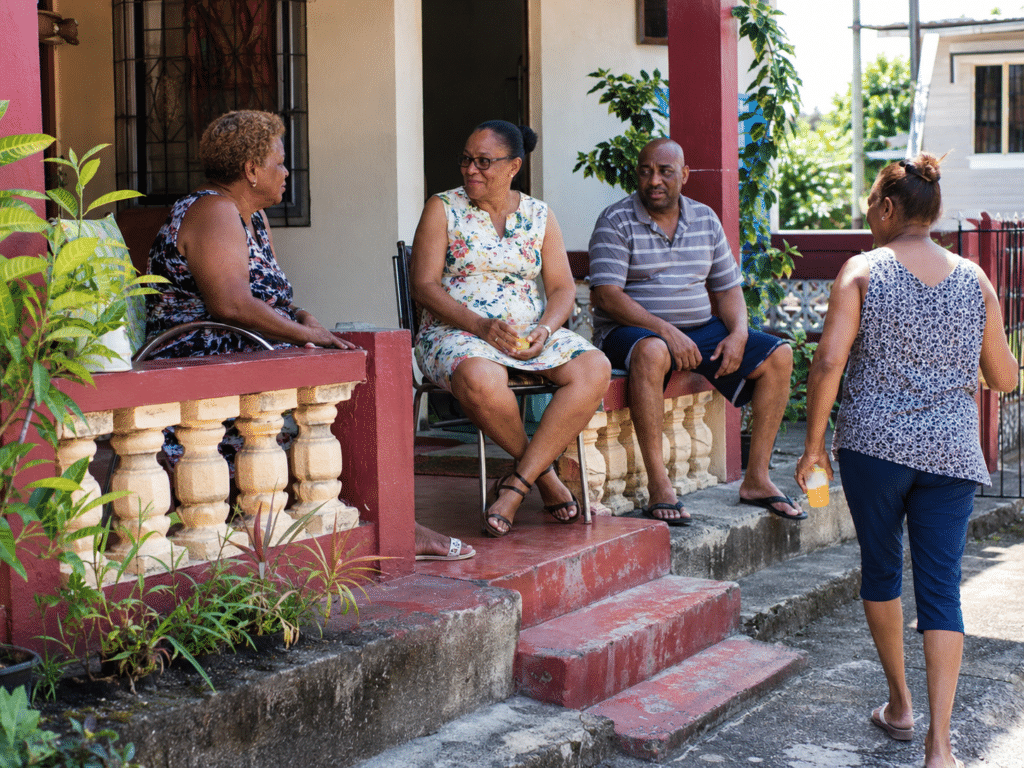
A simple word for a moment that matters
In Trinidad and Tobago English, to hang out means spending time with others in an informal way. The word can also function as a noun: in that case, it refers to the gathering itself. The official Tourism Trinidad website translates “liming” as “hanging out,” whether you’re with just one person or a group of friends. But this translation doesn’t tell the whole story.
It doesn’t necessarily have to involve a specific activity. It can take place over a meal, an outing, a steelpan rehearsal, or a night out. It can also arise almost spontaneously, when a conversation drags on and no one feels the need to leave. What matters isn’t what we accomplish, but the quality of the time we spend together.

Do nothing, but do it together
Seen from the outside, liming could be mistaken for idleness. Yet this apparent emptiness is filled with conversation, humor, observation, and relationships. A study published by the University of the West Indies describes it as a social leisure activity that promotes integration. It also highlights the importance of “picong,” the playful and inventive banter that animates certain Trinidadian conversations.
Everyone can talk about their day, comment on current events, tease a friend, or listen to others’ stories. Topics overlap with no set order. A serious discussion might be interrupted by a joke, only to resume a few minutes later. The moment doesn’t have to be productive to be meaningful. It strengthens bonds.

Nor is this term limited to a single generation. A study conducted among 242 residents of Trinidad, aged 18 to 74, used it to explore the enduring nature of positive social relationships as people age. The authors remain cautious, but their question already speaks volumes: the ” “lime” help maintain the connection?
The word also appears in everyday expressions. You can go “lime,” organize a river “lime,” or extend a rehearsal with a panyard “lime.” Tourism Trinidad, for example, describes the Caura River “lime” as a day spent by the water with food, drinks, tables, chairs, and good company. The setting may change, but the idea remains the same: simply being together is the whole point.

An origin that is less certain than is commonly believed
According to the Oxford English Dictionary, the verb“lime”has been attested in Caribbean English since at least 1941. Its exact origin, however, remains a matter of debate. The dictionary suggests a possible connection to “limey,” an old term associated with the British, but popular accounts offer other explanations. In the absence of certainty, it is best not to turn a hypothesis into an official story.
This uncertainty in no way diminishes the power of the word. It has been adopted, adapted, and has become deeply rooted in local usage. Today, it belongs to that category of words that can be translated but are difficult to replace. “Going out,” “hanging out,” or “spending time together” describe the action. It also conveys the atmosphere, the flexibility, and the importance placed on others.

Timeshares as an Asset
In a daily life often structured around schedules, goals, and results, he advocates for a different way of measuring the value of a moment. Simply being present is enough. Conversation becomes the activity itself. Time spent with others is not considered wasted time.
Perhaps this is where this word becomes more than just a Trinidadian expression. It reminds us that a society is also built in spaces without a set agenda: in front of a house, by a river, in a panyard, or around a shared meal. It doesn’t put life on hold. It’s part of it. After Trinidad and Tobago and its art of shared time, RK Words will head to Puerto Rico. Next week, it’s time for “ay bendito”

In Trinidad and Tobago, “lime” refers to spending time with other people in a casual setting. A file It can bring friends, neighbors, or family members together for a conversation, a meal, or simply a moment shared. The word evokes both the gathering itself and the relaxed atmosphere that accompanies it.
Translate “lime” The phrase “hanging out with friends” conveys the general idea, but does not fully capture its cultural significance. In Trinidad and Tobago, the file values presence, interaction, humor, and the time we devote to others. It’s not just about doing nothing: conversation and camaraderie become the main activity.
A “file” can happen almost anywhere: in front of a house, in a bar, near a street vendor, by a river, or after a steelpan rehearsal. Some people refer to it as river lime or panyard lime. The location may change, but the essence remains the same: getting together without a strict schedule and enjoying the time we spend together.
The victory that changes a name
When Trinidad renamed its calypso grand prix “Calypso Monarch” in 1978, it wasn’t by chance. It was because a woman had just won the title for the first time after decades of male domination. The woman’s name was McCartha Linda Sandy-Lewis. On stage, she was known as Calypso Rose. She was 38 years old. Forty-eight years later, in 2026, she is 86, with over 800 songs, more than 20 albums, and a presence that continues to cross international stages.
From Bethel to the first songs
McCartha Linda Sandy-Lewis was born on April 27, 1940 in Bethel, a village in northwest Tobago. Her father was a Spiritual Shouter Baptist minister, a long-marginalized Afro-Caribbean religious tradition. He opposed his daughter’s musical career. She nevertheless began composing and singing her own calypsos as a teenager, around the age of 15. At the time, calypso was a male domain. There were very few women in the carnival tents. Calypso Rose broke through this barrier.

A woman in the tents
She turned professional in the mid-1960s. She originally performed under the stage name Crusoe Kid. She later adopted the name that would accompany her all her life: Calypso Rose. Within a few years, it became one of the most recognizable names in Caribbean calypso. In 1966, her song “Fire in Me Wire” made a lasting impression at the Trinidad and Tobago Carnival. The title already announced what was to become his strength: a popular, direct voice, capable of making people dance and commenting on society.

New York, Bob Marley and the international scene
In 1967, at the age of 27, she performed in the United States for the first time. Her career also crossed paths with Bob Marley & The Wailers. Calypso Rose would later cite him as one of the figures who inspired her. This passage through New York opened up a wider space for an artist from Tobago.
1977-1978: the ceiling cracks
The decisive moment came in 1977. Calypso Rose became the first woman to win the Trinidad Road March, a competition for the song played most during the Carnival parade days. Her winning song was “Tempo”, often known as “Gimme More Tempo”. The following year, she won the Road March again, and also won the main competition, then called Calypso King. The song was later renamed Calypso Monarch. This sequence establishes her in history: first woman Road March, first woman to win the grand national title, and symbol of a calypso that could no longer ignore women.
A political voice as much as a musical one
One of the artist’s singularities lies in her political function. Many of her songs deal with the condition of women, work, violence and power relationships. In 1983, “No Madam” denounced the exploitation of domestic workers. The song became a popular anthem and remains associated with debates on wage protection for domestic workers in Trinidad and Tobago. Later, “The Other Woman”, “Solomon” and “Leave Me Alone” extended this message. In Trinidadian culture, Calypso Rose became a public voice, capable of transforming a carnival song into a social argument.
New York, illness and return
In 1983, she moved to New York, where she maintained a strong base. She continues to tour, write and sing. She also went through serious health problems before returning to the stage. In 2011, the documentary “Calypso Rose, Lioness in the Jungle”, directed by Pascale Obolo, places her story in a wider memory: that of a woman who had to conquer her place in a world made for men.
The global comeback with Far From Home
The big turning point in her contemporary career came in 2015. Manu Chao, Franco-Spanish singer and former member of Mano Negra, discovered her during carnival in Port of Spain. An artistic bond was forged. With Belgian-Canadian producer Ivan Duran, he accompanies the album “Far From Home”, released in 2016. In 2017, this album won the Victoire de la Musique award in the world music album category. She was 76 at the time. Instead of being a final tribute, this album became an international relaunch.
Coachella, SACEM and the new generations
What follows is even more surprising. In December 2018, she received the Grand Prix Musiques du Monde from SACEM in France. In April 2019, at 78, she becomes the oldest person scheduled for a full set at Coachella, California, and the first calypsonian to hold that spot. Her song “Leave Me Alone”, re-recorded with Machel Montano and Manu Chao, circulates as a cry against the harassment of women in party spaces. Calypso Rose speaks to a generation that discovered her not in the tents, but on the world’s stages.
More than a prize list
One dimension deserves to be mentioned. She has written over 800 songs. She has recorded over 20 albums. She has received several major honors, including the Humming Bird Medal Gold and, in 2017, the Order of the Republic of Trinidad and Tobago, the nation’s highest honor. But what defines Calypso Rose is longevity. More than sixty years after her first songs, she remains linked to the stage, to transmission and to writing.


The voice of Tobago, the memory of the Caribbean
For Tobago, Calypso Rose is a voice that has carried the island far beyond its borders. For the entire Caribbean, she is even more: proof that a black woman born in a Tobago village in 1940 can redefine an entire musical genre. At a time when the United States is celebrating Caribbean American Heritage Month in June, she is a reminder of what this month can also tell us: Caribbean trajectories that move scenes and imaginations. How many other voices from the region are still waiting to be heard with the same attention?
Calypso Rose is the stage name of McCartha Linda Sandy-Lewis, a singer and songwriter born in Bethel, Tobago, in 1940. A major figure in calypso, she is known for paving the way for women in a genre long dominated by men. With over 800 songs and more than 20 albums, she is considered one of the most important voices in Trinidad and Tobago and the Caribbean.
Calypso Rose made history by becoming the first woman to win the Trinidad Road March, then the great national contest then known as Calypso King. After her victory, the title was renamed Calypso Monarch, a sign that her presence had changed the symbolic rules of the genre. Her songs also deal with strong social issues, such as domestic work, violence against women and harassment.
Born in Tobago, Calypso Rose has taken the voice of her island to international stages, from Trinidad and Tobago to New York, from France to Coachella. Her career shows how an artist from a small Caribbean territory can transform an entire musical genre. She embodies a living memory of the Caribbean: festive, political, resilient and able to speak to the world without losing her local roots.
