HISTORY & HERITAGE

“¿Qué lo que?” Three words, three letters, one identity
In the Dominican Republic, an encounter can begin with three words that might baffle anyone who translates Spanish literally. A friend arrives, a message pops

In the Dominican Republic, an encounter can begin with three words that might baffle anyone who translates Spanish literally. A friend arrives, a message pops

In its first appearance at the 37th CBU Media Awards, Richès Karayib walked away with four honors: two Awards and two Special Mentions. The results

From August 17 to 19, 2026, Georgetown hosted the 57th General Assembly of the Caribbean Broadcasting Union. Gathering under the theme “Caribbean Media and AI,”

In Saint-Laurent-du-Maroni, the journey to the Voltaire Falls begins well before the first waterfall. From the town, the Paul Isnard Trail leads into the forest
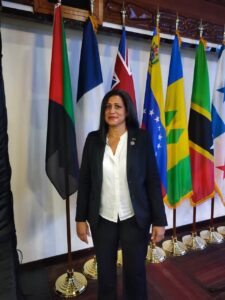
Martinique is taking on a new role within the Association of Caribbean States. For 2026–2027, it will join the Executive Bureau of the Special Committee

In Venice, Annalee Davis did not bring any abstract images of Barbados. For the 2026 Art Biennale, the artist brought plants from her garden, textiles,

In Aruba, an old house can tell more than just the story of a building. It speaks of the wind, the heat, the cultivated land,

In Santo Domingo, Kundengo Minier and César Namnúm were recently honored for more than five decades dedicated to traditional Dominican music and sound. But during

In Jamaica, sometimes just a few words are enough to remind us that even a small gesture is never truly insignificant. “One-one coco full basket”

In San Basilio de Palenque, in the department of Bolívar in northern Colombia, the memory of freedom is still spoken, sung, taught, and organized as

On July 16, 1941, Peter Minshall was born in Georgetown, British Guyana, and grew up in Port of Spain, Trinidad and Tobago, where he became

The history of Caribbean cinema continues its journey through the 1980s. After three episodes devoted to the early developments of several cinematic movements in the

In Princes Town, in southern Trinidad and Tobago, the “doubles” were born in 1936 from a simple gesture: a customer asking for a second piece

In May 1977, a Cuban dancer took the stage in New York with the Alvin Ailey Dance Theater. In the audience that evening, actor Harry

“Asere, ¿qué bolá?”, this Cuban street greeting, was already in common use in Havana’s working-class neighborhoods long before a U.S. president adopted it as well.

In Santo Domingo, on the banks of the Ozama River, the Fortaleza Ozama has weathered more than five centuries of Dominican history without ever falling